Prices from Amazon AU, updated daily. Swipe or use the arrows for more.
Disclosure: This article contains affiliate links to amazon.com.au. If you buy through one of these links iFix may earn a small commission at no extra cost to you. It doesn't change which products we recommend. We focus on what actually lasts based on 16 years of repair-shop experience.
Quick summary7 picks
- Entry PickLevede Face Hole Sun Lounger Tanning Chair about$76
- Costway Outdoor Folding Chaise Lounge about$76
- Marbella Outdoor Sun Lounger about$101
- Amalfi Outdoor Sun Lounger about$129
- Costway Outdoor Chaise Lounge Chair about$180
- Livsip Sun Lounger about$204
- Most PremiumGardeon 2PC Sun Lounge Folding Camping… about$250
Why a repair shop is writing about sun loungers
A sun lounger has nothing electronic in it, but the way they fail is the way a lot of gear fails on the Central Coast: salt air gets into a thinly coated steel joint, the coating blisters, rust creeps along under the paint, and one day a hinge lets go. We see the same corrosion on charging ports and screws from phones that live by the pool, so I've got a fair idea of what coastal air does to metal and plastic over a couple of summers.
This guide covers single sun loungers and pairs you'd leave by a pool, on a deck or take to the beach. It doesn't cover outdoor sofa sets, which have their own guide in outdoor lounge settings, or pool floats. I've stuck to what each Amazon AU listing actually says on the day I checked it, and where a listing leaves out a weight limit, a frame material or a warranty, I've said so rather than guessing.
One thing worth knowing up front: most of what sells well on Amazon AU in this category comes from a handful of furniture sellers, and several of them sell near-identical frames under different brand names. Where two listings looked like the same lounger in a different colour or under a sister brand, I've kept one.
I've also left out listings written for the US market, the ones that only give weight limits in pounds and sizes in inches. A lounger has no plug, so it isn't the electrical problem a US appliance is, but a listing written for another market tends to carry another market's materials and fixings, and in my experience they're harder to get parts or a warranty answer for here. Everything below is sold through Amazon AU by a seller that passed my checks for overseas and import listings.
Resin, steel or aluminium: what the frame is made of
The frame decides how long a lounger lasts more than anything else. There are three main types in this price range. Resin or polypropylene (PP) loungers are moulded plastic, often with a rattan-style or wood-grain finish. They can't rust, they're light, and they shrug off pool water, but plastic goes chalky and brittle in years of hard sun, and the leg joints and recline notches are the parts that crack.
Steel-framed loungers are usually powder-coated or painted tube with a fabric sling. Steel is strong for its price, but once the coating chips at a joint or a rivet, it rusts, and near the coast it rusts quickly. Listings say things like anti-rust surface or rust-resistant, which is a description of the coating, not a promise about salt air. Aluminium frames don't rust the way steel does and they're lighter, so they're the better pick near the beach, but they cost more and the joints and fixings still need looking after.
If you live within a few kilometres of the water like we do in Erina, I'd lean towards resin or aluminium, or plan on rinsing and covering a steel frame. Wherever you are, look at the joints in the photos: welded joints and fully sleeved rivets hold up better than bare rivets through a thin tube, and plastic end caps on the feet stop the tube sitting in water. Further inland, a steel frame kept under cover between uses will usually last several summers. What I'd avoid anywhere is leaving a steel lounger out on the lawn all year, because the feet sit in damp grass and that's where the rust starts.
Slings, fabric and cushions
The fabric is the other part that wears out. Most folding loungers use Oxford fabric, a woven polyester usually described by its weight in denier, so 500D or 600D on these listings. Higher denier is a heavier, tougher weave. Textilene, which the Gardeon pair uses, is a coated mesh that drains and dries fast, which is why you see it on pool furniture. Resin loungers have no sling at all, which is one less thing to wear, but they're harder to lie on for long without a towel or a cushion.
Cushioned loungers are the most comfortable and the most work. The Livsip listing gives 8cm thick cushions with removable covers, which is the right idea, because the cover is the part you'll wash most often. The catch with any cushion outdoors is water: foam that gets soaked and stays wet in the shade goes mouldy and smells, so cushions want to come inside, or at least into a dry box, when it rains and overnight.
UV is what finishes most slings. Sun breaks down the fibres and the stitching long before the fabric looks worn, and the usual failure is a seam letting go where the sling wraps the frame. Check those seams at the start of each summer, and if one is pulling, having the sling restitched usually costs less than replacing the lounger. An upholsterer or a local sailmaker can usually do it, and it's worth asking for UV-rated thread, since ordinary polyester thread is often what gave out in the first place.
Recline positions, locks and pinch points
All six picks have five recline positions, so the number itself won't separate them. What matters is how the backrest locks. Most use a notched bar or a ratchet on each side, and the failure I'd expect is one side wearing or bending so the backrest drops at an angle or slips when someone leans back. Before you buy, look at how the lock engages and whether it's metal or plastic.
Folding loungers also have pinch points. The hinges that make them fold into thirds will happily catch a finger, and kids love folding chairs, so show them how it works or keep the folding ones away from the littlest ones. Push the backrest fully into each notch rather than leaning back on a half-engaged lock, which is what bends the bar over time.
Footrests are a nice extra on some of the folding loungers, but they're more hinges, and more hinges means more to wear, and every extra hinge is another spot where sand and salt collect and another joint to rinse. If you just want something to lie on by the pool, a simple fixed-leg lounger with one well-made backrest lock usually outlasts a clever one with five adjustment points.
If a lock does start slipping, don't keep using it. A backrest that drops suddenly is how people get a pinched hand or a fright, and a bent bar only gets worse. On most folding loungers the lock is a common part held in with a bolt or a rivet, so it's worth looking for a replacement or asking a local welder or handyman to straighten it before you write the whole lounger off.
Weight limits, and what the number means
Most listings quote a maximum load, and the range here is wide: 150kg on the Costway canopy lounger and the Gardeon pair, 180kg on the Costway resin pair and 200kg on the Marbella. The Levede and Livsip listings don't state one. I'd treat a stated limit as a static load evenly spread over the lounger, which isn't how people use them. Sitting down hard on the end, two kids on one lounger or someone sitting on the raised backrest all put far more load on one joint than the number assumes.
So if you're near the top of a lounger's limit, or you'll have people sitting on the edge to chat, pick one with a good margin and a wide base. The Costway resin pair's listing mentions six reinforced legs and support bars behind the back, which is the sort of detail that matters more than the headline number. Put loungers on level ground, too, because a lounger rocking on uneven pavers twists the joints every time someone moves.
Weight also cuts the other way. A lounger that's light enough to carry to the beach is light enough to blow across the yard in a southerly, and we get plenty of those on the coast. Folding loungers and resin ones in particular should be folded, stacked or moved against a wall when a storm is coming, because a lounger tumbling across a deck is how glass doors and pool fences get chipped, and how the lounger itself ends up with a cracked leg.
Salt, sun and storage: making one last
The easiest maintenance is a hose. Rinse the frame and fabric with fresh water every few weeks over summer if you're near the coast, and straight away after a swim if it's beside a saltwater pool, since dried salt holds moisture against the metal. Let it dry in the sun before you fold it or cover it. On steel frames, touch up any chip in the powder coat with a dab of outdoor paint before rust gets a start, especially at the joints and rivets.
Store folding loungers dry and off the ground in winter. A garage or shed is better than a cover outside, because covers trap condensation if they're not vented. If a lounger has to stay out, tilt it so water doesn't pool on the sling or the seat. For resin loungers, keep them out of the hottest afternoon sun when they're not being used if you can, since UV is what makes PP go chalky and brittle. A clear outdoor UV protectant on resin doesn't last forever but it does slow the fading.
Check the fixings each spring. Loose bolts and rivets let the frame flex, and a flexing joint wears quickly and rusts faster because it keeps cracking its own coating. Most loungers use common bolts and nuts, so a few minutes with a spanner or a screwdriver at the start of summer usually adds years.
Don't use harsh cleaners on any of them. Bleach and strong pool chemicals break down fabric coatings and powder coat faster than sun does, so stick to warm water, a mild detergent and a soft brush, then rinse well. For cushion covers, follow the care label, wash them on a gentle cycle and dry them fully before they go back on the foam, since a damp cover over dry foam just moves the mould problem inside.
Phones, tablets and speakers by the pool
The pool problem that actually lands on our counter isn't the lounger, it's what gets put on it. Phones slide off a sloped backrest into the pool, a tablet sits on a wet towel all afternoon, or a speaker gets knocked into the water. Water resistance ratings come from lab tests in still fresh water, not chlorinated or salt pools, so a rating isn't a promise, and our page on how waterproof phones really are explains why. Chlorine and salt also leave residue in charging ports and speaker grilles as they dry, which is what we end up cleaning out weeks later when a phone suddenly won't charge or sounds muffled.
Heat is the other one. A phone left face-up on a lounger in full summer sun can get hot enough to shut itself down, and repeated heat is hard on batteries. Keep devices in the shade under an outdoor umbrella or in a bag. If something has been dunked, turn it off, keep it off the charger and dry the outside, since charging while wet is what does the lasting damage, as water damage explained goes through. If it still isn't right, bring it into our Erina shop and we'll tell you what it needs before you spend anything.
The 6 picks, $76 to $250
Prices are Amazon AU at time of writing (2026-11-23) and move week to week. Ranks are Amazon AU category sales ranks, checked the same day. Two of the picks are sold as pairs, so check the per-lounger price before you compare.

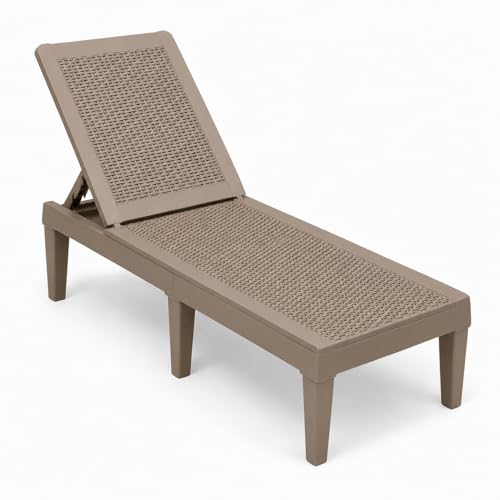
Marbella Outdoor Sun Lounger, Polypropylene Resin, 5-Position Recline
ASIN B0G3VS52J1 • $101.32 • Sold by Elektra - AU on Amazon AU
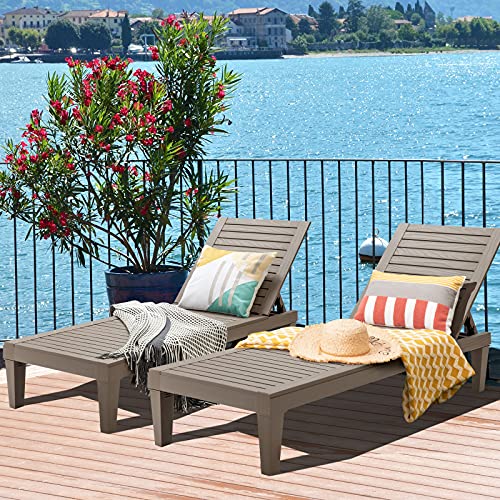
The Marbella resin sun lounger costs about $101 at time of writing, sold by Elektra - AU, with HOVEROO named as the brand in the listing data. It returns #2 in Amazon AU's Sunloungers category and #754 overall when I checked, the best Sunloungers rank of the six picks. It's a moulded polypropylene lounger with a rattan-style, wood-grain finish, and the reason it's my top pick is simple: a resin frame can't rust, which matters more than anything else if you live near the coast or put a lounger beside a saltwater pool. The rattan-style finish is moulded into the plastic rather than woven, so there are no strands to unravel or snap the way real or PE wicker does after a few summers in the sun.
The listing says it's fully weatherproof and UV-protected, resistant to rust, rot and fading, and it quotes a 200kg capacity, the highest stated load of the six. It has a five-position recline and the listing says it assembles in about five minutes with no screws or tools. The title gives a weight of 8.4kg, although the shipping data in the listing works out heavier, so I'd read 8.4kg as the lounger itself and expect the box to weigh more. Either way it's light enough to move around the pool by yourself. With no screws in the build, there's nothing to rust or work loose, which is the other half of why resin suits the coast. Being light also means it's one to stack or move against a wall when a storm is forecast, since a resin lounger picked up by a southerly can travel a long way across a yard.
What you give up with resin is comfort and sun life. A moulded seat is harder than a sling, so most people will want a towel or an outdoor cushion on it, and polypropylene left in full sun every day for years goes chalky and the recline notches are the part I'd expect to crack eventually. Keep it in the shade when it's not being used, and push the backrest fully into each notch rather than leaning back on a half-set position. There's no warranty stated on the listing. Rinse it off with a hose after a swim.
Honest caveats: No warranty is stated on the listing. The title weight of 8.4kg and the listing's shipping weight don't agree, so read the lighter figure as the lounger alone. A hard resin seat needs a towel or cushion for long sessions. Polypropylene fades and gets brittle with years of full sun.
Best for: Coastal backyards and saltwater pools where a steel frame would rust.
Frame: Polypropylene resin • Recline: 5 positions • Max load: 200kg (listing) • Weight: 8.4kg (title) • Assembly: Tool-free, about 5 minutes (listing) • Warranty: Not stated • Seller: Elektra - AU • Rank: #2 in Sunloungers (Amazon AU)
View on Amazon AU
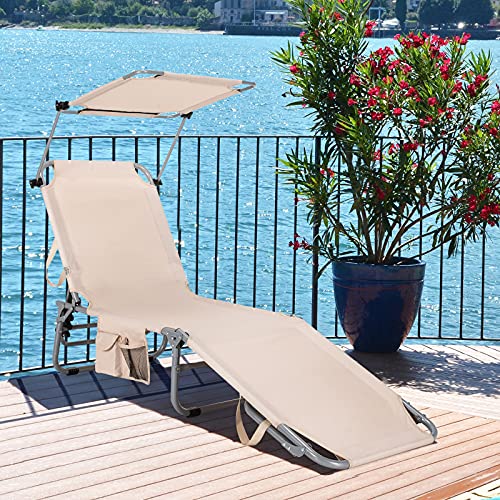
Costway Outdoor Folding Chaise Lounge with Rotatable Canopy
ASIN B09R4MH5F1 • $76.45 • Sold by COSTWAY-AU on Amazon AU
The Costway folding chaise lounge with the rotatable canopy costs about $76 at time of writing, sold by COSTWAY-AU, and returns #4 in Sunloungers and #1,060 overall on Amazon AU when I checked. It's one of the two lowest-priced picks, level with the Levede, and the one I'd point to for a beach or a backyard without much shade, because the small canopy over the head end rotates 360 degrees so you can keep the sun off your face as it moves across the sky. The side pocket and carry ropes make it a reasonable beach lounger too, as long as you can carry about 7kg, which is what the listing's shipping data works out to.
The listing describes a heavy-duty steel frame with an anti-rust surface, holding up to 150kg, and an Oxford fabric sling that's breathable. It has five backrest positions, a side storage pocket for sunglasses and a drink, carry ropes, and it folds for storage. The listing says most of it comes assembled and you only fit the canopy, which suits anyone who doesn't want to spend an afternoon with an Allen key. The model number in the listing data is COST10027NP. Oxford fabric is light and folds well, but the listing doesn't give a denier figure for this one, so I can't compare its sling directly with the 600D Levede. The canopy and the pocket are the parts most likely to wear or tear first, and the canopy can usually be left off on days you don't need it.
The canopy is the part I'd watch in wind. A small shade on a pivot catches gusts, and on an exposed beach or a windy deck it's the canopy arm and its pivot that bend or snap first, so fold it down or take it off when the wind gets up. The steel frame is coated, not stainless, so on the coast I'd rinse it with fresh water after the beach, dry it before folding, and touch up any chipped paint at the joints before it starts to rust. Fold the canopy down before you fold the lounger.
Honest caveats: The steel frame is coated rather than rust-proof, so salt air will find any chip. The canopy arm is vulnerable in wind. No warranty is stated on the listing. A Costway face-hole lounger shares the same model number stem in the listing data, so I've left it out as a likely sibling.
Best for: Beaches and backyards with no shade, on a tight spend.
Frame: Steel, anti-rust coating • Fabric: Oxford • Recline: 5 positions • Max load: 150kg (listing) • Shade: 360 degree rotating canopy • Folds: Yes • Seller: COSTWAY-AU • Rank: #4 in Sunloungers (Amazon AU)
View on Amazon AU
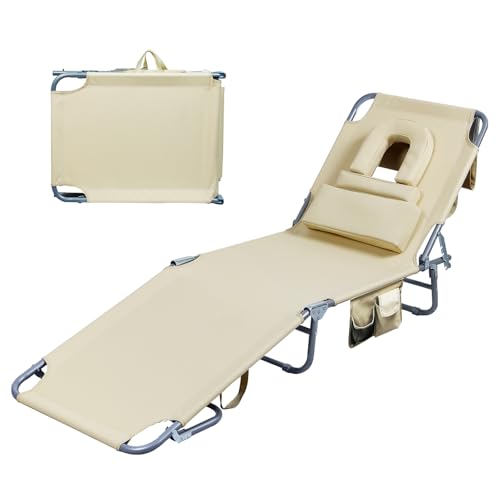
Levede Face Hole Sun Lounger, 5-Position Backrest, Khaki
ASIN B0DQ1GHCLH • $75.90 • Sold by Sello-Products on Amazon AU
The Levede face-hole sun lounger costs about $76 at time of writing, sold by Sello-Products, and returns #1 in Amazon AU's Camping Loungers category and #483 overall, the best overall rank of the six picks when I checked. Its point of difference is a face hole with a Velcro flap, so you can lie face down with your head supported and then flip the back cover over to lie face up. It comes with three adjustable or removable cushioned pillows for your neck and shoulders. It folds like a big camp chair, so it's the sort of lounger you'd throw in the boot for the beach rather than leave by the pool all summer.
The listing describes a metal frame and 600D Oxford fabric with water, tear and wear resistance, a five-position backrest, a side pocket for a phone or a book, and a carry handle so it folds and carries like a big camp chair. The model in the listing data is OD1066-KH. The listing data gives a length that works out to about 188cm, which is fine for most adults but worth checking against your own height if you're tall, since your feet will hang off the end of a short lounger. The pillows are the part I'd look after most. Being removable means you can bring them in out of the rain and dry them properly, which is what stops them going musty, and keeping them dry also keeps the Velcro on the face flap gripping, since Velcro full of sand and salt stops holding.
The listing doesn't state a weight limit, a frame material beyond metal, or a warranty, which is a lot of gaps for something you'll be lying on. I'd treat it as a light-duty folding lounger and not let two people sit on it at once. It's sold by a marketplace seller rather than an AU-named storefront, so keep the paperwork. The side pocket is handy, but it's also exactly where phones end up next to a pool, so keep them in the shade instead. Brush sand off the hinges before you fold it.
Honest caveats: No weight limit, frame metal or warranty is stated on the listing. Seller is a marketplace seller rather than an AU-named storefront. At about 188cm long in the listing data, tall people should measure first. Folding hinges are pinch points for small fingers.
Best for: Anyone who wants to lie face down comfortably at the beach or pool.
Frame: Metal (type not stated) • Fabric: 600D Oxford • Recline: 5 positions • Max load: Not stated • Extras: Face hole, 3 removable pillows, side pocket • Folds: Yes, with carry handle • Seller: Sello-Products • Rank: #1 in Camping Loungers (Amazon AU)
View on Amazon AU
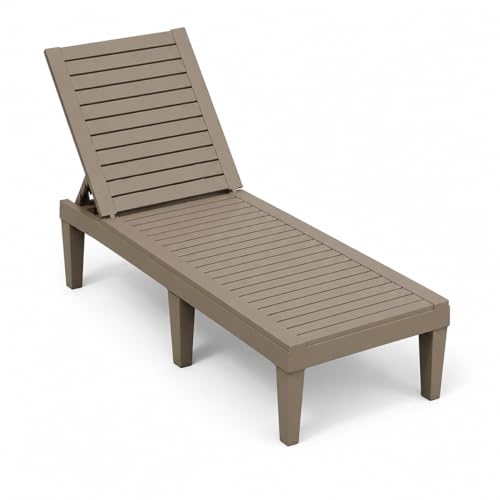
Costway Outdoor Chaise Lounge Chair, 2-Pack, 180kg, Coffee
ASIN B0FY4S9Z8H • $179.95 • Sold by COSTWAY-AU on Amazon AU
The Costway resin chaise lounge 2-pack costs about $180 at time of writing for the pair, so around $90 a lounger, sold by COSTWAY-AU. It returns #1 in Amazon AU's Chaise Lounges category and #7,814 overall when I checked. It's the pick I'd go for if you want two matching loungers beside a pool without paying for an aluminium set, because like the Marbella it's a moulded PP frame that can't rust, and the listing says it's sun and rain resistant. Being sold as a pair also means matching replacements later are less of a worry, since you're not trying to find the same colour two summers on when one gets damaged.
The detail I like on this listing is the structure: it describes support bars behind the back, six reinforced legs and a 180kg load per lounger, which is more structural information than most of these listings give. The five-position backrest adjusts from 29cm to 84.5cm high according to the listing, and it has a locking system to hold the position. The seat uses a slotted, hollowed-out design for airflow, which also means rain drains straight through rather than pooling. The listing's backrest range is the most detailed of the six, which tells you how upright it goes before you buy, and the locking system it mentions is the part I'd test on arrival by leaning back firmly on each position. A lock that holds on day one under a firm lean is a good sign for the next few summers.
The trade-offs are the same as any resin lounger. It's a hard seat, so plan on a towel or cushion for long stretches, and years of full sun will fade it and eventually make it brittle, with the recline notches the likeliest part to crack. Keep the pair stacked in the shade or under cover when they're not in use. The listing doesn't state a warranty, and the model shown in the listing data is OP70808. Stack them in the shade when not in use.
Honest caveats: Priced as a pair, so compare it per lounger. No warranty is stated on the listing. A hard slotted resin seat needs a towel or cushion for long sessions. Polypropylene fades and becomes brittle after years of full sun. Its overall rank is well behind the Marbella.
Best for: Two matching rust-free loungers for a pool or deck.
Frame: Polypropylene resin • Quantity: 2 loungers • Recline: 5 positions, 29cm to 84.5cm backrest height • Max load: 180kg each (listing) • Legs: 6 reinforced legs • Warranty: Not stated • Seller: COSTWAY-AU • Rank: #1 in Chaise Lounges (Amazon AU)
View on Amazon AU
Livsip Sun Lounger with 8cm Thick Cushion and Pillow, Grey
ASIN B0CKXD84DF • $203.92 • Sold by Oikos 1943 on Amazon AU
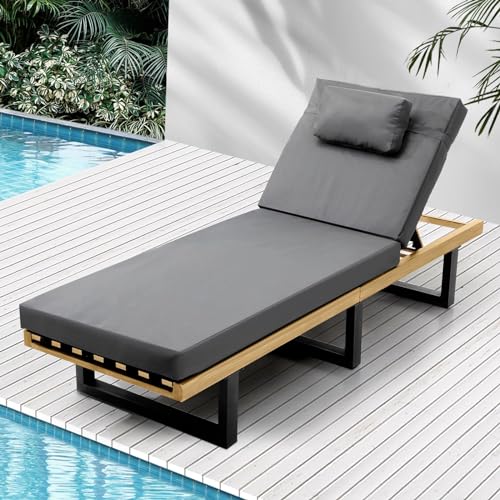
The Livsip cushioned sun lounger costs about $204 at time of writing, sold by Oikos 1943, and returns #8 in Sunloungers and #2,012 overall on Amazon AU when I checked. It's the comfort pick: an 8cm thick cushion and an adjustable pillow on a steel frame, the kind of lounger you'd actually spend an afternoon on rather than perch on for a swim break. It has a five-position adjustable backrest and a contoured shape according to the listing. It's the dearest single lounger of the six written picks, so it makes most sense if you'll use it a lot, on a covered deck or a patio rather than out on the lawn.
The listing describes a rust-resistant steel frame and weather-resistant cushions, with removable cushion covers for cleaning, which is the feature I'd look for first on any cushioned outdoor lounger. It's also one of only two picks with a warranty stated, a one-year warranty against manufacturer defects in the listing data. It's a heavier lounger than the folding ones, with the listing data working out to about 20kg, so it's one you set up on a deck and leave rather than carry to the beach. The removable covers matter because they're what you'll clean most, and being able to wash them separately keeps the foam out of the washing machine. A dry storage box or a spot inside for the cushion, and a breathable cover for the frame, will add years to it, especially through a wet Central Coast autumn.
Cushions are the weak point outdoors. Weather-resistant isn't waterproof, and foam that gets soaked and sits in the shade will smell and go mouldy, so I'd bring the cushion inside overnight and whenever rain is coming. The listing doesn't state a weight limit, and the frame is coated steel rather than aluminium, so on the coast rinse it now and then and touch up chips. It's sold by a marketplace seller, so keep the warranty paperwork somewhere you'll find it. A cushion box nearby is worth the space.
Honest caveats: No weight limit is stated on the listing. Cushions need to come in out of the rain, or the foam goes mouldy. The coated steel frame will rust where the coating chips. It's heavy at about 20kg in the listing data, so it's a deck lounger, not a beach one. Seller is a marketplace seller.
Best for: A deck or patio lounger you'll lie on for hours.
Frame: Steel, rust-resistant coating • Cushion: 8cm thick, removable covers • Recline: 5 positions • Max load: Not stated • Weight: About 20kg (listing data) • Warranty: 1 year (listing) • Seller: Oikos 1943 • Rank: #8 in Sunloungers (Amazon AU)
View on Amazon AU
Gardeon 2PC Aluminium Sun Lounge with Wheels
ASIN B0HQ2F42G7 • $249.95 • Sold by Artiss Furnishings on Amazon AU
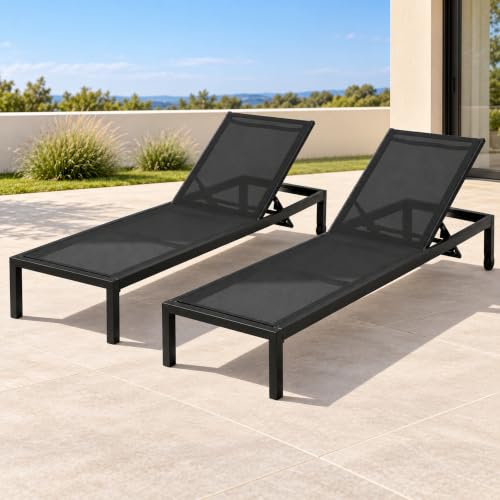
The Gardeon two-piece aluminium sun lounge set costs about $250 at time of writing for the pair, so around $125 a lounger, sold by Artiss Furnishings. It returns #10 in Sunloungers and #2,252 overall on Amazon AU when I checked. It's the only pick whose listing names an aluminium frame, and if you want a sling lounger near the coast, that's the frame material I'd choose, since aluminium doesn't rust the way coated steel does once the paint is chipped. Being sold as a matched pair also suits a pool area, where two loungers side by side usually get far more use than one on its own.
The listing describes powder-coated aluminium framing with a high-tensile, breathable textilene fabric that dries fast, which is why you see textilene on most pool furniture. It quotes a 150kg capacity, heavy-duty bracing and non-slip foot pads for decks, tiles, grass and pool surrounds, a five-position backrest and two rear wheels so you can roll it into the shade rather than drag it. There are armrests, and the listing data shows a one-year warranty, one of only two picks with a warranty stated. Textilene doesn't hold water the way a cushion does, so it dries quickly after a swim and doesn't go musty, which makes this pair the lower-maintenance sling option here. The armrests help with getting up and down, and they give you somewhere to rest a drink that isn't the deck.
Aluminium still has weak spots. The fixings that join the frame are often steel, and that's where you'll see rust stains first near salt water, so check them and rinse the frame now and then. The rear wheels will pick up sand and grit, which wears the axles, so give them a rinse too. It's sold by a marketplace furniture seller rather than an AU-named storefront, so keep the order details. At this price I'd still want to see the fixings before I'd call it a coastal lounger for years. Rinse the wheels after a beach trip.
Honest caveats: Priced as a pair, so compare it per lounger. Fixings may be steel even though the frame is aluminium, and those can rust near salt water. Wheels collect sand. Seller is a marketplace seller. The shipping weight in the listing data is for the pair and the packaging, not one lounger.
Best for: A matching pair of sling loungers beside a coastal or saltwater pool.
Frame: Powder-coated aluminium • Fabric: Textilene • Quantity: 2 loungers • Recline: 5 positions • Max load: 150kg (listing) • Wheels: 2 rear wheels • Warranty: 1 year (listing) • Seller: Artiss Furnishings • Rank: #10 in Sunloungers (Amazon AU)
View on Amazon AUSide-by-side comparison
What we see fail in the workshop: sun loungers and the gear around them
Loungers don't come in for repair, but the corrosion that kills them is the same corrosion we clean off phone charging ports and screws every summer, and the devices that end up in the pool usually fell off a lounger first. These are the failures I'd plan around before buying one, and how to put them off for as long as you can.
Rust starting at the joints
On coated steel loungers, rust nearly always starts where the coating is thinnest or gets scraped: rivets, hinge bolts, the recline bar and the feet. Salt air leaves a film that holds moisture against any bare metal, and once rust gets under the paint it lifts the coating as it spreads. Rinse steel frames with fresh water, let them dry before folding, and dab outdoor paint on any chip straight away. On aluminium frames, it's the steel fixings that stain first, so watch those, and swap a badly rusted bolt for a stainless one.
Slings splitting at the seams
A sling usually fails at the stitching where it wraps the frame, not in the middle of the fabric. UV breaks down the thread faster than the weave, and the seam takes the full load every time someone sits down hard on the end. Look along the seams at the start of each summer. A sling that's starting to pull can often be restitched by an upholsterer or a sailmaker for less than a new lounger, and storing it out of the sun over winter slows the whole process down.
Phones in the pool and heat on the lounger
This is the one that actually lands on our counter. Phones slide off sloped backrests into the pool, and a phone left face-up on a lounger in full summer sun can overheat and shut down, which is hard on the battery if it keeps happening. Keep devices in the shade, not in the side pocket by the water. If one goes in, turn it off, leave the charger alone and dry the outside, since charging while wet is what does the lasting damage. If it still isn't right, have it checked before you replace it.
Decision tree: which one should you actually buy?
- Live near the coast or have a saltwater pool? → The Marbella resin lounger at about $101 can't rust and quotes a 200kg load; for a sling pair, the Gardeon aluminium set at about $250.
- No shade where you'll lie? → The Costway folding lounger with the rotating canopy at about $76; fold the canopy down when it's windy.
- Want to lie face down? → The Levede face-hole lounger at about $76 has a face hole and three removable pillows, but no stated weight limit.
- Need two matching loungers for a pool? → The Costway resin 2-pack at about $180 for the pair, with six reinforced legs and 180kg stated per lounger.
- Want the most comfortable lounger for a deck? → The Livsip at about $204 has an 8cm cushion with removable covers; bring the cushion in when it rains.
- Phone ended up in the pool? → Turn it off, keep it off the charger and bring it into our Erina workshop; we'll tell you what it needs before you spend anything.
Frequently asked questions
What is the best sun lounger material for the coast?
Near salt air or beside a saltwater pool, I'd choose resin (polypropylene) or aluminium. Resin can't rust and aluminium doesn't rust the way steel does, although aluminium loungers often use steel fixings that can still stain. Coated steel is fine inland or kept under cover, but salt air finds any chip in the coating and rust spreads from the joints. Whatever you buy, rinse it with fresh water now and then and let it dry before you fold or cover it.
How much weight can a sun lounger hold?
It varies a lot, and some listings don't say. Of these six, the stated limits are 150kg on the Costway canopy lounger and the Gardeon pair, 180kg per lounger on the Costway resin pair and 200kg on the Marbella, while the Levede and Livsip listings give none. Treat a stated limit as an even static load. Sitting down hard on the end, or two people on one lounger, puts far more strain on a single joint than the number assumes.
Can I leave a sun lounger outside all year?
You can, but it won't last as long. Resin loungers cope best, although years of full sun make polypropylene chalky and brittle. Steel frames left on damp grass rust from the feet up, and fabric slings and seams break down in UV. Cushions should come inside whenever it rains or they'll go mouldy. Storing folding loungers dry in a shed or garage over winter, and tilting fixed ones so water doesn't pool, adds a few years for very little effort.
Are resin sun loungers comfortable?
They're firmer than a fabric sling or a cushioned lounger, because the seat is moulded plastic. Most people put a towel or an outdoor cushion on a resin lounger for long sessions. The upside is that there's no fabric to fade, split or go mouldy, and the frame can't rust, which is why I'd still pick resin beside a saltwater pool. A slotted resin seat, like the Costway pair, also drains rain straight through and dries quickly after a swim.
What does 600D Oxford fabric mean on a lounger?
Oxford is a woven polyester fabric, and the number before D is the denier, a measure of the thickness of the yarn. 600D is a heavier, tougher weave than 500D, so it usually stands up better to wear and tearing. Most folding loungers use Oxford fabric because it's light and folds easily. Textilene, used on the Gardeon pair, is a coated mesh that drains and dries faster, which is why you see it on a lot of pool furniture.
How do I stop a steel sun lounger rusting?
Rinse it with fresh water every few weeks over summer, and straight away after it's been splashed with salt or pool water, then let it dry fully before folding it or putting a cover on. Check the joints, rivets and feet, because that's where rust starts, and touch up any chip in the coating with outdoor paint before rust gets under it. Store it dry and off the ground over winter, and don't leave the feet sitting in damp grass.
Related buying guides
Phone slid off the lounger into the pool?
Pool water, then a hot afternoon, is hard on phones, tablets and speakers, and charging a wet device is what does the lasting damage. If something has gone quiet, won't charge or has lines on the screen after a day by the pool, bring it into our Erina workshop and we'll tell you what it needs before you spend anything.
Visit our Erina workshop Book Online