Prices from Amazon AU, updated daily. Swipe or use the arrows for more.
Disclosure: This article contains affiliate links to amazon.com.au. If you buy through one of these links iFix may earn a small commission at no extra cost to you. It doesn't change which products we recommend. We focus on what actually lasts based on 16 years of repair-shop experience.
Quick summary7 picks
- Entry PickSTANLEY FATMAX | 1650W 190mm Circular Saw -… about$891650W.
- Skil PWRCore 20V Circular Saw about$115
- Bosch 18V Cordless Circular Saw 150mm with… about$120
- Bosch Professional Cordless Circular Saw… about$229
- DeWalt DCS570N 18V XR Li-Ion Brushless… about$259
- Makita DHS680Z 18V LXT Brushless 165mm about$269
- Most PremiumMilwaukee M18FCS66G30 18V FUEL Brushless 184mm about$399
What a circular saw really costs you
A circular saw looks like a one-off purchase, but most of them aren't. Five of the six picks here are cordless, and all five are sold skin only, which means the price on the listing buys the saw and nothing else. No battery, no charger. So the number that matters isn't the saw's price, it's the saw plus whatever it takes to make it run, and that depends almost entirely on which battery platform you already own or are about to buy into.
That's why I've built this guide around the battery first and the saw second. If you've already got a shed full of yellow DeWalt or teal Makita tools, the right saw is nearly always the one that takes the batteries on your shelf, even if a different brand's saw is a bit better on paper. If you're starting from nothing, the saw is a good moment to pick a platform you'll stick with, because the next ten tools you buy will follow it.
The other big decisions are simpler. Corded or cordless decides how much you pay up front and whether you can work away from a power point. Brushless or brushed mostly decides how long the motor lasts and how far a battery goes. Blade size decides how thick a board you can cut in one pass. I'll go through each of those, and then the six picks, which run from $89 for a corded Stanley FatMax to $399 for a Milwaukee M18 FUEL at time of writing.
I've kept this to handheld circular saws for timber, the kind you'd use to cut sheet goods, decking and framing. I left out the mini saws with 85 to 125mm blades, the concrete and masonry saws, track and plunge saws, and the no-name "compatible with Makita" saws that turn up in searches. If what you mostly do is square crosscuts on narrow boards, a mitre saw is the better tool for that job, and a circular saw is the one for long rips and sheets.
Corded or cordless
A corded saw is still the least expensive way to get a full-size blade and plenty of power. The Stanley FatMax FME301 runs a 1,650W motor and a 190mm blade for $89, and you never wait on a battery. At 240V, 1,650W draws a bit under 7 amps, so it sits comfortably on a normal 10A socket, and the power it uses in a weekend of cutting costs cents. The trade-off is the lead: you're tied to a power point, and you're always minding where the cord is.
Most cordless saws cut a little shallower than a corded saw of the same price, and they cost more once you add the battery. What you get is freedom to walk out to the back fence or up onto a deck frame without running leads, and that's worth a lot on a real job. For anyone who already owns 18V tools, cordless is usually the obvious choice, because the batteries are already paid for and sitting on the charger.
If you go corded, use a heavy-duty extension lead and unroll it fully. A thin lead over 20 or 30 metres drops voltage, so the motor runs slower and hotter under load, and a coiled lead can heat up on a long cut. Plug into an RCD-protected circuit, which most newer homes have on every power point. If yours doesn't, a portable RCD between the lead and the wall is a small, sensible spend before you start cutting outdoors.
The battery platform is the real purchase
Every big tool brand runs its own battery slide, and they don't swap. A Makita LXT battery won't fit a DeWalt, and a Milwaukee M18 pack won't fit a Bosch. Bosch even runs two 18V systems that don't mix: the green POWER FOR ALL range for home use, which the EasyCirc 18V belongs to, and the blue Professional range, which the GKS 18V-57-2 belongs to. The blue range also works with the AMPShare alliance of other brands, according to its listing. So check the colour before you order.
To give you real numbers, I priced a few batteries and chargers on Amazon AU the same day. A Bosch green 18V 3Ah battery with a fast charger was $99 from Amazon AU. A DeWalt multi-voltage charger was $49 and a DeWalt twin pack of 18V 5Ah batteries with no charger was $169, both from Tradiebrokers. A Milwaukee M12 and M18 rapid charger was $85 from the same seller. Add those to the skin price and the DeWalt saw lands somewhere near $477 with two batteries, more than the saw itself.
That arithmetic is why I'd rarely tell someone to pick a saw on its own merits. If you've got one battery and a charger already, a skin-only saw is a good buy. If you've got nothing, the platform with the tools you'll want next matters more than which saw cuts a little faster. I'd look at what a cordless drill kit you'd want, what a grass trimmer or blower costs on the same battery, and go from there.
I'd also stay away from the no-name compatible batteries that turn up next to every genuine pack. They're usually a fraction of the price, and some are fine, but a lot of them skip the cell balancing and temperature protection that the genuine packs carry, and a saw is one of the hardest loads you can put on a battery. If you're curious about what no-name chargers do to lithium packs, it's the same story with tool packs. A genuine battery costs more, and in my experience it's the one that's still working in five years.
Brushless or brushed motors
A brushed motor uses small carbon blocks, the brushes, rubbing on a spinning commutator to switch the current. They wear down with use, they spark, and they make heat. On a lot of older and corded saws you can replace them, and they're a common part. A brushless motor does that switching electronically on a small controller board instead, so there's nothing rubbing and wearing, and more of the battery's energy ends up turning the blade.
In practice that means a brushless cordless saw usually gets more cuts out of each charge, runs cooler and holds its speed better when the blade is buried in a thick board. Four of the cordless picks state a brushless motor on their listings: the Bosch Professional GKS 18V-57-2, the DeWalt DCS570N, the Makita DHS680Z and the Milwaukee M18 FUEL. The Bosch EasyCirc's listing doesn't say either way, and the Stanley corded saw's listing doesn't state its motor type.
Brushless isn't free of faults, it just moves them. The brushes are gone, but now there's a controller board doing the work, and when that board fails, which usually happens after heat, water or dust gets in, it's a bigger repair than a set of brushes. Keep the vents clear, blow the sawdust out after a big job, and don't leave a brushless tool sitting in the rain on a job site. Treat it like any other electronics and it'll last a long time.
Blade size, cut depth and the blade itself
Blade size sets how deep the saw can cut, and depth is what decides whether you can get through a board in one pass. The DeWalt and the Milwaukee run 184mm blades, the Stanley a 190mm blade, the Bosch Professional and the Makita 165mm, and the Bosch EasyCirc 150mm. The Stanley's listing quotes up to 66mm of cut, the DeWalt's depth scale runs to 65mm, the Bosch Professional's listing says 57mm and the EasyCirc's says 48mm. The Makita and Milwaukee listings don't state a maximum depth.
For most home work, 45mm is the number to keep in mind, because that's roughly the thickness of standard framing timber. Every pick that states a depth clears that at 90 degrees, but tilt the shoe to 45 degrees for a bevel and you lose a lot of depth. That's where a 184 or 190mm blade earns its keep, and where a 150mm saw starts to struggle. If you'll be cutting decking, sheets and the odd stud, a 165mm saw is plenty.
The blade that comes in the box matters more than people think. The Stanley ships with an 8-tooth TCT blade, which is fast and rough, fine for framing and demolition but not for anything you'll see. For plywood and benchtops a blade with more teeth leaves a much cleaner edge. A dull blade is also the most common reason a saw feels like it's lost power, so before you blame the motor, try a sharp blade and watch the difference.
Check the arbor size and the blade diameter before you buy replacements, because they have to match the saw exactly. Never fit a bigger blade than the guard was made for, and never use a blade rated for a lower speed than the saw spins at. Fit a new blade with the battery out or the plug pulled, check the teeth point the same way as the arrow on the guard, and do the arbor bolt up firmly but without a breaker bar.
Skin only, kits and what's in the box
Skin only, bare tool and tool only all mean the same thing: a saw with no battery and no charger. The DeWalt, Makita, Milwaukee and both Bosch saws here are all sold that way, and each listing says so. The Bosch Professional comes in a cardboard box rather than a case, according to its listing. The EasyCirc's box contents list the saw, a 150mm blade, a box, a suction adapter and a parallel stop, which is more than the others mention.
A parallel stop, sometimes called a rip fence, clips onto the shoe and runs along the edge of the board to keep a long cut straight. It's worth having. The Milwaukee's shoe is described as track-compatible, so it'll run on a guide rail if you buy one. For the rest, a straight length of aluminium clamped to the sheet does the same job, and it's how most people get a clean cut on a sheet of plywood with a handheld saw.
Whichever you pick, read the box contents line on the current listing before you order. Tool listings change, kits get split into skin-only listings and back again, and a few of the picks' feature lists are thin. Where a listing doesn't state the depth, the weight or what's in the box, I've said so on its card rather than filling the gap from memory.
Kickback, guards and setting up a cut
Kickback is the thing to understand before you use any circular saw. When the blade pinches in the cut, usually because the board sags and closes on it, the teeth grab the timber and the saw can jump back toward you very fast. Support the board on both sides of the cut so the offcut falls away rather than closing up, keep the blade depth set just a few millimetres below the board, and keep your body to one side of the saw's line rather than directly behind it.
The lower guard should spring back over the blade every time you finish a cut. If it sticks, it's usually sawdust and resin packed into the guard, and it's worth cleaning out before you carry on. The Milwaukee's listing mentions an electric blade brake, which stops the blade quickly after you let go of the trigger, and that's a feature I'd like on every saw. On the others, wait for the blade to stop before you lift the saw out of the cut.
Dust is the other thing to plan for. The Stanley, both Bosch saws and the Milwaukee all list a dust port or suction adapter,. Hooking a saw up to a wet and dry shop vacuum keeps your line visible and keeps fine dust out of the motor. Clamp the work to a solid workbench or a pair of sawhorses, never hold a short offcut in your hand, and wear eye and hearing protection for every cut.
How I picked these six
The Stanley and the Bosch EasyCirc are sold new by Amazon AU. The Bosch Professional, DeWalt, Makita and Milwaukee are sold by Tradiebrokers, an Australian tool seller that's on our approved reseller list, because Amazon AU doesn't stock those skin-only saws itself right now. I left out anything sold as renewed or refurbished, saws from overseas sellers, and a Makita listing with a US model code, because I couldn't confirm it was the Australian unit.
Ranks are Amazon AU's own sales ranks in its Power Saws category, checked today. The Stanley corded saw has the best rank of the six at #4, with the Milwaukee next at #6 and the DeWalt at #17. Ranks move every day, and the skin-only saws rank on the strength of people who already own the batteries, so don't read a lower rank as a worse saw.
Prices are at time of writing and they move, especially heading into the November sales. If you've already got a saw that's sparking, losing power or won't start, or a battery that dies halfway through a cut, bring it into our Erina workshop before you replace it. Plenty of those faults are a worn set of brushes, a tired trigger switch or one bad battery, and it's worth knowing which before you spend anything.
The 6 picks, $89 to $399
Prices are Amazon AU at time of writing (2026-11-10) and move week to week. Ranks are Amazon AU sales ranks in the Power Saws category, checked the same day.

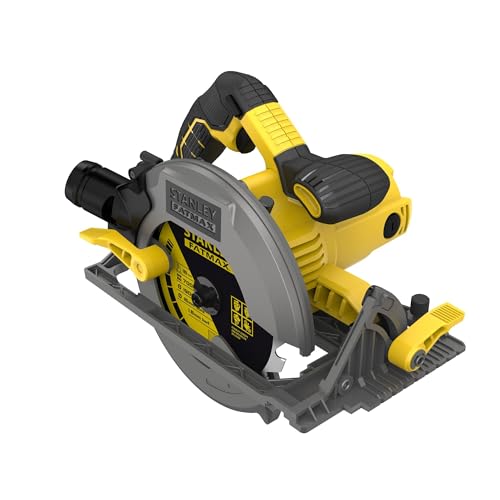
STANLEY FATMAX 1650W 190mm Corded Circular Saw (FME301-XE)
ASIN B07N16WMBS • $89.00 • Ships from Amazon AU
The Stanley FatMax FME301 is the lowest-priced pick at $89 at time of writing, and it's sold by Amazon AU. It has the best rank of the six at #4 in Amazon AU's Power Saws category, and #4,359 overall. The part number is FME301-XE, and the XE ending is the code Stanley uses for its Australian units, which is the tell I look for. It's a corded saw with a 1,650W motor and a 190mm blade. I'd pick it for anyone who doesn't own an 18V battery platform and just wants a saw that cuts. There's no battery to buy, no charger and nothing to run flat halfway through a sheet.
The listing says it cuts up to 66mm deep, which is the deepest stated cut of the six, and the depth lever adjusts quickly for rip, cross and bevel cuts. The shoe pivots to 55 degrees, and there's a bevel detent for the two most-used angles so you don't have to set them by eye. It ships with an 8-tooth TCT blade and has a vacuum cleaner connection for dust. The listing sums it up as made for straight and angled cuts through wood, and that's what it's for. At 1,650W it sits well inside a normal 10A socket, so it won't trip anything on its own. Just don't share that circuit with a big heater or a compressor while you cut.
The listing doesn't state the motor type, the weight or whether there's a blade brake, so check the manual if those matter to you. The 8-tooth blade is fast and rough, so plan on a finer blade for anything you'll see. Run it on a heavy-duty lead, unroll the lead fully, and plug into an RCD-protected outlet. For a first circular saw with no battery to think about, it's the pick. If the trigger ever starts sticking or the motor sparks heavily, get the brushes and switch checked before you replace it.
Honest caveats: Honest caveats: it's corded, so you're tied to a power point and a lead on every cut. The listing doesn't state the motor type, the weight or a blade brake. The supplied 8-tooth blade is built for speed, not a clean edge, so budget for a better blade if you cut sheet goods or anything visible.
Best for: Someone with no battery platform who wants a full-size blade and the deepest stated cut for the least money.
Price: $89 (Amazon AU) • Model: FME301-XE • Power: Corded, 1,650W • Blade: 190mm, 8-tooth TCT supplied • Max cut depth: Up to 66mm • Bevel: Up to 55 degrees, with detents • Dust: Vacuum connection • Rank: #4 in Power Saws (Amazon AU)
View on Amazon AU
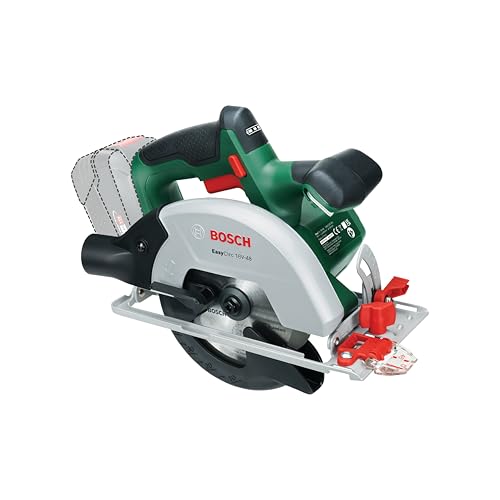
Bosch EasyCirc 18V-48 Cordless Circular Saw 150mm, Skin Only (06033B1500)
ASIN B0FQV9C2M1 • $120.00 • Ships from Amazon AU
The Bosch EasyCirc 18V-48 is $120 at time of writing, sold by Amazon AU, and it ranks #45 in Power Saws and #20,513 overall. The part number is 06033B1500. It's a compact cordless saw on Bosch's green POWER FOR ALL 18V system, the home range, and it's sold without a battery or charger. I'd pick it for someone who already has green Bosch tools, or who wants a light saw for occasional jobs around the house and doesn't need to cut thick framing. It's the saw I'd hand to someone who's a bit nervous of a big 184mm saw. It's also small enough to live in a kitchen drawer or a laundry cupboard.
The listing says it cuts wood up to 48mm, which clears standard framing timber at 90 degrees, and that depth is set by material thickness, so you dial in the board size rather than measuring. Bosch's cut control is described as making the marked line easier to see and follow. The box contents line lists the saw, a 150mm blade, a box, a suction adapter and a parallel stop, which is the most complete box of the cordless picks. The listing says the POWER FOR ALL battery runs 150-plus devices across 10-plus brands, so one battery can go a long way. That covers green Bosch drills, trimmers and blowers, plus the other alliance brands.
The listing doesn't say whether the motor is brushless, and it doesn't state a bevel range or a weight. Remember it's the green range, so blue Bosch Professional batteries won't fit it. On the same day, a green Bosch 18V 3Ah battery with a fast charger was $99 from Amazon AU, so a first-time buyer is looking at roughly $219 all up. For light work on the green platform, it's the pick. Keep the battery off the charger once it's full, store it indoors, and don't push the small blade through hardwood faster than it wants to go.
Honest caveats: Honest caveats: battery and charger aren't included, and it's the green home range, which doesn't share batteries with Bosch Professional. The 48mm maximum cut is the shallowest of the six, so bevel cuts on thicker timber will need two passes. The listing doesn't state the motor type, bevel range or weight.
Best for: Owners of green Bosch 18V tools, or anyone wanting a light, compact saw for occasional jobs at home.
Price: $120 (Amazon AU) • Model: EasyCirc 18V-48 (06033B1500) • Power: 18V POWER FOR ALL, skin only • Blade: 150mm, supplied • Max cut depth: 48mm • In the box: Blade, suction adapter, parallel stop • Motor: Not stated on the listing • Rank: #45 in Power Saws (Amazon AU)
View on Amazon AU
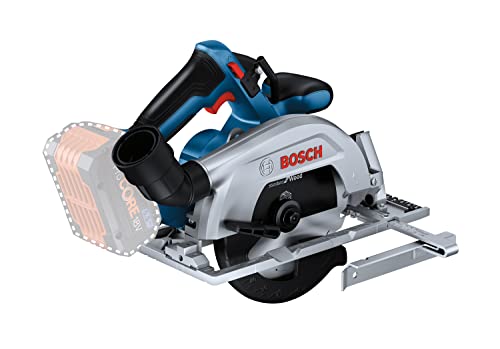
Bosch Professional GKS 18V-57-2 Cordless Circular Saw 165mm, Skin Only (06016C1200)
ASIN B0BGBQYW4Y • $229.00 • Sold by Tradiebrokers on Amazon AU
The Bosch Professional GKS 18V-57-2 is $229 at time of writing, sold by Tradiebrokers, an Australian tool seller on our approved list. It ranks #21 in Power Saws and #13,812 overall. The part number is 06016C1200. It's a compact brushless saw with a 165mm blade on Bosch's blue Professional 18V system, sold without batteries or a charger, in a cardboard box. I'd pick it for anyone already on blue Bosch, or for someone who wants a compact trade saw and likes that the blue batteries also work across the AMPShare alliance of other brands. It's a saw for regular use rather than the odd weekend job, and it's built to be carried around a site.
The listing says it cuts 57mm deep, which is plenty for framing and decking, and that the brushless motor gives fast cutting with good runtime per charge. The listing says the blade sits on the right of the motor, which is how Bosch lays out this compact design. It has an external dust extraction port that suits Bosch vacuums. The listing says the batteries and chargers are fully compatible with the Bosch Professional 18V system and with other brands in AMPShare, which widens the tools you can run off one pack. It's a sensible middle size, not too heavy for overhead work and deep enough for most jobs. I'd call it the best balance of size and depth on the blue platform.
It's the blue range, so the green EasyCirc's batteries won't fit, and the other way round. The listing doesn't state the bevel range, the weight or a blade brake. Tradiebrokers sells it rather than Amazon AU, so read the seller's returns and warranty terms on the listing. Blow the dust out of the vents after a big job, because the brushless controller doesn't like being packed with sawdust. For a compact brushless saw on blue Bosch, it's the pick, and I'd pair it with a 5Ah or bigger battery for long rips.
Honest caveats: Honest caveats: it's skin only in a cardboard box, so you'll need a blue Bosch Professional or AMPShare battery and charger. It's sold by Tradiebrokers rather than Amazon AU. The listing doesn't state the bevel range, weight or a blade brake, and 57mm of depth is less than the 184mm saws offer for bevelled framing cuts.
Best for: Blue Bosch Professional or AMPShare battery owners who want a compact brushless 165mm saw.
Price: $229 (Tradiebrokers) • Model: GKS 18V-57-2 (06016C1200) • Power: 18V Professional / AMPShare, skin only • Motor: Brushless • Blade: 165mm, on the right • Max cut depth: 57mm • Dust: External extraction port • Rank: #21 in Power Saws (Amazon AU)
View on Amazon AU
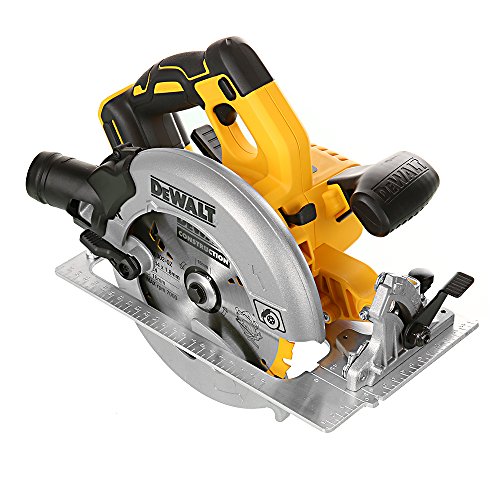
DeWalt DCS570N 18V XR Brushless Circular Saw 184mm, Skin Only
ASIN B071GLYD5L • $259.00 • Sold by Tradiebrokers on Amazon AU
The DeWalt DCS570N is $259 at time of writing, sold by Tradiebrokers, and it ranks #17 in Power Saws and #12,459 overall. It's an 18V XR brushless saw with a full 184mm blade, sold skin only, so there's no battery or charger in the box. I'd pick it for anyone already running yellow DeWalt 18V tools, which is a lot of people, and who wants a full-size saw for framing, decking and sheet work without dropping to a smaller blade. It's the most common saw size on a building site for good reason, and it suits a home renovator just as well. If you're replacing an old corded saw, it's the closest match in size.
The listing says the depth scale runs to 65mm, which is the deepest stated cordless cut of the six, so bevelled cuts through framing timber are well within its range. It's described as a general-purpose saw for ripping, cross-cutting and bevelling in wood and other construction materials. The listing credits its stable block construction with low vibration and long service life, and its high-torque brushless motor with durability and power. On the same day, a DeWalt multi-voltage charger was $49 and a twin pack of 18V 5Ah batteries was $169, both from Tradiebrokers, so starting from nothing it lands near $477. Already own two packs and a charger, and it's simply the $259.
The listing doesn't state the bevel range, the weight or whether there's a blade brake, so check DeWalt's spec sheet if those matter. Tradiebrokers sells it, not Amazon AU, so read its returns and warranty terms. A 184mm saw pulls hard on a battery, so a 2Ah compact pack will run flat quickly; a 5Ah pack suits it far better. For DeWalt owners wanting a full-size saw, it's the pick. Keep the blade sharp and the guard clean, because a dull blade on a brushless motor still just heats everything up.
Honest caveats: Honest caveats: it's skin only, and starting from no DeWalt batteries it costs well more than the saw price once you add a charger and packs. It's sold by Tradiebrokers rather than Amazon AU. The listing doesn't state the bevel range, weight or a blade brake, and the feature text is short.
Best for: Yellow DeWalt 18V owners who want a full 184mm brushless saw with the deepest stated cordless cut.
Price: $259 (Tradiebrokers) • Model: DCS570N • Power: 18V XR, skin only • Motor: Brushless • Blade: 184mm • Max cut depth: 65mm on the depth scale • Use: Rip, cross-cut and bevel • Rank: #17 in Power Saws (Amazon AU)
View on Amazon AU
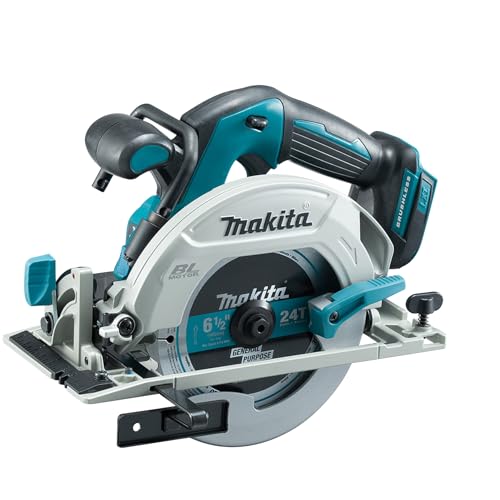
Makita DHS680Z 18V LXT Brushless 165mm Circular Saw, Skin Only
ASIN B00WW83F4Q • $269.00 • Sold by Tradiebrokers on Amazon AU
The Makita DHS680Z is $269 at time of writing, sold by Tradiebrokers, and it ranks #47 in Power Saws and #21,004 overall. The model code is DHS680Z, and the Z ending is Makita's code for a skin-only tool. It's an 18V LXT brushless saw with a 165mm blade. I'd pick it for anyone already running teal Makita LXT batteries, which plenty of people already have on the shelf, and who wants a compact brushless saw rather than a full 184mm one. It suits renovation work, sheet goods and roof framing, where a lighter saw is much easier to hold steady. It's also a sensible second saw beside a bigger corded one.
The listing says the shoe tilts up to 50 degrees for bevels, and it describes the saw as suitable for roofing and interior work. It also lists two battery charge status indicators, which is a handy way to see how much is left before a long cut. Being brushless, it should get more out of each LXT pack than an older brushed Makita, and with no brushes to wear there's less to service over the years. The 165mm size keeps it compact enough to use one-handed on a sawhorse, though I'd still use two hands for every cut. A bigger LXT pack suits it far better than an old compact one.
The feature list is the thinnest of the six. It doesn't state the cut depth, the weight, a blade brake or what's in the box beyond the saw, and one line reads like it was copied from a drill listing. So read Makita's own spec sheet before you order, and check the depth against the timber you cut most. Tradiebrokers sells it rather than Amazon AU. For Makita LXT owners wanting a compact brushless saw, it's the pick. Store the batteries indoors through summer, because a hot ute cab is hard on lithium cells.
Honest caveats: Honest caveats: the listing is thin and doesn't state the cut depth, weight or blade brake, so confirm them from Makita's spec sheet first. It's skin only and sold by Tradiebrokers rather than Amazon AU. It has the weakest category rank of the six, and the 165mm blade gives up depth against the 184mm saws.
Best for: Makita LXT battery owners who want a compact brushless saw for renovation and roof work.
Price: $269 (Tradiebrokers) • Model: DHS680Z • Power: 18V LXT, skin only • Motor: Brushless • Blade: 165mm • Bevel: Up to 50 degrees • Max cut depth: Not stated on the listing • Rank: #47 in Power Saws (Amazon AU)
View on Amazon AU
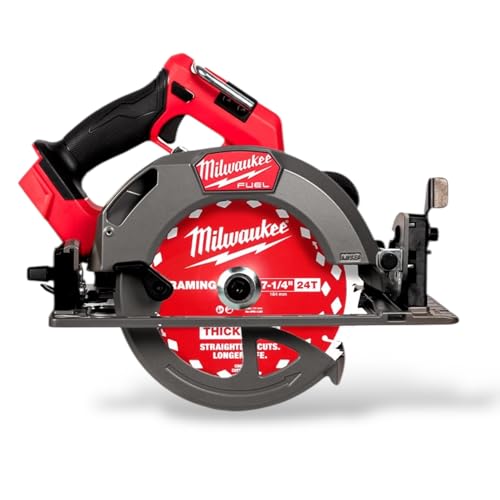
Milwaukee M18 FUEL M18FCS66G30 Brushless 184mm Circular Saw, Skin Only
ASIN B0F7XKZLHK • $399.00 • Sold by Tradiebrokers on Amazon AU
The Milwaukee M18 FUEL M18FCS66G30 is the most expensive pick at $399 at time of writing, sold by Tradiebrokers, and it ranks #6 in Power Saws and #7,946 overall, the second-best rank of the six. It's an 18V brushless saw with a 184mm blade, sold skin only. The listing doesn't return a separate part number, so the model code above comes from the title. I'd pick it for someone already on red Milwaukee M18 batteries who uses a saw most weekends, or for anyone who wants the most stated features of the six and is happy to pay for them. It's the saw I'd expect to see on a builder's ute rather than in a home shed.
The listing says the motor spins at 6,000 RPM and holds speed under load. It has bevel detents at 22.5, 45 and 50 degrees, and depth detents at 12, 19 and 32mm, so common cuts set up quickly. The shoe and guards are magnesium, there's an electric blade brake and an LED work light, plus a dust chute, a rafter hook and a shoe that runs on a guide track. The listing quotes up to 750 cuts per charge, but that's with Milwaukee's 12.0Ah FORGE battery, which isn't included and is a big pack, so expect far fewer on a small one. Even so, it's the most detailed listing of the six by a long way.
The listing doesn't state the cut depth, the weight or the bevel range beyond the detents. It's skin only, and on the same day a Milwaukee M12 and M18 rapid charger was $85 from Tradiebrokers before any battery, so this is the costliest saw to start from scratch. Tradiebrokers sells it rather than Amazon AU. For an M18 owner who cuts a lot, it's the pick. Use the blade brake as a habit, not an excuse, and still let the blade stop before you lift it clear. Clean the magnesium shoe with a dry rag rather than solvent, so the scale markings stay readable.
Honest caveats: Honest caveats: it's the most expensive saw here and skin only, so a first M18 battery and charger add a lot. The 750 cuts per charge figure needs a 12.0Ah battery that isn't included. The listing doesn't state the cut depth, weight or a separate part number, and it's sold by Tradiebrokers rather than Amazon AU.
Best for: Milwaukee M18 owners who cut most weekends and want a blade brake, magnesium shoe and track compatibility.
Price: $399 (Tradiebrokers) • Model: M18FCS66G30 (from the title) • Power: 18V M18 FUEL, skin only • Motor: Brushless, 6,000 RPM stated • Blade: 184mm • Detents: Bevel 22.5, 45, 50 degrees; depth 12, 19, 32mm • Safety: Electric blade brake, LED light • Rank: #6 in Power Saws (Amazon AU)
View on Amazon AUSide-by-side comparison
What we see fail in the workshop: circular saws
Circular saws are simple machines, and most of their faults come down to wear, dust or a battery that's been treated badly. The ones that come into the shop usually aren't finished, they've just got one part that's given up. Here's what tends to go wrong, how to tell which part it is, and what to check before you buy a new saw or a new battery.
Sparking, losing power or stopping under load
On a brushed saw, heavy sparking at the vents and a motor that slows badly in the cut usually means the carbon brushes are worn short. They're a common part on most corded saws and a quick job when they're accessible. On a brushless saw, cutting out under load is more often the battery's protection circuit tripping, or the controller getting too hot because the vents are packed with sawdust. Try a sharp blade and a full, genuine battery first, because a dull blade makes every saw feel weak. If that fixes it, you've spent the price of a blade instead of a saw.
Trigger sticks or the saw won't start
Trigger switches take a lot of dust, and on a saw they're one of the first parts to go. A trigger that sticks, a saw that only runs when you hold the trigger at a certain angle, or one that's dead with a known-good battery all point to the switch. On corded saws, also check the cord where it leaves the handle, because that's where it bends most and where the copper breaks inside the sheath. Don't tape a damaged cord and keep using it; get the cord or switch replaced.
Battery dies halfway through a cut
A battery that shows full on its gauge but cuts out as soon as the saw is under load usually has one weak cell group. The pack's voltage sags under the heavy current a saw pulls, and the protection circuit switches it off. It might still run a drill fine, which is why people often don't notice. Heat is what ages these packs fastest, so keep them out of a hot car, and charge them on the genuine charger. One bad pack is a lot less to replace than a new kit.
Decision tree: which one should you actually buy?
- No battery platform and just want a saw that cuts? → The Stanley FatMax FME301 at $89, corded with a 190mm blade and up to 66mm of cut.
- Already own green Bosch 18V tools? → The Bosch EasyCirc 18V-48 at $120, light and compact, with the blade, suction adapter and parallel stop in the box.
- On blue Bosch Professional or AMPShare batteries? → The Bosch Professional GKS 18V-57-2 at $229, a compact brushless 165mm saw with 57mm of cut.
- Running DeWalt or Makita 18V batteries? → The DeWalt DCS570N at $259 for a full 184mm brushless saw, or the Makita DHS680Z at $269 for a compact brushless 165mm one.
- On Milwaukee M18 and cutting most weekends? → The Milwaukee M18 FUEL M18FCS66G30 at $399, with an electric blade brake, depth and bevel detents and a track-compatible shoe.
- Saw sparking, losing power or a battery cutting out? → It's usually brushes, a trigger switch or one weak battery. Bring it into the Erina shop and we'll tell you what's wrong and whether it's worth fixing before you spend anything.
Frequently asked questions
Should I buy a corded or cordless circular saw?
If you don't own any 18V tools and mostly cut near a power point, a corded saw gives you a full-size blade and plenty of power for the least money, like the Stanley FatMax FME301 at $89. If you already own batteries from one brand, a skin-only cordless saw on that platform is usually the better buy, because the batteries are already paid for and you can cut anywhere. Starting from nothing, cordless costs noticeably more once you add a battery and charger.
What does skin only mean on a circular saw?
Skin only, bare tool and tool only all mean the saw comes with no battery and no charger. You need batteries from the same brand and platform, and they don't swap between brands. Bosch runs two 18V ranges that don't mix: green for home use and blue Professional for trade. All five cordless saws in this guide are sold skin only, so price the battery and charger before you compare saws on the listing price alone.
Is a brushless circular saw worth it?
For a cordless saw, usually yes. A brushless motor has no carbon brushes to wear out, it runs cooler and it usually gets more cuts from each battery charge, which matters on a tool as hungry as a saw. The trade-off is a controller board that's a bigger repair if it fails, usually after heat, water or packed sawdust. For a corded saw used now and then, a brushed motor is fine, and the brushes are a common replacement part.
What size circular saw blade do I need?
For most home work a 165mm saw is plenty, because it cuts through standard framing timber of about 45mm at 90 degrees. A 184 or 190mm blade gives you more depth for bevel cuts through thicker timber. Always buy replacement blades in the exact diameter and arbor size your saw takes, never fit a bigger blade than the guard was made for, and check the blade's speed rating is at least the saw's top speed.
Why is my circular saw losing power?
The most common reason is a dull or dirty blade, so try a sharp one first. On a brushed saw, worn carbon brushes cause power loss and heavy sparking. On a cordless saw, a battery with a weak cell can show full but cut out under load. A long, thin extension lead also drops voltage on a corded saw, so it runs slower and hotter. If none of those fix it, get the switch and motor checked.
Are compatible no-name batteries safe in a circular saw?
Some are fine, but many leave out the cell balancing and temperature protection that genuine packs carry, and a circular saw pulls a very heavy current. That's when a poorly built pack gets hot, sags or fails early. I'd stick to genuine batteries for a saw, store them indoors out of the heat, and charge them on the maker's charger. A genuine battery costs more, but it usually outlasts several no-name ones.
Related buying guides
Saw sparking or battery cutting out?
Most circular saw faults we see come down to worn carbon brushes, a sticky trigger switch, a cord broken inside the sheath or one tired battery pack. Bring the saw and its battery into our Erina workshop and we'll check which part has actually failed and tell you whether it's worth fixing before you spend anything.
Visit our Erina workshop Book Online