Prices from Amazon AU, updated daily. Swipe or use the arrows for more.
Disclosure: This article contains affiliate links to amazon.com.au. If you buy through one of these links iFix may earn a small commission at no extra cost to you. It doesn't change which products we recommend. We focus on what actually lasts based on 16 years of repair-shop experience.
Quick summary7 picks
- Entry PickBosch 1000W Wet & Dry Vacuum Cleaner & Blower about$1791000W.
- Bosch Home & Garden 18V Cordless Wet and… about$189
- Bosch 1.200 W Wet & Dry Vacuum Cleaner &… about$199200W.
- Bosch Professional 18V System Industrial… about$239
- Kärcher WD4S Wet and Dry Vacuum Cleaner about$2991100W.
- DeWalt Wet & Dry Vacuum 45L - 1300W about$3261300W.
- Most PremiumUnimac 30L Wet And Dry Dust Extractor | 3… about$3991600W.
A shop vac isn't a house vacuum
A wet and dry shop vacuum is a big tub, a motor on top and a wide hose, built to suck up things that would kill a house vacuum: sawdust, plaster dust, gravel, broken glass, leaves and standing water. It's the tool for the garage, the workshop, the car, the gutter clean-out and the laundry flood. It's loud, it's bulky and it doesn't do carpet well, but it'll take a bucket of water off the floor and keep going.
If you meant the cordless machines that wash and vacuum hard floors at the same time, that's a wet dry floor cleaner, a different tool with a different job. The search results mix the two together, because both get called wet and dry vacuums, but a floor washer won't survive a pile of sawdust and a shop vac won't mop your kitchen.
I've picked five here from $179 to $399 at time of writing. Three are corded: the Bosch UniversalVac 15 and the Kärcher WD4S for general garage work, and the Unimac 30L extractor for running off sanders and saws. Two are Bosch 18V battery machines sold without a battery, one from the green home range and one from the blue Professional range. Four are sold by Amazon AU and the Bosch Professional unit is sold by Atkinsons Australia.
I left out a DeWalt 23L tub whose part number carried an EU prefix, because I couldn't confirm it was an Australian-plug unit from the listing data. I also skipped a second Bosch UniversalVac listing with no feature text at all, and the tool-reseller extractors whose sellers I couldn't place as Australian retailers.
Wet pickup and what it does to the motor
Most shop vacs use what's called a bypass motor, where the air that's sucked through the tub never passes over the motor windings. The motor has its own cooling fan drawing clean air from outside. That's what lets them pick up water safely: the wet air goes through the fan and out the exhaust without touching anything electrical. It's also why you should never block the cooling vents on top, because that's the motor's only fresh air.
Most wet and dry vacs also have a float in the tub, a ball or cage that rises with the water and shuts off the airflow before water reaches the motor. You'll hear the motor note jump and the suction drop when it closes. That's your cue to stop and empty the tub. None of these five listings describes its float, so check the manual, and don't try to keep vacuuming once the suction suddenly drops on a wet job.
The filter matters on wet jobs too. The Bosch UniversalVac 15 and the Kärcher WD4S both say the same filter handles wet and dry work, so there's nothing to swap mid-job, which is the way I'd want it. What you must do is take out any paper or fleece dust bag before you vacuum water, because a wet bag tears and turns to mush. Then empty the tub straight after, rinse it, and leave the lid off to dry.
A tub left with a few centimetres of dirty water in it for a week grows mould on the filter and corrodes anything metal inside. It's the most common way a good shop vac starts to smell, and it's the easiest thing to avoid. Dry the filter in the sun before you put it back in, and store the vac with the lid loosely on so air can get in.
Filters: the part that decides suction
Suction on a shop vac falls off for one reason more than any other, and it's a clogged filter. Fine dust like plaster, cement, MDF and sanding dust packs into the pleats until the motor's working hard and moving very little air. A big watt figure on the box doesn't help once the filter's blocked, which is why I'd pick a shop vac on its filter before I'd look at the motor rating.
There are three common setups. A cartridge filter, like the Bosch UniversalVac 15's, is a cylinder of pleated material around the motor inlet. A flat pleated filter, like the Kärcher WD4S's, sits in a frame under the head, and Kärcher's design lets you lift it out without your hand touching the dirt. The Unimac uses water filtration with a HEPA filter, where the air bubbles through a tank of water first, which traps a lot of dust before it ever reaches the filter.
Bags are the other half of the story. A fleece or paper bag catches most of the dust before it reaches the filter, so the filter stays clean far longer and suction holds up as the bag fills. The Kärcher comes with one fleece bag and says the filter stays in for wet and dry work, so the bag is the only thing you change. The UniversalVac 15 includes a paper filter bag. For a lot of sanding or plaster dust, I'd always run a bag.
Tap the filter clean outside after every big job, wearing a mask, and replace it when it won't come clean any more. A filter is a consumable, so price a spare before you buy the vacuum. Kärcher's listing says filters, bags and nozzles are available in Australia whenever you need them, which is worth more than it sounds. The Unimac's listing mentions a semi-auto filter clean, which knocks dust off the filter while you work.
Watts, mbar and airflow
Three numbers turn up on shop vac listings, and only two of them tell you much. Watts is the power the motor draws, not how hard it sucks. Mbar is the vacuum the motor can pull, which decides how well it lifts heavy debris and water up the hose. Airflow, in litres per second, decides how much air moves through the nozzle, which is what carries light dust and sawdust. A good shop vac needs both.
The Bosch UniversalVac 15 lists 1,000W and 240 mbar. The Kärcher WD4S lists 1,100W, 240 mbar and 55 litres of air a second, the only pick that gives all three figures. The Unimac lists a 1,600W copper motor and doesn't give mbar or airflow. The two battery Bosch machines don't state a suction figure either. On the stated numbers, the Bosch and Kärcher pull the same vacuum, and the Kärcher's airflow figure gives you a way to compare it against other machines.
Hose diameter matters as much as any of these. A narrow hose speeds the air up and helps on fine dust, but it chokes on wood chips and leaves. A wide hose carries bulky debris without blocking. The listings here give hose lengths rather than diameters, so if you're planning to pick up planer shavings, look at the photos and the nozzle sizes on the current listing.
Running cost is modest. At an assumed tariff of about 33c/kWh, the 1,100W Kärcher running for half an hour uses about 0.55kWh, which comes to roughly 18c. A full afternoon of workshop extraction on the 1,600W Unimac is still well under a dollar. The cost of ownership is filters and bags, not power.
Power tool extraction and pass-through sockets
Hooking a vacuum to a sander, a track saw or a mitre saw catches the dust at the blade instead of sweeping it up later, and it makes a huge difference to how much ends up on everything else in the garage. The Bosch UniversalVac 15 includes a universal power-tool adapter, the AdvancedVac 18V-8 lists power tool connectability, and the Bosch GAS 18V-10 L includes an adapter in the box. The Unimac is the one built around it.
The Unimac's listing describes a 240V pass-through power socket, so you plug the sander into the vacuum and the vacuum switches on when the tool does. It also has a pass-through Nitto air connection for air-powered sanders, and a suction regulator to dial back the pull so it doesn't drag a sander across the panel. The listing pitches it at drywall and automotive sanders and power saws, which is exactly what a pass-through extractor is for.
Here's the electrical catch with any pass-through socket. The vacuum and the tool share one wall socket, and a standard Australian 10A socket tops out at 2,400W. The Unimac's motor is 1,600W, so the tool plugged into it should draw no more than about 800W, or you'll be tripping the breaker or overheating the plug. Most random orbital sanders sit under that, while a big circular saw or a mitre saw usually doesn't, so check the tool's rating plate first.
If you're cutting concrete, tile or engineered stone, the WHS rules call for a properly rated M or H class extractor, and none of these listings claims that rating. These are general workshop and garage vacs, fine for timber, plasterboard and everyday mess. For the hazardous stuff, hire or buy a certified extractor for that job.
Corded or battery
A corded shop vac runs as long as you need it to and costs less for the suction you get, which is why three of the picks are corded. The 18V machines win on convenience: no cord to drag around the car, no hunting for a power point at the back of the shed, and you can take one up a ladder to the gutter. If you already own cordless drill kits on the same battery platform, a bare-tool vac is an easy way in, since the battery is the expensive bit.
Both 18V picks are sold without a battery or charger, so budget for one if you don't already have the right platform. The AdvancedVac 18V-8 runs on Bosch's green home and garden 18V system, and the GAS 18V-10 L runs on the blue Bosch Professional 18V system, which the listing says is part of the AMPShare battery partnership shared with other brands. Check which system your existing tools use before you buy, because the two Bosch ranges are easy to mix up.
Run time depends almost entirely on the battery you put in, and neither listing gives a run time. A bigger amp-hour pack gives longer run time and adds weight. Expect a battery vac to be for quick jobs, a car interior, a sawdust clean-up after a cut, a spill, rather than an afternoon of sanding extraction.
Hoses, cords, tanks and storage
The Kärcher WD4S has a 6m cable and a 2.2m hose, and the Bosch UniversalVac 15 has a 2.2m hose. The GAS 18V-10 L has a 1.6m hose, and it doesn't need a cable at all. The Unimac's listing doesn't give hose or cable lengths. A short cable on a shop vac means an extension lead, so use a heavy-duty one, unwind it fully, and keep the join off a wet floor.
Tank size is a trade-off between how often you empty it and how big the thing is to store. The Bosch UniversalVac 15 has a 15L tank, the Kärcher a 20L stainless steel tank, and the Unimac a 30L water filtration tank. The GAS 18V-10 L lists a 10 litre gross container. Bigger isn't always better: a full 30L tub of water weighs about 30kg, so you'll be emptying it well before it's full on a wet job.
Onboard storage matters more than it sounds, because a shop vac with its nozzles lost in a drawer gets used less. The Bosch UniversalVac 15 keeps its accessories on the vacuum, the Kärcher parks the hose, cord and nozzles on the body and adds a shelf for screws and nails, and the Unimac has onboard accessory storage too. The GAS 18V-10 L comes with a shoulder strap and four removable rolls, so it can be carried or wheeled.
Making one last
Most shop vacs that come into our Erina workshop have a motor that's run hot behind a clogged filter, a float that's stuck, or a switch and cord that have lived in a wet garage. Clean the filter after every big job, run a bag for fine dust, empty and dry the tub after wet work, and keep the vents on the head clear. That covers most of it.
Never vacuum anything hot, like ash from a fire pit or sparks from a grinder, since a smouldering ember in a tub of sawdust is a fire waiting to happen. Keep it away from petrol, solvents and anything flammable, because the motor sparks. And keep a shop vac for workshop jobs: using it after the pressure washer has blasted a driveway is fine, but it isn't built to run for an hour as a pump.
Warranty and parts are worth weighing. The Kärcher listing states a two year warranty with spare parts and service agents across Australia, and the Bosch UniversalVac 15 lists 2 years plus an extra year when registered with MyBosch. The AdvancedVac 18V-8 and GAS 18V-10 L each list 2 years. The Unimac listing doesn't state a warranty, so check the current listing before you order.
The 5 picks, $179 to $399
Prices are Amazon AU at time of writing (2026-11-08) and move week to week. Ranks are Amazon AU category sales ranks, checked the same day.

Bosch UniversalVac 15 Wet and Dry Vacuum and Blower, 1,000W, 15L
ASIN B07J3Q65XP • $179.00 • Ships from Amazon AU
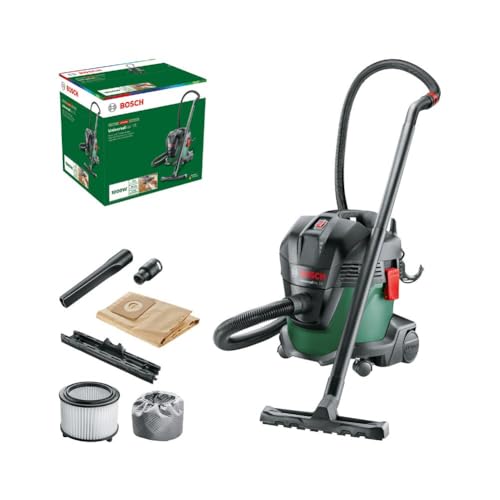
The Bosch UniversalVac 15 is the shop vac I'd start most people with, and it's $179 at time of writing, sold by Amazon AU. It's ranked #61 in Amazon AU's Power Tools category and #1,467 overall, though that rank is shared with Bosch's PAS 15-200 and PAS 15-220 listings, so it's a grouped figure rather than this model's alone. The model on the listing is 06033D1140. It has a 1,000W motor pulling 240 mbar into a 15L tank, the same stated vacuum as the Kärcher at a lower price. It also blows as well as sucks, which is handy for clearing leaves off a path or sawdust out of a corner. It's the pick with the best mix of price and stated suction.
The filter is the part I like. Bosch says the built-in cartridge filter handles wet and dry work, so there's no swapping mid-job, and every accessory clips onto the vacuum for storage. The box includes a floor nozzle with a brush insert, a crevice nozzle, two extraction pipes, an extraction adapter, a 2.2m hose, a handle, a paper filter bag, the filter and a prefilter. That extraction adapter is for connecting a power tool, so you can run it off a sander or a saw. Bosch lists a 2 year warranty, plus an extra year if you register it with MyBosch. For a garage that does a bit of everything, it covers it.
The listing doesn't state a cable length, an airflow figure or whether it has a pass-through power socket, so plan on switching the vacuum on and off yourself when it's on a tool. A 15L tank is the smallest corded one here, which means more emptying on a wet job. Take the paper bag out before you vacuum water, then empty and dry the tub straight after. Register it with MyBosch on the day it arrives, since that extra year costs nothing. For most garages and sheds, this is the one I'd buy.
Honest caveats: The rank is shared with two other Bosch 15L listings. Cable length and airflow aren't stated, and there's no stated pass-through socket for automatic tool switching. The 15L tank fills fast on wet jobs. Take the paper bag out before vacuuming water.
Best for: Most garages and sheds that want a corded wet and dry vac with solid stated suction at a sensible price.
Motor: 1,000W • Suction: 240 mbar • Tank: 15L • Filter: Cartridge, wet and dry • Extras: 2.2m hose, blower, power-tool adapter, onboard storage • Warranty: 2 years, plus 1 with MyBosch registration • Model: 06033D1140 • Seller: Amazon AU • Rank: #61 in Power Tools (Amazon AU, listing shared with PAS 15-200/220)
View on Amazon AU
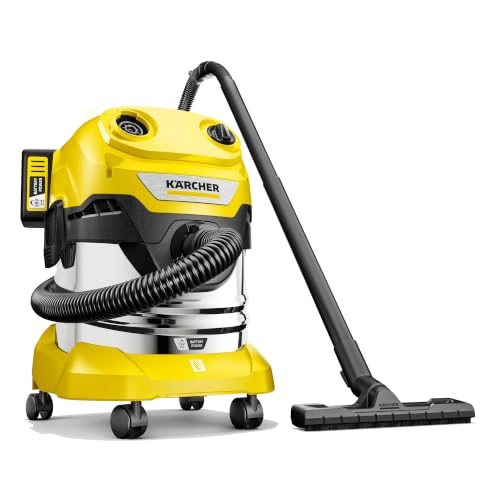
Kärcher WD4S Wet and Dry Vacuum Cleaner, 20L Stainless Steel
ASIN B0CXPYGLR4 • $299.00 • Ships from Amazon AU
The Kärcher WD4S is $299 at time of writing, sold by Amazon AU, and it's ranked #19 in Amazon AU's Cylinder Vacuums category and #47,769 overall. The part number on the listing is 1.628-261.0. It lists 1,100W, 240 mbar and 55 litres of air a second into a 20L stainless steel tank, which makes it the only pick that gives all three suction figures. The stainless tank won't crack if it's knocked off a trailer, and it doesn't stain the way plastic does. Kärcher pitches it at the garage, workshop, cellar, terrace and car interior, wet or dry, including standing liquid. It's the one I'd pick for heavy fine-dust work.
The filter design is the reason. Kärcher's flat pleated filter lifts out of its box without your hand meeting the dirt, and the same filter stays in for wet and dry work, so nothing changes mid-job. A three-layer fleece bag catches the fine dust and keeps suction up as it fills, and the bag is the only thing you change. The box includes a 2.2m hose with a removable curved handle, two 0.5m tubes, a wet and dry floor nozzle, a crevice nozzle and one fleece bag. The cable's 6m long, the longest stated cable here. The hose, cord and nozzles all park on the body, and there's a shelf on top for screws and nails.
At $120 more than the Bosch, you're paying for the stainless tank, the bigger capacity, the stated airflow and the filter system. Kärcher's listing states a two year warranty with spare parts and authorised service agents across Australia, which is worth having on a tool you'll keep for years. It doesn't mention a power-tool adapter or pass-through socket, so it's less suited to running off a sander. Only one fleece bag comes in the box, so order spares with it. Take the bag out before wet jobs and dry the tub after.
Honest caveats: No power-tool adapter or pass-through socket is mentioned on the listing. Only one fleece bag is included, so buy spares. It costs $120 more than the Bosch for the same stated 240 mbar. The overall rank is well behind the Bosch. Remove the bag before vacuuming water.
Best for: Garages and workshops with a lot of fine dust, where filter design and local parts matter most.
Motor: 1,100W • Suction: 240 mbar, 55 l/s airflow • Tank: 20L stainless steel • Filter: Flat pleated, wet and dry, plus fleece bag • Hose and cable: 2.2m hose, 6m cable • Warranty: 2 years • Model: 1.628-261.0 • Seller: Amazon AU • Rank: #19 in Cylinder Vacuums (Amazon AU)
View on Amazon AU
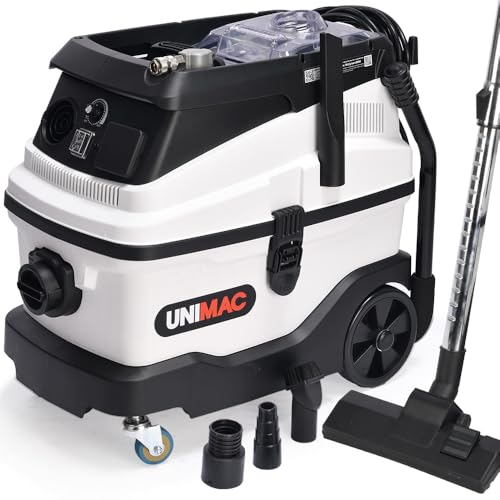
Unimac 30L Wet and Dry Dust Extractor UM-3IE
ASIN B0F52HRY3N • $399.00 • Ships from Amazon AU
The Unimac 30L Wet and Dry Dust Extractor is the most expensive pick at $399 at time of writing, sold by Amazon AU, and it's ranked #296 in Amazon AU's Automotive Interior Care Products category and #13,142 overall. The model on the listing is UM-3IE. It has a 1,600W copper motor, the highest stated wattage here, and a 30L water filtration tank, the biggest tank among the picks. Unimac pitches it for extracting dust from drywall and automotive sanders and power saws. That's the job it's built around, and it's the one I'd buy for a shed that sands a lot. It also does ordinary wet and dry vacuuming and has a blower mode.
The feature list is the longest of any pick. There's a 240V pass-through power socket, so a sander plugged into it switches the extractor on and off with the tool, and a pass-through Nitto air connection for air-powered sanders. A suction regulator lets you back the pull off so it doesn't drag the tool. The air goes through water first and then a HEPA filter, and there's a semi-auto filter clean to knock dust off the filter as you work. It has five nozzle accessories, onboard storage, castor wheels and a folding handle. For automotive panel work or plasterboard sanding, it's the most complete package here, and the castors make a 30L tub easy to move round a car.
Mind the socket limit. With a 1,600W motor, the tool plugged into the pass-through should draw no more than about 800W to stay inside a 10A socket's 2,400W, so check your sander's rating plate. The listing doesn't state a warranty, mbar, airflow, hose or cable length, so check them before you order. Empty and rinse the water tank after every session, since standing dusty water smells fast. It's a big unit to store, so measure the corner of the shed it'll live in. If extraction is the main job, it's worth it.
Honest caveats: Warranty, suction figures, hose and cable lengths aren't stated on the listing. The 1,600W motor leaves about 800W for any tool on the pass-through socket. The water tank must be emptied and rinsed after each use. It's the biggest and most expensive pick here.
Best for: Sheds and garages doing a lot of sanding, where automatic tool switching and water filtration matter.
Motor: 1,600W copper • Tank: 30L water filtration • Filter: Water plus HEPA, semi-auto filter clean • Tool extraction: 240V pass-through socket, Nitto air pass-through • Controls: Suction regulator • Extras: Blower, 5 nozzles, castors, folding handle • Model: UM-3IE • Seller: Amazon AU • Rank: #296 in Automotive Interior Care Products (Amazon AU)
View on Amazon AU
Bosch AdvancedVac 18V-8 Cordless Wet and Dry Vacuum, Bare Tool
ASIN B09CLDC89W • $189.00 • Ships from Amazon AU
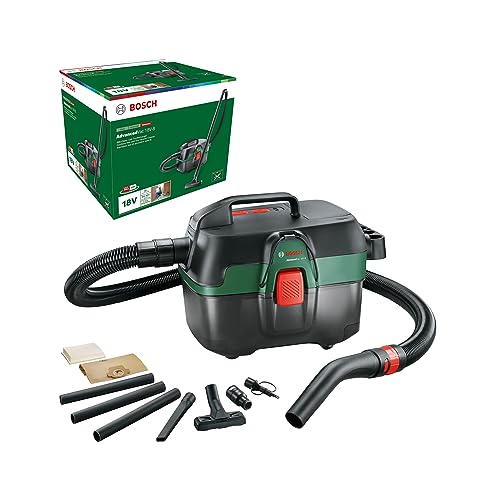
The Bosch AdvancedVac 18V-8 is $189 at time of writing, sold by Amazon AU, and it's ranked #59 in Amazon AU's Upright Vacuums category and #76,827 overall. It's sold without a battery or charger, and it runs on Bosch's green 18V home and garden system. The part number on the listing is 06033E1000. Bosch calls it a portable 3-in-1 battery vacuum for the home, garden, car or camper. It takes dry, wet, coarse or fine dirt, and it inflates air beds or blows leaves as well. It's the one I'd pick for someone who already owns green Bosch 18V tools and wants a vac with no cord to drag around the car.
The listing also says it connects to power tools for dust removal while you're sanding or drilling, which is useful with a green Bosch drill or sander on the same battery. It includes an accessory set, though the listing doesn't list what's in it. The inflator is a small thing that turns out handy when camping, and the blower clears leaves off a path in a few seconds. Bosch lists a 2 year warranty. It's the lightest-duty pick in this guide, and it isn't meant to replace a corded shop vac for a big clean-up. For car interiors, spills and quick sawdust clean-ups, it's the right size, and it'll fit on a shelf.
The listing doesn't state a tank size, suction figure, run time or hose length, so I can't compare its suction with the corded picks. Budget for a battery and charger if you don't already own the green Bosch 18V system, and remember it won't take the blue Professional batteries. A bigger amp-hour pack gives longer run time at the cost of weight. Empty and dry it after wet jobs, the same as the big tubs. Keep the battery out of it when it's stored, so the pack doesn't sit in a damp garage. For quick jobs on a battery platform you already own, it's the easy pick.
Honest caveats: Sold without a battery or charger, on the green Bosch 18V system only. Tank size, suction, run time and hose length aren't stated on the listing. The accessory set's contents aren't listed. It's for quick jobs, not a big clean-up. Empty and dry it after wet use.
Best for: Car interiors, spills and quick clean-ups for anyone already on Bosch's green 18V battery system.
Power: 18V battery (green Bosch home and garden system), bare tool • Pickup: Dry, wet, coarse and fine • Extras: Inflator and blower, power tool connection • Warranty: 2 years • Tank: Not stated on the listing • Model: 06033E1000 • Seller: Amazon AU • Rank: #59 in Upright Vacuums (Amazon AU)
View on Amazon AU
Bosch Professional GAS 18V-10 L Cordless Wet and Dry Extractor, Bare Tool
ASIN B07WH4QD8H • $239.00 • Sold by Atkinsons Australia on Amazon AU
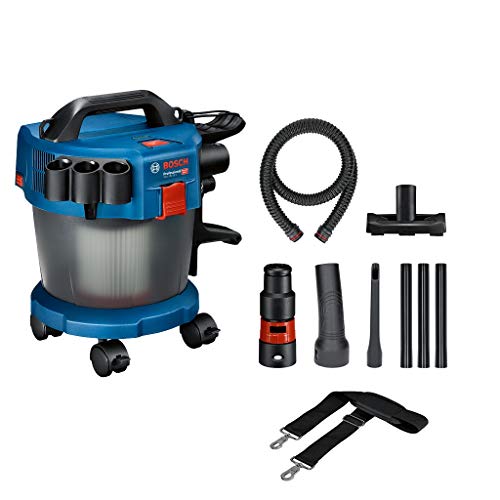
The Bosch Professional GAS 18V-10 L is $239 at time of writing, sold by Atkinsons Australia, and it's ranked #12,620 in Amazon AU's Power Tools category, the weakest rank of the picks. It's sold without a battery or charger and runs on the blue Bosch Professional 18V system. The part number on the listing is 06019C6302. The listing gives it a 10 litre gross container and a rotational airflow design that Bosch says is filter-friendly, keeping suction up for longer. It's light and compact enough to carry on a shoulder strap. It's the one I'd pick for a tradie already carrying blue Bosch batteries in the ute, since the vac then costs no more than the bare tool.
The box is well kitted out: a 1.6m hose, an elbow pipe, three extension tubes, a 250mm crevice nozzle, a floor nozzle, a HEPA filter, a shoulder strap, four removable rolls and an adapter. The rolls let it wheel along a floor, and the strap lets it go up a ladder or into a roof space. The listing says the batteries and chargers work across the Bosch Professional 18V system and the AMPShare battery partnership, so batteries from other AMPShare brands fit too. Bosch lists a 2 year manufacturer warranty. Atkinsons Australia is a local tool retailer selling through Amazon AU, so returns go through an Australian business. It's a well-equipped kit for the price.
The listing doesn't state a suction figure or a run time, and run time depends on the pack you fit, so I can't rank its pull against the corded machines. It won't take the green home and garden batteries, so check your tools first. A 1.6m hose is the shortest stated hose here. Its weak rank suggests few buyers on Amazon AU, so most will find it elsewhere. Tap the HEPA filter clean after each job. Keep the strap clear of the hose when you carry it up a ladder. For cordless extraction on site, it's the pro pick.
Honest caveats: Sold without a battery or charger, on the blue Bosch Professional 18V system. Suction and run time aren't stated on the listing. The 1.6m hose is the shortest stated here. It has the weakest rank of the picks and is sold by Atkinsons Australia rather than Amazon AU.
Best for: Tradies and serious DIYers already on Bosch Professional or AMPShare 18V batteries who want cordless extraction.
Power: 18V battery (Bosch Professional / AMPShare), bare tool • Container: 10 litres gross • Filter: HEPA • Hose: 1.6m • In the box: Elbow pipe, 3 extension tubes, crevice and floor nozzles, strap, 4 rolls, adapter • Warranty: 2 years manufacturer • Model: 06019C6302 • Seller: Atkinsons Australia • Rank: #12,620 in Power Tools (Amazon AU)
View on Amazon AUSide-by-side comparison
What we see fail in the workshop: shop vacuums
Shop vacs are tough, but they live in dusty, damp garages and get used hard, and the faults we see follow from that. Here's what usually goes wrong once one's had a few years of sawdust and spills, and what you can check yourself before you decide the motor's gone. Most of it comes back to the filter and the float.
Motors run hot behind a clogged filter
A shop vac that's lost suction and smells hot nearly always has a filter packed with fine dust. The motor keeps spinning but moves almost no air, and on a bypass motor that also means the cooling side is working harder. Run long enough like that, and the brushes and bearings wear quickly. Clean or replace the filter, run a bag for sanding and plaster dust, and check the vents on the head are clear. If the suction doesn't come back with a fresh filter, the hose is usually blocked somewhere.
Stuck floats and wet motors
The float that shuts off airflow when the tub's full can stick open with dried gunk, or shut with a cracked cage. If it sticks open, water gets drawn into the motor, which is how a shop vac ends up tripping the safety switch. Unplug it, take the head off, and check the float moves freely and the cage isn't cracked. A motor that's taken in water needs drying out and checking before it's run again. Don't keep testing it, since a wet motor can short and take the switch with it.
Switches and cords in a wet garage
The power switch and cord on a shop vac live a hard life on wet floors, and that's where we see corrosion and broken conductors. A vac that cuts out when you move the cord, or a switch that crackles or sticks, is worth fixing before it fails completely. Keep the cord off standing water, unwind any extension lead fully, and store the vac somewhere dry. A cord or switch replacement is usually a modest repair on a good machine, and it's far less than the price of a new one.
Decision tree: which one should you actually buy?
- One corded vac for the garage and shed? → The Bosch UniversalVac 15 at $179: 1,000W, 240 mbar, a 15L tank, a blower and a power-tool adapter.
- Lots of fine dust and you want the best filter setup? → The Kärcher WD4S at $299, with a lift-out flat pleated filter, a fleece bag, a 20L stainless tank and a 6m cable.
- Sanding all day and want the vac to switch with the tool? → The Unimac 30L at $399, with a 240V pass-through socket, water filtration and a HEPA filter.
- Already own green Bosch 18V tools? → The Bosch AdvancedVac 18V-8 at $189 as a bare tool, for car interiors, spills and quick clean-ups.
- On blue Bosch Professional or AMPShare batteries? → The Bosch GAS 18V-10 L at $239 as a bare tool, with a HEPA filter, a shoulder strap and rolls.
- Shop vac lost suction, tripping the switch or cutting out? → It's usually a clogged filter, a stuck float or a damaged cord. Bring it into our Erina workshop and we'll tell you what's actually wrong before you buy another.
Frequently asked questions
What is the difference between a wet and dry vacuum and a floor washer?
A wet and dry shop vacuum is a tub with a motor on top and a wide hose, built for sawdust, plaster dust, gravel, leaves and standing water in a garage or workshop. A floor washer, often also called a wet dry vacuum, is a cordless machine that washes and vacuums hard floors inside the house with a roller and a clean water tank. They aren't interchangeable. A floor washer won't survive a pile of sawdust, and a shop vac won't mop your kitchen.
Can you vacuum water with a shop vac?
Yes, that's what the wet side is for, but take out any paper or fleece dust bag first, because a wet bag tears. The Bosch UniversalVac 15 and Kärcher WD4S both say their filters handle wet and dry work without swapping. Most shop vacs have a float that shuts off airflow when the tub fills, which you'll hear as a jump in the motor note and a drop in suction. Empty the tub then, and rinse and dry it straight after the job.
Why has my shop vac lost suction?
Nine times out of ten it's a clogged filter. Fine dust from plaster, cement, MDF and sanding packs into the pleats until the motor moves very little air. Tap the filter clean outside, wearing a mask, or replace it if it won't come clean. Running a fleece or paper bag catches most fine dust before it reaches the filter. If suction doesn't come back with a clean filter, check the hose for a blockage and make sure the float isn't stuck shut.
Can I plug a power tool into a shop vac?
Only if it has a pass-through socket, like the Unimac 30L's 240V socket, which switches the vacuum with the tool. Remember the vacuum and tool share one wall socket, and a standard Australian 10A socket tops out at 2,400W. With the Unimac's 1,600W motor, the tool should draw no more than about 800W. Check the tool's rating plate. Without a pass-through socket, use the power-tool adapter to connect the hose and switch the vacuum on and off yourself.
Is a cordless shop vac worth it?
It is if you already own batteries on the same system and want a vac for quick jobs like car interiors, spills and sawdust after a cut. Both 18V picks here are sold without a battery or charger, so budget for one if you need it. The Bosch AdvancedVac 18V-8 runs on the green home and garden system, and the GAS 18V-10 L on the blue Professional system. For an afternoon of sanding extraction or a big clean-up, a corded vac is the better tool.
Is a shop vac worth repairing?
Usually, on a good machine. The common faults are a motor worn from running behind a clogged filter, a stuck float that let water into the motor, and a corroded switch or broken cord from life in a wet garage. A filter is a consumable, and a cord or switch is usually a modest repair. If it trips the safety switch, stop using it and have it checked, since a motor that's taken in water can short. Get a quote and compare it with a new vac.
Related buying guides
Shop vac lost suction or tripping the switch?
Most shop vac faults we see come down to a motor worn behind a clogged filter, a stuck float that let water in, or a corroded switch and cord. Bring it into our Erina workshop and we'll find the actual fault and tell you whether it's worth fixing or replacing before you spend anything.
Visit our Erina workshop Book Online