Prices from Amazon AU, updated daily. Swipe or use the arrows for more.
Disclosure: This article contains affiliate links to amazon.com.au. If you buy through one of these links iFix may earn a small commission at no extra cost to you. It doesn't change which products we recommend. We focus on what actually lasts based on 16 years of repair-shop experience.
Quick summary6 picks
- Entry PickDelSol Floating Shelves for Wall Wooden… about$27.90
- MUSONG Wood Corner Floating Shelves Set of… about$30.66
- cerbass 3 Pack White Wood Floating Shelves… about$42.99
- DelSol 91.5 cm Large Floating Shelves for… about$51.43
- 2-Pack Floating Wall Shelves about$55.99
- Most PremiumTakara Set of 3 Seiso Floating Wall Shelves about$119.95
Why a repair shop is writing about floating shelves
A floating shelf looks like the simplest thing in the house, a board on the wall with nothing holding it up. What's actually holding it up is a steel bracket, a couple of screws and whatever those screws are biting into behind the paint. That's where floating shelves fail, and it's also where people drill straight through the cable feeding a power point. The second part is why an electronics shop has an opinion on shelves.
Shelves also end up carrying electronics: a router, a smart speaker, a phone on charge, a soundbar, a gaming console that's run out of room on the TV unit. A shelf that sags or lets go takes those with it, and a router cooking on a shelf crammed against the ceiling has its own problems. So I've picked on the things that keep a shelf on the wall, and I've said plainly where a listing doesn't give a load figure.
The five picks run from $27.90 to $119.95 at time of writing, all sold by Australian storefronts that passed my retail check. I've left out no-drill acrylic and adhesive shelves, which hold far less, tiered tower units, which are furniture, and several listings that gave loads in pounds with no size, or stated a different load in the title to the one in the features. Two of the five state a load rating; I'll come back to what that means.
What the load ratings really mean
A load rating on a floating shelf is a rating for the shelf and bracket on a particular wall, fixed the way the instructions say. The Takara listing is the most honest of the five about this: it rates each shelf at 5kg on plasterboard and 10kg on brick. The cerbass listing says each shelf supports up to 12kg and that it suits drywall, plaster or brick, without saying whether 12kg holds on all three. The DelSol and MUSONG listings give no figure at all.
To put those numbers in context, a row of paperbacks 30cm long usually weighs somewhere around 4 to 6kg, and a stack of hardback cookbooks can pass 10kg in less than half a metre. A pot plant with wet soil is often heavier than it looks. A router is light, a soundbar is usually 2 to 4kg, and a small console a bit more. So 5kg on plasterboard is a shelf for display, not for a run of books.
Depth matters as much as weight. A floating shelf works as a lever: the further a load sits from the wall, the harder it pulls the top of the bracket away from the wall and pushes the bottom in. The same 5kg at the front edge of a 23.5cm deep shelf pulls the top screws far harder than 5kg pushed back against the wall. Put the heavy things at the back.
Treat a stated rating as the most a properly fixed shelf should ever carry, and a missing rating as a reason to start light. Where a listing gives no figure, I'd load a shelf with display pieces first and add weight slowly, watching the front edge for droop over a week or two.
Plasterboard, brick and studs
Most Australian homes built in the last few decades have plasterboard walls on timber or steel studs, usually at 450mm or 600mm centres. A screw into a stud holds far more than any plug in plasterboard alone, so find the studs first. A floating shelf bracket with two or three holes rarely lines up with two studs, but getting even one screw into a stud makes a real difference.
Where you can't hit a stud, use a proper plasterboard anchor rather than the little plastic plugs in the box. Spring toggles and metal self-drilling anchors spread the load behind the board; a plain plastic plug in plasterboard often just spins or pulls through. The supplied plugs are usually meant for brick or block, and the cerbass and DelSol listings both say their hardware suits more than one wall type, which is optimistic for plasterboard.
Brick and block walls need a masonry bit and a hammer drill, and the supplied plastic plugs usually do fine there. The holes need to be the plug's size exactly and clean of dust, or the plug spins. Older homes with lath and plaster or rendered brick need a look before you drill, because the surface can crumble around a hole and leave nothing for the plug to grip.
The MUSONG corner shelf lists concrete, wallpapered walls, lime plaster, painted walls, timber panels and doors as suitable surfaces. A hollow-core internal door is a poor place for any shelf; its skin is thin and a screw has little to bite into, so keep a door to the lightest display piece if you use one at all.
Cables and pipes behind the wall
This is the part I care about most. Power cables in Australian walls usually run straight up or down from a power point or light switch to the ceiling or the floor, so the strip of wall directly above and below every power point and switch is the place most likely to hold a live cable. Shelves get hung in exactly those places, over a power point for a charger or beside a switch at the door.
Before you drill, run a stud and cable detector over the spot, mark anything it finds, and move the shelf if you have to. Don't drill directly above or below a power point or switch, and keep clear of the wall behind a kitchen sink, a basin or a toilet, where water pipes run. If the dust coming out of a hole turns dark, or you feel the bit suddenly grab or slip, stop. A drill bit through a cable is a job for a licensed electrician, not a roll of tape.
Our cordless drill kit guide covers the drill side, and most decent kits will handle shelf holes in plasterboard and brick. Use the drill's clutch for driving screws into plasterboard anchors, because an over-tightened screw crushes the board and the anchor loses its grip. If you're renting, check the lease before you drill at all; many Australian leases need the landlord's written OK for wall fixings, and a few small, neat holes in the right place are easier to patch when you move out than a shelf that tore out of the plaster.
Hidden brackets and how they fail
Most floating shelves use one of two bracket types. One is a steel plate or bar screwed to the wall with pins or rods that slide into holes drilled in the back of the shelf. The other is a pair of small L or keyhole brackets hidden behind or under the board. The rod type gives the cleanest look; the L type is often stronger for its size because the shelf sits on it rather than hanging off pins.
Rod brackets fail in two ways. The rods bend downward under a heavy load, so the shelf slowly tips forward, or the holes in the shelf wear oval and the board starts to wobble. Both get worse with soft board. The Takara shelves are MDF with a laminate finish, the DelSol and MUSONG shelves are solid timber, and DelSol's two sets are paulownia, which is light and easy to handle but soft, so its holes don't grip pins as hard as a dense board would.
The third failure is the wall end. A bracket that's fixed with screws too short, or into plasterboard without a proper anchor, pulls out at the top first. You'll usually see the paint crack in a line above the shelf before it lets go. If you see that crack, take the load off and refix the bracket into a stud or better anchors before you put anything back on.
Length, depth and what fits
The five picks cover very different jobs. The Takara set is the deepest at 23.5cm and runs 90cm long, with three shelves to a set; it's also listed in 30cm and 60cm sets. The DelSol large set is the longest at 91.5cm but only 15cm deep. The cerbass and DelSol guardrail shelves are about 40cm long and 15cm deep, and the MUSONG set is two corner shelves for a 90-degree corner.
A 15cm shelf suits paperbacks, small plants, photos and toiletries. A 23.5cm shelf takes most hardbacks, a small speaker or a router with room to breathe. Measure what you want to put on the shelf, not just the wall, because a shelf that's slightly too shallow ends with things hanging off the front edge, which is the worst place for weight.
Long shelves need more fixings. A 90cm shelf has room to cross two studs at 450mm centres, which is a good reason to pick a long shelf if the wall allows. Short shelves give more layout options, staggered up a wall or spread across rooms, but each one has fewer screws doing the work.
Routers, chargers and electronics on shelves
A floating shelf is a popular home for the Wi-Fi router, and it's often a better spot than behind the TV or in a cupboard. Up off the floor and out in the open, a router usually covers a house better. Leave space around it for air, because routers run warm all day and night, and keep it off a shelf jammed up under the ceiling where heat collects. Our home Wi-Fi router guide covers placement in more detail.
Phones and tablets on charge on a bedside or hallway shelf are fine, as long as the charger is a decent one and the phone isn't buried under clothes or a pile of paper. A no-name charger that runs hot is the bigger risk, and our bad chargers explainer shows what to look for. Run the cable down the wall neatly rather than across the front of the shelf where it can be snagged.
Speakers and soundbars vibrate, and over months that vibration can walk light items off the edge of a shelf and loosen screws in soft anchors. A thin rubber pad under a speaker helps. If a phone, tablet or laptop does come off a shelf and lands badly, our Erina workshop can check the screen and the board before you decide what it's worth spending.
Fitting them level and keeping them up
Mark the bracket holes with the bracket itself held against a spirit level, not with a tape measure from the ceiling, because ceilings are rarely level. Drill pilot holes, fit the anchors, then screw the bracket on and check it again before the shelf goes on. A floating shelf shows the smallest tilt, and a shelf that slopes forward also lets things slide off.
Think about what's underneath. Keep heavy shelves away from the space above a bed or a couch, and keep anything breakable off shelves at a height kids can pull on or cats can jump to. DelSol's large set lists cat shelves as a use, but with no stated load rating I'd keep a cat shelf for a proper rated cat-wall system rather than a decorative board.
Check the shelves every few months: a gap opening at the top of a bracket, a crack in the paint above it, or a front edge that's dropped are all signs the fixing is going. Tighten or refix early. A shelf that's fixed into a stud, loaded within its rating with the heavy items at the back, usually stays up for as long as you own the house.
The 5 picks, $27.90 to $119.95
Prices are Amazon AU at time of writing (2026-11-18) and move week to week. Ranks are Amazon AU category sales ranks, checked the same day. These shelves sit in two different categories, so each card also gives the overall Amazon AU rank for a fairer comparison.

Takara Seiso Floating Wall Shelves, 90cm, Set of 3, Honey Oak
ASIN B0GGF5S9ZS • $119.95 • Sold by Time2Shopau on Amazon AU
The Takara Seiso set is the one listing of the five that rates its shelves by wall type: each 90cm shelf supports up to 5kg on plasterboard and 10kg on brick. That's the honest way to rate a floating shelf, and it tells you straight away that these are display and light-storage shelves on plasterboard. It's sold by Time2Shopau, an Australian storefront that passed my retail check, and its part number starts 93, the GS1 Australia barcode prefix, which points to an Australian-registered product. It ranks #25 in Bookcases on Amazon AU, a rank the listing shares with its 30cm and 60cm sets.
Each set has three shelves measuring 90 x 23.5 x 3.8cm, which makes them the deepest of the five picks and only a little shorter than the DelSol large set. They're MDF with a water-resistant laminate finish in a honey oak pattern, which wipes clean and suits a kitchen or living room. The 23.5cm depth takes most hardbacks, a small speaker or a router, and 90cm is long enough to cross two studs at 450mm centres. The listing doesn't describe the bracket type or say what fixings come in the box, so check that when it arrives and buy proper plasterboard anchors if the plugs are plain plastic.
This is the set I'd buy for a living room wall, provided you fix each shelf into at least one stud. The plasterboard figure is low for a 90cm shelf, so think of it as a long display shelf. Keep books and heavy pieces at the back. MDF doesn't love standing water, so wipe spills off the laminate quickly. Use the 30cm or 60cm sets where 90cm won't fit. The low plasterboard figure is a warning worth heeding, not a fault, and it's more useful than a big number with no wall attached. Check every shelf sits level after a week of use. A 90cm shelf that's dropped even a few millimetres at one end is telling you a fixing has moved.
Honest caveats: Only 5kg per shelf on plasterboard, which is light for a 90cm shelf. The bracket type and supplied fixings aren't described. MDF swells if water gets into a cut edge or a bracket hole. It's the highest-priced of the five at time of writing. The overall rank is well behind the cerbass set.
Best for: A long living room or kitchen display shelf where you want the load stated for your wall.
Size: 90 x 23.5 x 3.8cm, 3 shelves • Load stated: 5kg plasterboard, 10kg brick • Material: MDF, water-resistant laminate • Finish: Honey oak pattern • Other lengths: 30cm and 60cm sets • AU tell: 93-prefix GS1 part number • Overall rank: #15,423 on Amazon AU • Seller: Time2Shopau • Rank: #25 in Bookcases (Amazon AU), listing shared across lengths
View on Amazon AU
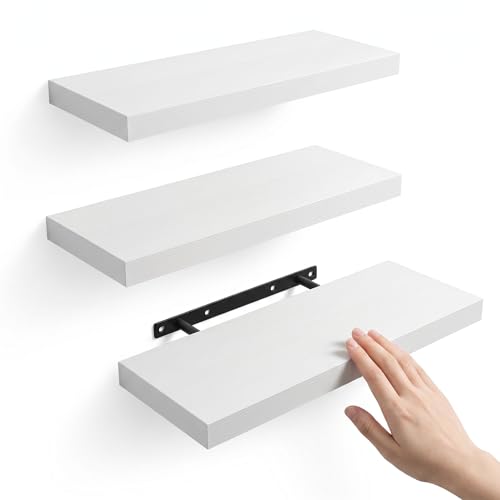
cerbass 3 Pack White Wood Floating Shelves, 40 x 15 x 3cm
ASIN B0GY8WM8Y1 • $42.99 • Sold by AU Shine on Amazon AU
The cerbass three-pack is the best-ranked of the five on overall Amazon AU sales, at #1,009 overall, and it states a load of up to 12kg per shelf. It's sold by AU Shine, an Australian storefront that passed my retail check. Each shelf is 40 x 15 x 3cm in white, with concealed brackets, and the listing says the 3cm thickness is there to stop the sagging thin shelves get over time. The listing's #174 rank in Home Storage and Organisation is shared with its two-pack and brown versions. Its overall rank was well ahead of the other four when I checked, which tells you plenty of Australian buyers are using it. White shows dust and fingermarks more than a timber finish, but wipes clean.
The listing says all the hardware and step-by-step instructions are included, and that it suits drywall, plaster or brick walls. What it doesn't say is whether the 12kg figure holds on plasterboard as well as brick, and I'd be surprised if it did with plain plugs. On plasterboard, I'd put at least one screw per bracket into a stud or use metal plasterboard anchors, then treat 12kg as a ceiling rather than a target. At 15cm deep these suit paperbacks, plants, toiletries and spices rather than a router or a speaker. Concealed brackets give the cleanest look of the five, with nothing visible under the shelf, but they also mean you can't see a bracket bending until the shelf has already tipped forward. A 3cm board also gives the bracket pins more timber to sit in than a thin shelf.
For most people wanting a few small shelves, this is the set I'd start with. White suits a bathroom or a kid's room, and three short shelves give plenty of layout options. Keep the heavy items at the back against the wall. Check the front edges after a fortnight for any droop. The two-pack suits a smaller wall. Short 40cm shelves rarely line up with two studs, so plasterboard anchors will be doing most of the work on at least one bracket. Buy metal anchors rather than trusting the supplied plugs. A small spirit level makes three shelves line up properly. Space them at least 30cm apart vertically so taller items fit.
Honest caveats: The 12kg rating doesn't say which wall it applies to, and plasterboard with plain plugs won't usually manage it. The listing doesn't name the wood or the board. At 15cm deep it won't take most hardbacks. The model field just reads Floating Shelf, with no part number.
Best for: A few short shelves for a bathroom, hallway or bedroom, with a stated load per shelf.
Size: 40 x 15 x 3cm, 3 shelves • Load stated: Up to 12kg per shelf • Walls listed: Drywall, plaster, brick • Brackets: Concealed • Hardware: Included • Colour: White (brown also listed) • Overall rank: #1,009 on Amazon AU • Seller: AU Shine • Rank: #174 in Home Storage & Organisation (Amazon AU), listing shared
View on Amazon AU
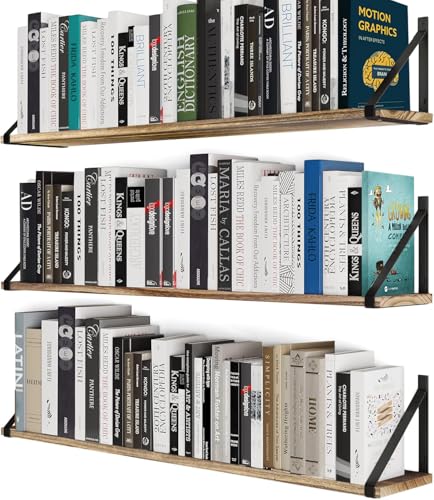
DelSol 91.5cm Large Floating Shelves, Burned Wood, Set of 3
ASIN B0DNHJJJ93 • $51.43 • Sold by VIVVA Australia on Amazon AU
The DelSol large set gives you three long shelves, each listed at 91.5 x 15cm, in solid paulownia timber with a burned wood finish on metal brackets. It's sold by VIVVA Australia, an Australian storefront that passed my retail check, and sits at #205 in Bookcases on Amazon AU. At 91.5cm it's nearly the same length as the Takara set at a far lower price, but it's much shallower, at 15cm against 23.5cm, so it's a different kind of shelf for different things. DelSol sells two of the five picks through the same storefront, so returns and missing-part claims go to one Australian seller. The burned finish darkens the paulownia's grain, which hides small dents better than a pale board would.
Paulownia is a light, soft timber, which makes long shelves easy to lift into place and puts less weight on the fixings before you load them. It also dents easily and doesn't grip bracket pins as hard as a dense board. The listing says the package comes with all the mounting hardware and easy instructions, but it doesn't give a load rating anywhere, which is the gap I'd weigh most. It says the shelves are longer, wider and sturdier than others, which is a claim, not a figure. It lists bathroom, pantry, plant and book uses.
I'd use these for a long run of light things: photos, a row of paperbacks pushed back to the wall, plants in light pots. A 91.5cm shelf can reach two studs, so fix into both. With no stated rating, load it gradually. Wipe it dry in a bathroom, since bare timber marks. Don't use it as a cat shelf. Paulownia's light weight is a real plus on a long shelf, because the shelf itself puts less load on the fixings than a 90cm MDF board does. Drill the bracket holes carefully, since soft timber splits if a pilot hole is too small. Check the brackets are snug after the first month.
Honest caveats: No load rating is stated anywhere on the listing. Paulownia is soft, so it dents and the bracket holes can wear. The bracket type isn't described beyond metal. The overall rank is the lowest of the five. Burned finishes vary from board to board.
Best for: A long, light-duty display shelf in solid timber where the 15cm depth suits what you're shelving.
Size: 91.5 x 15cm, 3 shelves • Load stated: Not stated • Material: Solid paulownia timber • Finish: Burned wood • Brackets: Metal • Hardware: All mounting hardware included • Overall rank: #81,891 on Amazon AU • Seller: VIVVA Australia • Rank: #205 in Bookcases (Amazon AU)
View on Amazon AU
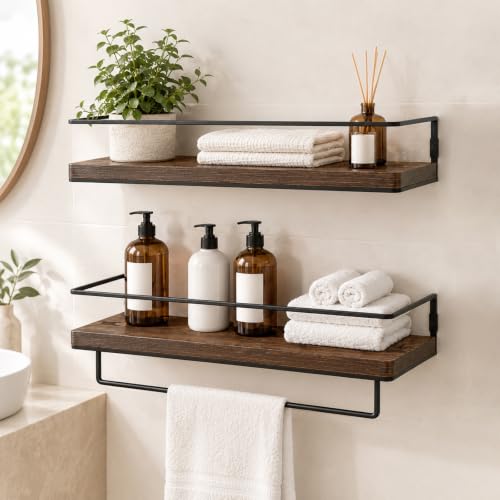
DelSol Rustic Paulownia Floating Shelves with Metal Guardrail, Set of 2
ASIN B0DMS93FQX • $27.90 • Sold by VIVVA Australia on Amazon AU
The DelSol guardrail set is the lowest-priced of the five at $27.90, and it has a feature none of the others list: a black metal rail along the front of each shelf to stop things falling off. It's sold by VIVVA Australia and ranks #63 in Home Storage and Organisation, and #2,520 overall, the second-best overall rank of the five. Each shelf is listed at 14.5 x 40cm in rustic paulownia, so they're small, light shelves for small, light things. That makes it the lowest-priced way into a floating shelf of the five picks, and the rail sets it apart from the plain boards. Two shelves suit a narrow wall beside a mirror or over a laundry tub.
The listing says the set comes with screws, anchors and instructions and can go on drywall, brick or studs, which is the only one of the five to name studs. The guardrail suits a bathroom, laundry or kitchen, where bottles and jars get bumped, and it stops a vibrating speaker walking a small item off the edge. There's no load rating, and paulownia is soft, so keep these to toiletries, spices, small plants and keys. Like the larger DelSol set, it's described as lightweight and durable, which is a fair description of the timber. The rail also helps in a kid's room for small books facing out, though I'd mount it high enough that it isn't used as a handhold. As a rough guide, a full bottle of shampoo weighs around half a kilo, so a row of toiletries adds up faster than it looks.
This is a good little set for a bathroom or laundry wall. I'd still find a stud for at least one screw per shelf, because the anchors in a set at this price are usually basic plastic plugs. Wipe the timber dry after splashes. The rails make these a poor fit for books. Check the screws are snug every few months. At this price it's an easy set to try on a wall before committing to something bigger. Use a stud finder before drilling a bathroom wall, since pipes run there. Keep the rails clear of towels, which hold moisture against the timber. Replace the plugs if they spin.
Honest caveats: No load rating is stated. Paulownia is soft and will mark. The supplied anchors aren't described and are likely basic plugs. At 14.5 x 40cm they're small shelves. The rail limits what fits, and the listing doesn't say how the rails attach. It's a small set for small things.
Best for: A bathroom, laundry or kitchen wall where a front rail stops bottles and jars sliding off.
Size: 14.5 x 40cm, 2 shelves • Load stated: Not stated • Material: Rustic paulownia timber • Front rail: Black metal guardrail • Walls listed: Drywall, brick, studs • Hardware: Screws, anchors, instructions • Overall rank: #2,520 on Amazon AU • Seller: VIVVA Australia • Rank: #63 in Home Storage & Organisation (Amazon AU)
View on Amazon AU
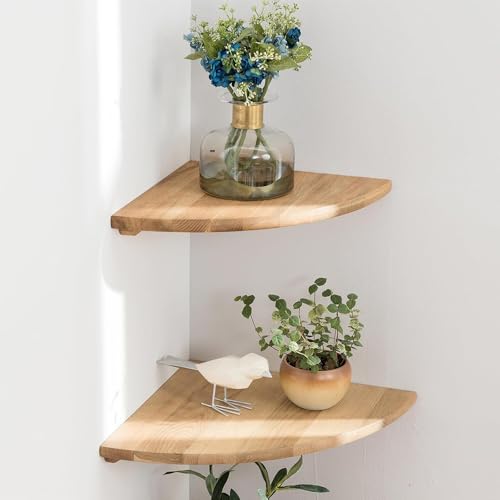
MUSONG Solid Wood Corner Floating Shelves, Set of 2
ASIN B0GXPSRYV5 • $30.66 • Sold by MUSONG-AU on Amazon AU
The MUSONG set is two corner shelves designed for a 90-degree corner, in solid wood finished with a clear wood oil. It's sold by MUSONG-AU, an Australian storefront that passed my retail check, and ranks #49 in Bookcases on Amazon AU. A corner is a good place for a floating shelf in a small room, because it uses wall that's usually empty and puts two walls behind the shelf rather than one. The listing gives its size as 18 x 3.8cm, which I read as 18cm along each wall and 3.8cm thick. MUSONG-AU is the brand's own Australian storefront. Rounded corners on the shelves are a sensible touch for a corner people walk past, where a square edge catches hips and shoulders.
The listing names a long list of surfaces it suits: concrete, wallpapered walls, lime plaster, painted walls, timber panels and doors. It also says it performs best on solid, stable walls, which is the honest bit. There's no load rating, and the listing doesn't describe the brackets or the fixings in the box. The oiled finish shows the grain and knots, so no two shelves look quite the same, and oil is easy to touch up if a shelf gets marked. It lists books, speakers, plants, lamps and vases as uses. Corner shelves are fixed to two walls, so the load is shared, which usually makes a small corner shelf sturdier than a straight shelf of the same size. The corner itself is also easy to level against, since the two walls guide it.
These suit a corner by a desk or a bed for a phone, a small plant or a smart speaker. In plasterboard, a corner often has a stud right behind it, which helps. With no stated load, keep it to light items. Re-oil the timber once a year. Skip the hollow door option. Measure the corner before you order, because a corner that isn't quite square leaves a gap at the back of the shelf. A smart speaker on a corner shelf also projects sound into the room well. Oiled timber marks if a wet glass sits on it. Wipe it and it'll be fine. Check the fixings every few months.
Honest caveats: No load rating is stated and the brackets and fixings aren't described. The size is given only as 18 x 3.8cm, so check the depth from the photos. Only suits a true 90-degree corner. Natural knots and grain vary between shelves. Doors are a poor surface for any shelf.
Best for: An empty room corner by a desk or bed for a phone, a plant or a small speaker.
Size: 18 x 3.8cm (as listed) • Load stated: Not stated • Material: Solid wood, clear wood oil • Fit: 90-degree corners • Surfaces listed: Concrete, plaster, panels, doors • Shelves: 2 • Overall rank: #22,638 on Amazon AU • Seller: MUSONG-AU • Rank: #49 in Bookcases (Amazon AU)
View on Amazon AUSide-by-side comparison
| Product | Price | Best for |
|---|---|---|
| DelSol Floating Shelves for Wall Wooden… | ~$27.90 | |
| MUSONG Wood Corner Floating Shelves Set of… | ~$30.66 | |
| cerbass 3 Pack White Wood Floating Shelves… | ~$42.99 | |
| DelSol 91.5 cm Large Floating Shelves for… | ~$51.43 | |
| 2-Pack Floating Wall Shelves | ~$55.99 | |
| Takara Set of 3 Seiso Floating Wall Shelves | ~$119.95 |
What we see fail in the workshop: shelf drops
We don't repair shelves, but we see what falls off them: routers, tablets, phones, speakers and the odd laptop. The shelf nearly always gave a warning first, and the device damage nearly always follows one of three patterns. Here's what to look for on the wall and what happens to the electronics when it lets go, so you can catch it before the shelf takes a device to the floor.
Brackets pulling out of plasterboard
The usual story is a shelf fixed with plain plastic plugs into plasterboard and loaded over time until the top of the bracket pulls away. The paint cracks in a line above the shelf weeks before it drops. If you see that crack, unload the shelf and refix into a stud or metal plasterboard anchors. A router or speaker that comes down with it often survives; a tablet landing on its corner usually doesn't. Metal anchors cost a few dollars more and are worth it.
Routers cooking on crowded shelves
A router squeezed onto a short shelf between books, or pushed up under the ceiling, runs hotter than it should all day, every day. Over a year or two that heat dries out its power supply and it starts dropping out or rebooting. Give a router air on all sides and keep it off a shelf in direct sun. If it's rebooting on its own, try a cooler spot before you replace it. Dust in its vents makes the heat worse, so blow it out now and then.
Phones and tablets off the edge
Phones on charge on a narrow shelf get pulled off by their own cable when someone walks past, and vibration from a speaker walks small things to the edge. A corner drop cracks the glass and can crack the screen underneath. Run cables down the wall rather than across the front of the shelf, use a rail or a deeper shelf for devices, and check a dropped phone's screen and charging before assuming it's fine. A case with raised corners takes a lot of the shock out of a shelf drop.
Decision tree: which one should you actually buy?
- Want the load stated for your wall type? → The Takara Seiso set rates each 90cm shelf at 5kg on plasterboard and 10kg on brick.
- Just want a few small shelves that sell well? → The cerbass three-pack lists 40 x 15 x 3cm shelves at up to 12kg each.
- Want a long run of solid timber? → The DelSol large set gives three 91.5cm paulownia shelves, but states no load rating.
- Shelving a bathroom or laundry? → The DelSol guardrail set has a metal rail along the front to stop bottles sliding off.
- Got an empty corner by a desk or bed? → The MUSONG set is two oiled solid wood shelves for a 90-degree corner.
- Phone or tablet came off a shelf? → Check the screen and that it still charges, then bring it into our Erina workshop and we'll tell you what it needs before you spend anything.
Frequently asked questions
How much weight can a floating shelf hold?
It depends on the shelf, the bracket and above all the wall and fixings, and many listings don't give a figure. Of the five picks, the Takara set rates each shelf at 5kg on plasterboard and 10kg on brick, and the cerbass set states up to 12kg per shelf without saying which wall. The DelSol and MUSONG listings give no rating. Fix into a stud where you can, keep heavy items at the back, and treat any stated rating as a ceiling.
Can floating shelves go on plasterboard?
Yes, but plasterboard alone holds far less than a stud or brick. Find the studs with a detector, usually at 450mm or 600mm centres, and get at least one screw per bracket into one if you can. Where you can't, use proper plasterboard anchors such as spring toggles or metal self-drilling anchors rather than the plain plastic plugs in the box, which tend to spin or pull through. The Takara listing's lower plasterboard rating shows how much the wall matters.
How do I avoid drilling into a cable?
Power cables in Australian walls usually run straight up or down from power points and switches, so avoid the wall directly above and below them. Run a stud and cable detector over the spot before you drill and move the shelf if it finds anything. Keep clear of the wall behind sinks, basins and toilets, where pipes run. If the dust turns dark or the bit grabs suddenly, stop. A damaged cable is a job for a licensed electrician.
Why is my floating shelf sagging?
Usually the bracket's rods have bent under the load, the holes in the shelf have worn oval, or the bracket is pulling away from the wall at the top. Look for a gap at the top of the bracket or a crack in the paint above it, which means the fixing is going. Take the load off, refix into a stud or better anchors, and move heavy items to the back of the shelf. A soft board like paulownia wears pin holes faster than dense timber.
Can I put my router on a floating shelf?
Usually it's a good spot, since a router up off the floor and out in the open tends to cover a home better than one in a cabinet. Pick a shelf deep enough that the router sits fully on it with space around it for air, and keep it out of direct sun and away from the ceiling, where heat builds up. Of the five picks, the 23.5cm deep Takara shelves suit a router best. Run the power and network cables down the wall neatly.
Are floating shelves safe for books?
On a properly fixed shelf with a stated rating, yes, within limits. A row of paperbacks 30cm long usually weighs somewhere around 4 to 6kg, and hardbacks much more, so a shelf rated at 5kg on plasterboard is really for display. For a run of books, choose a deeper shelf fixed into studs or brick, keep the books pushed back against the wall, and check the front edge for droop after a couple of weeks. Shallow 15cm shelves suit paperbacks better than hardbacks.
Related buying guides
Phone or tablet come off a shelf?
Shelves drop devices onto hard floors corner first, and that's how screens and the glass over them crack. If a phone or tablet has a cracked screen, a dead spot or won't charge after a fall, bring it into our Erina workshop. We'll check the screen and the board and tell you what it needs before you spend anything.
Visit our Erina workshop Book Online