Prices from Amazon AU, updated daily. Swipe or use the arrows for more.
Disclosure: This article contains affiliate links to amazon.com.au. If you buy through one of these links iFix may earn a small commission at no extra cost to you. It doesn't change which products we recommend. We focus on what actually lasts based on 16 years of repair-shop experience.
Quick summary8 picks
- CheapestHeated Throw Blanket 130×160cm about$30.51
- GOTCOZY Electric Blanket 130x160cm-Faux Fur… about$47.99
- Dreamaker Linea Striped Heated Throw about$74.94
- GOTCOZY Electric Blanket 130x160cm-Soft… about$59.98
- Sunbeam Feel Perfect Sherpa Fleece Heated… about$83.00
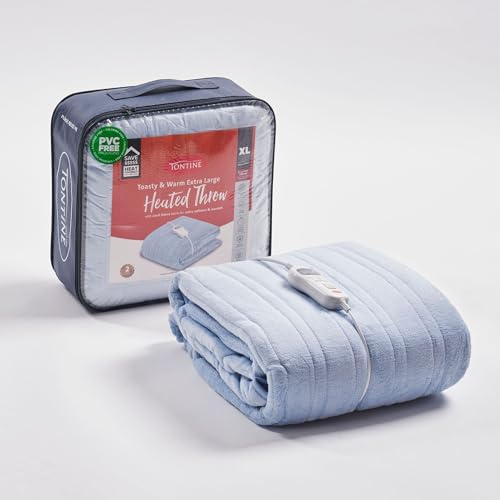
- Tontine Extra Large Coral Fleece Heated… about$86.43
- LINENOVA Electric Blanket Heated Throw… about$99.99120W.
- Most PremiumSunbeam Feel Perfect Faux Fur Heated Throw… about$139.00
Heat the person, not the room: the arithmetic
Here is the whole argument in three numbers. A 2,000W fan heater running flat out at the Australian average tariff of roughly 33c per kWh costs about 66c an hour. A 120W heated throw at the same tariff costs about 4c an hour. Over a four-hour evening on the couch that is $2.64 against 16c. Over a ninety-day winter of evenings it is roughly $238 against about $14. Those are my assumptions stated plainly: 33c/kWh, full power the whole time, no thermostat cycling. Your tariff will differ. The ratio will not.
The reason the gap is so large is physics, not marketing. A room heater has to warm every cubic metre of air in the room, and then keep warming it as it leaks out through single-glazed windows, under doors, and into the ceiling cavity. Most Central Coast houses I walk into were built for summer. They shed heat like a colander sheds water. A heated throw skips the room entirely and puts a low-wattage resistive element a few millimetres from your skin, under a layer of fleece that traps the warmth. You are heating perhaps a cubic metre of air, and most of that is trapped.
That does not make a throw a replacement for a heater. If three people are in the lounge, or you are moving about, or the room is cold enough that your face and hands ache, a throw will not fix that. It is a one-person solution for a seated person. But for the single most common Australian winter scenario, one or two people on the couch between dinner and bed, a throw at 120W does the job a 2,000W heater was doing, at a sixteenth of the power. If you want to confirm the draw on your own unit rather than take a listing's word for it, a plug-in meter from our smart energy monitor guide will show you watts in real time, and you will see the element cycling on and off as the controller holds temperature.
What is actually inside a heated throw
Strip the fleece off and a heated throw is simple. A thin insulated heating wire snakes back and forth through the blanket in a serpentine pattern, stitched into channels so it cannot bunch. That wire terminates at a small plug on the blanket edge. The detachable controller clips onto that plug and holds all the electronics: a transformer or switch-mode supply, a small microcontroller, a triac or relay to switch the element, and the buttons and display. The mains cord runs from the controller to the wall. Three parts, then: element, controller, cord. Each fails in its own way.
The element is the part people worry about and the part that fails least. Modern throws use a dual-conductor wire where a sensing conductor runs alongside the heating conductor inside the same sheath. If the sheath softens from a localised hot spot (a fold, a pet lying on it, a pillow piled on top), the two conductors touch and the controller cuts power. Sunbeam calls this Secure Sleep Protection on the TRF4200 and describes it as switching off on abnormal heat or current. The LINENOVA, GOTCOZY and Dreamaker listings all state overheat protection without describing the mechanism. Assume it is some version of the same idea and do not rely on it as a reason to fold the throw while it is running.
The controller is the part that fails most. It lives on the floor beside the couch. It gets stepped on. The cord gets yanked from the blanket plug at an angle. The internal solder joints on the plug socket crack and the throw goes intermittent, working when you wiggle the connector and dying when you let go. That intermittent contact is also where heat builds, because a resistive joint under load is a tiny heater of its own. When a customer brings in a throw that smells hot at the controller end, that joint is where I look first, and I find it on roughly one in three. The good news is that the controller is the one part you can usually buy separately for the name brands. For the generic listings it is often a whole-unit replacement.
Fabric weight, gsm and why 130 by 160 is the usual size
Gsm is grams per square metre and it is the only honest way to compare how thick a throw will feel, because every listing calls its fabric soft, plush or luxurious. Of the four throws here, the listings give us 220gsm micro fleece with sherpa on the Sunbeam and 200gsm double-sided flannel fleece on the LINENOVA. The GOTCOZY and Dreamaker listings do not state a weight. Higher gsm means more fibre trapping more air, which means the same element warms you more and loses less to the room. It also means a heavier throw and a slower wash-and-dry.
Sherpa deserves a specific word. It is a raised, curly pile that looks like fleece from a sheep and it is very good at trapping warm air close to the body. It also pills, holds pet hair, and takes longer to dry. Three of the four here have sherpa on one face. If you have a dog that lives on the couch, the flat flannel face is the one you want facing up.
Size is oddly consistent. The GOTCOZY and LINENOVA are 130 by 160cm, the Dreamaker is 160 by 130cm, and the Sunbeam listing does not state a size. That is a single-person lap-and-shoulders throw, not a blanket for two, and not something to tuck under a mattress. If you want the bed-sized version of this hardware with fitted skirts and dual controllers, that is a different product and a different guide, and I have covered it in the electric blankets guide published alongside this one. The throw is for the couch, the recliner, the desk chair and the caravan.
Controllers, heat settings and auto-off timers
All four throws here have between six and nine heat settings. More settings are not more warmth. The maximum is set by the element wattage and the controller's cut-off temperature, which none of the four listings state. What more settings buy you is finer control near the low end, which is where you will run it for most of the evening. In the workshop, a throw on setting nine at the start and setting two after twenty minutes is the normal pattern. Anything that lets you settle on a low duty cycle is saving you power and stretching the life of the element.
The auto-off timer is a safety feature first and a convenience second. Falling asleep under a throw that keeps running all night is how you get a scorched patch on the fleece and a cracked element sheath. The Sunbeam gives you 1, 3 or 9 hours. The LINENOVA gives you a choice of nine hourly steps. The Dreamaker states a 3-hour auto-off and the GOTCOZY a fixed 10-hour shut-off. I prefer the short options. Set it to one hour, let it run out, press the button again if you want more. That habit means the throw is off before you are asleep.
Cord length matters more than it sounds. The LINENOVA states a 3.2m cord. The others do not state a length. A short cord means the controller dangles in mid-air between the couch and the wall, which is exactly how the plug socket on the blanket edge gets levered open. If the cord will not reach the wall with slack to spare, use a single extension lead, not a powerboard with a heater on it.
SAA, RCM and the marks that actually mean something in Australia
This is the section that matters most and the one most buying guides skip. In Australia, electrical equipment sold for household use needs to be certified to the relevant AS/NZS standard and carry the RCM (Regulatory Compliance Mark, the tick inside a triangle). Older stock and many listings refer to SAA approval, which is the historical name for the same certification pathway and still the term most Australians recognise. An electric blanket or throw is classed as a level 3, high-risk item under the Electrical Equipment Safety System (EESS), which means it needs a certificate of conformity registered before it can be legally sold here. That is not paperwork for its own sake. It means someone tested the element, the controller and the overheat cut-out to the Australian standard.
Now read the four listings with that in mind. The LINENOVA states it is tested to AU/NZ standards and is SAA, EMC and EESS certified. The GOTCOZY states SAA certified. The Sunbeam is a major Australian brand selling under its own name on Amazon AU, and its TRF4200 is the sort of product that has been sold through Australian department stores for years; the listing does not spell out the mark but the brand's presence in the Australian market is its own evidence. The Dreamaker listing says the throw is tested for Australian Standards, which is worth having on the page, but it does not name SAA or RCM or show a certificate.
That does not mean the Dreamaker is dangerous. A stated standard is a better start than a bare European mark. It means I cannot tell you from the listing that it was tested to the Australian standard, and for a product that sits on your lap with a mains element inside it, I would want to see the RCM on the controller or the tag before I ran it unattended. If you buy one, look for the tick in the triangle on the moulded controller or the sewn label. If it is there, fine. If it is not, that is useful information. The same logic applies to every no-name power brick that comes across my workshop counter: the absence of a mark is not proof of a fault, but it removes the evidence that anyone checked.
Washing, storage and making it last five winters
All four throws state they are machine washable. All four also expect you to detach the controller first, and the Sunbeam goes further by stating the elements are waterproof and fully immersible. Read that carefully. The blanket is washable. The controller is not. If the controller goes through a wash cycle it is finished, and I have had more than one brought in with the tell-tale white mineral crust on the board that says it went swimming. The plug socket on the blanket edge is also a water trap: after a wash, stand the throw with that edge down and let it drain before you dry it.
Wash cold or warm on a gentle cycle, no wringing, no tumble drying on high. Heat plus agitation is what cracks the wire insulation. Line dry flat or over two lines so the weight does not hang from one fold. Never plug it in to dry it faster. The element sheath has to be fully dry before it sees mains, because damp insulation plus 240V is how a throw trips the safety switch, or worse, does not.
Storage is where most of the damage I see actually happens. A throw folded tight into a cupboard for eight months develops permanent creases in the wire, and a creased wire is a wire with a stress point. The next winter it works for a fortnight and then the overheat cut-out starts tripping at random, because the damaged section runs hot. Roll it loosely instead of folding it. Store it in a dry spot, not the bottom of a wardrobe that backs onto an exterior brick wall, because the same condensation that corrodes a phone's logic board will green the pins on the blanket plug over a humid Central Coast summer. A quick look at those pins before the first use each year takes ten seconds.
What to check before you order, and what to do the day it arrives
- The mark. SAA or RCM stated on the listing, and the tick in the triangle on the product when it arrives. CE alone is not an Australian approval.
- Fabric weight. Look for a gsm figure. If the listing will not give you one, the fabric is probably the thinnest thing on the page.
- Timer options. At least one short auto-off (1 to 3 hours). A fixed 10-hour shut-off is better than nothing but it is not a habit-former.
- Controller and cord. Detachable controller, stated cord length, and a photo clear enough that you can see how the plug joins the blanket.
- Who is selling it. Sold and shipped by Amazon AU, or a third-party seller. Both are fine, but warranty claims on a third-party listing go through that seller, and a stated warranty term is worth more than an implied one.
- Washing instructions. Machine washable with the controller removed. If the listing is vague, assume hand wash only.
On the day it arrives: unroll it flat, plug it in, run it at full for ten minutes and feel the whole surface. Check the controller does not get warm at the plug socket. Then set the timer to one hour and forget about it. If anything is off, that is a return, not a project. I do not repair heated throws at the Erina workshop because a mains element sewn into fleece is not a board-level job, but I do see the controllers, and I see the powerboards that were feeding them, and I will happily tell you whether what you have is worth keeping. The throws below are the four I would put on my own couch, in the order I would buy them.
The four picks, $51 to $83
Prices are Amazon AU at time of writing (15 August 2026) and move week to week. Ranks are Amazon AU category sales ranks, checked the same day.

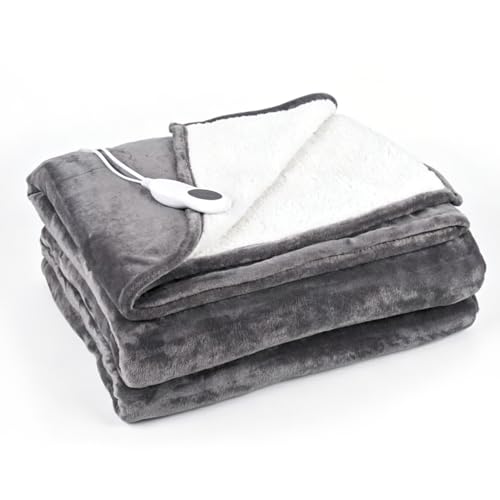
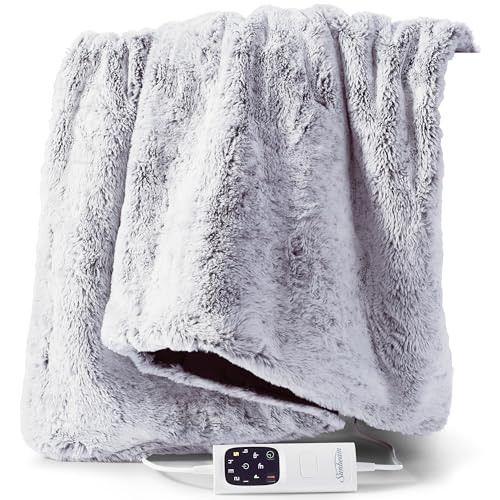
Sunbeam Feel Perfect Sherpa Fleece Heated Throw TRF4200, Grey
ASIN B08Z3KZYR2 • $83.00 • Ships from Amazon AU
The Sunbeam TRF4200 is the most expensive throw here at $83 at time of writing, and it is the one I would buy, for one reason above the others: Sunbeam is an Australian brand with a parts channel, and a heated throw is a product that fails at the controller. When the controller on a generic throw dies you bin the whole thing. When the controller on a Sunbeam dies you have a realistic path to a replacement. The rest of the specification is solid rather than spectacular. The listing gives 220gsm micro fleece with a sherpa face, six heat settings, and a stated 10-minute fast heat-up, which matches what I would expect from a throw in this wattage class.
The safety story is the other reason. Sunbeam's Secure Sleep Protection is described on the listing as an overheat mechanism that switches the throw off on abnormal heat or current, which is the dual-conductor sensing approach I described earlier, named and stated rather than implied. The auto-off timer gives you 1, 3 or 9 hours. That 1-hour option is the one I would use nightly. The controller is detachable, the elements are described as waterproof and fully immersible, and the throw is machine or hand washable. That immersible claim is a stronger statement than the other three listings make, and it tells me the element sheath and the blanket-side plug were designed with the wash in mind rather than tolerated.
It sits at #12 in Amazon AU's Bed Throws category, ahead of the Dreamaker and the LINENOVA. It is the dearest throw here and I understand the hesitation. Thirty dollars is real money. But across a three-to-five winter life the difference is about $8 a year, and what you are buying with it is a brand that will still exist when you need a controller, a stated overheat mechanism, and fabric weight that is in the upper half of this group. If you want one throw and do not want to think about it again, this is it.
Honest caveats: Size is not stated on the listing, so assume the usual single-person throw dimensions and check the current page before ordering. Power rating is not stated either. Six heat settings is the fewest in this group, which is fine in practice but worth knowing. Grey sherpa shows pet hair. The price is the highest here, and the gap is real if you only want a throw for one winter.
Best for: Anyone who wants a throw from a brand with an Australian parts channel and a named, stated overheat mechanism, and is happy to pay about $30 more for it.
Price: $83 at time of writing • Fabric: 220g/m2 micro fleece with sherpa face • Heat settings: 6 • Auto-off: 1, 3 or 9 hours • Heat-up: 10 minutes stated • Safety: Secure Sleep Protection overheat cut-out (abnormal heat or current) • Washing: Detachable controls, waterproof immersible elements, machine or hand wash • Size and power: Not stated on the listing • Rank: #12 in Bed Throws (Amazon AU)
View on Amazon AU
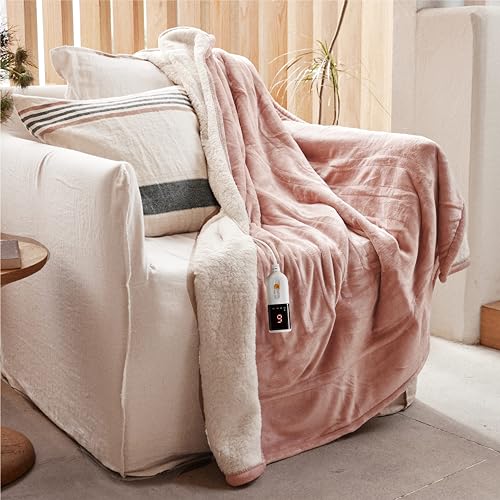
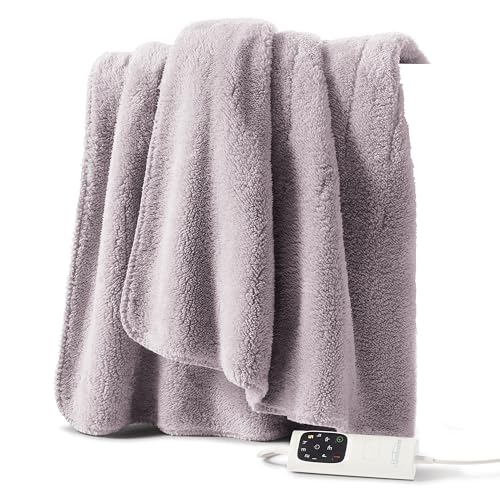
GOTCOZY Flannel Heated Throw 130x160cm, Pink
ASIN B0CR9WBJQM • $51.38 • Sold by Phoenix Home AU on Amazon AU
At $51.38 at time of writing the GOTCOZY is the lowest price in this group, and the reason it is here rather than one of the dozens of similar throws on Amazon AU is a single line on the listing: SAA certified. That is the line that separates a product someone has had tested to the Australian standard from one that has not, and at this end of the market it is the first thing I filter on. It is 130 by 160cm, silky plush on one face and sherpa on the other, with nine heat settings and overheat protection. The fabric weight is not stated, which usually means it is on the lighter side, and I would plan for that.
The controller is a single button that cycles through the nine settings. That is simple and it is also eight presses from high to low, so you will mostly pick a level and leave it. The auto shut-off is a fixed 10 hours. That is a long time. It will stop the throw running for a whole day if you forget it, but it will not stop it running through the night, so the habit of switching it off yourself matters more on this throw than on the Sunbeam or LINENOVA with their short timer options. Machine washable with the controls removed, which is the standard instruction and the one to follow.
It ranks #13 in Amazon AU's Blankets, Throws and Patchwork Quilts category, which is a broader category than Bed Throws and so not directly comparable with the other three. It is sold by a third-party seller (Phoenix Home AU) on Amazon AU, so warranty goes through them. For a first heated throw, a spare for the guest room, or a throw for a teenager's desk, it does the job at the lowest outlay here, and it has the mark that matters. Just set your expectations on fabric weight, and switch it off yourself rather than leaning on the timer.
Honest caveats: No fabric weight, no power rating and no cord length are stated on the listing. The only auto-off is a fixed 10 hours with no short option. One-button control is slow to step down. Pink is the colour listed; check the current page for others. Third-party seller, so warranty and returns go through Phoenix Home AU rather than Amazon directly.
Best for: A first or spare heated throw where SAA certification at the lowest outlay matters more than fabric weight or timer flexibility.
Price: $51.38 at time of writing • Size: 130 x 160cm • Fabric: Silky plush one side, sherpa the other (weight not stated) • Heat settings: 9, single button • Auto-off: Fixed 10 hours • Safety: Overheat protection, SAA certified • Washing: Machine washable with controls removed • Seller: Phoenix Home AU on Amazon AU • Rank: #13 in Blankets, Throws & Patchwork Quilts (Amazon AU)
View on Amazon AU
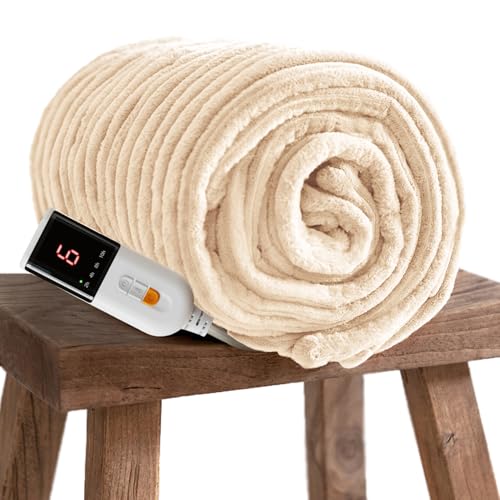
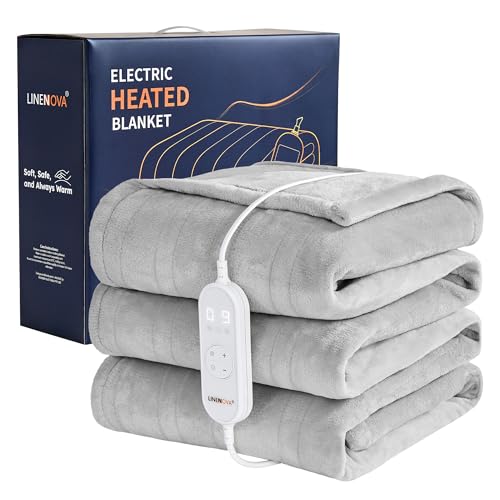
LINENOVA Flannel Fleece Heated Throw 130x160cm
ASIN B0GLMKFV4D • $64.99 • Sold by NOVOBAY on Amazon AU
The LINENOVA is the throw whose listing reads like someone who understood the product wrote it. At $64.99 at time of writing it states the power rating (120W), the cord length (3.2m), the fabric weight (200gsm double-sided flannel fleece), the certifications (tested to AU/NZ standards, SAA, EMC and EESS), and the timer options (1 to 9 hours). Every question I would ask is answered on the page. The listing also makes the same claim this whole article makes, that 120W is roughly one twentieth of a traditional electric heater, and on a 2,400W heater that arithmetic is right. It is also the only listing of the four that gives me a wattage I can hold the seller to, which matters when the whole case for a throw rests on that number.
Nine heat settings and nine timer options give you the finest control in the group, and the 1-hour timer option is the one I want. The 3.2m cord is the only stated cord length here and it is a good one: long enough to reach a wall socket from the middle of most lounges without an extension lead, which means the controller sits on the floor with slack in the cord rather than hanging off the blanket plug. That single detail probably does more for the lifespan of the plug socket than anything else on the specification sheet. Double-sided flannel means no sherpa face to pill or hold hair, and 200gsm is a reasonable middle weight.
It ranks #14 in Amazon AU's Bed Throws category, just behind the Sunbeam, and is sold by a third-party seller (NOVOBAY) on Amazon AU. What you give up against the Sunbeam is the brand's parts channel and the named overheat mechanism. What you gain is about $18, a stated 120W figure you can hold the listing to, the longest stated cord, and EESS certification spelled out. If the Sunbeam is the one I would buy for myself, this is the one I would tell a friend on a tighter budget to buy.
Honest caveats: Third-party seller, so warranty claims go through NOVOBAY. The overheat protection is stated but not described, so there is no way to know from the listing how it works. 200gsm is the lightest stated weight here. No warranty term is listed. Colour options are not stated in the data I have, so check the current page.
Best for: Anyone who wants the stated 120W rating, a long cord, a 1-hour timer and Australian certification spelled out, for under $65.
Price: $64.99 at time of writing • Power: 120W stated • Size: 130 x 160cm • Fabric: 200gsm double-sided flannel fleece • Heat settings: 9, with 9 timer options • Auto-off: 1 to 9 hours • Cord: 3.2m • Safety: Tested to AU/NZ standards; SAA, EMC and EESS certified; overheat protection • Rank: #14 in Bed Throws (Amazon AU)
View on Amazon AU
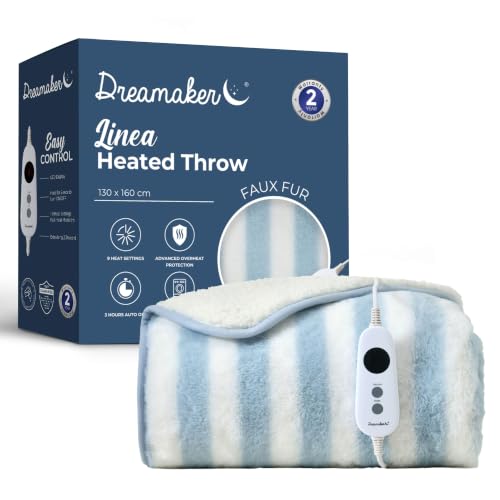
Dreamaker Linea Striped Electric Heated Throw 160x130cm, Blue
ASIN B0GRG8SX5T • $74.94 • Sold by Time2Shopau on Amazon AU
The Dreamaker Linea is the style pick of this group, and it costs $74.94 at time of writing. It sits at #463 in Amazon AU's Bed Throws category, sold by Time2Shopau on Amazon AU. The listing gives 160 by 130cm, striped faux fur on one face and sherpa fleece on the reverse, nine heat settings (a fast heat setting, then levels 1 to 8 on a single button), a 3-hour auto-off and overheat protection. The stripe is the headline, and the sherpa reverse is what you will feel against your legs. It is the one to look at if the throw lives on a sofa where people see it.
The reason it is fourth and not first is the certification line. Under a safety heading the listing says the throw is tested for Australian Standards, which is a claim worth having on the page. It does not name SAA or RCM, though, and it does not say who tested it or show a certificate. A sentence is not a mark. For a mains element that sits on your lap, I want to see the Australian mark either stated on the page or on the controller when it arrives. It may well be there. I cannot tell you that from the listing, and that is the point of this whole guide: buy on what is stated, not on what is probably fine.
If you buy it, the day-one check is simple. Find the tick in the triangle on the controller or the sewn label. If it is there, you have a good-looking reversible throw with a stated machine-wash instruction, and I would be happy with it. If it is not, you have a decision. Faux fur and sherpa both trap warm air well and both hold pet hair, so if a dog lives on the couch, keep the sherpa side up or the throw off the dog's side of the sofa. The 3-hour auto-off is shorter than the GOTCOZY's fixed 10 hours, which suits an evening on the couch and means it will not run all night. Machine washable, controller removed, as always.
Honest caveats: SAA and RCM are not named on the listing; "tested for Australian Standards" is a claim, not a mark. Fabric weight, power rating, cord length and warranty term are not stated. The auto-off is 3 hours, so it cannot be left to run overnight. Sold by a third-party seller (Time2Shopau), so any warranty claim goes through them.
Best for: <strong>Best for:</strong> Someone who wants a reversible striped faux fur and sherpa throw with a stated 3-hour auto-off, and is willing to confirm the mark on the controller on arrival before relying on it.
Price: $74.94 at time of writing • Size: 160 x 130cm • Fabric: Striped faux fur one side, sherpa fleece the other (weight not stated) • Heat settings: 9, single button • Auto-off: 3 hours • Safety: Overheat protection; "tested for Australian Standards" (SAA/RCM not named) • Washing: Machine washable, controller detached • Rank: #463 in Bed Throws (Amazon AU)
View on Amazon AUSide-by-side comparison
What we see fail in the workshop: heated throws
A heated throw has three parts that can fail: the controller, the cord and plug, and the element sewn into the fleece. After 16 years in the workshop in Erina I can tell you the order they go in, and it is not the order people expect. The element is last. The controller and the joint where the cord meets the blanket are first, and most of that damage is done by the way the throw is used and stored, not by a defect.
The blanket-side plug and the cracked solder joint
The plug on the blanket edge is a small moulded socket with pins soldered to a tiny board or crimped to the element wires. The controller cord hangs off it at an angle every night. Over a winter the pins work loose or the solder cracks, and you get an intermittent throw that works when you jiggle the connector. The danger is not the loss of heat. It is that a loose joint under load is resistive, it gets hot, and it softens the plastic around it. A controller end that is warm to the touch, or a plug that smells hot, is the sign. A cord that reaches the wall with slack, like the LINENOVA's stated 3.2m, is the main defence.
Controllers that went through the wash
Every listing here says machine washable with the controller removed, and every winter a few controllers go through anyway. A switch-mode supply and a microcontroller do not survive a wash cycle. I see the white mineral crust on the board and the green corrosion on the button contacts, and even if the unit dries out and appears to work, the corrosion keeps going and it fails weeks later. Sometimes it fails on, which is worse than failing off. If a controller has been wet, retire it. For a Sunbeam there is a realistic path to a replacement controller. For a generic throw it is a new throw, and the cost of that is the reason the brand premium is not as large as it looks.
Creased elements from folded storage
The element wire is fine, insulated and flexible, but it is not meant to be creased hard and left that way for eight months. A throw folded tight into a cupboard develops permanent kinks, and a kinked wire has a stress point where the conductor thins and the sheath is strained. The next winter it runs for a fortnight and the overheat cut-out starts tripping, because that section runs hot. Sometimes you feel it first as a warm stripe. Roll the throw loosely, store it dry, and before the first use of the season lay it flat, run it at full for ten minutes and feel across it for hot or cold stripes. Either one is a reason to stop using it, not a reason to keep going until it fails properly.
Decision tree: which one should you actually buy?
- I want one throw, I do not want to think about it again, and $30 extra does not bother me? → The Sunbeam Feel Perfect TRF4200 at $83. Australian brand, stated overheat mechanism, 1-hour timer, and a realistic path to a replacement controller when it eventually dies.
- I want the lowest price that still states an Australian safety mark? → The GOTCOZY at $51.38. SAA stated on the listing, nine settings, overheat protection. Accept the fixed 10-hour auto-off and a fabric weight that is not stated.
- I want a stated 120W rating, a long cord and every spec spelled out, under $65? → The LINENOVA at $64.99. 120W, 3.2m cord, 200gsm, 1 to 9 hour timer, SAA and EESS spelled out on the page. The best value of the four.
- I want a reversible striped faux fur and sherpa throw and I am happy to check the mark myself on arrival? → The Dreamaker Linea at $74.94. Nine settings, a 3-hour auto-off and a stated Australian Standards line. Confirm the tick in the triangle on the controller before relying on it unattended.
- I am heating a whole room with two or three people in it, not one person on the couch? → A throw is the wrong tool. See the oil column heaters guide for the room-heating arithmetic, and keep the heater off the powerboard.
- My throw smells hot at the controller, goes intermittent, or has a warm stripe? → Stop using it. A mains element in fleece is not a board-level repair, but bring the controller and the powerboard it was on to our Erina workshop and I will tell you honestly whether anything is worth saving.
Frequently asked questions
How much does a heated throw cost to run in Australia?
Take the stated wattage, divide by 1,000, and multiply by your tariff. At the Australian average of roughly 33c per kWh, a 120W throw costs about 4c an hour at full power, and less once the controller is cycling the element to hold a set temperature. A four-hour evening is around 16c. Compare that with a 2,000W fan heater at about 66c an hour on the same tariff. Of the four throws in this guide only the LINENOVA states its wattage (120W), so for the others measure it with a plug-in energy monitor if you want the exact figure.
What does SAA certified mean and is CE good enough?
SAA is the historical name for Australian electrical safety approval, now formalised as the RCM (the tick inside a triangle) under the Electrical Equipment Safety System. Electric blankets and throws are classed as high-risk items and need a registered certificate of conformity to be legally sold here. CE, UKCA and GS are European and British marks. They show testing to those standards, not to the Australian one. A listing that only states CE has not told you the product was tested to AS/NZS requirements. Look for SAA or RCM on the listing, then look for the tick in the triangle on the controller or sewn label when it arrives.
Can I put a heated throw in the washing machine?
All four throws here state they are machine washable, and all four expect the controller to be detached first. The controller must never get wet. Wash cold or warm on a gentle cycle, do not wring it, and do not tumble dry on high, because heat plus agitation is what cracks the insulation on the element wire. Line dry flat or draped over two lines so the weight is spread. Let the blanket-side plug socket drain and dry completely. Never plug it in to speed up drying. Only reconnect the controller when the throw is fully dry to the touch everywhere, including inside the plug.
Is it safe to fall asleep under a heated throw?
Every throw here has an overheat cut-out and an auto-off timer, and the timer is the feature to lean on. Falling asleep under a throw running all night is how you end up with a scorched patch and a cracked element sheath, because a body lying still on a folded section traps heat in one spot. Set the shortest timer available (1 hour on the Sunbeam and LINENOVA, a fixed 3 hours on the Dreamaker) and let it switch itself off before you drift off. Never run a throw folded, never pile pillows or a pet on top while it is on, and never tuck it under a mattress.
Why did my heated throw stop working after one winter?
Nine times out of ten it is the controller or the plug on the blanket edge, not the heating element. The plug socket gets levered by a short cord hanging off it, the solder cracks and the throw goes intermittent. Or the controller got damp, or went through the wash, and the board corroded. The other common cause is folded storage, which creases the element wire and produces a hot section that trips the cut-out. If the throw is warm or smells hot at the controller end, or has a warm or cold stripe, stop using it. Sunbeam controllers can often be replaced; generic ones usually cannot.
Can I run a heated throw on a powerboard or extension lead?
A 120W throw on its own is a small load and an extension lead is fine if the cord will not reach. The rule I would give you is about what else is on that powerboard. A 2,000W heater takes nearly all of a standard 10A socket's 2,400W capacity, and a heater plus a throw plus a TV on one powerboard is how boards melt. Keep heaters on their own wall socket. Put the throw wherever is convenient, but use one lead, not a chain of them, and make sure the controller sits on the floor with slack rather than hanging off the blanket plug.
Related buying guides
Controller running hot, throw gone intermittent, or not sure about that powerboard?
A heated throw fails at the controller and the plug long before the element gives out, and a warm connector is a warning, not a quirk. Bring the controller, the cord and the powerboard it was feeding from into our Erina workshop and I will tell you straight whether it is worth keeping. Sixteen years of board-level work on the Central Coast means I know what a corroded or heat-stressed joint looks like before it becomes a problem.
Visit our Erina workshop Book Online