Prices from Amazon AU, updated daily. Swipe or use the arrows for more.
Disclosure: This article contains affiliate links to amazon.com.au. If you buy through one of these links iFix may earn a small commission at no extra cost to you. It doesn't change which products we recommend. We focus on what actually lasts based on 16 years of repair-shop experience.
Quick summary7 picks
- Entry PickRossi MAG120 Mk III 120A Inverter Welder about$178
- YESWELDER 205Amp Stick Welder about$180
- YESWELDER 135A Gasless Flux Core MIG Welder… about$186
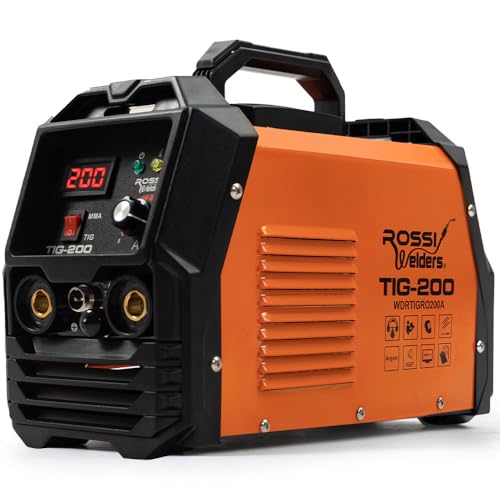
- Rossi TIG MMA 200A Welder about$265
- YESWELDER 200A TIG Welder with Pulse about$340
- YESWELDER 185A MIG Welder 240V about$400
- Most PremiumYESWELDER 250A Aluminum MIG Welder 240V about$500
MIG, TIG or stick: which kind you actually need
Most people buying their first welder want to fix a trailer, a gate, a farm implement or a ute tray, and for that a MIG welder is usually the right tool. MIG feeds a wire through the torch that melts into the joint, so you pull the trigger and weld, and it's the easiest process to learn. Gasless MIG uses a flux-cored wire that shields itself, so there's no gas bottle to buy or refill, and it copes better with a breeze outdoors.
Gas MIG uses solid wire and a bottle of shielding gas, and it gives cleaner, neater welds with less spatter on thinner steel. The YESWELDER 185A and 250A here can do both, so you can start gasless and add a gas bottle later if you get serious. The trade is that gas costs money, the bottle has to be rented or bought, and a gust of wind outdoors blows the gas away and leaves a porous weld.
Stick welding, or MMA, uses a flux-coated rod and clamps onto the job with no wire feed at all. It's the most forgiving process on rusty or dirty farm steel and it works outdoors in wind, but it's harder to learn and slower to clean up. All five picks can stick weld as one of their modes, so you're never stuck if the wire feed plays up or you need to weld something thick and grubby out in a paddock.
TIG is the fine work: thin stainless, neat visible welds and, with an AC machine, aluminium. It's the hardest to learn, needs gas, and is slow, so it isn't where I'd start most people. The YESWELDER 200A here is a DC pulse TIG, which means steel and stainless but not aluminium, and its listing says so plainly. If aluminium's the main job, a MIG with a spool gun or an AC TIG is the way, and both cost more than the steel-only options.
The 10A or 15A plug question
This is the part most listings bury and the one that catches people out at home. A standard Australian power point is 10A. A 15A plug has a wider earth pin and physically won't go into a 10A socket, and that's on purpose, because the welder can draw more current than a 10A circuit is built for. Four of the five picks here state a 15A plug on the listing, so check you've got a 15A outlet in the shed or garage before you order one.
If you don't have one, the fix is a licensed electrician fitting a 15A outlet on a suitable circuit, which isn't usually a big job. What you shouldn't do is cut the plug off, file the earth pin or use an adaptor to jam a 15A plug into a 10A socket. That's exactly how leads, plugs and wiring overheat, and it's illegal in Australia for good reason. The same goes for long, thin extension leads: use a 15A lead rated for the job, fully unrolled.
Duty cycle, the spec most listings leave out
Duty cycle is how long a welder can weld out of a 10 minute period before it has to stop and cool down, at a given current. A 60 percent duty cycle at 100A means six minutes of welding and four minutes of rest at that setting. Turn the current up and the duty cycle drops, turn it down and it rises. It's the honest measure of how hard a machine can work, and it's the number most listings on Amazon AU leave out or give without the current it applies to.
Of the five picks, only the YESWELDER 135A gasless MIG states a duty cycle at all, and it gives 60 percent at room temperature without saying at what current. On a 35 degree day in a tin shed that figure will be lower, because duty cycle ratings are usually measured at a cooler temperature than a Central Coast summer. When a welder hits its limit, the thermal protection stops it and you wait, which is annoying but far better than cooking the electronics.
For home and farm repair work, duty cycle matters less than people think, because you rarely weld for more than a minute or two without stopping to chip, grind or reposition. It matters a lot if you're running long seams on a trailer or fabricating gates all day. If the listing doesn't state it, check the manual on the brand's website before you buy, and expect a smaller machine to stop more often on long runs at full current.
What an inverter actually changes
Old transformer welders were big lumps of copper and iron that weighed 30 or 40 kilos. An inverter welder uses power electronics to switch the mains at high frequency, so the transformer inside can be tiny, which is why every pick here with a stated weight comes in between about 4.8 and 9.5kg. They're also smoother to weld with and easier on power than an old transformer box. The catch is that they're full of circuit boards, fans and switching parts, and those fail in different ways from the old machines.
The heart of most of these is a set of IGBT switching transistors on a heatsink, cooled by a fan pulling air through the case. That airflow is the weak point. Welding shops and sheds are full of grinding dust, and grinding dust is steel, so it's conductive. Over time it builds up on the boards and heatsink, and it can short components or stop heat getting out. Most dead inverter welders I'd look at have a story that includes a grinder used right next to the machine.
Inverters also don't love dirty power. Several of these listings mention automatic compensation for voltage fluctuation, which helps on a long lead or a weak supply. Running one from an inverter generator is generally fine if the generator is big enough and gives clean output, but check the welder's manual for a minimum generator size, because a small open-frame generator can trip or upset the welder's electronics.
Running cost and the power you'll draw
A welder's running cost is small next to its consumables. If a welder on a 15A plug pulled the full 15A at 240V, that's 3,600W, and at the AU average tariff of roughly 33c per kWh it would cost about $1.19 for an hour of continuous welding. Nobody welds continuously for an hour on a machine like these, and the listings don't state actual input power, so real power costs are usually well under a dollar for a session.
The real running costs are wire, gas, rods, contact tips and nozzles. Gasless flux-core wire costs more per kilo than solid wire, but there's no gas bottle. A gas bottle has either a rental fee or a purchase price plus refills, and that's where gas MIG gets expensive for occasional users. Contact tips and nozzles wear and spatter up, so buy a few spares in the right size for the torch when you buy the welder, rather than finding out on a Sunday that you've run out.
Safety gear and where you weld
Budget for safety gear on top of the welder, because some of these listings include basic kit and some don't. An auto-darkening helmet, leather welding gloves, a long-sleeved cotton or wool shirt and leather boots are the minimum. Synthetic clothing can melt from spatter. Keep a fire extinguisher nearby, clear away rags, sawdust and anything flammable, and check the area for smouldering spatter for a while after you finish, especially in a shed full of timber offcuts from a mitre saw.
Weld somewhere with good airflow and keep your head out of the smoke plume, and never weld on galvanised steel, painted metal or anything that's held fuel or chemicals without proper preparation. Keep kids and pets well back, because the arc flash can hurt anyone looking at it without a helmet, even from across the yard. And keep the welder itself away from the grinder, both for the dust reason above and so sparks don't land on its cables or vents.
Look after the cables. The earth clamp and torch cable get dragged across steel, stood on and dropped, and a cracked lead or a loose earth clamp is a common reason for a welder that seems to have lost power. Clamp the earth close to the weld on clean bare metal, and check the torch and earth cables for cuts or hot spots before each job. A poor earth also makes the welder work harder for a worse weld.
What wears out and how to make it last
On a MIG welder, the wire feed is the part that needs the most attention. The drive rollers have grooves for each wire size and type, and the wrong roller, or a roller worn smooth, makes the wire slip and stutter. The liner inside the torch cable wears and fills with debris, and a kinked or dirty liner is the usual reason wire feeds badly. Blow the liner out when you change wire, keep the cable as straight as you can, and swap contact tips as they wear.
Inside the case, keep the fan and vents clear. Every few months, with the welder unplugged and left for a while so any capacitors can discharge, blow the dust out with dry compressed air from a distance, and keep the welder on a bench above floor level rather than down in the grinding dust. Store it somewhere dry. Moisture and conductive dust on the boards are a bad mix, and a damp shed over winter is a common way to corrode connectors and contacts.
When an inverter welder does fail, it's often a power supply part, a failed fan, a cooked switching device or a burnt connector, and some of those are worth fixing on a good machine. Opening one is not a casual job though, because there are high voltages on the boards even after it's unplugged. If yours trips the breaker, won't power up or smells hot, stop using it and get it looked at by someone who does electronics repairs on the Central Coast or power tool repairs rather than poking around inside it.
How I picked these five
I searched Amazon AU for MIG, TIG, stick and inverter welders between about $150 and $900, kept new listings from Amazon AU or Australian storefronts, and sorted by sales rank. Then I dropped anything whose listing didn't confirm it was built for Australian power. Several popular listings state 220V or 230V and don't mention a plug at all, and a couple of others had no plug or voltage information, so they're out even though some rank well.
Four of the five picks are from YESWELDER, sold through its Australian storefront, because its listings were the only ones in range that stated 240V and a 15A plug outright. The fifth is the Rossi MAG120 Mk III, which Amazon AU sells itself and which lists C-Tick approval, the older Australian and New Zealand compliance mark. That's how the supply looks on the day, not a claim that YESWELDER is better than the big Australian trade brands, most of which weren't sold new by Amazon AU when I checked.
Three YESWELDER MIG listings share one sales rank across the whole Amazon AU site, so their category ranks look closer together than their real sales probably are, and I've noted that on each card. The YESWELDER 200A TIG has the best category rank here at #6 in TIG Welding Equipment. Prices run from $178 to $500 at time of writing, and I've kept to what each listing states rather than guessing at duty cycles or capacities they don't give.
If you're setting up a home workshop, a welder sits alongside a decent mechanic's tool kit and an angle grinder as the tools that let you fix rather than replace. And if your welder stops working after the warranty, whether it's a dead fan, a burnt connector or a machine that trips the power, bring it to our Erina workshop and we'll tell you whether it's worth fixing before you spend anything.
The 5 picks, $178 to $500
Prices are Amazon AU at time of writing (6 November 2026) and move week to week. Ranks are Amazon AU category sales ranks, checked the same day.

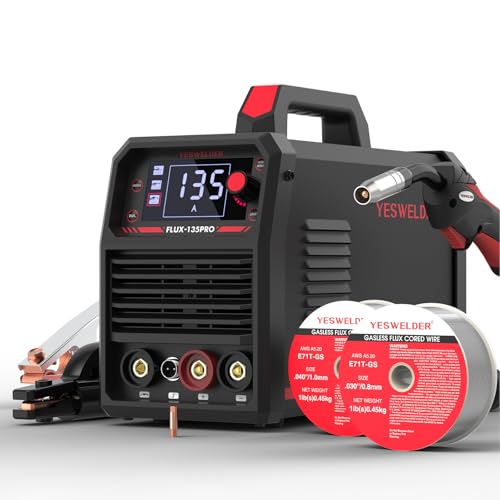
YESWELDER 135A Gasless Flux Core MIG Welder 240V with 2 Spools of Wire
ASIN B0FGX5YYJT • $185.99 • Sold by YESWELDER-AU on Amazon AU
The YESWELDER 135A gasless MIG is the welder I'd point most first-time buyers to, and it's #26 in Amazon AU's Power Welders category at time of writing. That rank is shared with YESWELDER's other MIG listings, so treat it as the family's rank rather than this model's alone. It's $186, sold by YESWELDER's Australian storefront. The part number FLUX-135-PRO matches the title. It runs on 240V with a 15A plug, and it comes with two spools of flux-cored welding wire, so you can start straight out of the box once you've got a 15A outlet and safety gear. It's a three-in-one machine covering gasless MIG, stick and lift TIG, and it's the least expensive YESWELDER pick.
It's the only pick that states a duty cycle at all, 60 percent at room temperature, though the listing doesn't say at what current. It takes 0.8mm and 1.0mm flux-cored wire on small 2lb spools, and the listing gives wire feed speed ranges for both. Synergic control means you set the wire speed for the job and it matches the voltage for you, with manual fine-tuning of plus or minus 3V once you know what you're doing. Stick mode has adjustable arc force and hot start, and there's a built-in VRD, a voltage reduction device that lowers the voltage at the rod when you're not welding. It weighs 5.2kg.
Lift TIG needs a separate torch the listing says isn't included. It's gasless only, so the welds need more cleanup than gas MIG, and it takes small spools rather than the bigger 5kg rolls. Keep spare contact tips in 0.8mm and 1.0mm. Blow the dust out of its vents every few months. Clamp the earth on clean bare metal close to the weld. Store the wire spools sealed and dry, because flux-core wire picks up moisture and welds worse. Check the torch cable for cuts before each job. For trailer repairs, gates and farm fixes on a first welder, it's the one I'd buy.
Honest caveats: Honest caveats: it needs a 15A outlet, so it won't plug into a normal 10A power point. The 60 percent duty cycle has no current attached, so it's hard to compare. It's gasless only, with no gas MIG option. The rank is shared with other YESWELDER MIG listings. A lift TIG torch costs extra.
Best for: A first welder for trailer, gate and farm repairs, with no gas bottle to buy.
Processes: Gasless MIG, stick, lift TIG (torch extra) • Output: Up to 135A • Duty cycle: 60% at room temperature (current not stated) • Wire: 0.8mm and 1.0mm flux core, 2lb spools • Power: 240V, 15A plug • Extras: VRD, arc force, hot start, 2 spools of wire • Weight: 5.2kg • Seller: YESWELDER-AU • Rank: #26 in Power Welders (Amazon AU), listing shared
View on Amazon AU
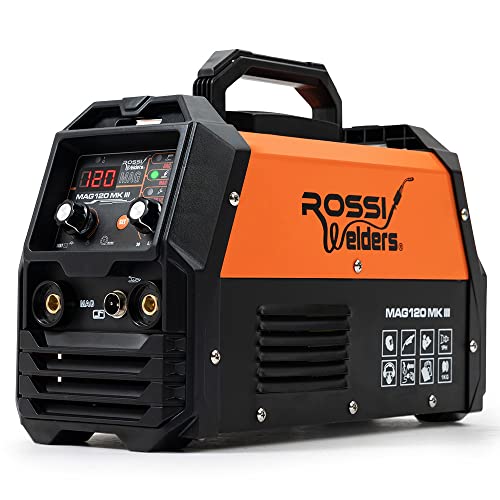
Rossi MAG120 Mk III 120A Inverter Welder
ASIN B0BZ3NDSKZ • $178.00 • Ships from Amazon AU
The Rossi MAG120 Mk III is the least expensive pick at $178, and it's the only one sold by Amazon AU itself. It's #105 in Amazon AU's Power Welders category at time of writing. The model code MAG120 MK III matches the title. Rossi is a brand sold through Edisons, an Australian company that also sells it through its own EdisonsDirect store, and the listing states RoHS and C-Tick approval, the older Australian and New Zealand compliance mark. It's a small gasless machine that does flux-core MIG with an automatic wire feed, plus stick welding with rods. It also ranks #144,649 across the whole Amazon AU site, the weakest overall figure here.
The listing gives a current range of 35 to 120A, the lowest top end of the five, with a lift arc start that it says avoids high-frequency interference near sensitive equipment. It lists IGBT inverter technology and a pure copper toroidal transformer, plus automatic overload and overheat protection. It weighs about 5kg, the listing's own figure, and comes with a carry strap, which makes it the easiest pick to throw in the ute and take to a fence or a gate. The listing claims it welds from 0.5mm up to 12mm thick, which I'd read as best case with stick rods and several passes rather than a single MIG pass.
The listing doesn't state a plug rating, duty cycle or warranty, so check those on the current listing before you order. It's gasless only, so there's no gas MIG upgrade path later on. Keep it out of grinding dust and blow the vents out every few months. Buy spare contact tips with it. Store flux-core wire sealed and dry between jobs. Clamp the earth on clean bare metal near the weld. Read the manual's settings chart before the first weld, because it's quicker than guessing. For light repairs on a small spend from an Amazon AU listing, it's the one I'd buy.
Honest caveats: Honest caveats: the listing doesn't say whether it has a 10A or 15A plug, so confirm that before you buy. At 120A maximum it's the least capable here on thicker steel. Duty cycle and warranty aren't stated. It has the weakest overall Amazon AU rank of the five. There's no gas MIG or TIG mode.
Best for: Light gate, fence and bracket repairs on the smallest spend, from an Amazon AU listing.
Processes: Gasless MIG (flux core), stick • Output: 35 to 120A • Start: Lift arc • Compliance: RoHS, C-Tick (listing) • Power: Plug rating not stated • Weight: About 5kg, carry strap • Seller: Amazon AU • Rank: #105 in Power Welders (Amazon AU)
View on Amazon AU
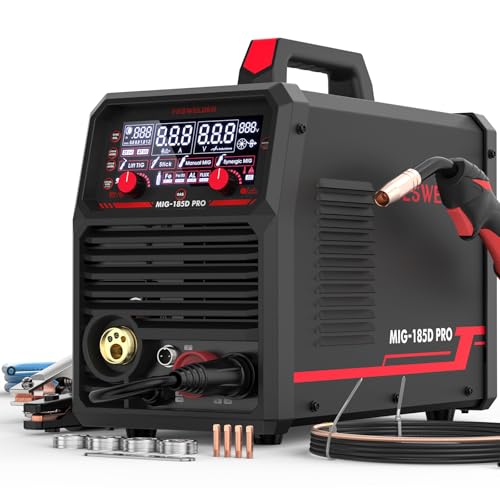
YESWELDER 185A 5-in-1 Multi-process MIG Welder 240V
ASIN B0DYDLMNRW • $399.99 • Sold by YESWELDER-AU on Amazon AU
The YESWELDER 185A is the step up for people who want gas MIG as well as gasless, and it's #112 in Amazon AU's Welding Equipment category at time of writing. It shares its overall Amazon AU rank with YESWELDER's other MIG listings, so its sales are hard to separate from theirs. It's $400, sold by YESWELDER's Australian storefront. The part number MIG-185D-PRO matches the title. It runs on 240V with a 15A plug and does five processes: gasless flux-core MIG, gas MIG, spool gun MIG, lift TIG and stick. The lift TIG torch and the spool gun are both extras the listing says you'll need to buy.
With 185A of output it handles thicker steel than the 135A machines, and it takes both small 2lb and bigger 10lb wire spools in sizes from 0.023 to 0.045 inch, according to the listing. That matters because the bigger spools cost less per kilo of wire. Synergic MIG sets the voltage to match the wire speed, and manual MIG lets you set both yourself once you've got the feel for it. Stick mode has adjustable hot start, arc force and anti-stick. It weighs 9.5kg with a carry handle. With a spool gun added, the listing says it can weld aluminium, which the 135A and TIG picks can't. Manual mode is handy for someone who wants to learn proper settings rather than lean on synergic forever.
No gas regulator, bottle, spool gun or TIG torch is listed in the box, so price those before you compare it with the 135A. Get a 15A outlet sorted before it arrives. Use the right drive roller for each wire size and type. Blow out the torch liner whenever you change wire. Store spare wire sealed and dry. Check the gas hose and regulator fittings for leaks with soapy water when you set up. Clamp the earth on clean bare metal close to the weld. For a home workshop that wants gas MIG on steel and an aluminium option later, it's the one I'd buy.
Honest caveats: Honest caveats: duty cycle isn't stated on the listing. It needs a 15A outlet. The aluminium claim depends on buying a spool gun separately, and a gas regulator and bottle aren't included either. Its rank is shared across YESWELDER's MIG listings, so it doesn't show this model's sales on its own.
Best for: A home workshop that wants gas and gasless MIG on steel, with a spool gun option for aluminium.
Processes: Gasless MIG, gas MIG, spool gun MIG, lift TIG, stick • Output: Up to 185A • Wire: 2lb and 10lb spools, 0.023 to 0.045 inch • Control: Synergic and manual MIG • Power: 240V, 15A plug • Weight: 9.5kg • Seller: YESWELDER-AU • Rank: #112 in Welding Equipment (Amazon AU), listing shared
View on Amazon AU
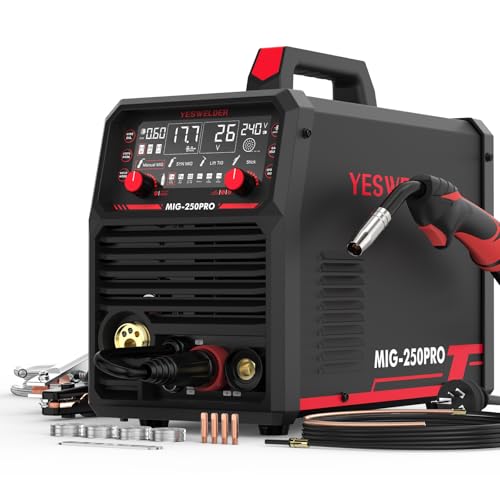
YESWELDER 250A Aluminium MIG Welder 240V, 6-in-1 Multiprocess
ASIN B0DXVJ9V9S • $499.99 • Sold by YESWELDER-AU on Amazon AU
The YESWELDER 250A is the most capable welder here and the most expensive at $500, sold by YESWELDER's Australian storefront. It's #26 in Amazon AU's Power Welders category at time of writing, a rank it shares with YESWELDER's other MIG listings. The part number MIG-250PRO matches the title. It runs on 240V with a 15A plug and does six processes: MIG, pulsed MIG, flux core, spool gun MIG, lift TIG and stick. The lift TIG torch and spool gun are extras, the same as on the 185A. It's the one for heavier fabrication and long seams on trailers and gates. It's the biggest YESWELDER MIG in this guide, and like the 185A it takes both gas and gasless wire.
Pulsed MIG is the feature that sets it apart. The machine pulses the current so the weld puddle stays easier to control on thin steel and aluminium, with less spatter and less risk of burning through. The listing gives wire sizes of 0.6, 0.8 and 1.0mm for solid and stainless wire, 0.8 and 1.0mm for flux core, and 1.0 and 1.2mm aluminium wire through a spool gun. Synergic MIG matches voltage to wire speed with plus or minus 3V of fine-tuning, and manual MIG is there too. The 250A top end gives it more headroom on thicker steel than any other pick here. Pulsed MIG takes a bit of practice to set up well, so start on the synergic settings and adjust from there.
The listing doesn't state a duty cycle, weight or warranty, so check the manual before you plan long runs at full current. Price a spool gun, gas regulator and bottle before you compare it with the 185A. Get the 15A outlet in first. Keep it on a bench away from grinding dust and the floor. Use the correct drive rollers for aluminium wire, because steel rollers crush it. Blow out the torch liner when you change wire. Clamp the earth close to the weld on bare metal. For heavier fabrication and aluminium on one machine, it's the one I'd buy.
Honest caveats: Honest caveats: duty cycle, weight and warranty aren't stated on the listing. It needs a 15A outlet. Aluminium MIG needs a spool gun bought separately, and no gas regulator or bottle is listed. The rank is shared with YESWELDER's other MIG listings. It's more machine than most home repair jobs need.
Best for: Heavier fabrication, long seams and aluminium MIG with a spool gun, on one machine.
Processes: MIG, pulsed MIG, flux core, spool gun MIG, lift TIG, stick • Output: Up to 250A • Wire: 0.6 to 1.0mm solid, 0.8 to 1.0mm flux, 1.0 to 1.2mm aluminium • Control: Synergic (plus or minus 3V) and manual • Power: 240V, 15A plug • Weight: Not stated • Seller: YESWELDER-AU • Rank: #26 in Power Welders (Amazon AU), listing shared
View on Amazon AU
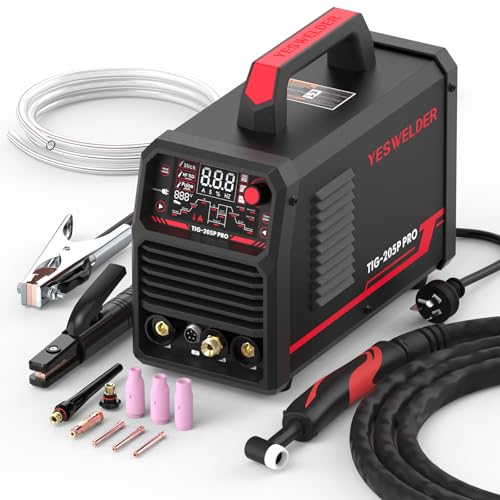
YESWELDER 200A Pulse TIG Welder 240V, Stick, DC TIG and Pulse TIG
ASIN B0DYD4Y8Z6 • $339.99 • Sold by YESWELDER-AU on Amazon AU
The YESWELDER 200A pulse TIG is #6 in Amazon AU's TIG Welding Equipment category at time of writing, the best category rank of any pick here. It's $340, sold by YESWELDER's Australian storefront. The part number TIG-205P-PRO matches the model the listing names. It runs on 240V with a 15A plug and does three processes: stick, DC TIG and pulse TIG. It also ranks #11,322 across the whole Amazon AU site, the best overall figure of the five. The listing is clear that it can't weld aluminium, so it's for steel and stainless only. It's the pick for neat, visible welds on thinner steel and stainless, and the only TIG-first machine here.
It uses high-frequency, non-contact arc starting, so the tungsten doesn't have to touch the work to strike an arc, which keeps the tip cleaner. The listing gives an 85V open-circuit voltage, a TIG range from 5A up to 200A, and a stick range of 20 to 160A, with 6010 rods mentioned as suitable. There's a 5-pin foot pedal socket for current control, adjustable arc force and hot start for stick, anti-stick and a memory that keeps your settings after power-off. It weighs 4.8kg, so it's the lightest stated weight of the 15A machines here. Pulse TIG switches the current between a high and a low setting many times a second, which helps on thin stainless where heat builds up quickly and warps the work. The memory means you're not setting it up from scratch every time you switch it on.
You'll need an argon bottle and regulator for TIG, which the listing doesn't include, and a foot pedal if you want one. The high-frequency start can upset nearby electronics, so keep phones, laptops and chargers away from the work. Keep tungstens sharp and clean, and grind them lengthways rather than around the tip for a steadier arc. Check the argon hose fittings for leaks with soapy water. Clamp the earth on clean bare metal. Blow out the vents every few months. For stainless and fine steel work on a pulse TIG, it's the one I'd buy.
Honest caveats: Honest caveats: it can't weld aluminium, because it's DC only. It needs a 15A outlet and an argon bottle and regulator, which aren't included. TIG takes the longest to learn of any process here. Duty cycle and warranty aren't stated. A foot pedal is an extra.
Best for: Neat TIG welds on steel and stainless, for someone willing to learn the hardest process.
Processes: DC TIG, pulse TIG, stick • TIG range: 5 to 200A • Stick range: 20 to 160A • Arc start: High-frequency, non-contact • Open-circuit voltage: 85V • Power: 240V, 15A plug • Weight: 4.8kg • Seller: YESWELDER-AU • Rank: #6 in TIG Welding Equipment (Amazon AU)
View on Amazon AUSide-by-side comparison
What we see fail in the workshop: inverter welders
Inverter welders are power electronics in a dusty, hot, rough environment, and a few faults come up again and again. These are the three I'd watch for. Most come down to dust, heat and cables, and most can be avoided with where the welder lives and how it's looked after. Some are worth fixing on a good machine, and some aren't once you price the parts.
Conductive dust and dead fans
Grinding dust is fine steel, and it gets sucked into the welder by its own cooling fan. Over time it coats the boards and heatsink, which can short parts or stop them cooling, and it wears out the fan bearings. A welder that trips its thermal protection quickly, has a fan that rattles or doesn't spin, or shuts down for no clear reason is often clogged. Keep the welder up on a bench, away from the grinder, and blow the dust out with dry air every few months.
Switching parts and power boards
The IGBT switching transistors and the power board around them do the heavy lifting in an inverter welder, and they're what usually fails when one dies outright. Common causes are dust, running past the duty cycle on a hot day, a weak or overloaded supply, and plugs or leads that have been modified or overloaded. A welder that blows a breaker the moment it's switched on, or smells hot, needs to stop being used. Repair depends on parts being available for that model.
Torch liners, earth clamps and cables
Plenty of welders come in for faults that aren't inside the box at all. A kinked or dirty torch liner makes wire feed badly, a worn contact tip makes the arc wander, and a loose or corroded earth clamp makes the welder seem weak. Cracked cables and burnt connectors are common too. Check the simple parts first: swap the tip, blow out the liner, clean and tighten the earth clamp, and check the cables for cuts or hot spots before assuming the welder's dead.
Decision tree: which one should you actually buy?
- You want a first welder for trailer and farm repairs, with no gas bottle? → The YESWELDER 135A gasless MIG at $186 comes with two spools of wire and runs on a 15A plug.
- You want the smallest spend from an Amazon AU listing? → The Rossi MAG120 Mk III at $178 does gasless MIG and stick, and weighs about 5kg.
- You want gas and gasless MIG with an aluminium option later? → The YESWELDER 185A at $400 does five processes and takes a spool gun for aluminium.
- You're doing heavier fabrication or long seams? → The YESWELDER 250A at $500 has pulsed MIG and the most output here.
- You want neat TIG welds on steel and stainless? → The YESWELDER 200A pulse TIG at $340 has HF start and the best category rank here.
- Your welder trips the power, won't start or smells hot? → Stop using it and bring it into our Erina workshop. We'll check it and tell you if it's worth fixing.
Frequently asked questions
Can I plug a welder into a normal power point?
Only if the welder has a 10A plug. Four of the five picks here state a 15A plug, which has a wider earth pin and won't fit a standard 10A Australian socket. You need a 15A outlet fitted by a licensed electrician on a suitable circuit. Don't use an adaptor or modify the plug, because that's how leads and wiring overheat. Use a 15A-rated extension lead if you need one, fully unrolled.
Is gasless MIG good enough for home use?
For most home and farm repairs, yes. Gasless flux-core MIG is easier to set up, has no gas bottle to rent or refill, and handles wind outdoors better than gas MIG. The welds are a bit messier and need more cleanup, and flux-core wire costs more per kilo. If you later want neater welds on thin steel, a machine that does both, like the YESWELDER 185A or 250A, lets you add gas without buying a new welder.
What does duty cycle mean on a welder?
It's the share of a 10 minute period a welder can weld at a given current before it has to rest. A 60 percent duty cycle at 100A means six minutes of welding and four of cooling at that setting. Higher current lowers the duty cycle and hot weather lowers it further. Many Amazon AU listings don't state it, or state it without the current it applies to, so check the brand's manual before buying for long welding runs.
Can I run an inverter welder from a generator?
Usually, if the generator is big enough and gives clean output. Inverter welders don't like voltage dips, so check the welder's manual for a minimum generator size and choose a generator with headroom above that. An inverter generator gives cleaner power than an open-frame one. A welder with a 15A plug needs a generator with a 15A outlet, not an adaptor. Start on lower settings and watch for the generator labouring or the welder cutting out.
Can these welders weld aluminium?
Only some, and only with extra parts. The YESWELDER 185A and 250A can weld aluminium with a spool gun bought separately, plus the right gas. The YESWELDER 200A TIG is DC only, and its listing says it can't weld aluminium. The YESWELDER 135A and Rossi MAG120 are gasless steel machines. For regular aluminium work, an AC TIG or a MIG with a spool gun is the way to go. Aluminium also needs clean metal, the right wire and practice.
How do I make an inverter welder last?
Keep it away from the grinder and off the floor, because grinding dust is conductive and gets pulled inside by the fan. Blow the dust out with dry air every few months with it unplugged. Don't push it past its duty cycle on hot days, use the right plug and lead, and store it somewhere dry. Look after the torch liner, contact tips and earth clamp, because they cause many of the faults people blame on the welder.
Related buying guides
Welder tripping the power, dead or cutting out?
Most inverter welder faults we see come down to conductive dust, failed fans, cooked switching parts and burnt connectors or cables. Bring it into our Erina workshop and we'll check it over and tell you what it'll cost and whether it's worth fixing before you spend anything.
Visit our Erina workshop Book Online