Prices from Amazon AU, updated daily. Swipe or use the arrows for more.
Disclosure: This article contains affiliate links to amazon.com.au. If you buy through one of these links iFix may earn a small commission at no extra cost to you. It doesn't change which products we recommend. We focus on what actually lasts based on 16 years of repair-shop experience.
Quick summary8 picks
- Entry PickMenbyci 24Pcs Trim Removal Tool Set with… about$26.99
- Menbyci 148Pcs Trim Removal Tool Kit about$32.99
- 21-Piece Universal Automotive Repair Kit about$45.99
- Crescent 20 Piece X10 3/8" Drive 6 Point… about$79.828" screen.
- APOLLO TOOLS 56 Piece Compact Metric Auto… about$67.384" screen.
- Amazon Basics 173-Piece General Household… about$89.90
- Amazon Basics Mechanics Socket Set about$90.10
- Most PremiumDEWALT Mechanics Tools Kit and Socket Set about$126.084" screen.
The labour-rate arithmetic
Workshop labour on the Central Coast runs somewhere between $120 and $180 an hour now depending on the shop, and it's been climbing faster than most of the other bills in the household pile. Nobody sensible argues a mechanic shouldn't charge for a hoist, insurance, diagnostic gear and twenty years of pattern recognition. The argument is about which jobs actually need all that. A wiper blade doesn't. An air filter doesn't. A battery swap, a globe, a cabin filter, most of the small stuff that pads out a minor service doesn't either, and those jobs get billed at the same hourly rate as the work that genuinely earns it.
The kits in this guide sit between $80 and $149, which is less than a single hour of that labour, and the payback case doesn't need exaggerating. One air filter and one battery fitted yourself covers the Crescent set. What the tools really buy is the ability to say yes to the small jobs the moment they appear, instead of queueing them for a service three weeks out and paying shop rates for ten minutes of socket work. In my experience the spend also changes behaviour: people with a socket set check things, and cars that get checked cost less.
The frame for everything below is a boundary. There's a set of jobs that are sensible with hand tools on a driveway, a set that are legal but silly without a hoist and experience, and a set you shouldn't touch at all, and the next section draws those lines before a single socket gets recommended. A tool kit is for the first set. Buying one doesn't make anyone a mechanic, and the best thing a $90 kit ever does is teach its owner exactly where their own boundary sits.
What's sensible to do yourself, and what isn't
The comfortably-DIY list is longer than most people think: wiper blades, air and cabin filters, globes where the housing allows it, the 12V battery, topping up washer fluid and coolant to the marked lines, checking and rotating tyres if you've got a proper jack and stands, and the endless small jobs like number plate screws, loose trim and corroded terminals. Oil and oil filter changes are within reach for a lot of cars too, with two honest caveats: you need somewhere lawful to take the old oil, and some cars bury the filter badly enough that the job stops being worth it. Tyre pressures belong on that list as well, and the tyre inflator guide covers the gear side of that habit.
The don't-touch list matters more. Brakes, steering, suspension and anything the car's weight or your safety hangs on belong with people who do them weekly, and that's before you get to airbag systems, seatbelt pretensioners and fuel lines, where an amateur mistake stops being expensive and starts being dangerous. Anything under warranty deserves a read of the logbook terms first, since servicing rules and record-keeping expectations vary. And the rules on what's permitted differ by state for some work, particularly anything electrical or gas-related in vans and caravans, so when a job smells regulated, check before you spanner. None of this is me covering myself; it's the same boundary I hold in the workshop.
The safety rules for the sensible list are few and non-negotiable. Never put any part of yourself under a car held only by a jack: stands or ramps on hard level ground, every time, with the wheels chocked. Disconnect the negative battery terminal before working near anything electrical. Let exhausts and cooling systems cool before touching them, and never open a hot radiator cap. Wear glasses when you're under anything, because rust and grit obey gravity. All of it is basic, none of it is optional, and every experienced home mechanic I know follows it more carefully than the beginners do, not less.
Torque matters more than muscle
The most expensive habit in amateur car work is overtightening. Steel bolts thread into aluminium heads and cast housings all over a modern car, the aluminium always loses, and a stripped sump plug or a snapped wheel stud turns a ten-minute job into a workshop visit that costs more than the tool kit did. Fasteners have specified torque figures for a reason: the engineers already decided how tight, and tighter than that isn't more secure, it's pre-loading a failure. The figures are in the workshop manual and usually a search away, and the discipline of looking them up is worth more than any single tool in these kits.
None of the five kits here includes a torque wrench, and I'd rather say that plainly than let a specs table imply otherwise. For wheel nuts, spark plugs, sump plugs and anything threading into aluminium, a torque wrench is the missing purchase, and until it arrives the working rule is restraint: snug plus a little, never your full weight on the end of a breaker of any kind. We see the miniature version of this failure every week, screws chewed and threads stripped by people who leaned on them, and the devices arrive at the bench in Erina in exactly the state an over-torqued sump plug leaves an engine. Same physics, smaller spanner.
Fastener condition is the other half of the discipline. A rusted bolt wants penetrating oil and patience, not a longer bar, because the snapped-off stud is always a worse problem than the seized one. Six-point sockets grip the flats of a fastener instead of its corners, which is why they round things off far less than 12-point ones when the going gets tough, and it's why the Crescent listing makes a point of its off-corner loading design. Push a spanner rather than pulling it where you can, keep your knuckles clear of edges, and when a fastener starts to round, stop and rethink before it becomes archaeology.
The socket set quality tells
Tool sets at this end of the market are hard to judge from photos, but the listings leak quality signals if you know where to look, and the ratchet is the best of them. The tooth count decides the swing arc: an 84-tooth ratchet like the Crescent's needs only a stated 4.3 degrees of movement to click over, where old 36-tooth designs need ten, and that difference is the whole game in the cramped spaces where cars actually get worked on. DEWALT states 72 teeth on its ratchets, which is the same class. When a listing doesn't mention tooth count at all, that silence is usually its own answer.
Steel and finish are the second tell. Chrome vanadium is the standard honest alloy at this price and the Amazon Basics socket set states it; Crescent states its own Crestoloy alloy and a manganese phosphate finish, the dull black coating that shrugs off corrosion better than bright chrome once tools live in a shed. Beyond that, look for quick-release ratchets that actually let sockets off without a fight, 6-point sockets for anything that'll see real torque, and markings you can read with dirty hands. Every one of those details appears in these listings somewhere, and the sets that state them tend to be the sets that thought about them.
The case matters more than it gets credit for. A blow-moulded case with a pocket per socket, like the Amazon Basics kits state, is an inventory system: the empty pocket tells you a socket is still sitting on the strut tower before you close the bonnet. The APOLLO's zippered pouch with elastic straps gives up some of that discipline to win portability, which is the right trade for a kit that lives in the car. Loose tools in a milk crate are how sockets go missing and how rust starts, and a set whose case survives is a set that stays complete for a decade.
Metric, SAE and the mismatch trap
Australian cars are metric, effectively all of them for decades now, and the fastest way to ruin a fastener is a near-enough SAE socket on a metric head. A 13mm bolt will accept a half-inch socket just well enough to round its corners under load, and the driveway lore of just use the closest one has chewed more bolt heads than rust ever has. The rule costs nothing: the socket either fits snugly or it's the wrong socket, and if a set makes you guess which system you're holding, its markings have already failed you once.
The five picks split on this and the split should steer you. The APOLLO kit is stated metric only, which for an Australian glovebox is exactly right. The Crescent set states both SAE and metric across its 20 pieces. The DEWALT's listing title states SAE, and its feature copy never claims metric coverage, so as listed it's a set for American iron, older machinery and the imperial corners of a shed rather than a modern Australian daily, and its caveat box says so in plain words. The two Amazon Basics kits list piece counts without fully itemising systems, which is typical for the brand and worth a scroll through the listing images before ordering.
If the fleet is one modern car, buy metric and stop worrying; the imperial pieces in a mixed set will mostly sleep in their pockets. The people who genuinely need SAE know who they are, they own something American, agricultural or old, and for them the DEWALT reads like the pick rather than the compromise. The trap is only ever the middle path: working on a metric car out of an SAE-heavy set because it was there, one close-enough socket at a time. That's the path that ends with rounded heads and a set of extractor bits nobody wanted to buy.
Modern cars are electronics with wheels
The thing that's changed under the bonnet isn't the fasteners, it's what they're holding down. A current car is a network of control modules, and a spanner slipped across the wrong terminals, or a battery disconnected carelessly, can create faults that look far scarier than they are. Some cars drop window auto-up settings, radio codes and learned idle behaviour when the 12V supply goes away, and they relearn or get reset easily enough, but you want to know that before it happens rather than during. The workshop manual's battery-disconnect notes are worth thirty seconds, and on stop-start cars the battery itself is often an AGM unit that costs enough to justify care.
Diagnostics belong in the modern DIY kit alongside the sockets. Half the value of doing your own small jobs is knowing what the car thinks is wrong before anyone quotes you, and a Bluetooth OBD2 scanner under $50 reads the fault codes that used to be a workshop secret. The pairing is natural: the scanner tells you the story, the tool kit handles the parts of it that sit on the sensible-DIY list, and the printout makes you a far harder customer to upsell on the parts that don't. It's the same diagnostic-first habit we apply on our computer repair benches, just with dirtier hands.
Knowing when to stop is a skill these kits should come with. Stop when a fastener fights back harder than penetrating oil and patience can answer, when a job turns out to need the car higher than stands safely take it, when anything on the brakes-steering-suspension list is involved, or when the fault codes point somewhere the manual starts using words like calibration. Handing a half-done job to a professional costs a little pride and less money than handing them a broken stud. The good workshops don't sneer at DIY customers; they sneer at the ones who wouldn't stop.
How I picked the five
Same screen as the rest of this series. Condition New, price inside the $50 to $400 band from the queue, no import-version titles, no foreign export sellers, and a live Amazon AU category sales rank on the day of checking. All five picks this time are sold by Amazon AU directly, which takes the storefront-seller caveats off the table entirely. The lead pick by rank is the Amazon Basics 173-piece at number four in Tool Sets, and the rest hold real if humbler positions: the APOLLO and Crescent in the four-to-six hundreds of the same category, the DEWALT at 95 in Automotive Tool Sets, and the big socket set at 826 in Spanners and Wrenches.
Specs come off the listings and nowhere else, and this category punishes that rule more than most, because tool listings love piece counts and go quiet on what the pieces are. Where a listing doesn't itemise its metric coverage, its warranty or its steel, the specs tables below say not stated rather than guessing, and the SAE flag on the DEWALT is exactly that discipline applied somewhere inconvenient. Prices are the day-of snapshot and move week to week. No torque figures, no thread lore and no boundary-drawing in this guide came from a listing; that part is mine, and the listings only supplied the steel.
The 5 picks, $67 to $149
If you want one answer for the car and the house, I'd get the Amazon Basics 173-piece at around $90. It's the best seller of this lot in Amazon AU's Tool Sets category by a long way, it has the spanners, ratchet and hex keys a minor service actually uses, and every piece gets its own pocket so you can see what's missing. If you only want a metric kit that lives in the boot, the APOLLO 56-piece is the one I'd pick.
Prices are Amazon AU at time of writing (11 October 2026) and move week to week. Ranks are Amazon AU category sales ranks, checked the same day.

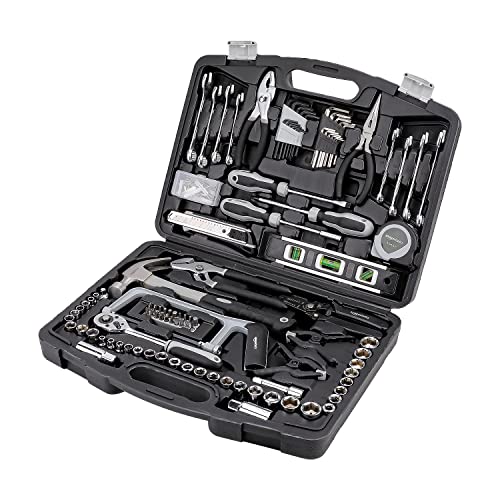
Amazon Basics 173-Piece Household and Mechanic's Hand Tool Kit
ASIN B07V3TD5Q7 • $89.90 • Ships from Amazon AU
The 173-piece is the volume seller of this list by a distance, number four in Amazon AU's entire Tool Sets category, and the reason is that it answers the question most households are actually asking, which is one kit for everything, including the car. The listing itemises more than most at this price: eight combination wrenches, a 3/8 inch ratchet wrench, twenty-two hex keys, slip-joint and long nose pliers, and the supporting cast of drivers and bits, all in heat-treated, chrome-plated alloy steel per the listing, with non-slip handles and a blow-moulded case that gives every piece a pocket. At $90 it's the set that makes the garage, the flat-pack and the fuse box the same purchase.
For the car specifically, it covers the sensible-DIY list from the earlier sections at entry depth: filters, battery terminals, globes, trim, plates and the general fettling that makes up the bulk of real driveway work on a modern car. The combination wrenches matter more than they look, because plenty of fasteners under a bonnet sit in places a socket and ratchet simply can't reach, and the twenty-two hex keys cover the grub-screw-and-Allen-bolt world that standard socket sets ignore. The case's one-pocket-per-piece layout is the inventory system the quality-tells section praised, and on a kit this size it's the difference between owning 173 pieces and owning about 150 with opinions about where the rest went.
The ceiling on this kit is real, though, and it's the ratchet. The listing states no tooth count, and the steel, while stated and warranted for a year, is household grade rather than the Crescent's bench grade, so the hard, stuck, high-torque jobs deserve better metal than this case carries. The honest configuration for a lot of readers is this kit for breadth plus the Crescent for the car-grade core, which lands at $147 all up and between them covers nearly everything a household and its car will ever ask of hand tools.
Honest caveats: Household grade rather than bench grade: no stated ratchet tooth count and a one-year stated warranty, so give the brutal jobs to better steel. The listing doesn't fully itemise metric versus SAE coverage across the set, so scroll the listing images before ordering if that matters to your fleet.
Best for: The one-kit household: car, furniture, fuse box and everything else, with every piece getting a pocket.
Pieces: 173, household and mechanic's selection • Wrenches: 8 combination, plus 3/8 inch ratchet wrench • Hex keys: 22, stated • Steel: Heat-treated, chrome-plated alloy, stated • Case: Blow-moulded, pocket per piece • Warranty: Stated 1 year • Seller: Amazon AU, condition New • Price: $90 at time of writing • Rank: #4 in Tool Sets (Amazon AU)
View on Amazon AU
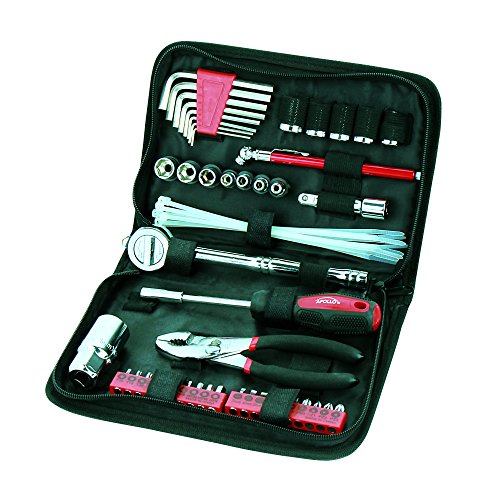
APOLLO TOOLS 56 Piece Compact Metric Auto Tool Set, Zippered Case DT9775
ASIN B0713Z4Y7T • $67.66 • Ships from Amazon AU
The APOLLO kit answers a different question from everything else here: not what should live in the garage, but what should live in the car. Fifty-six pieces in a zippered case the listing states fits a larger glove compartment, a backpack or a motorcycle saddle bag, with the tools held by elastic straps so they stay put over corrugations. The contents are exactly the roadside essentials you'd hope for: the most-used 1/4 inch and 3/8 inch sockets, hex keys, slip joint pliers and a tyre gauge, per the listing. And it's stated metric only, which in an Australian context isn't a limitation at all, it's the correct answer arriving without the imperial padding.
The use case is the breakdown that's fixable and the trip where fixable matters. A battery terminal that's worked loose, a trim panel flapping on the freeway, a licence plate hanging by one screw, the hose clamp that just needs a nip: none of these are workshop jobs, but every one of them is miserable without tools on hand, and the boot of most cars contains a jack, no more. Paired with a jump starter and an inflator this is the difference between a delay and a recovery truck for a decent share of roadside stops. The tyre gauge earns its pocket too, since servo gauges are communal property with communal accuracy.
The honest limits: light-duty steel for light-duty jobs, and the listing states no tooth counts, no alloys and no warranty, so the quality tells this guide leans on are simply absent here. That's all priced in at $68, and honestly it's not what a kit like this is for. Nobody rebuilds a hub on the roadside with a glovebox set; they get the car moving again and book the real job. Judge it as portable insurance rather than a workshop rival and it's an easy recommendation, especially for a young driver's first car.
Honest caveats: Light-duty by design: the listing states no steel spec, tooth count or warranty, so don't lean on it like the bench sets. Metric only, which suits Australian cars but not older imperial machinery. The zippered case trades the empty-pocket inventory discipline of a moulded case for portability.
Best for: The boot or glovebox of every car in the household, and first cars especially.
Pieces: 56, compact roadside selection • Drives: 1/4 inch and 3/8 inch sockets, most-used sizes • System: Metric only, stated • Extras: Tyre gauge, hex keys, slip joint pliers • Case: Zippered, elastic straps, glovebox sized • Seller: Amazon AU, condition New • Price: $67 at time of writing • Rank: #620 in Tool Sets (Amazon AU)
View on Amazon AU
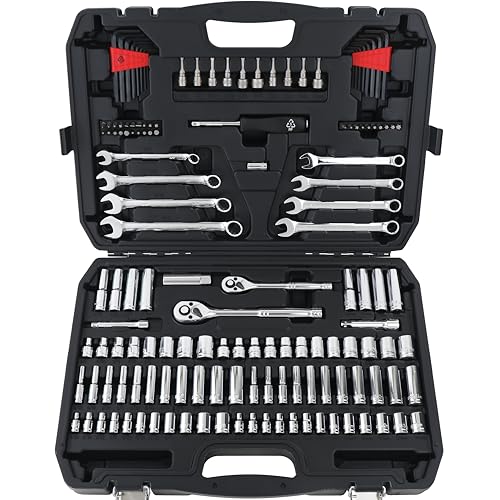
Amazon Basics Mechanics Socket Set, 145-Piece
ASIN B074MH432L • $91.94 • Ships from Amazon AU
Where the 173-piece kit spreads itself across the whole house, the 145-piece points everything at fasteners. It's a dedicated mechanics socket set, chrome vanadium forged per the listing, with quick-release, reversible ratchets and a full polished chrome finish for corrosion protection, and the sheer coverage is the purchase: at this piece count you stop guessing whether the odd fastener on the strut top or the deep one on the battery clamp has a socket that fits, because something in this case almost certainly does. At $92 it's barely more than the household kit, and for the reader whose interest is the car rather than the flat-pack, it's the better-aimed ninety dollars.
Depth of coverage changes how jobs feel. Deep sockets reach the nuts that sit a long way down on their studs, battery clamps and strut tops being the classics, multiple drive sizes mean the small fasteners get small-drive finesse instead of big-drive brutality, and a full size run means the difference between the right socket and the nearly-right one, which the mismatch section already establishes as the difference between a job and a repair. The quick-release ratchets are a stated feature worth having at this count, because a set this size lives and dies by how fast sockets come on and off when you're hunting through forty candidates for the one that fits.
The listing's weakness is vagueness. Beyond the forging and the finish it states very little: no ratchet tooth counts, no itemised metric-versus-SAE breakdown, no warranty term, and its category rank sits in Spanners and Wrenches at 826 rather than headline territory. The chrome vanadium claim is the right claim at this price, but the set earns the balanced badge rather than a premium one because so much of its quality is asserted by a piece count rather than specified. It's the breadth play: buy it for coverage, and let the Crescent or the DEWALT supply the ratchet you actually love.
Honest caveats: The listing is thin on specifics: no tooth counts, no metric/SAE itemisation and no stated warranty, so quality beyond the stated chrome vanadium forging is taken on faith. Rank 826 in its category is modest, and the case design gets no meaningful description on the listing at all.
Best for: Maximum socket coverage per dollar for the car-focused shed, wrapped around a better ratchet.
Pieces: 145, dedicated socket set • Steel: Chrome vanadium, forged, stated • Ratchets: Quick release, reversible, stated • Finish: Full polished chrome, anti-corrosion, stated • Systems: Not itemised on the listing • Warranty: Not stated on the listing • Seller: Amazon AU, condition New • Price: $92 at time of writing • Rank: #841 in Spanners & Wrenches (Amazon AU)
View on Amazon AU
Crescent 20 Piece X10 3/8" Drive 6 Point SAE/Metric Mechanics Tool Set
ASIN B07K7616H7 • $80.36 • Ships from Amazon AU
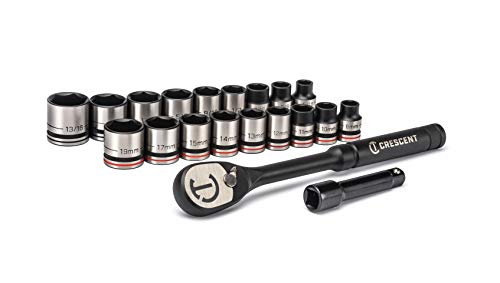
The Crescent set is the smallest kit here and the one whose listing reads most like it was written by someone who uses tools. Twenty pieces on a 3/8 inch drive, six-point sockets in both SAE and metric, and a ratchet the listing actually specifies: 84 teeth, a stated 4.3 degrees of swing to engage, an enclosed head design for grit resistance and a teardrop profile stated up to 21 per cent slimmer than competitors. Those are the numbers this guide's quality-tells section is built on, and finding all of them stated at $80 is why it earns a place next to sets with eight times the piece count. The steel is Crescent's stated Crestoloy alloy, dressed in a black manganese phosphate finish.
That finish choice says something about intent. Bright chrome photographs well; manganese phosphate is the dull military-grey coating chosen for corrosion resistance and holding a film of oil, and it's the coating you find on tools that are expected to live hard lives in sheds and utes rather than kitchen drawers. The six-point sockets with stated off-corner loading grip fastener flats rather than corners, which is precisely the feature you'll be glad of on the day a suspension bolt or a rusted exhaust clamp fights back. Twenty pieces means there's no pretence of covering everything here: this is the core ratchet-and-sockets heart of car work, done properly, with nothing padding the count.
The limits are the piece count and the single drive size. No 1/4 inch drive for the small fasteners, no spanners, no pliers, no screwdrivers, so as an only kit it leaves gaps that the Amazon Basics sets fill with quantity. I'd frame it as the quality anchor: the set whose ratchet and sockets you'll still prefer in ten years, bought first and surrounded with lower-cost breadth later. For someone who already owns a household toolbox and wants the car-grade core added to it, this is the cleanest $80 in the guide.
Honest caveats: Twenty pieces covers the ratchet-and-socket core only: no 1/4 inch drive, no spanners, pliers or drivers, so it's a companion to a household kit rather than a replacement for one. The case gets no real description in the listing, and no warranty term is stated either.
Best for: The quality core: a properly specified ratchet and 6-point sockets to build the rest of a kit around.
Pieces: 20, 3/8 inch drive • Sockets: 6-point, SAE and metric, off-corner loading • Ratchet: 84 tooth, stated 4.3 degree swing arc • Head: Enclosed, teardrop low-profile design • Steel: Stated Crestoloy alloy • Finish: Black manganese phosphate, corrosion resistant • Seller: Amazon AU, condition New • Price: $80 at time of writing • Rank: #886 in Tool Sets (Amazon AU)
View on Amazon AU
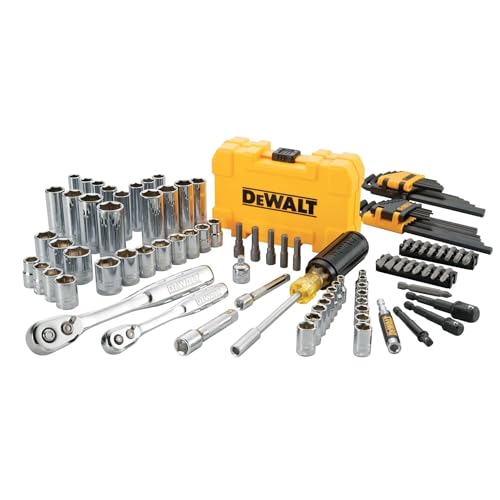
DEWALT Mechanics Tools Kit and Socket Set, 1/4" and 3/8" Drive, SAE, 108-Piece
ASIN B00U0P0GHM • $149.09 • Ships from Amazon AU
The DEWALT is the set people expect to see at the top of a list like this, and for the right buyer it mostly earns that expectation. A hundred and eight pieces across 1/4 inch and 3/8 inch drives, 72-tooth quick-release ratchets stated for high-torque ratcheting in tight arcs, the brand's Direct Torque design stated to reduce fastener rounding, an anti-slip vinyl grip on the bit driver and a removable accessory case inside the main one. It holds rank 195 in Amazon AU's Automotive Tool Sets category at $149, and the fit, finish and ratchet feel DEWALT trades on is the reason someone pays double the Crescent's money for the same drive sizes.
The catch sits right there in the listing title, and this guide won't bury it for the sake of a tidy list: the listing states SAE. Nothing in the feature copy claims metric coverage, and I only quote what listings state, so as sold this is a set for American vehicles, older imperial machinery, agricultural gear and the workshop that already knows it needs inch sizes. For that buyer it's arguably the best-specified metal in the guide, with tooth counts and torque design stated rather than implied. For the owner of one modern Australian car it's a set that will spend its life being almost the right size, which the mismatch section explains is worse than being obviously wrong.
So the recommendation comes with routing attached. Own something with imperial fasteners, or building a serious bench where a second system belongs anyway: buy it, enjoy the ratchets, and the two-drive layout with the removable accessory case makes it a genuinely pleasant set to spend a Saturday working out of. Everyone else should either verify current metric availability in this line before ordering or put about $172 into the Crescent plus the 145-piece instead, which costs a bit more but speaks the language every bolt in the driveway actually uses.
Honest caveats: The listing states SAE and never claims metric coverage, which on a modern Australian car means near-size sockets and rounded fasteners; treat it as a set for imperial machinery unless you verify otherwise. No warranty term is stated on the listing either, and $149 is Crescent-plus-sockets money.
Best for: Imperial fleets and serious benches: American iron, older machinery, and owners who know why they need SAE.
Pieces: 108, two-drive mechanics set • Drives: 1/4 inch and 3/8 inch • System: SAE, stated; metric not claimed • Ratchets: 72 tooth, quick release, stated • Torque design: Stated Direct Torque, reduces rounding • Case: Removable accessory case inside main case • Seller: Amazon AU, condition New • Price: $149 at time of writing • Rank: #195 in Automotive Tool Sets (Amazon AU)
View on Amazon AUSide-by-side comparison
What we see fail at the bench: tools and the hands holding them
Car tool kits don't come across an electronics bench, but their failure modes do, in miniature, every single day. Stripped fasteners, chewed heads, wrong-size drivers and seized threads are most of what stands between a repairable device and a write-off, and the causes scale up to cars without changing character. Three patterns from the small end of the trade, all of them cheerful warnings for the big end.
The wrong size, used anyway
Most chewed fasteners were never stuck; they met a driver that almost fit. On phones it's a Phillips in a pentalobe, on cars it's a half-inch socket on a 13mm head, and the mechanism is identical: the tool contacts the corners instead of the flats, the corners yield, and the fastener becomes a extraction job. The fix costs nothing but honesty. If the fit has play in it, it's the wrong tool, and thirty seconds of finding the right one is the entire difference. Six-point sockets buy forgiveness on the marginal cases, which is why they're all through the better listings here.
Torque by feel, learned the hard way
Every trade has its version of the snapped stud. Ours is the cracked board from an over-tightened shield screw; the driveway version is the sump plug that strips its thread into an aluminium pan, and both come from treating tightness as a virtue. Fasteners clamp correctly at their specified torque and start failing past it, and feel is only a substitute for the specification after years of calibration against it. Look the figure up, buy the torque wrench before the wheel nuts and spark plugs need it, and be suspicious of your own strength on anything threading into aluminium.
Rust finishes what neglect starts
Tools fail slowly and then suddenly. Chrome sockets shrug off a shed's humidity until the day a chip in the plating lets moisture at the steel, ratchet internals gum up with dust and old grease, and the kit that got rained on once in a ute tray develops seized extensions a year later. Storage is the maintenance: tools dry before the case shuts, a wipe of oil on anything that lives hard, and the case actually closed rather than propped. The manganese phosphate finish on the Crescent set exists precisely because someone expected the shed to be unkind.
Decision tree: which one should you actually buy?
- Building around quality, adding breadth later? → The Crescent X10 at $80: the best-specified ratchet and 6-point sockets in the guide, in both metric and SAE.
- One kit for house, car and everything else? → The Amazon Basics 173-piece at $90, number four in Tool Sets for a reason, with the Crescent added later for the car-grade core.
- Car-focused shed that wants socket coverage above all? → The Amazon Basics 145-piece at $92: chrome vanadium breadth that stops the guessing, best wrapped around a better ratchet.
- Something for the boot, the roadside and the first car? → The APOLLO 56-piece at $68, metric only in a zippered case that actually fits a glovebox, next to a jump starter and an inflator.
- American, agricultural or older imperial machinery in the fleet? → The DEWALT 108-piece at $149: stated 72-tooth ratchets and SAE sizing that finally gets used for what it's for.
- Chewed a screw on a phone, laptop or console trying the same job at home? → Stripped heads on electronics are recoverable more often than people think, but each attempt makes the next one harder. Stop before the head is round and bring it in to our Erina workshop: we'll get it open and tell you what it needs before you spend anything.
Frequently asked questions
What car maintenance can I do myself without a mechanic?
The sensible home list: wiper blades, air and cabin filters, globes where access allows, the 12V battery, fluid top-ups to the marked lines, tyre pressures and rotation with proper stands, and small jobs like trim, plates and corroded terminals. Oil changes are achievable on many cars if you can dispose of the oil lawfully and reach the filter. Leave brakes, steering, suspension, airbags, fuel systems and anything structural to professionals, and check your logbook terms on a car under warranty. The boundary isn't about intelligence, it's about consequences: the DIY list fails small and obviously, while the professional list fails expensively or dangerously.
Do I need a torque wrench for basic car work?
For the lightest jobs, no, restraint and a snug fit cover trim screws and hose clamps. The moment wheel nuts, spark plugs, sump plugs or anything threading into aluminium enters the picture, yes, and it's the first purchase after any of these kits. Fasteners have specified torque figures, tighter is not safer past them, and the classic amateur failures, stripped sump threads, snapped studs, warped brake rotors from uneven wheel nut torque, are all overtightening stories. None of the five kits in this guide includes a torque wrench, so budget for one separately and look the figures up rather than trusting feel.
Are Amazon Basics tools good enough for car work?
For the sensible-DIY list, generally yes, and the listings state the right things at the price: heat-treated alloy steel on the 173-piece, chrome vanadium forging on the 145-piece socket set. What they don't state is the enthusiast detail, ratchet tooth counts, itemised size coverage, long warranties, and that silence is the honest gap between household grade and bench grade. My practical read: they're the breadth half of a kit, and the hard, stuck, high-torque jobs deserve the Crescent's or DEWALT's better-specified metal. Plenty of cars get maintained for years on exactly this grade of tool without drama.
What does ratchet tooth count actually mean?
The tooth count sets how far the handle must swing before the mechanism catches the next tooth and can drive again. An 84-tooth ratchet like the Crescent's engages in a stated 4.3 degrees; an old 36-tooth design needs ten, and in the cramped corners where car work actually happens, the difference decides whether you can work a fastener at all or just rock the handle uselessly. Higher counts use smaller teeth, so the engineering and steel quality matter more as the number climbs, which is why a stated tooth count from a real tool brand is a quality tell and a missing one usually means the maker would rather not say.
Should I buy metric or SAE sockets in Australia?
Metric, with almost no exceptions for modern cars: Australian vehicles have been metric for decades, and Japanese, Korean, European and current American models all speak it. SAE earns its place only if you own older imperial machinery, American classics, some agricultural and marine gear, or imported equipment from the inch world. The danger is the near miss, a half-inch socket sits on a 13mm head just well enough to round it under load, so never mix systems by feel. Of these picks, the APOLLO is stated metric only, the Crescent covers both, and the DEWALT is listed as SAE, which is why its write-up routes it to imperial fleets.
What tools should I keep in the car itself?
A compact kit like the APOLLO covering the most-used sockets, hex keys and pliers, plus the things no socket replaces: a torch, gloves, a tyre gauge, a phone charger lead, and ideally a jump starter and a compact inflator, which turn the two most common roadside stops into ten-minute delays. Keep it all in a case that stays zipped over corrugations, check it twice a year because borrowed tools migrate, and remember the boot kit's job is to get the car moving again, not to finish the repair. Anything the roadside kit can't fix in twenty minutes was never a roadside job.
Related guides
Chewed screws are how gadgets die too
The same overtightening and wrong-driver habits that strip sump plugs kill phones, laptops and consoles on our bench every week. If you've started a repair at home and hit a screw that's rounding, stop while it still has corners. Bring it in to Erina and we'll open it properly, assess the damage and tell you what it needs before you spend anything.
Book Online