Prices from Amazon AU, updated daily. Swipe or use the arrows for more.
Disclosure: This article contains affiliate links to amazon.com.au. If you buy through one of these links iFix may earn a small commission at no extra cost to you. It doesn't change which products we recommend. We focus on what actually lasts based on 16 years of repair-shop experience.
Quick summary8 picks
- Entry PickGiraffe Tools Grandfalls Pressure Washer G20B about$400
- Bosch Home & Garden High Pressure Washer… about$4381900W.
- Jet-USA RX550 Electric High-Pressure Washer… about$459
- Bosch 2100W Electric High Pressure Washer… about$5392100W.
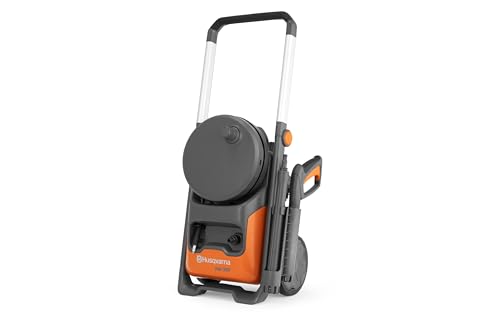
- Husqvarna PW 350 Electric Pressure Washer… about$5592100W.
- Bosch 2200W Electric High Pressure Washer… about$6022200W.
- Kärcher K4 Power Control 2100PSI Electric… about$609
- Most PremiumKÄRCHER K5 Premium 2300PSI Electric… about$849
PSI is the number on the box, flow is the one that cleans
Every pressure washer box leads with PSI, and it's the least useful number on it. Pressure is what lifts grime off a surface, but flow rate, measured in litres per minute, is what carries it away, and a machine with big pressure and a small flow will take forever to clean a driveway. If you multiply PSI by flow in gallons per minute you get what the trade calls cleaning units, which is a rough but honest way to compare two machines that quote very different headline numbers.
Here's how that plays out with the listings in this guide. The Kärcher K4 Power Control quotes 2,100 PSI and 7 litres a minute, which is about 1.85 gallons, so roughly 3,900 cleaning units. The K5 Premium quotes 2,300 PSI and 8.3 litres a minute, about 2.2 gallons, so around 5,000. The Jet-USA RX550 quotes a peak of 3,500 PSI but no flow rate at all, and neither Bosch listing gives a flow figure either. Without flow, I can't run the sum, and I'd treat a big PSI claim on its own with some suspicion.
Peak pressure is another trap. Some brands quote the highest pressure the pump reaches for an instant when the trigger closes, rather than the working pressure you get with the trigger held down. Kärcher and Bosch both quote pressures in the range you'd expect from a mains machine of this size, which is a good sign. A 3,500 PSI claim from a mains-powered machine on a standard Australian socket is a peak figure, and I'd expect the working pressure to sit well below it in real use.
What an Australian power point can really run
A standard 10A Australian power point tops out at about 2,400W, and every machine in this guide sits under that, with the Bosch AdvancedAquatak 150 the highest stated at 2,200W. That's close enough to the limit that how you power it matters. Run it on a long, thin extension lead and the voltage drops along the cable, the motor draws more current to make up for it, and it runs hotter than it should. I'd plug it straight into an outdoor socket with RCD protection wherever you can, and keep the hose long instead of the power lead.
If you must use a lead, use a short, heavy-duty one rated for 10A outdoor use, unroll it fully so it can't heat up on the drum, and keep the plug and socket off wet concrete. Don't share the circuit with a pool pump or an air conditioner while you're cleaning, because a tripped breaker halfway through a driveway is the least of your worries if the lead is undersized. Check for the RCM compliance mark on the plate too, which every reputable brand sold through Amazon AU should carry.
Running cost is small. At the Australian average tariff of roughly 33c per kWh, a 2,100W machine running flat out for an hour costs about 70c, and most jobs around the house are well under an hour of trigger time. Water use is the bigger number. At 8.3 litres a minute, the K5 uses about 500 litres an hour, which is still usually less than a garden hose left running, but it's worth knowing if you're on tank water or under restrictions.
Induction motors against universal motors
Most consumer pressure washers use a universal motor, which is a brushed motor that spins fast, weighs little and costs less to make. It's also louder, and its carbon brushes wear down with use until the motor stops. An induction motor has no brushes, runs slower and quieter, and generally lasts much longer, but it's heavier and costs more. Both Bosch AdvancedAquatak models here say induction motor on the listing, and that's one of the main reasons I'd consider them over a similar-priced machine that doesn't say.
The Kärcher listings in this guide don't state a motor type at all, and the Jet-USA listing doesn't either, so I can't tell you which they use from the listing data. That's not a reason to avoid them, but it's the first question I'd want answered before buying a machine for heavy weekly use. A motor type the brand is proud of tends to be printed on the box, so a listing that stays quiet on it usually isn't hiding an induction motor.
Whatever the motor, heat is what kills it. Pressure washers draw the most current when the trigger is held, and the motor gets most of its cooling from the water moving through the pump. That's why running a pressure washer with the trigger released for long periods, or without enough water coming in, is hard on the whole machine. Release the trigger between jobs for a minute or two at most, and turn the machine off when you walk away to move the car or grab a different lance.
Pumps, seals and the unloader valve
The pump is the expensive part of any pressure washer. Consumer machines mostly use an axial pump, where a tilted plate drives small pistons back and forth, and the pistons seal against rubber packing that wears over time. Pump heads on the lower end of the market are often plastic, while better ones use aluminium or brass. The Bosch AdvancedAquatak 150 lists an all-metal alloy quad pump with four cylinders, which is a step up from a three-piston plastic head and should cope better with heat and long sessions.
The part that fails most often isn't the pump itself but the unloader valve. When you release the trigger, the pump keeps spinning for a moment, and the unloader either diverts water in a loop or tells the motor to stop. Machines with total stop systems switch the motor off when the trigger closes, which saves wear. When the unloader sticks, the machine pulses, hums without spraying, or won't turn off, and those are among the most common faults people describe when they bring one in.
Seals and O-rings are the other wear items. Every quick-connect fitting on the gun, lance and hose has a small O-ring that dries out and cracks in the Australian sun, and a leaking fitting drops pressure at the nozzle. Keep a small pack of the right O-rings in the shed and a smear of silicone grease on each one, and store the machine out of direct sun. Most of the leaks I see are a two-dollar O-ring rather than anything wrong inside the machine.
Water supply, filters and running dry
A pressure washer can only push out the water it's given, so your tap has to keep up. Fill a 10 litre bucket from the garden tap and time it. If it takes 60 seconds, your tap supplies 10 litres a minute, which is enough for any machine here. If it takes much longer, the pump will starve, and a starving pump cavitates, which chews up seals and valves quickly. Low tank-water pressure is a common cause of short pump life in rural and semi-rural homes.
Every machine here has an inlet filter, and the Bosch AdvancedAquatak 140 lists double filtration while the 150 lists a metal water filter. Check the inlet filter every few uses and rinse it out, especially if you're on bore or tank water with sediment in it. Grit that gets past the filter scores the pump pistons and sticks the unloader. Both Bosch models also say they're self-priming capable, which means they can draw from a tank or bucket, though the 150's listing notes the accessory is sold separately.
Never run the machine without water flowing. Connect the hose, turn the tap on fully, squeeze the trigger until water runs steadily and only then turn the motor on. Running dry for even a short time can overheat the pump seals, and that kind of damage often isn't covered by warranty because it's treated as misuse. If you've got a tank pump, make sure it's running and primed before you start, and keep an eye on the tank level on long jobs.
Accessories that change what a machine can do
The kit in the box often matters as much as the machine. A surface cleaner, the round attachment with spinning jets under a cover, turns driveway cleaning from a stripey, slow job into an even one, and it stops the splash coming back at you. The Kärcher K4 and K5 both include the T 5 surface cleaner in their home kits, and the Jet-USA pack includes a floor cleaner. Neither Bosch listing mentions one, so budget for it separately if paths and driveways are the main job.
Lances and nozzles are the next thing to check. A rotary or turbo nozzle spins a narrow jet in a cone, which cuts through moss and grime on concrete quickly, but it's harsh on timber decking and car paint. The Bosch 150 includes both rotary and variable fan lances, the K4 includes a Dirt Blaster and spray lance, and the Jet-USA has a turbo wand with a ceramic nozzle and five tips. A wide fan pattern held well back is what you want on cars, cladding and anything painted.
Detergent systems vary too. The Jet-USA has a built-in 1 litre tank, both Bosch machines include a 550ml detergent nozzle, and the K5 comes with a foam jet and car shampoo. Use detergents made for pressure washers, because household products can foam inside the pump and some will damage seals. If you're cleaning the car or caravan, our car maintenance kit guide covers the other tools worth having in the garage.
What not to point a pressure washer at
A pressure washer will happily strip paint, lift mortar, gouge soft timber and drive water into places it should never go. Keep the nozzle well back from weatherboards, window seals and flyscreens, and never aim up under roof tiles, eaves or wall vents. Water forced under a tile or into a wall cavity can sit there for weeks. If you're cleaning gutters or the roofline, our gutter and roof maintenance guide covers safer tools for working up high.
Electrics and outdoor equipment are the other big one. Don't spray air conditioner outdoor units, pool equipment, solar inverters, outdoor power points or light fittings, and keep the jet off solar panels too, since high pressure can damage the seals around the glass and the panel's backing. Water that gets into an electrical enclosure under pressure is how a five-minute clean turns into an expensive repair, and the corrosion sometimes takes months to show up on a circuit board.
On cars, keep to a wide fan at a sensible distance and stay off badges, rubber seals, stone chips and the engine bay. Pressure lifts loose paint at the edge of a chip and can push water past door seals into the wiring looms that run through the doors. Indoors is a different job altogether, and for hard floors inside the house our wet dry floor cleaner picks are the right tool rather than anything that sprays at 2,000 PSI.
How I picked these five
All five picks are electric machines sold new by Amazon AU, so returns and warranty go through Amazon's local process. I checked each listing's pressure, flow rate where it's given, motor type, what's in the box and the sales rank on the day I wrote this. I've left out petrol machines, cordless battery units and anything sold by marketplace sellers with no Australian presence, and I stuck to roughly $400 to $1,000, where the machines get big enough for driveways and decks.
Two pairs of picks share a listing on Amazon AU: the K4 and K5 sit on one Kärcher listing, and the two Bosch machines sit on another, so each pair shows the same sales rank. I've kept both from each pair because they differ in ways that matter, flow rate on the Kärchers and pump construction on the Bosch machines. Where a listing leaves out a figure like flow rate or motor type, I've said not stated rather than fill the gap with a number from somewhere else.
Pressure washers come into the workshop less often than phones and laptops, but the faults that do come in are usually the electrical side: tripping RCDs, burnt switches and motors cooked on long extension leads. If yours trips the power, hums without spraying or smells hot, bring it to our Erina workshop and we'll check whether it's the motor, the switch or the lead before you spend anything on a replacement.
The 5 picks, $459 to $849
Prices are Amazon AU at time of writing (20 October 2026) and move week to week. Ranks are Amazon AU category sales ranks, checked the same day.

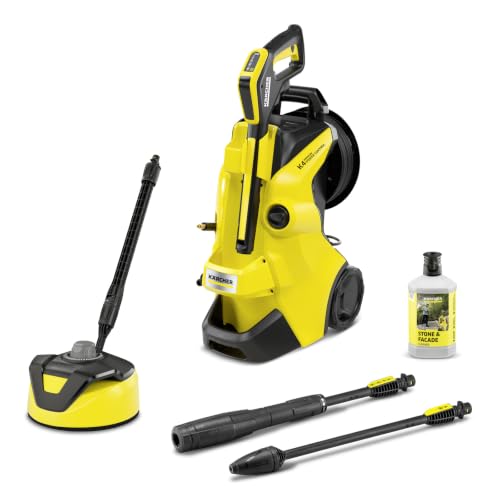
Kärcher K4 Power Control Electric Pressure Washer with Home Kit
ASIN B0CNGH3Q6R • $609.00 • Ships from Amazon AU
The Kärcher K4 Power Control is the pressure washer I'd buy for most homes, and at $609 from Amazon AU it shares the #4 spot in Amazon AU's Pressure Washers category with its K5 sibling on the same listing. It quotes 2,100 PSI and 7 litres a minute, which works out to roughly 3,900 cleaning units, plenty for driveways, paths, outdoor furniture and the car. Kärcher rates it for about 30 square metres an hour. It comes with a 9 metre high-pressure hose on a built-in reel, a high-pressure gun, a Dirt Blaster lance and a spray lance. The home kit adds the T 5 surface cleaner and a litre of stone cleaner. Kärcher lists the weight at 11.5kg.
The Power Control part of the name is the G 160 Q gun, which shows the pressure level you've selected so you can check it at a glance. You set the pressure by turning the spray lance, and that matters because the right setting for a car is far below the right setting for mossy concrete. The hose reel keeps the high-pressure hose tidy and off the ground, which is where most hoses get kinked and damaged. There's an extendable telescopic handle for moving and storing it, and a detergent system for applying cleaning products. The Kärcher part number is 1.603-423.0, which is the code to quote for spares and warranty. A T 5 surface cleaner in the box saves buying one separately.
The listing doesn't state the motor type or wattage, so I can't tell you whether it's induction or universal from the listing data. The shared listing means the #4 rank covers both the K4 and K5 together, so I can't split out how this model sells on its own. The 9 metre hose is the shortest of the Kärcher pair. For most suburban jobs, it's still the one I'd start with, and it's the one most people are choosing. Kärcher spares, hoses and accessories are easy to find locally, which helps a machine like this keep going for years.
Honest caveats: The listing doesn't state the motor type or wattage. The #4 rank is shared with the K5 on the same listing. The 9 metre hose is shorter than the K5's 10 metres, so long driveways may need the machine moved partway through.
Best for: A typical home with a driveway, paths, outdoor furniture and a car to keep clean.
Pressure: 2,100 PSI • Flow: 7 L/min • Hose: 9m on reel • Area rating: 30 m²/h (listing) • Kit: G 160 Q gun, Dirt Blaster, spray lance, T 5 surface cleaner • Weight: 11.5kg (listing) • Model: 1.603-423.0 • Seller: Amazon AU • Rank: #4 in Pressure Washers (Amazon AU, listing shared with K5)
View on Amazon AU
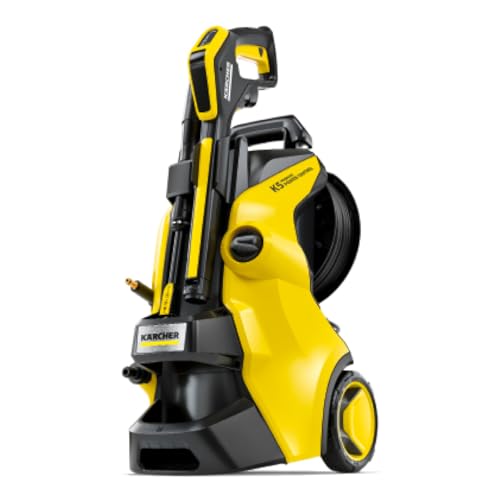
Kärcher K5 Premium Smart Control Pressure Washer, Car and Home Kit
ASIN B0CNG82V3H • $849.00 • Ships from Amazon AU
The Kärcher K5 Premium Smart Control is the strongest machine in this guide by the numbers that matter, and it's $849 from Amazon AU. It quotes 2,300 PSI and 8.3 litres a minute, about 5,000 cleaning units, roughly a third more than the K4. That extra flow is what makes big driveways, long fences and decks go faster. It shares the #4 rank in Amazon AU's Pressure Washers category with the K4 on the same listing. The hose is 10 metres on a reel that rolls in and out easily, and the listing says the hose is protected and stored without taking up much space. It's sold by Amazon AU, so returns are simple.
The kit is the most complete here. The home kit has the T 5 surface cleaner and a litre of stone and facade cleaner, and the car kit adds a wash brush, a 0.3 litre foam jet and a litre of car shampoo. The Multijet lance lets you switch spray patterns without swapping lances, which saves time moving between the car and the driveway. Kärcher says the machine has a low centre of gravity so it sits safely on sloping driveways, which is a sensible detail on hilly Central Coast blocks. Listing data puts the machine at about 12kg. The Kärcher part number is 1.324-681.0. If you'd use every piece of that kit, it's the most complete package here.
Like the K4, the listing doesn't state the motor type or wattage, and the Smart Control name isn't explained in the listing features, so I wouldn't buy it for any app or connected feature without checking first. The shared rank means I can't tell how the K5 sells on its own. At 8.3 litres a minute, check your tap keeps up with the bucket test. For big driveways and frequent use, it's the one I'd choose. The extra metre of hose and the low centre of gravity both help on long, sloping driveways, and Kärcher accessories are easy to find.
Honest caveats: No motor type or wattage on the listing, and the Smart Control features aren't described in the listing data. The #4 rank is shared with the K4. At 8.3 litres a minute it needs a tap that can supply more than that, so do the bucket test first.
Best for: Big driveways, decks and fences, and anyone who'll use the car kit as well as the surface cleaner.
Pressure: 2,300 PSI • Flow: 8.3 L/min • Hose: 10m on reel • Kit: Multijet lance, T 5 surface cleaner, wash brush, foam jet • Detergents: Stone and facade cleaner 1L, car shampoo 1L • Weight: About 12kg (listing data) • Model: 1.324-681.0 • Seller: Amazon AU • Rank: #4 in Pressure Washers (Amazon AU, listing shared with K4)
View on Amazon AU
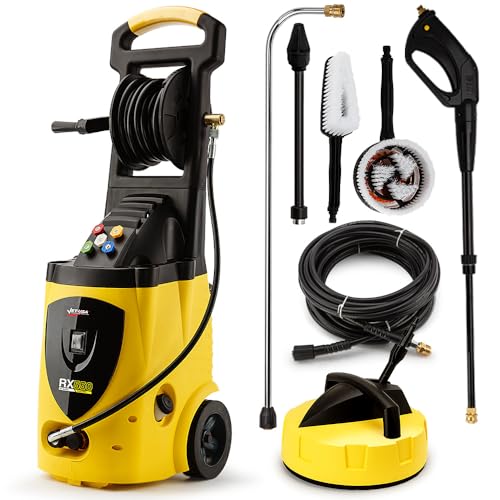
Jet-USA RX550 Electric High-Pressure Washer Ultimate Pack
ASIN B0757KJ2PF • $459.00 • Ships from Amazon AU
The Jet-USA RX550 Ultimate Pack is the lowest-priced machine in this guide at $459 from Amazon AU, and it's ranked #25 in Amazon AU's Pressure Washers category, so plenty of people are buying it. The headline is a 3,500 PSI peak, which is the biggest pressure claim here by a long way. The kit is generous for the money: a 30 metre commercial-grade hose, a turbo wand with a ceramic nozzle, five Pro-Tip nozzles, a roof lance for hard-to-reach jobs, a floor cleaner, brushes and a deck cleaner. It also has a built-in 1 litre detergent tank with an injection system. It's sold here by Amazon AU, and the brand's name aside, the listing is an Australian one with an AU barcode.
That 30 metre hose is the standout feature for me. It means you can leave the machine near the tap and power point and walk the hose around the house, rather than dragging the machine and an extension lead behind you. The floor cleaner does the job of a surface cleaner on paths and driveways, and the roof lance helps reach second-storey windows and eaves from the ground, though I'd keep it well away from roof tiles. Listing data puts it at about 30kg, so it's heavy compared with the Kärchers. The listing identifies the model by barcode, 9348948004904, which is worth keeping with the receipt. Five nozzles cover most outdoor jobs around a house.
The 3,500 PSI is a peak figure, and the listing doesn't state a flow rate, a wattage or a motor type, so I can't compare its real cleaning power with the others. A 30 metre hose also loses some pressure along its length compared with a short one. At about 30kg, it's a lot to lift into a ute. For a big property where hose reach and kit matter most, it's a reasonable pick, but I'd go in knowing the headline number is a peak. Keep the spare nozzles in their holder, because they go missing fast.
Honest caveats: The 3,500 PSI is a peak claim, and the listing gives no flow rate, wattage or motor type to judge it by. At about 30kg in listing data it's the heaviest here. A 30 metre hose drops some pressure over its length compared with a short one.
Best for: A large property where long hose reach and a full kit matter more than verified cleaning figures.
Pressure: 3,500 PSI peak (listing claim) • Flow: Not stated on the listing • Hose: 30m commercial grade • Kit: Turbo wand, 5 nozzles, roof lance, floor cleaner, brushes • Detergent: Built-in 1L tank • Weight: About 30kg (listing data) • Seller: Amazon AU • Rank: #25 in Pressure Washers (Amazon AU)
View on Amazon AU
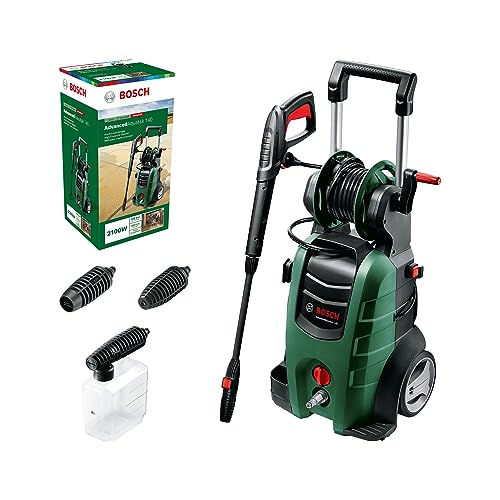
Bosch AdvancedAquatak 140 Electric Pressure Washer, 2100W Induction Motor
ASIN B07QMKG353 • $539.00 • Ships from Amazon AU
The Bosch AdvancedAquatak 140 is $539 from Amazon AU, and it's the lowest-priced machine in this guide that says induction motor on the listing. It's rated at 2,100W and 2,030 PSI, which Bosch also gives as 140 bar, and it's ranked #53 in Amazon AU's Pressure Washers category on a listing it shares with the AdvancedAquatak 150. An induction motor has no carbon brushes to wear out and generally runs quieter and lasts longer than the universal motors in most consumer machines. The 8 metre high-pressure hose sits on a reel with push-fit connections. Bosch includes a selection of nozzles and a 550ml high-pressure detergent nozzle. It's sold by Amazon AU, so returns go through the local process.
The listing states a 2 year warranty, plus an extra year if you register the machine online with MyBosch, which makes 3 years and is the longest warranty stated in this guide. Register it the day it arrives, because that third year only counts if you do. The listing mentions double filtration on the water inlet, which matters on tank or bore water with grit in it, and says the machine is self-priming capable, so it can draw from a tank with the right accessory. It has a metal telescopic handle, large wheels and on-board storage for the nozzles and lance. Listing data puts it at about 21kg, heavier than a Kärcher because of the induction motor. The Bosch part number is 06008A7D40.
The listing doesn't state a flow rate, so I can't put it into cleaning units against the Kärchers, and there's no surface cleaner in the box, so budget for one if driveways are the main job. The shared listing means the #53 rank covers the 150 as well. At about 21kg it's heavier to lift into a car. For anyone who wants an induction motor and the longest warranty here, it's the one I'd look at first, and the inlet filtering suits rural water supplies. Spare nozzles and hoses are easy to get.
Honest caveats: No flow rate on the listing, so it can't be compared on cleaning units. No surface cleaner in the box. The #53 rank is shared with the AdvancedAquatak 150. The third warranty year depends on registering the machine online with MyBosch.
Best for: Regular use where an induction motor and a 3 year warranty (with registration) matter more than the kit.
Power: 2,100W induction motor • Pressure: 2,030 PSI (140 bar) • Flow: Not stated on the listing • Hose: 8m on reel, push-fit • Extras: Nozzles, 550ml detergent nozzle, double filtration • Warranty: 2 years, plus 1 with MyBosch registration • Weight: About 21kg (listing data) • Seller: Amazon AU • Rank: #53 in Pressure Washers (Amazon AU, listing shared with AdvancedAquatak 150)
View on Amazon AU
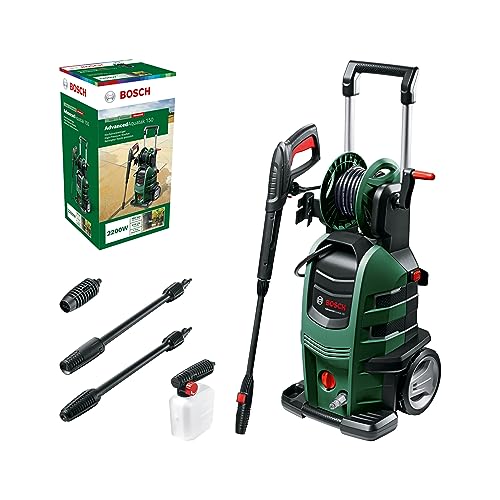
Bosch AdvancedAquatak 150 Electric Pressure Washer, 2200W with Metal Quad Pump
ASIN B0BG1LNXSQ • $602.00 • Ships from Amazon AU
The Bosch AdvancedAquatak 150 is the heavy-use pick in this guide at $602 from Amazon AU. It's rated at 2,200W and 2,175 PSI with an induction motor, and it's the only machine here that lists an all-metal alloy quad pump with four cylinders. A metal pump head copes with heat and long sessions better than a plastic one, and four pistons share the work instead of three. It shares the #53 rank in Amazon AU's Pressure Washers category with the AdvancedAquatak 140. Bosch says it suits large vehicles, boats, outdoor furniture, footpaths, driveways, fences, brick and patios, which is a fair list for a machine of this size. It's sold by Amazon AU.
The kit includes a high-pressure gun, an 8 metre hose on a reel, a variable fan jet lance, a rotary fan lance, a fixed fan nozzle, a 550ml detergent nozzle and a metal water filter. The rotary lance is the one for mossy concrete and stubborn grime, and the variable fan is the one for cars, cladding and anything painted. A metal inlet filter is sturdier than the plastic mesh most machines use. It's self-priming capable, though the listing notes the accessory for drawing from a tank is sold separately. Listing data puts it at about 22kg, the second heaviest here. The Bosch part number is 06008A7740, which is the code to quote for parts. The metal telescopic handle and large wheels help on rough ground.
At 2,200W it's the closest machine here to the 2,400W limit of a standard 10A socket, so plug it straight into an outdoor power point and skip thin extension leads. The listing doesn't state a flow rate or a warranty term, and there's no surface cleaner in the box. For boats, caravans and anyone who'll run it for long sessions every weekend, it's the one I'd buy, mainly for that metal pump. The induction motor and metal pump are the two parts I'd most want in a machine that runs for hours at a time, and that's what sets it apart from the K5, which has more flow and more kit but doesn't state its motor or pump type on the listing.
Honest caveats: At 2,200W it sits closest to a standard socket's 2,400W limit, so avoid long extension leads. No flow rate or warranty term on the listing, and no surface cleaner in the box. The accessory it needs to self-prime from a tank or bucket is sold separately, so add it to the order if you're on tank water.
Best for: Long, frequent sessions on boats, caravans and big hard surfaces where a metal pump earns its keep.
Power: 2,200W induction motor • Pressure: 2,175 PSI • Pump: All-metal alloy quad pump, 4 cylinders • Flow: Not stated on the listing • Hose: 8m on reel • Kit: Rotary and variable fan lances, fixed fan nozzle, 550ml detergent nozzle • Weight: About 22kg (listing data) • Seller: Amazon AU • Rank: #53 in Pressure Washers (Amazon AU, listing shared with AdvancedAquatak 140)
View on Amazon AUSide-by-side comparison
What we see fail in the workshop: pressure washers
Pressure washers that come in mostly have electrical faults rather than worn-out pumps. Water, vibration and high current through a long lead are hard on switches, cords and motors, and the faults usually start small. Catch them early and it's often a part or a lead rather than a new machine. These are the three I'd want every owner to know about before the warranty runs out.
Tripping the RCD the moment it starts
A pressure washer that trips the safety switch as soon as it starts usually has water where it shouldn't be: in the motor, in the switch housing or in the plug and lead. It can also be a motor winding breaking down. Don't keep resetting the RCD and trying again, because the RCD is doing its job and telling you there's leakage to earth. Unplug it, let it dry somewhere warm for a couple of days and check the lead and plug for cuts and corrosion. If it still trips, it needs testing before anyone uses it again.
Motors cooked on long extension leads
Running a 2,000W-plus machine on a long, thin extension lead drops the voltage at the motor, so it draws more current and runs hot. Do that every weekend and the motor windings or the brushes on a universal motor wear out early, and sometimes the thermal cut-out starts tripping halfway through a job. The fix is simple: plug the machine into the outlet and use a longer water hose instead of a longer power lead. A burnt smell or a motor that slows under load is the warning sign. Check the lead's rating plate if you can't avoid one.
Pulsing, humming and the stuck unloader
A machine that pulses, hums without spraying or won't switch off when you release the trigger usually has a sticking unloader valve or a pressure switch fault in a total stop system. Grit from the water supply, a clogged inlet filter or a pump that's been run dry are the usual causes. Clean the inlet filter, check the tap supply with a bucket and make sure the nozzle isn't partly blocked. If it still pulses, the valve or switch needs attention, and running it in that state wears the motor and pump faster.
Decision tree: which one should you actually buy?
- Typical house with a driveway, paths and a car? → The Kärcher K4 Power Control at $609: 2,100 PSI, 7 litres a minute and a T 5 surface cleaner in the box.
- Big driveway, decks and fences? → The Kärcher K5 Premium at $849 has the most flow here at 8.3 litres a minute, plus a car kit and surface cleaner.
- Want an induction motor and the longest warranty? → The Bosch AdvancedAquatak 140 at $539: induction motor and 2 years plus 1 more with MyBosch registration.
- Boat, caravan or long weekend sessions? → The Bosch AdvancedAquatak 150 at $602 has an induction motor and the only all-metal quad pump in this guide.
- Large block where hose reach matters most? → The Jet-USA RX550 Ultimate Pack at $459 has a 30 metre hose and the most kit, but its 3,500 PSI is a peak figure.
- Pressure washer tripping the power, humming or smelling hot? → Stop using it, unplug it and let it dry, then bring it to our Erina workshop and we'll tell you whether it's the motor, the switch or the lead before you spend anything.
Frequently asked questions
What PSI pressure washer do I need for a driveway?
For a concrete driveway, a machine around 2,000 to 2,300 PSI with a flow rate of 7 litres a minute or more does the job well, especially with a surface cleaner attachment. Flow matters as much as pressure, because it's the water volume that carries the dirt away. A higher PSI with a low flow rate will take much longer to clean the same area. Multiplying PSI by flow in gallons per minute gives cleaning units, which is a more honest way to compare machines than PSI alone.
Is an induction motor pressure washer worth it?
If you'll use it often or for long sessions, generally yes. An induction motor has no carbon brushes to wear out, runs slower and quieter, and usually lasts longer than the universal motors in most consumer machines. The trade-off is weight and price, since induction machines are heavier and cost more. For a few short jobs a year, a well-made universal motor machine is fine. For weekly use on boats, caravans or big driveways, an induction motor is the safer long-term bet.
Can I use a pressure washer on an extension lead?
It's better not to. A long, thin lead drops the voltage at the motor, so it draws more current and runs hotter, which shortens its life and can trip the thermal cut-out. Plug the machine straight into an outdoor socket with RCD protection and use a longer water hose to reach the job. If you must use a lead, choose a short, heavy-duty outdoor lead rated for 10A, unroll it fully and keep the connections off wet ground.
Why does my pressure washer pulse or surge?
Pulsing usually means the pump isn't getting enough water or the unloader valve is sticking. Check the tap is fully on, do a bucket test to confirm your supply exceeds the machine's flow rate, clean the inlet filter and make sure the nozzle isn't partly blocked. Air in the system can also cause it, so run water through the hose and gun before starting the motor. If it still pulses after that, the unloader valve or pressure switch probably needs cleaning or replacing.
Can I pressure wash my car?
Yes, carefully. Use a wide fan nozzle, keep the lance well back from the paint and stay off badges, rubber seals, stone chips and the engine bay. High pressure can lift loose paint at the edge of a chip and force water past door seals into the wiring inside the doors. A foam jet with a car shampoo made for pressure washers loosens dirt first, so you need less pressure to rinse it off. Never use a rotary or turbo nozzle on paintwork.
How do I store a pressure washer between uses?
Disconnect the water and power, squeeze the trigger to release any trapped pressure, then drain the water from the pump, hose and gun. Coil the hose loosely on its reel without kinks and keep the machine somewhere shaded, because sunlight dries out O-rings and hoses. Rinse the inlet filter before you put it away. In the rare cold snap, keep it somewhere frost-free, as water left in the pump can crack it. A smear of silicone grease on the quick-connect O-rings stops them drying out between uses.
Related buying guides
Pressure washer tripping the power or humming? Get it checked
Most pressure washers that stop working have water in the switch or motor, a cooked motor from a long extension lead, a damaged power lead or a sticking unloader. Bring yours to our Erina workshop and we'll test it and tell you what's failed, and whether it's worth fixing, before you spend anything on a new machine.
Visit our Erina workshop Book Online