Prices from Amazon AU, updated daily. Swipe or use the arrows for more.
Disclosure: This article contains affiliate links to amazon.com.au. If you buy through one of these links iFix may earn a small commission at no extra cost to you. It doesn't change which products we recommend. We focus on what actually lasts based on 16 years of repair-shop experience.
Quick summary6 picks
- Canoly C16 Cold Press Juicer about$149.99150mm chute, sorbet and nut milk.
- NutriBullet Slow Juicer about$187
- Ninja NeverClog Cold Press Juicer about$149150W.
- Wide chuteTUUMIIST Cold Press Juicer about$92.95
- Most PremiumKuvings C8000J Cold Press Juicer about$449.95
- Entry PickKeenray EL18 Cold Press Juicer about$79.99
Cold press or centrifugal, and why it matters
A cold press juicer, also sold as a slow or masticating juicer, crushes produce with a single plastic auger turning at somewhere around 50 to 80 RPM. A centrifugal juicer, like the Breville Juice Fountain range, shreds it on a flat blade disc spinning at thousands of RPM and flings the juice through a basket. Both make juice, but they wear out in completely different ways, and that's the part most reviews skip.
This guide only covers the slow, auger type. I left the centrifugal machines out on purpose, including the ones with "cold" in the name, because they're a different machine with a different set of faults. If you mostly want smoothies with the whole fruit in, a jug machine from the blender guide is usually the better fit and it's quicker to clean.
The slow design has real advantages for a household that juices most days. It's quieter, it handles leafy greens and celery far better, and the motor is small because torque comes from gearing rather than speed. The trade-off is time: you feed it slower, and cleaning the screen properly takes longer than most people expect when they're standing in the shop.
How a slow juicer actually works
Inside the base there's a small motor, a reduction gearbox and a drive shaft that pokes up through a seal into the juicing bowl. The auger sits on that shaft, inside a mesh screen, and the screen sits inside a rotating brush holder on most models. Produce goes down the chute, the auger's flights drag it down and press it against the screen, and juice passes through the mesh while the dry pulp is pushed out a separate exit.
Every one of those parts is a wear item, and they're mostly plastic. The auger is usually a hard plastic like Ultem or a similar engineering resin, sometimes with a steel tip where it meets the drive. The screen is a fine stainless mesh moulded into a plastic frame. The brushes that wipe the screen are silicone. When something goes wrong, it's usually at a joint between two of those materials.
The gearbox is the part people don't think about. Reducing a motor to 50-odd RPM takes a fair bit of gearing, and on lower-priced units those gears are plastic too. If you force a stalled auger by holding the button down, it's the gearbox that takes the strain. A stripped gear sounds like the motor running happily while the auger sits still, and that's one of the most common faults we see with these.
The auger and screen are the parts that wear
The mesh screen is the first part that gives up. Fine stainless mesh is moulded into a plastic ring, and after a year or two of daily scrubbing the mesh can lift from the frame or tear at the bottom edge. Once there's a hole, pulp goes straight into the juice and the auger starts riding on the wrong surface, which then wears the auger itself.
Augers crack too, mostly at the base where the drive shaft engages. A juicer that's been run with frozen fruit, hard ginger root in big chunks or whole carrots fed too fast puts a lot of twisting load on that spot. A crack there often starts as a faint click with every revolution, so if yours begins clicking, stop using it and look closely before it splits.
Before you buy, check whether the screen and auger are sold separately in Australia and what they cost. Big brands like Ninja and NutriBullet have local parts channels, while smaller brands may only offer spares by emailing the seller. If a replacement screen costs half the price of the juicer, that tells you how long the brand expects you to keep it, and I'd weigh that before the chute size.
Motor and gearbox faults are a different story. If the base hums but won't turn, or it trips and won't reset after cooling, bring it into our Erina workshop and we'll tell you whether it's a switch, a thermal cutout or a stripped gear before you spend anything. A lot of the time it's the interlock switch, which is a small part and an easy repair.
Motor overload, reverse and the safety interlock
Every juicer here has a thermal or overload cutout in the motor. It's there to stop the windings cooking when the auger jams, and it does its job, but people often read it as the juicer dying. If the motor stops mid-batch and won't restart, unplug it, leave it 20 to 30 minutes and clear whatever's packed in the bowl before you try again.
The reverse button is the other tool you've got. Reverse backs the auger off a jam so the pulp can loosen, and a couple of short reverse taps usually clears it. What you shouldn't do is flick between forward and reverse rapidly under load, because that slams the gearbox in both directions. Give it a second or two in each direction.
It's also worth knowing what the motor rating means. A 150W slow juicer isn't weak compared with a 1,000W centrifugal one, because the gearbox multiplies the torque at the auger many times over. What a low wattage does mean is that the motor runs hot quickly if it's stalled, so the cutout trips sooner. Keep batches moving, stop when the note of the motor drops, and you'll rarely see it trip at all.
The interlock is a small switch or magnet that stops the motor unless the bowl and lid are seated properly. Juice and pulp get into it over time, and a sticky interlock gives you a juicer that runs one day and refuses the next. Wiping the contact area dry after cleaning, and keeping the base out of the sink, prevents most of these. They're small, low-cost switches but a pain to get at, so prevention is the better option.
Pulp jams and what causes them
Most jams come from three things: fibrous produce fed in long strands, too much fed at once, and produce that's too dry. Celery is the classic one. Long strings wrap around the auger and bind it against the screen, so cut celery into 2 to 3 cm lengths across the grain and it goes through without a fuss. Kale stems, pineapple core and ginger behave the same way.
Alternating soft and hard produce helps a lot. A handful of leafy greens followed by a piece of apple or carrot lets the harder piece push the soft material through. Feeding a whole bag of spinach in one go packs the bowl solid, and the auger can't move it. Ninja's NeverClog pitch is mainly about the shape of the auger and chute coping with exactly this.
Wide chutes are good for prep time, but they make jams more likely because people drop in whole apples and oranges. A chute that wide will happily swallow a large apple, then the auger has to crush the whole thing at once. I'd still cut hard fruit in half on any of these, and peel citrus first, because the pith and skin are hard on the screen.
Cleaning time is the real cost
The bit that makes people give up on slow juicers is cleaning. You've got the auger, the screen, the brush holder, the bowl, the lid, the chute and the jug, and pulp gets into all of them. On most models you're looking at five to ten minutes at the sink, and the screen needs a proper scrub with the supplied brush, not just a rinse.
Clean it straight away. Pulp that dries on the mesh sets hard and plugs the holes, and a half-blocked screen pushes more load onto the motor next time you use it. If the screen does get clogged, a soak in warm water with a little dishwashing liquid loosens it, and an occasional soak in a mild citric acid solution shifts the white film that builds up in hard-water areas.
Dishwasher-safe parts help, but the screen still does better hand-washed because dishwasher heat can warp the plastic frame over time. If you already own a food processor, you'll know the feeling of putting it away rather than cleaning it. A juicer you can strip in three steps gets used, and one that takes ten gets stuck in a cupboard.
A routine that works for most people: run a cup of water through the juicer while it's still assembled to flush the screen, then strip it and rinse each part before the pulp dries. Scrub the screen from the inside with the round brush, check the shaft seal for cracks once a week, and leave everything to air dry before you put it back together. Ten minutes a day is easier than a long soak at the weekend.
Silicone brushes and seals stain from beetroot, carrot and turmeric. That's cosmetic and doesn't affect how it runs. What does matter is the seal at the bottom of the bowl around the drive shaft, because once that hardens or tears, juice gets down the shaft and into the base, and that's when we see corrosion on the switch and the motor terminals.
Chute size, capacity and counter space
Chute sizes run from about 77mm up to roughly 147mm across the juicers on Amazon AU. A bigger chute means less chopping, and some models have a built-in cutter at the top of the auger so whole fruit gets pre-sliced as it goes down. That's handy, but it adds another sharp part to clean, and those cutting edges dull over time just like a knife.
Capacity numbers on these listings are confusing. A 2.6L figure on one model may be the hopper volume, another quotes the juice jug, and a third quotes the pulp container. The jug and pulp bin sizes matter more in practice, because a small pulp bin fills halfway through a batch and you'll have to stop, empty it and start again with a full bowl.
These are tall machines. Vertical slow juicers stand 40 to 46 cm high, which means they often won't fit under overhead cupboards with the lid on. Measure before you buy if you plan to leave it out on the kitchen counter, and remember that a juicer you have to lift down and set up each time is one you'll use less.
Weight matters for the same reason. The units here run from about 3.6 kg up to 6 kg, and a heavier machine sits steadier when you push hard produce down the chute, but it's more awkward to lift out of a low cupboard every morning. If it's going to live in a cupboard, I'd lean towards the lighter one and a smaller chute rather than the biggest machine on the list.
Power, running cost and electrical safety
Slow juicers draw very little power. The Ninja is rated at 150W, so at the AU average of roughly 33c per kWh, the Ninja costs about 5c for an hour of flat-out juicing. Running cost isn't a factor here at all. The real cost of ownership is screens, augers and seals over the years, so price those parts rather than the electricity.
Check for an RCM mark on the base or the plug. All the units here are sold by Amazon AU or AU storefronts with Australian plugs, which is what you want for any appliance that lives next to a sink. Overseas listings with US or UK plugs, or a model code ending in -US or -UK, turn up regularly in this category and I've left all of them out, because an adaptor on a wet counter is the last thing you want. A juicer with a water-damaged base is exactly the kind of thing the water damage guide covers, and it usually starts with a perished shaft seal.
Don't run a juicer from a powerboard that's already carrying a kettle and a toaster. A juicer only draws a little, but the kettle can use most of a 10A circuit on its own, and an overloaded powerboard is a fire risk regardless of which appliance tips it over. Plug it straight into a wall socket, keep the cord clear of the wet area and unplug it before you pull the bowl off.
The 6 picks, $80 to $399
Prices are Amazon AU at time of writing (17 November 2026) and move week to week. Ranks are Amazon AU category sales ranks, checked the same day.

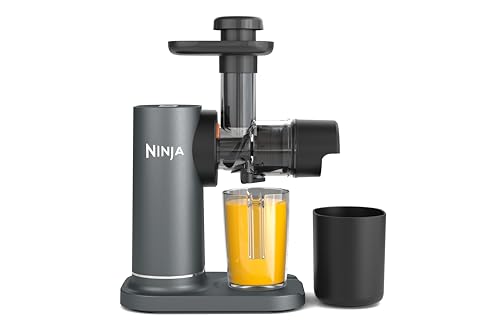
Ninja NeverClog Cold Press Juicer (JC151ANZ)
ASIN B0DM5L3NY2 • $149 • Ships from Amazon AU
The Ninja NeverClog is one of the best-selling juicers on Amazon AU at the moment, sitting at #1 in the Juicers category, and it's sold and shipped by Amazon AU at $149. The model number on the listing is JC151ANZ, and the ANZ suffix is the Australian and New Zealand version, which is what you want for the plug and the warranty. It runs a 150W base that turns the auger slowly with plenty of torque. Ninja's pitch is that the auger and chute are shaped to keep fibrous produce moving without jamming, and that lines up with the most common reason slow juicers stall. It's also the lightest machine here at about 3.6 kg according to the listing, so it's easy to lift down from a cupboard and set up.
You get two interchangeable filters, one for less pulp and one for more, which is the same idea as the fine and coarse screens on other brands. The juice jug holds 700ml and the pulp container 1L, so you can get through a decent family batch before you have to empty anything. There are two one-touch programs plus reverse, and reverse is the one you'll actually use when something binds. The listing says the parts are dishwasher safe and BPA-free, and there's an anti-drip lever on the spout that stops juice running down the front of the base. That spout matters more than it sounds, because juice dripping onto the base is how the switch area ends up sticky.
In my experience Ninja is a brand where you can get spare parts in Australia without too much hunting, which matters on a machine where the screen is a wear part. Check the current listing for the filter part numbers before you commit and price a spare screen at the same time. The listing doesn't state the chute diameter or the auger speed in RPM, so I can't compare those directly with the others here. It doesn't state a warranty length either, so look that up on Ninja's site. Feed celery in short lengths and use reverse rather than force when it slows. For most people who juice a few times a week, this is the one I'd buy.
Honest caveats: the listing doesn't state the chute diameter, auger RPM or warranty length. The 150W rating is low on paper, though torque comes from gearing, not wattage. Two filters are supplied, but spare filter part numbers aren't listed. The listed weight of about 3.6 kg is light for a slow juicer. Check the screen price before you buy.
Best for: Most households that juice a few times a week and want a big-brand machine with local parts support.
Type: Vertical cold press (slow) juicer • Motor: 150W high-torque base • Filters: 2 interchangeable (low and high pulp) • Juice jug: 700ml • Pulp container: 1L • Programs: 2 one-touch plus reverse • Model: JC151ANZ • Seller: Amazon AU • Rank: #1 in Juicers (Amazon AU)
View on Amazon AU
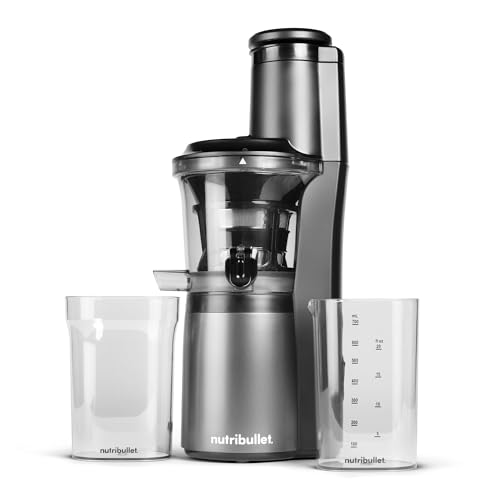
NutriBullet Slow Juicer (NBJ07300)
ASIN B09HS5ZRQP • $187 • Ships from Amazon AU
The NutriBullet Slow Juicer is the longest-running model in this list and the big-brand pick here, at $187 from Amazon AU. It sits at #32 in Juicers, and the model number on the listing is NBJ07300. NutriBullet lists a high-torque, low-speed motor and a steel-tipped auger, and the steel tip is the detail I like most. It's where the auger meets the drive, which is the exact spot where all-plastic augers crack under load. The listing gives a 1-year manufacturer warranty, which is shorter than some brands but is at least stated plainly. It's a heavier unit at about 6 kg, so it's steadier on the counter but less fun to lift in and out of a cupboard.
The feed chute is described as wide-mouthed, which cuts down on chopping, although the listing doesn't give the exact diameter. In the box you get the juicer, a recipe book and the user guide, and no extra screens, so this is a juice-only machine rather than a juice, sorbet and nut-milk unit. NutriBullet says it's quiet because of the slow speed, and that's true of the whole category. It stands about 46 cm tall, so measure under your cupboards before you plan to leave it out. The tall shape also means the pulp exit is higher off the counter, which makes it easier to fit a bowl underneath. It's a simple machine with fewer extras to clean.
NutriBullet has a solid presence in Australian stores and spare parts are generally easier to find than for smaller brands. The listing doesn't state the motor wattage, the RPM or the jug and pulp container sizes, so you're relying on the brand rather than the spec sheet here. Clean the screen straight after each use, because pulp dried in the mesh is what usually puts extra load on these motors. Keep the base out of the sink and dry the drive seal area each time. If you want a known brand and you don't need sorbet screens, this is a sensible machine at the price, and the steel tip on the auger is a real plus.
Honest caveats: the listing doesn't state the motor wattage, RPM, chute diameter or jug sizes. Only one screen is supplied, so there's no sorbet or nut-milk option. The warranty is 1 year from the manufacturer. At about 6 kg and 46 cm tall it won't suit every cupboard. Check spare auger pricing before you buy.
Best for: Buyers who want a well-known brand under $200 and only plan to make juice.
Type: Vertical slow (masticating) juicer • Auger: Steel-tipped • Motor: High-torque, low-speed (wattage not stated) • Chute: Wide-mouth (diameter not stated) • Weight: About 6 kg (listing) • Warranty: 1 year manufacturer • Model: NBJ07300 • Seller: Amazon AU • Rank: #32 in Juicers (Amazon AU)
View on Amazon AU
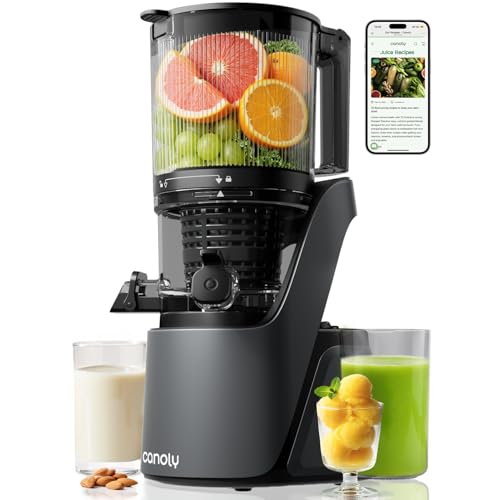
Canoly C16 Cold Press Juicer, 150mm Chute
ASIN B0GH6TFDH1 • $149.99 • Sold by Canoly AU on Amazon AU
The Canoly C16 is a wide-chute slow juicer at $150, sold by Canoly AU and fulfilled by Amazon, and it's #4 in Amazon AU's Masticating Juicers category. It's a lesser-known brand, so I'd normally be wary, but the listing is detailed. The feed chute is 150mm across with a 2.6L capacity, and a built-in pre-cutter that the maker says prevents clogging, so whole fruit and vegetables go in with less chopping than on the narrower machines here.
It comes with a 3-in-1 set of strainers: the title names juice, sorbet and nut milk, and a bullet describes dedicated filters for juice, almond milk and smoothies. The listing quotes a brushless AC motor at only 35 decibels, a 99.6% juice yield from its cold press design, and a pulp separator. The whole unit comes apart in 3 steps, and the removable parts are listed as BPA-free and dishwasher safe, with a removable pulp outlet. Fewer steps usually means a faster clean, and that's what keeps a juicer in use.
The catch with a smaller brand is spare parts and the warranty. The listing quotes a 15-year motor warranty, which is the maker's claim, so find out what it covers and who you'd claim with before you rely on it, and ask the seller whether screens and augers are sold in Australia. The listing doesn't state a wattage, auger speed or weight. Use the finest strainer for soft fruit and a coarser one for celery and greens, because fine mesh packs up quickly with fibre.
Honest caveats: this is a smaller brand and spare parts availability in Australia isn't stated. The 35 decibel, 99.6% yield and 15-year motor warranty figures are the maker's claims. The listing doesn't give a wattage, RPM or weight.
Best for: A first slow juicer for weekly use, with sorbet and nut-milk strainers and a wide chute.
Type: Vertical cold press (slow) juicer • Chute: 150mm • Capacity: 2.6L • Strainers: 3-in-1 (juice, sorbet, nut milk) • Motor: Brushless AC, 35dB (listing) • Motor warranty: 15 years (maker's claim) • Wattage: Not stated on the listing • Seller: Canoly AU (Amazon fulfilled) • Rank: #4 in Masticating Juicers (Amazon AU)
View on Amazon AU
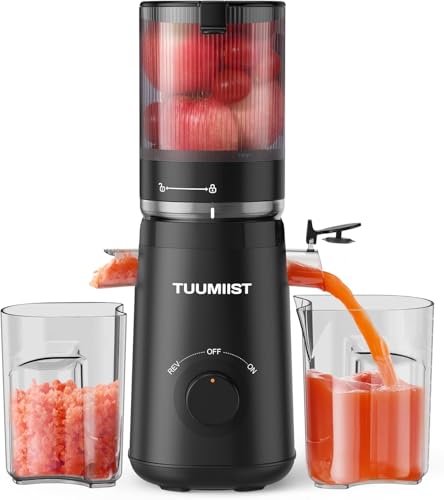
TUUMIIST Cold Press Juicer, 5.8-inch Feed Chute
ASIN B0FDLD6HCZ • $92.95 • Sold by pp-au on Amazon AU
The TUUMIIST is the one for people who hate chopping, and it's $93 from pp-au, an Australian storefront. It ranks #3 in Amazon AU's Masticating Juicers category. The title gives a 5.8-inch extra-large feed chute (about 147mm) and a 1.8L capacity, so whole-sized fruit and vegetables go in without being cut up first. The listing quotes an auger speed of 43 RPM and a noise level under 70 decibels.
It has a one-touch reverse button for clogs, which the listing pitches at coarse fibres like ginger and celery. The filter is a one-piece design rather than a fine net, the parts are removable for cleaning, and there's no cutter blade at the top. The listing says the parts are BPA-free and the unit carries a 2-year warranty. It only runs once it is fully assembled, with the hopper turned to align with the lock mark, which is worth knowing the first time it refuses to start.
The chute size is the thing to check. The title says 5.8 inches and the description says 5.3 inches, so treat it as a wide chute of roughly 135 to 147mm and not a firm figure. A wide chute tempts people to drop in whole hard fruit, which is where jams start, so I'd still halve large apples and peel oranges. The listing doesn't state the wattage, so I can't compare the motor with the others, and the warranty is the seller's own, so keep the order confirmation.
Honest caveats: the chute size is given as 5.8 inches in the title and 5.3 inches in the description. The listing doesn't state wattage. The 2-year warranty is the seller's own, so keep the order confirmation. Halve hard fruit even with the wide chute.
Best for: People who want the least chopping and a low price.
Type: Vertical cold press (slow masticating) juicer • Chute: 5.8 inch in the title, 5.3 inch in the description • Capacity: 1.8L (as listed) • Speed: 43 RPM • Noise: Under 70 dB (listing) • Motor: Wattage not stated • Clog release: One-touch reverse • Warranty: 2 years (seller) • Seller: pp-au • Rank: #3 in Masticating Juicers (Amazon AU)
View on Amazon AU
Keenray EL18 Cold Press Juicer (200W, 80mm Chute)
ASIN B0BWHDJQ7W • $79.99 • Ships from Keenray AU
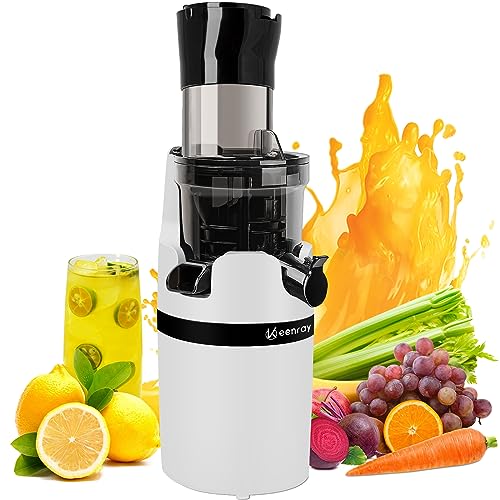
The Keenray EL18 is the lowest-priced juicer on this page at $80, sold by Keenray AU, a brand storefront on Amazon AU, and it ranks #6 in the Masticating Juicers category. It is a vertical slow masticating juicer, and the listing gives a 200W motor, a 50 to 65 RPM auger and a noise level below 60 decibels. That is the same slow-auger design as every other pick here, just in the plainest and least expensive form, so it suits someone who wants to find out whether they will actually juice every week before spending $150 or more.
The listing describes an 80mm feed chute and a 1L capacity, so it takes larger pieces than a standard narrow chute but still needs more chopping than the TUUMIIST or the Canoly at around 147 to 150mm. The reverse function is the feature that matters most on a juicer at this price, because reverse is what clears a stalled auger. The listing also describes a motor-protection chip that pauses the machine every 20 minutes, which is worth knowing mid-batch, since it will stop on its own. The box includes a safety lock, two collector cups and a cleaning brush, and the brush is what you will use on the screen straight after each batch.
Keenray states a 1-year warranty and points buyers to the after-sales email address in the instruction manual, so keep the order confirmation and the manual. The listing does not say what the auger is made of, and it does not say whether spare screens and augers are sold in Australia, so ask the seller before you buy and price a spare screen, because the screen is the first part to wear. Clean the mesh straight after each use, before the pulp dries in it.
Honest caveats: the 80mm chute means more chopping than the wider-chute picks here. Keenray is a lesser-known brand, so check where spare screens and augers come from. The motor-protection pause every 20 minutes will interrupt a very large batch.
Best for: Buyers who want the lowest-priced slow juicer on this page, with reverse for jams, and will chop larger produce first.
Type: Vertical cold press (slow masticating) juicer • Motor: 200W • Speed: 50 to 65 RPM • Chute: 80mm • Capacity: 1L (as listed) • Noise: Below 60 dB (listing) • Clog release: Reverse • Extras: Two collector cups, cleaning brush • Model: EL18 • Warranty: 1 year (Keenray) • Seller: Keenray AU • Rank: #6 in Masticating Juicers (Amazon AU)
View on Amazon AU
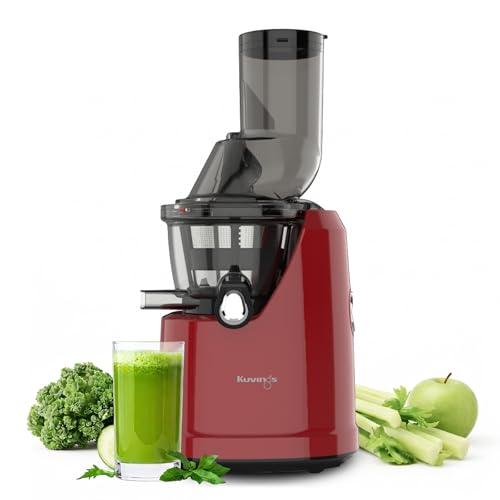
Kuvings C8000J Cold Press Juicer (Red)
ASIN B0GFGWQ63Y • $449.95 • Ships from Amazon AU
The Kuvings C8000J is the premium pick here at $399, sold and shipped by Amazon AU, and it sits at #39 in the Juicers category. The listing is for the red finish. It describes a low-speed cold press design with a 77mm wide feeding chute, and says apples, oranges, carrots, beetroot and leafy greens feed in with minimal cutting. That chute is narrower than the Canoly's 150mm and the TUUMIIST's 5.8-inch chute, so I'd still halve large apples and cut celery into short lengths across the grain.
The listing says the classic motor runs with low noise and vibration, which suits early mornings. It also says the low-speed pressing gives a strong yield, particularly from greens and celery, and that the strainer handles juices, smoothies, frozen desserts and nut butters. On cleaning, it says the simple assembly has fewer parts and rinses clean under the tap with the included cleaning tool. Fewer parts is the thing that keeps a juicer in use, because a long clean is why most slow juicers end up in a cupboard.
The listing contradicts itself on the strainers. The title says 3 strainers for juice, smoothie and sorbet, while one bullet says 1 strainer is included in the box. Check what is in the box on the live listing before you buy, and price a spare strainer at the same time because the screen is a wear part. The listing doesn't state the wattage, RPM, weight, dimensions, jug size or warranty length either, so look those up on Kuvings' site, and ask where spare strainers and augers come from in Australia. Clean the strainer straight after each batch, before the pulp dries in the mesh.
Honest caveats: the strainer count is inconsistent between the title (3) and a bullet (1). The listing doesn't state wattage, RPM, weight, jug size or warranty. It is the highest-priced juicer on this page. Check spare strainer and auger availability before you pay.
Best for: Buyers who want a wide-chute premium slow juicer from Amazon AU and will confirm the strainer set first.
Type: Cold press (slow) masticating juicer • Chute: 77mm wide • Strainers: Title says 3, a bullet says 1 • Finish: Red • Model: C8000J • Warranty: Not stated on the listing • Seller: Amazon AU • Rank: #39 in Juicers (Amazon AU)
View on Amazon AUSide-by-side comparison
| Product | Price | Best for |
|---|---|---|
| Canoly C16 Cold Press Juicer | ~$149.99 | A first slow juicer with sorbet and nut-milk screens |
| NutriBullet Slow Juicer | ~$187 | A well-known brand under $200, juice only |
| Ninja NeverClog Cold Press Juicer | ~$149 | Most households, with a big brand behind the parts |
| TUUMIIST Cold Press Juicer | ~$92.95 | Anyone who hates chopping fruit (wide chute) |
| Kuvings C8000J Cold Press Juicer | ~$449.95 | A premium slow juicer with a 77mm chute |
| Keenray EL18 Cold Press Juicer | ~$79.99 | The lowest price for a slow juicer with reverse, if you will chop larger produce |
What we see fail in the workshop: cold press juicers
Slow juicers come in with a short list of faults, and most of them start with a jam or with juice getting where it shouldn't. The motor itself is rarely the problem. It's the parts around it, the gears, the seal and the switches, that give up first, and nearly all of them can be checked before you decide the whole machine is finished.
Stripped gearbox after a forced jam
The motor runs, you can hear it, but the auger doesn't turn. That's nearly always a stripped gear in the reduction gearbox, and it usually follows a jam where someone held the button down instead of using reverse. On some models the gear is a replaceable part and on others it's moulded into the drive assembly. Either way, it's worth a look before you replace the whole juicer, because the motor is usually fine and the gearbox is the only thing that's failed. Using reverse early, instead of forcing it, is what stops this happening in the first place.
Juice in the base and a sticky interlock
A hardened or torn shaft seal lets juice track down the drive shaft into the base. Sugary juice dries sticky and attracts more, and it gums up the interlock switch so the juicer refuses to start unless you jiggle the bowl. Left long enough it corrodes the switch terminals and the motor connections. If your juicer starts and stops at random, stop using it and get the base checked, because a dried-out sticky switch is a lot easier to fix than corroded terminals. Checking the seal at the bottom of the bowl once a week catches it early.
Thermal cutout tripping every batch
A juicer that cuts out every few minutes is usually overheating because the screen is half blocked or the produce is going in too fast. Clean the screen properly, including a soak to clear dried pulp from the mesh, and feed more slowly. If it still trips on a clean screen and soft fruit, the cutout or the motor windings may be on the way out, and that's when it's worth bringing in so we can measure it rather than guess. Thermal cutouts are low-cost parts, but they're there for a reason, so never bypass one.
Decision tree: which one should you actually buy?
- Want one juicer that suits most households? → The Ninja NeverClog at $149 ranks #1 in Amazon AU's Juicers category, it's light and it's built around avoiding jams.
- Want a big brand under $200? → The NutriBullet Slow Juicer at $187 has a steel-tipped auger and a stated 1-year warranty, juice only.
- Want sorbet and nut-milk strainers on a smaller outlay? → The Canoly C16 at $150 comes with 3-in-1 strainers for juice, sorbet and nut milk and a 150mm chute.
- Hate chopping fruit? → The TUUMIIST at $93 has a wide 5.8-inch feed chute and a one-touch reverse. Check the chute size on the listing first, as the title and description differ.
- Want the lowest price for a slow juicer with reverse? → The Keenray EL18 at $80 has a 200W motor and reverse for jams, but its 80mm chute means more chopping.
- Want a premium slow juicer with a wide chute? → The Kuvings C8000J at $399 has a 77mm chute and a fewer-parts clean, but check the strainer count on the listing first.
- Juicer humming but not turning, or cutting out? → Bring it to our Erina workshop. We'll check the gearbox, seal and interlock and tell you whether it's a part or a new juicer before you spend anything.
Frequently asked questions
Is a cold press juicer better than a centrifugal juicer?
It depends on what you juice and how much time you've got. A cold press juicer handles leafy greens, celery and wheatgrass far better and runs much quieter, because a slow auger crushes produce instead of shredding it at high speed. A centrifugal juicer is faster to feed and usually quicker to clean, and it's fine for hard fruit like apples and carrots. If you mostly juice greens, go cold press. If you want a quick apple and carrot juice before work, a centrifugal machine is usually less fuss.
Why does my slow juicer keep jamming?
Most jams come from long fibrous strands, too much produce at once or produce that's too dry. Cut celery and kale stems into 2 to 3 cm lengths across the grain, alternate soft and hard produce, and don't drop whole hard fruit into a wide chute. When it slows, stop and use reverse for a second or two rather than holding the button down. A half-blocked screen also makes jams more likely, so clean the mesh properly after every use.
How long should a cold press juicer last?
The motor in a decent slow juicer usually lasts many years because it runs slowly and draws little power. The parts that wear are the mesh screen, the auger, the silicone brushes and the shaft seal, and how long those last depends on how often you juice and how well you clean. Daily users often need a new screen within a couple of years. Check that spare screens and augers are sold in Australia before you buy, because that's what decides whether the juicer lasts.
Can I put a slow juicer's parts in the dishwasher?
Many listings say the parts are dishwasher safe, including the Ninja here. Even so, I'd hand-wash the mesh screen with the supplied brush, because dishwasher heat can warp its plastic frame over time and the jets don't clear dried pulp from the mesh well. The bowl, jug and pulp container usually handle the dishwasher fine. Never put the motor base in the dishwasher or the sink. Wipe it with a damp cloth and dry the area around the drive shaft.
How much power does a cold press juicer use?
Very little. The Ninja here is rated at 150W. At the AU average of roughly 33c per kWh, a 150W juicer running flat out for an hour costs about 5c, and most batches take ten to fifteen minutes. Running cost isn't worth worrying about with these. The real ongoing cost is replacement screens, augers and seals over the years, so check those prices before choosing between models.
Is it worth repairing a juicer?
Often, yes, if the fault is in the base. A stripped gear, a sticky interlock switch or a failed thermal cutout are usually much less than the cost of a new juicer, especially on a $250 to $400 machine. A cracked auger or torn screen is a parts order rather than a repair. If the motor itself has failed on a low-priced unit, replacing the juicer usually makes more sense. Bring it to an electronics repair shop and get it checked before you decide.
Related buying guides
Juicer humming, leaking or cutting out?
Most juicer faults are a stripped gear after a jam, a worn shaft seal letting juice into the base or a sticky interlock switch, and many of them are a part rather than a new machine. Bring it into our Erina workshop and we'll check the gearbox, seal and switch and tell you what it needs before you spend anything.
Visit our Erina workshop Book Online