Prices from Amazon AU, updated daily. Swipe or use the arrows for more.
Disclosure: This article contains affiliate links to amazon.com.au. If you buy through one of these links iFix may earn a small commission at no extra cost to you. It doesn't change which products we recommend. We focus on what actually lasts based on 16 years of repair-shop experience.
Quick summary5 picks
- CheapestYamaha DTX402K Electonic Drum Kit with… about$598
- Alesis Turbo Mesh Kit - 7 Piece Mesh… about$599
- Donner DED200 E Drum Set about$6408" screen.
- Roland TD-07DMK Electronic V-Drums… about$1,049
- Most PremiumAlesis Nitro Ultimate XL 10-Piece… about$1,149
Why most people buy an electronic kit
Nearly everyone who buys an electronic drum kit is solving a noise problem. An acoustic kit in a suburban house or a unit is loud enough to start a conversation with the neighbours, and an electronic kit with headphones turns most of that into a quiet tapping. That's the main job, and it's the yardstick I'd judge every kit in this guide against.
The second job is learning. Every kit here has a module with a metronome, play-along tracks or lessons, and the ones with Bluetooth or USB connect to learning apps on a tablet. For a teenager starting out, that's often more useful than an acoustic kit, because practice can happen at any hour without anyone else in the house noticing.
What an electronic kit won't do is feel exactly like an acoustic one, and how close it gets depends almost entirely on the pads. That's where the money goes in this band, and it's the first thing I'd look at on any listing. The number of sounds in the module comes a long way second.
One more framing point. The $500 to $1,500 band covers everything from a complete starter kit to the bottom of Roland's serious range, and the gap between them is mostly in the snare pad, the hi-hat and the module's editing. Decide early whether this is a kit for a learner who might stop, or for a drummer who'll play for years.
Mesh heads or rubber pads
Electronic pads come in two kinds. Rubber pads are solid, durable and simple, but they're harder under the stick, they bounce back less like a real drum and they're noisier to hit. Mesh heads are a tensioned woven head over a sensor, and they feel and rebound much closer to an acoustic drum, and they're quieter in the room.
Four of the five kits here list mesh heads on the snare and toms. The Roland TD-07DMK uses Roland's double-ply mesh, the Alesis Nitro Ultimate XL and Turbo Mesh use Alesis mesh heads, and the Donner DED200 lists mesh on the snare and toms. The Yamaha DTX402K listing describes silent pads but doesn't say mesh, so if mesh is what you want, confirm the pad type before ordering.
I left out the Roland TD-1K even though it's sold by Amazon AU. Its listing describes four rubber drum pads, and at $1,223 when I checked it was more than the all-mesh TD-07DMK at $1,049. That's an easy call. Mesh heads can also be tensioned like a real drum to change the feel, which rubber can't do, and that adjustment is worth having as a player improves.
Mesh heads do wear, though slowly. A head that's been played hard for a few years can go slack or develop a dent under the main playing spot, and that changes how the sensor reads it. Retensioning with the drum key usually brings it back, and replacement heads are a standard part on the major brands. I'd keep the drum key with the kit and check the tension every few months.
The snare and hi-hat are where kits differ
The snare is the pad you hit most, and the difference between a single-zone and a dual-zone snare is easy to hear. A dual-zone snare has a separate sensor for the rim, so a rimshot or a cross-stick sounds different from a hit on the head. The TD-07DMK lists an 8-inch dual-zone snare, the Donner lists an 8-inch dual-zone mesh snare and the Alesis Nitro Ultimate XL lists a 12-inch mesh snare.
The hi-hat is the other big one. On most starter kits the hi-hat is a pad on an arm with a separate pedal on the floor that tells the module whether it's open or closed. That works, but it doesn't move like a real hi-hat. The Alesis Nitro Ultimate XL is the only kit here with a stand-mounted movable hi-hat, and the listing says it works with a traditional hi-hat stand, which is sold separately.
Bigger pads matter more than people expect. A 6.5-inch tom is a small target for a learner, and a 10-inch or 12-inch pad is much closer to an acoustic kit. That's why the Nitro Ultimate XL, with 10-inch dual-zone toms, feels like a bigger kit than its price suggests, and why the 8-inch toms on the Turbo Mesh and Donner are a fair middle ground.
Cymbals follow the same logic. A choke function, where you grab the cymbal edge to stop it ringing, is listed on the Nitro Ultimate XL ride and crashes and on the Donner. On the smaller kits the cymbal pads are fixed at 10 inches, which is fine for learning and less convincing for playing along to real songs.
The module, sounds and connections
The module is the small box that turns pad hits into sound. The numbers on the listings vary a lot: 10 kits and over 100 sounds on the Turbo Mesh, 25 preset and 25 user kits with 143 instruments on the TD-07DMK, 31 kits and over 450 sounds on the Donner, and 52 kits with over 640 sounds on the Nitro Ultimate XL. The bigger number isn't automatically better.
What matters more is how well the module reads the pads, which Roland is known for, and how easy it is to edit a kit. The TD-07DMK lists V-Edit, EQ, ambience and 30 multi-effects for shaping sounds, and that's the kind of editing that keeps a drummer interested once the preset kits get old. The Alesis offers free access to BFD Player, a drum sound app that runs on a computer or inside a recording program.
For connections, USB to a computer for recording and MIDI is listed on the TD-07DMK, DTX402K and Donner, and Bluetooth is listed on the TD-07DMK and Nitro Ultimate XL for playing along to music from a phone. The Turbo Mesh and Donner list an aux input for the same job with a cable. All of them have a headphone output, which is the one you'll use most.
What's in the box and what costs extra
This is where the listed prices mislead. The TD-07DMK listing is clear that the kick pedal, drum throne and drumsticks are sold separately, and that you'll need headphones or an amplifier to hear anything. Roland recommends its DAP-3X accessory pack to complete the kit. By the time those are added, a $1,049 kit can be a fair bit more, so price the extras before comparing.
At the other end, the Donner DED200 lists almost everything: a rack, hi-hat control, bass drum pedal, headphones, a throne, an audio cable and sticks. The Alesis Turbo Mesh includes sticks, a drum key and both a hi-hat pedal and a kick pedal. The Yamaha listing names the kit and its stand. For a parent buying a first kit, the Donner's box is the most complete.
The headphones matter more than people think. A kit played through tinny headphones sounds tinny no matter how good the module is, so budget for a decent wired over-ear pair if the kit doesn't include one, or if the included pair is basic. For younger drummers, kids' headphones with a volume limit are worth looking at, and wired is better than Bluetooth because Bluetooth adds a delay you'll feel on every hit.
Sticks are worth a mention as well. Heavy rock sticks hit mesh pads harder than they need to and transfer more noise into the rack and the floor, so a lighter pair is a good idea for home practice. Nylon-tipped sticks also last longer on cymbal pads. None of this costs much, but it changes how the kit sounds in the room and how long the pads stay in good shape.
Noise: what headphones fix and what they don't
Headphones silence the sound coming out of the module, but they do nothing about the sticks hitting the pads or the beater hitting the kick pad. Mesh heads are quiet, but a kick pedal is a mechanical thump straight into the floor, and on timber floors or upstairs in a unit that travels through the building more than any other noise from the kit.
The usual fix is isolation under the kick and the hi-hat pedal. A drum riser made from a layer of board on tennis balls, or a few layers of dense rubber matting, takes a lot of the thump out. A drum rug under the whole kit stops it creeping and helps a bit with the floor noise. If you live in an apartment, my apartment noise control guide covers more of the same thinking.
Cymbal pads are the next noisiest part, especially rubber ones that clack under the stick. Practising with a lighter grip helps, and so do lighter sticks. It's worth talking to the neighbours before the kit arrives, because a couple of agreed practice hours goes a long way with people who'd otherwise only hear the thump at the wrong time.
If the kit's going in a garage, the floor is usually a concrete slab, which carries far less thump into the house than timber does. That's often the simplest answer for a family home. Just keep it off the bare concrete with a rug or mat, because damp and dust are hard on the module and the jacks, and pick a spot away from the roller door where moist air comes in.
How long a kit lasts, and what wears
The pads and module on an electronic kit last a long time if the kit stays in one place. When a kit comes into the shop, it's nearly always for a pad that stopped triggering, triggers when you hit a different pad, or cuts in and out. Most of the time the fault isn't the pad or the module at all. It's the cable loom between them.
Most kits use a multi-core snake that plugs into the back of the module, with individual leads running out to each pad. Those leads get pulled when the rack is adjusted, kicked when the drummer sits down and bent hard where they plug in. The jack sockets on the pads and the connector on the module loosen over time, and a cable that's been trodden on breaks inside its jacket where you can't see it.
The other common fault is the module's power adapter. It gets lost, swapped for one from another device, or replaced with a generic one with the wrong voltage or polarity, and that can damage the module. Keep the original labelled and with the kit, and read up on why mismatched power adapters cause trouble before you grab one from a drawer.
Coastal humidity also adds slow corrosion to jacks and module sockets on a kit kept in a garage or a closed-up room. A kit that lives indoors, with the cables tied neatly to the rack, will stay trouble-free for years.
Before you buy: what to check on arrival
When the kit arrives, check every part against the contents list on the listing before you start building, because a missing clamp or cable is much easier to sort out in the return window. Build the rack loosely first, set the pad heights, then tighten everything and run the cables along the rack with ties rather than leaving loops on the floor.
Then hit every pad and every zone, softly and hard, and check each one triggers the right sound and only that sound. Check the hi-hat opens and closes smoothly with its pedal, the cymbals choke if they should, and the kick pad triggers cleanly from the pedal. Plug in the headphones and confirm both sides work.
If one pad is dead or crosstalks with another, swap its cable with a neighbour's to see whether the fault follows the cable or stays with the pad. That five-minute test tells you what's actually wrong. Every kit here except the Donner is sold and shipped by Amazon AU, and if the fault turns up later, our Erina workshop can check the loom, jacks and module before you buy any parts. Pianists in the house might also like my digital piano guide.
Finally, set the module up properly before deciding you don't like a kit. Most modules ship with the pad sensitivity at middle settings, and adjusting each pad to the way you play makes a bigger difference than people expect. Ten minutes with the manual on sensitivity and crosstalk settings usually turns a kit that feels uneven into one that feels right, and it costs nothing.
The 5 picks, $598 to $1,149
Prices are Amazon AU at time of writing (17 October 2026) and move week to week. Ranks are Amazon AU category sales ranks, checked the same day.

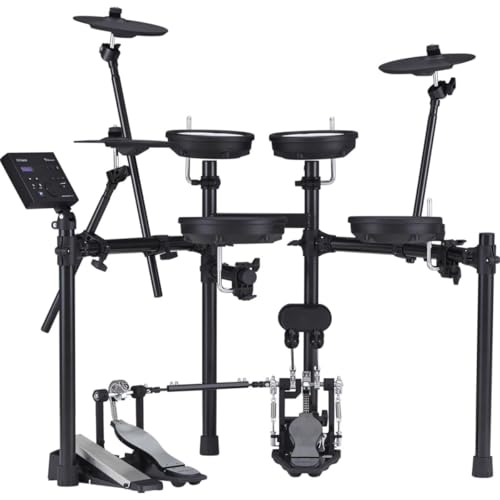
Roland TD-07DMK V-Drums All Mesh Head Electronic Drum Kit, Black
ASIN B099P1DB5N • $1,049.00 • Ships from Amazon AU
This is the kit I'd point most people to, and it's the best-ranked kit in this guide at number 51 in Amazon AU's Drum Set Cymbals category at the time of writing. The TD-07DMK is the entry point to Roland's V-Drums range, and the thing it does better than anything else here is read the pads accurately. The snare and toms use Roland's double-ply mesh heads, which the listing describes as ultra-quiet and near-silent to play. You get a PDX-8 8-inch snare pad with separate head and rim zones and three PDX-6A 6.5-inch single-zone tom pads. It's sold and shipped by Amazon AU, which keeps returns and warranty simple, and it costs $1,049.
The TD-07 module has 25 preset kits, 25 user kits and 143 instruments, which is fewer than some kits here but they're well-made sounds. The editing is where it pulls ahead: V-Edit, EQ, ambience and 30 multi-effects let you shape a kit to your taste, and that keeps a drummer interested long after the presets get old. Bluetooth is built in for playing along to music and lessons from a phone or tablet, and Bluetooth MIDI is listed too. USB connects it to recording software on a computer. Roland includes 40 free Melodics lessons for learners. For a teenager who's serious about drumming, this is the kit that won't be outgrown in a year.
Read the box contents carefully. The listing says the kick pedal, throne and sticks are sold separately and that you'll need headphones or an amplifier, and Roland recommends its DAP-3X accessory pack. Price those in before comparing it with the Donner or Alesis kits. From a repair point of view, Roland's cable looms and pads are a common part with a long track record, so a faulty lead or jack later in life is a known, simple fix. Tie the leads along the rack and they'll rarely give trouble. Keep the power adapter with the module.
Honest caveats: The 6.5-inch toms are small targets and single-zone, so they're less like an acoustic kit than the bigger Alesis pads. The kick pedal, throne, sticks and headphones are all extra. The rank is in a cymbals category on Amazon AU, which is how the listing is filed rather than a sign of what it is.
Best for: A learner who'll stick with it and wants the most accurate pads and the best editing in this band.
Type: All-mesh electronic drum kit • Module: TD-07, 25 preset and 25 user kits, 143 instruments • Snare: PDX-8 8-inch, head and rim zones • Toms: 3 x PDX-6A 6.5-inch single-zone • Connectivity: Bluetooth audio and MIDI, USB • Not included: Kick pedal, throne, sticks, headphones • Sold by: Amazon AU • Rank: #51 in Drum Set Cymbals (Amazon AU)
View on Amazon AU
Alesis Nitro Ultimate XL 10-Piece Electronic Drum Kit with Stand-Mounted Hi-Hat
ASIN B0GSQKPYTW • $1,149.00 • Ships from Amazon AU
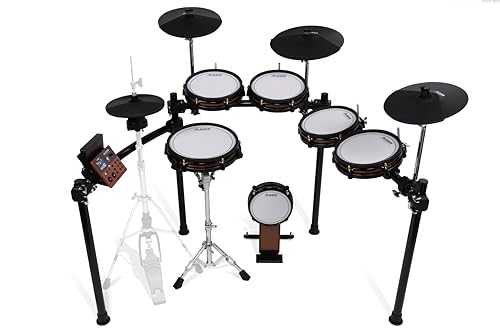
If you want an electronic kit that looks and feels as close to full size as this price allows, the Nitro Ultimate XL is the one. It's a 10-piece kit with 10-inch dual-zone toms, a 12-inch mesh snare, 12-inch dual-zone crashes and a 14-inch triple-zone ride with choke, all according to the listing. Those are much bigger targets than the TD-07DMK's 6.5-inch toms, and for a drummer moving between a kit at home and an acoustic kit at school or in a band, size matters. It's sold and shipped by Amazon AU at $1,149, and it ranks 1,978th in the broad Drums and Percussion category at the time of writing, so it's a newer or less common kit.
The standout feature is the stand-mounted movable hi-hat, the only one in this guide. Instead of a pad on an arm and a separate pedal, it sits on a hi-hat stand and moves like the real thing, and the listing says it works with traditional hi-hat stands, which are sold separately. The module has 52 built-in kits and over 640 sounds. Alesis also gives free access to BFD Player, which runs on a computer or as a plugin inside recording software and opens up a much bigger sound library. There's Bluetooth for play-along practice and 90 days of free Drumeo lessons. That's a lot of kit for a drummer who's past the beginner stage.
Two things to plan for. The hi-hat stand is extra, so add it to the cost straight away, and a 10-piece kit needs real floor space, so measure before ordering. More pads also means more cables in the loom, which is the part that fails first on any kit, so tie the leads to the rack and keep them off the floor. Alesis's module reading of the pads is generally decent but a step behind Roland in my experience. It's still a lot of kit at this price. Check the throne height suits the bigger kit.
Honest caveats: The hi-hat stand is sold separately, and the listing doesn't state whether a kick pedal, throne or sticks are included, so check the contents. The rank is low in a broad category, which tells us less than the others' ranks. The listing doesn't state USB or the module's editing depth.
Best for: A drummer past the beginner stage who wants big pads and a real moving hi-hat.
Type: 10-piece mesh electronic drum kit • Snare: 12-inch mesh • Toms: 10-inch dual-zone mesh • Cymbals: 12-inch dual-zone crashes, 14-inch triple-zone ride with choke • Hi-hat: Stand-mounted, movable (stand sold separately) • Module: 52 kits, 640+ sounds, Bluetooth • Sold by: Amazon AU • Rank: #1,978 in Drums & Percussion (Amazon AU)
View on Amazon AU
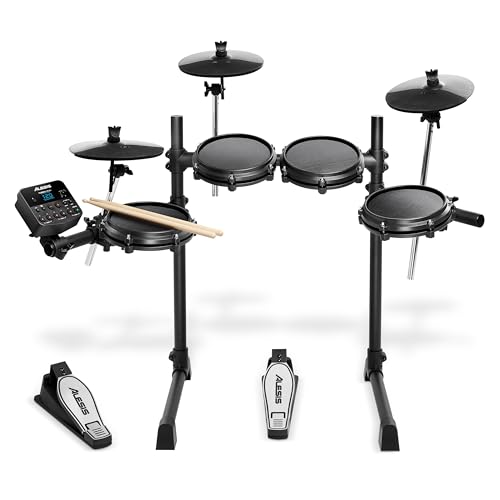
Alesis Turbo Mesh Kit 7-Piece Mesh Electronic Drum Kit, Black
ASIN B07HYTRL7D • $599.00 • Ships from Amazon AU
The Turbo Mesh is the simplest way into a mesh kit in this guide. At $599 it's sold and shipped by Amazon AU, and Amazon AU doesn't publish a sales rank for it at the time of writing. It's a seven-piece kit with an 8-inch mesh snare, three 8-inch mesh toms and three 10-inch cymbals, plus an Alesis hi-hat pedal and kick pedal according to the listing. That means it's mostly ready to play out of the box, and the mesh heads give a much better feel and less stick noise than rubber pads at the same price. The listing also includes drumsticks and a drum key for tensioning the heads, which is a nice touch.
The Turbo drum module is basic, with 10 ready-to-play kits and over 100 sounds, and that's fine for a learner. What's more useful are the teaching features: 30 built-in play-along tracks, a metronome, an aux input to play along to music from a phone with a cable, and a drum coach function to help build timing. For a young beginner, that covers the first year or two of practice without needing an app or a subscription. The 8-inch toms are bigger than the Roland's 6.5-inch pads, which makes them easier targets for someone still learning where to aim. It's also small enough to fit in a bedroom corner, which suits most homes I see.
This is the kit I'd buy for a child who wants to try drums and might lose interest, because nothing much is wasted if they do. The limits show up once a drummer improves: the module sounds and editing are simple, and the listing doesn't mention USB or Bluetooth. Treat the cable loom gently, keep the module's power adapter with the kit, and it should last through the learning years. I'd also add a pair of wired headphones and a basic throne at the right height, because neither is listed in the box and a kitchen chair puts a learner at the wrong height for the pedals.
Honest caveats: Amazon AU doesn't publish a sales rank for it. The listing doesn't state USB, Bluetooth, dual-zone pads or choke cymbals, so expect a basic module. A throne and headphones aren't listed in the contents. The 10-inch cymbals are small compared with acoustic cymbals.
Best for: A young beginner trying drums for the first time on a mesh kit that's nearly complete in the box.
Type: 7-piece mesh electronic drum kit • Snare: 8-inch mesh • Toms: 3 x 8-inch mesh • Cymbals: 3 x 10-inch • Module: 10 kits, 100+ sounds, 30 play-along tracks • Included: Hi-hat and kick pedals, sticks, drum key • Sold by: Amazon AU • Rank: Not published by Amazon AU (checked 17 October 2026)
View on Amazon AU
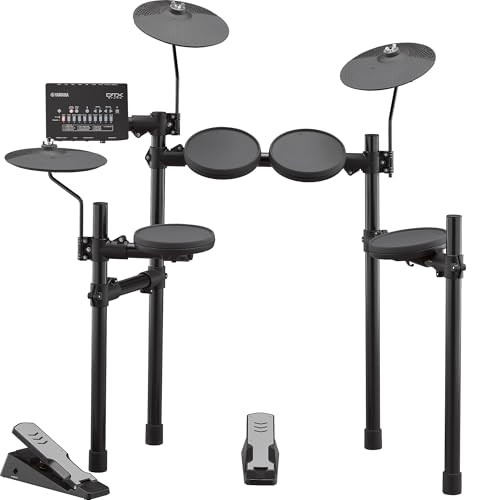
Yamaha DTX402K Electronic Drum Kit with Training Functions, Black
ASIN B07FKRSSZY • $597.99 • Ships from Amazon AU
Yamaha's DTX402K is a starter kit built around learning, and at $598 it's the lowest-priced pick here. It's sold and shipped by Amazon AU, and Amazon AU doesn't publish a rank for it at the time of writing. The listing pitches it at learners and enthusiasts of all ages, with built-in training functions and a headphone output so it can be played at any hour. It describes silent pads and pedals that recreate the expression of an acoustic kit, but it doesn't say mesh heads anywhere, so if mesh is important to you, check the pad type before ordering. The kit comes on an adjustable stand according to the listing.
Where it does well is the practice side. Yamaha pairs the kit with its own apps to make practice more engaging, and the listing says you can personalise and record your playing. There's a USB port that connects the kit to a tablet or computer for audio recording or MIDI, which means it'll also work with drum learning apps and recording software. That's a useful extra at this price, and it's more than the Turbo Mesh lists. Yamaha's modules are generally simple to use, which suits a child who just wants to sit down and play. The brand also has a big network of music teachers who know these kits well. That counts for a lot.
If the pads are rubber, the kit will be louder under the stick than the mesh kits and the rebound will feel firmer, so think about who else is in the house. From a repair point of view, the weak points are the same as any kit: the cable loom, the pad jacks and the module's power adapter. Keep the adapter labelled and the cables tied to the rack and it should be trouble-free. I'd also check what the box includes before ordering, because the listing doesn't spell out the kick pedal, throne or sticks, and those can add a fair amount to the real cost of getting started.
Honest caveats: The listing doesn't state the pad material, pad sizes, number of kits or sounds, or whether a kick pedal, throne and sticks are included, so check the contents and the maker's spec page. Amazon AU doesn't publish a rank for it.
Best for: A learner who'll use apps, recording and training tools more than mesh-pad feel.
Type: Electronic drum kit • Pads: Silent pads (material not stated on the listing) • Training: Built-in training functions, Yamaha apps • Connectivity: USB audio and MIDI, headphone output • Stand: Adjustable stand included • Sold by: Amazon AU • Price: $598 at time of writing • Rank: Not published by Amazon AU (checked 17 October 2026)
View on Amazon AU
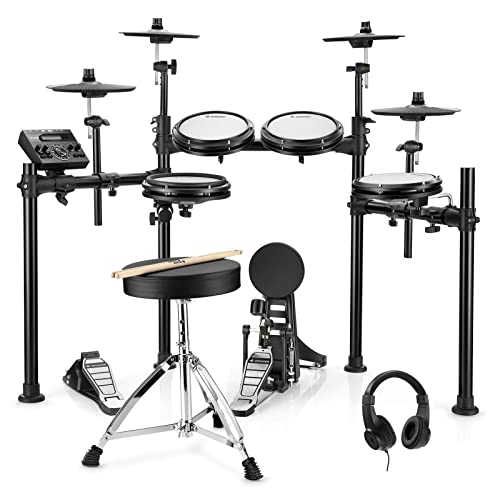
Donner DED200 Mesh Electronic Drum Set with Throne, Headphones and Sticks
ASIN B0B2R5FG5W • $639.99 • Sold by Raneasy on Amazon AU
The Donner is the kit with the most in the box, which matters a lot to a parent buying a first kit. At $640 it's sold by Raneasy, a marketplace seller rather than Amazon AU, and it ranks 395th in Amazon AU's Drums and Percussion category at the time of writing, which is a better rank than the Alesis Nitro Ultimate XL. The listing describes an 8-inch dual-zone mesh snare, three 8-inch mesh toms, a 6-inch kick pad with double-pedal compatibility, a 10-inch hi-hat, two 10-inch crashes and a 10-inch ride with choke. That's a full kit layout with mesh where it matters. For a learner, I'd take that layout over a smaller kit any day.
The module lists 31 kits and over 450 sounds, 50 play-along songs, a sequencer, a metronome, an aux input and a recording function, plus USB MIDI and free Melodics lessons. The box is the real selling point though. The listing includes a foldable metal stand with a four-post aluminium rack, a hi-hat control, a bass drum pedal, headphones, a drum throne, an audio cable and sticks. That's everything you need to start playing the day it arrives, which none of the other kits here can say. Donner also notes it doesn't run any subscription services, so there's nothing to keep paying for. For a first kit, that's a lot of drum for the price.
Because it's sold by a marketplace seller, I'd read the seller's returns terms before ordering and keep all the packaging until you're sure it works. The included headphones and throne are basic, so expect to upgrade them later. The cable loom is the weak point on any kit at this price, so tie the leads to the rack and don't let them sit under the pedals. I'd also set a reminder to test every pad and zone in the first week, because a marketplace seller's return window is the easiest way to sort out a faulty lead or pad. After that, keep the module's adapter with the kit.
Honest caveats: It's sold by Raneasy, a marketplace seller, not Amazon AU, so returns and warranty go through them. The 6-inch kick pad is small, and the included headphones and throne are entry-level. The listing doesn't state Bluetooth, and the 10-inch cymbals are small next to acoustic ones.
Best for: A first kit for a learner where everything, including throne and headphones, needs to be in one box.
Type: 8-piece mesh electronic drum set • Snare: 8-inch dual-zone mesh • Toms: 3 x 8-inch mesh • Cymbals: 10-inch hi-hat, 2 x 10-inch crash, 10-inch ride with choke • Module: 31 kits, 450+ sounds, USB MIDI • Included: Rack, pedals, throne, headphones, sticks • Sold by: Raneasy (marketplace seller) • Rank: #395 in Drums & Percussion (Amazon AU)
View on Amazon AUSide-by-side comparison
| Product | Price | Best for |
|---|---|---|
| Yamaha DTX402K Electonic Drum Kit with… | ~$598 | |
| Alesis Turbo Mesh Kit - 7 Piece Mesh… | ~$599 | |
| Donner DED200 E Drum Set | ~$640 | |
| Roland TD-07DMK Electronic V-Drums… | ~$1,049 | |
| Alesis Nitro Ultimate XL 10-Piece… | ~$1,149 |
What we see fail in the workshop: electronic drum kits
Electronic drum kits come into the shop for a short list of faults, and the pads and module themselves are rarely the problem. Most of it comes down to the cables, the sockets they plug into and the power adapter. All three are easy to look after and easy to damage, so here's what to watch for over the life of the kit.
A pad that stops triggering or cuts in and out
When a pad goes dead or only works some of the time, the cable is the first suspect. Leads get stood on, pinched in the rack clamps and bent sharply where they plug into the pad, and the copper inside breaks while the outer jacket looks fine. Swapping the lead with a neighbouring pad's tells you straight away whether the fault follows the cable. If it does, a new lead is a small part. If it stays with the pad, it's usually the pad's jack socket or, less often, the sensor under the head, and both are fixable on most kits.
Crosstalk and false triggers
Crosstalk is when hitting one pad also triggers another, and it usually comes from vibration travelling through the rack or a sensitivity setting that's too high. It also turns up when a sensor or its cable is damaged and starts picking up noise. Check the pads aren't touching each other or the rack, tighten the clamps, and lower the sensitivity on the pad that's false-triggering. Most modules have a crosstalk cancel setting for exactly this. If none of that fixes it, the sensor or the loom has a fault worth having checked, before a cracked sensor gets worse.
Module power and socket faults
The module runs from an external power adapter, and those get lost or swapped. A generic adapter with the wrong voltage or reversed polarity can damage the module's power circuit in seconds, and one with a noisy output can make the kit hum through the headphones. The big multi-pin socket where the cable snake plugs in also loosens if the snake gets yanked when the kit is moved. Keep the original adapter labelled with the kit, unplug the snake before moving the rack, and use a surge-protected powerboard. Those habits prevent most module faults.
Decision tree: which one should you actually buy?
- Want the kit that reads the pads best and won't be outgrown? → The Roland TD-07DMK at $1,049, plus a kick pedal, throne, sticks and headphones.
- Want big pads and a real moving hi-hat? → The Alesis Nitro Ultimate XL at $1,149, with a hi-hat stand added.
- Buying a first mesh kit for a child who might lose interest? → The Alesis Turbo Mesh at $599, with pedals, sticks and a drum key in the box.
- Care most about apps, recording and training tools? → The Yamaha DTX402K at $598, with USB audio and MIDI.
- Need everything, throne and headphones included, in one box? → The Donner DED200 at $640 from a marketplace seller.
- Pad dead, crosstalking or the module humming? → Bring it to our Erina workshop and we'll check the cables, jacks and module power and tell you what it needs before you spend anything.
Frequently asked questions
Are mesh heads worth paying more for on an electronic drum kit?
For most drummers, yes. Mesh heads feel and rebound much more like an acoustic drum than rubber pads, and they're quieter under the stick, which matters in a house or a unit. They can also be tensioned to change the feel as a player improves. Rubber pads are durable and simple but harder and louder to hit. In this guide the Roland TD-07DMK, both Alesis kits and the Donner list mesh heads on the snare and toms, so there's no need to settle for rubber in this price band.
How quiet is an electronic drum kit really?
With headphones, the sound from the module is silent to everyone else, but the physical noise isn't. Sticks on mesh heads make a quiet tapping, sticks on rubber pads and cymbal pads make more of a clack, and the kick pedal sends a thump straight into the floor. On timber floors or in a unit, that thump is what neighbours hear. A drum riser on tennis balls or dense rubber matting under the kick and hi-hat pedals cuts it down a lot. Agreeing practice hours with the neighbours helps too.
What do I need to buy as well as the kit?
It varies a lot by kit, so read the contents list on the listing. The Roland TD-07DMK listing says the kick pedal, throne and sticks are sold separately and that you'll need headphones or an amplifier. The Alesis Nitro Ultimate XL needs a hi-hat stand. The Donner DED200 includes a throne, headphones, pedals and sticks. Almost everyone ends up wanting a better pair of wired headphones and some kind of mat or riser under the kit to reduce floor noise. Price all of that in before comparing kits on the listed price alone.
Can I use Bluetooth headphones with an electronic drum kit?
I wouldn't. Bluetooth audio adds a short delay between hitting a pad and hearing the sound, and on drums you feel that on every hit, which makes timing harder rather than easier. Wired over-ear headphones plugged into the module's headphone output are the right choice and never need charging. Bluetooth on these kits, where it's listed, is mostly for streaming music from your phone into the module to play along to, which works well because a small delay on the backing track doesn't matter in the same way.
Why does one pad on my kit keep cutting out?
Nine times out of ten it's the cable, not the pad. Leads get stood on, pinched in rack clamps and bent where they plug in, and the wire breaks inside the jacket. Swap the lead with a neighbouring pad's lead and see whether the fault moves. If it moves with the cable, replace the cable. If it stays with the pad, the pad's jack socket or sensor is the likely fault, and both can usually be repaired. Check the module's sensitivity settings too, because a pad set too low can seem to drop out on soft hits.
Is a Roland kit worth it over a starter kit from Alesis or Donner?
If the drummer is going to keep playing, I reckon it usually is. Roland's modules are known for reading the pads accurately, so soft notes, rolls and rimshots come through the way they were played, and the TD-07DMK's editing tools keep it useful for years. The trade-off is that its listed price doesn't include a kick pedal, throne, sticks or headphones. For a child who's just trying drums, the Alesis Turbo Mesh or Donner DED200 makes more sense because they're nearly complete in the box and less is lost if interest fades.
Related buying guides
Drum pad dead, crosstalking or the module humming?
Most electronic drum kits that come into the shop have a damaged cable, a loose pad jack or a module power fault from the wrong adapter, and all three are usually fixable for far less than a new kit. Bring it into our Erina workshop and we'll find the fault and tell you what it needs before you spend anything.
Visit our Erina workshop Book Online