![[100% Aussie Owned] Fireproof Document Bag](/images/affiliate-products/B0C3YSZ7SC.jpg)
Prices from Amazon AU, updated daily. Swipe or use the arrows for more.
Disclosure: This article contains affiliate links to amazon.com.au. If you buy through one of these links iFix may earn a small commission at no extra cost to you. It doesn't change which products we recommend. We focus on what actually lasts based on 16 years of repair-shop experience.
Quick summary9 picks
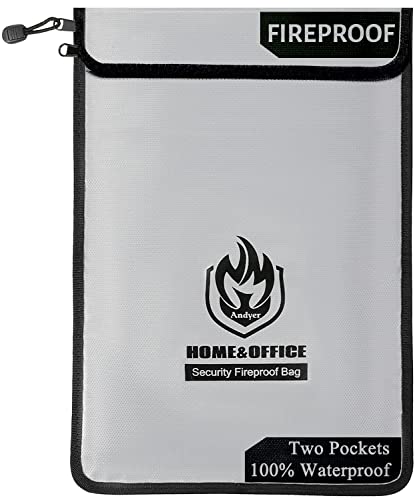
- Cheapest[100% Aussie Owned] Fireproof Document Bag about$29.87
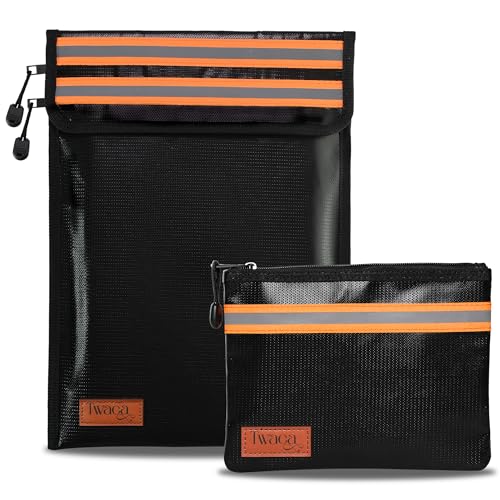
- 100% Aussie Owned - Twaca- Fireproof… about$39.87
- Fireproof Document Box with Lock about$41.8015.5" screen.
- Upgraded Two Pockets Fireproof Document Bag about$47.3111" screen.
- LYCENXI Fireproof Document Box with Lock about$63.99Hard-shell case, 13 pockets, Combination lock.
- SentrySafe Fireproof Safe Box with Key Lock about$91.99
- SentrySafe CHW20205 Fireproof Waterproof… about$100.56
- Sentry CHW30100 Fire & Water Resistant… about$234.00
- Most PremiumKABISAFE Fireproof Safe Box with Fireproof… about$339.99
The box you buy years before you need it
Every summer the fire maps get a bit worse, and every year more people I talk to have quietly thinned out their insurance to keep the premium payable. Higher excesses, lower contents cover, sometimes none at all. I can't do anything about premiums from a repair bench. What I can tell you is that when a house burns or floods, the two things money never brings back are the paperwork proving what you owned and the drives holding the photos. Both fit in a steel box that costs less than a phone screen, and almost nobody buys the box until after the event.
A fireproof document safe is one of the dullest purchases in this whole gear series, and that's exactly why it works. It has no app, no firmware, no subscription and no battery that matters. You load it once, add to it a few times a year, and it sits in a cupboard doing nothing for a decade. Then one bad afternoon it earns back every dollar in a single half hour, or it doesn't, and which of those happens was decided by the rating you did or didn't read on the day you bought it.
I've picked five boxes between $64 and $289: three SentrySafe chests sold by Amazon AU, one large KABISAFE cabinet from an AU storefront and one hard-shell file organiser, all new stock at the time of writing. Four of them carry proper laboratory ratings for fire, water or both. The fifth is in the list partly as a working example of how to read a listing that doesn't state one, because that gap is the single most common trap in this category.
A fire rating is a time and a temperature
The word fireproof on its own tells you nothing. Steel doesn't burn, so any steel box is technically fireproof while everything inside it cooks. A real rating names a laboratory, a time and a temperature, and on the Sentry units in this guide it reads: UL classified for half an hour at 1550°F, which is 843°C. That means the box sat in a furnace at house-fire temperatures for thirty minutes and the inside stayed below the point where paper chars. The number that matters is the one you can't see, the internal temperature, and the rating is the only evidence you'll ever get about it. No stated rating means no evidence, and with this product evidence is the whole purchase.
Half an hour sounds short until you think about what it's for. It's not meant to outlast the fire, it's meant to outlast the part of the fire that happens in that room, which mostly moves through in well under thirty minutes, and to hold on until the water arrives. It pairs with the rest of the early-warning chain: working photoelectric smoke alarms shorten the fire, and the box carries your paper through whatever's left. Longer ratings exist overseas at much higher prices, but for a home document box, a genuine tested half hour is the sensible floor.
Now the trap. Plenty of listings in this category, including big sellers, say fireproof in the title and never state a time or a temperature anywhere. The KABISAFE cabinet in this guide is one of them: heavy steel, a 20mm door, a fireproof drawer by name, and no laboratory rating stated on the listing. That doesn't make it a bad product, it makes it a security cabinet whose fire performance is unproven. I've included it because the size and the lock are genuinely useful, but I'll only say what the listing supports, and you should read every safe listing with that same filter.
Paper ratings and media ratings are different tests
Paper is surprisingly tough. It yellows and chars somewhere around 200°C and up, which is why a box that holds its interior below that through a half hour furnace run saves your certificates. Flash memory is nowhere near that tough. The plastics, the solder and the NAND cells inside a USB stick or an SSD all start giving up at temperatures paper barely notices, and a drive doesn't have to melt to die. Heat it enough and the stored charge that represents your data leaks away quietly, so the stick looks fine and reads as garbage.
That's why the better boxes carry a second verification. The SentrySafe 1210, the smallest chest here, is ETL verified for the same half hour specifically for CDs, DVDs, memory sticks and USB drives, on top of the UL paper rating. That second mark exists because the lab had to prove a lower internal temperature, and it's the difference between a box for paper and a box for paper plus data. If a backup drive is going in, buy the unit with the media verification and don't assume the paper rating covers it.
And even then, a safe is one copy, not a backup. Fire is only one of the ways a drive dies, and the box does nothing about the other ones: age, drops, controller failure. The drive in the safe should be one leg of a proper backup setup, rotated a few times a year, not the lone home of the family photos. A fireproof box full of the only copy is just a slower way to lose everything.
The water rating matters as much as the fire one
House fires end wet. If the brigade saves the room, everything in it gets hosed, and a fire box that isn't sealed fills up with exactly the water that saved it. That's the quiet reason the water rating matters even for people who never think about floods: the most likely way water reaches your documents is through a fire being put out above them. The Sentry chests at $101, $117 and $234 in this guide are all ETL verified for 72 hours of full submersion, which covers the hosing, the flood and the burst pipe in one number.
Storm and flood risk is its own argument, and on this coast it's not theoretical. A sealed box turns a flooded laundry from a disaster for your paperwork into a wipe-down job. It also protects against the slow version, the leaking hot water unit that soaks a cupboard floor for a week while nobody looks, which is the same failure I bang on about in the leak sensor guide. If the safe lives on a floor, and most do, assume water will find it eventually.
One practical note on sealed boxes: a seal that keeps water out also keeps moisture in. Close damp paper inside one and it stays damp for months. It's worth opening the box a couple of times a year to let it breathe, and a small silica gel pack inside costs almost nothing. The entry SentrySafe 1210, for what it's worth, states no water rating at all on its listing, so treat it as a fire box and shelve it above ankle height. The dearer chests don't share that gap, and it's the main thing separating the $91 box from the $101 one.
What actually goes in one
The paper list writes itself once you imagine standing in front of an insurance assessor with nothing. Passports, birth and marriage certificates, the will, property deeds and mortgage papers, insurance policy schedules, vehicle papers, business registration if you run one, and a printed page of the serial numbers and receipts for everything expensive in the house. That last one is the sleeper: proving ownership is half the fight in a contents claim, and a single afternoon of photographing receipts covers it for years. Keep that page current whenever something expensive enters the house, it takes a minute and saves an argument.
For data, one rotated backup drive earns its spot, and so does a USB stick with scans of everything else in the box. Scans matter because the flood and fire damaged drives that land at our Erina workshop are recoverable more often than people expect, but recovery has odds attached, and a $10 stick of PDFs beats betting on them. If a drive has already been through something, the data recovery rundown covers what's realistic before you spend anything.
What stays out: anything you need weekly, because friction kills the habit and the box ends up living open, and anything that shouldn't exist on paper at all. Old statements and expired cards with your details on them aren't archives, they're identity theft stock, and they belong in the shredder guide pile instead. A safe protects what you keep. Being ruthless about what you keep is the free upgrade.
Bolting down, placement and the keys
A box under 15 kilos protects against fire and water, not against a person, because a person just carries it out the door. That's not a flaw, it's the design, and the fix is included in the carton: the SentrySafe 1210 ships with bolt-down hardware and the KABISAFE cabinet has pre-drilled holes in its back and base. Bolted through a cupboard floor or a stud, a small safe stops being a handle for a burglar and becomes an anchor for you. Ten minutes with a drill roughly doubles what the box is worth in practice.
Placement is about physics. Heat rises and floors fail late, so low in the house beats high, and a ground floor cupboard on a slab is about as good as a home spot gets. Keep it off the literal floor if it has no water rating, and out of the garage, which in my experience is both the hottest room in the house across a summer and the first place anyone uninvited looks. Under the bottom shelf of a linen cupboard, bolted, is boring and right.
Then the part everyone skips: getting back in. Every key-locked Sentry here ships with two keys, and the second one should live somewhere that isn't the house, with family or at work. The KABISAFE runs a keypad with override keys, and its battery compartment is external, so a flat battery is an inconvenience instead of a lockout. Whatever you buy, open it twice a year. A safe you can't open in a hurry has quietly become a very heavy paperweight.
Reading the sizes honestly
Safe listings quote capacity in cubic feet, which nobody can picture. Rough translation: the 0.18 cubic foot SentrySafe 1210 is a lunchbox, right for passports, folded certificates, a couple of drives and not much else. The 0.28 cubic foot CHW20205 adds enough room for a stack of envelopes. The 10.2 litre CHW30100 swallows a few years of a household's papers, and the 2.6 cubic foot KABISAFE is a genuine cabinet with a shelf and a drawer. Thick fire insulation means every one of them is far smaller inside than the outside suggests, so judge by interior numbers where the listing gives them.
The A4 question decides more purchases than the fire rating. Chests this size mostly want documents folded, which is fine for a birth certificate and wrong for anything that must stay flat. The hard-shell file organiser at $64 is the one shaped for the job: it keeps papers flat and divides them into 13 pockets, so certificates and passports stay filed instead of sliding into a heap every time you move it. If your pile includes originals that can't crease, that shape beats extra litres.
Weight reads two ways. The 9 kilo CHW20205 and 13 kilo CHW30100 are light enough to grab in an evacuation, which is genuinely worth something when minutes matter, and light enough to steal, which is the bolt argument again. My honest sizing advice is to buy one size past today's pile, because the box fills up the way every drawer does, and the person who buys a second bigger safe two years later paid for the lesson twice. And measure the spot it's going before ordering, because the insulation makes every one of these deceptively bulky outside.
The 5 picks, $64 to $289
Prices are Amazon AU at time of writing (21 September 2026) and move week to week. Ranks are Amazon AU category sales ranks, checked the same day.

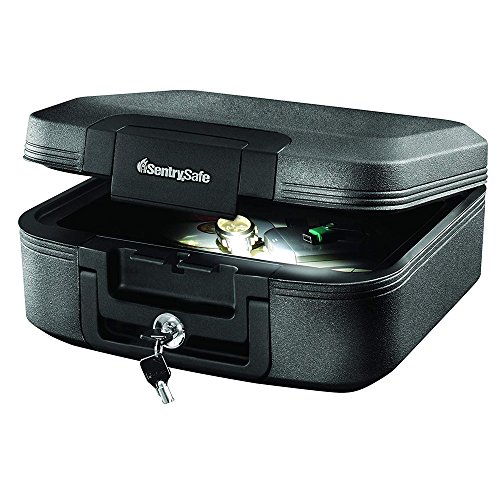
SentrySafe 1210 Fireproof Chest with Key Lock, 0.18 cu ft
ASIN B008HZUI34 • $90.86 • Ships from Amazon AU
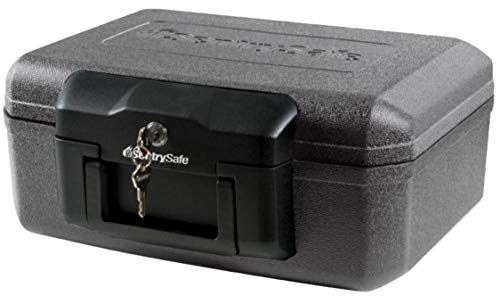
This is the box I'd tell most households to start with, and the market agrees: it sits at #3 in Amazon AU's Cabinet Safes category at $90.86, sold by Amazon AU. The rating is the real thing, UL classified for half an hour at 1550°F, which is 843°C, and it carries the second mark that matters for anyone storing data: ETL verification for the same half hour covering CDs, DVDs, memory sticks and USB drives. That pairing at this price is why it leads the guide. Most of what people actually need protected, passports, certificates and a backup drive, fits in exactly this footprint, and every dollar in the price went into the insulation rather than electronics.
The details are simple and mostly right. The key lock is a privacy lock that doubles as a latch, and Sentry states it keeps the lid from opening in a fire, which is its real job: a fire box that bursts open in the heat protects nothing. Two keys come in the carton, so one can live offsite from day one, and bolt-down hardware is included, which turns a 9 second grab-and-go theft into a job with tools. Carrying grips on the sides make it easy to take with you in an evacuation. Exterior size is 6.1 by 14.3 by 11.2 inches, so it hides on a cupboard shelf without announcing itself.
Capacity is 0.18 cubic feet, and I'd treat that honestly as passports, folded documents, two or three drives and some keepsakes rather than the family archive. That's not a criticism, it's the design brief: the box for the twenty documents that actually matter, not the filing cabinet. For the load-it-and-forget-it job, the important paper of a household in one place with a real fire rating and real media protection behind a $91 price, nothing else on Amazon AU came close this month, and the sales rank suggests plenty of buyers ran the same comparison. It's the one I'd bolt inside a linen cupboard without thinking twice.
Honest caveats: No water rating is stated on the listing, so keep it off the floor and above any likely water line; the wet risk in a fire is real. Capacity forces folding for anything A4. The key lock is about privacy and keeping the lid shut in heat, not resisting a determined attack.
Best for: The household document and backup drive box, bolted in a cupboard and opened four times a year.
Type: Fireproof chest, key lock • Fire rating: UL classified, 1/2 hour at 1550°F (843°C) • Media: ETL verified for CDs, DVDs, memory sticks, USB drives • Water: Not stated on the listing • Capacity: 0.18 cubic feet • Exterior: 6.1 x 14.3 x 11.2 inches • Includes: Two keys, bolt-down hardware, carrying grips • Price: $90.86 at time of writing • Rank: #3 in Cabinet Safes (Amazon AU)
View on Amazon AU
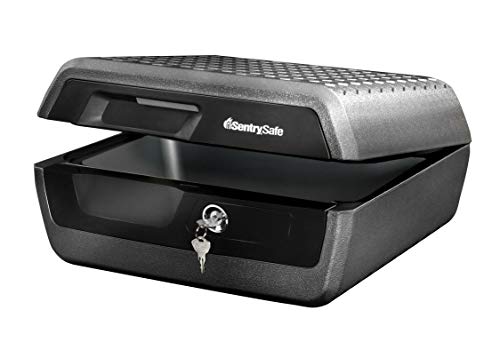
SentrySafe CHW20205 Fireproof Waterproof Box, 0.28 cu ft
ASIN B015P0X7F4 • $100.88 • Ships from Amazon AU
Ten dollars up from the 1210 buys the rating I'd actually want, and it's the one most people don't know to look for. The CHW20205 keeps the UL half hour fire classification and adds ETL verification for 72 hours of full water submersion, sitting at #24 in Cabinet Safes at $100.88 from Amazon AU. Submersion is the word doing the work there. This isn't splash resistance, it's the box sitting under water for three days with dry paper inside, which covers the flooded laundry, the burst flexi hose and the most likely event of all, the fire brigade hosing down the room the safe lives in. Fire ratings get all the attention, but this pairing is the complete answer.
The fire claim on the listing covers documents, small valuables, DVDs and USBs for the half hour, and the practical touches are better than the price suggests. There's an interior light, which sounds like a gimmick until you're going through the box in a dark cupboard, a tubular key lock with two keys that holds the lid shut in heat, and a carrying handle for taking it with you. Exterior is 15.4 by 14.3 by 6.6 inches against an interior of 12.8 by 8.5 by 4.4 inches, and that gap between the two numbers is the insulation you're paying for. It weighs 20 pounds, call it 9 kilos, so it's liftable with one hand.
This is the default pick for anyone on a floodplain, near a creek, in a unit below someone else's washing machine, or honestly anyone whose safe will live at floor level, which in practice is nearly everyone who buys one. The extra 0.1 cubic feet over the 1210 buys meaningful breathing room for a household's paper, and the flat lunchbox shape hides in places a cabinet never could. The fire rating gets the attention, the water rating gets used, and this is the least you can spend to have both from a listing that states them properly, which is why it wears the balanced badge.
Honest caveats: The waterproof rating assumes the lid is seated and locked, so it only protects a box you actually keep shut. Interior height is 4.4 inches, shallower than the exterior suggests, and A4 still has to fold. The separate ETL media verification the 1210 quotes isn't stated on this listing, the USB claim sits inside the fire endurance line.
Best for: Ground floor and flood-exposed homes, and any safe that will live at floor level.
Type: Fireproof and waterproof chest, key lock • Fire rating: UL classified, 1/2 hour at 1550°F • Water: ETL verified, 72 hours of submersion • Capacity: 0.28 cubic feet • Interior: 12.8 x 8.5 x 4.4 inches • Weight: 20 pounds (about 9 kg) • Extras: Interior light, carry handle, two keys • Price: $100.88 at time of writing • Rank: #24 in Cabinet Safes (Amazon AU)
View on Amazon AU
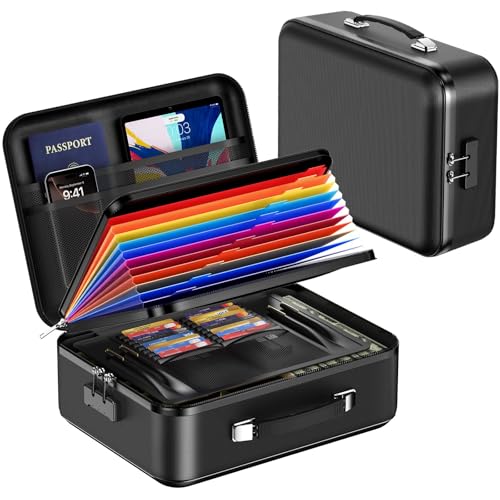
LYCENXI Fireproof Document Box with Lock, Hard-Shell Accordion File Organizer
ASIN B0H2922445 • $63.99 • Ships from HNSMART-Au
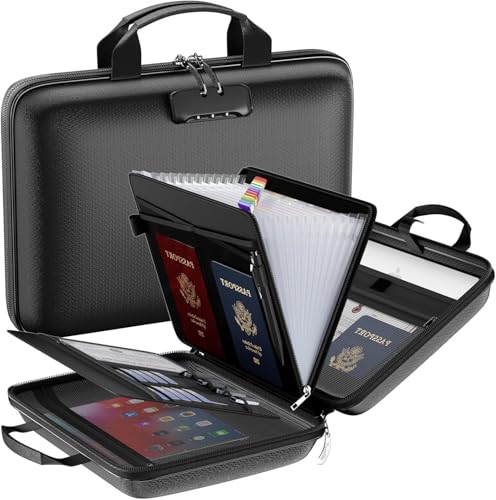
Most chests in this category quietly assume you’ll fold everything, and plenty of documents shouldn’t be folded: originals with seals, older certificates on heavy paper, anything a bank or a court will one day want pristine. This is the one shaped for that job. The outside measures 36 by 27cm and the thickness expands up to 10cm when the pile grows. The listing says it may fit letter and legal-size files, so check your biggest originals against those dimensions before you buy. Inside it is a 13 pocket accordion folder with labels rather than an open cavity, so certificates, tax years and insurance papers each get their own slot, with card slots and passport holders for the small items.
The flat format changes how the box gets used, and mostly for the better. A chest becomes an archaeology dig after a few years, layers of paper in the order life happened. A filed folder stays organised the way a drawer does, which means you actually find the insurance schedule during the phone call instead of after it. Construction is a hard shell over a silicone-coated fireproof insulating layer, which is a different approach to the soft fireproof pouches sold at this price: the shell stops the whole thing crushing or creasing under whatever lands on it. A double metal zipper closes it, and the lock is a built-in combination, so there are no keys to lose.
If your document pile is mostly paper rather than drives and objects, this shape serves it better than either chest, and it is the one I’d point at anyone consolidating a family’s certificates after a death or a move, which is when most of these get bought. It is also the only pick here you can lift and carry out of the house in one hand, which matters more than people expect, because a bolted safe does not evacuate with you. Pair it with scans of everything on a USB stick stored somewhere else, and the whole family record survives fire, water and the more common disaster, misplacement.
Honest caveats: this is the one pick on the list with no UL or ETL certification stated on the listing. The listing describes the material as fireproof and water-resistant and cites an SGS burning test to UL94 VTM-0, which is a material flammability result rather than a timed fire rating. It publishes no tested temperature or duration, so treat it as protection against a short, moving house fire rather than the half hour at 843°C class the SentrySafe chests are rated to. Water-resistant is also not submersion-verified. Zips and seams are the weak point in any soft-sided design, hard shell or not.
Best for: Households whose valuables are mostly paper: certificates, deeds and originals that must stay flat, and anyone who wants the record to leave the house with them.
Type: Hard-shell fireproof document organiser, combination lock • Fire rating: Not UL classified; listing cites an SGS UL94 VTM-0 burning test only • Water: Water-resistant, no submersion rating stated • Fits: 13 pocket accordion folder, listing says it may fit letter and legal files • Exterior: 36 x 27cm, expands to 10cm thick • Closure: Double metal zipper, built-in combination lock • Price: $63.99 at time of writing • Rank: #128 in Security Lock Boxes (Amazon AU)
View on Amazon AU
Sentry CHW30100 Fire & Water Resistant Chest, 10.2L
ASIN B00TOMP2YY • $234.00 • Ships from Amazon AU
This is the family-sized version of the same idea, and the listing states the fire rating in the units we actually use: UL classified for up to 30 minutes at 843°C, with ETL verified water protection for up to 72 hours. At $234 from Amazon AU and #16 in Cabinet Safes, it exists for the household that has outgrown a lunchbox-sized chest, ten point two litres of interior swallows years of paperwork, a proper stack of passports, several drives and the odd irreplaceable object, and the thing still closes. If one box is going to hold everything that matters in the house, this is the size where that stops being a squeeze.
It weighs about 13 kilos empty, which tells you where the money went: that mass is fire insulation wrapped in a sturdy casing, and it's also the honest trade-off of the class. Thirteen kilos plus contents is still liftable by the top carry handle in an evacuation, and still carryable by anyone who breaks in, so the bolting advice from earlier applies double here. The privacy key lock comes with two keys, and the format is compact enough for a cupboard floor, a wardrobe base or under a bed, which, given the submersion rating, are all legitimate spots for this one. The lid format is still a chest rather than a filing drawer, so plan the packing order: the papers you touch yearly on top, the archive underneath.
Buy it when the paper pile is genuinely big, or when you want margin instead of Tetris. The insulation maths favours bigger boxes: one 10 litre chest is easier to place and bolt, and simpler to keep organised, than three small ones scattered around the house, and there's only one set of keys to manage. The other honest use case is the person consolidating a parent's or a business's records in one hit, where the smaller chests fill up on day one. At $234 it's a considered purchase, but it's also the last one of these you'd need to buy.
Honest caveats: It costs more than two CHW20205s, so you're paying for consolidation rather than protection per dollar. Thirteen kilos empty gets heavy fast once loaded, so mount it low, not on a high shelf. No separate media verification is stated on the listing, and the lock is the same privacy-grade key as the smaller chests.
Best for: One-box households consolidating years of documents, drives and keepsakes with fire and flood cover.
Type: Fire and water resistant chest, key lock • Fire rating: UL classified, up to 30 minutes at 843°C • Water: ETL verified, up to 72 hours • Capacity: 10.2 litres • Weight: About 13 kg • Carry: Top handle • Includes: Two keys • Price: $234.00 at time of writing • Rank: #16 in Cabinet Safes (Amazon AU)
View on Amazon AU
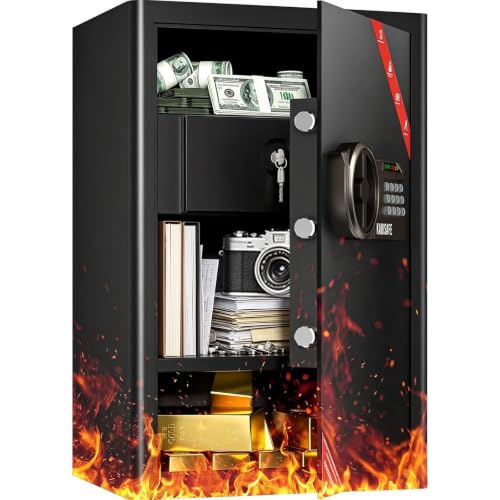
KABISAFE 2.6 cu ft Home Safe with Digital Keypad and Drawer
ASIN B0F2MKYJWP • $288.99 • Sold by KABISAFE AU on Amazon AU
This is a different animal to the Sentry chests: a 2.6 cubic foot steel cabinet with a 60 by 37 by 31 centimetre interior, a shelf, an internal drawer and a proper door rather than a lid. At $288.99 from the KABISAFE AU storefront, sitting at #5 in Amazon AU's Hotel Safes category, it's the pick for people who want one fixed cabinet for documents, drives, jewellery and the awkward valuable things no chest accepts. Access is a digital keypad taking a 3 to 8 digit code, with two manual override keys for the day the electronics sulk, and the door is a 20mm slab thrown by a three-bolt steel latch. It's built to be anchored: pre-drilled holes sit in the back and the base.
The listing's details are mostly sensible. Three wrong codes in a row trips an auto-lock and a built-in alarm, which is a real deterrent to a teenager or an opportunist working through birthdays. The battery compartment is external and hidden, so a flat battery never locks you out of your own cabinet, an interior light comes on when the door opens, and a red and green indicator shows door state at a glance. The internal drawer cabinet is described as fireproof and it's a tidy spot for the passports and certificates, keeping the small critical paper separated from the bulk storage above it. Nothing here needs an app or a cloud account either, which for a safe I count as a feature rather than a gap.
Read my earlier section before buying, though, because this is the working example: nowhere on the listing is a time and temperature fire rating from UL or ETL. I'd buy it as a big, well-featured, anchorable security cabinet that likely slows a fire down, and I'd keep the truly irreplaceable paper inside a rated Sentry chest sitting on its shelf. That layered setup is genuinely the strongest option on this page. You get the keypad convenience and the sheer capacity from the cabinet, the proven half hour from the chest inside it, and a thief has to beat both layers to reach anything that matters.
Honest caveats: No laboratory fire rating and no water rating are stated on the listing, so its fire and flood performance is unverified next to the Sentry units. The anti-theft alarm can only be silenced by pulling the battery, which cuts both ways. Replacement keys go through the seller using the cylinder code in the keyhole.
Best for: A bolted-down household cabinet for bulk valuables, ideally with a rated fire chest inside it.
Type: Steel security cabinet, digital keypad plus override keys • Capacity: 2.6 cubic feet, interior 60 x 37 x 31 cm • Door: 20mm solid door, three-bolt steel latch • Code: 3 to 8 digits, auto-lock and alarm after three wrong entries • Battery: External hidden compartment • Fire rating: Not stated on the listing • Mounting: Pre-drilled holes, back and base • Price: $288.99 at time of writing • Rank: #5 in Hotel Safes (Amazon AU)
View on Amazon AUSide-by-side comparison
| Product | Price | Best for |
|---|---|---|
| [100% Aussie Owned] Fireproof Document Bag | ~$29.87 | |
| Upgraded Two Pockets Fireproof Document Bag | ~$47.31 | |
| 100% Aussie Owned - Twaca- Fireproof… | ~$39.87 | |
| Fireproof Document Box with Lock | ~$41.80 | |
| SentrySafe Fireproof Safe Box with Key Lock | ~$91.99 | |
| SentrySafe CHW20205 Fireproof Waterproof… | ~$100.56 | |
| Sentry CHW30100 Fire & Water Resistant… | ~$234.00 | |
| KABISAFE Fireproof Safe Box with Fireproof… | ~$339.99 | |
| LYCENXI Fireproof Document Box with Lock | ~$63.99 | The flat file |
What we see fail at the bench: heat and water damaged storage
The reason a repair shop has opinions about safes is that we meet the drives and phones that needed one. Heat and water are the two killers this box exists to stop, and both arrive at the bench weekly in milder forms than a house fire: the car boot in January, the flooded garage shelf, the roof space where someone stored the old laptops. The failure patterns repeat, and they're worth knowing before you decide what goes in the safe.
Flash memory that cooked quietly
Flash storage loses data to heat without any drama. The charge sitting in a NAND cell leaks faster as temperature climbs, so a USB stick or SSD that spent a summer in a hot shed can come back unreadable with no burn marks and no warning. We see this most in January and February: drives from cars, garages and roof spaces that look factory fresh and read as corruption. It's why the ETL media verification on a fire chest matters, the paper rating alone permits internal temperatures that flash won't survive, and why the archive copy of anything should live somewhere cool as well as somewhere safe.
The drives that drowned
Water damaged drives mostly die twice. The first death is the soaking, which is often survivable. The second is what happens next: someone plugs the drive in to see if it still works, current flows through a wet board, and electrolysis starts eating the copper. A hard drive from a flooded cupboard that arrives still wet and never powered has decent odds. The same drive after a week of drying on a windowsill and two hopeful plug-ins is a much harder job. If water reaches your storage, sealed box or not, the rule is simple: don't power it, get it looked at.
Locked out of your own box
The most avoidable version of this product failing is the one where it worked perfectly and the owner still can't get in. Lost keys with no spare, keypad batteries flat for a year, codes nobody wrote down, safes inherited locked from relatives. Cheerful marketing never mentions it, but access is a maintenance job: second key stored away from the house, code lodged with someone you trust, batteries changed when the smoke alarm's get changed. The KABISAFE's external battery compartment earns real credit here, and any safe you haven't opened in a year is a lockout rehearsal.
Decision tree: which one should you actually buy?
- Just need passports, certificates and a couple of drives covered? → The SentrySafe 1210 at $91. Real UL half hour fire rating, ETL media verification for the drives, bolt-down kit in the box. Keep it above floor level since it has no water rating.
- Safe will live at floor level, or flood and storm water is a real risk? → The CHW20205 at $101. Same fire class plus 72 hour submersion verification, which also covers the fire brigade's hose. It's the right default for most homes.
- Documents that must stay flat and organised? → The hard-shell file organiser at $64. Keeps papers flat and 13 pockets keep certificates and passports filed, but note it carries no UL or ETL rating.
- Years of paperwork and one box to rule them all? → The CHW30100 at $234. Ten litres, 30 minutes at 843°C, 72 hours under water, and it consolidates everything worth protecting into one bolt-down spot.
- Want a big keypad cabinet for bulk valuables as well as paper? → The KABISAFE at $289, bolted through the base, with a rated Sentry chest inside it for the irreplaceable paper. The layered setup covers security and fire honestly.
- A drive or phone has already been through fire or water? → Don't power it on and don't put it on charge. Bring it to the workshop in Erina as it is, the earlier we see it, the better the odds for the data.
Frequently asked questions
Are fireproof safes waterproof as well?
Only if the listing says so, and the difference matters more than people expect. Fire and water resistance are separate laboratory tests, and plenty of fire chests, including the entry SentrySafe in this guide, state no water rating at all. The practical problem is that the two events arrive together: a house fire ends with the room being hosed, so an unsealed fire box often survives the flames and drowns in the rescue. If the safe will live at floor level, and most do, I'd treat the 72 hour submersion verification on the mid-range Sentry units as the spec worth paying the extra ten dollars for.
What does a UL half hour fire rating actually mean?
It means an independent laboratory put the box in a furnace at 1550°F, which is 843°C, for thirty minutes, and the temperature inside stayed low enough that paper remained usable. It's a test of the insulation, not the steel. That's also why the word fireproof without a number means nothing: bare steel survives a fire fine while the contents char. Half an hour is designed to outlast the intense phase of a room fire and hold on until water arrives. When you compare safes, you're comparing the time, the temperature and the laboratory, and a listing that states none of them is telling you something too.
Will USB drives and hard drives survive in a fireproof safe?
Only in a box rated for media, and even then with caveats. A paper rating allows internal temperatures that destroy flash memory and hard drives long before paper chars, which is why the SentrySafe 1210 carries a separate ETL verification specifically for memory sticks, USB drives, CDs and DVDs. If drives are going in the safe, that second mark is the one to check for. And keep the bigger picture: heat is only one way a drive dies. The copy in the safe should be one leg of a real backup routine with another copy elsewhere, not the only home your photos have.
Should I bolt a fireproof safe down?
Yes, in almost every case. A chest under 15 kilos does nothing against theft on its own, it just packages your most important belongings with a carry handle. Bolting changes that completely: the SentrySafe 1210 includes the hardware and the KABISAFE cabinet has pre-drilled holes in the back and base for exactly this. Bolt through a cupboard floor, a stud or a slab, low in the house where heat arrives last. The one trade-off is evacuation, a bolted safe doesn't leave with you, which is another argument for keeping a grab-friendly folder of copies while originals stay anchored.
What size safe do I need for A4 documents?
Check the interior dimensions, not the cubic feet, because fire insulation makes every box far smaller inside than outside. Most small chests want A4 folded, which is fine for many documents and wrong for originals with seals or heavy paper that has to stay flat. The hard-shell file organiser in this guide is shaped for flat storage with a 13 pocket accordion folder inside, while the 0.18 and 0.28 cubic foot chests suit folded paper and drives. My general sizing rule is to buy one size beyond today's pile, because the box fills like every drawer in the house does, and upgrading later means buying twice.
My drive or phone already went through a fire or flood. Is the data gone?
Not necessarily, and what you do next moves the odds more than what already happened. Don't power it on, don't charge it, and don't dry it on a windowsill for a week first. Water plus current is what kills boards, corrosion spreads and eats tracks long after things look dry, and heat damaged drives can deteriorate further with every power-up attempt. Bring it in as it is, wet is fine. Recovery is assessed honestly before anything is spent: sometimes it's a cleanup and a copy, sometimes it's board-level work, and sometimes the honest answer is no, but early arrivals get the good outcomes.
Related buying guides
Fire or water already got to a drive or phone?
Every week devices arrive that survived the event and were finished off by a hopeful power button. If a drive, phone or laptop has been through heat or water, leave it off and bring it in to Erina as it is. We'll open it, assess the board and the storage honestly, and tell you what the data's chances are before you spend a dollar.
Visit our Erina workshop Book Online