Prices from Amazon AU, updated daily. Swipe or use the arrows for more.
Disclosure: This article contains affiliate links to amazon.com.au. If you buy through one of these links iFix may earn a small commission at no extra cost to you. It doesn't change which products we recommend. We focus on what actually lasts based on 16 years of repair-shop experience.
Quick summary8 picks
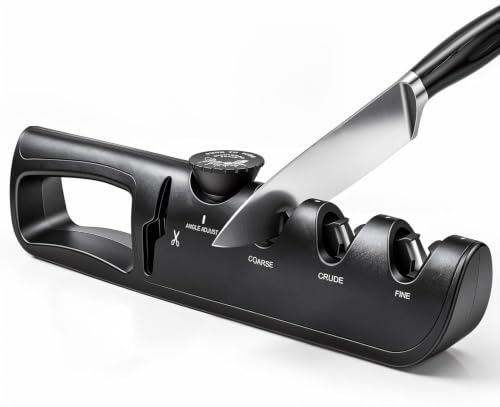
- Entry Pick4-Stage Professional Knife Sharpener with 6… about$29
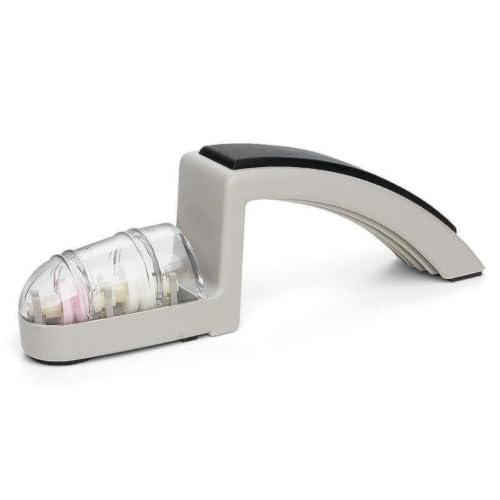
- Global Minosharp 2 Stage Ceramic Water… about$31
- Scanpan Classic 3 Step Sharpener about$42
- Furi Pro Diamond Fingers Compact Knife… about$45
- Minosharp3 Plus Ceramic Water Sharpener about$58
- Global 3 Stage Ceramic Water Sharpener G-913 about$66
- Davis & Waddell D1517 Essentials… about$85
- Most PremiumChef's Choice ProntoPro Diamond Hone Knife… about$88
Why a sharpener matters more than the knife
A blunt knife is the most common tool problem in any kitchen, and it's rarely the knife's fault. Every cut rolls the very edge over a little, and after a few weeks of use the edge is folded and flattened instead of keen. A sharp knife goes where you point it. A blunt one needs pressure, and pressure is what makes a blade skid off a tomato skin or an onion. Keeping the edge up is the lowest-cost upgrade you can give a kitchen, and it makes a mid-priced knife cut better than an expensive one left blunt.
I've picked six sharpeners here from $31 to $88 at time of writing, all sold new by Amazon AU. Four are handheld pull-through sharpeners from Global's Minosharp range, Furi and Scanpan, one is a manual three-stage diamond sharpener from Chef's Choice, and one is an electric Davis & Waddell. Five of them rank in Amazon AU's Manual Knife Sharpeners category, at #9, #18, #19, #141 and #143, and the electric one ranks #348 in Speciality Appliances.
I left out whetstone kits, which do the best job of all but take real practice to use well, and grinder attachments for powered belt sharpening systems, which are a workshop tool rather than a kitchen one. I also skipped knife and sharpener sets, because the knife is the bit you should choose on its own. Everything here is a sharpener you can use on a kitchen counter in a couple of minutes.
Most of the electric sharpeners on Amazon AU don't list their wattage, voltage or plug at all, and several came from sellers I couldn't confirm were supplying Australian stock. That's why there's one electric pick here, sold by Amazon AU, rather than three. The manual ones have no motor or cord to fail, and for most home kitchens they do the job just as well, more slowly and with more control.
Edge angles: 15 degrees or 20
The edge angle is the most important number on a knife and the one most people never check. It's the angle each side of the blade is ground to, measured from the centre line. Japanese-style knives like Global, Shun and most santokus are usually ground at around 15 degrees a side, which gives a finer, sharper edge. Western knives from German makers are usually closer to 20 degrees, which is a little less keen but tougher and slower to dull.
A sharpener grinds the edge to its own angle, whatever the knife started at. Put a 15 degree Japanese knife through a 20 degree sharpener and it'll come out with a thicker, blunter edge than it was made with. Put a 20 degree German knife through a 15 degree sharpener and the first few goes take off a lot of steel reshaping the edge, and the finer edge may chip on hard foods like pumpkin. Matching the sharpener to the knife matters more than any other choice here.
Among the picks, the Global Minosharp 2 Stage lists a 15 degree angle and the Scanpan Classic 3 Step lists 20 degrees. The Chef's Choice ProntoPro covers both, with its listing saying it suits 15 and 20 degree class knives. The Furi, the Minosharp3 Plus and the Davis & Waddell don't state an angle on the listing, so check the manual or the maker's site before you put a good Japanese knife through one.
If you don't know your knife's angle, the maker's website will usually say. As a rough guide, if it's a Japanese brand or the box says santoku, gyuto or nakiri, assume 15. If it's a German or a supermarket-brand Western chef's knife, assume 20. Mixed drawers are common, and they're where a two-angle sharpener like the ProntoPro earns its price.
Ceramic, diamond and tungsten: what the wheels do
What does the cutting inside a sharpener decides how fast it works and how much steel it takes. Tungsten carbide blades, like the first stage of the Scanpan, scrape a new edge on quickly and aggressively. They're good at bringing back a very blunt knife, but they remove the most metal and leave the roughest finish, so they're best used sparingly rather than every week.
Diamond abrasives grind fast and stay flat for a long time, because diamond is harder than any knife steel. The Chef's Choice ProntoPro uses diamond in all three of its stages, with micron-sized diamond in the last one for polishing, and the Furi uses eight diamond-coated fingers. The Scanpan's middle stage is a diamond steel for honing. Diamond is the right choice for harder Japanese steels, which can glaze over softer abrasives.
Ceramic wheels are the gentlest. They take off less steel per pass and leave a finer edge, which is why they're the usual final stage. The two Minosharp picks are ceramic water sharpeners: you fill a small compartment with water, and the wheels run through it as you sharpen. The Minosharp3 Plus listing says that water keeps the wheels cool, and it also carries the steel dust away instead of letting it clog the ceramic.
Stages exist so you don't use the coarsest abrasive every time. Coarse is for a blade that's properly blunt or has a small nick, and fine or polishing stages are for touching up an edge that's only lost its bite. Most weeks, a knife that's kept up only needs a few passes through the fine stage. Going straight to coarse every time is what wears good knives down years early.
What a pull-through sharpener does to a good knife
Every sharpener removes steel. That's how it works: it grinds away the folded, worn edge until there's fresh metal meeting at a point. A pull-through sharpener does that fast and with no skill required, which is its whole appeal, but it does it with less control than a stone in experienced hands. A good knife sharpened sensibly will last decades. One dragged through a coarse slot every few days will slowly lose width and develop a dip near the heel.
The dip happens because the heel of the blade, closest to the handle, often can't reach the wheels properly in a pull-through slot, and the bolster on many German knives gets in the way. Over years, the middle of the blade gets ground and the heel doesn't, so the knife stops meeting the board along its whole length. Pull the knife through slowly and evenly from heel to tip, and keep the blade upright in the slot, and it takes far longer to show.
Light pressure is the other habit that matters. The wheels do the work, and pushing down hard just takes more steel and can chip a thin Japanese edge. A few gentle passes beat one heavy one every time. When the edge catches on a fingernail or slices paper cleanly, stop. More passes after that just remove metal for no gain.
Serrated bread knives need a different approach. Most pull-through slots will grind the tips of the serrations flat rather than sharpen the scallops. The Chef's Choice ProntoPro is the one pick here whose listing says it sharpens serrated knives, and for any of the others I'd leave the bread knife out of it. A serrated knife used only on bread stays sharp for a very long time anyway.
Electric sharpeners: motors, cords and a 10A socket
An electric sharpener is a small motor spinning abrasive wheels or belts behind guided slots. It's faster than a manual sharpener and needs less effort, which suits people with weak grip or a big drawer of knives. The trade-off is that a motor spinning a coarse wheel takes steel off quickly, and it's easy to overdo it. With an electric sharpener, a couple of passes is usually enough, and the coarse slot should be the exception.
The Davis & Waddell D1517 is the electric pick. Its title lists two grind settings, coarse and fine, plus slots for scissors and screwdrivers, non-slip feet and a removable drawer that catches the metal filings. Its feature list is thin, though: it gives a 1.67 kg package weight and China as the country of origin, and no wattage, voltage, angle or warranty. That's typical of electric sharpener listings on Amazon AU, and it's why I'd check the manual and the plug when it arrives.
Sharpeners draw very little power compared with a kettle or a toaster, so they won't stress a 10A wall socket. What matters is the plug and cord. Check that the plug has Australian pins and that the RCM mark is on the plug or the rating label underneath. If an electric sharpener arrives with an adaptor in the box or a foreign plug, send it back. A small motor fed through a travel adaptor is a fire risk sitting on your counter.
Keep the filings drawer emptied. Metal dust is conductive, and on poorly sealed sharpeners it can work its way past the wheels into the motor housing over time. Unplug it, tip the drawer into the bin and wipe around the slots with a dry cloth after every few sessions. Never rinse an electric sharpener under the tap or put it in the dishwasher.
Honing between sharpens
Honing and sharpening aren't the same job. Sharpening grinds new metal. Honing pushes a rolled edge back into line without removing much at all. Most of the bluntness you feel after a week of cooking is a rolled edge, not a worn one, so honing first and sharpening only when honing stops working is the way to make a knife and a sharpener both last far longer.
Some of the picks do both. The Furi listing says its diamond fingers set the bevel and hone at the same time, and the Scanpan's second stage is a diamond steel that hones. A fine ceramic stage on the Minosharp picks works as a light hone too. A few passes through the finest stage before a big cooking session usually brings a knife back without touching the coarse stage at all.
A good board helps more than people expect. Glass, stone and ceramic chopping boards blunt an edge in a few cuts. Timber and soft plastic boards are kind to it. Scraping chopped food across the board with the edge, rather than the spine, also rolls the edge over fast. Flip the knife and use the back.
Storing knives and the rest of the kit
How you store a knife decides how often it needs sharpening. Loose in a drawer, it knocks against other steel every time the drawer opens, and the edge chips. A block, a magnetic strip or a blade guard keeps it off other metal. The dishwasher is worse again: the heat, the detergent and the rattling against cutlery all dull an edge and can loosen handles. Hand wash, dry straight away and put it away.
Most of these sharpeners are hand wash only, and the Minosharp 2 Stage's listing says so plainly. Empty the water compartment on the water sharpeners after use and let them dry upside down, because standing water and steel dust leave a grey sludge on the wheels that slows them down. Replacement ceramic wheels are available for the Global Minosharp 2 Stage, according to its listing, so it's a sharpener you can keep going rather than throw out.
A sharp knife pairs well with good kitchen gear. If you've spent money on a decent set of stainless pans or a food processor, a sharpener is the low-cost piece that makes the everyday prep work around them easier. For purees and soups a stick blender does what no knife can, but for everything you chop by hand, the edge is what matters.
Choosing between them
For a drawer of Japanese knives, a 15 degree sharpener is the safe starting point, and the Global Minosharp 2 Stage at $31 is the best-ranked pick here. For German or supermarket Western knives, the Scanpan Classic 3 Step's 20 degree angle suits them better. For a mixed drawer, the Chef's Choice ProntoPro's two angles are worth its $88 at time of writing. If grip or speed matters most, the electric Davis & Waddell does the work for you.
Look at how often you'll actually sharpen, too. A compact Furi lives in a drawer and comes out for a quick touch-up. A water sharpener needs filling and drying, which is a small extra step but leaves a finer edge. An electric sharpener needs a spot near a power point. The best sharpener is the one you'll pull out every couple of weeks, not the one with the most stages.
If an electric sharpener stops spinning, starts sparking or smells hot, unplug it and stop using it. Most of the faults that come into our Erina workshop on small motor appliances are a worn switch, a damaged cord or dust in the motor, and a sharpener is no different. Manual sharpeners have nothing to fail but the wheels, and on the ones with replaceable wheels that's a small fix.
The 6 picks, $31 to $88
Prices are Amazon AU at time of writing (2026-11-08) and move week to week. Ranks are Amazon AU category sales ranks, checked the same day.

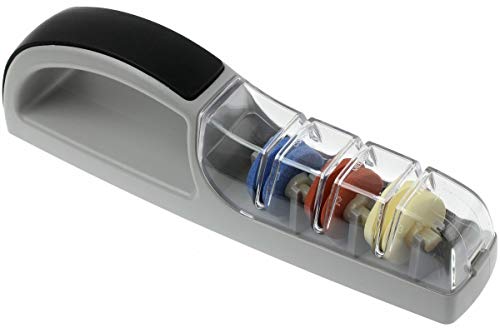
Global Minosharp 2 Stage Ceramic Water Knife Sharpener
ASIN B00005OL3L • $30.95 • Ships from Amazon AU
The Global Minosharp 2 Stage is the lowest-priced pick at $30.95 at time of writing, sold by Amazon AU, and it's the best-ranked pick here at #9 in Amazon AU's Manual Knife Sharpeners category and #1,037 overall. It's a handheld ceramic water sharpener from Global, the Japanese knife maker, with a coarse and a fine ceramic wheel. The listing says it's designed for knives with a 15 degree cutting angle. That makes it the natural partner for Global, Shun and most other Japanese knives. It's the one I'd buy first for a drawer of Japanese-style knives. The rank tells you plenty of people agree, and at this price it's an easy way to find out how much difference a sharp edge makes.
You fill the small water compartment, set it on the counter and pull the knife through the coarse wheel and then the fine one. The water keeps the ceramic cool and carries the steel dust away, so the wheels stay cutting for longer. The listing describes an ergonomic handle for comfort and safety and a rubber base for a secure grip, which matters because a sharpener that slides around is the one that slips. Replacement ceramic wheels are available, according to the listing. That means it can keep going for years rather than being thrown out when the wheels wear down. Two stages keep it simple: coarse when the knife's properly blunt, fine for the weekly touch-up.
It's hand wash only, and the knife is sold separately, as the listing points out. There's no warranty stated on the listing. At 15 degrees, it'll reshape the edge on a 20 degree German knife, taking extra steel to do it, so keep it for knives that match. Empty the water and dry it upside down after each use. Use the fine wheel for weekly touch-ups and keep the coarse one for a properly blunt edge. Check the wheels for grey build-up every few months. For a Japanese knife on a small outlay, it's the one to start with.
Honest caveats: The 15 degree angle suits Japanese knives and will reshape a 20 degree Western edge. It's hand wash only. There's no warranty stated on the listing. It's two stages, so there's no separate polishing wheel. The water compartment needs emptying and drying after use.
Best for: Anyone with Japanese-style knives who wants a gentle ceramic sharpener for regular touch-ups.
Type: Handheld ceramic water sharpener • Stages: 2 (coarse and fine ceramic) • Angle: 15 degrees • Base: Rubber, non-slip • Wheels: Replaceable • Cleaning: Hand wash only • Seller: Amazon AU • Rank: #9 in Manual Knife Sharpeners (Amazon AU)
View on Amazon AU
Furi Pro Diamond Fingers Compact Knife Sharpener
ASIN B000F8SIOW • $45.41 • Ships from Amazon AU
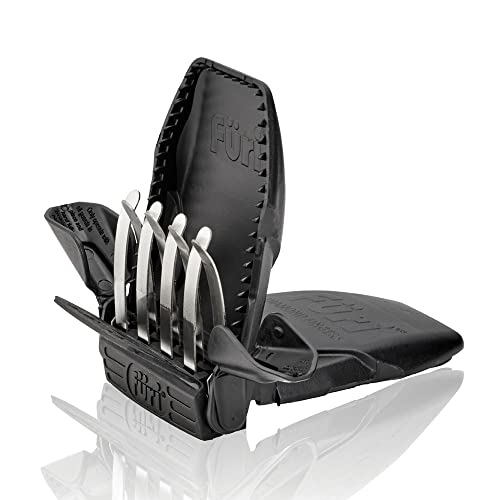
The Furi Pro Diamond Fingers is $45.41 at time of writing, sold by Amazon AU, and it's ranked #19 in Amazon AU's Manual Knife Sharpeners category and #2,879 overall. It's the compact sharpener in Furi's Pro range, and it's built to fold away into a small block. Instead of wheels, it uses eight diamond-coated fingers, made with what Furi calls Ozitech, which flex as the knife passes between them. The listing says it sets the edge bevel and hones at the same time, with no guesswork. It's black, with a body of Japanese stainless steel. It's the one I'd pick for a quick touch-up that lives in a drawer and comes out in seconds.
The outer shell folds out in seconds to make a handle and safety guards, and folds back to a compact block for storage. That's why Furi pitches it at home cooks, travelling chefs and people who want one in a camping kit or a caravan. Diamond is hard enough to work on hard Japanese steels as well as softer Western ones, and the fingers adjust to the blade rather than forcing a single fixed slot. It also carries the longest guarantee of any pick here, at 25 years against defects, which says something about how simple it is inside. With no wheels or motor, there's very little on it that can wear out or break.
The listing doesn't state an edge angle, so check Furi's guidance before putting a 15 degree Japanese knife through it. Its single stage means there's no separate coarse slot for a badly blunt edge, so a neglected knife takes more passes. The fingers clog with steel dust over time; brush them out with a dry toothbrush. Use light pressure and let the diamond do the work. Keep the guards folded out while it's in use. Keep the guarantee paperwork, since 25 years is a long time to remember where you bought it. For a small, tough sharpener with a long guarantee, it's very good value.
Honest caveats: The edge angle isn't stated on the listing. It's a single stage, so very blunt knives take more passes. The diamond fingers need brushing out now and then. It hones and sets the bevel together, with no separate polishing stage. Folding guards must be open while sharpening.
Best for: Home cooks and campers who want a compact diamond sharpener with a long guarantee for quick touch-ups.
Type: Handheld diamond finger sharpener • Abrasive: 8 diamond-coated fingers • Angle: Not stated on the listing • Handle: Folding, with safety guards • Guarantee: 25 years against defects • Colour: Black • Seller: Amazon AU • Rank: #19 in Manual Knife Sharpeners (Amazon AU)
View on Amazon AU
Scanpan Classic 3 Step Knife Sharpener
ASIN B003B2ZS6K • $42.00 • Ships from Amazon AU
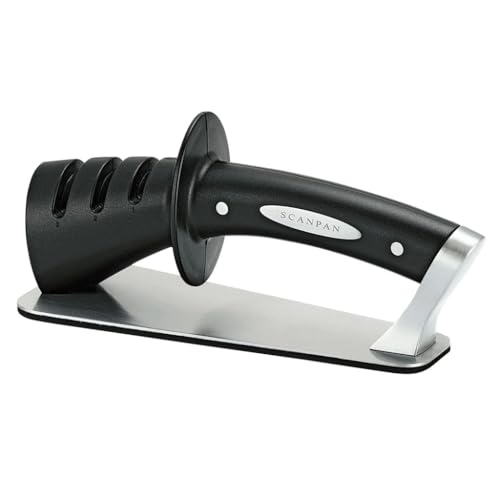
The Scanpan Classic 3 Step is $42 at time of writing, sold by Amazon AU, and it's ranked #143 in Amazon AU's Manual Knife Sharpeners category and #22,727 overall. It's a black handheld pull-through sharpener from Scanpan, the Danish cookware maker, and it's the 20 degree pick. The listing says its first stage uses tungsten steel to realign the edge to a 20 degree angle, its second stage is a diamond steel that hones, and its third stage uses ceramic fingers to polish. China is listed as the country of origin. It's the one I'd pick for a drawer of German and Western knives, the kind most Australian kitchens actually have.
Three separate stages make it a full sharpening kit in one block. The tungsten stage brings back a properly blunt edge quickly, the diamond stage hones the result, and the ceramic stage polishes it. On a knife that's kept up, you'll mostly use the second and third stages and leave the tungsten alone. The 20 degree angle suits the tougher edges on German chef's knives and most supermarket Western knives, which would lose their edge quickly if they were ground to 15 degrees. It's a sensible pick for knives that see heavy daily use, including on harder vegetables. Three stages in one block also means one tool in the drawer instead of a sharpener and a separate honing steel.
Tungsten carbide is aggressive, so a few light passes is enough, and using it every week will wear a knife down faster than it needs to. The listing doesn't state a warranty, a base grip or cleaning instructions. Its rank is the lowest of the manual picks here. Wipe the slots clean with a dry cloth after use. Keep Japanese knives away from it, since 20 degrees will thicken their edge. Hold it firmly on a flat counter, since the listing doesn't mention a grip base. For Western knives that take a beating, it's a practical three-stage sharpener.
Honest caveats: The tungsten first stage removes steel quickly, so use it sparingly. The 20 degree angle will thicken a Japanese knife's edge. Warranty, base grip and cleaning instructions aren't stated on the listing. Its rank is the lowest of the manual picks here.
Best for: Kitchens with German or Western knives that want a three-stage sharpener at a 20 degree angle.
Type: Handheld pull-through sharpener • Stages: 3 (tungsten, diamond steel, ceramic) • Angle: 20 degrees • Colour: Black • Origin: China • Seller: Amazon AU • Rank: #143 in Manual Knife Sharpeners (Amazon AU)
View on Amazon AU
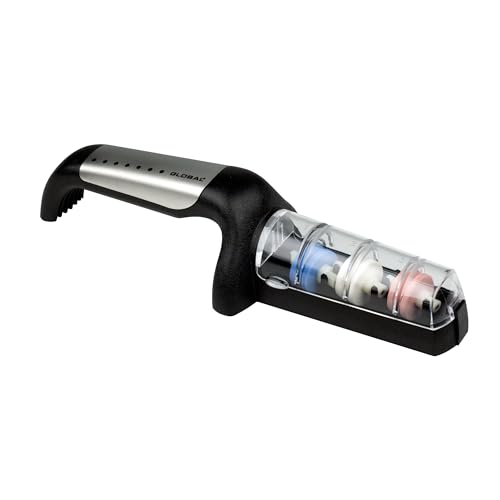
Minosharp3 Plus Ceramic Water Sharpener
ASIN B000WZFBOS • $57.95 • Ships from Amazon AU
The Minosharp3 Plus is $57.95 at time of writing, sold by Amazon AU, and it's ranked #18 in Amazon AU's Manual Knife Sharpeners category and #2,598 overall. It's the three-stage version of the Minosharp ceramic water sharpener, recommended on the listing for Global knives and most other knife brands. It's handheld and sold by Amazon AU, and the listing calls it a complete sharpening process in one unit. Like the two-stage Minosharp, it runs its ceramic wheels through a water compartment. It's the one I'd pick for someone with good Japanese knives who wants the finest edge a pull-through can give, without learning to use a whetstone.
The third stage is the difference. Where the two-stage model goes from coarse to fine, this adds a further stage, which leaves a more polished edge that stays keen longer between sharpens. The listing says the water compartment keeps the wheels cool for better sharpening, and it also carries steel dust away so the ceramic doesn't clog. Ceramic takes off less steel per pass than diamond or tungsten, so it's the gentlest way of keeping a thin Japanese edge in shape. It costs about $27 more than the two-stage model at time of writing, for that extra stage. If you only own one or two good knives, the two-stage model covers most of what this does.
The listing doesn't state an edge angle, a warranty or whether replacement wheels are available, so check those before you buy. It's designed around Global knives, so a 20 degree Western knife isn't what it's built for. Fill the water to the line before each use and empty it after. Dry it upside down so the wheels don't sit in sludge. Use the coarse stage only on a properly blunt edge. Light pressure matters more on ceramic than on diamond. For the best finish on Japanese knives, it's the one to buy.
Honest caveats: Edge angle, warranty and replacement wheels aren't stated on the listing. It's built around Global and Japanese-style knives. The water compartment needs filling and emptying every time. It costs about $27 more than the two-stage Minosharp for the extra stage.
Best for: Owners of good Japanese knives who want a three-stage ceramic water sharpener for the finest edge.
Type: Handheld ceramic water sharpener • Stages: 3 • Cooling: Water compartment • Angle: Not stated on the listing • Suits: Global and most other knife brands • Seller: Amazon AU • Rank: #18 in Manual Knife Sharpeners (Amazon AU)
View on Amazon AU
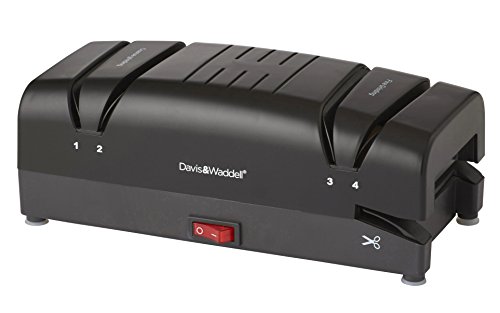
Davis & Waddell D1517 Essentials Electric Knife Sharpener
ASIN B077FH3BVV • $84.95 • Ships from Amazon AU
The Davis & Waddell D1517 Essentials is $84.95 at time of writing, sold by Amazon AU, and it's ranked #348 in Amazon AU's Speciality Appliances category and #25,175 overall. It's the electric pick, a black multi-function sharpener for kitchen knives, scissors and screwdrivers. The title lists two grind settings, coarse and fine, plus non-slip feet and a removable drawer. The model is D1517, as the title says, and the colour is black. It ships from Amazon AU, so returns go through Amazon's usual process if the plug isn't right. It's the one I'd pick for someone with weak grip or a drawer full of knives and scissors to get through in one sitting.
A motor does the work, so you guide the knife through the slot and the wheels spin against it. That's quicker and takes less effort than any manual pick here, and the scissor and screwdriver slots make it a general sharpening station for the kitchen and the shed. The removable drawer catches the metal filings, which keeps them off the counter and out of the motor. Non-slip feet stop it walking across the counter while it runs, which matters when you're guiding a sharp blade into a slot. It's the one pick with a stated weight, a 1.67 kg package, and that weight helps it sit still. Having one tool for knives, scissors and screwdrivers also means fewer separate sharpeners cluttering the drawer.
The feature list is the thinnest here: it doesn't state the wattage, voltage, plug, edge angle or warranty. Check that the plug has Australian pins and an RCM mark when it arrives. A motor-driven coarse wheel takes steel off fast, so use one or two light passes and keep the coarse setting for blunt knives. Empty the drawer after every few sessions. Never rinse it under the tap. Unplug it before you empty the drawer or wipe the slots. For an electric sharpener sold by Amazon AU, it's the one I'd choose.
Honest caveats: Wattage, voltage, plug, edge angle and warranty aren't stated on the listing. A motorised coarse wheel removes steel quickly, so go lightly. It needs a spot near a power point. Its rank is the lowest of the picks. Empty the filings drawer regularly and keep it away from water.
Best for: Anyone with weak grip or a lot of knives and scissors who wants an electric sharpener sold by Amazon AU.
Type: Electric sharpener • Settings: Coarse and fine • Sharpens: Knives, scissors, screwdrivers • Features: Non-slip feet, removable filings drawer • Package weight: 1.67 kg • Power: Not stated on the listing • Model: D1517 • Seller: Amazon AU • Rank: #348 in Speciality Appliances (Amazon AU)
View on Amazon AU
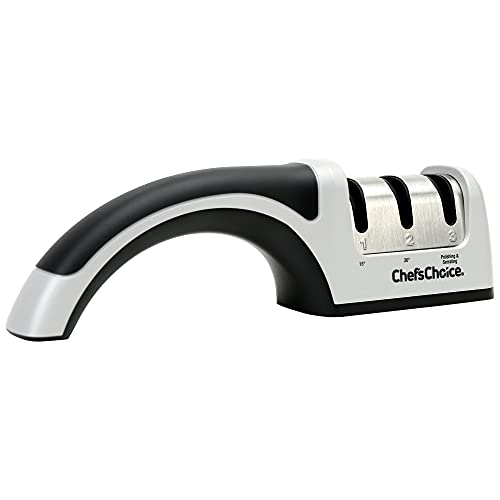
Chef's Choice ProntoPro Diamond Hone Knife Sharpener
ASIN B007IVBET0 • $88.02 • Ships from Amazon AU
The Chef's Choice ProntoPro Diamond Hone is the most expensive pick at $88.02 at time of writing, sold by Amazon AU, and it's ranked #141 in Amazon AU's Manual Knife Sharpeners category and #22,696 overall. It's a black and grey manual three-stage sharpener, and its listing says it suits both 15 and 20 degree class knives. That's the feature that sets it apart from the other picks. Chef's Choice is best known for its electric sharpeners, and this is its manual model. It's the one I'd pick for a mixed drawer of Japanese and Western knives, where a single-angle sharpener would get one of them wrong every time it's used.
All three stages use diamond abrasives, according to the listing. The first two sharpen and hone, and the third polishes the edge with micron-sized diamond for a finish that's free of burrs. Chef's Choice calls its system CrissCross, with diamond wheels working on both sides of the edge at the same time. The listing also says it sharpens straight-edge and serrated knives, plus sports and pocket knives, the one pick here that lists serrated blades. Diamond suits hard Japanese steels that can glaze softer abrasives, so it's a good match for a premium knife. Three stages also mean you can choose how much steel to take, from a full sharpen to a light polish before dinner.
The listing doesn't state a warranty, a base grip or which slots are for which angle, so read the instructions before the first pass. It costs about twice the Scanpan at time of writing. With diamond in every stage, it takes steel off efficiently, so stay light. Brush the slots out with a dry brush now and then. Keep the serrated setting for serrated knives only. Practise on an everyday knife before your best one, so you get a feel for the slots. For a household with both kinds of knife, it's the one to buy.
Honest caveats: Warranty and base grip aren't stated on the listing, and you'll need the instructions to match angles to slots. It's the most expensive pick. Diamond in every stage removes steel efficiently, so go lightly. It's manual, so it's slower than the electric pick on a big batch of knives.
Best for: Mixed drawers of Japanese and Western knives, plus serrated blades, that need one sharpener for both angles.
Type: Manual 3-stage sharpener • Abrasive: Diamond in all three stages • Angles: 15 and 20 degree class knives • Sharpens: Straight edge, serrated, sports and pocket knives • Technology: CrissCross diamond wheels • Colour: Black and grey • Seller: Amazon AU • Rank: #141 in Manual Knife Sharpeners (Amazon AU)
View on Amazon AUSide-by-side comparison
What we see fail in the workshop: knife sharpeners
Manual sharpeners have almost nothing to break, so the faults are mostly worn or clogged abrasives. Electric ones add a motor, a switch and a cord, and those fail the way they do on any small kitchen appliance. Here's what usually goes wrong and what you can check yourself before you throw one out. Most of it comes down to dust and wear.
Wheels that stop cutting
A sharpener that used to bring an edge back and now just polishes it has usually clogged rather than worn out. Steel dust packs into ceramic wheels and diamond fingers, and the knife slides over it instead of being ground. On water sharpeners, the grey sludge left in the compartment dries onto the wheels. Rinse the ceramic, scrub it with a soft brush and let it dry fully. If it still won't cut, the wheels are worn, and on models with replaceable wheels that's a small part. Keep the compartment emptied after use.
Electric sharpeners that won't spin
An electric sharpener that hums but won't spin, or runs and then stops, usually has steel dust in the motor or a worn switch. Filings get past the wheels on poorly sealed units and build up around the motor shaft. Unplug it and empty the filings drawer first, then check whether the wheels turn freely by hand. A switch that only works when you press it hard is wearing out. Both are usually repairable, but don't open the motor housing while it's plugged in, and don't spray lubricant into it, which only binds more dust.
Cords, plugs and hot smells
A sharpener's motor draws little power, so a cord or plug that runs warm points to damage, not load. Look for kinks where the cord leaves the body, which is where it's flexed every time it's moved, and for brown marks around the plug pins. A hot or burning smell during use means it stops there. A cord replacement is usually a modest repair. Never run an imported sharpener through a travel adaptor, and check for the RCM mark on any electric unit you buy, on the plug or the label underneath.
Decision tree: which one should you actually buy?
- Japanese knives and a small outlay? → The Global Minosharp 2 Stage at $30.95, the best-ranked pick here, with ceramic water wheels at a 15 degree angle.
- Want something compact for a drawer or a camping kit? → The Furi Pro Diamond Fingers at $45.41, with eight diamond fingers, a folding handle and a 25-year guarantee.
- German or Western knives? → The Scanpan Classic 3 Step at $42, with tungsten, diamond and ceramic stages at a 20 degree angle.
- Good Japanese knives and want the finest edge? → The Minosharp3 Plus at $57.95, a three-stage ceramic water sharpener built around Global knives.
- Weak grip or a big batch of knives and scissors? → The Davis & Waddell D1517 at $84.95, the electric pick, with coarse and fine settings and a filings drawer.
- Electric sharpener stopped spinning or smells hot? → It's usually dust in the motor, a worn switch or a damaged cord. Bring it into our Erina workshop and we'll find the fault and tell you if it's worth fixing before you spend anything.
Frequently asked questions
Are electric knife sharpeners bad for knives?
Not if they're used lightly. An electric sharpener spins its abrasive faster than you'd ever pull a knife through a manual one, so it removes steel quickly, and heavy or repeated use of the coarse slot wears a knife down years early. One or two light passes, with the coarse setting kept for blunt knives, is fine. The bigger risk is the angle: if the sharpener grinds at 20 degrees and your knife is a 15 degree Japanese blade, it'll thicken the edge whatever kind of sharpener it is.
What angle should I sharpen my kitchen knife at?
Match the angle the knife was made with. Most Japanese-style knives, like Global and Shun, are ground at about 15 degrees a side, and most German and Western knives at about 20 degrees. Among the picks, the Global Minosharp 2 Stage lists 15 degrees, the Scanpan Classic 3 Step lists 20 degrees and the Chef's Choice ProntoPro handles both. If you don't know your knife's angle, the maker's website will usually say.
How often should I sharpen my knives?
Less often than most people think, if you hone in between. For a home kitchen, a few passes through a fine stage every week or two keeps an edge going, and a full sharpen with a coarse stage is only needed every few months, or when honing stops bringing the edge back. Using a timber or soft plastic board, hand washing and storing knives off other metal all stretch the time between sharpens.
Can I sharpen a serrated bread knife in a pull-through sharpener?
Only if the sharpener says it can. Most pull-through slots will grind the points of the serrations flat rather than sharpen the scallops between them. Among the picks, the Chef's Choice ProntoPro is the one whose listing says it sharpens serrated knives. For the others, leave the bread knife out. A serrated knife used only on bread stays sharp for a very long time, and when it does go, a tapered ceramic rod does the scallops one at a time.
What's the difference between honing and sharpening?
Sharpening grinds away steel to make a new edge. Honing pushes a rolled or bent edge back into line without removing much metal. Most of the bluntness you feel after a week of cooking is a rolled edge, so honing brings it back. Some sharpeners do both: the Furi listing says its diamond fingers set the bevel and hone together, and the Scanpan's middle stage is a diamond steel for honing.
Is an electric knife sharpener worth repairing?
A good one often is. There's not much inside: a small motor, a switch, a cord and the abrasive wheels. Most faults are steel dust around the motor, a worn switch or a damaged cord, and those are usually modest repairs. Worn wheels can sometimes be replaced. If the motor itself has failed on a low-priced unit, compare the quote with a new sharpener, and if it smells hot or sparks, stop using it and have it checked before you plug it in again.
Related buying guides
Electric sharpener stopped working?
Most electric sharpener faults we see come down to steel dust in the motor, a worn switch or a damaged cord and plug. Bring it into our Erina workshop and we'll find the actual fault and tell you whether it's worth fixing or replacing before you spend anything.
Visit our Erina workshop Book Online