Prices from Amazon AU, updated daily. Swipe or use the arrows for more.
Disclosure: This article contains affiliate links to amazon.com.au. If you buy through one of these links iFix may earn a small commission at no extra cost to you. It doesn't change which products we recommend. We focus on what actually lasts based on 16 years of repair-shop experience.
Quick summary8 picks
- Entry PickDEERC 9309E 1/16 All Terrain Fast RC Cars… about$1101200mAh.
- DEERC 9312E 1/18 Scale Fast RC Cars about$1101200mAh.
- 1:18 RC Cars for Adults & Boys Fast 4WD All… about$1201300mAh.
- Rc Cars 1:14 All Terrain RC Car for Adults… about$1301300mAh.
- DEERC 9201E 1:10 Large Remote Control Truck… about$160
- MJX Hyper GO 14208 1/14 Brushless 4X4 RC… about$1802000mAh.
- DEERC 209E 1:10 Fast Brushless RC Car for… about$2401500mAh.
- Most PremiumDEERC 8618 1/16 Fast Brushless RC Cars for… about$280
Toy grade and hobby grade
RC cars split into two camps. Toy-grade cars are the ones in department stores: plastic gears, a built-in battery and no spare parts, so when something snaps the car's finished. Hobby-grade cars have proportional steering and throttle, a separate speed controller, swappable battery packs, oil-filled shocks and, most importantly, parts you can replace when they break. Every pick here sits at the hobby end, or very close to it.
The difference shows up the first time you crash. And you will crash, because that's half the fun. A hobby car that cartwheels into a kerb usually breaks a suspension arm, a steering link or a bumper, which are low-cost plastic parts designed to snap before something expensive does. A toy car that does the same often breaks its chassis or strips its gearbox, and there's nothing to replace.
If you're buying for a young child who just wants to drive around the backyard, a toy-grade car or even a kids ride-on car is fine. These picks are aimed at older kids, teens and adults who'll drive fast, jump things and want to keep the car running for more than a summer. Most of the listings say 8+ or adult, and the fast ones really are adult toys.
All five picks are sold on Amazon AU, from $110 to $280 at time of writing. Four are DEERC, sold by DEERC's own Australian storefront, and one is MJX, sold by Amazon AU. That's mostly what Amazon AU stocks in hobby RC at this price. The big hobby names like Traxxas and Arrma didn't show up as clean listings in this range on the day I checked. If you're after something that flies instead, our drone guide covers the same battery questions.
Brushed or brushless motors
This is the biggest decision. A brushed motor uses carbon brushes rubbing on a commutator to switch the current. It's simple, smooth at low speed and inexpensive, but the brushes wear, the motor gets hot, and top speed is limited. The two brushed picks here use a 380 motor in the small DEERC 9309E and a 540 motor in the bigger 9201E, and both list top speeds in the 40 to 48km/h range.
A brushless motor switches the current electronically, so there's nothing rubbing inside. It runs cooler, lasts longer and makes a lot more power for its size. That's why the three brushless picks list 60km/h or more. The catch is that the extra speed hits everything else harder: tyres, driveshafts, suspension arms and the battery all take more abuse, and crashes at 70km/h break more than crashes at 30km/h.
My advice for a first hobby car is brushed, unless the driver's already handy with a remote. Brushed cars are easier to control, more forgiving on grass and the gear lasts longer. If you already know you want speed, or you're buying for an adult who's driven RC before, go brushless and set the throttle limit low for the first few runs.
Motor KV ratings show up on the brushless listings: 2300KV on the DEERC 209E, 4400KV on the MJX and 5480KV on the DEERC 8618. KV is how many RPM the motor spins per volt. Higher KV means more speed on the same battery, but also more heat and more strain on the drivetrain, so a higher number isn't automatically better.
LiPo batteries: the part that needs respect
Most hobby RC cars run on lithium polymer packs, usually called LiPo. They pack a lot of energy into a small, light pack, which is why they're used, and they're safe enough when they're treated properly. But a LiPo that's overcharged, over-discharged, punctured or charged on a no-name charger can swell, smoke and catch fire, and a LiPo fire is very hard to put out.
The rules are simple. Only charge with the charger that came with the car or a proper balance charger. Charge on a non-flammable surface, never on carpet, a bed or a car seat, and never leave it charging while you're out of the house. A LiPo charging bag is a few dollars and worth having. If a pack swells or puffs up, stop using it, because swelling means the cells inside are breaking down.
Don't run a LiPo flat. Most speed controllers have a low-voltage cut-off that slows or stops the car when the pack gets low, and that's your cue to stop. Running past it damages the cells. And if you're putting the car away for more than a week or two, store the pack part-charged rather than full or empty, ideally in a fireproof box away from anything that burns.
The same lithium chemistry runs e-scooters, drones and power tool packs, and the failure modes are the same. Most of the lithium battery trouble we see starts with the wrong charger, so here's why no-name chargers cause so much trouble. It's the one part of an RC car where cutting corners can go badly wrong.
2S, 3S and what the numbers mean
LiPo packs are described by how many cells they have in series. A 2S pack has two cells and runs at 7.4V nominal. A 3S pack has three cells and runs at 11.1V. More voltage means more speed from the same motor, which is why several listings quote one top speed on the included battery and a higher one on an optional 3S pack.
Only fit a 3S pack if the listing says the speed controller supports it. The MJX listing says its standard pack is a 2S 2000mAh LiPo and suggests a 3S pack for more speed. The DEERC 209E and 8618 both come with 3S packs in the box. Putting a 3S pack in a car whose controller is only rated for 2S is a quick way to burn out the controller.
Capacity, quoted in mAh, decides how long you can drive. The small DEERC 9309E comes with two 1200mAh packs, the 209E with two 1500mAh 3S packs and the MJX with a 2000mAh pack. Every pick that states run time quotes it across both included batteries, so halve the number for one pack. Fast driving and big jumps cut it further.
Discharge rate, the C number, matters for fast brushless cars. The 209E's packs are rated 20C and the 8618's 45C. A higher C rating can deliver more current without heating up, which suits high-powered motors. When you buy spare packs, match the voltage, plug type and physical size first, then the C rating.
Scale, size and where you'll drive
Scale is the car's size against a real vehicle. A 1:16 or 1:18 car is small enough to carry in one hand, a 1:14 is mid-sized, and a 1:10 is big enough to handle long grass, gravel and rough ground. Bigger cars ride over bumps that stop small ones, but they need more space and they hit harder when they crash.
For a backyard, a park or a footpath, a 1:16 or 1:14 car is plenty. For a dirt track, a paddock or a beach, a 1:10 handles the ground better. The DEERC 9201E and 209E are the 1:10 picks here. The 9309E and 8618 are 1:16, and the MJX is 1:14, which its listing says is small enough to carry in a backpack.
Tyres matter more than most people expect. Monster truck tyres suit grass and dirt, while short course and truggy tyres suit gravel and hard tracks. If you'll mostly drive on bitumen, any of these will wear their tyres down quickly, and a set of road tyres is worth buying once you've worn the first ones out.
Mind where you drive. Footpaths, car parks and streets are where RC cars get run over or run into someone, and a 70km/h truck can hurt a person or a pet. Find a quiet park, an empty dirt patch or a local RC track, and keep the fast cars well away from people.
Spare parts decide how long a car lasts
Every RC car breaks parts. Suspension arms, steering knuckles, driveshafts, bumpers and spur gears are the usual casualties, and the cars that last are the ones you can get those parts for. Before you buy, search the model number plus parts, and see what comes up. If there's nothing, the first big crash may be the last one.
DEERC sells spares for its popular models, and the 209E even comes with an extra set of swing arms in the box, which tells you which part breaks first. MJX's Hyper Go range has a following, and parts for the 14208 turn up from hobby sellers. Check part availability for the exact model before you order, because these brands change their range often.
Metal parts aren't always better. Metal gears and driveshafts last longer than plastic ones, and several picks list a metal gear servo, metal differential or metal driveshafts. But plastic suspension arms are designed to break and protect the chassis. A car with every part in metal can transfer a crash into something harder to replace, like the chassis or the motor mount.
Keep a small kit with the car: a set of hex keys, a few spare arms and links, a spare spur gear and some thread lock. Most fixes take ten minutes with the right parts, and a car that's down for a week waiting on a part is the usual reason people give up on the hobby.
Water, mud and the speed controller
Several listings say waterproof, but read the detail. The DEERC 9309E and 209E list an IPX4 waterproof ESC, which means splash resistant, not submersible. Puddles and wet grass are fine. Driving through a creek or into the surf is not, and water in the receiver or the motor bearings is what usually ends a session.
After a wet or muddy run, take the battery out, shake the water out, let the car dry with the body off, and dry the bearings and screws before they rust. Salt water is much worse than fresh, so if you've been on a beach, rinse the car gently with fresh water and dry it properly before you put it away.
The speed controller, or ESC, is the electronic box between the battery and the motor. It's the part most likely to fail from heat or water. If a car starts cutting out, stuttering or won't respond after a wet run, unplug the battery, dry everything and let it sit overnight. Heat-related cut-outs usually mean you've been driving too hard on a hot day. If it still won't come good, bring the car and remote into our Erina workshop and we'll tell you what's failed before you buy parts.
How I picked these five
I searched Amazon AU for hobby RC cars and trucks, kept only new stock sold by Amazon AU or a brand with an AU storefront, and dropped toy-grade cars, licensed toys and anything whose model or part number pointed to a US version. One brushless DEERC that ranked #2 was left out because its part number ended in US and its listing quoted two different top speeds.
Then I read each listing's features against its title for speed, battery and motor claims, kept the ones that agreed, and ranked them by Amazon AU's Hobby RC Trucks sales rank on the day. The five best-ranked that fit run from $110 to $280, and a few close contenders are in the extras below the picks.
Speed figures on RC listings are the maker's own numbers and usually assume a fresh battery, smooth ground and the best gearing. Treat them as a guide to which car is faster than which, not as what you'll see on a GPS in the park.
The 5 picks, $110 to $280
Prices are Amazon AU at time of writing (2026-11-07) and move week to week. Ranks are Amazon AU category sales ranks, checked the same day.

DEERC 9309E 1:16 4WD Brushed RC Monster Truck, 2 Batteries
ASIN B0F21LY3KT • $109.99 • Sold by DEERC STORE AU on Amazon AU
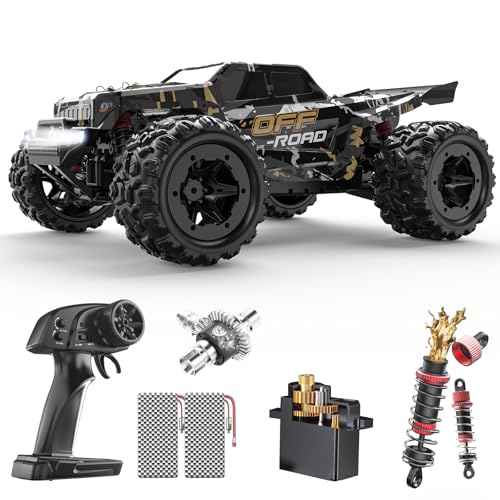
The DEERC 9309E is the best-ranked RC car among the picks and the one I'd start most people on. It's $110 at time of writing, sold by DEERC STORE AU, the brand's Australian storefront on Amazon, and it's ranked #2 in Hobby RC Trucks. The part number is AU4-9309E, which is the AU version. It's a 1:16 four-wheel drive monster truck with a 380 brushed motor, and the listing gives a top speed of up to 40km/h. It comes with two 1200mAh LiPo packs, and the listing quotes up to 40 minutes of driving across both, so plan on about 20 minutes a pack. It's ready to run out of the box.
For a car at this price, the drivetrain is better than I'd expect. The listing names metal oil-filled shocks, a metal differential, a metal driveshaft and a metal gear servo. That's the stuff that usually strips or bends first on lower-priced cars, so it should take some punishment. It also has working LED headlights and a rear wheelie bar, which stops it flipping over backwards when you punch the throttle. The ESC is rated IPX4, so puddles and wet grass are fine, but don't drive it into water. The colour is black with grey accents. At 1:16 it's small enough for a backyard or a park, and light enough that crashes don't break much.
The #2 rank is shared with a brushless DEERC listing that's grouped with it on Amazon, so it isn't this model's rank alone. Charge the LiPo packs on a hard surface with the supplied charger, and never leave them charging unattended. Search the 9309E part number for spare arms before the first crash. Unplug the battery as soon as you stop driving, and let the motor cool before the second pack. Keep it off bitumen if you want the tyres to last. It's the right first hobby car for a teenager or an adult who wants something fun, tough and not too fast.
Honest caveats: It's brushed, so it won't match the brushless picks for speed, and the brushes wear over time. The rank is shared with another DEERC listing grouped with it. The listing doesn't name the battery plug type or the charger in the box. The marketing copy aims it at kids as well as adults, but 40km/h needs supervising.
Best for: First-time hobby drivers and teens who want a tough, small four-wheel drive truck with spare batteries.
Scale: 1:16, 4WD • Motor: 380 brushed • Top speed: Up to 40km/h (listing) • Battery: 2 x 1200mAh LiPo • Run time: Up to 40 min across both packs (listing) • Waterproofing: IPX4 ESC • Model: 9309E (part AU4-9309E) • Seller: DEERC STORE AU • Rank: #2 in Hobby RC Trucks (Amazon AU), listing shared with another DEERC model
View on Amazon AU
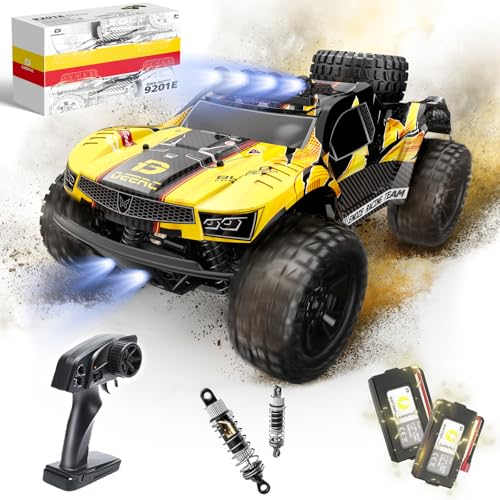
DEERC 9201E 1:10 4WD Brushed Short Course RC Truck, 2 Batteries
ASIN B09PQL64P7 • $159.99 • Sold by DEERC STORE AU on Amazon AU
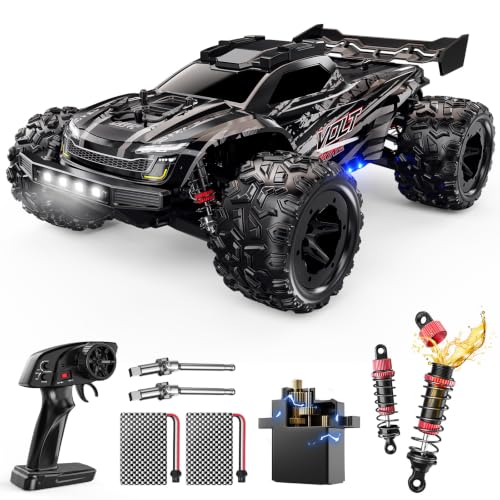
The DEERC 9201E is the big brushed truck, at $160 and ranked #38 in Hobby RC Trucks. It's sold by DEERC STORE AU and the model code is 9201E, matching the title. At 1:10 scale it's the largest brushed pick here, and the listing describes it as a short course truck with a 540 brushed motor, a heat sink on the motor, a 30A ESC and a 2.2kg steering servo. The listed top speed is up to 48km/h, a little more than the 9309E. It comes with two rechargeable batteries according to the title, though the feature text doesn't name their chemistry or capacity, so check the photos and the box contents section.
Size is the reason to pick this one. A 1:10 truck rolls over long grass, gravel and rough paddocks that would stop a 1:16 car, and it's easier to see at a distance. The listing names independent front and rear suspension with shock absorbers, reinforced bumpers, anti-skid rubber tyres with an aggressive tread and an LED lighting system. The 540 motor is the standard brushed size in hobby RC, which is good news for spares, because replacement 540 motors are easy to find. The listed weight is about 2.2kg, heavier than the small cars, so it carries more momentum into a crash. It's a good fit for a bigger yard or a dirt patch.
The listing doesn't state waterproofing, battery type or run time, so treat it as dry-weather only until you've checked. Keep the motor heat sink clear of grass and mud, because a brushed 540 runs hot. Check the gear mesh and screws after the first few runs, since big trucks shake things loose. Ask the seller about spare arms and the battery type before ordering. Run it on grass or dirt rather than bitumen, which wears tyres fast. It's the pick for someone who wants a big truck without the speed and battery care of a brushless car.
Honest caveats: The listing doesn't state the battery type, capacity, run time or any waterproof rating. It's brushed, so expect brush wear and heat on long runs. The rank is lower than the smaller DEERC. At 1:10 it needs more space, and the listed dimensions look like box sizes rather than the truck itself.
Best for: Drivers with a big yard or paddock who want a large, simple brushed truck that rolls over rough ground.
Scale: 1:10, 4WD short course • Motor: 540 brushed with heat sink • ESC: 30A • Servo: 2.2kg • Top speed: Up to 48km/h (listing) • Battery: 2 rechargeable (type not stated) • Model: 9201E • Seller: DEERC STORE AU • Rank: #38 in Hobby RC Trucks (Amazon AU)
View on Amazon AU
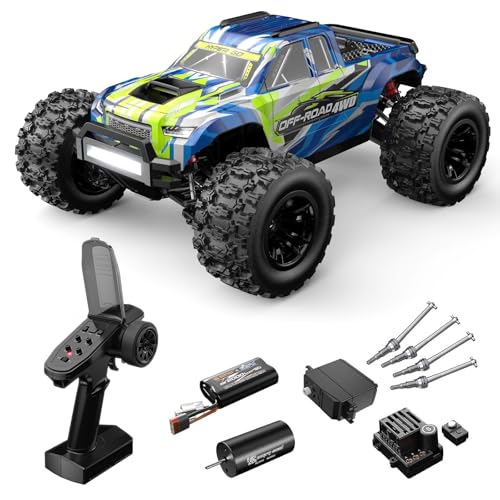
MJX Hyper Go 14208 1:14 Brushless 4WD RC Short Course Truck with Gyro
ASIN B0FR48NQML • $180.00 • Ships from Amazon AU
The MJX Hyper Go 14208 is the least expensive brushless pick at $180, and it's the one pick sold by Amazon AU itself, which keeps returns simple. It's ranked #62 in Hobby RC Trucks and the model and part number are both 14208, matching the title. It's a 1:14 four-wheel drive short course truck with a 2852 brushless motor rated at 4400KV and a 45A waterproof ESC. The listing gives a top speed of up to 45mph, which is about 72km/h, and says a 3S LiPo can be added for more speed. The standard battery is a 2S 2000mAh LiPo, and the title says two packs are included. It's sold ready to run.
The spec sheet reads like a proper hobby car. The listing names an aluminium chassis, carbon steel gears, powder metal differential gears, an adjustable CNC aluminium motor mount and full metal hydraulic shocks. It also has sealed differentials and a central limited-slip system, which spreads power more evenly and protects the drivetrain. The steering uses a 6kg digital servo, and the gyro helps keep it straight under hard acceleration. The remote is a 2.4GHz four-channel unit with a six-channel receiver and a listed range of 150m, which is plenty for a park. There's also an adjustable throttle, which I'd set low for the first few runs, because 72km/h is fast for a 1:14 truck.
The listing's dimensions are clearly placeholders, so don't read anything into them. Only fit a 3S pack once you're comfortable at full 2S speed, and match the plug and size. Charge on a hard surface and stop if a pack swells. Search the 14208 part number for spare arms and gears before you need them. Unplug the battery after every run, and let the motor and ESC cool between packs. It's the brushless car I'd buy for someone who wants real speed at a sensible price, from a seller that handles returns directly.
Honest caveats: At up to 72km/h it's too fast for young kids, despite the listing mentioning ages 8 to 12. The listing doesn't name the charger or plug type. Run time isn't stated. The rank sits well behind the DEERC picks, and the listed dimensions are placeholders. Spare parts come from hobby sellers, so check availability first.
Best for: Drivers stepping up to brushless who want a well-specified 1:14 truck with a gyro, sold by Amazon AU.
Scale: 1:14, 4WD short course • Motor: 2852 brushless, 4400KV • ESC: 45A waterproof • Top speed: Up to 45mph / about 72km/h (listing) • Battery: 2S 2000mAh LiPo (3S supported) • Steering: 6kg digital servo, gyro • Model: 14208 • Seller: Amazon AU • Rank: #62 in Hobby RC Trucks (Amazon AU)
View on Amazon AU
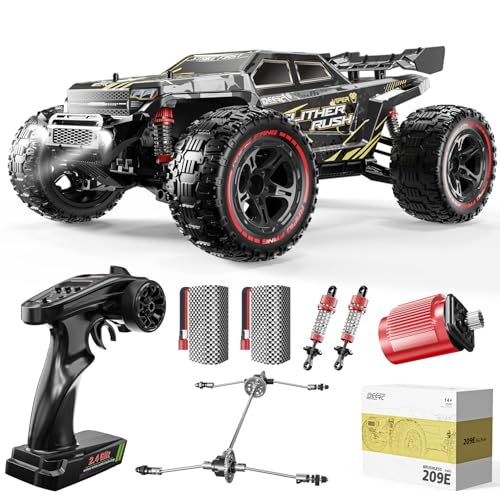
DEERC 209E 1:10 Brushless 4WD RC Truck, 2 x 3S Batteries, Extra Swing Arms
ASIN B0FKSPJ43X • $239.99 • Sold by DEERC STORE AU on Amazon AU
The DEERC 209E is the big brushless truck, at $240 and ranked #37 in Hobby RC Trucks. It's sold by DEERC STORE AU and the model and part number are both 209E, which matches the title. At 1:10 scale it has a 2847 brushless motor rated at 2300KV with a metal heat sink, and a 45A waterproof ESC rated IPX4. The listing gives a top speed of 37mph or more, which lines up with the 60km/h in the title. It comes with two 3S 11.1V 1500mAh packs rated 20C, and the listing quotes up to 40 minutes across both, so about 20 minutes each. It's ready to run out of the box.
The box contents are the clever part. DEERC includes an extra set of swing arms, which are the suspension arms that usually snap first when a big truck lands badly, so you can fix the most common break straight away. The listing also names front and rear metal sheet chassis reinforcements, a 38T metal gear differential, metal driveshafts, adjustable 35 to 55mm oil-filled shocks and a three-wire metal gear servo. A wheelie bar helps on hard launches. The colour is black with gold stripes and a printed body. Its low KV motor on 3S gives plenty of torque for a 1:10 truck without the extreme speed of the 8618. It's a good step up for someone who's outgrown a small brushed car.
The listing doesn't name the charger or the battery plug type, so check both before buying spare packs. Store the 3S packs part-charged and away from anything that burns. Swap the spare swing arms in with a hex key, and keep a set of links handy. Check the motor and ESC temperature after each pack. Set the throttle limit low until you're used to the power, then open it up. It's the pick for someone who wants a big, fast truck built for bashing, with the first repair already in the box.
Honest caveats: It's the second most expensive pick, and 3S packs need more care than 2S ones. The listing doesn't name the charger, the battery plug or a run time per pack. Shared feature copy calls it both a truck and a crawler. At 1:10 and 60km/h it hits hard in a crash, so drive it well away from people.
Best for: Drivers who've outgrown a small brushed car and want a big 3S brushless truck with spare arms in the box.
Scale: 1:10, 4WD • Motor: 2847 brushless, 2300KV • ESC: 45A, IPX4 • Top speed: 37mph+ / 60km/h+ (listing) • Battery: 2 x 3S 11.1V 1500mAh 20C • Extras: Spare swing arms • Model: 209E • Seller: DEERC STORE AU • Rank: #37 in Hobby RC Trucks (Amazon AU)
View on Amazon AU
DEERC 8618 1:16 Brushless 4WD RC Truggy, 2 x 3S LiPo Batteries
ASIN B0F18JXB9H • $279.98 • Sold by DEERC STORE AU on Amazon AU
The DEERC 8618 is the fastest pick and the most expensive, at $280 and ranked #45 in Hobby RC Trucks. It's sold by DEERC STORE AU. The part number is 8618-AU and the model is 8618E, the AU version. It's a small 1:16 truggy with a 2847 brushless motor rated at 5480KV and a 50A ESC with a cooling fan. It comes with two 3S LiPo packs rated 45C, and the listing claims a GPS-tested top speed over 56mph, which is about 90km/h, with up to 40 minutes of running across both packs. That's a lot of speed for a car this size, and it's the reason the drivetrain matters as much as the motor.
The listing also names an electronic stability program that keeps the truck straight at high speed and reduces rollovers, which matters at these speeds. The drivetrain gets 1.8mm CNC aluminium chassis blocks, a hardened steel pinion, a 37T metal spur gear and sealed bevel gears with front and rear differentials. There are four adjustable oil-filled shocks and 85mm tyres with sponge inserts. The 2.4GHz transmitter has a listed range of 260m and an adjustable throttle limit from 30 to 100 percent, which is the first thing I'd turn down. Like the other DEERC picks, it's ready to run. The servo is a 2.3kg three-wire unit, so steering isn't as strong as the MJX's 6kg servo.
At 90km/h, a crash with a person or a pet can cause real harm, so this is an adult's car for an empty space. Start with the throttle at 30 percent. Check the motor and ESC temperature after each pack, because a 5480KV motor on 3S runs hot. Charge the packs in a LiPo bag. Search the 8618 part number for spare gears and arms, because at this speed you'll need them. Clean and check the bearings after every dusty run. It's the pick for an experienced driver who wants the most speed for the money.
Honest caveats: It's the most expensive pick and by far the fastest, which makes it the hardest on parts and the riskiest around people. The servo is the weakest among the brushless picks at 2.3kg. The 56mph figure is the maker's own claim. The listing doesn't name the charger or plug type, and 3S 45C packs need careful charging and storage.
Best for: Experienced adult drivers who want the most speed for the money and have a big, empty space to use it.
Scale: 1:16, 4WD truggy • Motor: 2847 brushless, 5480KV • ESC: 50A with fan, stability control • Top speed: 56mph+ / about 90km/h (listing) • Battery: 2 x 3S LiPo, 45C • Range: 260m (listing) • Model: 8618E (part 8618-AU) • Seller: DEERC STORE AU • Rank: #45 in Hobby RC Trucks (Amazon AU)
View on Amazon AUSide-by-side comparison
What we see fail in the workshop: RC cars
RC cars come into the shop for the same few reasons, and most of them trace back to a crash, water or a battery. The good news is that hobby-grade cars are built to be fixed, and most faults cost less to sort than they look. Here's what usually goes wrong and what you can check yourself, with the battery unplugged, before you spend anything on parts.
Puffed or dead LiPo packs
A LiPo pack that's swollen, won't hold charge or makes the car cut out early has usually been run flat, overcharged or stored full for months. Swelling is the warning sign: the cells are breaking down and producing gas, and a swollen pack can catch fire if it's charged again or punctured. Don't charge it and don't keep using it. Put it somewhere non-flammable and take it to a battery recycling point. Then work out why it happened, because the next pack will go the same way if nothing changes.
Car won't respond or cuts out
If the car won't drive or keeps cutting out, start with the simple things: fresh batteries in the remote, a charged pack in the car, and the bind between remote and receiver. Check the battery plug isn't loose or melted. After a wet run, a cut-out usually means water in the receiver or ESC, so dry it out overnight. If the ESC smells burnt or the motor won't spin with a known-good pack, one of them has likely failed and needs replacing. Swap in a known-good pack before you blame the controller.
Grinding noise and no drive
A grinding or clicking noise with the wheels not turning is almost always a stripped spur gear or pinion, or a gear mesh that's come loose. Hard landings, full throttle from a standstill and stones in the gears are the usual causes. It's a common, inexpensive fix: replace the gear, set the mesh with a strip of paper between the teeth, and tighten the motor screws. If a driveshaft or differential has failed, the same rule applies: find the part number first. Clean the gears after every dusty or sandy run.
Decision tree: which one should you actually buy?
- You want a first hobby car that's tough and not too fast? → The DEERC 9309E at $110 is the best-ranked pick, brushed, 1:16 and comes with two LiPo packs.
- You've got a big yard or paddock and want a big, simple truck? → The DEERC 9201E at $160 is the 1:10 brushed truck with a 540 motor.
- You want brushless speed at a sensible price? → The MJX Hyper Go 14208 at $180 is sold by Amazon AU, has a gyro and runs on a 2S LiPo.
- You want a big brushless truck for bashing? → The DEERC 209E at $240 is 1:10 on 3S, with spare swing arms in the box.
- You're an experienced driver after the most speed? → The DEERC 8618 at $280 is the fastest pick, with a 5480KV motor on 3S LiPo.
- Your RC car's battery, controller or charger has failed? → Bring it into our Erina workshop. We'll find the fault and tell you what it'll cost to fix before you spend anything.
Frequently asked questions
Should I buy a brushed or brushless RC car?
For a first hobby car, brushed is usually the better choice. Brushed cars are slower, easier to control and more forgiving, and their simple motors are easy to replace. Brushless cars run cooler, last longer and are much faster, which is great once you can drive, but the extra speed is harder on tyres, suspension and driveshafts, and crashes break more. If you go brushless straight away, use the throttle limit on the remote for the first few runs.
Are LiPo batteries safe in RC cars?
They're safe when they're treated properly. Charge only with the supplied charger or a proper balance charger, on a non-flammable surface, and never leave a pack charging while you're out. Don't run packs flat, and store them part-charged rather than full if the car will sit for more than a week or two. Stop using any pack that swells or puffs up. A LiPo charging bag or fireproof box costs little and is worth having.
What does 2S and 3S mean on an RC battery?
It's the number of LiPo cells in series. A 2S pack has two cells and runs at 7.4V nominal, and a 3S pack has three cells and runs at 11.1V. More voltage means more speed from the same motor. Only fit a 3S pack if the listing says the speed controller supports it, because a controller rated for 2S can burn out on 3S. When buying spares, match the voltage, plug type and physical size first.
How long do RC car batteries last per charge?
It depends on the pack size and how hard you drive. The picks here that state run time quote it across both included packs, usually up to 40 minutes, so expect around 20 minutes per pack in normal driving. Fast brushless driving, big jumps and long grass all cut that down. Charging usually takes longer than driving, so a third pack is the easiest way to get more time out of a session. Store packs part-charged between sessions.
Are fast RC cars suitable for kids?
The slower brushed picks suit older kids and teens with supervision. The brushless picks, which list 60 to 90km/h, are adult toys whatever the marketing says, because a crash at that speed can hurt a person or a pet and break expensive parts. Use the throttle limit on the remote, drive in an empty park or on a track, and keep LiPo charging an adult's job. For young children, a toy-grade car or a ride-on is a better fit.
Can I drive a waterproof RC car through water?
Usually only through puddles and wet grass. Most listings that say waterproof mean the electronics are splash resistant, such as the IPX4 ESC on the DEERC 9309E and 209E, not that the car can be driven underwater. Creeks, surf and deep puddles push water into the receiver, motor and bearings. After a wet run, take the battery out, dry the car with the body off and dry the bearings and screws. Salt water needs a fresh water rinse first.
Related buying guides
RC car battery, charger or controller playing up?
Most RC faults we see come down to a worn-out LiPo pack, a failed speed controller, a damaged battery plug or water in the electronics. Bring the car, remote and charger into our Erina workshop and we'll find the actual fault and tell you what it'll cost to fix before you spend anything.
Visit our Erina workshop Book Online