Prices from Amazon AU, updated daily. Swipe or use the arrows for more.
Disclosure: This article contains affiliate links to amazon.com.au. If you buy through one of these links iFix may earn a small commission at no extra cost to you. It doesn't change which products we recommend. We focus on what actually lasts based on 16 years of repair-shop experience.
Quick summary8 picks
- Entry PickRigo Kids Ride on 6V 30kg Car SUV Remote… about$149
- HONEY JOY Kids Ride On Car about$166
- Ride On Car Licensed Toyota Tacoma Jeep… about$210
- Hoveroo Zippy 4-in-1 Electric Wiggle Car… about$219100W.
- Rigo Land Rover Kids 12V 30kg Ride on Car… about$230
- INFANS 12V Licensed Lamborghini Sian Kids… about$280
- OLAKIDS 2 Seater Ride on Car for Kids about$320
- Most PremiumHONEY JOY 2-Seater Ride on Car about$320
What you're actually buying
A kids electric ride-on car is a plastic body on four wheels, with one or two small motors, a battery under the seat, a foot pedal, a steering wheel and usually a remote so a parent can drive it. That's the whole machine. The licensed badges, the music and the lights are what sell it in the photos, but the parts that decide whether it still runs next summer are the battery, the charger and the motors.
The five in this guide sit between $149 and $280 on Amazon AU at time of writing. Three of them are made by Rigo and sold by Artiss Furnishings, one is a licensed Lamborghini from INFANS, and one is a Hoveroo wiggle car that works quite differently from the rest. Rigo turns up so often because it dominates Amazon AU's Kids' Electric Vehicles category, and most of the other brands I found were sold by sellers I couldn't verify.
Prices in this category move a lot, and the same car is often listed several times in different colours at different prices. I've used the listing with the best rank and the clearest specs for each car, but it's worth checking the other colours before you buy. I've judged them on the parts that matter once the box is gone. That means voltage and motors, whether there's a parent remote, the stated weight limit, the suspension, what the listing tells you about the battery and charger, and the warranty. Where a listing doesn't say something, I've said so on the card rather than guessing.
6V or 12V, and what that changes
Voltage is the first spec to read, and it's usually in the title. A 6V car is slower and has less push, which suits toddlers on flat paths and indoor floors. A 12V car has more torque, so it copes better with grass, a slight slope and a heavier child, and it usually feels faster even when the top speed is similar. The Rigo Toyota Tacoma, the Rigo Land Rover and the INFANS Lamborghini in this guide are all 12V, and the Rigo SUV is 6V.
Top speed is quoted on only one of the car-style picks. The Rigo Land Rover says 3 to 5km/h, which is walking to brisk walking pace, and that's typical for this class. The Hoveroo wiggle car quotes three speeds of 3, 5 and 8km/h. Faster isn't always better for a three-year-old, and a car that starts gently matters more than its top speed, which is why the soft start most of these listings mention is worth having.
Watch for titles that disagree with themselves. One Rigo SUV listing I checked had 12V in the start of the title and 6V further along, so I left it out and used the listing where everything said 6V. If a title and the specs don't match, I'd assume the lower figure until the seller confirms it, because that's usually what arrives.
Parent remotes and soft start
Almost every car here comes with a parent remote. It lets you steer and stop the car from a few metres away while your child sits in it, and it overrides the pedal and the steering wheel. For a child under about four, that's the feature I'd care about most, because it means you can stop the car before it reaches the driveway or the pool fence without running after it.
The remotes on these cars are usually 2.4GHz, and the Rigo SUV listing says so outright. Like any small remote, it runs on its own batteries, and a flat remote is the most common reason a car seems to have stopped responding. If the car drives on the pedal but not the remote, change the remote's batteries first and then redo the pairing from the manual before you assume anything is broken.
Soft start, or slow start, means the motor ramps up gradually instead of jerking forward when the pedal goes down. The Rigo, INFANS and Land Rover listings all mention it. It's kinder on small passengers and it's kinder on the gearbox too, because a sudden start on grass is exactly what strips the plastic gears inside the motor housing.
None of the parent remotes are a reason to leave a child alone in one. These cars are for flat, fenced areas with an adult nearby, not driveways, footpaths near roads or anywhere near water.
Weight limits and what they mean
The Rigo cars quote a 30kg load capacity, and the Hoveroo quotes 50kg. The INFANS listing doesn't state one. A weight limit on a ride-on is mostly about the motors and gearbox rather than the plastic body, because the body will usually hold a lot more than the motors can move.
Running near the limit isn't dangerous in itself, but it works the motors harder, drains the battery faster and wears the gears sooner. Two kids squeezed into a one-seat car, or one big kid driving up a grassy slope, is the usual way a gearbox fails early. If your child is close to the stated limit already, a 12V car or the Hoveroo's higher figure gives you more years before they outgrow it.
Size matters as well as weight. The Rigo Land Rover and the INFANS Lamborghini are about 108cm long, the Rigo Toyota is about 100cm and the Rigo SUV is 93cm. Measure where you'll store it, because these don't fold and they shouldn't live outside in the rain.
Age ranges on the listings are a rough guide rather than a rule. A tall three-year-old may fit a car meant for four to six, and a small six-year-old may still be comfortable in a toddler car. Sit your child in the seat in a shop if you can, or measure the distance from the seat to the pedals on the listing photos. If their knees are hitting the steering wheel, they'll outgrow it within a season.
Batteries and chargers, the part that fails first
Most 6V and 12V ride-on cars use sealed lead-acid batteries, the same basic type as a car or alarm battery, just much smaller. The listings in this guide mostly don't state the chemistry or the capacity, which is a gap, and I'd look for it in the manual before you buy. The Hoveroo is the exception, with a lithium battery it says runs for up to an hour of continuous play.
Lead-acid batteries hate being left flat. If a car gets put away at the end of summer with a dead battery and sits until spring, there's a good chance the battery won't take a charge again. The fix is boring but it works: charge it fully after every use, and if it's going to sit for a while, top it up once a month. That alone usually doubles how long the battery lasts.
Use the charger that came with the car, or a replacement made for that exact voltage and connector. A 12V charger on a 6V battery will overheat it, and a no-name charger with no RCM mark is a fire risk sitting on your garage floor. If you want to know more, here's why no-name chargers are a risk. For a lead-acid pack that's already struggling, a proper smart battery charger with a 6V or 12V mode and a maintenance setting can sometimes bring it back.
When the battery does die, replace it with the same voltage, a similar capacity and the same connector. Most are a standard size, but measure the old one and the space under the seat before you order, and check the replacement is a sealed type designed for this use.
Motors, gearboxes and pedals
The motors on these cars are small brushed motors, each driving a wheel through a plastic gearbox. They're simple and usually reliable, but the gears are the weak point. Grass, sand and gravel load the motor much harder than a flat path, and a child who floors the pedal and then slams it into reverse is doing the gearbox no favours.
The foot pedal is a simple switch, and the wiring from it runs under the car where it picks up dirt and water. A car that stutters or cuts out when the pedal is held down is usually a dirty switch or a loose plug rather than a dead motor. Check the plug connections under the seat first, because they're the easiest thing to fix.
The control board is the part between the pedal, the remote and the motors. It's a small board, usually behind the seat or under the bonnet, and it's what handles the soft start and the remote override. It can be damaged by water, by a wrong charger with reversed polarity, or by a short in the wiring. When it fails, the car may do nothing at all, or the remote may stop working while the pedal still does. Replacement boards exist for the common brands, but they need to match the remote and the motor wiring.
Plastic wheels are the other thing to know about. Most of these cars run hard plastic tyres, sometimes with a rubber strip, and they slip on wet grass and wear on concrete. Spring suspension, which the Toyota, Land Rover and INFANS listings mention, smooths things out on rough ground but won't give you grip the wheels don't have.
Assembly and the first charge
Most of these cars arrive partly built. You'll usually fit the wheels, the steering wheel, the seat, the windscreen and the mirrors, and you'll connect the battery for the first time. Expect to spend an hour or so on it with the manual, a screwdriver and a spanner. Don't over-tighten the wheel nuts, because they hold plastic hubs that crack if they're forced, and the wheels need to spin freely.
Read the manual on the first charge before you do anything else. Lead-acid ride-on batteries usually need a long first charge, often much longer than a normal charge, before the car is driven at all. Skipping it and letting your child drive straight out of the box is one of the most common ways a new battery loses capacity in its first few weeks. It's hard to make a toddler wait, so do the first charge the night before they get it.
Check the battery connections are tight and the right way round before you close the seat. A loose battery terminal causes cutting out that looks like a much bigger fault. Then test the remote, the pedal, and the forward and reverse switch on a flat surface without a child in it, and see how quickly it stops when the pedal is let go. If anything doesn't work out of the box, contact the seller straight away, while you're still inside the returns window.
Rain, storage and what I left out
These cars are built for outdoor play but not for living outside. Rain gets into the switch, the speaker, the lights and the battery compartment, and corrosion on those plugs is behind a lot of the faults we see. Store it in a garage or under cover, and if it does get soaked, disconnect the battery and let it dry out completely before you charge it. Here's what water does to wiring and boards if you want to know why.
I left out the push-along cars with no motor, the small electric RC cars that kids don't sit in, and the go-karts and 24V buggies that are a different class of machine. I also left out several listings where the title disagreed with the specs, and a Vespa-style motorcycle that's a good toy but isn't a car. For older kids who've outgrown a ride-on, an electric scooter is the next step, with its own rules about where it can be ridden.
I've also left out the claims in the listings about what these cars do for your child's development. What I can tell you about is the hardware: what powers it, what it's rated to carry, and what usually breaks.
The 5 picks, $149 to $280
Prices are Amazon AU at time of writing (4 November 2026) and move week to week. Ranks are Amazon AU category sales ranks, checked the same day.

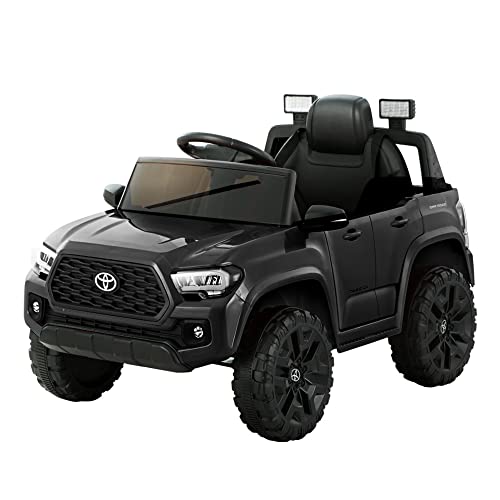
Rigo Licensed Toyota Tacoma 12V Kids Ride-On Car with Parent Remote, Black
ASIN B0BLRFP4NJ • $209.95 • Sold by Artiss Furnishings on Amazon AU
The Rigo Toyota Tacoma is the ride-on car I'd start with for most families. It's $210 on Amazon AU at time of writing, sold by Artiss Furnishings, and it's #4 in Amazon AU's Kids' Electric Vehicles category, the best-ranked of the car-style picks here. It's a licensed Toyota Tacoma ute body on a 12V system, so it has more push on grass and gentle slopes than a 6V car. The listing quotes a 30kg capacity, and the model number RCAR-LS-TOYO-BK matches the black finish in the title. Other colours of the same car are listed separately, and their prices don't always match this one. It's the car I'd point most people to first, because it balances power, size and rank better than anything else here.
You get two ways to drive it. Your child uses the foot pedal and the steering wheel, and a parent remote lets you steer and stop it from a distance. There's four-wheel spring suspension and an adjustable seat strap, which the listing says gives smoother rides on flat surfaces. Working headlights, a horn, push-button start and an MP3 input round it out. The listed weight is about 18.7kg and it measures about 100 x 63 x 57cm, so it's a solid car to lift into the boot but still manageable for one adult. The 30kg figure covers most kids up to about five or six. The MP3 input takes music from a phone or a USB stick, which is handy, but it's also one more socket that doesn't like rain.
The listing doesn't state the battery capacity, the run time, the top speed or the warranty, which are all things I'd want to know. Check the current listing and the manual for the battery type before you buy, and ask the seller about warranty if it isn't shown. Rigo is the most common brand in this category on Amazon AU, so spare batteries and chargers are generally easier to find than for a one-off brand. Charge it fully after every use, and keep it under cover. For a 12V car with a remote at this price, it's the one I'd pick first in the category.
Honest caveats: Honest caveats: the listing doesn't state battery capacity, run time, top speed or a warranty period. Artiss Furnishings is a marketplace seller rather than a brand storefront, so check the returns window. The suspension helps on rough ground, but the hard plastic wheels still slip on wet grass. It doesn't fold for storage.
Best for: Most families wanting a 12V licensed car with a parent remote and suspension.
Voltage: 12V • Control: Foot pedal plus parent remote • Load capacity: 30kg • Suspension: Four-wheel spring • Size: About 100 x 63 x 57cm • Weight: About 18.7kg (listed 41.3 lb) • Model: RCAR-LS-TOYO-BK • Seller: Artiss Furnishings (marketplace) • Rank: #4 in Kids' Electric Vehicles (Amazon AU)
View on Amazon AU
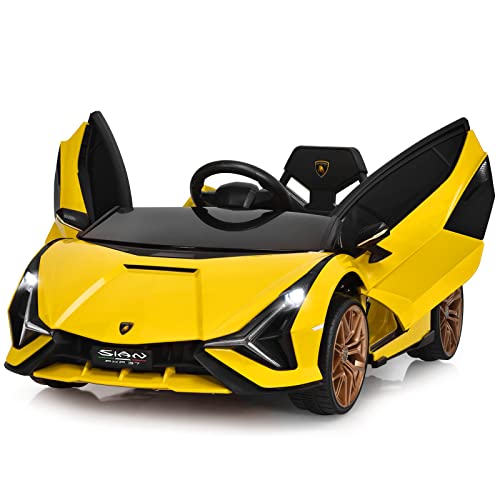
INFANS Licensed Lamborghini Sian 12V Kids Ride-On Car with Parent Remote, Yellow
ASIN B09PG7KX7Q • $279.95 • Sold by INFANS-AU on Amazon AU
The INFANS Lamborghini Sian is the pick if the look matters as much as the drive. It's $280 on Amazon AU at time of writing, sold by INFANS-AU, the brand's own storefront, and it's #10 in Amazon AU's Kids' Electric Vehicles category. It's a licensed Lamborghini body on a 12V system, with doors that open upwards on small pneumatic-style struts, real LED lights and a carbon fibre textured finish. The model number QLS-6388 is listed, and this listing is the yellow version. Several other colours are listed under separate ASINs at slightly different prices. INFANS is a brand that sells a range of kids' gear on Amazon AU through its own storefront, which is a step up from a bare-name marketplace seller.
It has the same two driving modes as the Rigo cars: pedal and steering wheel for your child, and a parent remote that takes over when you need it. The listing mentions slow start, a spring shock absorption system and adjustable seat belts. There's a built-in media player that connects to a phone or tablet, with USB and TF card slots. At the back are small hidden wheels so you can tilt it and roll it like a trolley, which is handy given it's about 108cm long and weighs about 12kg. That makes it the lightest of the 12V cars here, so it's the easiest to carry up steps or lift into a car. The media player is a nice extra, but it's also something that drains the battery if it's left switched on in the shed.
The listing doesn't state the battery capacity, the run time, the top speed, a weight limit or a warranty period, which is a lot of gaps for the most expensive car here. INFANS selling through its own AU storefront helps if something goes wrong, but check the current listing for warranty before you order. The low-slung body has less ground clearance than a ute or SUV, so it's better on paths and short lawn than rough grass. The doors are the part I'd expect to wear first, so open and close them gently.
Honest caveats: Honest caveats: the listing doesn't state the battery capacity, run time, top speed, weight limit or warranty period. The low body suits paths and short lawn rather than rough ground. The lift-up doors and their struts are the most delicate part. At about 108cm long, check your storage space first.
Best for: A licensed supercar look with a parent remote, from a brand selling through its own AU storefront.
Voltage: 12V • Control: Foot pedal plus parent remote • Suspension: Spring shock absorption • Doors: Lift-up, strut assisted • Size: About 108 x 64 x 41cm • Weight: About 12kg (listed 26.5 lb) • Model: QLS-6388 • Seller: INFANS-AU • Rank: #10 in Kids' Electric Vehicles (Amazon AU)
View on Amazon AU
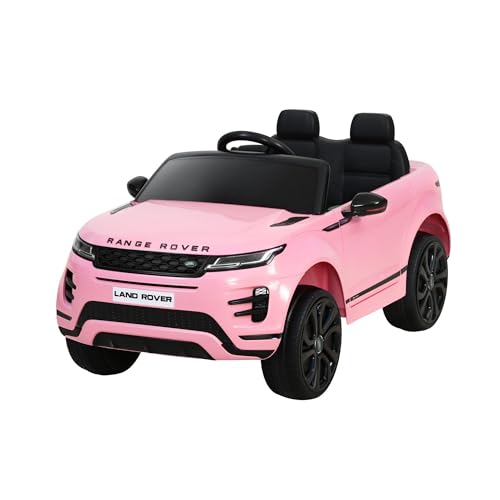
Rigo Licensed Land Rover 12V Kids Ride-On SUV with Parent Remote, Pink
ASIN B08QTY9ZRK • $229.95 • Sold by Artiss Furnishings on Amazon AU
The Rigo Land Rover is the car with the most complete listing in this guide. It's $230 on Amazon AU at time of writing, sold by Artiss Furnishings, and it's #14 in Amazon AU's Kids' Electric Vehicles category. It's a licensed Land Rover SUV body on a 12V system, and the listing quotes a 30kg load capacity, a speed of 3 to 5km/h and dimensions of 108 x 66 x 52cm. It also lists a one-year warranty, which the Toyota from the same maker doesn't state, and the part number RCAR-EVOQUE-LS-PK matches the pink finish. Evoque is the Land Rover model the body is based on. Having a speed figure on the listing helps you judge whether it suits a younger child.
It drives with a pedal and steering wheel or a parent remote, and the listing mentions slow start, four-wheel suspension and a seat belt. There's more detail than usual too, with a power display, a two-turn key start, head and rear lights, a radio, an adjustable rear mirror and MP3 with USB and SD slots. The listed weight is about 18.6kg, close to the Toyota. The listing gives an age range of 37 to 72 months, which lines up with the 30kg limit for most kids in that range. The two-turn key and the rear mirror are small touches, but kids notice them, and the power display tells you when to charge before it stops mid-lap. It's the widest car here, so check it fits through your side gate.
The battery capacity and run time aren't stated, so check the manual before you buy. This listing is pink, and other colours may be listed separately at different prices, so compare them before you choose. Because it's a Rigo, the same spare parts and chargers that fit the Toyota will often fit, although you should always match the voltage and connector before ordering. If the stated speed and warranty matter to you, this is the one to choose. Just keep it under cover, because the radio and key switch don't like rain.
Honest caveats: Honest caveats: the listing doesn't state battery capacity or run time. This listing is pink, and other colours may be listed separately at different prices. At 108 x 66cm it's the widest car here, so check your gate and storage. Artiss Furnishings is a marketplace seller, so check the returns window alongside the one-year warranty.
Best for: Buyers who want a stated speed, size and warranty on a 12V licensed SUV.
Voltage: 12V • Speed: 3 to 5km/h • Load capacity: 30kg • Size: 108 x 66 x 52cm • Weight: About 18.6kg (listed 41 lb) • Warranty: One year • Model: RCAR-EVOQUE-LS-PK • Seller: Artiss Furnishings (marketplace) • Rank: #14 in Kids' Electric Vehicles (Amazon AU)
View on Amazon AU
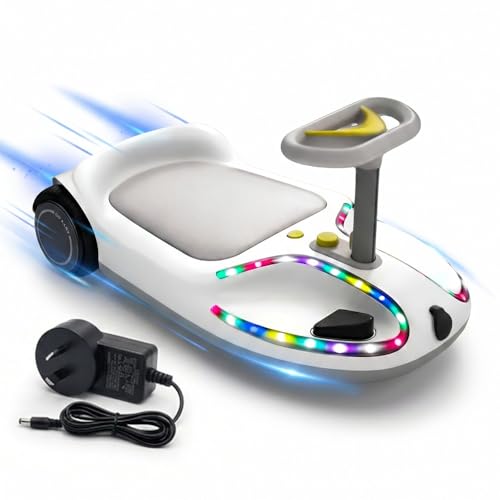
Hoveroo Zippy 4-in-1 Electric Wiggle Car, 3 Speeds, White
ASIN B0FJFZKLH4 • $219.00 • Sold by Elektra - AU on Amazon AU
The Hoveroo Zippy isn't a model car at all. It's an electric wiggle car, a low ride-on that spins and drifts, and it's the only pick here with a lithium battery. It's $219 on Amazon AU at time of writing, sold by Elektra - AU, and it's #2 in Amazon AU's Kids' Electric Vehicles category, the best-ranked pick in the guide. It has four modes: electric ride-on, manual wiggle car, parent push and luggage pull. The listing quotes a 100W motor, a 50kg weight capacity and an age range of 3 to 10. That's a much wider range than the model cars cover, because the low seat and the 50kg limit suit older kids too. The white finish and compact body make it the easiest of the five to keep indoors.
There are three speeds of 3, 5 and 8km/h, so you can start slow and open it up as your child gets more confident. The listing says the battery gives up to an hour of continuous play on a charge, which is the only run time stated in this guide. It's much smaller than the others at 67.5 x 38.5 x 33.5cm and about 8.5kg, so it fits in a car boot or a cupboard. The 50kg limit means it lasts much longer as kids grow, and it works indoors on hard floors as well as on paths. The luggage pull mode means you can tow it behind you when your child gets tired, which is more useful than it sounds at the park.
The trade-off is that there's no parent remote and no steering wheel in the usual sense, so your child needs to be old enough to control it. The 8km/h top speed is quick for a toddler, so start on the lowest setting. Lithium batteries handle sitting idle better than lead-acid, but don't leave it flat for months. Use only the supplied charger, because lithium packs need the right charge profile. The warranty isn't stated, and the part number ELCTWGLCAR is generic, so keep your receipt. It's a different kind of toy from the rest, and for the right age it's the best of the five.
Honest caveats: Honest caveats: there's no parent remote, so it suits kids old enough to steer and stop on their own. The 8km/h top setting is fast for small kids. The listing doesn't state the battery capacity, the charger spec or a warranty period. It's a wiggle car, not a model car, so it doesn't have the look of the others.
Best for: Older kids and indoor or path use, with a lithium battery and a 50kg limit.
Motor: 100W • Battery: Lithium, up to 1 hour (per listing) • Speeds: 3, 5 and 8km/h • Load capacity: 50kg • Modes: Electric, wiggle, push, pull • Size: 67.5 x 38.5 x 33.5cm • Weight: About 8.5kg (listed 18.7 lb) • Seller: Elektra - AU • Rank: #2 in Kids' Electric Vehicles (Amazon AU)
View on Amazon AU
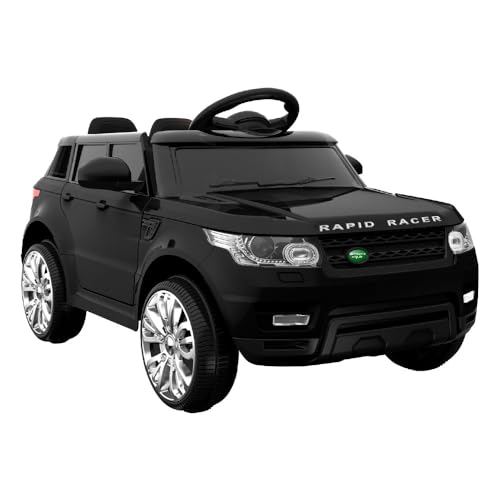
Rigo Kids Ride-On SUV 6V with Parent Remote, Black
ASIN B077966YTW • $149.37 • Sold by Artiss Furnishings on Amazon AU
The Rigo SUV 6V is the gentler, lower-cost option for younger kids. It's $149 on Amazon AU at time of writing, sold by Artiss Furnishings, and it's #5 in Amazon AU's Kids' Electric Vehicles category. It runs on 6V, so it's slower and has less push than the 12V cars, which suits toddlers on flat paths and short lawn. The listing quotes a 30kg capacity and an overall size of 93 x 54 x 45cm. It's the only Rigo listing here that mentions a 2.4GHz parent remote by name. Rigo's other SUV listings in white and pink sell at slightly different prices. It's the smallest of the Rigo cars here, which helps if storage is tight.
Your child drives with a pedal and steering wheel, and the parent remote overrides both. The listing mentions a soft speed system that ramps acceleration and braking gradually, which suits a nervous first-time driver. There's a seat belt, headlights, a horn and an MP3 player that takes a micro TF card or a USB stick. The listing says the tyres are anti-flat, which means solid rather than inflatable, and it lists a one-year warranty. The listed weight is about 14kg. Solid tyres can't go flat, but they're harder and noisier on concrete than rubber. The MP3 input is easy to use, though it's worth turning the music off when the car's parked so it doesn't drain the battery.
The 6V system is the limit to understand. It's fine for flat ground and small kids, but it'll struggle on thick grass, slopes and heavier children, and kids tend to outgrow it sooner than a 12V car. The battery capacity and run time aren't stated, so check the manual. I picked this black listing because another Rigo SUV listing had 12V in its title and 6V in its specs. It doesn't have a model number listed either, so keep your receipt and order number for warranty claims. For a first car on flat ground, it does the job well.
Honest caveats: Honest caveats: 6V is slow on thick grass and slopes, and kids outgrow it sooner. The listing doesn't state the battery capacity, run time or a model number. There's no suspension mentioned. Artiss Furnishings is a marketplace seller, so check the returns window alongside the one-year warranty.
Best for: Toddlers on flat paths and short lawn, with a parent remote and a gentle start.
Voltage: 6V • Control: Foot pedal plus 2.4GHz parent remote • Load capacity: 30kg • Tyres: Anti-flat (solid) • Size: 93 x 54 x 45cm • Weight: About 14kg (listed 30.9 lb) • Warranty: One year • Seller: Artiss Furnishings (marketplace) • Rank: #5 in Kids' Electric Vehicles (Amazon AU)
View on Amazon AUSide-by-side comparison
What we see fail in the workshop: kids ride-on cars
Ride-on cars come into the shop for the same three reasons almost every time. The battery won't hold a charge after a winter in the shed, the charger has failed or been swapped for the wrong one, or the car cuts out because water or dirt has got into the pedal and the plugs under the seat. The motors themselves are usually the last thing to go.
Lead-acid batteries left flat over winter
This is the big one. A sealed lead-acid battery that's left flat for a few months sulphates, which means the plates inside get coated and won't take a charge again. The car seems dead, the charger light goes green straight away, and the battery reads a healthy voltage with nothing connected but collapses as soon as the motors pull. Sometimes a smart charger with a recovery mode brings it back. More often it needs a new battery of the same voltage, capacity and connector. Charging after every use and once a month in storage prevents most of it.
Wrong or failed chargers
The original charger gets lost, and the replacement that turns up is the wrong voltage, the wrong polarity on the plug, or a no-name brick with no RCM mark. A 12V charger on a 6V battery overheats it, and reversed polarity can damage the control board. Chargers also fail on their own, usually at the cable where it enters the brick or at the plug. Before you buy a new battery, check the charger's output with a multimeter, because a dead charger looks exactly like a dead battery. If you don't have a meter, we can test both for you.
Pedal switches and corroded plugs
A car that stutters, cuts out or only runs on the remote often has a fault in the foot pedal switch or the wiring from it. The pedal sits low, so it gets dirt, sand and water, and the plugs under the seat corrode if the car lives outside. Disconnect the battery, unplug each connector, clean it, dry it and plug it back in firmly. That fixes a surprising number of them. If the motor still won't run with good connections, the gearbox may have stripped, which usually means replacing the motor and gearbox unit as one part.
Decision tree: which one should you actually buy?
- First ride-on for a toddler on flat ground? → The Rigo SUV 6V at $149, with a parent remote, soft start and a one-year warranty.
- A 12V car with a remote for most backyards? → The Rigo Toyota Tacoma at $210, the best-ranked car-style pick, with spring suspension.
- You want the stated speed, size and warranty? → The Rigo Land Rover at $230, which lists 3 to 5km/h, 108 x 66 x 52cm and a one-year warranty.
- The look matters as much as the drive? → The INFANS Lamborghini Sian at $280, from INFANS' own AU storefront, with lift-up doors.
- An older child or indoor use, with less storage space? → The Hoveroo Zippy wiggle car at $219, with a lithium battery, three speeds and a 50kg limit.
- The car won't charge, cuts out or the charger has died? → Check the charger output and the plugs under the seat first. If it's still dead, bring the battery and charger into our Erina workshop and we'll test both and tell you what it needs before you spend anything.
Frequently asked questions
Is a 6V or 12V ride-on car better?
A 12V car has more torque, so it copes better with grass, gentle slopes and heavier kids, and it usually feels faster. A 6V car is slower and gentler, which suits toddlers on flat paths and indoor floors. If your child is two or three, a 6V car with a parent remote is plenty. If they're older or you have a grassy backyard, 12V is the better choice and they won't outgrow it as quickly.
How long does a kids ride-on car battery last?
Run time per charge depends on the battery, the ground and the child's weight, and most of these listings don't state it. The Hoveroo is the only one that quotes a figure, up to an hour of continuous play. Battery life in years depends mostly on how you treat it. A lead-acid battery that's charged after every use and topped up monthly in storage can last several seasons, while one left flat over winter often won't take a charge again.
Can I use a different charger on a ride-on car?
Only if it matches the battery's voltage, the connector and the polarity, and it's made for that battery type. A 12V charger on a 6V battery will overheat it, and a lithium battery needs a lithium charger. Look for an RCM mark, which shows it's approved for sale in Australia. A no-name charger with no markings is a fire risk, and reversed polarity can damage the car's control board as well as the battery.
Why has my kids ride-on car stopped working?
Start with the simple things. Charge the battery fully, check the remote has fresh batteries, and check the plugs under the seat are clean and pushed in firmly. If it runs on the remote but not the pedal, the pedal switch or its wiring is the usual fault. If the charger light goes green straight away and the car won't move, the battery has probably sulphated. A stripped gearbox usually makes a grinding or whirring noise with the wheel not turning.
Can kids ride-on cars be left outside?
They're built for outdoor play but not for outdoor storage. Rain gets into the pedal switch, the plugs, the speaker and the battery compartment, and corrosion there causes a lot of faults. Sun fades and weakens the plastic over time. Keep it in a garage or under cover, and if it does get soaked, disconnect the battery and let it dry out fully before you charge or drive it. A cover helps if a garage isn't an option, as long as it keeps water out of the seat and the battery compartment.
Do kids ride-on cars need a parent remote?
For kids under about four, I'd want one. It lets you steer and stop the car from a few metres away and overrides your child's pedal and steering, so you can stop it before it reaches a driveway, a fence or a pool. Four of the five cars in this guide have one. The Hoveroo wiggle car doesn't, so it's better suited to older kids who can steer and stop on their own.
Related buying guides
Ride-on car dead after winter, or the charger's stopped working?
Most ride-on faults are a lead-acid battery that sat flat too long, a failed or wrong charger, or corroded plugs and a dirty pedal switch. Bring the car's battery and charger into our Erina workshop and we'll test both, check the wiring and tell you what it needs before you spend anything.
Visit our Erina workshop Book Online