Prices from Amazon AU, updated daily. Swipe or use the arrows for more.
Disclosure: This article contains affiliate links to amazon.com.au. If you buy through one of these links iFix may earn a small commission at no extra cost to you. It doesn't change which products we recommend. We focus on what actually lasts based on 16 years of repair-shop experience.
Quick summary6 picks
- Entry PickBelleza Eterna Slim RFID Women's Wallet about$24.99
- Vaultskin Moorgate Slim Leather Card Holder about$29.99
- Travelon RFID Blocking Double Zip Wallet about$57.95
- Timberland Men's Wellington Leather RFID… about$38.50
- Alpine Swiss RFID Protected Mens Spencer… about$29.99
- Most PremiumRFID Blocking Genuine Leather Wallet for… about$64.99
What a skimmer can actually read off your card
The scary version of RFID skimming goes like this: someone brushes past you on a train with a reader in their bag and empties your account. The real version is a lot less exciting. Australian contactless bank cards talk at 13.56 MHz over a standard (ISO 14443) that was designed to work across a few centimetres, and in practice a terminal needs the card almost touching it. Researchers have stretched that range with big antennas and custom gear, but nobody's doing that quietly in a crowd at Gosford station.
Then there's what comes off the card. On most cards a reader can pull the card number and the expiry date, and on some older cards the cardholder's name. It doesn't get the three-digit security code printed on the back, and it never gets your PIN. Every contactless payment is also signed by the chip with a one-time code, so a copy of the data can't simply be replayed at another terminal to buy something. That's the part the marketing on these wallets usually leaves out.
So is there any risk at all? A little. A card number and expiry can occasionally be used at an overseas online store that doesn't check the security code, and relay attacks (where two devices pass a live card's signal between them over a distance) have been shown in research. Both are rare, and both tend to get picked up by your bank's fraud systems. I'd call it a small risk that a $25 wallet does close off, rather than a reason to lose sleep or empty your wallet into a lead-lined box.
Where card fraud in Australia really happens
If you want to know where the money actually goes, AusPayNet (the industry body that manages Australia's payment rules) publishes card fraud figures every year, and for a long time now the large majority has been card-not-present fraud. That's your card details being used online or over the phone, usually after they were stolen from a breached website, typed into a fake checkout page, or read out to a scammer who rang pretending to be the bank's fraud team.
Old-style skimming, where a fake reader was glued over an ATM slot to copy the magnetic stripe, dropped right off once chip and PIN took over. Contactless skimming in the wild barely shows up in the published figures at all. If you've lost money on a card lately, the odds are very high it came through a phishing text, a dodgy online store or a remote-access scam, and our guide to the first 24 hours after a scam is the place to start.
None of that makes an RFID wallet pointless. It just means it's one small layer, and if it's the only thing you've done to protect your cards it's guarding the window while the front door's open. I'd rather someone bought a decent wallet for the reasons in the next section and switched on transaction alerts in their banking app, than spent $50 on a blocking wallet thinking the job was done and nothing else needed doing.
Why a blocking wallet is still worth having
The best reason I've found to own one has nothing to do with criminals. It's card clash. If you keep an Opal card and a contactless bank card in the same wallet and tap the wallet on a gate, the reader can pick up the wrong card, or both, and you end up paying the fare on a bank card or getting knocked back at the barrier. Transport for NSW warns about this on its own site. A wallet with a blocking section lets you keep the bank cards shielded and the transit card in an outside slot, so only one card answers the reader. It's handy at work too, where a building access card and a bank card in one wallet can confuse a door reader the same way an Opal gate gets confused.
It's the same at the shops. Tap a fat wallet on a payment terminal and you can't always be sure which card paid, which matters if one's a business card and the other's personal. Keeping everything shielded except the card you've chosen takes the guesswork out of it, and it's a habit that also stops the odd double charge when two cards answer at once.
Then there's physical protection, which gets far less attention than it deserves. A card's chip is a small module glued into a pocket in the plastic, and the contactless side runs on a fine wire coil buried around the edge of the card. Sit on a soft wallet in a back pocket for a couple of years and the card flexes every time you sit down, which is how chips crack and coils snap. A firmer wallet, or better still an aluminium card case, takes most of that flexing away.
How to test a blocking wallet with your own phone
Don't take the listing's word for it. Most of the products I looked at say RFID blocking without stating which frequencies they block or quoting any test, and one of them (the Timberland below) talks about low frequency blocking, which isn't the band bank cards use. You can check a wallet in about two minutes at home with any phone that has NFC.
- Turn NFC on in your phone's settings. Most Android phones have it, usually under Connected devices or Connections.
- Hold a contactless bank card flat against the back of the phone, near the top. The phone should buzz or show a message within a second or two. If it doesn't, slide the card around until it does, because the NFC coil sits in a different spot on each model.
- Put the card in the wallet's blocking slot, close the wallet, and hold it against the same spot for a few seconds.
- Repeat for each slot you plan to use, and once more with the wallet open.
If the phone still reacts with the card shielded and the wallet shut, the blocking isn't doing much. If it only reacts when the wallet's open, that's normal: the blocking layer has to wrap around the card to work, and an open bifold leaves one face exposed. A phone isn't a lab instrument, but it reads at the same 13.56 MHz and over a similar distance to a payment terminal, so I reckon it's a fair real-world check. Do it the day the wallet arrives, while it's still easy to send back.
One thing that trips people up: some phones only read a card when the screen's unlocked and awake, and some want a wallet app set up before they'll react to a card at all. If your phone does nothing even with the bare card, try a different card or a friend's phone before you decide anything about the wallet. A test only means something once you've seen it work with the card out.
What wears out first: leather, linings and pop-up cases
On a leather wallet the blocking layer is usually a thin metallised fabric sewn in behind the lining. It works fine when new, but it creases at the fold every time you open the wallet, and after a few years of that the foil can crack along the spine. Nothing tells you it's happened. That's another reason to repeat the phone test once a year or so, especially on a wallet that lives in a back pocket and gets sat on all day.
Stitching goes next, usually on the card slots nearest the fold, and leather slots stretch. A slot that started out holding a card snugly will hold it loosely after a year, and a loose card is the one that slides out when you pull a different one. If you carry a lot of cards, look for more slots rather than stuffing two into each, because doubled-up slots stretch faster and the outer card wears its edges.
Pop-up aluminium cases fail differently. The case itself is close to indestructible, but the lever and the small slide mechanism that pushes the cards out are the weak point. Grit from a pocket or a handbag gets in and it starts to jam, and the capacity on these is quoted for standard cards, so a thick embossed card or one of the newer metal cards can stop it working entirely. Test it with the cards you actually carry, not the number on the box.
The leather itself is the easy part. A wallet that gets soaked and dries out stiff, or one that bakes in a hot car over summer, cracks at the fold sooner, and a bit of leather conditioner a couple of times a year goes a long way. None of that is specific to RFID wallets, but the blocking layer sits right at that fold, so the same wear that cracks the leather is what cracks the foil.
Phones, wallet cases and magnets
A lot of people have moved their cards into a phone wallet case or a magnetic card holder stuck to the back of the phone. That's fine for the cards, but two things come up at the shop. Phone wallet cases with a magnetic clasp sit a magnet right next to the cards, and magnetic stripes don't like magnets. Bank cards mostly run on the chip and contactless now, so a wiped stripe usually doesn't matter, but hotel key cards and some older building access cards are stripe-only and wipe easily.
The other is the phone's own tap-to-pay. Put a blocking card holder on the back of a phone and it can stop the phone paying, since the phone's NFC coil is on the back too. People bring phones in thinking the NFC has died, and it's the card sleeve. Take the holder off and test before you assume the phone's faulty. If tap-to-pay still won't work with the case off, the coil or its flex cable may be damaged, and that's something we can check at the Erina workshop without much fuss.
If you're already paying by phone most of the time, you've got better card protection than any wallet can give you. Phone wallets pay with a token that stands in for your real card number, so even a merchant breach doesn't expose the card itself. The plastic card can stay in a drawer at home for the odd place that won't take a phone. If you do keep a physical card in use, everything else in this guide still applies, but it's a much smaller job when the card only comes out once a week.
What I'd actually do to protect your cards
Here's the order I'd put things in. Turn on push notifications for every transaction in your banking app, because you'll spot a fraudulent charge the same day rather than on the statement. Learn where the card lock button is in the app, so a lost card gets frozen in seconds while you look for it. Pay by phone where you can. Shred old statements and expired cards (the home shredder picks cover the cross-cut models that make sense), and put a hardware security key on your email and banking logins if your bank supports one.
Then buy the wallet. Pick it the way you'd pick any wallet: for the number of cards you carry, whether you need a coin pocket, and how it sits in your pocket or bag. The blocking layer is a bonus that sorts out card clash and closes off a small risk, not the main event. If the wallet is the thing you're more likely to lose than to have skimmed, a tracker is worth more than any blocking layer, and the item tracker guide goes through the options.
And if a card has already been used without you, ring the bank on the number printed on the back of the card (never one from a text message), then work through getting money back after a scam. Banks generally refund unauthorised card transactions that are reported promptly, and in my experience the sooner you call, the cleaner that process tends to be.
The 6 picks, $25 to $65
Prices are Amazon AU at time of writing (2 October 2026) and move week to week. Ranks are Amazon AU category sales ranks, checked the same day.

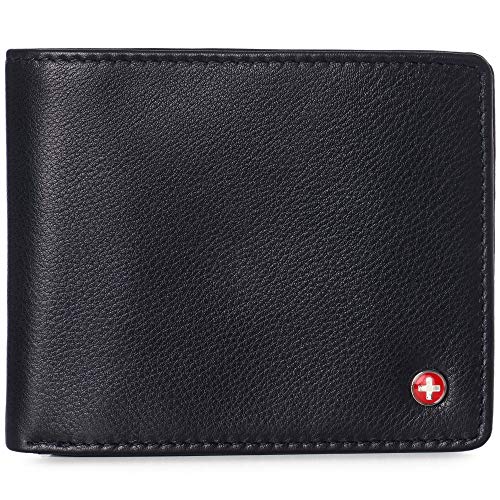
Alpine Swiss Spencer RFID Leather Bifold Wallet with Flip-Out ID
ASIN B00MAVN0R2 • $29.99 • Sold by Alpine Swiss AU Store on Amazon AU
This is the highest-ranked wallet in the guide, sitting at #9 in Amazon AU's Men's Wallets category at $30, sold by the Alpine Swiss AU Store. It's a hybrid design: it closes like a normal bifold but has a flip-out panel that opens it up more like a trifold, and that's where the ID window lives. Alpine Swiss quotes 12 card slots, 3 vertical pockets for odds and ends, and a fully lined section for notes. The listing gives the size as 4 1/4 by 3 1/4 by 1/2 inch, which works out at roughly 10.8 by 8.3 by 1.3 cm, so it's a normal pocket wallet rather than a slim one.
Twelve slots is a lot, and that's the main reason I'd pick it. Most people shopping for an RFID wallet are carrying several contactless cards, and a wallet with a slot for each card holds them firmly and wears more evenly than one where you double up. The flip-out is the handiest part for card clash. Put a transit card or work access card in the flip-out, keep the bank cards in the main slots, and you can tap the outside card without the others answering. Just check with the phone test that the main slots really are shielded once the wallet's shut, because the listing doesn't say which pockets carry the blocking layer.
The listing says genuine leather, and it comes in a recycled gift box, which suits it as a present. What it doesn't give is any detail on the blocking itself: no frequency and no test standard. That's normal for the category, and it's why I'd test it rather than trust it. For a full-size wallet that holds plenty of cards, sold through an Australian storefront, it's the one I'd start with, and if the fit doesn't suit you it's an easy one to send back while it's new. Black is the colour on this listing, and other colours and finishes are offered.
Honest caveats: No blocking frequency or test result is stated, and the listing doesn't say which slots are shielded, so run the phone test on each slot. The title mentions two ID windows while the feature list describes one. At about 1.3 cm thick empty, it's a full-size wallet that will bulge with all 12 slots filled.
Best for: Someone carrying a lot of cards who wants a full-size leather wallet with a separate flip-out for a transit card.
Style: Bifold with trifold flip-out • Card slots: 12, plus 3 vertical pockets • ID window: Yes, in the flip-out • Size: About 10.8 x 8.3 x 1.3 cm • Material: Genuine leather • RFID frequency: Not stated on the listing • Seller: Alpine Swiss AU Store • Price: $30 at time of writing • Rank: #9 in Men's Wallets (Amazon AU)
View on Amazon AU
Timberland Wellington Leather RFID Bifold Commuter Wallet
ASIN B0748NY6XP • $38.50 • Ships from Amazon AU
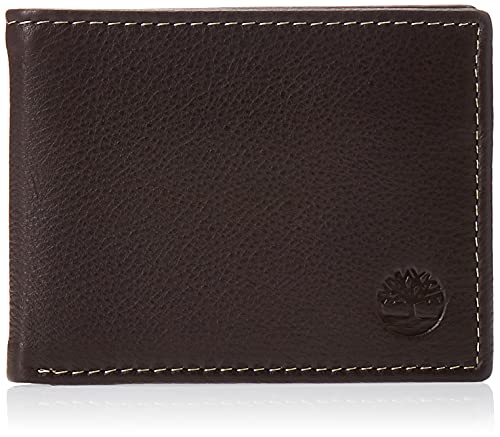
Timberland's Wellington is #13 in Amazon AU's Men's Wallets category at $38.50, and it's one of two wallets in this guide sold by Amazon AU itself (the Travelon is the other), which keeps returns simple. It's a leather bifold with a side flip-out pocket carrying two clear ID windows, so like the Alpine Swiss it can work as a trifold when you need the extra panel. The listing gives the size as 4.375 by 3.375, which reads as inches, so roughly 11.1 by 8.6 cm closed. It ships in a Timberland gift box, with the logo embossed on the front corner and again inside. It's a commuter wallet in Timberland's naming, which mostly means it's built around that flip-out for a work or transit pass.
The part I'd question is the blocking claim. Timberland's listing says the wallet has low frequency RFID blocking in the lining. Bank cards, Opal cards and most building access cards used in Australia run on high frequency, 13.56 MHz, and low frequency RFID is a different band (usually around 125 kHz, used by older access fobs and pet microchips). It's quite possible the lining blocks both, since a metallised fabric isn't fussy about frequency at close range, and the wording may just be loose copywriting. But I wouldn't assume it. This is the one I'd most want to put through the phone test the day it arrives. A wallet that only half blocks is worse than one that doesn't claim to, because you stop checking.
The number of card slots isn't stated on the listing, which is an odd thing to leave out of a wallet listing, so count them in the photos before you buy. Everything else about it is sensible: leather that softens with use, a layout that doesn't need explaining, and first-party Amazon AU supply. If you want a plain, well-known wallet and you're happy to test the blocking yourself, it's a sound pick. If the test fails, Amazon AU's returns process is about as easy as it gets, which is part of why it's here. And if it passes, you've got a wallet that'll do the job for years without you thinking about it.
Honest caveats: The listing claims low frequency RFID blocking, which isn't the 13.56 MHz band that bank and transit cards use, so test it with a phone before relying on it. The number of card slots isn't stated anywhere on the listing; count them in the photos.
Best for: A plain, recognisable leather bifold bought straight from Amazon AU, for someone who'll test the blocking themselves.
Style: Bifold with side flip-out • ID windows: 2, in the flip-out • Size: 4.375 x 3.375 (about 11.1 x 8.6 cm) • Material: Genuine leather • RFID claim: Low frequency blocking lining (per listing) • Card slots: Not stated on the listing • Seller: Amazon AU • Price: $38.50 at time of writing • Rank: #13 in Men's Wallets (Amazon AU)
View on Amazon AU
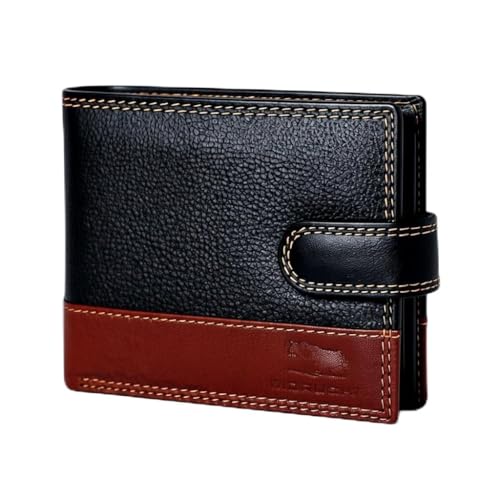
Morucha M75 RFID Leather Bifold Wallet with Snap Coin Pocket
ASIN B08DG585TP • $64.99 • Sold by Walletsking AU on Amazon AU
This one is sold by Walletsking AU under the Morucha brand (model M75), and it's #16 in Amazon AU's Men's Wallets category at $65, the most expensive wallet here. The extra money goes into the leather: the listing describes it as natural cowhide top grain leather, then calls it a full-grain finish a sentence later. Those aren't quite the same thing (full grain keeps the outer surface intact, top grain is sanded or split), so I'd treat it as good cowhide and not read too much into either label. The size is given as 12 by 9.5 by 2 cm closed. It ships in a gift box, and the listing offers black and brown.
The layout is where it earns its place. There are 8 card slots, 4 hidden pockets for receipts or spare cards, 2 full-length note compartments, an ID window and a snap-close coin pocket. Not many slim bifolds still have a coin pocket, and for anyone who still gets coins in change at the markets or needs a few for a parking meter, that's a real reason to choose it. Eight slots is fewer than the Alpine Swiss, but with the hidden pockets for cards you rarely use, it should carry a normal load without bulging too much. The ID window suits a driver's licence, though plenty of people carry the digital licence on their phone now.
The snap on a coin pocket is usually the first thing to go on a wallet like this, because it's a small pressed fitting that takes a pull every time you open it. Open it by the leather tab rather than yanking the flap and it'll last a lot longer. Like the others, the listing claims RFID blocking but gives no frequency or test, so check it at home. If you want a better-made leather wallet with a coin pocket, this is the pick. It's also the one I'd pick as a gift, since it's the best finished of the five.
Honest caveats: The listing contradicts itself on the leather grade, calling it top grain and full grain in the same paragraph. No RFID frequency or test result is given. At 2 cm thick it's the bulkiest wallet here before you add coins, so it sits better in a front pocket or a bag.
Best for: Someone who wants a better-finished leather bifold with a proper snap coin pocket.
Style: Bifold • Card slots: 8, plus 4 hidden pockets • Note compartments: 2, full length • Coin pocket: Yes, snap closure • ID window: Yes • Size: 12 x 9.5 x 2 cm • Material: Cowhide leather (listing says top grain and full grain) • Seller: Walletsking AU • Rank: #16 in Men's Wallets (Amazon AU)
View on Amazon AU
Belleza Eterna Slim RFID Leather Women's Wallet with 9 Card Slots and Coin Purse
ASIN B0G64C4W7M • $24.99 • Sold by Belleza Eterna-AU on Amazon AU
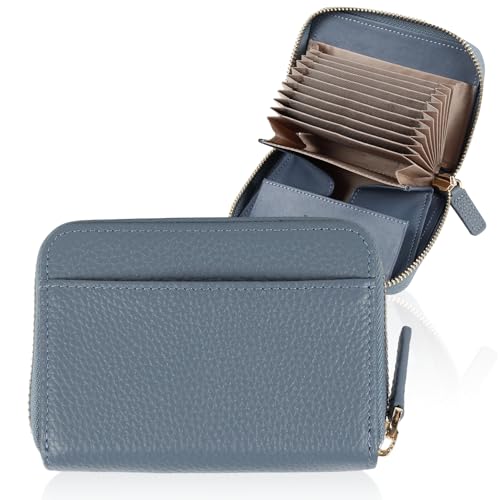
The Belleza Eterna slim wallet is #27 in Amazon AU's Women's Wallets category at $24.99, sold by Belleza Eterna-AU, and it's the lowest-cost pick in this guide. It's a compact zip wallet measuring about 8.5 by 11.5 by 3 cm and weighing 110 g. The listing quotes 9 card slots, 1 bill compartment, a zip coin pocket and 2 additional pockets, and describes the leather as cowhide. The coin pocket has a box-style opening with a gusset underneath, so bills don't have to fold to fit. The listing sold me on size more than anything: it's small enough for a handbag pocket or a jacket, and it won't weigh down a bag.
The listing says it has a radio-wave blocking filter to protect credit and ID cards, and gives no frequency or test standard. As covered above, the real-world skimming risk is small: a reader has to be within a few centimetres, and a payment needs a merchant account and a terminal that the bank can trace. What a blocking layer does for a wallet like this is stop card clash when a transit card and a bank card share a pocket. Buy it for the size and the layout, and run the phone test on the day it arrives.
The zip is the part to look at. The listing names a YKK zipper (it also says German zipper further down, so the listing isn't consistent), and a good zip on a coin pocket beats a snap that pops open under pressure. Zip pulls and the corners where the coin box meets the body are what wear first on a wallet opened many times a day. It comes in a gift box and several colours, and the listing title shows Dusty Blue, so check which colour you're ordering. Nine slots is fewer than the Alpine Swiss, so if you carry a lot of loyalty and membership cards, count yours first.
Honest caveats: The blocking claim comes with no frequency or test result, so run the phone test on arrival. Nine slots is modest, and the listing calls the zipper both YKK and German, so check the pull feels solid when it arrives.
Best for: A small handbag wallet for someone who wants a zip coin pocket, a modest set of card slots and the lowest price in the guide.
Style: Slim zip wallet • Card slots: 9 • Other storage: 1 bill compartment, 2 additional pockets • Coin pocket: Yes, zip with box opening • Size: About 8.5 x 11.5 x 3 cm • Weight: 110 g • Material: Cowhide leather • Seller: Belleza Eterna-AU • Rank: #27 in Women's Wallets (Amazon AU)
View on Amazon AU
Vaultskin Moorgate Slim Leather Credit Card Holder with RFID Blocking
ASIN B0CP43BFFL • $29.99 • Sold by Vaultskin AU on Amazon AU
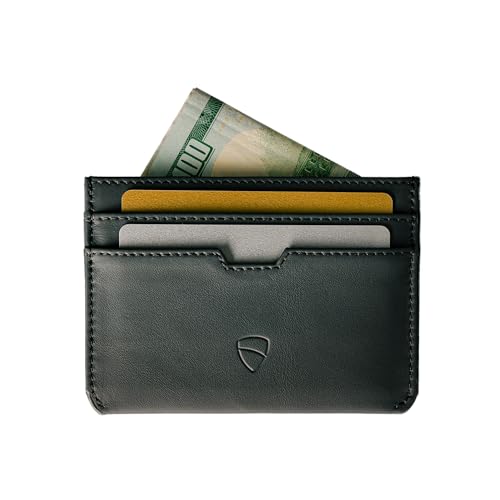
The Vaultskin Moorgate is #46 in Amazon AU's Men's Credit Card Holder category at $29.99, sold by Vaultskin AU. It's a different idea from the others: a small card holder and not a full wallet. The listing gives the size as 7.5 by 10.5 by 1 cm and the weight as 20 g. It has two front pockets, two back pockets and a middle compartment, each holding up to two cards, which makes ten cards plus cash, and the leather is described as premium cow leather. It comes in four colours and a paper envelope pack, and the listing says it suits men and women.
For anyone who finds a full wallet too thick, this is the slim answer. At 1 cm it sits in a front pocket without bulging, and 20 g is next to nothing. The listing calls the RFID blocking full protection but gives no frequency or test, so it's a phone-test job on the day it arrives, slot by slot. A firm, thin holder also does a fair job of keeping cards flat, which is what saves the contactless coil from flexing in a back pocket, though leather will still soften with wear.
The trade is capacity and extras. There's no coin pocket listed, and the cash space is the middle compartment, so it suits someone who pays by card or phone and carries a note or two. Putting two cards in each pocket is how you reach ten, and doubled-up slots stretch faster, so I'd start with one or two cards per pocket and see how it wears. If you want the slimmest option in the guide and rarely handle cash, this is the one I'd choose.
Honest caveats: No RFID frequency or test result is stated, so run the phone test on each pocket. There's no coin pocket and little room for cash, and ten cards means two to a pocket, which stretches the leather sooner.
Best for: Someone who wants the slimmest holder in the guide for a front pocket, pays mostly by card or phone and rarely handles cash.
Style: Slim card holder • Card capacity: 10, two per pocket • Pockets: 2 front, 2 back, 1 middle compartment • Cash: Middle compartment • Coin pocket: None listed • Size: 7.5 x 10.5 x 1 cm • Weight: 20 g • Material: Cow leather • Seller: Vaultskin AU • Rank: #46 in Men's Credit Card Holder (Amazon AU)
View on Amazon AU
Travelon RFID Blocking Double Zip Wallet, Smoke
ASIN B07MG89375 • $27.41 • Sold by Amazon AU
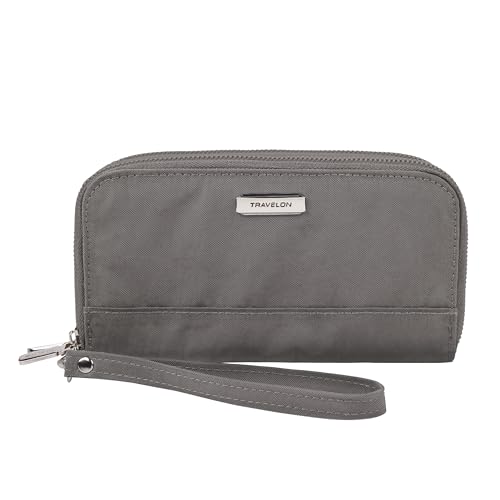
The Travelon Double Zip is the travel wallet in this guide: #244 in Amazon AU's Women's Wallets category at $27.41, sold by Amazon AU itself. It's a zip-around nylon wallet in a smoke grey, and the listing counts two zippered compartments, three currency pockets, a zippered coin pocket, 12 card slots and a rear slip pocket for receipts and tickets. The listing gives the size as 7.5 by 4 by 1.25 inches, which works out at roughly 19 by 10 by 3.2 cm, and the weight as 0.39 lb, or about 175 g.
The job it's built for is the airport queue. Travelon says it holds a phone or two, a passport and an international licence, and the separate currency pockets are there to keep one country's notes apart from another's. That makes it the closest thing here to a phone clutch: one zip, and your cards, cash, coins, passport and phone are in the same place. The listing says the whole wallet is shielded from scans, which is the claim to test. If it's true, a shielded wallet will also stop a phone tapping to pay from inside it, as covered in the phones and card holders section above, so take the phone out of the wallet when you want to pay with it.
The trade is bulk. At about 3.2 cm thick it's a bag or jacket wallet, not a back-pocket one, and 12 cards plus a phone and passport will only make it fatter. Nylon keeps the weight down, though it's a plain travel finish and not a leather one. The listing doesn't say which part of the wallet carries the blocking layer or give any frequency or test result, so treat the shielding as unproven until you've run the phone test on it, zipped shut. For a trip, a long day out or a bag with room to spare, it's a sensible $27 and the only zip-around here.
Honest caveats: No blocking frequency or test result is stated, so run the phone test on each pocket with the wallet zipped. The listing is written with US travel in mind (inches, ounces, mentions of TSA and Global Entry), so check that your phone and passport actually fit before you rely on it. About 3.2 cm thick, so it won't suit a front or back pocket.
Best for: Travel days when you want a phone, passport, cards and a couple of currencies in one zip-around, shipped by Amazon AU.
Style: Zip-around travel wallet • Card slots: 12 • Compartments: 2 zippered, 3 currency pockets, 1 zippered coin pocket, rear slip pocket • Holds: Phone and passport, per the listing • Size: About 19 x 10 x 3.2 cm (7.5 x 4 x 1.25 in) • Weight: About 175 g (0.39 lb) • Material: Nylon • Colour: Smoke • RFID frequency: Not stated on the listing • Seller: Amazon AU • Price: $27 at time of writing • Rank: #244 in Women's Wallets (Amazon AU)
View on Amazon AUSide-by-side comparison
| Product | Price | Best for |
|---|---|---|
| Belleza Eterna Slim RFID Women's Wallet | ~$24.99 | A small handbag wallet with a zip coin pocket at the lowest price here. |
| Vaultskin Moorgate Slim Leather Card Holder | ~$29.99 | The slimmest holder here, for a front pocket and mostly card or phone payments. |
| Travelon RFID Blocking Double Zip Wallet | ~$57.95 | A zip-around travel wallet with 12 slots and room for a phone and passport. |
| Timberland Men's Wellington Leather RFID… | ~$38.50 | A plain Amazon AU leather bifold you'll test yourself. |
| Alpine Swiss RFID Protected Mens Spencer… | ~$29.99 | A full-size leather wallet with 12 slots and a flip-out for a transit card. |
| RFID Blocking Genuine Leather Wallet for… | ~$64.99 | A better-finished leather bifold with a snap coin pocket. |
What we see fail in the workshop: cards, wallets and the phones they sit on
Wallets themselves don't come in for repair, but the cards and phones that live in them do. Most of what we see has nothing to do with skimming. It's physical wear from being sat on, magnets in the wrong place, and phone faults that turn out to be a card holder. These are the three that come up most often.
Cracked chips and broken contactless coils
A card that suddenly won't tap but still works when you insert it, or the reverse, has usually been flexed too many times. The contactless coil runs around the edge of the card as a very fine wire, and a back-pocket wallet bends it every time you sit down until a joint breaks. Chips crack the same way, and a cracked chip often works on some terminals and not others. There's no fixing a card. Ask the bank for a replacement, then move the new one into a firmer wallet or an aluminium case so it doesn't happen again.
Tap-to-pay faults that aren't faults
A customer brought in a phone recently that had stopped paying at the shops, convinced the NFC had failed. It had a magnetic card holder stuck to the back with a blocking layer in it. Off came the holder, and the phone paid first go. If your phone won't pay, take every case and card holder off and try it bare before booking anything in. When it still won't pay bare, the NFC coil, its flex cable or the connector it plugs into is worth checking, and those are usually fixable.
Swollen batteries hidden by wallet cases
Folio and wallet cases wrap the whole phone, which hides the early sign of a swelling battery: a back panel or screen that's started to lift at one edge. By the time it's obvious through a stiff leather case, the screen is often already pushed up. Take the phone out of its case every so often and look at it edge-on on a flat table. Any gap or rock is a reason to stop charging it overnight and have the battery looked at, because a swollen lithium cell is something you don't want to keep pressing on in a tight case.
Decision tree: which one should you actually buy?
- Carrying a lot of cards and want a full-size wallet? → The Alpine Swiss Spencer at $30 has 12 card slots and a flip-out for a transit card, and it's the top-ranked pick here.
- Want it shipped by Amazon AU and kept simple? → The Timberland Wellington at $38.50, or the Travelon Double Zip at $27 if you want a zip-around. Do the phone test on the Timberland, because the listing's blocking claim is worded oddly.
- Still need a coin pocket? → The Morucha M75 at $65 has a snap coin pocket, 8 slots and 4 hidden pockets in better leather.
- Small handbag wallet with a zip coin pocket? → The Belleza Eterna at $25 has 9 card slots, a zip coin pocket and a compact 8.5 by 11.5 cm body.
- Want the slimmest option for a front pocket? → The Vaultskin Moorgate at $30 is 1 cm thick, weighs 20 g and holds up to 10 cards.
- Travelling and want phone, passport and cards in one zip-around? → The Travelon Double Zip at $27 has 12 card slots, a zippered coin pocket and room for a phone and passport, but at about 3.2 cm thick it won't suit a pocket.
- Phone stopped paying, or the battery looks like it's lifting? → Take the case off and test it bare first. If it's still faulty, bring it to our Erina workshop and I'll tell you what's wrong before anything's done.
Frequently asked questions
Do RFID blocking wallets actually work?
Most do block a card from being read while the wallet is closed, because a layer of metallised fabric or an aluminium case stops the 13.56 MHz signal contactless cards use. The catch is that very few listings say what they block or show any test, so you can't tell from the box. The easy check is to hold a contactless card against the back of an NFC phone until it reacts, then try again with the card inside the closed wallet. If the phone stops reacting, the blocking is doing its job.
Can someone steal money by tapping my wallet in a crowd?
It's very unlikely. A reader needs to be within a few centimetres of the card, and a contactless payment needs a registered merchant account and terminal that the bank can trace back to a real business. Data read off a card doesn't include the security code or your PIN, and each payment carries a one-time code from the chip, so copied data can't just be replayed. Most card fraud in Australia happens online, using details stolen from websites or handed over in scams.
Is an RFID wallet worth it if I pay with my phone?
Less so. When you pay by phone, the phone sends a token that stands in for your real card number, which is better protection than any wallet. Where a blocking wallet still helps is card clash, if you carry a transit card and a bank card together, and in protecting cards from bending. If your plastic cards mostly stay at home, I'd spend the money on a good phone case instead.
Will an RFID wallet stop my Opal card working?
It can, if the Opal card is inside the blocking section. That's actually the point for bank cards, since it stops the gate charging the wrong card, but your transit card needs to sit in a slot without blocking. Wallets with a flip-out or outer slot handle this well. Test it at home first with a phone: if the phone can read the Opal card in its slot with the wallet shut, the gate will too.
Can a magnet in my phone case wipe my bank card?
A magnet can wipe a magnetic stripe, but Australian bank cards mostly use the chip and contactless now, so a wiped stripe rarely stops a card working. Hotel key cards and some older building access cards are stripe-only, and they wipe easily if they sit against a magnetic clasp or a magnetic phone mount. Keep those cards away from magnets, and if a bank card ever needs its stripe at an older terminal overseas, ask the bank for a replacement.
Do RFID sleeves work as well as RFID wallets?
Yes, a sleeve that fully wraps the card blocks it as well as a wallet does, and sometimes better, because there's no open edge. The downside is that you have to slide the card in and out every time you use it, and sleeves wear through at the opening. They're handy for a spare card kept in a drawer or a travel card you rarely use. For daily cards, a wallet with blocking slots is less fiddly.
Related buying guides
When tap-to-pay stops working on your phone
If your phone won't pay at the terminal, try it out of its case first, because a card holder with a blocking layer is a common culprit. If it still won't pay bare, the NFC coil, its flex cable or the connector may be at fault. Bring it in to Erina and I'll tell you what's failed and what it'll take to fix before you spend anything.
Visit our Erina workshop Book Online