Prices from Amazon AU, updated daily. Swipe or use the arrows for more.
Disclosure: This article contains affiliate links to amazon.com.au. If you buy through one of these links iFix may earn a small commission at no extra cost to you. It doesn't change which products we recommend. We focus on what actually lasts based on 16 years of repair-shop experience.
Quick summary6 picks
- CheapestUniden UH755-5 Watt UHF CB Splashproof… about$143
- Oricom UHF2400 2 Watt Handheld UHF CB Radio… about$149
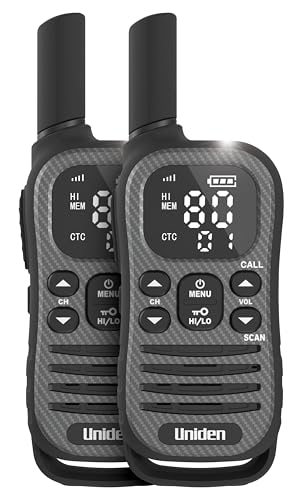
- Uniden 2 Watt UHF Radio about$170
- Retevis RB448 Plus Walkie Talkie about$1802000mAh.
- ORICOM UHF310 Micro 5 Watt UHF CB Radio -… about$205
- Most PremiumOricom DTX600 Waterproof IP67 5 Watt… about$2192600mAh.
Why a UHF radio still earns a spot in the glovebox
Head an hour west of the Central Coast into the Watagans or up past Wollombi and your phone can drop to nothing in the space of one gully. That's where a UHF CB radio earns its spot. It talks directly to the radio in the car behind you without a tower, a SIM or a plan, and on a convoy, a farm or a worksite it's still the fastest way to say the track's washed out before the next vehicle finds out the hard way.
It also costs nothing to run, which counts for a lot here: there's no service fee at all. UHF CB in Australia runs under a class licence, so you don't apply for anything or pay anything to use one, as long as the radio is an approved 80-channel unit and you stick to the channel rules. That combination of zero running cost and no network dependency is why these radios have outlasted three generations of mobile networks, and why most four-wheel drive clubs still expect every car in the group to have one.
What a UHF radio isn't is an emergency beacon. If you're heading somewhere properly remote, it's a convoy tool, and it works alongside a PLB or satellite messenger, not instead of one. A handheld's call for help only reaches someone who's listening within range.
The channel rules you actually need to know
ACMA's class licence covers the band from 476.4125 to 477.4125MHz, and it sets aside a handful of channels you can't treat like the rest. Channels 5 and 35 are for emergency messages only. Channels 22 and 23 are for telemetry and telecommand, which means you can't speak on them at all, and packet radio and other data use aren't allowed anywhere on the CB band. Those four are the ones people get wrong most, usually by scanning onto 22 for a quiet chat. Learn those four and you've covered the mistakes that get people in trouble.
The other block to understand is the repeater pairs. Channels 1 to 8 and 41 to 48 are repeater output channels, and 31 to 38 and 71 to 78 are the matching inputs. With duplex switched on, your radio transmits on the input and listens on the output, so a hilltop repeater can carry your signal much further than a handheld ever could on its own. Leave duplex off and park on one of those channels for a chat, and you'll be talking straight into somebody else's repeater traffic.
Beyond the rules, there are conventions. Channel 40 is generally where the trucks are on the highway, and channel 18 is widely used by caravanners and campers, while many 4WD clubs and parks pick their own. None of that's law, but turning up on 40 with a chatty group of four cars will get you told about it, and it should.
Why the range on the box is fiction
Every handheld in this category has a range figure printed on it, and the Uniden in this guide states 17km. That number isn't a lie exactly, but it's the best case: two radios with clear line of sight, usually hilltop to hilltop with nothing in between. UHF behaves a lot like light. It goes where it can see and struggles with anything solid, so a ridge, a stand of wet gums or the body of the car you're sitting in takes a big bite out of it.
In practice, handheld to handheld on flat ground or in bush, you're usually looking at a few kilometres, and in my experience a lot less in thick timber or between buildings. Height matters far more than power. Standing on a rock or holding the radio above the roofline does more than doubling the wattage, because doubling transmit power from 2W to 5W helps, but not as much as people expect from the number on the box. Weather plays a part too, and heavy rain in thick bush can shave a bit more off on top of the terrain.
That's why an in-car radio with a roof-mounted antenna will nearly always outperform a handheld of the same wattage, and why repeaters exist at all. If you need reliable range across hilly country, the honest answer is a fixed radio with a decent antenna plus duplex onto a local repeater, not a handheld with a bigger number on the packaging.
2 watts or 5 watts: what the power rating buys you
UHF CB handhelds mostly come in two power classes, 2W and 5W, with 5W being the most you'll see on this kind of radio. The 5W radios here let you switch down to a lower setting, and the Uniden states a 5W and 1W option. That switch matters more than it looks: the low setting is perfectly fine for talking between cars in the same convoy and it stretches battery life a long way, so the full 5W can be kept for when you actually need the reach.
A 2W radio like the Oricom UHF2400 twin pack is a different tool. It's lighter, the batteries last longer, and for a campsite, a farm, a building site or keeping track of the kids on the next ridge over, 2W is plenty. Where a 2W radio runs out of puff is the long-distance call over broken ground, and that's not what a twin pack is really bought for.
One thing I'd steer clear of is the no-name walkie-talkie sets that turn up in this price range with vague channel counts and no Australian certification. Some of them aren't on the Australian CB band at all, and a radio that transmits outside it isn't legal to use here. Every pick in this guide either states 80 UHF CB channels or states RCM compliance, or both.
Splashproof, IP54 and IP67 are not the same promise
Water is the thing that kills handheld radios, and the listings use three different levels of promise. Splashproof means it'll survive rain and a wet glove, nothing more. IP54 is splash and dust resistance against a defined test, still not immersion. IP67 means it's tested against dust getting in at all and against immersion in water up to a metre for half an hour, which is the level you want for anything that rides in a kayak, a boat or a muddy river crossing.
The catch is that IP ratings describe a new radio with every seal in place. Battery doors, the charging port cover and the antenna seal are the weak spots, and once a battery door clip is cracked or the port flap has torn, the rating means nothing. The same gap between IP ratings and real life that catches out phone owners applies here. Check seals at the start of every trip, and if a radio does go under, take the battery out straight away and let it dry fully before you power it back up. Our notes on what water does to a circuit board explain why the first hour matters most.
Handheld or in-car: which one to buy first
If you only buy one, think about where you'll actually use it. A handheld goes anywhere: out of the car to guide someone through a tricky section, around a campsite, across a paddock. An in-car radio wired to the car's power, with a proper antenna on the roof or bullbar, is the better radio in almost every technical sense, but it stays in the car.
The Oricom UHF310 in this guide is a micro in-car unit, small enough to tuck under a dash or into a console on cars where there's no room for a full-size radio. It needs a permanent 12V supply and an antenna, and the listing doesn't state that an antenna is included, so budget for one. Wiring it properly with a fuse at the battery end and keeping the antenna cable out of door seals is where most of the reliability comes from, and that's the same discipline as the wiring a 12V car fridge needs.
A word on antennas, because they decide more of an in-car radio's performance than the radio does. Higher-gain antennas push more of the signal towards the horizon, which suits flat open country, while lower-gain antennas spread it more evenly, which suits hilly and timbered country where the other radio might be above or below you. For most people driving the coast and the ranges west of here, a mid-gain antenna is the sensible middle, and a solid mount matters as much as the antenna itself.
Plenty of people end up with both: an in-car unit for the drive and a handheld for everything outside the car. If that's the plan, buy the in-car radio first and add a 2W or 5W handheld later.
Batteries, chargers and getting through a long weekend
Battery life is the spec that decides whether a handheld is still useful on day three of a trip. Transmitting takes far more power than listening, so the operating times on these listings assume the radio spends most of its life receiving, which on a quiet trip it does. A chatty convoy on 5W can flatten a pack in a fraction of the stated time, and dropping to low power for car-to-car talk stretches it a long way.
Charging is the other half. Radios that charge from USB-C, like the Retevis pair, will top up from a phone charger, a power bank or the car's USB port. Radios that only charge in a proprietary cradle need that cradle and its plug pack with you, and a cradle running off a no-name 12V adaptor in the car is one of the more common reasons a radio stops charging properly. The same rules apply as with phones: poorly made chargers do more damage to lithium packs than age does, so stick to the supplied charger or a known brand.
If a radio sits in a drawer between trips, store it with the pack at roughly half charge and top it up the night before you leave. A lithium pack left flat for months can drop below the point where the charger will recover it, and one kept full in a hot car ages faster than one that's used every week.
How I picked these five
Every radio here is sold new, sits inside a $143 to $219 band, and is sold by Amazon AU or a named Australian storefront, with no import versions and nothing from overseas sellers. Every one states 80 UHF CB channels, and the Retevis also states its RCM certification number on the listing. Amazon AU's product data doesn't publish a category rank for UHF radios, so where a rank is shown it's the website-wide sales rank, and four of the five carry no published rank at all. I've said so on each card rather than guessed.
I left out the low-priced kids walkie-talkie sets that turn up on the same searches, a 6-pack retail radio kit that's built for shop floors rather than the bush, and colour variants of the same model. The Oricom DTX600 comes in several colours at slightly different prices; I've listed the lime one because it was the lowest on the day and because a bright radio is easier to find when you drop it in the grass. If a radio stops transmitting or won't hold a charge, bring it into the Erina workshop and I'll tell you whether it's the battery, the antenna connector or the radio before you replace anything.
The 5 picks, $143 to $219
Prices are Amazon AU at time of writing (9 October 2026) and move week to week. Amazon AU doesn't publish a UHF radio category rank, so ranks are its website-wide sales rank, checked the same day; four picks had no published rank.

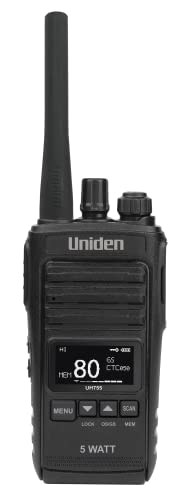
Uniden UH755 5 Watt UHF CB Splashproof Handheld Radio
ASIN B08P6VY4FJ • $143.00 • Ships from Amazon AU
The Uniden UH755 leads this guide because it's the handheld most Australians are actually buying, by a long way. It sat at #2,542 across all of Amazon AU on the day I checked, which for a UHF radio is a very strong number, and none of the other picks had a published rank at all. It's $143 from Amazon AU, it's a full 5W handheld, and Uniden has been making CB radios for the Australian market long enough that parts, chargers and battery packs are easy to find. That last point matters more than any spec on a radio you'll be carrying for the next ten years. It's the radio I'd suggest to anyone unsure where to start.
The listing is short. It states 80 UHF channels, selectable 5W or 1W transmit power, a splashproof body, a 17km range and 35 hours of operating time. The power switch is the useful bit: 1W is plenty for talking between cars in the same convoy and it stretches the battery, while 5W is there for the call back to the camp across the valley. Take the 17km with a big grain of salt. As I've explained above, that's a hilltop-to-hilltop figure, and on flat ground through timber you'll get a small fraction of it. The 35 hour figure will also assume mostly listening rather than talking, so expect less on a busy convoy channel at full power.
Splashproof is the rating to understand before you buy. It'll handle rain, wet hands and a damp esky lid without trouble, but it isn't rated for immersion, so a dunking in a creek crossing is a different story. If water is likely, look at the DTX600 or the Retevis pair instead. The listing doesn't say what's in the box beyond the radio, so check whether a charger, belt clip and spare battery are included, because a second battery pack is the most useful accessory on any handheld you'll use for more than a day at a time.
Honest caveats: Splashproof, not waterproof, so it won't survive a swim. The listing doesn't state the battery type or capacity, what charger is supplied, or whether duplex and CTCSS codes are supported, though most 80-channel radios include them; check before you buy if you need repeater access. The 17km range is a best case.
Best for: A first handheld from a brand with easy-to-find parts, for convoys, campsites and farm work.
Channels: 80 UHF CB • Power: 5W / 1W selectable • Water: Splashproof (no IP rating stated) • Stated range: 17km (best case, line of sight) • Operating time: 35 hours (stated) • Sold by: Amazon AU • Rank: #2,542 overall on Amazon AU
View on Amazon AU
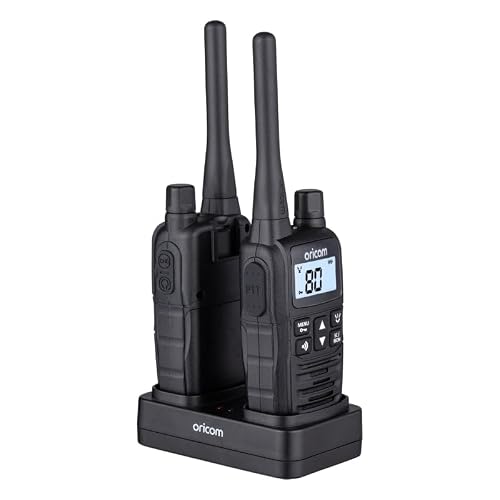
Oricom UHF2400 2 Watt Handheld UHF CB Radio Twin Pack
ASIN B0CVGLH7CN • $149.00 • Ships from Amazon AU
The Oricom UHF2400 twin pack is the pick when you need a pair rather than one radio. Two 2W handhelds for $149 from Amazon AU, which is about the price of a single 5W radio, and for most of what people buy a twin pack for, 2W is all you need. Think a campsite where one person's at the car and another's down at the water, a farm with someone on the tractor, or guiding a trailer into a tight spot at the boat ramp. Oricom is an Australian brand and its radios are everywhere in this market, which helps when you need a replacement battery or charger in a few years.
The listing states 80 channels with duplex, CTCSS and DCS codes, a backlit display, dual watch, channel scan and VOX, plus an LED torch built in. Duplex means repeater access works, which stretches a 2W radio's reach a long way in areas with repeater coverage. Dual watch lets it listen to two channels at once, so you can sit on your group's channel and still hear the highway channel. VOX means hands-free transmit when you speak, handy on a ladder but prone to transmitting the wind, so I'd leave it off in the car. If you're mixing them with radios the rest of the group already owns, match the CTCSS or DCS code across all of them, or nobody will hear anybody.
The torch is more useful than it sounds for night setups at camp, and it's one less thing to pack. Two radios also means two batteries to keep charged, so check the charging arrangement before your first trip. Twin packs also make a good starter set for families, because the radios are identical and nobody has to learn two sets of buttons. If one ends up with the kids, lock the keypad once it's on the right channel and set a code, and you'll stop hearing every other group on the beach through it.
Honest caveats: At 2W the range is shorter than a 5W radio, especially over hills. The listing doesn't state an IP rating, battery capacity or what charger comes in the box, so treat these as dry-weather radios until you know otherwise. Amazon AU had no published sales rank for this listing on the day I checked.
Best for: A pair of radios for camping, farm work or the boat ramp, where both people need one and the distances are short.
Channels: 80 UHF CB, duplex • Power: 2W • In the box: 2 handhelds (twin pack) • Codes: CTCSS and DCS • Features: Dual watch, scan, VOX, backlit display, LED torch • Water: Not stated on the listing • Sold by: Amazon AU • Rank: Not published by Amazon AU (checked 9 October 2026)
View on Amazon AU
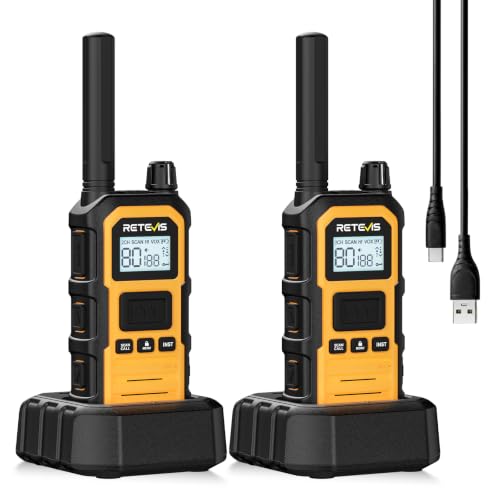
Retevis RB448 Plus IP67 UHF CB Radio (2 Pack)
ASIN B0H7WQSBKC • $179.99 • Sold by Retevis Direct AU on Amazon AU
The Retevis RB448 Plus is a two-pack with a better water rating than anything else in this price range. It's $180 for the pair from the Retevis Direct AU storefront, and the listing states IP67 water and dust sealing, a 2 metre drop rating and a 2000mAh lithium battery good for 18 hours of use and 100 hours of standby. It's also the only listing here that prints its Australian certification number and states RCM compliance, which is the paperwork you want to see on a radio from a brand that isn't one of the two big local names. For a pair of waterproof radios that's a strong price, well under what two IP67 handhelds from the bigger brands usually cost.
It's an 80-channel CB radio with USB-C charging, a charging dock in the box, vibration alerts for incoming calls, a key lock to stop accidental channel changes, and dual large PTT buttons. The key lock is a small thing that solves a real problem, because a radio clipped to a pack or a seatbelt will find its way onto channel 22 sooner or later. USB-C charging means it'll top up from the same lead as a phone in the car, which beats a proprietary cradle when you're three days from a power point. Vibration alerts are handy on a noisy boat or a windy ridge where you won't always hear a call come in.
The listing doesn't state transmit power, which is the one number I'd want to see before buying a pair for long distances. The bodies are PC and TPE plastic rather than metal, which is fine for the money and lighter in the hand. If they're mostly for a kayak, a boat or a group walk where everyone stays within a kilometre or two, that probably won't matter. If you want reach across hills, buy a 5W radio for the lead car and keep these for the water, and rinse them in fresh water after any salt exposure.
Honest caveats: Transmit power isn't stated on the listing, so don't buy these expecting 5W reach. The "instant channel" distress feature only reaches radios on the same channel within range; it isn't a beacon. Sold by the brand's AU storefront rather than Amazon. No published Amazon AU sales rank on the day I checked.
Best for: A waterproof pair for kayaks, boats and wet-weather trips, where a dunking is likely and the other radio is never far away.
Channels: 80 UHF CB • In the box: 2 radios, charging dock, belt clips, lanyard, USB-C cable • Water/dust: IP67, 2m drop (stated) • Battery: 2000mAh Li-ion; 18h use, 100h standby (stated) • Charging: USB-C or dock • Certification: RCM, cert. no. SHU26084LV (stated) • Power: Not stated on the listing • Sold by: Retevis Direct AU • Rank: Not published by Amazon AU (checked 9 October 2026)
View on Amazon AU
Oricom UHF310 Micro 5 Watt In-Car UHF CB Radio
ASIN B07776FS9Y • $205.00 • Ships from Amazon AU
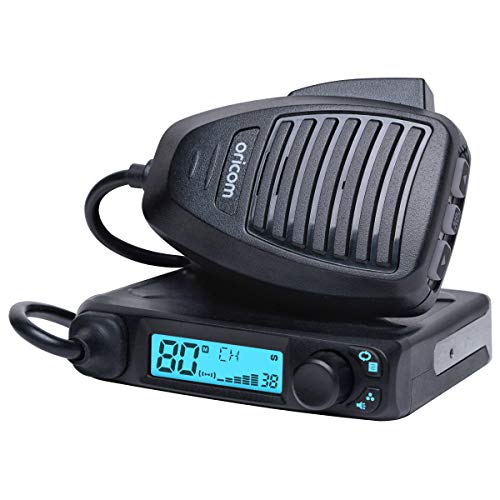
The Oricom UHF310 is the one pick here that isn't a handheld. It's a micro-size 5W in-car radio for $205 from Amazon AU, built for cars where a full-size DIN radio won't fit, which on a lot of modern dashboards is most of them. The flip screen function means the display can be turned to read correctly whichever way up you mount it, so it'll go under the dash, in a console or on the roof lining. For anyone who drives with a group regularly, this is the radio I'd fit before buying a handheld at all. It's the most expensive pick here, and for a permanent install it's money well spent.
The listing states 80 channels with duplex, 38 CTCSS and 104 DCS codes, automatic level control and a backlit display that changes between seven colours. Automatic level control evens out your transmit volume so you're not distorting when you shout or vanishing when you mumble, which on a corrugated road with the windows down is a nice touch. The 5W output is the same as the best handhelds, but wired to a roof-mounted antenna it'll comfortably outperform any of them, because antenna height and gain do more than transmit power. Duplex and the code sets mean it'll talk to repeaters and to group radios set up with privacy codes, so it slots into whatever the club or the convoy is already using.
Installation is where these succeed or fail. It needs a fused 12V feed, a good earth and an antenna with its coax run cleanly away from door seals and pinch points. Run the power lead to the battery through an inline fuse rather than tapping a cigarette socket circuit, which is the usual source of noise and dropouts, and mount the antenna as high as practical with a clean earth to the body. If you're not comfortable with that wiring, an auto electrician installs radios like this every week. It's a half-day job done properly.
Honest caveats: The listing doesn't state whether an antenna, mounting bracket or power lead is included, so budget for an antenna at least. It needs proper 12V wiring to work reliably, and a poor install causes most in-car radio faults. Amazon AU had no published sales rank for this listing on the day I checked.
Best for: A permanent radio in a car with no space for a full-size unit, for anyone who drives in convoys or tows regularly.
Type: Micro in-car UHF CB • Channels: 80, duplex • Power: 5W • Codes: 38 CTCSS, 104 DCS • Display: Flip screen, 7 colour backlight • Audio: Automatic level control • Antenna: Not stated as included • Sold by: Amazon AU • Rank: Not published by Amazon AU (checked 9 October 2026)
View on Amazon AU
Oricom DTX600 IP67 5 Watt Handheld UHF CB Radio
ASIN B0C93G3X61 • $218.88 • Ships from Amazon AU
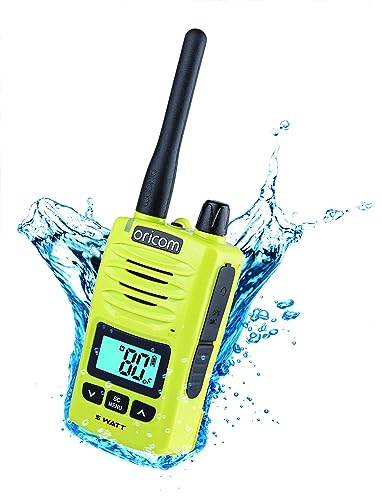
The Oricom DTX600 is the handheld I'd buy for someone who's hard on gear. It's $219 from Amazon AU in lime (other colours cost slightly more), it's a full 5W radio, and the listing states IP67 water and dust sealing plus a die-cast metal chassis. Metal inside matters on a radio, because it spreads the heat from the transmitter and it survives a drop onto rocks far better than a plastic frame does. This is the radio for the person who does river crossings, works outdoors or just keeps losing radios into creeks. It's also the one I'd hand to someone who's already lost a handheld to a river or a boat ramp.
The listing states 80 channels with duplex, switchable RF power, signal monitoring and triple watch, which lets it keep an ear on three channels at once. The battery is a 2600mAh lithium-ion pack quoted at up to 30 hours of operation, the largest stated capacity in this guide. The backlit LCD shows channel, signal strength and battery status. Switchable power means you can drop it down for convoy chatter and save the full 5W for when you need it, and on a pack this size that should mean a weekend away on one charge. Triple watch is the feature convoy leaders like most, since they can follow the group channel, the highway channel and an emergency channel together.
IP67 is the rating to have if water is part of the plan, but it only holds while the battery door and port seals are in good condition. Check them every trip, and replace a cracked battery door before it lets water in. A spare battery door costs very little next to a new radio. After salt water, rinse it in fresh water with the battery in and the door shut, then dry it before opening it up. The metal chassis also carries heat away from the transmitter, so it's less prone to cutting out on long transmissions in summer heat.
Honest caveats: It's the priciest handheld here, and the lime one was the lowest-priced colour on the day; the same radio in other colours sells for slightly more. The listing doesn't state what charger is supplied or the battery part number, so check that a spare pack is available before you buy. No published Amazon AU sales rank on the day I checked.
Best for: The toughest single handheld in the guide, for river crossings, boats and anyone who drops radios.
Channels: 80 UHF CB, duplex • Power: 5W, switchable • Water/dust: IP67 (stated) • Chassis: Die-cast metal • Battery: 2600mAh Li-ion, up to 30h (stated) • Features: Triple watch, signal monitoring, backlit LCD • Sold by: Amazon AU • Rank: Not published by Amazon AU (checked 9 October 2026)
View on Amazon AUSide-by-side comparison
What we see fail at the bench: UHF radios
Radios are simple inside, and the faults that come through the workshop door are nearly always the parts that get handled, plugged in or rained on rather than the radio board itself. Three of them account for most of what people think is a dead radio, and two can be sorted without buying anything new. The third needs a proper look inside, but early enough it's usually fixable.
Tired or swollen battery packs
A radio that drops out mid-transmit, or reads full on the charger and dies after a few calls, almost always has a worn battery pack. Transmitting at 5W pulls a lot of current, so a pack that's lost capacity sags the moment you key up and the radio resets. Lithium packs that have lived in a hot car can also swell, which shows up as a battery door that won't close properly. A swollen pack goes straight out of the radio and into battery recycling, never back in the charger, and a genuine replacement pack is usually a fraction of the cost of a new radio.
Broken antenna connectors
The antenna is a lever, and every knock against a door frame or a branch puts all of that force on a small connector soldered to the radio board. Over time the solder joint cracks, and the symptom is a radio that receives fine up close but can't be heard more than a few hundred metres away, or works only when you wiggle the antenna. On a handheld that's usually a repairable fault at board level. On an in-car radio the same symptom is more often crushed coax or a corroded connector at the antenna base, which is a cable job, not a radio job.
Water that got past the seals
IP-rated radios that have been in water usually come in after the owner powered them on wet, or charged them before they'd dried out. The seals worked for the first dunking, then a cracked battery door or a torn port flap let water sit inside, and corrosion did the rest over the following weeks. If a radio goes under, pull the battery straight away, leave it apart somewhere warm and dry for a couple of days, and don't put it on charge until you're sure. Green or white crust on the battery contacts means it's time for a proper clean.
Decision tree: which one should you actually buy?
- Want one dependable handheld from the brand everyone's buying? → The Uniden UH755 at $143. A 5W radio with a 1W setting, 80 channels and the best sales rank in this category on Amazon AU.
- Need two radios for camp, the farm or the boat ramp? → The Oricom UHF2400 twin pack at $149. Two 2W radios with duplex, dual watch and a built-in torch.
- Will the radios get wet? → The Retevis RB448 Plus pair at $180 for IP67 at a twin-pack price, or the Oricom DTX600 at $219 for a single 5W handheld with a metal chassis.
- Driving in convoys or towing regularly? → Fit the Oricom UHF310 micro in-car radio at $205 with a roof antenna before you buy a handheld.
- Radio won't hold a charge, or can't be heard past the end of the street? → Bring it into our Erina workshop and I'll tell you whether it's the battery, the antenna connector or the radio before you spend anything.
Frequently asked questions
Do I need a licence to use a UHF CB radio in Australia?
No individual licence is needed. UHF CB radios in Australia operate under ACMA's citizen band radio class licence, so you don't apply or pay a fee, but you do have to follow the class licence rules. That means using an approved radio on the designated channels, keeping channels 5 and 35 for emergencies, never talking on channels 22 and 23, and not running packet radio or other data on the CB band. CB repeater stations are the exception and need their own apparatus licence, which is why repeaters are run by clubs and organisations rather than individuals.
What is the real range of a 5 watt UHF handheld?
Usually a few kilometres handheld to handheld, and sometimes much less. The range printed on the box is a line-of-sight best case, often hilltop to hilltop with nothing in between. UHF signals struggle with hills, dense timber, buildings and vehicle bodies, so in the bush or a town you'll get a fraction of the stated figure. Height helps more than power, so getting the radio up high does more than going from 2W to 5W. For long distances, use duplex onto a repeater or fit an in-car radio with a roof-mounted antenna.
What are UHF channels 5 and 35 used for?
Channels 5 and 35 are set aside under the ACMA class licence for emergency messages only. Channel 5 is the simplex emergency channel and 35 is its repeater input, so a radio on channel 5 with duplex switched on transmits on 35 and can reach an emergency repeater. Don't use either for chatting, testing or convoy talk. In a real emergency you can also use any CB channel to attract attention, but people monitoring 5 are the ones most likely to be listening for a call for help.
Why can't I talk on channels 22 and 23?
Channels 22 and 23 are reserved for telemetry and telecommand, which is remote control and data from equipment like water tank monitors, gates and farm gear. The ACMA class licence says you can't speak on them at all. Voice traffic on those channels can interfere with that equipment, and it's one of the most common rule breaks because scanning radios stop on them and people assume a quiet channel is a free one. Lock your radio's keypad on long trips so it doesn't wander onto them while it's clipped to a belt or seat.
Is a UHF radio better than a satellite messenger for remote travel?
They do different jobs, and for proper remote travel you want both. A UHF radio talks directly to other radios nearby with no fees and no network, which makes it ideal for convoys, campsites and calling the car behind you. It can't reach anyone outside radio range. A PLB or satellite messenger can send an emergency alert from almost anywhere with a view of the sky, but it isn't a conversation tool for the group. Carry the radio for coordination and the beacon for the day something goes properly wrong.
Can I use a UHF handheld radio inside my car?
Yes, but it won't perform as well as you'd expect. The car's metal body blocks a lot of the signal, so a handheld held below the window line loses a big share of its range. Holding it up near the windscreen helps a bit. An external antenna adaptor on a handheld is possible on some models, but for regular car use a dedicated in-car radio wired to 12V with a roof or bullbar antenna is a much better setup. A handheld is still worth keeping in the car as a backup and for use outside it.
Related buying guides
Radio cutting out or can't be heard? Bring it in
Most dead radios aren't dead. A worn battery pack, a cracked antenna connector or a bit of water that got past a seal account for nearly all of what we see. Bring the radio and its charger into our Erina workshop and I'll tell you which part has failed, and what it'll cost to fix, before you spend anything on a new one.
Call (02) 4311 6146 Book Online