Prices from Amazon AU, updated daily. Swipe or use the arrows for more.
Disclosure: This article contains affiliate links to amazon.com.au. If you buy through one of these links iFix may earn a small commission at no extra cost to you. It doesn't change which products we recommend. We focus on what actually lasts based on 16 years of repair-shop experience.
Quick summary8 picks
- Entry PickAstroAI B8 Car Battery Jump Starter Power Bank about$58.97
- AstroAI B8 Car Battery Jump Starter Power Bank about$58.98
- 3000A Car Jump Starter about$59.99
- AstroAI MF16 Car Battery Jump Starter with… about$89.99
- Lucklike 7000A Jump Starter with Air… about$89.9918W.
- UGREEN 1000A Jump Starter and Air Compressor about$127.49
- NOCO Boost GB40: 1000A UltraSafe Jump… about$156.99
- Most PremiumNOCO Boost X GBX55: 1750A UltraSafe Jump… about$285.00
The battery fails on the cold morning, not the warm afternoon
A lead-acid car battery loses cranking grunt as the temperature drops, and it dies at the kerb outside your house at 6:40am, not in the servo car park at lunch. The fix used to be jumper leads and a second car, plus a neighbour willing to nose their bonnet up against yours in the rain. Now it is a lithium pack the size of a paperback that lives in the glovebox and starts the engine on its own. The catch is that the market sells these things on a single number, peak amps, and that number has almost nothing to do with whether the pack will turn your particular engine over on a cold morning.
I see the aftermath of that number at the bench. Packs bought on the biggest figure in the search results, left plugged into a dashcam adapter until the cells sat flat for six months, then presented as faulty. Most of them were fine when they were sold. They were killed by storage habits nobody explained at the checkout, and the pattern repeats so consistently that the storage section below is arguably the most valuable part of this page. This guide covers five packs sold by Amazon AU or AU storefronts, from a $70 glovebox unit to a $265 pack rated for 7.5L petrol engines, and the habits that decide whether the one you buy still works in year three.
Peak amps versus cranking amps: read the number properly
The headline number on a lithium jump starter is peak current: the maximum the cells can dump into a near-short for a fraction of a second. Cranking an engine is a different job entirely. The starter motor pulls heavy current for two to five seconds while the pack voltage sags under load, and what decides whether your engine turns over is how much current the pack sustains through that sag, not what it managed for a millisecond on a lab bench. Two of the picks here, the UGREEN and the NOCO GB40, both quote 1000A peak. A lower-priced pack quoting 8000A, like the AstroAI MF16, is not eight times stronger. It is quoting a more optimistic version of the same measurement, held for less time, into a friendlier load.
There is no enforced standard for the peak figure, which is why I put more weight on the engine coverage the maker is prepared to print on the listing. A stated limit like 6.0L petrol and 3.0L diesel is a specific claim the brand can be held to under consumer law, and brands know it. A four-digit amp figure with no engine rating attached to it is marketing, and the bigger the number, the more suspicious you should be of the fine print underneath. When two packs cost about the same, buy the one with the specific engine claim and the boring number, not the spectacular number with no claim behind it.
Match the pack to the engine, then stop paying for headroom
Engine displacement and fuel type set the real requirement. Diesels need roughly twice the cranking effort of a similar-size petrol because of their compression ratios, which is why every maker quotes a smaller diesel figure than petrol figure on the same pack. The AstroAI B8 quotes 7L petrol and 5.5L diesel from a 329g unit at $70, which is a bold ratio of claim to hardware. NOCO quotes 6.0L petrol and 3.0L diesel for the $176 GB40, and 7.5L petrol and 5.0L diesel for the $265 GBX55. Those NOCO figures run conservative, and that conservatism is a real part of what the extra money buys.
Work backwards from your own engine, not forwards from the shelf. A 1.8L Corolla or a 2.0L i30 is covered by everything on this page with margin to spare, so the smaller packs are the rational buy. A 3.2L diesel Ranger or Pajero is a different customer entirely: the honest choices are the GBX55 with its written 5.0L diesel rating, or accepting that a marginal pack might start the ute in January and leave you stranded in July. Cold mornings raise the load on everything. The oil thickens, the lead-acid battery sags harder, and the lithium pack itself delivers less current at low temperature, so it works closer to its limit exactly when the job is hardest. If the vehicle sleeps outside on the Central Coast through winter, size up one step from whatever the chart says.
Clamping order and what spark-proof actually does
Old-school jumper leads spark because the circuit completes the instant the last clamp touches metal, and that spark happens next to a battery that vents hydrogen. Every pack in this list ships smart clamps instead: the output stays electrically dead until the electronics see a real battery with correct polarity across the clamps, and only then does the relay close. Reverse the clamps on any of these and you get an error light, not a bang and a repair bill. That single feature is why I stopped recommending plain leads to anyone who does not already know their way around an engine bay, and why these packs are a defensible gift for a new driver.
The order still matters. Red clamp to battery positive, black clamp to the negative terminal or a bare metal ground point, then plug the clamp lead into the pack, then crank. Crank in short bursts. AstroAI prints a five-second limit on the B8 listing and that discipline applies to every pack here: if the engine has not caught in five seconds, stop, wait a minute, and work out why, because repeated long cranks cook the clamp cables and stress the cells. And when the engine finally starts, unplug the clamp lead from the pack straight away. AstroAI warns on the listing that a clamp lead left plugged into the EC5 port keeps drawing power with the car off, and can drag the pack down to a state it will never recover from. That warning is on one listing, and it applies to the whole category.
The lithium pouch inside is the consumable
Open any of these and you find the same architecture as a phone or a power bank: lithium pouch cells, a protection board, a DC-DC converter for the USB side. The same pouch cells I write about in the power bank guide live here, with one difference that matters. A power bank gets cycled weekly, which keeps the cells exercised and the owner aware of their state. A jump starter sits untouched for months at a stretch, and lithium cells self-discharge whether you use them or not, with the protection electronics drawing their own trickle on top. A pack stored at full charge in a hot car degrades fastest. A pack stored flat sinks below the protection board's cutoff voltage and never comes back.
The storage protocol is short and it is the difference between a five-year tool and a landfill story. Keep the pack at roughly half to three-quarters charge rather than pinned at 100 per cent, top it up every three months (AstroAI prints exactly this interval on the listing), and do not leave it baking on the parcel shelf through January. Cabin temperatures in a parked Australian car clear 60 degrees in summer, every listing here caps operating range at 50, and sustained heat at high charge is the specific combination that swells pouch cells. Under a seat or in the glovebox beats the boot floor above the exhaust line, and the house beats the car entirely if you only drive on weekends.
Treat the three-month top-up as a service item, the same way you treat wiper blades and coolant. Put a recurring reminder in the phone calendar and the whole problem disappears for the cost of ten minutes a quarter. A jump starter is the one gadget you buy hoping never to use, and the flat-pack-in-the-emergency story I hear most often at the counter traces back to eighteen months of storage with zero charging and a first test on the worst morning of the year.
Recharge speed, and the charger you feed it with
Recharge times between these packs vary by a factor of ten and almost nobody reads the spec before buying. The NOCO GB40 quotes 3 hours. The AstroAI B8 charges from a basic 5V/2A USB source, which in practice means overnight on the kitchen bench. At the other end of the table, the GBX55 takes 60 watts over USB-C Power Delivery and quotes 1.2 hours to full, with enough charge for one jump start after just 5 minutes on the lead. If the pack lives forgotten and flat until the morning you need it, and most of them do, that 5-minute figure is the difference between a tool and a paperweight you swear at.
Feed them properly, because the charger is part of the system. The USB-C packs negotiate their charge rate with the wall unit, so a quality charger from the GaN charger guide recharges a GBX55 at the full rate that a five-year-old phone brick never will. And the no-name brick is a worse idea here than usual: a jump starter spends its whole life at the edge of its storage window, and the out-of-spec voltage sag I document in the piece on counterfeit chargers is exactly the kind of input that confuses battery management boards. Spend properly once on the wall charger. Every battery in the house benefits from the same purchase.
A compressor bolted on: one box or two tools
Two faults strand cars at the kerb: flat batteries and flat tyres. The AstroAI MF16 bolts a 150 PSI inflator onto an 8000A-class jump pack for $90, auto-stops at a preset pressure, and quotes a 32 to 36 PSI top-up on a car tyre in under a minute, which is the actual job people do at the servo air hose. As a boot-of-the-car insurance policy, one box that answers both problems has obvious appeal, and the MF16's #4 sales rank in the category says plenty of buyers have already done that arithmetic and liked the answer.
The engineering trade is real, though, and worth naming before you buy. A combined unit shares one battery, one board and one case between two hard jobs, so a single fault takes out your entire roadside kit at once, and a compressor motor vibrates and heats the same enclosure the pouch cells live in. If the boot has room for two boxes, a dedicated jump pack plus a dedicated inflator survives longer and each tool does its own job better. If space or budget says one box, the MF16 is the honest version of the compromise. I run the numbers on dedicated inflators in a separate guide publishing alongside this one, and the two articles are meant to be read as a pair.
How I picked these five
Every pick is sold as new by Amazon AU or the brand's Australian storefront, sits inside the $60 to $300 band, and holds a real sales rank in Amazon AU's jump starter categories, checked the same day as the prices. No grey imports and no marketplace resellers shipping from overseas, for two reasons. A lithium pack that spent six weeks in a shipping container at unknown temperatures is a lottery ticket, and a warranty claim against a foreign seller goes nowhere when the pack fails in month eleven. Australian storefronts answer to Australian consumer law, and for a safety product that distinction is worth a few dollars of margin.
Specs come from the listings, not from my bench, and where a listing goes quiet on a number I say so in the caveats rather than inventing one. The five cover the actual spread of driveways: a $70 glovebox unit for the hatchback, a $90 combo with the compressor for the family wagon, a $127 combo from an accessories brand with a big AU footprint, with its own 150 PSI tyre inflator, and two NOCOs for people who want conservative ratings and a housing built to survive a decade of being thrown in the boot. Anything electronic that stops holding charge, jump pack included, can come past the workshop in Erina for a straight answer on whether it is worth opening.
The 5 picks, $70 to $265
Prices are Amazon AU at time of writing (23 August 2026) and move week to week. Ranks are Amazon AU category sales ranks, checked the same day.

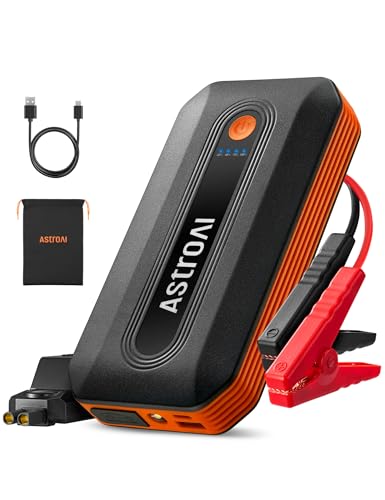
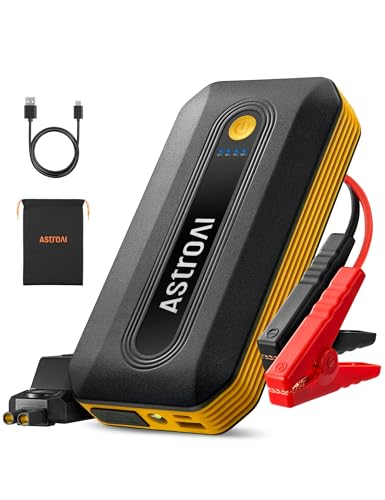
AstroAI B8 Jump Starter Power Bank, 7L Petrol / 5.5L Diesel
ASIN B0FB2L7CCX • $69.99 • Sold by AstroAI Direct AU on Amazon AU
At $69.99 from AstroAI's Australian storefront, the B8 is the current #1 seller in Amazon AU's jump starter category, and the reason is the ratio of claim to size. The listing quotes coverage for 7L petrol and 5.5L diesel engines from a unit that weighs 329 grams, light enough that you forget it is in the glovebox until the morning it earns its keep. It works across a stated -20 to 50 degrees C operating range, which covers a Central Coast winter morning and most of a summer cabin. For a first jump starter, or the pack you put in a partner's or parent's car, this is where I would start the conversation.
The protection list is the part I actually care about, because it is the part standing between a nervous owner and a live battery at 6am. Ten circuits are named on the listing: reverse polarity, reverse connection, overcurrent, overvoltage, overload, overcharge, overdischarge, short circuit, spark-proof, and high and low temperature cutoffs. That is the full set, and it means the clamps stay dead until they see a correctly connected battery. Beyond starting duty the B8 works as a small power bank for phones and as a three-mode LED torch, and the box includes the smart clamps, a USB-A to USB-C cable and a storage bag, so nothing extra needs buying before it goes in the car.
What sells me is the honesty in the fine print. AstroAI prints the five-second cranking limit, tells you to unplug the clamp lead after use because the EC5 port drains the pack even with the car off, and tells you to top the unit up every three months in storage. Those three sentences are the difference between a pack that works in year three and a warranty argument in year one. A listing that documents its own failure modes is a listing written by people who have processed the returns, and that candour is rare at any price, let alone $70.
Honest caveats: Peak current is not stated on the listing, so there is no amp figure to compare against the NOCOs, only the engine claim. Recharging is from a basic 5V/2A USB source, so plan on hours, not minutes. And that EC5 drain warning is real: leave the clamps plugged in and the pack can sink too low to recover.
Best for: The glovebox of any petrol hatch, sedan or SUV, and the pack you buy for someone else's car.
Price: $69.99 at time of writing • Stated engine coverage: 7L petrol / 5.5L diesel • Weight: 329g • Operating range: -20 to 50 °C • Protections: 10 named circuits incl. spark-proof • Extras: Power bank output, 3-mode LED torch • In the box: Smart clamps, USB-A to C cable, storage bag • Rank: #1 in Car Battery Jump Starters (Amazon AU)
View on Amazon AU
AstroAI MF16 Jump Starter with Air Compressor, 8000A, 150 PSI
ASIN B0FB3H1S4P • $89.99 • Sold by AstroAI Direct AU on Amazon AU
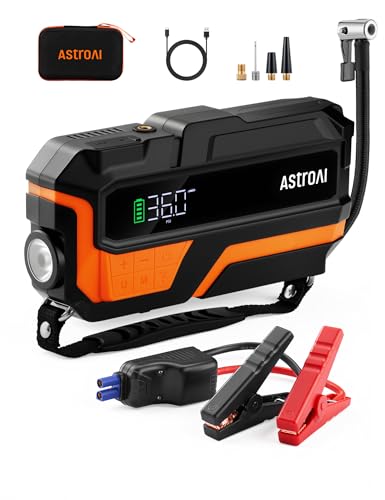
The MF16 is the one-box answer to the two ways a car strands you: it jump-starts the engine and it reinflates the tyre, for $89.99 from AstroAI's AU storefront. The compressor side runs to 150 PSI, shuts off automatically at a preset pressure, switches between PSI, kPa and bar, and the listing quotes a 32 to 36 PSI top-up on a car tyre in under a minute, which matches the job you actually do at the servo. It currently sits #4 in Amazon AU's jump starter category, a few places behind its own stablemate the B8, so the combo format has clearly found its market among people who would rather carry one box than two.
The jump-start side quotes 8000A peak alongside the same -20 to 50 degrees C envelope and the same ten named protection circuits as the B8, with the listing nominating motorcycles, sedans and SUVs as its targets. There is a boost mode for batteries too flat for the smart clamps to detect, which the listing sensibly gates behind a read-the-manual-first warning, a screen that stays readable in direct sunlight for pressure and charge state, and a heat dissipation system called out specifically for the compressor duty. The kit is genuinely complete: battery clamps, an EVA case, a USB-A to USB-C cable, four nozzles and a 60cm hose, so it covers footballs and bike tyres as well as the car it rides in.
My read after years of combo gadgets crossing the bench: this format suits the boot of the family car, where one box that answers both roadside problems beats two boxes someone forgot to pack. The trade is concentration of risk, because one battery and one board serve both tools, and a single fault takes your whole roadside kit with it. The screen helps manage that: pressure on one side, pack charge on the other, so a pre-trip glance tells you whether the box is actually ready. Buy it knowing the trade, and test both functions twice a year rather than assuming.
Honest caveats: The 8000A figure is a peak number with no stated engine litre coverage behind it, so treat the B8's written 7L/5.5L claim as the more useful spec. Compressor duty cycle is not stated on the listing. And a shared battery means a flat pack takes the inflator down with it.
Best for: The boot of the family car: one box that answers both a flat battery and a soft tyre.
Price: $89.99 at time of writing • Peak current (stated): 8000A • Compressor: 150 PSI, auto shut-off at preset • Inflation claim: 32 to 36 PSI in under 1 minute • Operating range: -20 to 50 °C • Protections: 10 named circuits incl. spark-proof • In the box: Clamps, EVA case, 4 nozzles, 60cm hose • Rank: #4 in Car Battery Jump Starters (Amazon AU)
View on Amazon AU
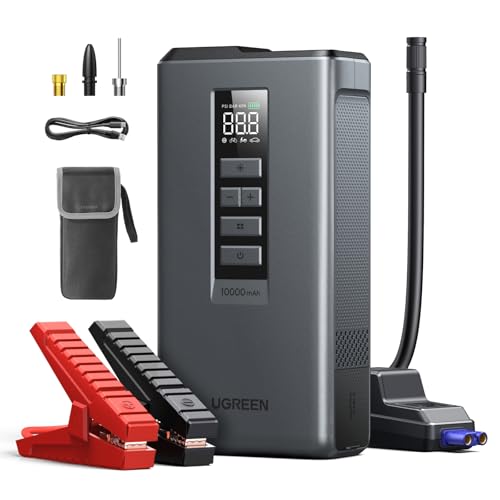
UGREEN 1000A Jump Starter and Air Compressor
ASIN B0DYTZFD8P • $127.49 • Sold by UGREEN GROUP LIMITED AU on Amazon AU
UGREEN's pack adds a compressor to the numbers that matter: 1000A peak, a 10,000mAh battery, up to 7L petrol and up to 5.5L diesel on the listing, $127.49 from the brand's AU storefront. That diesel figure deserves a second look. It sits well above the NOCO GB40's 3.0L diesel rating and even above the GBX55's 5.0L, from a pack with the same 1000A peak as the GB40, which makes this the value position of the five for owners of mid-size diesel engines who also want to pump their own tyres, as long as you treat the rating as a ceiling rather than a promise.
The listing doesn't give dimensions or weight, so I can't call this the smallest pack here; the compressor is the reason to buy it, not the size. That compressor is a 150 PSI unit with three air nozzles and five inflation modes (car, motorcycle, bicycle, balloon and a custom setting), auto shut-off at the pressure you set, and PSI, BAR or kPa units. On the electrical side the listing names intelligent safety clamps with reverse polarity, reverse connection, reverse charging, overcurrent and low-voltage protection, plus spark-proof design. Between rescues a digital display shows battery status, USB-A and USB-C ports cover the phone-and-tablet job, and a three-mode LED light (steady, strobe and SOS) doubles as the roadside torch.
UGREEN is a charging-accessories company before anything else, and it shows in the sensible port choices and the restraint of the spec sheet. Nothing on the listing is outlandish, every figure is one a test lab could check, and the brand has enough Australian retail presence that a warranty conversation happens in Australian consumer law territory rather than a chat window in another timezone. Charge it fully before first use, as the listing instructs; with lithium packs that first full charge calibrates the gauge, and the gauge is what you will trust at the roadside.
Honest caveats: Recharge time, weight, starts per charge and USB-C output wattage are not stated on the listing, so laptop charging is not something to count on. The compressor adds bulk and one more function to keep charged, and a 5.5L diesel rating from a 1000A pack is the sort of figure I would want to see tested on a cold morning before relying on it for a big 4WD.
Best for: Mid-size diesels and anyone who wants a jump starter and a tyre inflator in one box.
Price: $127.49 at time of writing • Peak current (stated): 1000A • Stated engine coverage: up to 7L petrol / 5.5L diesel • Battery: 10,000mAh • Air compressor: 150 PSI, 5 inflation modes • Ports: USB-A and USB-C output • Rank: #26 in Car Battery Jump Starters (Amazon AU)
View on Amazon AU
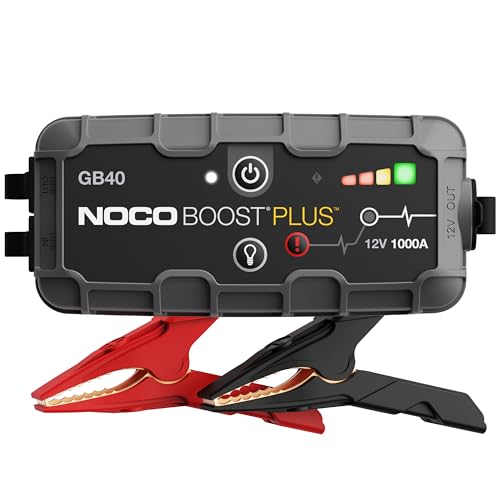
NOCO Boost GB40 1000A UltraSafe Jump Starter
ASIN B015TKUPIC • $147.99 • Ships from Amazon AU
The GB40 is the pack the roadside assistance vans made famous, sold here by Amazon AU at $148 and still holding #8 in the category years after launch, which for a product this old is a recommendation in itself. The rating is 1000A peak for engines to 6.0L petrol and 3.0L diesel, up to 20 starts per charge, with NOCO's UltraSafe spark-proof and reverse-polarity system on the clamps. NOCO's numbers run conservative, and that is the brand's entire personality: where a marketplace brand quotes its best-case lab pulse, NOCO quotes what the pack does on a cold morning with a genuinely flat battery, and the second-hand market's stubborn respect for these units reflects exactly that.
The housing is the other half of the price, and it is where the GB40 stops competing on spec sheets and starts competing on years. It is IP65-rated against water and dust with rubberised over-moulding, built for a decade of rattling around a boot with the recovery straps rather than for a padded drawer. The listing calls out high-conductivity clamps, which matters more than it sounds: clamp and cable resistance is precisely where marginal jump starters lose their cranking current, and it is the first place corrosion attacks in coastal air. A 100-lumen LED with seven modes including SOS and strobe rides on the front, and the whole unit comes in at a listed 2.5 lb, about 1.1 kilograms.
In the box are the heavy-duty leads, a USB-C charging cable and a microfibre storage bag, with a 1-year warranty behind the lot, and between rescues it will charge a phone over USB like any power bank. The GB40 is the pick for the buyer who wants the boring, proven answer: a known brand, conservative ratings, a weatherproof housing, and a design that has been rescuing the same engines for years without drama or revision. If the pack is going to live in a ute tray, a boat, or anywhere the weather reaches, the IP65 rating stops being a nice-to-have and becomes the deciding spec.
Honest caveats: The 3-hour recharge is the slowest of the NOCOs and the 3.0L diesel ceiling rules out the popular ute engines. A 1-year warranty is short for a $148 tool when AstroAI and UGREEN undercut it on price per amp. You are paying for the housing and the track record.
Best for: Petrol cars whose owners want the proven name and an IP65 housing that shrugs off the boot.
Price: $147.99 at time of writing • Peak current (stated): 1000A • Stated engine coverage: 6.0L petrol / 3.0L diesel • Starts per charge: Up to 20 (stated) • Housing: IP65, rubberised over-moulding • Recharge: 3 hours (stated) • Torch: 100-lumen LED, 7 modes • Weight: 2.5 lb listed (about 1.1 kg) • Rank: #8 in Car Battery Jump Starters (Amazon AU)
View on Amazon AU
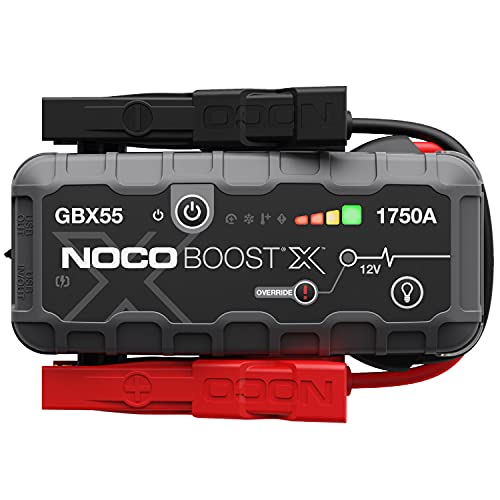
NOCO Boost X GBX55 1750A UltraSafe Jump Starter
ASIN B08WZKRHZZ • $265.00 • Ships from Amazon AU
The GBX55 is the pack for the vehicles everything else on this page politely declines: 1750A peak, rated in writing for 7.5L petrol and 5.0L diesel engines, $265 from Amazon AU and the current #1 seller in the Car Breakdown Assistance category. That 5.0L diesel rating is the line that matters for Australian driveways, because it covers the diesel 4WDs and utes that a 1000A pack will only start on a warm day with luck and a prayer. If the vehicle is a LandCruiser, a Patrol or a big diesel Ranger, this is the tier to shop in, and the UltraSafe 2.0 clamp protection carries over from the smaller packs with upgraded thermal management behind it.
The second reason to pay $265 is the charging architecture, which is a generation ahead of everything else here. The GBX55 takes and gives 60 watts over USB-C Power Delivery: it recharges in a quoted 1.2 hours from a proper PD wall charger, takes on enough energy for a jump start in 5 minutes flat, and in the other direction works as a 60W power bank that will charge a laptop at full speed, not just trickle a phone. For a device that spends its life half-forgotten in a boot, the 5-minute figure is the killer spec. Discover it flat, plug it into the car's USB-C port or a wall charger, make a coffee, start the truck.
The design trades starts for grunt, and NOCO is upfront about the arithmetic. A 60-second timer manages the high-voltage output between attempts, and the listing quotes up to 9 starts per charge rather than 20, which is the honest cost of pushing this much current through a pack this size. A 200-lumen seven-mode LED, heavy-duty leads, a USB-C cable and a storage bag round out the box, with the same 1-year warranty as the GB40 behind it. That is not a flaw, it is a design choice: fewer, harder starts for bigger engines, with the fast USB-C recharge there to refill the pack between them.
Honest caveats: Nine starts per charge, not twenty: the high-output design spends its energy faster, so the three-month top-up discipline matters more here, not less. It is also the price of two smaller packs, and for a 2.0L petrol hatch it is pure overkill. The 1-year warranty stands at this price too.
Best for: Diesel 4WDs, utes and big petrol engines, and road-trippers who want a 60W USB-C power bank in the same box.
Price: $265.00 at time of writing • Peak current (stated): 1750A • Stated engine coverage: 7.5L petrol / 5.0L diesel • Starts per charge: Up to 9 (stated) • USB-C Power Delivery: 60W in and out • Recharge: 1.2 hours; jump-ready in 5 minutes • Torch: 200-lumen LED, 7 modes • Rank: #1 in Car Breakdown Assistance (Amazon AU)
View on Amazon AUSide-by-side comparison
What we see fail at the bench: jump starters
Jump starters reach the bench in one of three states, and almost none of them died doing their job. They died in storage, in heat, or at the connector. All three failure modes are preventable, which is exactly why they are worth describing. The pattern below repeats across brands and price tiers, from no-name marketplace packs to the premium units, because the chemistry and the connectors are the same underneath.
Deep discharge: the pack that slept itself to death
Lithium cells self-discharge in storage, and a jump starter's protection board keeps drawing a trickle on top. Leave the pack for a year, or leave the clamp lead plugged into the EC5 port as AstroAI's listing specifically warns against, and the cells sink below the battery management system's low-voltage cutoff. Below that line the board refuses to accept charge, as designed, because charging a deeply discharged lithium cell is a fire risk. The pack is not always dead at that point, but recovering it is a job for someone with a bench supply and the sense to do it outdoors, not a reason to poke it with a random charger.
Heat swell: the parcel shelf is an oven
The second cohort arrives fat. Pouch cells kept at full charge in a car through an Australian summer generate gas, the pouch swells, and the case bulges or splits at the seam. A parked car's cabin can pass 60 degrees C, and every listing here caps operating range at 50. Swollen packs still show charge and will sometimes still crank, which convinces owners they are fine. They are not. A swollen lithium pouch pressed inside a sealed plastic case next to high-current electronics is a unit to retire, and retire properly: council battery drop-off, not the red bin.
Clamps, cables and ports: the resistance creep
The third failure is electrical friction. Clamp springs weaken, copper jaws oxidise, and the crimp where cable meets clamp corrodes, especially in coastal air. Every extra milliohm eats cranking voltage exactly when the starter motor needs it most, so a pack that starts the car in spring mysteriously fails in winter. The USB ports wear the same way they do on phones. Sixty seconds of maintenance twice a year covers it: scrub the clamp jaws with a wire brush or scouring pad, work the springs, check the cable insulation for cracking, and recharge to three-quarters before it goes back in the car.
Decision tree: which one should you actually buy?
- Petrol hatch or sedan, want the pack that just lives in the glovebox? → The AstroAI B8 at $70. It claims 7L petrol coverage at 329 grams, and its listing documents the storage habits that keep it alive. Set a three-month top-up reminder and forget it otherwise.
- Want one box that fixes a flat battery and a soft tyre? → The AstroAI MF16 at $90 bolts a 150 PSI auto-stop inflator onto an 8000A-class pack. Accept that one fault takes both tools, and test each function twice a year.
- Mid-size diesel on a sensible budget? → The UGREEN 1000A with built-in compressor at $127 quotes a 5.5L diesel rating, which beats the $176 NOCO GB40's 3.0L ceiling. Treat it as a ceiling, not a promise, for a pack with a 1000A peak. You get the tyre inflator too.
- Want the proven name with the weatherproof housing? → The NOCO GB40 at $176. Conservative 1000A rating, IP65 case, and years of roadside track record. Petrol to 6.0L, diesel to 3.0L only.
- Diesel 4WD, ute, or anything with a big engine? → The NOCO GBX55 at $265 is the only pick rated for 5.0L diesels, recharges in 1.2 hours over 60W USB-C, and is jump-ready 5 minutes after you find it flat.
- Pack will not take charge, bulging case, or the USB side is dead? → Stop charging it and bring it past our Erina workshop. I will tell you in minutes whether it is a recoverable protection lockout or a pack that needs safe disposal.
Frequently asked questions
What is the difference between peak amps and cranking amps?
Peak amps is the maximum current the pack can deliver for a fraction of a second into a near-short load. Cranking an engine draws heavy current for two to five seconds while voltage sags, and the current a pack sustains through that sag is always far lower than its peak figure. There is no enforced standard for how peak amps is measured, which is why an $80 pack can print 9000A while NOCO prints 1000A for a unit that starts the same cars. Compare packs on the stated engine coverage, in litres for petrol and diesel, because that is a claim the maker can be held to.
Will a lithium jump starter start my diesel?
If the pack's stated diesel rating covers your engine size, yes. Diesels crank harder than petrols because of their compression ratios, so every maker quotes a lower diesel figure: the UGREEN lists diesels to 5.5L, the NOCO GB40 to 3.0L, and the GBX55 to 5.0L. A 3.2L diesel ute sits above the GB40's rating, and while a marginal pack may work on a warm day, cold mornings raise the cranking load exactly when you need the start. For the common Australian diesel 4WDs, buy the GBX55 tier rather than gambling on a headline figure, the UGREEN's 5.5L claim included.
How often should I recharge a jump starter I never use?
Every three months, and AstroAI prints that interval on its own listing. Lithium cells self-discharge in storage and the protection electronics draw a small standing current on top, so a pack left for a year can sink below its battery management cutoff and refuse to charge at all. Store it at roughly half to three-quarters charge rather than pinned at 100 per cent, keep it out of extreme heat, and put the top-up in your phone calendar like a service item. The most common jump starter failure I hear about is simply eighteen months of neglect.
Is it safe to leave a jump starter in the car all year?
In the cabin, mostly, with one caveat: heat. A parked car's interior can clear 60 degrees C in an Australian summer, and every pack here lists a maximum operating temperature of 50. Sustained heat at full charge is what swells lithium pouch cells, so keep the pack in the glovebox or under a seat rather than on the parcel shelf or the boot floor above the exhaust, and if the car bakes outside all summer, consider bringing the pack inside for the worst months. If the case ever bulges, retire the unit through a battery recycling drop-off.
Can I take a jump starter on a plane?
Sometimes, and the rules are about watt-hours. Australian carriers treat jump starters as spare lithium batteries: carry-on only, never checked baggage, with airline approval generally required between 100Wh and 160Wh and a ban above that. None of the listings here state a watt-hour figure, so check the printed rating on the unit itself before you fly and confirm against your airline's current policy. If there is no Wh figure printed on the pack at all, expect security to refuse it. For road trips this is moot; for fly-in trips, check before you pack it.
The pack cranks the engine but the car still will not start. Now what?
A jump starter only replaces the battery's contribution. If the engine turns over strongly and never fires, the problem is fuel, spark or immobiliser, and no amount of amps will fix it. If the engine will not turn over at all with a healthy pack correctly clamped, suspect the starter motor, a corroded earth strap or seized internals. Follow the five-second rule: crank in short bursts, stop if nothing changes, because long cranks overheat the clamp cables. And if the battery goes flat repeatedly, get the charging system tested rather than buying a bigger jump pack.
Related buying guides
Jump pack that will not hold charge, or a car battery that keeps dying?
Half the dead jump starters people describe to me are protection-board lockouts from deep discharge, not dead cells, and half the flat car batteries are a charging-system fault the jump start only papers over. Walk the pack in to the Erina workshop and get a straight answer, backed by 16 years of board-level diagnostics. If it is worth fixing I will say so, and if it is not I will say that too.
Visit our Erina workshop Book Online