Prices from Amazon AU, updated daily. Swipe or use the arrows for more.
Disclosure: This article contains affiliate links to amazon.com.au. If you buy through one of these links iFix may earn a small commission at no extra cost to you. It doesn't change which products we recommend. We focus on what actually lasts based on 16 years of repair-shop experience.
Quick summary6 picks
- Entry PickPetSafe® ScoopFree® Crystal Classic… about$161
- Furryfable Automatic Cat Litter Box about$253
- Gimars Open Top Design Self Cleaning Litter… about$270
- Sefaul Open-Top Self-Cleaning Cat Litter… about$279
- Catlink Scooper Open-X Self-Cleaning Smart… about$430
- Most PremiumNeakasa M1 Plus Automatic Cat Litter Box… about$599
How an automatic litter box actually works
Most automatic litter boxes on Amazon AU are a drum or globe that holds the litter and slowly rotates after your cat leaves. As it turns, the litter passes through a screen, the clumps get separated out and drop into a sealed bin underneath, and the clean litter settles back into the tray. A small motor and gearbox do the turning, and a set of sensors decides when it's safe to start. It's a simple idea, and most of what goes wrong comes from those three parts.
The other approach is the one PetSafe uses with its ScoopFree Crystal Classic. Instead of a drum, it uses a disposable tray of crystal litter, which the listing says absorbs urine and dries out solid waste, and you throw the whole tray away when it's done. There's far less machine to go wrong, but you're locked into buying PetSafe's trays, so the running cost works differently. I've included one of each type here because the choice between them matters more than the brand.
Nearly all of the drum-style picks here are open-top or semi-open designs. Older automatic boxes were enclosed globes with a small door, and plenty of cats refused to use them, especially bigger cats. The open-top layout lets a cat see around while it's in there, and every listing makes a point of it. In my experience, whether your cat will use the thing is the biggest risk with any of these, so it's worth checking the entry height and tray size against your cat before anything else.
These are still electronic appliances sitting in a fairly hostile spot. There's dust from the litter, moisture from urine, the odd hairball and plenty of cleaning. The parts that come into a repair shop from these are much the same as from any small motorised appliance: a jammed or stripped gearbox, a failed sensor, a damaged power adapter or a control board that's had liquid on it. Most of that is preventable with the right litter and the right cleaning habits, which I'll come to.
Safety sensors are the spec that matters most
A box that rotates while a cat's inside it is the obvious worry, and it's why every listing leads with sensors. The picks here use different combinations: weight sensors in the feet or base, infrared sensors inside the drum and at the bin, and in the Gimars a radar sensor at the entry. The idea is the same in each case, the box detects a cat approaching or inside and pauses or won't start, then waits a set time after the cat leaves before it cleans.
More sensors aren't automatically better, but different kinds of sensor do cover each other's gaps. A weight sensor can miss a very light kitten, which is why several listings set a minimum cat weight and why the Neakasa includes a kitten mode that turns off automatic cleaning. An infrared sensor can be fooled by dust building up on its window. Check the minimum and maximum cat weight on the listing against your cats, and don't use automatic mode with a kitten under the stated minimum.
Mechanical limits help too. The Neakasa M1 Plus listing describes a gear structure that limits how far the litter bed can rotate, plus an anti-pinch design, so the moving parts can't trap a paw even if the sensors miss. Whatever you buy, watch the first few cleaning cycles with your cat around, keep the sensor windows clean, and keep the box away from where a curious cat might climb on the outside of it while it's running.
Litter type and the running cost nobody quotes
Drum-style boxes need clumping litter, because the screen relies on clumps to separate waste from clean litter. Loose, dusty or very fine litter makes a mess of it. One of the Advwin listings I checked says outright to use easy-clumping, low-dust litter because dusty litter can cover the sensors, and that's good advice for all of them. Clay and tofu clumping litters both generally work, but check the manual, because some boxes are fussier than others about grain size.
The PetSafe works the other way. It only works properly with PetSafe's own disposable crystal trays, and at time of writing Amazon AU had a single tray for about $39, a 3-pack for about $93 and a 6-pack for about $186, so around $31 a tray in the bigger packs. The listing says a tray lasts up to 30 days, which is a best case for one cat. That puts a year of trays at roughly $370 or more for one cat, which is more than double the price of the box itself.
Drum boxes have consumables too, mostly bin bags and any odour filters, and several listings include a starter supply of bags. Ordinary bags often fit at a pinch, but branded bags usually fit the bin's clips better. Factor the litter, bags and power into the comparison. A small motor that runs a few minutes a day uses very little electricity, so power isn't the cost to worry about, the litter and trays are.
Waste bin size and how often you'll empty it
Bin size is the number most people buy on, and the listings quote it in litres and days. The Gimars lists an 8 litre bin for up to 12 days, the Catlink a 13 litre drawer for up to 14 days with one cat, and the Neakasa an 11.2 litre bin for 7 to 14 days. Those day counts are best cases, usually for one cat. With two or three cats, expect to empty it a lot more often, roughly in proportion to the number of cats.
Leaving the bin to the last possible day isn't a great idea anyway. A full bin can stop the drum dumping its waste properly, which is one of the more common ways these boxes jam, and a bin that sits for two weeks in summer will smell when you open it, sealed or not. I'd empty it every few days regardless of what the indicator says, and use the app alerts as a backup reminder rather than as the schedule.
Think about where the box will sit, too. These are big, about 55 to 60cm on each side for most of the picks, and they need a power point nearby and clearance to pull the bin out. A laundry or bathroom corner is typical, but keep it out of the way of splashing water and mopping. A little space around it also makes it easier to clean behind, which is where tracked litter and hair build up over time.
Wi-Fi apps, 2.4GHz and what the app is good for
Every drum pick here has a Wi-Fi app, and at least two listings say the box connects on 2.4GHz Wi-Fi only. If your home Wi-Fi router combines its 2.4GHz and 5GHz bands under one network name, setup can fail or the box can drop off later. Giving the 2.4GHz band its own name usually sorts it out. The app is mostly there to start a clean manually, change the delay after the cat leaves, turn on kitten mode and tell you when the bin's full.
Several apps also log visits and record a cat's weight each time it steps in, and the Catlink listing says it can tell different cats apart by weight. That's useful in a multi-cat home just to know who's using the box. Treat it as a simple log of visits rather than anything more. Pairing a box like this with a pet camera is a common setup for people who travel.
Cleaning without wrecking the electronics
This is the part that sends most of these to a repair shop. The drum, screen and liner can usually come out and be washed, but the base holds the motor, the sensors and the control board, and it's not waterproof. One of the listings warns plainly not to clean the main body with water and to use a damp cloth instead. Take that seriously, because water and urine that run into the base corrode the board and connectors, and the damage often shows up weeks later. There's more on how liquid gets into electronics if you want the details.
A good routine is to empty the bin every few days, top up litter as needed, wipe the sensor windows and the rim weekly with a barely damp cloth, and do a full strip-down clean of the drum every few weeks. Let washed parts dry completely before they go back in. Don't spray cleaners near the base, and avoid harsh solvents on the plastic. If urine ever gets into the base, unplug it, dry it out and get it checked before you use it again.
Look after the power supply too. Most of these run from a separate power adapter, and a chewed, kinked or wet cable is a common fault. Keep the cable out of reach of cats that chew, don't run it under the box where it can be crushed, and if the original adapter fails, replace it with the right one rather than one of the no-name power adapters that turn up online with the same plug but the wrong voltage.
What jams, and how to un-jam it safely
Most automatic litter box jams come down to three things: clumps that are too big or wet for the screen, a bin too full for waste to drop into, or litter packed into the gap between the drum and the base. The motor strains, the box stops and usually throws an error in the app. Unplug it before you clear anything, then empty the bin, take out any oversized clumps and clean out packed litter. Forcing the drum round by hand can strip the gears.
If a box keeps jamming after that, the usual suspects are the wrong litter, too much litter in the drum, or a worn gearbox. Fill only to the marked line, because overfilling is a common reason the screen can't separate properly. A grinding or clicking noise during rotation usually means a gear problem. Stop running it at that point, because a motor that keeps driving a stripped gear can burn out, and that turns a small repair into a big one.
How I picked these five
I searched Amazon AU for automatic, self-cleaning and smart litter boxes between about $150 and $1,200, kept new listings from Amazon AU or an Australian brand storefront, and sorted by Amazon AU's Cat Litter Boxes sales rank. The four best-ranked drum-style boxes are from Gimars, Furryfable, Catlink and Neakasa, plus the PetSafe crystal tray as the alternative approach. Prices run from $161 to $599 at time of writing. The Gimars has the best category rank at #8 and the Furryfable is next at #14.
I left out several boxes from marketplace sellers without an Australian storefront, even where they ranked reasonably well, and I didn't list colour variants of the same model twice. Where a listing makes claims about cats' wellbeing, I've left those out and stuck to the hardware: sensors, bin size, litter type and warranty. Warranties on the picks run from one year to two years, and the two Amazon AU-sold picks both state two years.
If your automatic litter box stops turning, throws errors or has had liquid in the base, don't throw it straight out. Gearboxes, sensors, power adapters and control boards can sometimes be repaired, depending on the model and parts. Bring it to our Erina workshop and we'll tell you whether it's worth fixing before you spend anything.
The 5 picks, $161 to $599
Prices are Amazon AU at time of writing (6 November 2026) and move week to week. Ranks are Amazon AU category sales ranks, checked the same day.

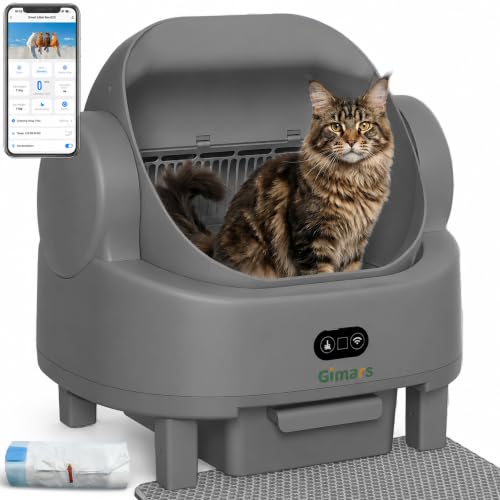
Gimars Open Top Self Cleaning Litter Box with App Control, Gray
ASIN B0FR95LDC3 • $269.79 • Sold by G-Official Store on Amazon AU
The Gimars open-top litter box is #8 in Amazon AU's Cat Litter Boxes category at time of writing, the best rank of any pick here, and it ranks #868 across the whole Amazon AU site. It's $270, sold by the G-Official Store storefront on Amazon AU. The model code CH-ICB023 matches across the listing. This listing is the grey one, and the other colours share the same rank. It's a fully open drum with a wide 37cm entry, so a cat can step in and out without feeling closed in. The listing states a one-year warranty, and it comes with trash bags and a litter mat.
It has the most sensors of the five, 12 in total according to the listing, covering infrared inside the drum and at the waste bin, a radar sensor at the entry and weight sensing. The idea is that it pauses as soon as a cat approaches, not just once it's inside. The sealed waste bin holds 8 litres, which the listing says lasts up to 12 days, and it supports cats from 1.5 to 10kg. It measures 56.8 x 54.4 x 50cm and the listing quotes cleaning at 32dB or less. The app runs on 2.4GHz Wi-Fi and lets you choose automatic cleaning after each visit or manual cleaning on demand.
Twelve days is a best case for one cat, so plan to empty it more often with two. Use clumping, low-dust litter so the sensors stay clear. Wipe the sensor windows weekly with a dry or barely damp cloth. Keep water away from the base when you clean. Put the 2.4GHz band on its own network name if setup fails. Keep the power cable behind the box where cats can't chew it. Leave it beside the old tray for a few days so your cat gets used to it first. For most homes with one or two cats, it's the one I'd buy.
Honest caveats: Honest caveats: the warranty is one year, half what the two Amazon AU-sold picks state. The 8 litre bin is the smallest of the drum picks. The listing doesn't state power consumption or the power adapter's rating. At about 57cm wide it needs a decent corner. Wi-Fi is 2.4GHz only.
Best for: Most one or two cat homes that want an open-top drum with plenty of sensors.
Type: Open-top rotating drum • Entry: 37cm wide • Sensors: 12 (infrared, radar, weight) • Waste bin: 8L, up to 12 days (listing) • Cat weight: 1.5 to 10kg • Size: 56.8 x 54.4 x 50cm • App: 2.4GHz Wi-Fi • Warranty: 1 year (listing) • Rank: #8 in Cat Litter Boxes (Amazon AU)
View on Amazon AU
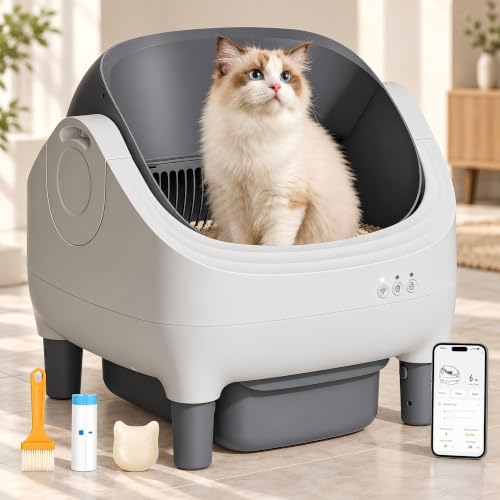
Furryfable Automatic Cat Litter Box, Open Top, App Control, Grey
ASIN B0H8YK5GSP • $252.99 • Sold by HSK-AU on Amazon AU
The Furryfable open-top box is #14 in Amazon AU's Cat Litter Boxes category at time of writing, the second-best rank here, and it ranks #1,487 across the whole Amazon AU site. This light grey listing is $253, sold by HSK-AU, an Australian storefront, and the white version is listed separately at $263 with the same rank. The model code ends in AU, which suggests local stock. It's an open-top drum with a 32cm entrance height and a usable tray area of 25 x 37cm, which the listing gives so you can check it against your cat. It comes with 20 waste bags.
Its safety system relies on weight sensors in all four feet plus a sensor inside the unit, so it pauses when a cat steps in. The app logs visits and records each cat's weight, and you can start a clean from your phone. The listing quotes cleaning at under 32dB, and the listed weight is about 11kg. The manufacturer warranty is one year. What I like is that the listing gives real tray and entry measurements rather than just calling itself spacious, which most don't, and that's what you need to judge whether a big cat will fit comfortably.
The listing doesn't state a waste bin size or a cat weight range, so check those on the current listing before you order. Use clumping litter and fill only to the marked line. Empty the bin before it's packed full. Keep cleaning water out of the base. If you've got a large cat, measure it against the 25 x 37cm tray first. Route the power cable behind the box. For a well-specified open-top box at a slightly lower price than the Gimars, it's the one I'd buy.
Honest caveats: Honest caveats: the listing doesn't state the waste bin capacity or the range of cat weights it supports. The warranty is one year. Its tray area is smaller than the bigger drum boxes, so check it against a large cat. The listing's odour figure is a marketing claim I can't test. Wi-Fi band isn't stated.
Best for: One-cat homes that want stated tray and entry measurements and four-foot weight sensing.
Type: Open-top rotating drum • Entry height: 32cm • Tray area: 25 x 37cm • Sensors: Weight sensors in four feet, internal sensor • Noise: Under 32dB (listing) • Weight: About 11kg • Included: 20 waste bags • Warranty: 1 year manufacturer • Rank: #14 in Cat Litter Boxes (Amazon AU)
View on Amazon AU
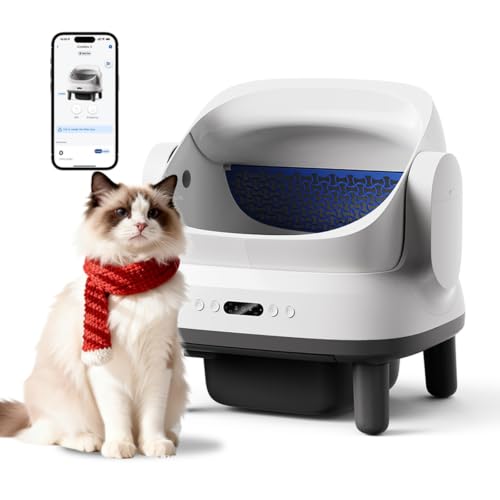
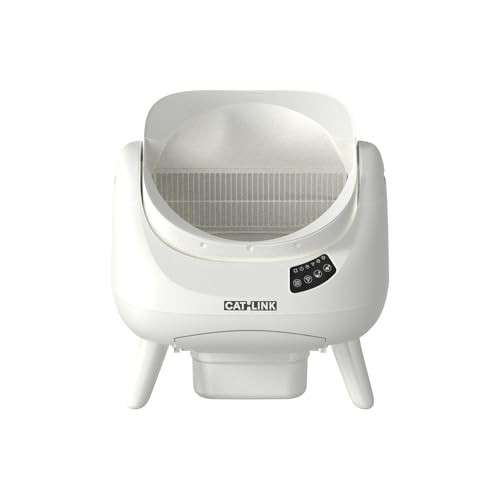
Catlink Scooper Open-X Self-Cleaning Smart Cat Litter Box, White
ASIN B0BNTMHC3Z • $429.99 • Ships from Amazon AU
The Catlink Scooper Open-X is #43 in Amazon AU's Cat Litter Boxes category at time of writing, and it ranks #3,633 across the whole Amazon AU site. It's $430 and sold by Amazon AU itself, which matters for returns and warranty claims. The part number CL-CH-01C08-W matches the white colour in the title. The listing states a two-year limited warranty, double the Gimars and Furryfable. It's a semi-open design rather than fully open, which the listing pitches at large breeds and cats that don't like enclosed boxes. It measures about 58.5 x 53.4 x 59.2cm, so it's one of the taller picks.
Its standout feature is a 13 litre waste drawer, the biggest stated capacity here, which the listing says gives up to 14 days for one cat. It uses a high-precision infrared sensor and gravity sensors to detect a cat. The app tracks visit frequency, duration and weight, and the listing says it can tell different cats apart by weight, which is handy in a multi-cat home where you want to know who's using the box. A drawer rather than a bin you lift out also tends to be easier to empty without spilling. Being sold by Amazon AU, it's also the simplest pick here to return if your cats refuse to use it, which is a real risk with any automatic box.
The listing doesn't state a cat weight range or Wi-Fi band, so check those before you order. Telling cats apart by weight only works when they're clearly different sizes. Empty the drawer every few days with several cats, whatever the capacity says. Wipe the infrared window weekly. Keep water away from the base. Give it a few days next to the old box before you take the old one away, so the cats get used to it. For a two or three cat household that wants the biggest drawer and Amazon AU as the seller, it's the one I'd buy.
Honest caveats: Honest caveats: it has the shortest feature list of the five, so cat weight limits, noise and Wi-Fi band aren't stated. Cat recognition by weight won't separate two similar-sized cats. It's semi-open, not fully open. At about 59cm tall it needs more clearance than the others.
Best for: Multi-cat homes that want the biggest waste drawer and Amazon AU as the seller.
Type: Semi-open rotating drum • Waste drawer: 13L, up to 14 days for one cat (listing) • Sensors: Infrared plus gravity sensors • App: Visit logging, weight, multi-cat recognition • Size: About 58.5 x 53.4 x 59.2cm • Seller: Amazon AU • Warranty: 2 year limited (listing) • Rank: #43 in Cat Litter Boxes (Amazon AU)
View on Amazon AU
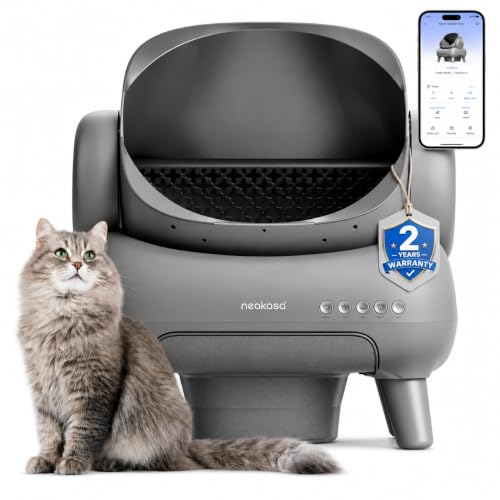
Neakasa M1 Plus Open-Top Automatic Cat Litter Box with Mat and 30 Bags
ASIN B0CSKBWBF6 • $599.00 • Sold by Neakasa Official AU on Amazon AU
The Neakasa M1 Plus is the most expensive pick at $599, sold by Neakasa's own Australian storefront, and it's #63 in Amazon AU's Cat Litter Boxes category at time of writing. It ranks #1,240 across the whole Amazon AU site, the second-best overall figure here. The model code PS0120 is the M1 Plus. The listing states a two-year manufacturer warranty, and the title adds a two-year protection plan on top, so check exactly what that covers on the current listing. It's an open-top design, and it comes with a mat and 30 refill bags. The listed weight is about 10kg.
It supports the widest range of cats here, from 1.5 to 15kg according to the listing, and up to three cats. The safety design is the most thorough of the five: a gear structure that physically limits how far the litter bed rotates, a six-array rotary infrared system that watches the cat's movement and position, and a kitten mode in the app for kittens under 1.5kg. The waste bin holds 11.2 litres and the litter bed 7.2 litres, which the listing says gives 7 to 14 days. A brush strip and sealing ring sit between the litter bed and bin to keep odours and liquid in.
The extra protection plan is part of what you're paying for, so read its terms before you compare prices. Turn on kitten mode for any cat under 1.5kg. Fill litter only to the marked line. Empty the bin before the indicator says it's full. Keep the base dry when you clean. Wipe the infrared sensors weekly so dust doesn't block them. Check the brush strip and sealing ring when you do a full clean, because a worn seal is what lets liquid reach the bin. For a big cat, several cats or anyone who wants the most mechanical safety, it's the one I'd buy.
Honest caveats: Honest caveats: it costs more than double the Gimars. The two-year protection plan in the title isn't explained in the feature list, so read its terms. The listing doesn't state noise or the Wi-Fi band. Seven to 14 days is a range for light use, so expect less with three cats.
Best for: Large cats and multi-cat homes that want the most mechanical safety and a two-year warranty.
Type: Open-top rotating litter bed • Cat weight: 1.5 to 15kg, up to 3 cats • Waste bin: 11.2L • Litter capacity: 7.2L • Safety: Rotation limit gear, 6-array infrared, kitten mode • Included: Mat, 30 refill bags • Warranty: 2 year manufacturer (listing) • Seller: Neakasa Official AU • Rank: #63 in Cat Litter Boxes (Amazon AU)
View on Amazon AU
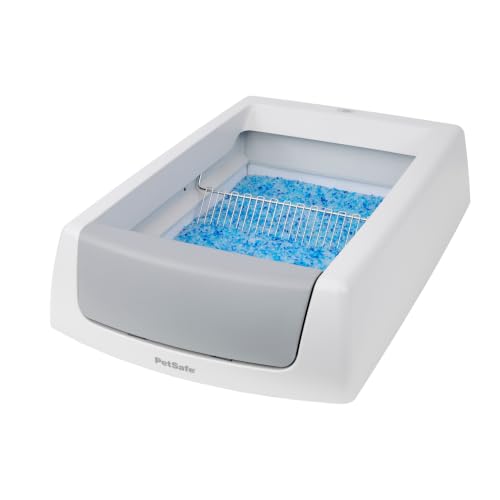
PetSafe ScoopFree Crystal Classic Self-Cleaning Litter Box System
ASIN B0F9KWHF7P • $160.65 • Ships from Amazon AU
The PetSafe ScoopFree Crystal Classic is the least expensive pick at $161, sold by Amazon AU, and it's #75 in Amazon AU's Cat Litter Boxes category at time of writing. It ranks #5,327 across the whole Amazon AU site. The part number PAL10-18122 matches the listing. It works differently from the other four: rather than a rotating drum and clumping litter, it uses a disposable tray of crystal litter, and one tray comes in the box. The listing states a two-year warranty, and Amazon AU stocks its replacement trays itself. It's the only pick without a Wi-Fi app, which also means there's no app or network setup to sort out. It comes in white.
The listing says the crystal litter absorbs urine and dries out solid waste, and that a tray lasts up to 30 days, after which you lift the whole tray out and bin it with its lid. The tray has a plastic lining to help stop leaks, and the listing says the crystals are 99 percent dust-free and low-tracking. Because there's no drum, there's much less to jam and fewer moving parts to wear. It's also the lowest and flattest box here, at about 70 x 49cm and 16cm tall according to the listed dimensions, so it fits under shelves and in tight laundries where a drum won't.
The catch is the trays. At time of writing a single PetSafe tray was about $39 on Amazon AU and the 3-pack and 6-pack work out at around $31 each, so a year for one cat is roughly $370 or more. Check the current tray price before you buy. Use only PetSafe trays in it. Put it on a flat, hard floor so the tray sits level. Swap the tray sooner with a second cat. For one cat in a tight space, where low maintenance matters more than running cost, it's the one I'd buy.
Honest caveats: Honest caveats: you're locked into PetSafe's disposable trays, and a year of trays for one cat costs more than double the box. Thirty days per tray is a best case for one cat. The listing doesn't say how the waste is moved or how the unit is powered. There's no app or Wi-Fi.
Best for: One cat in a tight space, for owners who'd rather pay for trays than clean a drum.
Type: Disposable crystal tray system • Litter: PetSafe crystal trays only (1 included) • Tray life: Up to 30 days (listing) • Tray cost: About $31 to $39 per tray on Amazon AU • Size: About 70 x 49 x 16cm (listing) • App: None • Seller: Amazon AU • Warranty: 2 years (listing) • Rank: #75 in Cat Litter Boxes (Amazon AU)
View on Amazon AUSide-by-side comparison
What we see fail in the workshop: automatic litter boxes
Automatic litter boxes are small motorised appliances in a dusty, damp corner, and they fail in predictable ways. These are the three faults I'd watch for. Most are caused by litter, liquid or the power cable rather than by bad design, and most can be prevented with the right litter and a careful cleaning routine. Some are worth repairing once the cause is fixed.
Stripped gears and strained motors
When a drum jams on oversized clumps or a packed bin and the box keeps trying to turn, the strain goes straight into the plastic gears and the small motor. The signs are grinding, clicking, a drum that stops partway or an error that keeps coming back. Unplug it and clear the jam before trying again, and never force the drum round by hand. A stripped gear can sometimes be replaced if parts are available, but a motor that's been driven against a jam for days often burns out too.
Liquid in the base and corroded boards
The base holds the control board, sensors and wiring, and it isn't sealed against water or urine. Hosing the box, overfilling the drum, or a leak from the liner lets liquid run into the base, and corrosion can take weeks to show up as random errors, dead buttons or a box that won't power on. If liquid gets in, unplug it and dry it fully before using it again. Board corrosion caught early can sometimes be cleaned, but once tracks and connectors corrode it gets harder.
Chewed cables and failed power adapters
Most of these run from a separate power adapter with a long low-voltage cable, and cats, dogs and vacuum cleaners all find it. A cable that's been chewed, crushed under the box or kinked at the plug end is a common reason for a box that cuts out or won't start. Route the cable behind the box and out of reach, and replace a damaged adapter with the right voltage and polarity rather than a generic one with the same plug that might damage the board.
Decision tree: which one should you actually buy?
- You want the best-ranked open-top box for one or two cats? → The Gimars open-top at $270 has 12 sensors, a 37cm entry and the best category rank here.
- You want stated tray measurements to check against your cat? → The Furryfable at $253 lists a 25 x 37cm tray and a 32cm entrance.
- You've got several cats and want the biggest bin? → The Catlink Scooper Open-X at $430 has a 13 litre drawer, is sold by Amazon AU and has a two-year warranty.
- You've got a big cat or want the most mechanical safety? → The Neakasa M1 Plus at $599 supports cats up to 15kg and limits how far the drum can rotate.
- You've got one cat and a tight space? → The PetSafe ScoopFree Crystal Classic at $161 is the lowest box here, but budget about $31 to $39 per tray.
- Your box won't turn, keeps throwing errors or has had liquid in the base? → Unplug it and bring it into our Erina workshop. We'll check the gears, board and adapter and tell you if it's worth fixing.
Frequently asked questions
Are automatic litter boxes safe for cats?
The ones here all use sensors to pause or stop cleaning when a cat is near or inside, and the Neakasa also limits how far its drum can rotate. Check the minimum cat weight on the listing, because a very light kitten may not register on weight sensors, and use kitten mode or manual cleaning for any cat under that weight. Watch the first few cycles with your cat around, and keep the sensor windows clean so they keep working properly.
What litter should I use in an automatic litter box?
Drum-style boxes need clumping litter, ideally low-dust, because the screen separates waste by catching clumps and dust can cover the sensors. Clay and tofu clumping litters generally work, but check the manual for grain size. Fill only to the marked line. The PetSafe ScoopFree is different and only works with PetSafe's own disposable crystal trays, so you can't use ordinary litter in it at all. Budget for the trays before you buy one.
How often do you empty a self-cleaning litter box?
Listings quote 7 to 14 days for the drum boxes here, but those are best cases, usually for one cat. With two or three cats, expect to empty it far more often. I'd empty it every few days regardless, because a full bin is one of the common causes of jams and a bin left for two weeks in summer smells when opened. Use the app's bin-full alert as a reminder, not the schedule.
Why won't my automatic litter box connect to Wi-Fi?
Most of these boxes only connect on 2.4GHz Wi-Fi, and at least two of the listings here say so. If your router uses one network name for both its 2.4GHz and 5GHz bands, setup can fail or the box can drop off later. Give the 2.4GHz band its own name and connect the box to that. Also check the box is within good range of the router, because a laundry at the far end of the house can have weak signal.
Why does my automatic litter box keep jamming?
The usual causes are oversized or wet clumps, a bin that's too full for waste to drop into, too much litter in the drum, or litter packed into the gap between drum and base. Unplug it, empty the bin, clear any packed litter and big clumps, and refill only to the line. If it keeps jamming or makes grinding or clicking noises, the gears may be worn, so stop running it and get it checked.
Can I wash an automatic litter box?
You can usually wash the removable drum, screen and liner, but never hose down or soak the base. The base holds the motor, sensors and control board, and water or urine getting into it causes corrosion that can show up weeks later. Wipe the base and sensor windows with a barely damp cloth, avoid spraying cleaners near it, and let washed parts dry completely before refitting them. If liquid gets into the base, unplug it and get it checked.
Related buying guides
Litter box stuck, throwing errors or dead?
Most automatic litter box faults we see are stripped gears and strained motors from jams, liquid corrosion in the base, and chewed cables or failed power adapters. Bring it into our Erina workshop and we'll check it over and tell you what it'll cost and whether it's worth fixing before you spend anything.
Visit our Erina workshop Book Online