Prices from Amazon AU, updated daily. Swipe or use the arrows for more.
Disclosure: This article contains affiliate links to amazon.com.au. If you buy through one of these links iFix may earn a small commission at no extra cost to you. It doesn't change which products we recommend. We focus on what actually lasts based on 16 years of repair-shop experience.
Quick summary7 picks
- Entry PickAxiom Defender Bass Guitar - Sunburst about$229
- Squier by Fender Debut Collection Precision… about$236.71
- Fender Squier by Fender Electric Mini… about$339
- Fender Squier Sonic Precision Bass Guitar about$384.30
- Squier by Fender Squier Sonic Bronco Bass about$39930" screen.
- Squier by Fender Affinity Series Precision… about$412.20
- Most PremiumFender Squier Affinity Series Jazz Bass about$475
Why a repair shop is writing about bass guitars
An electric bass is a wooden instrument with a small, simple circuit inside it, and that circuit is what comes into the workshop. Pickups, volume and tone pots, a little bit of wiring and an output jack are the whole of it on a passive bass, and they fail in predictable ways: a crackle when you turn a knob, a signal that cuts out when you move the lead, or a hum that goes away when you touch the strings. Most of those are small parts that cost less to fix than people expect.
So this guide picks basses on the usual things, like scale length, pickups, the neck and the price, and also on the parts that tend to give trouble first. All five picks are passive four-string basses, which means the pickups need no battery and the circuit is easy to work on. I've left out active basses with a 9V battery and preamp, five-string basses and acoustic basses, which suit players who already know what they want.
The five picks run from $229 to $475 at time of writing. Four are Squier by Fender, sold by Amazon AU itself: the Debut Precision Bass, the Mini Precision Bass, the Affinity Precision Bass PJ and the Affinity Jazz Bass. The fifth is the Axiom Defender, sold by Seltaeb Music, whose listing says it ships from an Australian seller with a 2 year warranty. I've also left out the all-in-one kits that bundle a no-name bass with an amp, because none of their listings state an Australian plug or an RCM mark for the amp.
Scale length and who it suits
Scale length is the distance from the nut at the top of the neck to the bridge, and it's the biggest physical difference between basses. A standard long-scale bass is about 34 inches, which is what most Precision and Jazz basses use. A short-scale bass is around 30 inches, with the frets closer together and less of a stretch for the left hand. That makes a real difference for kids, smaller adults and guitarists who are used to a shorter neck.
The Squier Mini Precision Bass is the short-scale pick here, and its listing calls it short scale without giving a figure, so check Fender's spec page before buying for a young child. The Axiom Defender lists a medium scale and a compact body, which usually means somewhere between the two, again without a number. The three full-size Squier listings describe a slim C-shaped neck but don't print a scale length either, so treat them as standard Fender long-scale basses and confirm on the maker's page.
Strings come in scale lengths too, and it's a common mistake to buy a set that doesn't fit. Long-scale strings on a short-scale bass leave the thick part of the string sitting over the nut, and short-scale strings on a long-scale bass don't reach the tuners. When you restring any of these, measure from the nut to the bridge saddle and buy strings marked for that length.
P, J and PJ: what the pickups actually do
A pickup is a magnet wrapped in a long coil of very fine copper wire. The steel string vibrates in the magnetic field and induces a small voltage in the coil, which the lead carries to the amp. That's the whole electrical idea, and it's why the pickup layout shapes the sound so much. Of the five picks, two use a Precision layout, one a Jazz layout and one a PJ layout, and the Axiom listing doesn't name its pickups at all.
A Precision Bass, or P-Bass, uses one split-coil pickup in the middle of the body, with a single volume and a single tone knob. It's a thick, punchy sound that sits under a band, and with only two knobs there's little to get wrong. The Squier Debut and Mini Precision Basses both list this split-coil layout. A split coil is two half-pickups wired to cancel each other's hum, which is why a P-Bass is quieter around noisy power supplies than a single-coil bass.
A Jazz Bass uses two single-coil pickups, one near the neck and one near the bridge, each with its own volume knob, plus a tone control. That gives more variety, from a round neck sound to a sharper bridge sound, and it's the Squier Affinity Jazz Bass pick. The Squier Affinity Precision Bass PJ mixes the two: a split-coil P pickup at the neck and a single-coil J pickup at the bridge, which is the most flexible layout of the five picks for a player who doesn't know their style yet.
The catch with single coils is hum. A single-coil pickup is a good antenna for 50Hz mains noise, so it buzzes near dimmer switches, LED drivers, phone chargers and computer power supplies, and the hum gets louder as you solo the bridge pickup. With both Jazz pickups up full, they cancel most of it out. If a J-style bass hums at home, try turning to face a different direction or moving away from the computer before assuming something's broken.
Knobs, jacks and the faults we see
The output jack is the part that fails first on almost every electric bass. Every time a lead is plugged in, pulled out or tripped over, it flexes the jack's spring contact and works its nut loose, and once the nut is loose the whole jack spins when you plug in, which twists and eventually breaks the wires behind it. If your bass cuts out when you wiggle the lead, check whether the jack spins before blaming the lead or the amp.
Volume and tone controls are small potentiometers, a carbon track with a wiper running across it. Dust and wear on the track cause the scratchy crackle you hear when you turn a knob, which is the second most common complaint. A squirt of contact cleaner made for electronics, worked in by turning the knob end to end a dozen times, usually clears it. If it doesn't, the pot is worn and gets replaced, which is a straightforward soldering job.
Hum that stops when you touch the strings or the bridge is normal on a passive bass. The strings are earthed through the bridge, and your hand becomes part of the shielding. Hum that doesn't stop when you touch the strings, or a buzz that comes and goes as you move, usually points to a broken earth wire or a dry solder joint inside the control cavity. That's a quick fix with the back plate off, and it's worth having it looked at before buying a new bass.
Tuners, necks and keeping it playable
Tuning machines on a bass carry a lot of tension, and loose or gritty tuners make a beginner bass hard to keep in tune. The Debut, Affinity Precision PJ and Affinity Jazz listings describe vintage-style open-gear tuners, which leave the gear exposed so you can see and lubricate it. The Mini Precision lists sealed die-cast tuners, which keep the dust out and usually need less attention. Either way, a tuner that turns without changing the pitch has a stripped gear and should be replaced, not tightened.
The neck moves with the seasons. Wood takes up moisture in humid summers and gives it back in dry winters, and the steel truss rod inside the neck is how you adjust for that. A bass that suddenly buzzes on the frets in winter, or plays high and stiff in a wet summer, usually needs a small truss rod turn rather than a repair. On the Central Coast, a bass kept in a sunroom or beside a heater moves more than one kept in a bedroom away from windows.
Keep a bass out of the car on a hot day and away from heaters and air-conditioner vents. A guitar left in a hot boot can lift its finish and loosen glue joints, and rapid swings in temperature are worse than a steady warm room. If your house runs very humid in summer, a dehumidifier in the music room helps the neck and also slows the rust that bass strings pick up from sweaty hands.
Amps, headphones and practising at home
A bass needs an amp built for bass. Bass notes are much lower than guitar notes, and a small guitar practice amp pushed hard on bass can flap its speaker cone against its limits, which tears the cone or the voice coil over time. A small bass practice amp, or a modelling amp that lists a bass mode, is the safer way to start. None of the five listings mentions an amp, so allow for one alongside the bass.
Headphones are how most people practise bass at home without upsetting the neighbours. A headphone amp that plugs straight into the bass, or a practice amp or audio interface with a headphone socket, lets you play at any hour. Our USB microphone guide covers recording vocals, and a basic audio interface records a bass straight into a computer without a microphone at all.
If you're playing with a drummer at home, our electronic drum kit picks pair well with a bass through headphones, because both can run silent through a small mixer. For the amp's power, plug straight into the wall or a good powerboard, and keep amp power supplies off the floor where they get kicked and stepped on.
Leads, plugs and what to buy alongside
The instrument lead is the most failed part in any bass setup, and it's the first thing to check when the sound cuts out. A thin, no-name lead breaks inside the plug, where the cable bends every time it's tugged. The giveaway is a crackle or a cut-out when you move the plug, but not when you move the middle of the cable. A lead with a solid strain relief, about 3m long, and a spare in the gig bag is the setup I'd go with.
Don't wind the lead tightly around your elbow and hand like a garden hose, because that twists the inner core and breaks it within months. Coil it loosely in loops that follow its natural lay, and unplug by the plug body, never by the cable. Run the lead under the strap at the strap button, so when someone trips on it, the tug lands on the strap rather than ripping the jack out of the body.
The other things worth having on day one are a clip-on tuner, a strap with locking ends or strap locks, a stand and a set of spare strings in the right scale length. A wall hanger or a floor stand keeps the bass off the couch and out of the path of pets, which is where most knocked-over basses end up with a cracked headstock.
Buying new, warranty and what to check on arrival
Buy new and check it on the day it arrives. Tune it up, play every fret on every string and listen for dead spots or buzzing, turn every knob slowly through its range while playing to check for crackle, and wiggle the lead in the jack. Check the neck for a crack at the headstock, which is the one shipping fault that matters. A fault found in the first week is a return, and a fault found in the first two years is usually a warranty claim.
Warranty terms vary by listing. The Squier Debut Precision Bass listing states a 2 year limited warranty from Fender, and the Axiom Defender listing states a 2 year warranty from an Australian seller. The Mini Precision, Affinity Precision PJ and Affinity Jazz listings don't state a warranty term at all, so check with Fender Australia before relying on it. Keep the order email, and register the bass with the maker where that's offered.
If something electrical goes wrong outside the warranty, like a crackling pot, a jack that spins or a hum that won't go away, it's usually a small soldering job rather than a new instrument. The same goes for the gear around it: a phone with a damaged charge port after recording sessions, a tablet used for lessons, or an audio interface that won't connect can come into our Erina phone repair workshop to be checked.
The 5 picks, $229 to $475
Prices are Amazon AU at time of writing (2026-11-15) and move week to week. Ranks are Amazon AU category sales ranks in Bass Guitars & Gear unless noted, checked the same day, with the overall Amazon AU rank alongside. The Debut Precision Bass listing shares one rank across its colours, and the Affinity Precision Bass PJ returned no rank from Amazon AU's API.

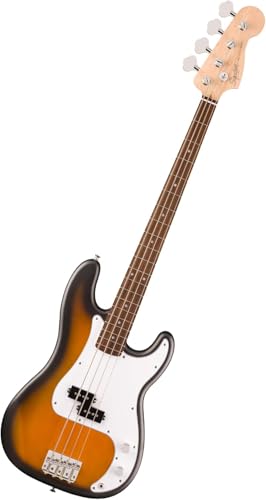
Squier by Fender Debut Collection Precision Bass, Laurel Fingerboard, 2-Colour Sunburst
ASIN B0CSLZXWNG • $236.71 • Ships from Amazon AU
The Squier Debut Precision Bass is the one I'd buy for most beginners, and it's the best-ranked bass guitar among the picks. The two-colour sunburst is listed at $236.71, sold by Amazon AU, and the Debut listing ranks #56 in Amazon AU's Bass Guitars & Gear category and #1,548 overall. That rank is shared across the Debut colours, which sell at $279 in Dakota Red and Daphne Blue, so the sunburst is the lowest-priced way into the same bass. Its part number is 0379700503. Buying from Amazon AU directly keeps a return simple in the first weeks, and a Fender-backed beginner bass is the easiest to find parts, strings and setup help for locally. The Debut is Squier's entry range, one step below the Affinity basses further down this list.
It's a full-size Precision Bass with one split-coil pickup, a volume and a tone knob, vintage-style open-gear tuners, a laurel fingerboard and a slim C-shaped neck. The listing describes chrome hardware and calls it a beginner bass for kids and adults, though a young child will find a full-size neck a stretch. The sunburst listing states a 2 year limited warranty from Fender against defects in materials and workmanship, the most detailed warranty statement of the five picks. A one-pickup, two-knob bass is the easiest instrument to learn on because there's nothing to fiddle with: volume up, tone where it sounds good, and play. The open-gear tuners can be oiled with a tiny drop of light machine oil once a year, and the slim neck suits most adult hands as well as teenagers'.
The listing doesn't state the scale length, body wood or weight, and the listing mentions no amp, lead or gig bag. Two knobs and one pickup keep the circuit about as simple as an electric bass gets, which is good for reliability. Tighten the output jack nut by hand when it starts to spin, and wipe the strings after every session so sweat doesn't rust them. Put it on a stand rather than leaning it against a wall, where a cat or a vacuum knocks it over. Register the warranty with Fender and keep the order email, because the 2 years runs from the purchase date.
Honest caveats: The listing doesn't state scale length, body wood or weight, and the rank is shared across the Debut colours. The listing mentions no amp, lead or gig bag. One P pickup gives a narrower range of sounds than the PJ or Jazz picks. Its warranty and rank details apply to the sunburst listing checked here.
Best for: Most beginners, teens and adults who want the best-ranked bass with a simple two-knob circuit and a 2 year Fender warranty.
Price: $236.71 (Amazon AU) • Pickups: 1 split-coil P • Controls: Volume, tone • Tuners: Vintage-style open-gear • Fingerboard: Laurel • Neck: Slim C shape • Warranty: 2 years limited (Fender) • Part number: 0379700503 • Rank: #56 in Bass Guitars & Gear, #1,548 overall on Amazon AU, listing shared across colours
View on Amazon AU
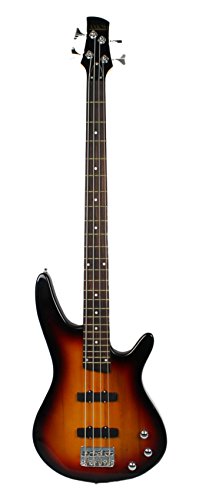
Axiom Defender Bass Guitar, Sunburst
ASIN B0795BCTJ9 • $229 • Sold by Seltaeb Music on Amazon AU
The Axiom Defender is the lowest-priced pick of the five and the one for a player who wants a compact bass from an Australian seller. It's listed at $229, sold by Seltaeb Music, and ranks #34 in Amazon AU's Electric Guitars category and #12,284 overall, which isn't directly comparable with the Bass Guitars & Gear ranks on the other cards. Its part number is AXDFSB. Seltaeb Music is a bare-name marketplace seller rather than Amazon AU, so check the delivery window and the returns details on the listing. Its 2 year warranty term matches the Debut's. If the delivery window shown on the listing runs past a week or two, that's a sign the stock isn't local after all, whatever the listing says.
The listing is very short. It describes the Defender as a beginner bass with a compact body and a medium scale, says it ships from an Australian seller, and states a 2 year warranty. That's the whole of the feature list. A medium scale usually sits between a 30 inch short scale and a 34 inch long scale, which suits a teenager or a smaller adult, but the listing gives no number, so ask the seller before buying for a child. A compact body and a medium scale make it a sensible first bass for a younger teenager who isn't ready for a full-size neck but has outgrown a child's instrument. With no pickup details on the listing, look closely at the photos to see whether it carries a P-style split coil or Jazz-style single coils, and ask the seller if it isn't clear.
The listing doesn't state the pickups, controls, tuners, woods or what's in the box, so this is a bass you buy on the seller's warranty rather than its spec sheet. On arrival, play every fret, turn every knob while playing, and wiggle the lead in the jack in the first week. Keep the order email, because the 2 year warranty runs through the seller rather than a maker. If anything electrical plays up inside the warranty, contact the seller first rather than opening the control cavity, which can void it.
Honest caveats: The listing is five short lines and doesn't state pickups, controls, tuners, woods or box contents. The seller is a marketplace shop rather than Amazon AU. Its rank sits in a different category from the other picks, so it can't be compared directly. There's no maker's spec page to check against, unlike the Squiers.
Best for: Teenagers and smaller adults who want a compact, medium-scale bass with a 2 year warranty from an Australian seller.
Price: $229 (Seltaeb Music) • Scale: Medium (length not stated) • Body: Compact • Pickups: Not stated on the listing • Warranty: 2 years (seller) • Seller: Marketplace, ships from Australia • Part number: AXDFSB • Rank: #34 in Electric Guitars, #12,284 overall on Amazon AU
View on Amazon AU
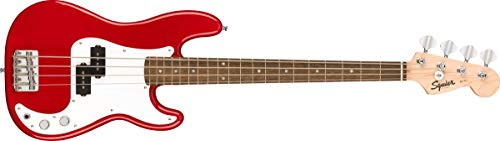
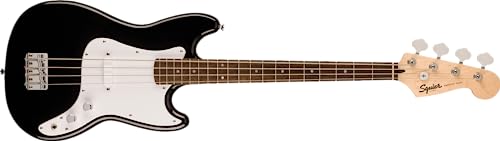
Squier by Fender Mini Precision Bass, Dakota Red
ASIN B088FYBDSL • $339 • Ships from Amazon AU
The Squier Mini Precision Bass is the short-scale pick of the five, and the one I'd buy for a child, a smaller adult or a guitarist adding bass. It's listed at $339, sold by Amazon AU, and ranks #1,108 in Bass Guitars & Gear and #25,273 overall, a long way behind the Debut. Its part number is 0370127554. It's a shorter, lighter take on the Precision Bass, with the frets closer together so the left hand doesn't have to stretch as far between notes. Amazon AU sells it directly, so a return in the first weeks is simple. Its weaker rank says it sells in smaller numbers than the full-size Debut, which makes sense for a bass aimed at a narrower group of players.
The listing describes a split single-coil pickup for a punchy P-Bass sound, a thin body to cut weight, a short-scale neck and sealed die-cast tuners. Sealed tuners keep the gears away from dust and sweat, which usually means less maintenance than the open-gear tuners on the other three Squiers. The listing doesn't print the scale length, so check Fender's spec page if the player is very young and the exact neck length matters. A thin body and a shorter neck also make it lighter on the shoulder, which matters for a child standing to play for half an hour at a time. The split single-coil pickup is the same P-Bass idea as the Debut's split coil, so it's quiet around chargers and computers.
It's priced above the full-size Debut for a smaller bass, and the listing doesn't state a warranty, the controls, the woods or the box contents. Short-scale strings are a different length from standard bass strings, so buy replacements marked short scale. Keep it on a stand away from the floor, because kids' basses get knocked over far more often than adults'. Measure the child against the bass in store photos if you're unsure, and remember a short scale only helps if the strings fit it. A clip-on tuner makes the first few months much easier for a young player.
Honest caveats: It costs more than the full-size Debut. The listing doesn't state scale length, a warranty, controls, woods or box contents. Short-scale strings are needed when restringing, and its rank is well behind the Debut's. A full-size Debut may suit a tall teenager better for less.
Best for: Kids, smaller adults and guitarists who want a shorter, lighter neck with a simple P-Bass circuit.
Price: $339 (Amazon AU) • Scale: Short (length not stated) • Pickups: 1 split single-coil P • Body: Thin, reduced weight • Tuners: Sealed die-cast • Warranty: Not stated on the listing • Part number: 0370127554 • Rank: #1,108 in Bass Guitars & Gear, #25,273 overall on Amazon AU
View on Amazon AU
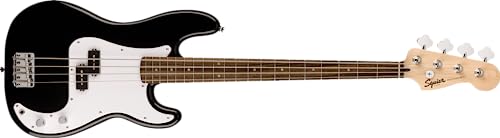
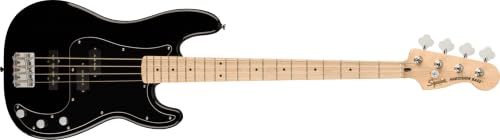
Squier by Fender Affinity Series Precision Bass PJ, Maple Fingerboard, Black
ASIN B091BJYLB3 • $412.20 • Ships from Amazon AU
The Squier Affinity Precision Bass PJ is the most flexible bass of the five, and the one I'd pick for a beginner who doesn't yet know what music they'll end up playing. It's listed at $412.20, sold by Amazon AU, and its part number is 0378553506. Amazon AU's API returned no rank of any kind for it when I checked on 2026-11-15, so I can't tell you how well it sells, only that Amazon AU itself stocks it. The Affinity line sits a step above the Debut in Squier's range. Buying from Amazon AU directly keeps a return in the first weeks simple. The black finish with a black pickguard hides fingerprints and small marks better than a sunburst, which helps on a bass that gets carried to lessons and rehearsals.
It mixes the two classic layouts: a split single-coil Precision pickup at the neck and a single-coil Jazz pickup at the bridge. The neck pickup gives the thick P-Bass sound, and blending in the bridge pickup adds bite for funk and rock. The listing describes a thin, lightweight body, a slim C-shaped neck, a maple fingerboard and vintage-style open-gear tuners. A maple fingerboard usually has a harder, brighter feel than the laurel on the Debut. On a PJ bass, the usual control layout is a volume for each pickup and a master tone, though the listing doesn't say, so check Fender's spec sheet. Rolling the bridge pickup down gives a straight P-Bass sound, so a beginner can start simple and add the J pickup later. The thin body keeps the weight down for standing practice.
The single-coil bridge pickup brings some hum when used on its own near dimmers, chargers and computer power supplies, which is normal rather than a fault. The listing doesn't state a warranty, scale length, the controls or the box contents. Wipe the maple fingerboard with a dry cloth after playing, because sweat and grime show up on a light fingerboard far more than a dark one. Keep the bass out of a hot car, because a thin body and a light finish on a black bass heat up quickly in the sun. Change strings every few months if you play daily.
Honest caveats: Amazon AU's API returned no rank for it, so its sales are unknown. The listing doesn't state a warranty, scale length, controls or box contents. The single-coil bridge pickup hums near mains noise when soloed. It costs well above the Debut, mostly for the second pickup.
Best for: Beginners who want one bass that covers both the P and J sounds while they work out their style.
Price: $412.20 (Amazon AU) • Pickups: Split single-coil P neck, single-coil J bridge • Body: Thin, lightweight • Neck: Slim C shape • Fingerboard: Maple • Tuners: Vintage-style open-gear • Part number: 0378553506 • Rank: Not returned by Amazon AU's API (checked 2026-11-15)
View on Amazon AU
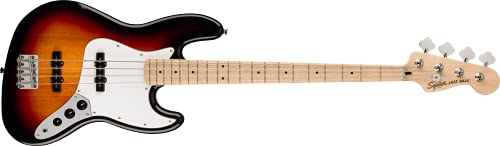
Squier by Fender Affinity Series Jazz Bass, Maple Fingerboard, 3-Colour Sunburst
ASIN B091BCR2G3 • $475 • Ships from Amazon AU
The Squier Affinity Jazz Bass is the highest-priced pick of the five and the one for a player who wants the classic two-pickup Jazz Bass sound. It's listed at $475, sold by Amazon AU, and ranks #333 in Bass Guitars & Gear and #8,338 overall, the second best-ranked of the three picks with a rank in that category. Its part number is 0378602500. It's a full-size four-string with a three-colour sunburst finish, a white pickguard and a maple fingerboard. Amazon AU sells it directly, so a return in the first weeks is simple. The Affinity line is Squier's step up from the Debut, and the Jazz Bass is the more traditional choice for funk, jazz and a lot of modern pop.
The listing describes two Squier single-coil Jazz Bass pickups voiced at Fender, a thin and lightweight body, a slim C-shaped neck profile and vintage-style open-gear tuners. Two pickups with their own volume controls give the widest range of sounds of the five picks, from a warm neck tone to a sharp, growly bridge tone. The Jazz neck is traditionally narrower at the nut than a Precision neck, which many players with smaller hands find easier. The maple fingerboard pairs with the brighter Jazz pickups for a sound that cuts through a band mix. A thin, light body makes it comfortable for long sessions, and a Jazz Bass's offset body shape sits well against the player's body when seated.
With both pickups up, a Jazz Bass cancels most of its hum, but soloing either single coil brings it back near dimmers, LED drivers and computer power supplies. The listing doesn't state a warranty, scale length, the exact controls or the box contents. Two pickups and the usual three knobs mean more solder joints in the cavity, so if a knob crackles, contact cleaner first, then a repair. Fit strap locks if you play standing, because a Jazz Bass that drops off a worn strap button lands on its headstock. Change strings when they go dull, and wipe them down after each session.
Honest caveats: It's the highest-priced pick of the five. The listing doesn't state a warranty, scale length, the exact controls or the box contents. Single-coil pickups hum near mains noise when either is soloed. A Jazz Bass usually carries three knobs, which is more to learn than the two-knob P basses.
Best for: Players who want the classic Jazz Bass sound and the widest range of tones from two pickups.
Price: $475 (Amazon AU) • Pickups: 2 single-coil J • Body: Thin, lightweight • Neck: Slim C shape • Fingerboard: Maple • Tuners: Vintage-style open-gear • Part number: 0378602500 • Rank: #333 in Bass Guitars & Gear, #8,338 overall on Amazon AU
View on Amazon AUSide-by-side comparison
What we see fail in the workshop: bass electronics
A passive bass has a tiny circuit, but it's a circuit that gets plugged in, unplugged, knocked and sweated on every day. The faults are predictable, they cost little to fix, and most are mistaken for a dead amp or a dead bass. These are the three I'd plan around.
Spinning output jacks and broken jack wires
The output jack's nut works loose from the strain of leads going in and out. Once it's loose, the jack turns every time you plug in, twisting the two wires behind it until one snaps off its lug. The symptom is a signal that cuts out or crackles when the lead moves. Tighten the nut with a spanner while holding the jack from inside the cavity so it doesn't turn, and if the sound still cuts out, the wires need resoldering.
Crackling volume and tone pots
Dust and wear on the carbon track inside a pot cause the scratchy noise when you turn a knob, usually on a bass that's sat unplayed in a cupboard for months. Electronics contact cleaner, sprayed into the pot through its opening and worked in by turning the knob end to end, clears most of them. A pot that still crackles, or that has a dead spot in its range, is worn and needs replacing, which is a short soldering job.
Hum, earth faults and dry joints
Hum that stops when you touch the strings is normal. Hum that doesn't, or a buzz that comes and goes as the bass moves, usually means a broken earth wire to the bridge or a dry solder joint on a pot. Both are found with the control plate off and a multimeter. Don't confuse it with single-coil hum near dimmers and chargers: move the bass away from them first, and if the buzz stays, it's the wiring.
Decision tree: which one should you actually buy?
- Most beginners, want the safe choice? → The Squier Debut Precision Bass at $236.71 in sunburst is the best-ranked bass of the five, with a simple two-knob circuit and a 2 year Fender warranty.
- Lowest price from an Australian seller? → The Axiom Defender at $229 has a compact body, a medium scale and a 2 year seller warranty, but a very thin listing.
- A child or smaller hands? → The Squier Mini Precision Bass at $339 has a short-scale neck, a thin body and sealed tuners.
- Don't know your style yet? → The Squier Affinity Precision Bass PJ at $412.20 combines a P neck pickup and a J bridge pickup.
- Want the classic Jazz Bass sound? → The Squier Affinity Jazz Bass at $475 has two single-coil pickups and the widest tone range of the five.
- Bass crackles or cuts out, or a phone or tablet used for lessons is playing up? → Check the jack and the lead first. For a phone, tablet or audio gear fault, bring it into our Erina workshop and we'll check it before you spend anything.
Frequently asked questions
Should a beginner buy a Precision or a Jazz bass?
Either works, and it mostly comes down to sound and feel. A Precision Bass has one split-coil pickup and two knobs, with a thick, punchy sound and a slightly chunkier neck. A Jazz Bass has two single-coil pickups and three knobs, with a wider range of sounds and a neck that's usually narrower at the nut. A PJ bass, like the Squier Affinity Precision Bass PJ, gives you both sounds in one, which suits a player who hasn't settled on a style.
Is a short-scale bass better for beginners?
It's better for some. A short-scale bass, around 30 inches compared with the usual 34, puts the frets closer together, so it's easier for kids, smaller adults and guitarists. Adults with average or larger hands usually manage a full-size bass fine and have a wider choice of strings and models. The Squier Mini Precision Bass is the short-scale pick here. Remember that short-scale basses need short-scale strings when you restring.
Can I play a bass through a guitar amp?
At low volume, yes, but it's not a good long-term plan. Bass notes push a speaker cone much further than guitar notes, and a small guitar amp turned up on bass can flap its speaker against its limits, which damages the cone or the voice coil over time. A small bass practice amp, a modelling amp with a bass mode or a headphone amp is a safer way to practise. None of the listings for the picks here mentions an amp.
Why does my bass crackle when I turn the knobs?
Dust or wear on the carbon track inside the volume or tone potentiometer. It's common on a bass that's been sitting unplayed. Spray electronics contact cleaner into the pot and turn the knob end to end a dozen times, which clears most cases. If it still crackles or has a dead spot, the pot is worn and needs replacing, which is a quick soldering job for a technician or a guitar tech.
Why does my bass hum, and why does it stop when I touch the strings?
The strings are earthed through the bridge, and when you touch them your body becomes part of the instrument's shielding, so hum that stops when you touch the strings is normal. Single-coil pickups also pick up mains hum from dimmers, LED drivers, chargers and computer power supplies. Hum that doesn't stop when you touch the strings, or a buzz that comes and goes as you move, usually means a broken earth wire or a dry solder joint inside.
What should I check when a new bass arrives?
Tune it, then play every fret on every string listening for buzzing or dead notes. Turn each knob slowly while playing to check for crackle, and wiggle the lead in the jack to check it doesn't cut out. Look closely at the headstock and where it meets the neck for any crack from shipping. Faults found in the first week are a simple return, so check it the day it arrives rather than after a month in the cupboard.
Related buying guides
Bass crackling, cutting out or humming?
Spinning output jacks, crackling pots and broken earth wires are small soldering jobs, and they're often mistaken for a dead amp or a dead bass. Bring it into our Erina workshop along with the lead you use, and we'll check it and tell you what it needs before you spend anything.
Visit our Erina workshop Book Online