Prices from Amazon AU, updated daily. Swipe or use the arrows for more.
Disclosure: This article contains affiliate links to amazon.com.au. If you buy through one of these links iFix may earn a small commission at no extra cost to you. It doesn't change which products we recommend. We focus on what actually lasts based on 16 years of repair-shop experience.
Quick summary8 picks
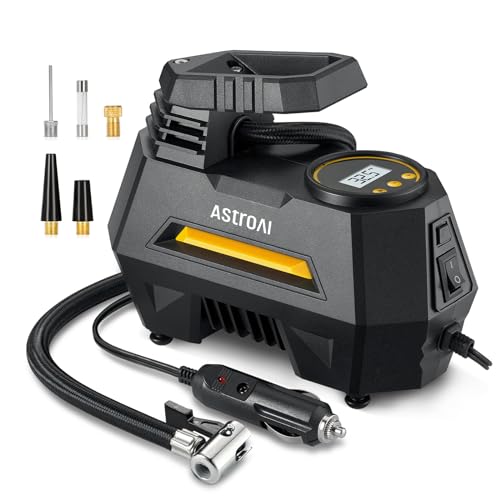
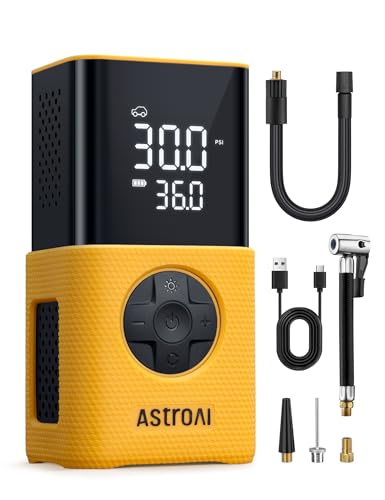
- Entry PickAstroAI 12V Car Tyre Inflator about$39.97
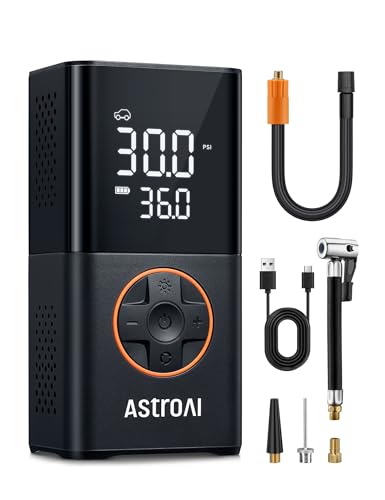
- AstroAI Cordless Tyre Inflator & Bike Pump about$39.994000mAh.
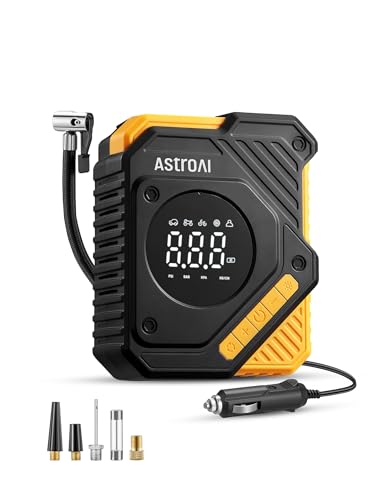
- AstroAI S1 Pro 12V Car Tyre Inflator about$39.98
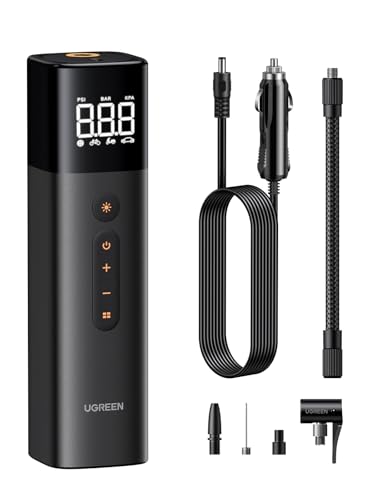
- UGREEN Tyre Inflator Portable Air… about$46.74
- AstroAI L7S Cordless Tyre Inflator & Bike Pump about$45.994000mAh.
- UGREEN Tyre Inflator Portable Air… about$67.992500mAh.
- Bosch Cordless Electric Air Pump about$123.32
- Most PremiumMICHELIN TATA Programmable High Power Rapid… about$142.77
The servo air hose is why these things exist
Think about the last time you used the air hose at a servo. The machine was around the back near the vacuum bay, the dial was scratched to the point of guesswork, and the gauge had been dropped on concrete a few hundred times since anyone last checked its calibration, if anyone ever did. Tyre pressure is the single most consequential thing you can maintain on a car for nothing: it affects braking distance, tyre wear, wet grip and fuel consumption. And most people outsource it to the worst-maintained instrument they touch all month, on whatever irregular schedule the fuel light happens to set for them.
A pocket inflator moves that job to your own garage on your own schedule, with the same gauge every time. The four picks here are sold by Amazon AU or the brand's AU storefront, from a $46 cordless unit that has become Amazon AU's #2 seller in the category to a $143 Michelin that runs off the car's 12V socket and reinflates from dead flat without asking a battery for permission. Between them they cover the weekly top-up, the bike shed, the footy pump-up before Saturday sport, and the day a tyre quietly goes down on the driveway overnight.
Gauge accuracy: the number the whole product hangs on
An inflator is a pump attached to a pressure gauge, and the gauge is the half that matters, because the pump only ever does what the gauge tells it. Overshoot by 6 PSI and the centre of the tread wears early while the ride goes brittle. Undershoot and the shoulders wear, the steering dulls, the car drinks more fuel and braking suffers in the wet. The servo dial cannot be audited by anyone. A digital unit at least states its claim in writing: Michelin quotes accuracy to plus or minus 1 PSI up to 50 PSI on the TATA 12266, which is the only hard accuracy figure on any listing in this group, and one of the reasons the oldest product on this page is still worth $143.
AstroAI comes at the same problem from the sampling side, quoting pressure sensors that read 200 times per second on the L7S. Bosch quotes real-time measurement with autostop. The honest position is that none of these are calibrated laboratory instruments, and each individual unit carries a small fixed offset of its own. What a digital gauge gives you that the servo dial never can is repeatability: the same number, measured the same way, by the same instrument, every Sunday morning. Check the tyre placard inside the driver's door, set the target, and let one consistent gauge hold you to it month after month. For tyre wear and fuel economy, consistency beats absolute truth.
Airflow and duty cycle: why small pumps hate big jobs
PSI ratings mislead people, and the category leans on that. Every unit here quotes 150 PSI, a car tyre needs about 36, so the max-pressure spec is settled and irrelevant before you start comparing. The spec that separates them is airflow. The AstroAI L7S quotes 17 litres per minute and a 30-to-36 PSI car tyre top-up in 90 seconds. The UGREEN quotes 15 litres per minute and a small car tyre from 2.0 to 2.5 bar in two minutes. The Michelin, drawing on the car's battery instead of its own, quotes 0 to 30 PSI in about three minutes, and that is a from-flat figure, a number the cordless units' listings conspicuously do not print. Airflow is the honest speed spec, and only two listings here print it.
Duty cycle is the spec none of these listings state, and it is the one that actually kills small pumps. A piston compressor the size of a soft drink can makes heat fast, and reinflating a full-size tyre from dead flat, or doing all four corners of a ute back to back on a hot afternoon, is exactly the job that cooks the motor windings and the board sitting next to them. AstroAI at least prints the boundary in plain text: the L7S listing rules out heavy-duty tyres on 4WDs, trucks, RVs and trailers outright. Read that honesty across the whole category, because it applies to every unit here. Top-ups are the design brief. A dead-flat LandCruiser tyre on hot sand is not. Pause between tyres, let the case cool to comfortably touchable, and the pump lasts years instead of one ambitious afternoon.
Cordless convenience has a battery tax
Three of the four picks are cordless, and a cordless inflator is a power tool that lives like a glovebox gadget, which is the worst life you can hand a lithium battery. The L7S carries a 4000mAh pack good for a quoted eight tyre top-ups per charge. The UGREEN runs two 2500mAh cells and quotes about twelve small-car tyres. Those numbers are perfectly adequate. The problem is the eleven months of storage between emergencies, the same slow death I describe in the jump starter guide: lithium cells self-discharge month by month, sink below the protection board's cutoff, and the pump that lived undisturbed in the boot for a year is dead on exactly the day the tyre is.
The routine that prevents it costs a few minutes a season. Charge to around three-quarters rather than pinning the pack at full, top it up every three months on a calendar reminder, and keep the unit in the cabin rather than on the boot floor through summer, because parked-car heat past 60 degrees is what swells pouch cells held at high charge. Feed it from a decent wall charger too; the no-name brick problem I cover in the piece on counterfeit chargers applies to every USB-C device in the house, and a pump you charge four times a year will happily hide a marginal charger's sins until it matters. Treat the inflator like the phone it electrically resembles and it will be charged on the one day that counts.
The 12V socket unit: old format, no battery to die
The Michelin in this list has no battery at all, and that absence is its entire argument. It draws from the car's 12V socket through a three-metre cord, so the energy source is the 40-plus amp-hour battery under the bonnet rather than a phone-sized cell inside the pump. Nothing self-discharges in storage. Nothing swells in the summer boot. The unit that sat untouched in the spare-wheel well for three years works exactly as well as the day it was boxed, which is precisely the behaviour you want from emergency equipment, and why I still rate the corded format in 2026 despite everything the cordless units do better on convenience. Emergency gear should have as few failure modes as possible, and this one deletes the biggest.
The trade-offs are honest ones and worth stating plainly. You need the car present, the engine should be running while you pump to spare the car battery, and the cord plus the 60cm hose sets your working radius, so it will not wander to the kids' bikes in the shed the way a cordless unit will. It is also the heaviest thing here at 1.1 kilograms. But for the buyer whose only question is whether the tyre gets reinflated on a dark roadside years from now, removing the battery from the equation removes the most likely failure mode entirely. Pair it with a cordless unit in the garage and the two formats cover each other's blind spots for under $200 combined.
Auto-stop, presets and the units trap
Every pick here shuts itself off at a target pressure, and that feature has quietly become the whole point of the product. Set 36 PSI, clip the chuck onto the valve stem, press go, and walk around checking the other three tyres while it works. No creeping past the target while you fumble with a trigger, no bleed-back guesswork with a stick gauge in the other hand. The Michelin adds proper programmability so your placard pressure survives as a stored preset between uses; the AstroAI carries five modes covering car, motorcycle, bicycle, ball and a custom value anywhere from 3 to 150 PSI, which between them cover everything a household inflates. The feature costs nothing extra at these prices, and it removes the one step people used to get wrong.
Mind the units screen, though, because it is the one way this convenience bites. These gauges switch between PSI, bar, kPa, and on the AstroAI kg/cm2 as well, and a 2.5-bar target accidentally entered in the wrong unit is how tyres end up comically and dangerously wrong. Australian tyre placards usually quote kPa alongside PSI, the servo dial trained everyone in PSI, and European bike manuals think in bar. Pick PSI, leave the setting there permanently, and convert the placard once. While you are at the driver's door, that placard is the number to trust, not the maximum pressure moulded into the tyre sidewall, which is a structural limit, not a recommendation, and running it daily wears the tread centre for no benefit.
A five-minute monthly routine that pays for the tool
Here is the routine that makes any of these four worth owning. Once a month, cold tyres, before the school run warms them: check all four corners against the placard, top up whatever is low, and glance at the tread while you are crouched there anyway. Five minutes, same gauge every time, and the auto-stop does the thinking. Underinflation is the quiet one: a tyre 8 PSI down looks normal from the kerb, wears its shoulders, and adds measurable rolling resistance that shows up at the bowser over a year. A slow leak announces itself as the corner that needs air every fortnight while the other three hold steady, and catching that pattern early is the difference between a $40 puncture repair and a new tyre.
The same session keeps the pump itself alive. You are cycling the battery gently instead of letting it sink flat, you notice the hardened chuck seal before it strands you, and the whole kit stays where it belongs instead of migrating to a drawer in the house. Monthly use is exactly the duty these small pumps are designed for, top-ups rather than rescues, so the routine that protects the tyres is also the one that protects the tool doing the checking. That is the whole pitch: the tyres last longer, the car uses less fuel, and the pump quietly earns its price back.
How I picked these four
Same rules as every guide in this series. Sold new by Amazon AU or the brand's Australian storefront, priced inside the $40 to $200 band, holding a real sales rank in Amazon AU's inflator categories on the day I checked, and no grey imports or overseas marketplace sellers, because a warranty on a $50 pump is only worth something if the seller answers to Australian consumer law when it fails in month eleven. Specs come from the listings alone, and where a listing goes silent, on duty cycle for instance, I say so in the caveats instead of inventing a number to fill the cell.
The four cover the real use cases rather than four shades of the same product: the AstroAI L7S as the do-everything cordless default, the UGREEN for the most battery per dollar, the Bosch EasyPump for the pocket-size bike-and-ball job with a serious warranty behind it, and the Michelin 12V for the spare-wheel well where batteries go to die. If a pump stops charging or a gauge starts reading nonsense, electronics like this can come past our Erina workshop, though I will usually tell you a $46 pump with a dead board is a recycling candidate, and that honesty costs nothing. For the laptop that manages the family fleet's rego and service paperwork, the computer side of the bench has you covered as well.
The 4 picks, $46 to $143
Prices are Amazon AU at time of writing (23 August 2026) and move week to week. Ranks are Amazon AU category sales ranks, checked the same day.

AstroAI L7S Cordless Tyre Inflator & Bike Pump, 150 PSI
ASIN B0DKJK869T • $54.99 • Sold by AstroAI Direct AU on Amazon AU
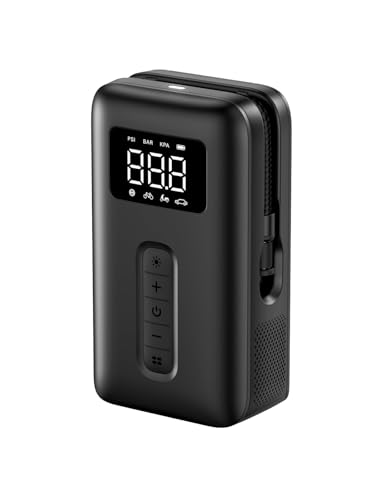
At $54.99 from AstroAI's AU storefront, the L7S is the default answer for most driveways, and Amazon AU shoppers have already voted: it sits #2 in the inflator category and holds #22 across the entire Automotive store. The claims are specific where this category is usually vague. Airflow of 17 litres per minute, a 195/65R15 tyre from 30 to 36 PSI in 90 seconds, and a pressure sensor sampling 200 times per second behind what AstroAI calls its TrueGauge dual display, with a claimed valid-data rate well above the category average. At 1.01 pounds, about 460 grams, it disappears into a door pocket, a pannier or a backpack without argument.
The 4000mAh battery is quoted at eight car-tyre top-ups per charge, which in practice is a season of monthly checks before it asks for the charger. Five preset modes cover car, motorcycle, bicycle, ball and a custom target anywhere from 3 to 150 PSI, with auto shut-off at the preset and four selectable pressure units including kg/cm2 for older motorcycle manuals. The extras lean genuinely useful rather than gimmick: a three-mode torch with SOS and strobe on top for the dark roadside, USB-C in and out so the pump moonlights as a small backup battery for a phone, and a silicone sleeve around the shell that exists because these things get dropped on concrete.
The honesty that sold me is in the exclusion list. AstroAI prints outright that the L7S is not for heavy-duty tyres on 4WDs, trucks, RVs or trailers, a boundary most small-pump listings leave you to discover the hard way on a hot afternoon with two corners still flat. Inside its stated lane, passenger car tyres, motorcycles, bikes and sports gear, it is the most complete unit here per dollar, and the one I would hand to most households first without much deliberation. It also makes the gift list: it is the tool people did not know they wanted.
Honest caveats: Not rated for heavy-duty 4WD, truck or trailer tyres, and the listing says so plainly. Duty cycle is not stated, so let it cool between corners on a full four-tyre session. Like every cordless unit, the battery needs a top-up every three months in storage or it will be flat when the tyre is.
Best for: The household default: car top-ups, bikes and sports gear from one unit in the door pocket.
Price: $54.99 at time of writing • Max pressure: 150 PSI • Airflow: 17 L/min • Inflation claim: 195/65R15, 30 to 36 PSI in 90 seconds • Battery: 4000mAh, about 8 tyre top-ups • Modes: Car, motorcycle, bicycle, ball, custom (3 to 150 PSI) • Extras: 3-mode torch, USB-C power bank function • Weight: 1.01 lb listed (about 460g) • Rank: #2 in Wheel & Tire Air Compressors & Inflators (Amazon AU)
View on Amazon AU
UGREEN Cordless Tyre Inflator, 150 PSI, Twin 2500mAh
ASIN B0BZJ9M8FY • $65.99 • Sold by UGREEN GROUP LIMITED AU on Amazon AU
UGREEN's inflator is the capacity play: two 2500mAh cells for 5000mAh total, the biggest battery in this group, quoted at about twelve small-car tyres per charge against the AstroAI's eight. At $65.99 from the brand's AU storefront and ranked #11 in the category, it is the unit for the two-car household, the caravan couple topping up six tyres before every trip, or anyone who would simply rather charge things half as often. Airflow is 15 litres per minute with the same 150 PSI ceiling as everything else here, and the listing quotes a small car tyre from 2.0 to 2.5 bar in two minutes and a bike tyre from empty to 45 PSI in three.
Auto shut-off at the set pressure works the same way as the AstroAI's, with the target and live pressure on a digital display, and the air hose stows away inside the body so the whole thing stays one tidy brick in the door pocket rather than a unit plus a loose hose migrating around the boot. The LED is the genuinely thoughtful touch: besides a white work light for the dark verge, it carries a red warning mode to flag you to oncoming traffic while you crouch at the wheel arch, which is the sort of feature you buy hoping never to rate. Charge it fully before first use, as the listing instructs, to calibrate the gauge you will be trusting later.
UGREEN is a charging-electronics company by trade, the same outfit whose jump starter and GaN wall chargers appear elsewhere in this series, and the battery housekeeping shows that heritage. Nothing on the listing is exotic or improbable, every figure is one a test bench could verify, and the brand has enough Australian retail presence that a warranty conversation happens under Australian consumer law rather than through a chat window in another timezone. It is the AstroAI's job done with more battery and fewer modes, and for plenty of households that is exactly the right trade.
Honest caveats: Slightly slower airflow than the AstroAI at 15 L/min, and no stated accuracy figure for the gauge. Preset modes are simpler, with no dedicated ball or bike programs, and duty cycle goes unstated as it does across the category. Recharge time is not on the listing either.
Best for: Multi-car households and caravan owners who want the most battery per dollar.
Price: $65.99 at time of writing • Max pressure: 150 PSI / 10.3 bar • Airflow: 15 L/min • Inflation claim: Small car tyre, 2.0 to 2.5 bar in 2 minutes • Battery: 2 x 2500mAh, about 12 tyres per charge • Light: LED work light with red warning mode • Storage: Hose stows inside the body • Rank: #11 in Wheel & Tire Air Compressors & Inflators (Amazon AU)
View on Amazon AU
Bosch EasyPump Cordless Mini Compressor, 150 PSI
ASIN B08HQHW4LS • $129.00 • Ships from Amazon AU
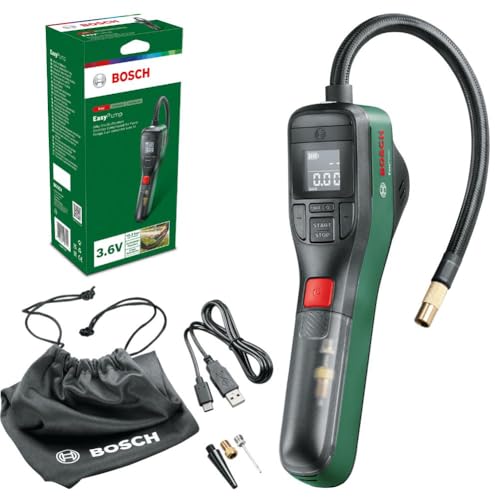
The EasyPump is Bosch's answer to the same brief, and it comes at the job from the small end: a 3.6V palm-size unit built for tyres, sports balls and smaller inflatables, sold by Amazon AU at $129 and ranked #2 in the Air Compressors category. The core loop matches the bigger units, up to 150 PSI with real-time pressure measurement and an autostop function that kills the motor at your target, wrapped in an ergonomic shape that actually fits a jersey pocket or a saddle bag. That last part is not a small thing. The inflator that comes along on the ride is worth more than the stronger one that stayed in the garage, and the EasyPump is the only unit here designed around that truth.
The accessory kit is where Bosch shows its intent. A French-valve adapter for road bikes, a ball needle, a volume adapter for inflatables and a USB-C charging cable all ship in the soft bag, so the one box covers the road bike, the footy and the air mattress without a separate trip to a bike shop for adapters. The display is generous for the size of the unit, and the operating logic is deliberately simple: set the number, press the trigger, wait for the stop. For the cyclist who occasionally tops up the car rather than the driver who occasionally pumps a bike, this is the right shape, and the build quality gap over the marketplace brands is obvious in the hand.
Then there is the warranty, where Bosch quietly embarrasses the category: two years standard, plus a third year free if you register the tool within 28 days at Bosch's site. Against the one-year cover typical of marketplace brands, three years on a $129 pump changes the cost-of-ownership arithmetic entirely, and it is backed by a company with an actual Australian service network for its power tools rather than a returns portal and a shrug. For a tool bought once and used for a decade, that support network is the quiet spec.
Honest caveats: This is a mini compressor, and the listing scopes it honestly to car, motorcycle and bike tyres, balls and smaller water toys. No airflow figure is stated, so expect a car tyre to take longer than the bigger cordless units, and treat a dead-flat full-size tyre as outside its comfort zone. A separate Bosch adapter is needed for some valve types.
Best for: Cyclists and small-inflatables households that want Bosch build and a three-year registered warranty.
Price: $129.00 at time of writing • Max pressure: 150 PSI • System: 3.6V rechargeable, USB-C charging • Autostop: Yes, at preset pressure • In the box: French-valve adapter, ball needle, volume adapter, soft bag • Warranty: 2 years, plus 1 on registration within 28 days • Rank: #2 in Air Compressors (Amazon AU)
View on Amazon AU
Michelin TATA 12266 Programmable Rapid 12V Tyre Inflator
ASIN B00IERQC80 • $142.77 • Ships from Amazon AU
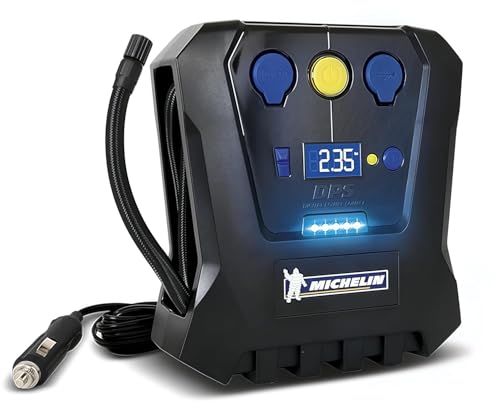
The Michelin 12266 is the oldest design on this page and the only one I would rate as true emergency equipment, because it has no battery to die in storage. It runs from the car's 12V socket through a three-metre cord, and its quoted 0 to 30 PSI in about three minutes is a from-flat figure, the exact job the cordless units' top-up claims politely step around. At $142.77 from Amazon AU it is the priciest unit here, and it earns the position with the only stated accuracy figure in the group, plus or minus 1 PSI up to 50 PSI, printed on the listing where a lawyer can read it. For an instrument you will trust for years, that written number is worth real money.
Programmability is the daily-use case rather than a gimmick. Set your placard pressure once and the pump runs to it and stops, switchable between PSI, bar and kPa for whatever the manual speaks. The hardware thinking is old-school in the best sense: a 60cm hose reaches valve stems without wrestling the case around the wheel arch, the body is sized for the spare-wheel well or under a seat at 19.5 by 17.5 by 8 centimetres and 1.1 kilograms, and there is a 12V passthrough socket built into the unit itself, so you can run a plug-in light while pumping in the dark, since the pump is occupying the car's only socket. Somebody who has actually changed a tyre at night designed that.
This is the unit for the buyer who thinks in decades rather than product cycles. Nothing self-discharges, nothing swells in the summer boot, and the wear items are brushes and seals that outlast most car ownership. Michelin's name is on the case, and the design has survived years on the market without needing a revision, which in a category this churn-heavy is a review in itself. Buy it, put it in the spare-wheel well, and forget it exists until it saves an evening. That is exactly what emergency equipment should be.
Honest caveats: Corded means the car must be present and running while you pump, and the working radius is the 3m cord plus 60cm hose, so bikes in the shed are not its job. No battery also means no power bank tricks or cordless convenience. At 1.1kg it is the heaviest unit here, and the price buys accuracy and longevity, not speed on top-ups.
Best for: The spare-wheel well: emergency kit that still works after three years untouched.
Price: $142.77 at time of writing • Power: Car 12V socket, 3m cord • Inflation claim: 0 to 30 PSI in about 3 minutes • Gauge accuracy: +/- 1 PSI up to 50 PSI (stated) • Hose: 60cm • Size / weight: 19.5 x 17.5 x 8 cm, 1.1kg • Extras: Built-in 12V passthrough socket, programmable preset • Rank: #58 in Wheel & Tire Air Compressors & Inflators (Amazon AU)
View on Amazon AUSide-by-side comparison
| Product | Price | Best for |
|---|---|---|
| AstroAI 12V Car Tyre Inflator | ~$39.97 | |
| AstroAI Cordless Tyre Inflator & Bike Pump | ~$39.99 | |
| AstroAI S1 Pro 12V Car Tyre Inflator | ~$39.98 | |
| UGREEN Tyre Inflator Portable Air… | ~$46.74 | |
| AstroAI L7S Cordless Tyre Inflator & Bike Pump | ~$45.99 | |
| UGREEN Tyre Inflator Portable Air… | ~$67.99 | |
| Bosch Cordless Electric Air Pump | ~$123.32 | |
| MICHELIN TATA Programmable High Power Rapid… | ~$142.77 |
What we see fail at the bench: tyre inflators
Small inflators die three ways, and none of them involve the pump wearing out from honest use. They die from heat, from storage, and from the connector, which makes them close cousins of every other lithium gadget that crosses the bench. The encouraging part is that all three failure modes respond to a few minutes of habit a year, and the habits are the same ones that keep jump starters and power banks alive.
Cooked pumps: the duty cycle nobody printed
A piston compressor the size of a soup can makes serious heat, and the listings in this category almost never state a duty cycle. The killer job is the dead-flat full-size tyre, or four corners of a ute done back to back on a summer afternoon: the motor windings and the little board behind them sit in the same hot box, and thermal damage accumulates quietly until the unit refuses to start. AstroAI's exclusion of heavy-duty tyres is the category's one honest admission. Pause between tyres, let the case cool to touchable, and the pump lasts years instead of one bad afternoon.
Storage-flat batteries: the pump that died waiting
The cordless units carry the same pouch cells as a phone, with the same slow self-discharge and the same protection-board cutoff below which they refuse to charge. An inflator's life is eleven months of boot storage punctuated by one emergency, which is the exact usage pattern that finds the cutoff. The fix costs nothing: charge to about three-quarters, top up quarterly, and store the unit in the cabin rather than the boot floor over summer, because parked-car heat past 60 degrees swells cells that are sitting at full charge. A calendar reminder beats a dead pump on a wet roadside.
Chucks, seals and USB ports: the small leaks
The mechanical end wears first at the valve chuck: the rubber seal inside the screw-on or clip-on head hardens, and the unit that used to seat cleanly starts hissing at the stem, which owners misread as a weak pump. A replacement seal or a careful reseat usually fixes it. On the electronic end, USB-C charging ports wear exactly as they do on phones, loose and intermittent, and cracked solder joints from boot-floor vibration finish the job. Coastal air corrodes spring contacts in the chuck lever too. A visual check of the hose and head twice a year catches most of it early.
Decision tree: which one should you actually buy?
- One unit for the car, the bikes and the footy? → The AstroAI L7S at $46. Five preset modes, 17 L/min, and the best claims-per-dollar in the category. It is the default for a reason.
- Two cars or a caravan, tired of charging gadgets? → The UGREEN at $66 carries twin 2500mAh cells for about twelve tyres per charge, roughly double the AstroAI's stamina, with a red roadside warning light thrown in.
- Mostly bikes and balls, want it pocket-size with a real warranty? → The Bosch EasyPump at $109. French-valve adapter and ball needle in the box, and up to three years of warranty when registered.
- Want the thing in the spare-wheel well to work in 2029? → The Michelin 12266 at $143. No battery to die, a stated +/- 1 PSI gauge, and 0 to 30 PSI in about three minutes off the car's 12V socket.
- Doing 4WD tracks with dead-flat reinflation after beach runs? → None of these. That job needs a heavy-duty 12V compressor with a stated duty cycle, and the AstroAI listing explicitly excludes it. Buy once from the 4WD aisle instead.
- Inflator will not charge, gauge reads nonsense, or the pump hums and does nothing? → Bring it past the workshop in Erina and I will tell you in minutes whether it is a recoverable battery lockout or a unit for the recycling drop-off. The honesty is free either way.
Frequently asked questions
How accurate are the digital gauges on these inflators?
The only pick that states a figure is the Michelin, at plus or minus 1 PSI up to 50 PSI. The others quote sampling rates or real-time measurement without committing to an accuracy band. None of them are calibrated instruments. What a digital gauge reliably gives you is repeatability: the same reading, the same way, every time, which is what matters for even tyre wear. If you want to audit yours, check it once against a quality stick or dial gauge and note the offset. A consistent gauge with a known offset beats a servo dial of unknown history every day of the week.
What pressure should I actually run my tyres at?
Use the placard inside the driver's door jamb, not the number moulded into the tyre sidewall. The sidewall figure is the tyre's maximum rated pressure, a limit rather than a recommendation. The placard states the vehicle maker's cold-inflation pressures, usually with separate figures for normal and loaded driving, and often in both PSI and kPa. Measure cold, before the tyres have warmed on the highway, because pressure rises with temperature and a hot reading will fool you into underinflating. Set your inflator's preset to the placard figure once and the auto-stop handles the rest.
Can these small inflators reinflate a completely flat tyre?
The Michelin quotes it directly: 0 to 30 PSI in about three minutes, per tyre, drawing from the car's battery. The cordless units can usually manage one from-flat car tyre, but it is the hardest job you can give them, the motor runs hot for several minutes, and their listings quote top-up scenarios rather than from-flat times for a reason. If you do it on a cordless unit, let the pump cool afterwards before asking for more. And if the tyre went flat by itself overnight, the pressing question is the puncture, not the pump: reinflating a holed tyre buys you a trip to the tyre shop, nothing more.
Why did my cordless inflator die after a year in the boot?
Storage, almost certainly, rather than a fault. Lithium cells self-discharge over months, the protection board draws a trickle on top, and once the pack sinks below the board's low-voltage cutoff it refuses to accept charge, by design, because charging a deeply discharged lithium cell is hazardous. Boot heat accelerates the whole process and can swell cells that were stored at full charge. The prevention is a quarterly top-up to about three-quarters and cabin storage in summer. Some locked-out packs can be recovered on a bench supply by someone who knows what they are doing; most owners are better off treating it as a lesson.
Are these inflators good enough for 4WD and trailer tyres?
No, and AstroAI deserves credit for printing it: the L7S listing excludes heavy-duty tyres on offroad vehicles, RVs, trucks and trailers. The volumes are larger, from-flat reinflation after beach driving is routine, and the job calls for a heavy-duty 12V compressor with a stated duty cycle, a proper chuck and its own thermal protection, sold in the 4WD aisle at a 4WD price. A pocket inflator will start the job and cook itself partway through. For passenger cars, SUVs on road tyres, bikes and sports gear, everything on this page is inside its lane.
Is the pump battery replaceable when it wears out?
Not user-replaceably, on any of the cordless picks here. The packs are internal, usually soldered or connectored inside a glued or screwed shell, and no listing in this group offers a spare battery part. Realistically a $46 to $109 unit with a worn pack is a recycling candidate after five-plus years, which is another argument for the storage habits that stretch pack life, and part of why the batteryless Michelin suits buyers who think in decades. Whatever you do, do not bin a lithium unit in household waste; council battery drop-offs exist exactly for these.
Related buying guides
Gadget batteries dying young all over the house?
The inflator, the jump pack, the power bank and the phone all run the same pouch cells, and they all die the same preventable deaths: deep discharge, summer heat and worn USB-C ports. I replace ports and diagnose battery faults at board level, backed by 16 years. Walk anything that will not charge in to the Erina workshop and get a straight answer on whether it is worth saving.
Visit our Erina workshop Book Online