Prices from Amazon AU, updated daily. Swipe or use the arrows for more.
Disclosure: This article contains affiliate links to amazon.com.au. If you buy through one of these links iFix may earn a small commission at no extra cost to you. It doesn't change which products we recommend. We focus on what actually lasts based on 16 years of repair-shop experience.
Quick summary5 picks
- CheapestMy Best Buy - Devanti Electric Fireplace 3D… about$61.672000W.
- Lenoxx Electric Fireplace Heater LF120 with… about$119.951000W.
- Devanti Electric Fireplace Fire Heater Wall… about$144.951800W.
- Bonaire Electric Fireplace Portable Heater… about$204.00950W.
- Most PremiumDimplex Bari 2kW Electric Fire about$224.96
It is a fan heater with a light show. Treat it as two products.
Strip the cast-iron paint and the glass off any electric fireplace under $300 and you find two separate machines sharing a case. The first is a fan heater: a resistive element, a small motor pushing air across it, a thermostat of some kind, and a thermal cut-off in case the air stops moving. The second is a light engine: a handful of LEDs, a motor or a set of rotating reflectors, a plastic or glass log set, and a driver board that turns 240V into a few volts of DC for the lights. Neither part knows the other exists. They share a power cord and a control board and that is about it.
That matters because people buy on the light show and then live with the heater. The flame effect is what sells the unit in the listing photo. The heater is what runs for six hours a night from June to September and decides whether the thing was worth buying. So I judge the two parts separately, and I would ask you to do the same. How good is it as a 2kW heater? Then, how good is it as a lamp? A unit that scores well on the first and tolerably on the second is a better buy than the reverse.
None of the four units here vent anything or burn anything. There is no gas, no flue, no clearance-to-combustibles rule beyond what applies to any fan heater. That is the genuine advantage of the category for renters and for anyone in a unit block where a gas heater is not an option. What you give up is the radiant punch of a real fire. A 2kW element is a 2kW element whether it sits behind a log set or inside a grey plastic box. The room gets exactly as warm either way.
Judge the heater: watts, stages, thermostat, cut-off
Every one of the four picks tops out at 1,800W or 2,000W, which is the practical ceiling for anything that plugs into a standard Australian 10A wall socket. A 10A socket at 240V gives you 2,400W, and the heater's own fan, control board and lights eat into that. So do not expect a bigger number from a different model. The number to care about is the low stage. The Dimplex and Lenoxx give you 1kW, the Devanti 1kW, the Bonaire 950W. A 1kW low stage is the one you will actually use most evenings once the room is up to temperature, and a heater with only a single 2kW stage would be a harder sell for me.
Thermostat type is the next thing to read for. A mechanical thermostat is a bimetallic strip that clicks the element on and off around a set point you cannot see. It works, but the hysteresis is wide, often 3 to 4 degrees either side, so the room swings. A digital thermostat (the Devanti lists one) reads a thermistor and switches a relay or triac around a number you choose on the remote. Tighter control, and the unit runs at lower average power because it stops overshooting. The Dimplex lists a built-in thermostat without stating the type. The Bonaire and Lenoxx listings do not state a thermostat at all, only heat levels and, in the Lenoxx's case, overheat protection. If a thermostat matters to you, ask the seller before ordering.
The thermal cut-off is the part that matters for electrical safety and the one nobody reads about. It is a small fuse or a bimetal switch bolted near the element. If the fan stalls, or a blanket falls across the outlet grille, the air temperature at the element climbs and the cut-off opens the circuit. A resettable one clicks back on once the unit cools. A one-shot thermal fuse blows permanently, and on a sealed unit that means the heater is dead until someone with a soldering iron gets to it. The Devanti and Lenoxx both list thermal or overheat protection. The Dimplex and Bonaire listings do not say, which does not mean it is absent, only that you should check the manual or look for the RCM mark on the rating plate, which tells you the unit has been through the Australian electrical compliance path at all.
Judge the light engine: LEDs, drivers, and flame-only mode
The flame effect on all four units is LED based. Older electric fires used halogen lamps and a spinning spindle; the lamps ran hot and blew every couple of winters, and the motor bearings dried out. LEDs fixed the lamp problem and created a new one. An LED itself rarely dies. What dies is the driver, a small switch-mode supply that drops 240V AC to a few volts DC and regulates current. The electrolytic capacitors in that driver sit in a warm box for years, and warm is what kills electrolytics. When the flame effect starts to flicker at mains frequency, dims on one side, or refuses to light while the heater still blows, that is nearly always the driver, not the LEDs.
Flame-only mode is the feature I would not buy without. The Dimplex listing says the flame effect runs without heat, year-round. The Lenoxx lists a flame-only mode with adjustable brightness. The Devanti remote controls flame colour and four brightness levels independently of heat. The Bonaire listing describes a LED flame effect but does not state a flame-only mode, so check before you assume. Why it matters: a unit that can run its light show for a few watts on a November evening gets used twelve months a year and earns its floor space. A unit that only lights up when the element is on gets unplugged in September and pushed behind the couch.
Brightness control is more than a nicety. LEDs driven at full current all evening run warmer, and the driver runs warmer with them. Running the effect at a lower brightness level, which both the Lenoxx and Devanti listings describe, lowers the thermal load on the one component most likely to fail. The Devanti's six flame colours are a matter of taste. I would set it to the orange and leave it, but the point is the driver is already built to modulate output, which usually means a slightly better board than a fixed-brightness unit.
Wall insert versus freestanding
Three of the four picks are freestanding: the Dimplex Bari in its cast-iron style case with the opening door, the Lenoxx LF120 with three-sided glass, and the Bonaire portable. The Devanti is a wall-mounted insert with a 10cm profile that the listing says can be surface-mounted or recessed. The choice is mostly about the room and whether you own the wall.
Freestanding wins on flexibility. You can move it to the bedroom in July and back to the lounge in August, and when the fan motor finally gets noisy in year five you can carry it to the Erina workshop rather than pulling it off a wall. The Bonaire draws its intake and pushes warm air out from the bottom, per the listing, which suits a unit sitting on the floor with nothing in front of it. The Dimplex and Lenoxx listings do not state outlet position, so look at the photos for the grille before you plan where it sits. Warm air needs to leave the unit and reach the room, not a cushion.
A wall insert looks better and costs more to live with. The Devanti's slim profile means the fan, element and driver board are all packed into a 10cm cavity, which is a tighter thermal environment than a freestanding box. Heat rises out of the top of a wall unit, so mounting it under a shelf or a TV puts warm air straight onto whatever is above it. And a recessed install means a fixed power point behind the unit, not an extension cord snaking out of the wall. That is a job for an electrician. Budget for the install separately from the unit. If the wall is plasterboard on studs and you are renting, freestanding is the answer.
Running cost, the 10A socket, and the powerboard rule
The sums are simple. At the Australian average tariff of roughly 33c per kWh, a 2,000W heater flat out costs about 66c an hour. On the 1kW stage it is about 33c. A 1,800W Devanti on high is about 59c. The flame effect alone is a rounding error, a few cents an evening at most. The thermostat is what moves the bill, because a unit that cycles at 40 percent duty on a mild night costs 40 percent of the flat-out figure. That is the real argument for a digital thermostat over a knob.
If you want to see the actual duty cycle rather than guess, put the fireplace on a plug-in energy meter for a week. Our smart energy monitor guide covers the ones that log to a phone, and the reading tells you two things: the true hourly cost in your room, and whether the thermostat is doing anything. A heater that draws 2kW for six hours straight on a 15 degree evening has a thermostat that is either broken or set to the ceiling.
Two hard rules on the electrical side. Never run an electric fireplace through a powerboard, and never share the socket with another heater. A 2kW heater is 8.3A on its own. Add a second heater or a kettle on the same double outlet and you are over the 10A the circuit breaker is sized for, and powerboards are rated for far less than that before the contacts overheat. Plug the fireplace straight into the wall, on its own, and check that the plug is not warm to the touch after an hour. A warm plug means a loose contact in the socket or a tired pin, and that is how the discoloured, half-melted plugs we see in the workshop get started.
What to check before you buy, and how to make it last
- RCM mark. Look for the tick-in-a-triangle on the rating plate, in the listing photos if you can find it. It says the importer has registered the unit for Australian electrical compliance. All four picks here are sold by Australian sellers on Amazon AU, but the mark is still the thing to check, not the seller name.
- Plug and cord. An Australian three-pin plug moulded to the cord, not an adaptor. A 2kW appliance on a travel adaptor is a fire in waiting.
- Thermostat and cut-off stated. If neither appears in the listing, ask.
- Flame-only mode. Stated for three of the four here.
- Grille position. Where does the warm air come out, and what will be in front of it?
- Remote or manual. The Dimplex lists both. A unit that is remote-only is a paperweight when the remote goes in the couch.
Once it is home, the single best thing you can do for an electric fireplace is keep the intake clean. The fan pulls room air across the element and every bit of pet hair and carpet lint comes with it. Dust builds on the element and burns off with a smell at the start of each winter, which is harmless, but it also builds on the fan blades and in the motor, which is not. A dusty fan moves less air, the element runs hotter, and the thermal cut-off starts tripping on nights it never used to. A vacuum nozzle over the intake grille every few weeks through winter is all it takes. Do it with the unit unplugged.
Do not store it in a damp garage over summer. Our water damage explainer covers what condensation does to a circuit board over months, and the control board in a fireplace is no different to the one in a laptop: copper traces, solder joints and a film of moisture become corrosion. Store it indoors, in its box if you kept it, and run it for ten minutes in flame-only mode before the first cold night to check everything wakes up.
How I picked these four, and what I left out
I went through the Amazon AU fireplace and heating rankings and kept the units that stated at least two of the three things I care about: a low heat stage under 1,100W, some form of thermostat, and some form of overheat or thermal cut-off. Then I looked for flame-only mode and an Australian seller. The four that survived span $119.95 to $202.46 at time of writing and cover both form factors. I left out anything that did not state its wattage in the title, anything listed as 220V only without an AU plug, and the big 1.5 metre media-console units, which are furniture with a heater in them and deserve their own guide.
You will notice I have not ranked them against ceramic fan heaters or oil columns. That is deliberate. If you just want warm air for the lowest purchase price, the ceramic fan heater guide will get you there for less, and if you want silent background warmth that holds through the night, the oil column guide is the place. An electric fireplace is for the person who wants the room to look warm as well as be warm, and is prepared to pay $60 to $100 over a plain fan heater for the light engine. Fair enough. Just know that is what the extra money buys.
One more thing from the Central Coast repair bench. Of the fireplaces that come through with a dead flame effect, most have a heater that still works perfectly. People throw the whole unit out because the pretty part stopped. A driver board is a small repair. If the heater side is fine, the unit is worth fixing, and the next section covers what tends to go and in what order.
The four picks, $120 to $202
Prices are Amazon AU at time of writing (15 August 2026) and move week to week. Ranks are Amazon AU category sales ranks, checked the same day.

Dimplex Bari 2kW Electric Fire, Freestanding with Optiflame
ASIN B09155FLK7 • $202.46 • Sold by Glen Dimplex Australia on Amazon AU
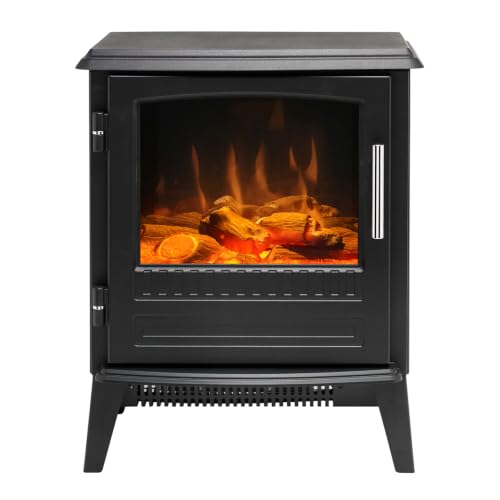
Dimplex has been building electric fires since before LEDs were an option, and the Optiflame effect is the one everybody else copies. The Bari is the freestanding stove-style version: black cast-iron style case, an opening door with chrome detail, and an LED log and coal-bed effect behind it. The listing states 1kW and 2kW settings with a built-in thermostat, manual controls on the unit plus a remote, and that the flame effect runs without heat year-round. No venting, no fuel. At $202.46 it is the dearest of the four by a few dollars and it is sold by Glen Dimplex Australia directly, which matters if you ever need a spare part or a warranty conversation. It ranks #6 in Amazon AU's Fireplaces category at time of writing.
As a heater it is a conventional 1kW/2kW fan unit with a thermostat, which is what you want. The thermostat type is not stated on the listing, so assume mechanical until the manual says otherwise. As a light engine it is the strongest of the four on reputation: Optiflame is a reflector-and-LED system that Dimplex has refined over a long time, and the units I have opened from this brand use a driver board that is better laid out than the generic ones. The opening door is a nice touch for cleaning the glass and for reaching the log set. The case is cast-iron style, not cast iron, so it is light enough to carry between rooms, which is the point of a freestanding unit.
The manual-plus-remote control is the detail I would pay for. In the workshop, the most common reason a fireplace gets written off is a lost or dead remote on a unit with no buttons. The Bari has both. Year-round flame-only running means it stays plugged in and in use through summer, which keeps the capacitors in the driver board cycling rather than sitting. The listing does not state thermal cut-off, outlet grille position, or room coverage, so ask Glen Dimplex if those matter to you before you order. I would still buy it over the others for a lounge room that gets used every night.
Honest caveats: Honest caveats: the listing does not state a thermal cut-off, the thermostat type, or the outlet position, and it does not give a room size. You are paying a premium for the brand and the flame engine, and the heater side is the same 1kW/2kW as the $120 unit below. Check the rating plate photo for the RCM mark.
Best for: The person who wants the most convincing flame effect on the market and a brand with Australian parts support, and is happy to pay for it.
Power: 1kW / 2kW, built-in thermostat • Type: Freestanding, cast-iron style stove case • Flame effect: Optiflame LED log and coal bed • Flame-only mode: Yes, runs without heat year-round • Controls: Manual and remote • Door: Opening door, chrome detail • Venting: None, no fuel • Seller: Glen Dimplex Australia • Rank: #6 in Fireplaces (Amazon AU)
View on Amazon AU
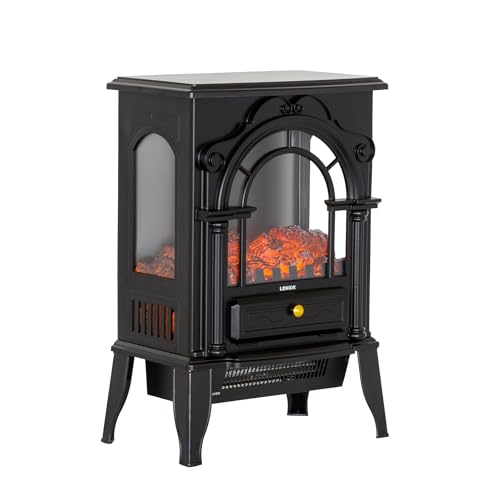
Lenoxx LF120 Electric Fireplace Heater, 3-Sided Glass
ASIN B0GRRVQK47 • $119.95 • Sold by Aussie discounts on Amazon AU
The Lenoxx LF120 is #1 in Amazon AU's Fireplaces, Stoves and Accessories category at time of writing, and at $119.95 it is the least expensive unit here by a clear margin. The listing states 1,000W and 2,000W heat stages, a flame-only mode with adjustable brightness, three-sided panoramic glass, overheat protection with auto shut-off, and a freestanding black case that needs no installation. Lenoxx is a long-running Australian-market brand, and the unit is sold by Aussie discounts on Amazon AU. It is the unit I would point most people at first, because it states the two things that matter on the heater side (two stages and overheat protection) and the one that matters on the light side (flame-only with brightness control).
Three-sided glass means the log set is visible from the front and both sides, which suits a unit sitting in an open room rather than against a wall, but it also means more glass to keep clean and three panes that the LED driver has to fill. Adjustable brightness helps there: drop it a notch and the driver runs cooler. The overheat protection is listed as auto shut-off, which is usually a resettable bimetal cut-off rather than a one-shot fuse, though the listing does not say which. A thermostat is not stated. Read that as two heat stages and a manual choice between them, unless the manual says otherwise. That is fine for a lot of rooms. It just means you will be turning it down by hand on milder nights.
What the listing does not say: remote or manual control, outlet grille position, room coverage, or the type of thermostat if there is one. I would ask the seller about the control method before ordering, because a remote-only unit with no buttons becomes a problem the day the remote dies. For $119.95 you are getting a working 2kW fan heater with a flame mode you can run in summer, and a sales rank that says a lot of Australians have reached the same conclusion. Spend the money you saved on a plug-in energy meter.
Honest caveats: Honest caveats: no thermostat is stated on the listing, and neither is the control method (remote, buttons or both). The three-sided glass is attractive and also three times the surface to keep free of fingerprints. Overheat protection is stated but the reset behaviour is not. Check the rating plate for the RCM mark.
Best for: Anyone who wants a working 1kW/2kW heater with a flame effect they can run year-round, for the least money, and does not need a thermostat.
Power: 1,000W / 2,000W • Type: Freestanding, no installation • Glass: 3-sided panoramic • Flame-only mode: Yes, adjustable brightness • Thermostat: Not stated on the listing • Safety: Overheat protection with auto shut-off • Seller: Aussie discounts • Rank: #1 in Fireplaces, Stoves & Accessories (Amazon AU)
View on Amazon AU
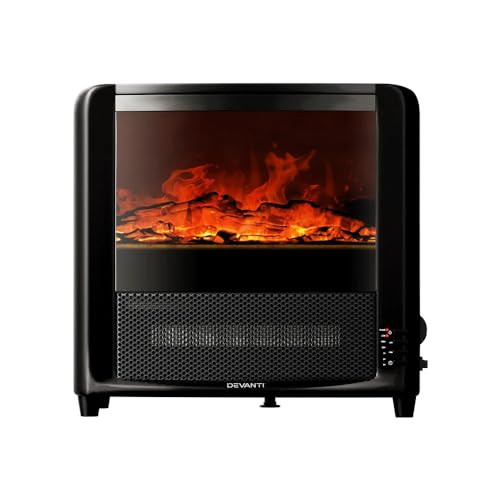
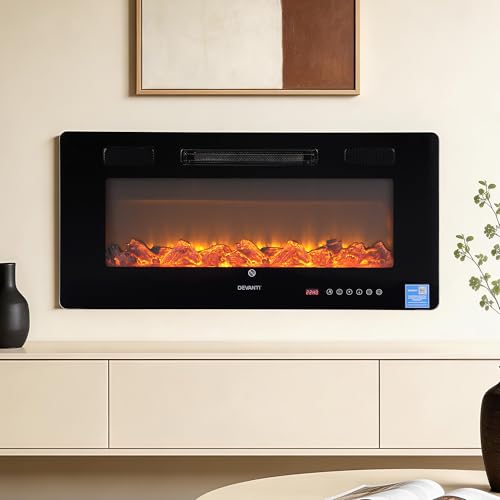
Devanti Wall Mounted Electric Fireplace Insert, 1800W, 3D Flame
ASIN B0GT7PXQM2 • $139.95 • Sold by Artiss Furnishings on Amazon AU
The Devanti is the only wall unit here and the only one that states a digital thermostat. The listing gives a 10cm slim profile that can be surface-mounted or recessed, 1,000W or 1,800W heat stages, a thermal cut-off, six flame colours, and a remote that controls flame colour, four brightness levels, heat, thermostat and a 0 to 12 hour timer. It is rated 220 to 240V for Australia. At $139.95 from Artiss Furnishings it sits in the middle of the group on price and ranks #9 in Amazon AU's Fireplaces category at time of writing. Devanti is a high-volume importer brand, so the expectation is a generic board inside a well-finished case, and the spec sheet supports that reading: lots of features, all controlled from one remote.
The digital thermostat is the reason to pick this over the others if you are fitting a wall unit. A remote with a set temperature and a thermostat that actually holds it means the unit cycles on mild nights instead of running flat out, and on a wall insert with a 10cm cavity that also keeps the internals cooler. The 1,800W top stage is 200W under the others, which in a 10cm case I read as a deliberate thermal margin rather than a shortcoming. The 0 to 12 hour timer is useful for a bedroom install. The six colours and four brightness levels tell you the LED driver is a modulating type, which generally means a better-specified board than a fixed-output one.
The things to plan for: a recessed install needs a power point behind the unit, which is an electrician's job, and surface mounting still needs a cord route. Mount it so there is clear air above the top grille, not a shelf or a TV. The listing does not state outlet position, room coverage, or whether there are any controls on the unit itself. With a remote-only wall insert, keep the remote somewhere fixed. It is the single most common point of failure for this form factor, and a replacement is not always easy to source.
Honest caveats: Honest caveats: the listing does not state any on-unit controls, so assume it is remote-only until the manual says otherwise. Recessed installation means a fixed power point behind the unit and an electrician. The 10cm profile is a tight thermal space for the driver board. Room coverage is not stated.
Best for: The owner-occupier who wants a wall-mounted fire with a real thermostat and a timer, and is prepared to budget for the install.
Power: 1,000W / 1,800W • Type: Wall mount or recess, 10cm profile • Thermostat: Digital • Safety: Thermal cut-off • Flame effect: 3D, six colours, 4 brightness levels • Timer: 0 to 12 hours • Controls: Remote • Voltage: 220 to 240V AU • Rank: #9 in Fireplaces (Amazon AU)
View on Amazon AU
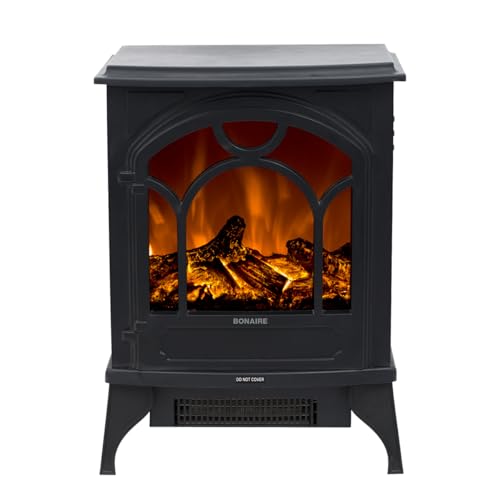
Bonaire Portable Electric Fireplace Heater, 950W/2000W, Log Set
ASIN B0DB824N7D • $199.00 • Sold by Bonaire Australia on Amazon AU
Bonaire is a name most Australians know from ducted gas and evaporative systems, and this portable fireplace is sold by Bonaire Australia directly. The listing states 950W low and 2,000W high, a realistic log set behind a tempered glass front, an LED flame effect, and a stated coverage of up to 20 square metres with air distribution from the bottom of the unit. At $199.00 it is a few dollars under the Dimplex and ranks #363 in Amazon AU's broader Heating category at time of writing, which is a different and much larger category than the Fireplaces rank the other three carry, so do not read it as a weaker seller.
Bottom air distribution is the useful detail. Warm air from the base spreads across the floor before it rises, which is how you want a room heated, and it keeps the outlet clear of the glass and log set. The 950W low stage is the lowest of the four, which is a small advantage on mild nights. Tempered glass on the front is the right material: it handles the thermal cycling of a heater grille without stress cracking the way ordinary float glass can. The 20 square metre figure is the only room coverage claim any of the four makes. Treat it as a lounge room in a brick house with the door shut, not an open-plan kitchen-living area.
What the listing does not state: a thermostat, a thermal cut-off, a flame-only mode, or the control method. Those are four significant gaps for a $199 unit, and I would want answers from Bonaire on at least the first three before ordering. The LED flame effect and log set are described without mention of brightness control. If it turns out to have flame-only mode and a thermostat, it moves up this list. As listed, it is a well-built portable heater with a light show from a brand with Australian support.
Honest caveats: Honest caveats: the listing does not state a thermostat, a thermal cut-off, a flame-only mode, or whether there is a remote. That is more unknowns than the other three. The 20 square metre figure is a manufacturer claim. The Heating category rank is not comparable to the Fireplaces rank on the other picks.
Best for: The buyer who wants bottom-outlet floor heating from an Australian heating brand and is willing to confirm the thermostat and flame-only questions with Bonaire first.
Power: 950W low / 2,000W high • Type: Portable, freestanding • Coverage: Up to 20 m2 (listing claim) • Airflow: Air distribution from the bottom • Front: Tempered glass • Flame effect: LED, realistic log set • Seller: Bonaire Australia • Rank: #363 in Heating (Amazon AU)
View on Amazon AUSide-by-side comparison
| Product | Price | Best for |
|---|---|---|
| My Best Buy - Devanti Electric Fireplace 3D… | ~$61.67 | |
| Lenoxx Electric Fireplace Heater LF120 with… | ~$119.95 | |
| Devanti Electric Fireplace Fire Heater Wall… | ~$144.95 | |
| Bonaire Electric Fireplace Portable Heater… | ~$204.00 | |
| Dimplex Bari 2kW Electric Fire | ~$224.96 |
What we see fail at the bench: electric fireplaces
An electric fireplace has three things that wear: a fan motor, an LED driver, and a thermal cut-off. The element almost never fails. The case never fails. After 16 years in the workshop the pattern is consistent enough that I can usually tell you what is wrong from the description over the phone, and the fix is usually a part that costs less than the postage. Here is what goes, in rough order of how often we see it.
Fan motor bearings and dust
The fan is a small shaded-pole or brushless motor running for hours every night pulling lint-laden air across itself. The sleeve bearings dry out. First it is a faint whine on startup, then a rattle at low speed, then a stall. A stalled fan with the element still energised is exactly what the thermal cut-off is there for, so the unit trips and goes cold. Most people describe this as the heater stopping and restarting. The cure is a new motor, which is a standard part on most of these units, or on a lucky day just a clean-out and a drop of oil on the bearing. Vacuuming the intake through winter pushes this failure out by years.
LED driver board and capacitors
The flame effect dims, flickers at mains frequency, drops out on one side, or stops while the heater still works. That is the driver, a small switch-mode supply sitting in a warm box for its whole life. Electrolytic capacitors dry out with heat and the ripple they are meant to smooth gets through to the LEDs. We replace the capacitors or the whole driver board depending on the unit. Running the effect at a lower brightness setting, where the listing offers one, lowers the thermal load on this board. Flame-only mode in summer keeps the capacitors cycling, which is better for them than sitting idle in a box for eight months.
Thermal fuse and the tired plug
A one-shot thermal fuse that has blown leaves a unit that lights up but never heats. It is a small, low-cost part, but on a sealed case it is a bench job, and the first thing we ask is why it went: a blocked grille, a dead fan, or the unit being run face-down against a couch. The other electrical failure is at the plug. A 2kW load through a socket with a worn contact heats the pin, the plastic browns and softens, and we see discoloured plugs that are one step from a melt. A warm plug after an hour is the warning. Stop using that socket until an electrician has looked at it.
Decision tree: which one should you actually buy?
- I want the most convincing flame effect and I do not mind paying for the brand? → The Dimplex Bari at $202.46. Optiflame is the effect everyone else copies, it runs flame-only year-round, and it has manual controls as well as the remote, which matters when the remote goes missing.
- I want a working 2kW heater with a flame mode for the least money? → The Lenoxx LF120 at $119.95. Two heat stages, overheat protection, flame-only with brightness control, and it is the #1 seller in its Amazon AU category for a reason. Just confirm the control method with the seller first.
- I own the house and want a wall-mounted unit with a real thermostat and timer? → The Devanti wall insert at $166.95. It is the only pick with a stated digital thermostat and thermal cut-off, plus a 0 to 12 hour timer. Budget for an electrician if you recess it.
- I want a floor-standing unit from an Australian heating brand that pushes warm air along the floor? → The Bonaire portable at $199.00, with bottom air distribution and a 950W low stage. Ask Bonaire about the thermostat and flame-only mode first, because the listing does not state either.
- I rent and the wall is plasterboard on studs? → Stay freestanding: Lenoxx at $119.95 or Dimplex at $202.46. A wall insert needs a fixed power point and a landlord who says yes, and neither is guaranteed.
- The flame effect has stopped, or the heater trips off and on, or the plug is getting warm? → Stop using it and bring it to our Erina workshop. A dead driver board, a tired fan motor, or a blown thermal fuse are all bench repairs, and the heater element underneath is almost always fine.
Frequently asked questions
How much does an electric fireplace cost to run per hour in Australia?
Work it from the wattage. At the Australian average tariff of roughly 33c per kWh, a 2,000W heater running flat out costs about 66c an hour, and the 1,000W low stage costs about 33c. The Devanti at 1,800W is about 59c on high. The flame effect on its own draws a few watts, so running flame-only for an evening costs a cent or two. A thermostat that cycles the element on a mild night cuts the figure roughly in proportion to the duty cycle, which is why a digital thermostat pays for itself over a winter. Check your own tariff on the bill and scale the numbers.
Can I run an electric fireplace on a powerboard or extension lead?
No. A 2,000W heater draws around 8.3A on its own, and a standard Australian 10A socket gives you 2,400W total before the breaker is doing its job. Powerboards are rated well under that for continuous load, and their contacts overheat long before the breaker notices. Plug the fireplace straight into a wall socket on its own, do not share the double outlet with another heater or a kettle, and feel the plug after an hour. A warm plug means a loose contact or a worn pin and that socket needs an electrician, not a different heater.
Does an electric fireplace need venting or a flue?
No. None of the four units here burn anything. The heat comes from a resistive element and a fan, the same as any ceramic or fan heater, and the flame is an LED effect behind glass. There is no combustion, no gas line, no flue, and no clearance-to-combustibles rule beyond keeping the outlet grille clear the way you would for any heater. That is why they suit renters and unit blocks where a gas heater is not an option. The trade-off is that you get the radiant output of a 2kW element, not a real fire.
What is the difference between a wall insert and a freestanding electric fireplace?
A freestanding unit sits on the floor, plugs into the wall, and moves between rooms. A wall insert mounts to or recesses into the wall, usually with a slim profile like the Devanti's 10cm, and needs a power point behind it for a recessed install, which means an electrician. Inserts look better and hold heat inside a tighter cavity, so the electronics run warmer. Freestanding units are easier to clean, easier to carry to a repair bench, and the only sensible choice if you rent. Three of the four picks here are freestanding.
Why has the flame effect stopped but the heater still works?
Because they are two separate circuits sharing a case. The flame effect runs off a small LED driver board that drops 240V to a few volts DC, and the electrolytic capacitors in that driver dry out after years in a warm box. When they go, the effect dims, flickers or dies while the element and fan carry on. It is a small repair, usually a handful of capacitors or a replacement driver board, and the unit is worth fixing if the heater side is sound. Running the effect at a lower brightness and using flame-only mode in summer both help it last.
Are these electric fireplaces safe to leave on overnight?
Treat them like any 2kW fan heater. A unit with a stated thermal cut-off (the Devanti and Lenoxx both list one) will shut the element down if the fan stalls or the grille is blocked. Keep a metre clear in front of the outlet, never drape anything over it, keep the intake vacuumed, and plug it straight into the wall. A timer, like the Devanti's 0 to 12 hour one, lets you run it for an hour at bedtime and have it switch off on its own. If the plug or cord is warm, stop and get the socket checked.
Related buying guides
Flame effect dead, fan rattling, or heater tripping? Bring it in.
Most electric fireplaces that get thrown out have a perfectly good heater and a dead driver board or a worn fan motor. Both are bench repairs. Walk it in to our Erina workshop on the Central Coast and we will tell you what has failed and what it costs to put right. 16 years of board-level work, and we would rather fix the unit than see it go to landfill.
Visit our Erina workshop Book Online