Prices from Amazon AU, updated daily. Swipe or use the arrows for more.
Disclosure: This article contains affiliate links to amazon.com.au. If you buy through one of these links iFix may earn a small commission at no extra cost to you. It doesn't change which products we recommend. We focus on what actually lasts based on 16 years of repair-shop experience.
Quick summary6 picks
- Entry PickBaumr-AG 8 Tonne Electric Hydraulic Log… about$529
- Baumr-AG 9 Tonne Electric Hydraulic Log… about$609
- Baumr-AG 10 Tonne Electric Hydraulic Log… about$759
- Baumr-AG 12 Tonne Petrol Hydraulic Log… about$889
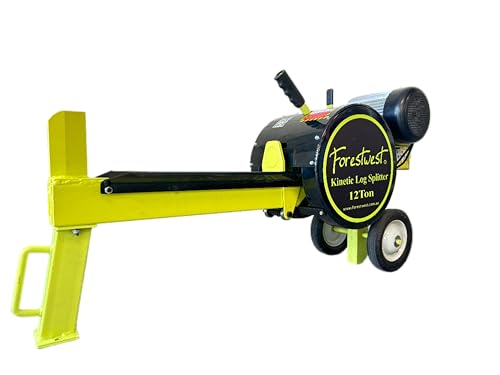
- Forestwest 11130 about$9191800W.
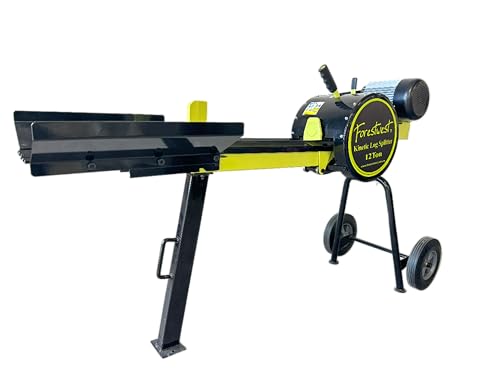
- Most PremiumForestwest 11130S about$9791800W.
Why I'd pick a splitter on log size, not tonnage
The number printed biggest on every log splitter box is the tonnage, and it's the number people shop on. It matters, but it's only half the story. The figure that decides whether a splitter will actually handle your woodpile is the log size it accepts, length and diameter, and on the Baumr-AG range that's printed on the listing for most models. A 9 tonne machine that only takes 250mm rounds is no help if your supplier drops off 350mm ironbark.
So before you look at a single listing, go out and measure what you're burning. Take the five fattest rounds in the pile, measure across the face and along the length, and write down the largest of each. Most firewood in Australia is cut to around 300 to 450mm long so it fits a standard wood heater firebox, but plenty of bulk loads come in longer, and a splitter with a 520mm stroke won't take a 600mm round at all.
Then think about the timber itself. Seasoned softwood and dry gum split with surprisingly little force, while green, knotty or twisted hardwood can stall a small machine halfway down the wedge. If you're splitting mostly dry, straight rounds under 250mm across, the 8 or 9 tonne electric models below will do the job. If it's fresh-cut red gum with forks in it, I'd look at 10 tonnes or more, or a kinetic machine.
Electric hydraulic, petrol hydraulic or kinetic
There are three ways these machines push a log onto a wedge, and they fail in different ways. An electric hydraulic splitter uses a mains motor to drive a small pump, which pushes oil into a cylinder and slowly forces the ram forward. They're quiet, you can run them under a carport, and there's no fuel to go stale. The trade-off is speed: a full stroke usually takes several seconds and the return stroke is slow too.
A petrol hydraulic splitter does the same job with a four-stroke engine driving a bigger pump. You get more force and you can use it out in the paddock, well away from a power point, which is why the 12 tonne Baumr-AG below is petrol. You also get everything that comes with a small engine: fuel that goes off, a carburettor that gums up over winter, oil changes and a pull start that gets harder every year you ignore the spark plug.
A kinetic splitter skips hydraulics completely. An electric motor spins up a pair of heavy flywheels, and when you pull the lever a rack is driven forward by that stored energy and slams the log onto the wedge in a couple of seconds. The Forestwest listings quote a cycle time of 2 to 3 seconds, against around 14.5 seconds for the petrol Baumr-AG. There's no hydraulic oil to leak, but there's a lot of mechanical energy, and the rack, clutch and flywheel bearings take the wear instead.
Motor load on a home circuit and your extension lead
An electric splitter is a heavy inductive load, and the moment the motor starts it draws well above its running current. A standard Australian power point is rated at 10 amps, which is about 2,400W, and that's the ceiling for the whole circuit, not just the socket you plug into. The Forestwest kinetic is rated at 1,800W and the Yukon 8 tonne in the marquee at 2.2kW, while the Baumr-AG listings don't state the motor wattage at all, so check the rating plate before you buy.
The extension lead is where I see most of the trouble. A long, thin lead drops voltage under load, and an induction motor fed low voltage runs hot, struggles to start and cooks its windings or start capacitor over time. Use the shortest heavy-duty lead that reaches, unroll it fully so it doesn't heat up on the drum, and never run a splitter off a powerboard. Our guide to surge powerboards covers what those boards are for, and a log splitter isn't on the list.
Running cost is small. At the Australian average tariff of roughly 33c per kWh, an 1,800W motor working flat out costs about 59c an hour, and you won't run it flat out for an hour very often. A portable RCD between the lead and the wall is worth the money if your outdoor circuit isn't already protected, because you're working with wet timber, damp ground and a metal frame. If you're splitting out in the paddock instead, a generator needs to cover that start surge, and our inverter generator guide explains how to size one.
What actually fails on a hydraulic splitter
On the electric hydraulic machines, the faults that come up most are almost all hydraulic, not electrical. The ram seal is the big one. When it starts to go you'll see oil weeping around the cylinder and the ram gets weaker, stalling on logs it used to split easily. Low oil does the same thing, and so does running it with air in the system, which usually happens after it's been tipped on its side in the back of a ute.
Most small electric hydraulic splitters have a bleed screw on the oil filler cap that needs to be loosened a turn or two before you run it and tightened again for transport. Forget to loosen it and the tank pressurises and pushes oil past the seals. Forget to tighten it and the oil ends up in your boot. I can't confirm from the listings exactly where Baumr-AG puts theirs, so read the manual that comes in the box before the first start.
The motor side fails less often, but when it does it's usually the start capacitor or the overload switch rather than the windings. A motor that hums and won't turn, or trips the safety switch the instant you press start, is the classic sign. That's often a part worth replacing, as long as you don't keep trying to start it while it's humming, which is how a small fault turns into burnt windings.
Petrol engines and kinetic machines have their own weak points
With petrol splitters, the engine is nearly always the issue, not the hydraulics. Fuel left in the tank and carburettor over summer goes stale, and the ethanol in E10 makes it worse by drawing in moisture. The next autumn the engine won't start or surges at idle, because a tiny jet in the carburettor is blocked with varnish. Run premium unleaded without ethanol if you can, and either drain the fuel or run the carburettor dry before you put it away.
Engine oil is the other one. A four-stroke engine that runs low on oil seizes, and on many small engines a low-oil sensor will stop it starting, which looks like a fault but is really a warning. Check it every time you fuel up, change it after the first few hours, then at the interval in the manual. The Baumr-AG listing quotes a 7.0hp four-stroke engine but doesn't name the engine maker, so ask the seller who makes it before you need parts.
Kinetic machines move the wear from seals to steel. The rack and the gear that drives it take a hammering every stroke, and the clutch or engagement mechanism that couples the flywheel to the rack is the part I'd expect to wear first. Keep the rack greased, don't let it run dry with grit stuck on it, and never try to split anything that won't fit cleanly against the wedge. The Forestwest listing says it removes hydraulic leak and pump issues, which is fair, but it adds a mechanical set of wear parts in exchange.
Safety features that actually matter
Every machine here uses a two-handed control, where one hand works the lever and the other holds a button or second lever, so neither hand can be near the wedge while the ram moves. Don't defeat it with a cable tie or a clamp. I know people do it to speed things up, and the kinetic machines in particular move fast enough that a hand near the wedge has no time to get clear.
The log catchers or side guards on the Baumr-AG electric models matter more than they look. Their winged design pushes split halves upward and outward rather than letting them fly, and it stops a round rolling off the beam onto your feet. Wear proper boots and safety glasses, because splinters and bark come off hard, and keep kids and pets well back. The 12 tonne petrol model has an integrated log cradle that does a similar job.
Working height is a practical safety issue as well as a comfort one. A machine that sits on the ground means lifting every round onto the beam and bending over the controls, which is when people lose their footing or drop a round on their toes. The Forestwest 11130S comes on a waist-high stand with wheels. The Baumr-AG electrics sit low, so many owners put them on a sturdy trestle or a low table at a comfortable height, which is fine as long as it's solid and level.
Storage, transport and making one last
Most splitters spend ten months a year sitting in a shed, and that's when the damage happens. Store a hydraulic machine level, with the ram fully retracted so the polished rod isn't exposed to moisture, and the bleed screw tight. A thin wipe of oil on the exposed rod stops surface rust, which otherwise chews the ram seal on the first stroke next season. Cover it, but don't wrap it in plastic that traps condensation against the steel.
Check the hydraulic oil level at the start of each season, and change the oil at the interval the manual gives. Milky oil means water's got in, often from storing it outside or from condensation in the tank, and it needs replacing before you run it. Weights matter for transport too: the Baumr-AG 8 tonne is listed at about 45kg, the 10 tonne around 74kg and the Forestwest about 76kg, so plan on two people to lift any of them into a ute.
Keep the wedge sharp, or at least free of big burrs. A blunt wedge needs more force to start a split, so the machine stalls more often and the seals and motor work harder than they should. A few passes with a file at the start of each season is enough. If the wedge is chipped badly, that usually comes from splitting rounds with nails or fencing wire in them, so check reclaimed timber before it goes on the beam.
If you're burning wood indoors, how you store the split firewood matters more than how you split it. Split rounds dry much faster than whole ones, so splitting early in spring and stacking off the ground under cover gives you dry wood by winter. If you're weighing up a wood heater against an electric option for a smaller room, our electric fireplace guide runs the numbers on what those cost to run instead.
How I picked these five
I started from every log splitter Amazon AU lists between about $400 and $1,100, then dropped anything that wasn't new, anything shipped by an overseas seller, and listings that gave no features at all. That left a clear group: four Baumr-AG machines and two Forestwest kinetic models, sold by Amazon AU, EdisonsDirect or Forestwest's own AU store, plus a couple of Yukon units through Klika with almost no listing data.
From those I picked across the three types and the tonnage range most homes actually use. The lead pick is the best-selling splitter in Amazon AU's Outdoor Power Tools category at the time of writing, the 9 tonne Baumr-AG. The others cover a lower-priced entry point, a bigger-diameter electric, a petrol machine for jobs away from power, and a fast kinetic option for people splitting a lot of wood each year.
The listings for these machines are thin compared with most appliances, and I've said so on each card where something important isn't stated, like motor wattage or the engine maker. Where something matters to how a splitter lasts and the listing is silent, I'd ask the seller before buying rather than assume. If yours stops working down the track, bring it to our Erina workshop and we'll tell you whether it's the motor, the switch or something hydraulic before you spend anything.
The 5 picks, $529 to $979
Prices are Amazon AU at time of writing (31 October 2026) and move week to week. Ranks are Amazon AU category sales ranks, checked the same day.

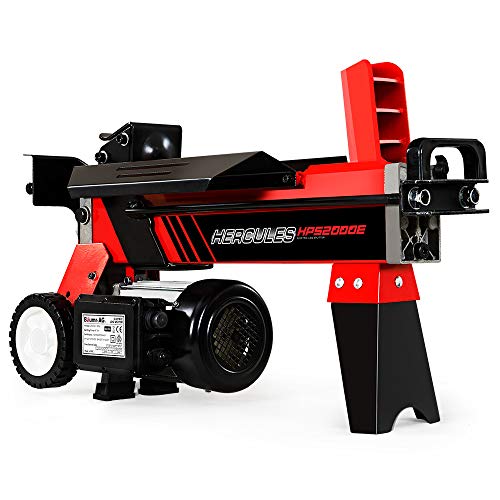
Baumr-AG 9 Tonne Electric Hydraulic Log Splitter HPS3200E
ASIN B0CGKBQXGM • $609.00 • Ships from Amazon AU
This is the splitter I'd point most households to first. It's the best-selling log splitter in Amazon AU's Outdoor Power Tools category at #731, it's sold and shipped by Amazon AU, and at $609 it sits in the sensible middle of the range. The listing rates it at 9 tonnes of splitting force, with a large encased hydraulic ram that takes logs up to 250mm wide and 520mm long. That covers most seasoned firewood cut to wood heater length. The model number on the listing is HPS3200E, and the part number matches the title, which is what I look for. It's electric, so there's no fuel, no fumes and no pull start, and you can run it under a carport or in an open shed.
The design is the classic horizontal beam with a hardened dual triangle wedge, which splits a round into four pieces in one pass on straight-grained wood. That cuts out a lot of second passes compared with a single flat wedge. The winged log catchers push the split halves upward instead of letting them drop or fly off the side, and they stop a round rolling off the beam. The listing calls the frame rugged and ultra-thick, which I'd read as marketing, but the weight backs it up a little at about 48kg. The listed dimensions come out at roughly 96cm long, 28cm wide and 52cm high, so it fits in a hatch or a small trailer easily.
What the listing doesn't state is the motor wattage or the cycle time, and those are the two things I'd want to know. Check the rating plate when it arrives and make sure your outdoor circuit and lead can carry it. Loosen the bleed screw before you start, and tighten it again before you move it. Keep the ram retracted in storage and wipe the rod with oil before winter. It's not the right machine for 300mm green hardwood, but for dry rounds at heater length it's the one I'd buy. It's the pick for most people with a wood heater and a normal woodpile.
Honest caveats: The motor wattage isn't stated on the listing, so check the rating plate against your circuit. The 250mm width limit rules out bigger rounds, and the listing gives no cycle time. It sits low on the ground, so you'll want a solid trestle to work at a comfortable height. The listing doesn't state the oil capacity or type either.
Best for: Most homes splitting seasoned firewood up to 250mm across at wood heater length.
Type: Electric hydraulic, horizontal • Force: 9 tonnes • Max log: 250mm wide, 520mm long • Wedge: Hardened dual triangle (four-way) • Weight: About 48kg • Model: HPS3200E • Seller: Amazon AU • Rank: #731 in Outdoor Power Tools (Amazon AU)
View on Amazon AU
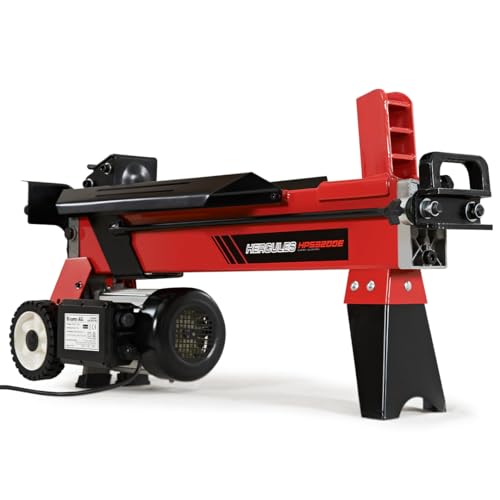
Baumr-AG 8 Tonne Electric Hydraulic Log Splitter
ASIN B08BTV62T8 • $529.00 • Ships from Amazon AU
If you only split a trailer load or two a year, this is the lowest-priced pick here at $529, and it's also sold and shipped by Amazon AU. It's rated at 8 tonnes, a tonne less than the lead pick, and it takes the same log size on the listing, up to 250mm wide and 520mm long. For seasoned softwood, dry gum and straight-grained rounds, that extra tonne rarely decides whether a log splits. Where you'll notice it is on knotty or green timber, which is when a smaller machine stalls with the ram halfway down. It's electric hydraulic like the lead pick, so it's quiet, there's no fuel to look after and you can use it under cover.
The listing describes the same layout as the 9 tonne, with a large encased hydraulic ram, a hardened dual triangle wedge and winged log catchers that push the split halves upward. The weight comes in at about 45kg, only a few kilos under the 9 tonne, so it isn't much easier to move around. The listing mentions Bulletproof Motor Technology but doesn't explain what that means or give a wattage, so I'd treat it as a name rather than a spec. The model number isn't given on the listing either, which makes ordering parts later a little harder. Write down the rating plate details when it arrives and keep the manual somewhere you'll find it.
It doesn't publish a category rank on Amazon AU at the moment, only a website-wide one, so it's selling far fewer than the 9 tonne model. That's no reason to avoid it, but the $80 gap to the lead pick is small for an extra tonne. Treat it the same way in storage: ram retracted, rod oiled, bleed screw tight and the oil checked each season. If your woodpile is mostly dry rounds under 250mm, it'll do the job fine. If you're unsure about the timber you'll get, I'd spend the extra on the 9 tonne.
Honest caveats: No category rank, no model number and no motor wattage on the listing. Same 250mm width limit as the lead pick with a tonne less force, so it stalls sooner on knotty or green hardwood. It sits low, so plan on a solid trestle. Check the rating plate against your outdoor circuit before the first start.
Best for: Occasional splitting of dry, straight rounds under 250mm at the lowest price here.
Type: Electric hydraulic, horizontal • Force: 8 tonnes • Max log: 250mm wide, 520mm long • Wedge: Hardened dual triangle (four-way) • Weight: About 45kg • Model: Not stated on the listing • Seller: Amazon AU • Rank: #71,299 overall on Amazon AU
View on Amazon AU
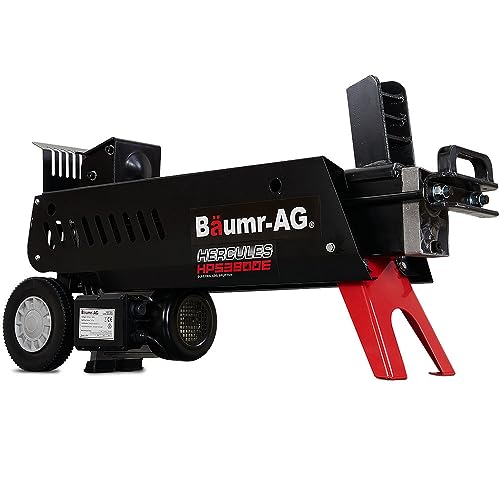
Baumr-AG 10 Tonne Electric Hydraulic Log Splitter HPS3800E
ASIN B0CCNNXD2Z • $759.00 • Sold by EdisonsDirect on Amazon AU
This is the electric splitter I'd move up to if your rounds are bigger than 250mm. It's rated at 10 tonnes, and the listing says it takes logs up to 320mm in diameter and 520mm long, which is the real reason to pay $759 for it. That extra 70mm across the face covers a lot of the bulk firewood loads that turn up from suppliers, especially red gum and box. It's sold by EdisonsDirect, which is Edisons, the Australian tool and machinery retailer that sells the Baumr-AG range. It ranks #1,545 in Amazon AU's Outdoor Power Tools category. The model number HPS3800E matches across the title and the part number, which is the check I make on every pick.
The listing adds a mobile base for transport and storage, which matters because this one's heavy at about 74kg. That's a lot more than the 9 tonne's 48kg, and the wheels make the difference between moving it on your own and needing two people every time. It uses the same hardened dual triangle wedge and an encased hydraulic ram, and the listing says it's suitable for use outdoors or in enclosed areas because there are no fumes. The listed dimensions come out at roughly 111cm long, 28cm wide and 53cm high. Like the other Baumr-AG electrics, the listing doesn't give a motor wattage or a cycle time, so check the rating plate.
A 10 tonne electric pulls more current than the 8 or 9 tonne models in my experience, so the extension lead matters even more here. Keep it short and heavy, unroll it fully, and don't share the circuit with anything else while you're splitting. Check the oil level before the first use each season and look for weeping around the ram. Store it level with the ram retracted and the bleed screw tight. Grease the wheels on the base now and then so they don't seize in the shed. It isn't fast, but for bigger rounds on mains power it's the pick I'd make.
Honest caveats: No motor wattage or cycle time on the listing, and a bigger electric motor is harder on long thin extension leads. At about 74kg it needs the wheels or two people. It's sold by EdisonsDirect rather than Amazon AU, so returns go through that seller's process. The listing doesn't state the oil type.
Best for: Bigger rounds up to 320mm across, split on mains power under cover.
Type: Electric hydraulic, horizontal • Force: 10 tonnes • Max log: 320mm diameter, 520mm long • Wedge: Hardened dual triangle (four-way) • Weight: About 74kg • Extras: Mobile base • Model: HPS3800E • Seller: EdisonsDirect • Rank: #1,545 in Outdoor Power Tools (Amazon AU)
View on Amazon AU
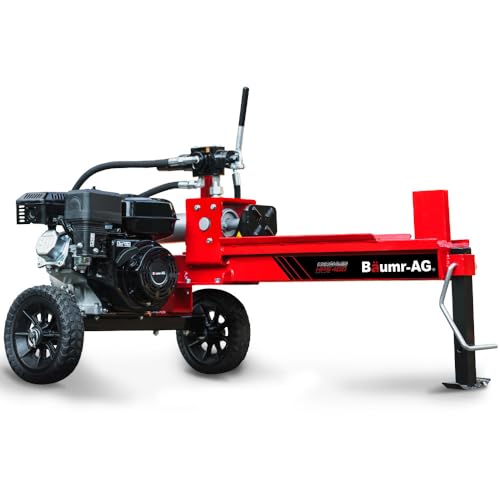
Baumr-AG 12 Tonne Petrol Hydraulic Log Splitter HPS400
ASIN B0D5984SJ6 • $889.00 • Ships from Amazon AU
If you're splitting out in the paddock, a long way from a power point, this is the pick. It's a petrol hydraulic splitter rated at 12 tonnes, with what the listing calls a 7.0hp four-stroke engine, and it's sold and shipped by Amazon AU for $889. It ranks #1,479 in Amazon AU's Outdoor Power Tools category. The listing gives a 14.5 second cycle time and says it takes logs up to 490mm long, which is a little shorter than the electric models' 520mm, so check that against your firewood. It doesn't give a maximum diameter. The extra force is what you're paying for, and it helps most on knotty, forked or green hardwood that stalls the smaller electric machines.
The listing describes an integrated log cradle, which catches the split pieces and stops rounds rolling off the beam. The weight comes in at about 72kg, and the listed dimensions work out to roughly 138cm long, 70cm wide and 79cm high, so it's a big machine to store and you'll want help loading it. Because it's petrol, it runs anywhere, but it's loud and it makes exhaust, so it's strictly an outdoor tool. It needs engine oil, fuel and the occasional spark plug as well as hydraulic oil, which is more to look after than the electrics. The listing doesn't name the engine maker, so ask the seller before you need a carburettor or a recoil starter.
Look after the fuel and this engine should start every autumn. Use fresh premium unleaded, avoid E10 if you can, and drain the tank or run the carburettor dry before you store it. Check the engine oil every time you fill up. The model number HPS400 is on the title, but no part number is listed. Keep the air filter clean too, because sawdust clogs it quickly. For property owners with acreage and a big woodpile, the extra force and freedom from a power lead are worth the work. For a suburban backyard, I'd stick with electric.
Honest caveats: The engine maker, fuel tank size and maximum log diameter aren't stated on the listing. The 490mm length limit is shorter than the electric picks. It's loud, makes exhaust and must be used outdoors. Stale fuel over summer is the most common reason these won't start, so drain or run it dry before storage.
Best for: Acreage and paddock splitting, away from power, on knotty or green hardwood.
Type: Petrol hydraulic, horizontal • Force: 12 tonnes • Engine: 7.0hp four-stroke (maker not stated) • Max log: 490mm long (diameter not stated) • Cycle time: 14.5 seconds • Weight: About 72kg • Model: HPS400 • Seller: Amazon AU • Rank: #1,479 in Outdoor Power Tools (Amazon AU)
View on Amazon AU
Forestwest 11130S 12 Ton Kinetic Log Splitter on Stand, 1800W Electric
ASIN B0DD71ZFW2 • $979.00 • Sold by Forestwest Australia on Amazon AU
This is the fastest machine here by a long way, and it's the one I'd look at if you split a lot of wood each year. It's a kinetic splitter, so there's no hydraulic pump or oil. An 1,800W electric motor spins up flywheels and the stored energy drives the rack forward, with a listed average cycle time of 2 to 3 seconds. That's against 14.5 seconds for the petrol Baumr-AG. It's rated at 12 tons of force and sold by Forestwest Australia for $979, ranked #2,402 in Amazon AU's Outdoor Power Tools category. The listing says it was tested on Jarrah, Stringybark and Yellow Box, which is a fair sign the seller has Australian hardwood in mind.
The 11130S comes on a waist-high stand with wheels, which means you're not lifting every round off the ground or bending over the controls. The weight comes in at about 76kg, and the listed dimensions work out to roughly 159cm long, 51cm wide and 96cm high on the stand. There's a sibling listing, the Forestwest 11130 without the S, which drops the full stand for a lower price, and the model numbers on the two listings (BM11130S and BM11130) match their titles. The 1,800W motor rating is stated, which is more than the Baumr-AG electrics give you, and at roughly 33c per kWh it costs about 59c an hour to run flat out.
The listing doesn't state a maximum log diameter or length, and it notes that split capacity varies with wood species, so measure your rounds against the stand once it's assembled. The rack and clutch are the wear parts, so keep the rack clean and greased. Speed is the risk with kinetics, so never defeat the two-handed control. The listing claims low maintenance, which is fair for hydraulics, but not mechanical wear. If you split several trailer loads a season, the time you get back is real. For one or two loads, the 9 tonne electric is plenty.
Honest caveats: Maximum log diameter and length aren't stated on the listing. Kinetic machines move fast, so the two-handed control matters more here than on the hydraulics. At 1,800W it needs a heavy, short lead on a circuit with nothing else running. It's sold by Forestwest Australia, not Amazon AU, so returns go through that seller.
Best for: People splitting several loads a year who want fast cycles at working height.
Type: Kinetic (flywheel), electric • Force: 12 tons (kinetic) • Motor: 1,800W • Cycle time: 2 to 3 seconds • Stand: Waist-high, with wheels • Weight: About 76kg • Model: BM11130S • Seller: Forestwest Australia • Rank: #2,402 in Outdoor Power Tools (Amazon AU)
View on Amazon AUSide-by-side comparison
| Product | Price | Best for |
|---|---|---|
| Baumr-AG 8 Tonne Electric Hydraulic Log… | ~$529 | |
| Baumr-AG 9 Tonne Electric Hydraulic Log… | ~$609 | |
| Baumr-AG 10 Tonne Electric Hydraulic Log… | ~$759 | |
| Baumr-AG 12 Tonne Petrol Hydraulic Log… | ~$889 | |
| Forestwest 11130 | ~$919 | |
| Forestwest 11130S | ~$979 |
What we see fail in the workshop: log splitters
Log splitters aren't electronics, but their motors, switches and controls end up on our counter more often than you'd expect, usually in autumn when someone pulls theirs out of the shed for the first time. Most of the faults come from storage, leads and oil rather than the machine wearing out. The good news is that most of them are worth fixing, and the checks below are the ones we start with.
Motors that hum and won't start
The most common electrical fault on electric hydraulic splitters is a motor that hums but won't turn, or trips the safety switch as soon as you press start. On single-phase induction motors that's usually the start capacitor or the motor's overload switch, not the windings. It's often brought on by long thin extension leads that starve the motor of voltage, especially on cold mornings when the oil is thick. Stop trying to start it the moment it hums, because each attempt heats the windings, and get the capacitor checked before it turns into a rewind.
Oil leaks and a weak ram
A ram that stalls on logs it used to split, with oil weeping around the cylinder, is a seal fault. Sometimes it's simply low oil from a bleed screw left loose in transport, which is an easy fix: top it up with the oil the manual specifies and bleed the air out. If the oil is milky, water has got into the tank and the oil needs changing before you run it again. A seal that's actually failed needs replacing, and the rust on an exposed ram rod is usually what chewed it.
Switches, controls and the cord
The two-handed switch takes a lot of abuse, from dirt, sawdust and being knocked around in a ute, and a worn switch can cut out mid-stroke or refuse to engage. The power cord is the other weak point, usually where it's been run over, crushed in a shed door or cut on the frame. A damaged cord on a metal-framed machine in wet conditions is a real electrical risk, so stop using it and have it replaced properly rather than taped up. Keep the switch housing clean and dry in storage.
Decision tree: which one should you actually buy?
- Splitting dry firewood under 250mm across for a wood heater? → The Baumr-AG 9 tonne HPS3200E at $609, sold by Amazon AU, is the one I'd buy.
- Only a load or two a year and want to spend the least? → The Baumr-AG 8 tonne at $529 takes the same 250mm rounds with a tonne less force.
- Your rounds are bigger than 250mm across? → The Baumr-AG 10 tonne HPS3800E at $759 takes logs up to 320mm in diameter on mains power.
- Splitting out in the paddock with no power nearby? → The Baumr-AG 12 tonne petrol HPS400 at $889 has the most force and needs no lead.
- Splitting several trailer loads a season and want it done faster? → The Forestwest 11130S kinetic at $979 cycles in 2 to 3 seconds and sits at working height.
- Your splitter hums, trips the safety switch or won't start? → Stop trying to start it and bring it into our Erina workshop, and we'll tell you whether it's the capacitor, switch or motor before you spend anything.
Frequently asked questions
How many tonnes of log splitter do I need?
It depends on the size and type of wood more than anything else. For dry, straight-grained rounds under 250mm across, 8 or 9 tonnes is usually plenty. For knotty, forked or green hardwood, or rounds around 300mm, I'd look at 10 to 12 tonnes or a kinetic machine. Measure the five fattest rounds in your pile across the face and along the length, then check the maximum log size on the listing, because a splitter that won't take the round is no use whatever its tonnage.
Can I run an electric log splitter on a normal power point?
Yes, the machines here plug into a standard 10 amp Australian power point, but the motor draws a lot of current at start-up. Use the shortest heavy-duty extension lead that reaches, unroll it fully, and don't run anything else on the same circuit while you split. Never use a powerboard. A long thin lead drops voltage and makes the motor run hot, which is the most common cause of motor and capacitor faults on these machines.
Are kinetic log splitters better than hydraulic ones?
They're much faster, with the Forestwest listings quoting 2 to 3 seconds a cycle against around 14.5 seconds for the petrol Baumr-AG hydraulic. There's no hydraulic oil or seals to leak. The trade-off is mechanical wear on the rack, gears and clutch, and the speed means the two-handed control matters even more. If you split a lot of wood each year, the time you get back adds up. For a load or two a season, a hydraulic electric is simpler and costs less.
Why is my hydraulic log splitter leaking oil?
The most common cause is a bleed screw on the oil filler cap left loose during transport, which lets oil escape. If the splitter was run with the screw tight, pressure in the tank can push oil past the seals. Oil weeping around the ram itself, along with a weaker push, usually means the ram seal is wearing. Check the oil level and colour first. Milky oil means water has got in and the oil needs changing before you run it again.
Should I buy a petrol or electric log splitter?
Electric suits most suburban homes, because it's quiet, has no fuel to go stale and can run under a carport. Petrol suits acreage where you're splitting far from a power point, and it usually gives you more force, like the 12 tonne Baumr-AG. The catch is the engine: stale fuel, carburettor blockages and oil changes. If you have power within a short lead's reach of your woodpile, I'd go electric.
How do I store a log splitter over summer?
Store it level and under cover, with the ram fully retracted so the polished rod isn't exposed. Wipe a thin film of oil on any exposed rod to stop rust, tighten the bleed screw, and check the hydraulic oil level and colour before the next season. For a petrol machine, drain the fuel or run the carburettor dry. Don't wrap it tightly in plastic, because that traps condensation against the steel.
Related buying guides
Log splitter humming but not starting?
Most electric splitters that stop working have a tired start capacitor, a worn switch or a damaged cord, not a dead motor. Bring yours into our Erina workshop and we'll check those first and tell you what's wrong and whether it's worth fixing before you spend anything on a new one.
Visit our Erina workshop Book Online