Prices from Amazon AU, updated daily. Swipe or use the arrows for more.
Disclosure: This article contains affiliate links to amazon.com.au. If you buy through one of these links iFix may earn a small commission at no extra cost to you. It doesn't change which products we recommend. We focus on what actually lasts based on 16 years of repair-shop experience.
Quick summary7 picks
- Entry PickCostway Towel Warmer for Bathroom about$97
- Costway Towel Warmer about$110
- Goldair Free Standing Heated Towel Rail about$119
- Decaura Vertical Heated Towel Rail about$13027W.
- Costway 35L Large Towel Warmer Bucket about$170
- Decaura 7-Bar Heated Towel Rail about$18095W.
- Most PremiumCOZI 6 Bars Heated Towel Rail for Bathroom… about$199200W.
What a heated towel rail actually does
A heated towel rail is a very small heater shaped like a ladder. It warms a towel enough to dry it between showers, and it takes the chill off one corner of the bathroom, but it won't heat the room. That's the first thing to get straight, because people sometimes buy one expecting it to replace a bathroom heater and then wonder why the room's still cold. The rails in this guide draw between 27 and 200 watts, which is a fraction of a 2,000W fan heater.
What they're good at is getting rid of damp towels. A towel that stays wet on a normal rail in a bathroom with poor airflow starts to smell musty within a day or two, and the moisture it gives off ends up on the ceiling, the grout and the window frames. A heated rail dries it in a few hours. In a house where the bathroom has no window or the exhaust fan is weak, that makes a real difference to the mould on surfaces and the mildew smell.
There are two common types. Wall-mounted ladder rails are the traditional kind, and freestanding rails sit on the floor with a stand, which suits renters because there's no drilling. A third option, the towel warmer bucket, heats a rolled-up towel or a robe inside a lidded tub, and it's for warmth rather than drying. I've included one of each, because they solve slightly different problems.
The four picks run from $110 to $199 on Amazon AU at time of writing. None of them is sold by Amazon AU itself. Two Decaura rails and the COZI are sold by Australian marketplace sellers, and the Costway bucket is sold by Costway's Australian store. I've judged them on install type, IP rating, compliance marks, wattage, controls and what wears out.
Plug-in or hardwired, and when you need an electrician
This is the decision that matters most. A plug-in rail runs off a normal power point, so you can fit it yourself, but the cord has to reach a socket, and the cord then runs down the wall where it can be splashed, pulled or caught. A hardwired rail is connected straight into the house wiring behind the wall, usually through a switch or a timer, so there's no cord at all and nothing to unplug.
In New South Wales and the rest of Australia, hardwiring anything into the fixed wiring is licensed electrical work, so it has to be done by a licensed electrician. That's not a box to tick, it's the law, and it's also what keeps the install safe and your home insurance intact. Expect to pay for a call-out on top of the rail, and more if a new circuit or switch has to be run through the wall or ceiling.
The two Decaura rails in this guide support both methods. Their listings say plug-in or hardwired, with hardware and instructions included and professional installation recommended for hardwiring. That's a useful option, because you can run it on a plug now and have an electrician hardwire it later, say when the bathroom gets renovated. The COZI is freestanding and the Costway bucket sits on a shelf or the floor, so both are plug-in only.
Power points in bathrooms are restricted under the wiring rules, and they usually have to sit well away from the bath and shower. In plenty of older Australian bathrooms that means the only socket is beside the vanity, and that's often what decides where a plug-in rail can go. If the cord won't reach the spot you want without an extension lead, don't use one. Get the rail hardwired or pick a different spot.
IP ratings: IP55 against IPX4
IP ratings tell you how well an appliance keeps out dust and water. The second digit is the water part. IPX4 means it's protected against splashing water from any direction, and IP55 means it's protected against dust and against low-pressure water jets. The X in IPX4 just means the dust part wasn't tested.
The two Decaura rails are listed at IP55, which is the stronger rating here and the one I'd want on a rail that's fixed to a bathroom wall. The COZI freestanding rail is listed at IPX4. The Costway bucket's listing doesn't state an IP rating at all, which is a reason to keep it away from the shower and out of the splash zone around a bath or basin.
An IP rating isn't permission to put a rail anywhere. The wiring rules divide a bathroom into zones around the shower and bath, and what's allowed in each depends on the rating and the type of connection. An electrician will know where a hardwired rail can go. For plug-in rails, the simple rule is to keep the rail and its plug out of reach of anyone standing in the shower or bath.
What they cost to run
Towel rails cost very little per hour, but people leave them on all day, which is where the cost adds up. At an Australian average tariff of roughly 33c per kWh, the Decaura 7-bar at its listed 95W costs about 3c an hour. Left on 24 hours a day, that's about 75c a day or roughly $23 a month. The Decaura vertical at 27W costs under 1c an hour, about 21c a day if it never turns off.
The COZI is listed at 200W, so it's about 6.6c an hour flat out, but its built-in timer runs from 2 to 12 hours, which caps how long it stays on. The Costway bucket's listing doesn't state its wattage, but it has a 1-hour auto shut-off, so it's only on while you're using it. Those figures assume each rail draws its full listed wattage the whole time, which a rail with a thermostat won't, so treat them as a ceiling.
The easiest way to cut the cost on a plug-in rail without a timer is a smart plug with a schedule. Set it to run for two hours after your morning and evening showers, and you'll dry the towels for a fraction of the all-day cost. For a hardwired rail, ask the electrician to fit a timer switch at the same time, since retrofitting one later means another call-out.
A quick note on wattage claims. Some towel rail listings describe themselves as energy saving or quote a daily figure without explaining it, so I've worked from the stated wattage where there is one. If a listing doesn't give a wattage at all, it's worth asking the seller before you buy, because it's the only number that tells you the real running cost.
Ladder rails, freestanding rails and buckets
A wall-mounted ladder rail is the neatest option and the one that dries towels best, because the towel hangs flat against the warm bars. The Decaura 7-bar is 600mm wide and 800mm high, which takes a couple of bath towels side by side. It mounts on the wall with the supplied hardware, so you'll be drilling into tiles, and that's worth doing carefully with a tile bit so you don't crack one.
For small bathrooms or a spot beside the vanity, the Decaura vertical is a single 900mm rail with two hooks. It won't dry a big bath towel as evenly, but it takes up very little wall space and draws only 27W. The listing also mentions a power switch at the bottom, so you can turn it off without reaching for the plug.
A freestanding rail like the COZI suits renters and anyone who doesn't want to drill tiles. It's light and moves around easily, which is the upside and the downside. A freestanding rail on a wet floor can tip, and its cord runs across the floor to the socket, so put it on a dry, level spot and keep the cord out of the walkway.
A towel warmer bucket is a different idea. You roll a towel or a robe into the tub, close the lid, and a heated liner warms it through for a set time. Most buckets, including the Costway pick here, are for having a hot towel ready after a winter shower rather than drying a damp one, though a few larger models add a drying mode. None of them does anything for the mould on the ceiling. If damp is the real problem, a dehumidifier is a better spend.
Compliance marks and what to look for on the listing
Electrical products sold in Australia need to meet our safety standards, and the mark that shows it is the RCM, the tick inside a triangle. You'll also see SAA approval numbers on many heaters and rails. The Decaura 7-bar listing states SAA certification, and the Costway bucket's listing says it's certified with SAA. The Decaura vertical and the COZI listings don't mention a compliance mark, so look for the RCM on the rating plate when the rail arrives.
Check the plug and voltage too. The Decaura listings quote 230V, and the COZI and Costway model codes end in AU, which is usually the Australian version. I left out several rails from overseas-looking sellers whose listings didn't state a voltage or a plug type, and one bucket whose part number ended in EU and carried a US certification. A rail with the wrong plug and an adaptor in a bathroom is exactly the setup I'd avoid.
Read the dimensions against the title, as well. One COZI listing puts 100 x 60cm in the title while its own feature list says 95 x 60cm, so I've used the white version, whose title and features agree. Small mismatches like that usually mean a copied listing, and they're worth checking before you drill holes based on the numbers.
Stainless steel against aluminium
The Decaura rails are listed as rust-resistant stainless steel, and the COZI is listed as corrosion-resistant aluminium. Both are fine in a bathroom. Stainless is heavier and usually feels more solid on the wall, while aluminium heats and cools faster and suits a freestanding rail that you'll move around.
What actually corrodes is the finish and the fittings rather than the bars. Painted and powder-coated rails can chip where a towel hook rubs, and once the coating's broken the metal underneath can stain. Brushed finishes like the Decaura's brushed nickel hide water marks better than gloss white or black, which show every splash.
Whatever the metal, wipe the rail down with a soft damp cloth and never use abrasive cleaners or bleach-based sprays on it. Those dull the finish and can get into the switch and the cord entry, which is where moisture causes the faults that bring rails in.
Getting the size and spot right
Measure before you buy. A rail needs room for a towel to hang without touching the floor, the toilet or the vanity, and it needs to be away from the door swing. The listing dimensions for the Decaura 7-bar are 600mm wide, 800mm high and 122mm deep, so check that depth against the space between the wall and the vanity edge, because a rail that sticks out 12cm in a tight bathroom gets bumped.
Think about what you'll hang on it. One bath towel per person dries well on a 600mm ladder rail. A family of four will want two rails or a bigger one, and a vertical rail suits one hand towel and a face washer. A freestanding rail like the COZI at 95 x 60cm holds a couple of towels and moves to the laundry on washing day.
Finally, consider the rest of the room. A towel rail helps with damp towels, but it won't fix a bathroom with no ventilation. If the ceiling's growing mould, run the exhaust fan for 15 minutes after a shower and look at the fan's flow. For actual room heating in winter, an oil column heater or a proper bathroom heater does that job, and if water ever gets into the switch or plug of any appliance, read what water does to electronics before you turn it back on. If a rail stops working, our Erina workshop can tell you whether it's the switch, the cord or the element.
The 4 picks, $110 to $199
Prices are Amazon AU at time of writing (5 November 2026) and move week to week. Ranks are Amazon AU category sales ranks, checked the same day.

Decaura 7-Bar Heated Towel Rail, 95W, IP55, Plug-in or Hardwired, 600 x 800mm
ASIN B0DS1W98Z6 • $179.98 • Sold by Decaura-Home on Amazon AU
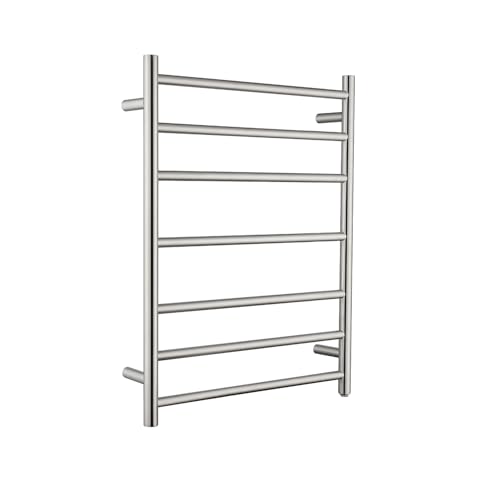
The Decaura 7-Bar is the rail I'd put in most bathrooms, and it's #17 in Amazon AU's Towel Racks category at time of writing, a rank its listing shares with the other Decaura sizes and colours. This version is $179.98, sold by Decaura-Home, a marketplace seller on Amazon AU. The listing quotes 230V and 95W, an IP55 rating and SAA certification, which is more compliance detail than most rails on Amazon AU give. It's 600mm wide, 800mm high and 122mm deep, in rust-resistant brushed stainless steel with round bars. The model is listed as Freerail. It's the best-ranked rail I found on Amazon AU that also states its wattage, IP rating and compliance mark.
What sets it apart is that it supports both plug-in and hardwired installation, with hardware and instructions in the box. You can run it from a power point now and have an electrician hardwire it later, and the listing recommends professional installation for the hardwired option. Seven bars take two bath towels side by side, and the listing says it warms towels in about 20 minutes. At 95W it costs about 3c an hour at 33c per kWh, so even on all day it's well under a dollar. Other sizes and finishes are listed separately, including a 5-bar in matt black. Those sibling listings vary in price by more than you'd expect, so check them all before you order.
The listing doesn't mention a switch, timer or thermostat on this model, so plan on a timer. For a plug-in setup that's a smart plug, and for a hardwired one it's a timer switch fitted by the electrician. Drill the tiles with a proper tile bit and use the wall plugs that suit your wall, since a heavy rail on loose fixings works itself out. Wipe it with a damp cloth only. The seller lists no warranty term, so ask before you buy. For a fixed rail with the stronger IP rating, it's the one I'd buy.
Honest caveats: The listing doesn't mention a switch, timer, thermostat or warranty term, so you'll need a timer to control running cost. Its rank is shared across every Decaura size and colour, so it isn't this model's own figure. It's sold by a marketplace seller rather than Amazon AU, and hardwiring needs a licensed electrician.
Best for: Most bathrooms where you want a proper wall rail that can be hardwired later.
Bars: 7, round • Size: 600W x 800H x 122D mm • Power: 95W, 230V (listed) • Install: Plug-in or hardwired • IP rating: IP55 • Compliance: SAA certification (listed) • Material: Brushed stainless steel • Seller: Decaura-Home • Rank: #17 in Towel Racks (Amazon AU), listing shared with other Decaura sizes
View on Amazon AU
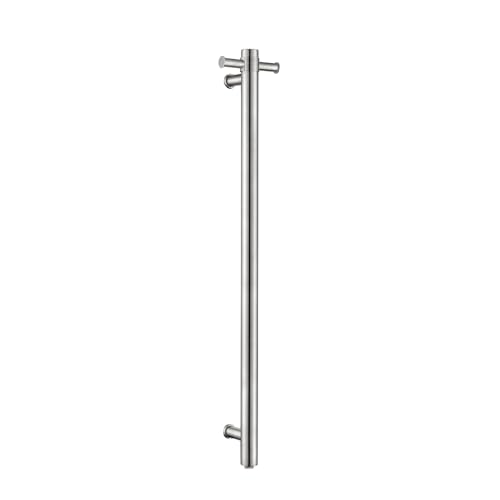
Decaura Vertical Heated Towel Rail 900mm, 27W, IP55, Dual Hooks
ASIN B0DS1W2G26 • $129.99 • Sold by Decaura-Home on Amazon AU
The Decaura Vertical is the pick for small bathrooms, ensuites and the narrow strip of wall beside a vanity. It's $129.99 on Amazon AU at time of writing, sold by Decaura-Home, and it carries the same #17 rank in the Towel Racks category because the listing is shared with the other Decaura rails. It's a single 900mm vertical rail with dual hooks, so you can hang two towels side by side. The listing quotes 230V and 27W, an IP55 rating and rust-resistant stainless steel in a brushed nickel finish. The model is listed as Freerail, the same as the 7-bar. At about a metre of wall height it fits where a ladder rail won't, including behind a door.
The 27W rating makes it the lowest-powered rail here. At 33c per kWh it costs under 1c an hour, or about 21c a day if it's never switched off, so running cost isn't really a concern. Like the 7-bar it supports both plug-in and hardwired installation, with hardware and instructions included and professional installation recommended for hardwiring. The listing also mentions a power switch at the bottom, so you can turn it off without unplugging it, which makes it easier to live with than a rail with no switch at all. Mount it with the switch end down and clear of the floor, so splashes from mopping don't reach it.
A single rail with hooks won't dry a big bath towel as evenly as a ladder, because the towel bunches. It suits hand towels, face washers and one bath towel folded over. The listing doesn't mention SAA certification the way the 7-bar's does, so check the rating plate for the RCM mark on arrival. It doesn't state a warranty either. Keep the switch dry and wipe the rail with a damp cloth only. Mount it high enough that a hanging towel clears the floor. If you only need to dry one or two towels, it's the one I'd buy.
Honest caveats: A single rail with hooks dries towels less evenly than a ladder rail. The listing doesn't mention SAA certification, a thermostat or a warranty term. Its rank is shared with every Decaura size, so it isn't this model's own figure. Hardwiring needs a licensed electrician.
Best for: Small bathrooms and ensuites where wall space is tight.
Type: Vertical single rail, dual hooks • Height: 900mm • Power: 27W, 230V (listed) • Install: Plug-in or hardwired • IP rating: IP55 • Switch: Power switch at the bottom • Material: Stainless steel, brushed nickel • Seller: Decaura-Home • Rank: #17 in Towel Racks (Amazon AU), listing shared with other Decaura sizes
View on Amazon AU
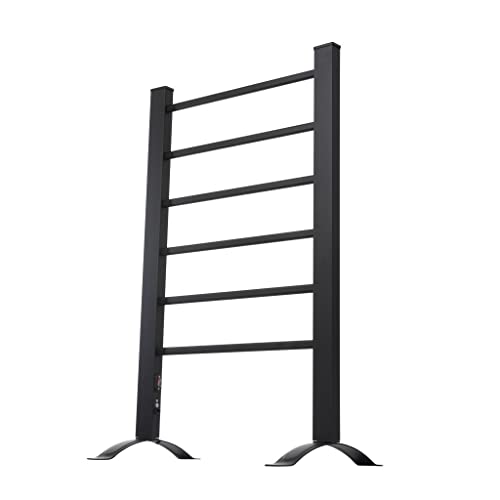
COZI 6-Bar Freestanding Heated Towel Rail, 200W, Timer, 95 x 60cm, White
ASIN B0GH7BJXX7 • $199.00 • Sold by AussieValue on Amazon AU
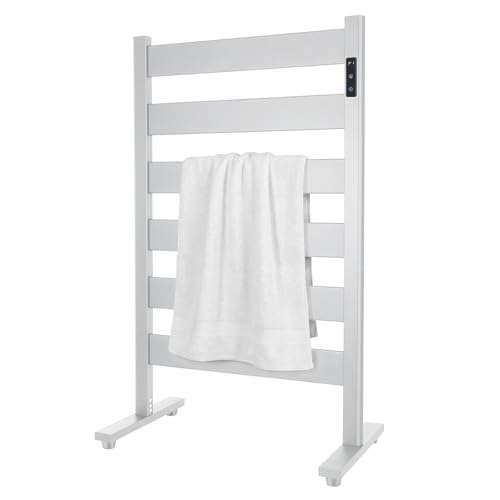
The COZI 6-Bar is the freestanding pick and the one I'd point renters at, because there's no drilling at all. It's $199 on Amazon AU at time of writing, sold by AussieValue, a marketplace seller, and it's #30 in Amazon AU's Towel Racks category. The listing quotes six wide bars on a 95 x 60cm frame, a 200W heating system, aluminium construction and an IPX4 rating. The model code is ASV-AU-FHTR-W-L, and the AU in it marks the Australian version. This is the white one. The black version is listed separately at $199.99, but its title says 100 x 60cm while its features say 95 x 60cm, so I've used the white listing.
The controls are the best in this guide. The listing describes three temperature settings, F1 to F3, covering 43°C to 77°C, and a timer that runs from 2 to 12 hours in 2-hour steps, with automatic shut-off. That timer matters more than the temperature range, because it stops the rail running all day. At 200W it costs about 6.6c an hour at 33c per kWh, so a 4-hour session is around 26c. The listing describes it as light and easy to move, which suits a bathroom, a laundry or a spare room on washing day. It also mentions a 1-year after-sales service. Because it's light, it also works as a drying rack for a few shirts in the laundry.
A freestanding rail can tip on a wet or uneven floor, so stand it on a dry, level spot away from the shower and keep the cord out of the walkway. The IPX4 rating covers splashes, not sitting in a puddle. The listing doesn't mention SAA or RCM approval, so check the rating plate on arrival. At 200W it's the most powerful rail here. Don't drape a wet bath mat over it, because water dripping onto the controls is the usual way these fail. If you can't drill your tiles, it's the one I'd buy.
Honest caveats: A freestanding rail can tip, and its cord runs across the floor to the power point. The listing doesn't mention SAA or RCM approval, so check the rating plate. IPX4 is a splash rating, a step below the Decaura rails' IP55. It's sold by a marketplace seller with a 1-year after-sales service rather than a stated warranty.
Best for: Renters and anyone who doesn't want to drill bathroom tiles.
Bars: 6, freestanding • Size: 95 x 60cm (listed) • Power: 200W (listed) • Temperature: 43°C to 77°C, 3 settings • Timer: 2 to 12 hours, auto shut-off • IP rating: IPX4 • Model: ASV-AU-FHTR-W-L • Seller: AussieValue • Rank: #30 in Towel Racks (Amazon AU)
View on Amazon AU
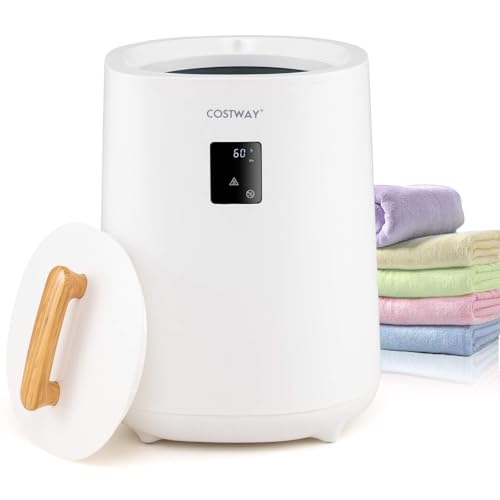
Costway 18L Towel Warmer Bucket with LED Display and Auto Shut-off
ASIN B0FXLQ2B8R • $109.95 • Sold by COSTWAY-AU on Amazon AU
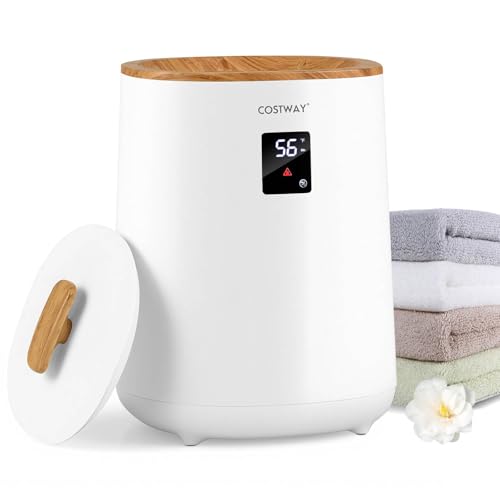
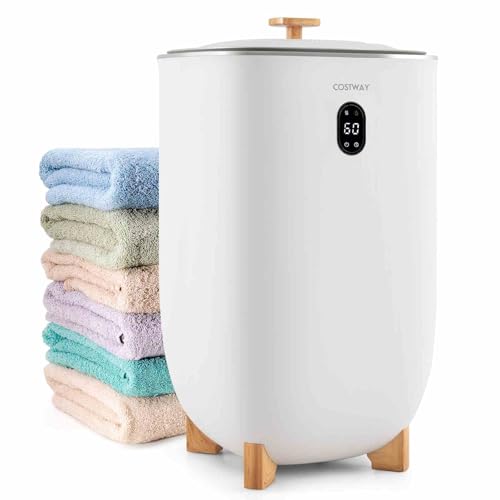
The Costway 18L is a towel warmer bucket rather than a rail, and it's here for people who want a hot towel or robe after a winter shower rather than a dry one. It's $109.95 on Amazon AU at time of writing, sold by COSTWAY-AU, Costway's Australian store, and it ranks #1,167 in Amazon AU's Bathroom Accessories category. The model code is CCWHW10553SE-AU. The listing quotes an 18 litre capacity that fits up to two large bath towels, a zinc-coated metal liner, and heating up to 128°C in as little as 8 minutes. It's the least expensive pick here, and Costway is a large homewares brand with its own Australian storefront, so returns go through an Australian seller.
Safety detail is better than most buckets on Amazon AU. The listing says it's certified with SAA and has a thermostat, built-in fuses and overheat protection, plus an auto shut-off after one hour. An LED display shows the elapsed time and the real-time temperature, and it starts with a single button. There's a fragrance disc holder under the lid, though the disc isn't included. I left out a 23 litre Costway bucket because its part number ended in EU and its listing quoted a US certification, so this is the one with Australian codes. It's light enough to sit on a shelf in the bathroom or a bedroom, and it doesn't need a wall or a power point near the shower.
The listing is clear that you shouldn't heat anything wet in it, which rules out drying a damp towel. It's for warming dry ones. It doesn't state its wattage or IP rating, so keep it well away from the shower and the bath, and on a stable surface. The 1-hour auto shut-off keeps running cost low. Don't block the vents, and unplug it before you wipe the liner. Let the liner cool before you put the lid away. For a warm towel on a cold morning rather than drying, it's the one I'd buy.
Honest caveats: It warms dry towels and robes only, and the listing warns against heating anything wet, so it won't help with damp towels or mould. The wattage and IP rating aren't stated on the listing. The fragrance disc isn't included. Its rank is in a broader Bathroom Accessories category, so it isn't directly comparable with the rails.
Best for: People who want a hot towel or robe after a winter shower.
Type: Towel warmer bucket • Capacity: 18L, up to 2 bath towels • Max temperature: 128°C (listed) • Shut-off: Auto after 1 hour • Display: LED, time and temperature • Compliance: SAA certified (listed) • Model: CCWHW10553SE-AU • Seller: COSTWAY-AU • Rank: #1,167 in Bathroom Accessories (Amazon AU)
View on Amazon AUSide-by-side comparison
What we see fail in the workshop: heated towel rails and warmers
Towel rails are simple appliances, and the heating element usually outlasts everything around it. What fails is the stuff that lives closest to the water: the switch, the cord entry and the plug. A bathroom is the harshest place in the house for electrics, because steam condenses into every gap, and the faults below come from that. Almost all of them start with a little moisture getting somewhere it shouldn't, over a few winters.
Switches and controls
The rocker switch or control panel is the weak point on most plug-in rails. Steam gets behind it, condenses, and over a few winters the contacts corrode until the switch gets hot, crackles or stops working. On freestanding rails with a touch panel, water dripping from a towel onto the controls does the same thing faster. If a switch ever feels warm or smells hot, stop using the rail and have it checked, because a failing switch carrying current in a wet room is not a fault to ignore. A replacement switch is usually a small part, so it's often worth fixing.
Cords, plugs and power points
Plug-in rails put a cord and a plug in a bathroom, and both take a beating. Cords get pulled when a towel is yanked off, and the strain relief where the cord enters the rail cracks, letting moisture in. Plugs left in a bathroom socket can show brown marks on the pins from corrosion. Check the cord and plug every few months, never use a double adaptor or an extension lead in a bathroom, and have the rail hardwired if the cord has to run across a wet area. A cord with cracked insulation should be replaced, not taped.
Elements and thermostats
When a rail stays cold with power at the switch, it's usually the element or a thermal cut-out. Dry rails use a heating cable through the bars and wet rails use a fluid fill with a cartridge element, and the listings here don't say which they use. A thermal fuse that's blown once often means the rail was covered or overheated, so don't stack wet towels three deep over it. On a rail under $200 an element fault usually costs more to fix than the rail is worth, so it's the switch and cord faults that are worth repairing. Check the rail is still under warranty before anything else.
Decision tree: which one should you actually buy?
- Want a proper wall rail that can be hardwired later? → The Decaura 7-Bar at $179.98, with IP55, SAA certification and plug-in or hardwired install.
- Small bathroom or ensuite? → The Decaura Vertical at $129.99. It's a single 900mm rail with two hooks that draws only 27W.
- Renting, or can't drill the tiles? → The COZI 6-Bar freestanding rail at $199, with three heat settings and a 2 to 12 hour timer.
- Want a hot towel after a winter shower rather than a dry one? → The Costway 18L towel warmer bucket at $109.95, with an SAA certification and a 1-hour auto shut-off.
- Damp bathroom with mould on the ceiling? → A rail dries towels, but the room needs ventilation. Run the exhaust fan longer, and look at a dehumidifier if the damp spreads.
- Rail switch crackling, cord damaged or not heating? → Stop using it and bring it to our Erina workshop, and we'll tell you whether it's the switch, the cord or the element before you spend anything.
Frequently asked questions
Do I need an electrician to install a heated towel rail?
Only if it's hardwired. Connecting anything into a home's fixed wiring is licensed electrical work in Australia, so a hardwired rail has to be installed by a licensed electrician. A plug-in rail just needs a suitable power point, and you can mount it yourself with the supplied hardware. The Decaura rails in this guide support both, so you can start with a plug and have them hardwired later. Ask the electrician to add a timer switch in the same visit.
How much does a heated towel rail cost to run?
It depends on the wattage and how long it's on. At roughly 33c per kWh, the 95W Decaura 7-Bar costs about 3c an hour, or about 75c a day if it runs nonstop. The 27W Decaura Vertical costs under 1c an hour. A 200W rail like the COZI is about 6.6c an hour. A timer or a smart plug that runs the rail for a couple of hours after showers cuts the cost a lot.
Will a heated towel rail heat my bathroom?
Not really. The rails in this guide draw 27 to 200 watts, while a typical bathroom or fan heater draws around 2,000W. A rail warms the towel and the wall around it, and in a small, closed bathroom you might notice a slight difference, but it won't heat the room on a cold morning. For that you need a proper heater rated for bathroom use, such as a ceiling heat lamp or a wall heater fitted by an electrician.
What IP rating should a bathroom towel rail have?
Higher is better. IPX4 means it's protected against splashing water from any direction, and IP55 adds dust protection and resistance to low-pressure water jets. The Decaura rails are listed at IP55 and the COZI at IPX4. The rating doesn't decide where a rail can go on its own, because the wiring rules set zones around the bath and shower, so keep any plug-in rail and its plug out of reach of the shower.
Can I leave a heated towel rail on all the time?
Most rails are designed to run for long periods, but leaving one on all day wastes power and wears the switch and element faster. A rail with a timer, like the COZI, or a plug-in rail on a smart plug schedule, gives you dry towels for a fraction of the cost. Never cover a rail with stacks of wet towels or a bath mat, because that traps heat around the element.
Is a towel warmer bucket better than a rail?
They do different jobs. A rail dries damp towels by spreading them over warm bars, which also cuts down on moisture in the bathroom. A bucket like the Costway 18L warms a dry towel or robe in a closed tub, so it's ready hot after a shower, and its listing warns against heating anything wet. If damp towels are the problem, buy a rail. If you want a hot towel in winter, the bucket is the one.
Related buying guides
Towel rail switch crackling or not heating?
Most towel rail faults we see are corroded switches, cracked cord entries and plugs damaged by bathroom steam, with the odd blown thermal fuse from a rail buried under wet towels. Bring it into our Erina workshop and we'll check the switch, cord and element, and tell you whether it's worth fixing before you spend anything.
Visit our Erina workshop Book Online