Prices from Amazon AU, updated daily. Swipe or use the arrows for more.
Disclosure: This article contains affiliate links to amazon.com.au. If you buy through one of these links iFix may earn a small commission at no extra cost to you. It doesn't change which products we recommend. We focus on what actually lasts based on 16 years of repair-shop experience.
Quick summary5 picks
- Entry PickGoplus Inflatable Kayak 2 Person about$140
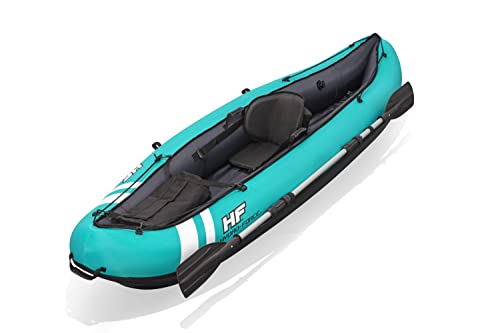
- BestwayBestway Hydro-Force Cove Champion X1 Kayak about$166
- INTEX 68307NP Explorer K2 Kayak about$199
- Costway Inflatable Kayak Set about$306
- Most PremiumBestway Ventura Kayak 2.80m x 86cm about$784
Why a repair shop is writing about inflatable kayaks
An inflatable kayak has no electronics in it, but it's the thing that most often puts a phone in the water on the Central Coast over summer. A lot of what comes through our door in January is a phone that went over the side on Brisbane Water, Avoca Lagoon or the Tuggerah lakes, or one that sat in a puddle in the bottom of a kayak all afternoon. So I've spent a fair bit of time talking to people about what they were paddling and how the phone ended up wet.
This guide covers recreational inflatable kayaks for one or two people, the kind you'd take on a lake, a lagoon or a calm river, deflate and put in the boot. It doesn't cover hard-shell kayaks, stand-up paddle boards or inflatable boats with oars. I've worked from what each Amazon AU listing says on the day I checked, and where a listing leaves something out, such as a warranty, a length or the number of air chambers, I've said so rather than guessing.
A few listings in this category are the same kayak under two names, with word-for-word feature text, and a couple of Bestway listings share one model number. Where that happened I kept one. I also left out an Intex listing whose model field named a different code from its title and part number, because I couldn't confirm which version would arrive. Some of these listings quote loads and lengths in pounds and feet as well as metric; a kayak has no plug, so that isn't the problem it is with an appliance, but I've given metric figures throughout.
Vinyl, laminated PVC and coated nylon: what the hull is made of
The hull material decides most of how an inflatable kayak behaves and how long it lasts. The lowest-priced kayaks use a single-layer vinyl or PVC, which is light and folds small but stretches when it's warm, so the kayak goes a little soft and floppy on a hot day. The Intex Explorer K2 uses what its listing calls rugged vinyl, and the Goplus calls its hull reinforced heavy-duty PVC.
A step up is laminated PVC with a mesh or fabric layer inside, which is what the Costway listing describes. The mesh stops the material stretching, so it holds its shape at higher pressure and feels stiffer on the water. Bestway's Inflata-Shield on the Cove Champion X1 is described the same way, as a material that resists punctures and limits stretching. The Bestway Ventura goes further with a coated nylon skin, which is tougher against scrapes from oyster beds and rocks, and that's mostly what its much higher price pays for.
None of these are drop-stitch kayaks, the type with a flat, board-stiff floor pumped to high pressure. Drop-stitch kayaks paddle more like a hard-shell, but they cost a lot more, and none of the listings in this band that passed my checks described one. If you're paddling a sheltered lagoon for an hour on a weekend, a well-made PVC kayak at these prices is enough for most people, and I'd spend the difference on a decent lifejacket and a dry bag instead.
One person or two, and what the load limit means
Three of the picks are sold as two-person kayaks and two are one-person. The stated loads range from 100kg on both Bestway one-seaters to 230kg on the Costway, with 181kg on the Intex K2 and 160kg on the Goplus. Read those numbers as everything in the kayak: both paddlers, the esky, the fishing gear and the dog. Two adults at 85kg each are already 170kg before anyone brings lunch.
A kayak loaded close to its limit sits low, takes on water over the sides in a bit of chop, and paddles slowly. I'd want a comfortable margin, so two average adults with gear are better off in the Costway than the Goplus, and a heavier single paddler should look at a two-person kayak and paddle it solo rather than squeezing into a 100kg one-seater. A two-person kayak paddled by one person is slower to turn but much more stable.
Two-person inflatables also need two paddlers who can coordinate, and new paddlers usually spend the first outing clashing paddles. If you mostly go out on your own, a one-seater is lighter to carry, quicker to pump up and easier to steer. If it's usually you and a partner or a child, the two-seaters make sense, and they're also handy for one adult with a big load of fishing gear.
Air chambers and valves: what keeps you afloat
Every inflatable kayak should have more than one air chamber, so that a puncture in one side doesn't sink the whole boat. The Costway and the Goplus listings both describe three separate chambers, and the Intex K2 describes high-buoyancy side chambers plus an inflatable I-beam floor. The Bestway listings don't give a chamber count, so check the manual. Pump them up in the order the instructions give, because the Goplus listing specifically says to inflate its valves in order 1, 2 and 3, and getting the order wrong can leave one chamber pressing against another.
Valves are the part I'd look at hardest. The Intex K2 uses Boston valves, a two-part screw valve that lets you pump fast and then cap it off, and the Bestway X1 lists an interlocking quick release valve. The Costway uses a spring-type valve with a pin that you set up or down, and it includes a pressure gauge with a maximum of 2.18 PSI on the listing. Sand in a valve seat is the most common reason I hear of an inflatable going soft over an afternoon, so rinse the valves and keep the caps on whenever the kayak is on the beach.
Pressure matters more than most people think. Under-inflated kayaks bend in the middle and paddle like a banana, and over-inflated ones strain the seams. On a hot day the air inside expands as the sun heats the hull, so a kayak pumped hard in the morning can be over pressure by lunchtime if it's left in full sun on the sand. Let a little out if it's sitting in the heat, and top it up again once you're on the water and the air has cooled.
Fins, skegs and why some kayaks won't go straight
The biggest complaint people have about an inflatable kayak is that it spins instead of going straight. A short, wide, flat-bottomed hull has very little to hold it on a line, so it turns a little with every stroke. A fin or skeg underneath the back of the kayak fixes most of that, and it's the single most useful part on the boat.
The Intex K2 has a removable skeg, the Costway comes with two fins, the Bestway X1 has removable fins you can swap for different water, and the Ventura comes with two removable fins. The Goplus 11.5 ft listing doesn't mention a fin in its feature text, only a streamlined hull, so check before you buy if tracking matters to you. Fins are also the part that gets lost or snapped, usually when someone drags the kayak up a boat ramp with the fin still on, so take it off before you pull the kayak onto sand or concrete and keep it in the carry bag.
Paddle technique matters too. A kayak that wanders is often being paddled with short, splashy strokes on one side. Longer, even strokes close to the hull, with the paddle blade fully in the water, keep most inflatables on a line in calm water. Four of the five listings say their paddles are aluminium (the Ventura's doesn't say), which is fine for a start, and a lighter paddle is the upgrade most people notice first.
Punctures, seams and sun: what leaks first
Punctures are less common than people expect. Most leaks I hear about come from the seams, the valves or a slow leak where a seat or a fitting is glued to the hull. Heat and UV are what weaken those glued joints, so a kayak left inflated on a hot deck or in the back of a ute for weeks will usually start leaking at a seam before it ever gets a hole in it.
Four of the five list a repair patch or kit in the box (the Goplus listing doesn't mention one), and the Costway kit also includes a valve wrench, which is handy because a valve that has worked loose is an easy fix if you've got the tool. To find a slow leak, pump the kayak up firmly and wipe soapy water over the seams and valves; bubbles will show you where the air is coming out. Patch on a dry, clean, warm surface, press it down firmly and give the glue the full time the instructions give before you go out again.
Oysters, rock shelves and fishing hooks are the real puncture risks around here. If you fish from the kayak, keep hooks and knives in a tackle box rather than loose in the bottom of the boat, and watch where you beach it. Paddling over shallow oyster beds at low tide is how most of the holes I've seen happened, and the coated nylon on the Ventura is the hull here best suited to that kind of water.
Rinsing, drying and storing an inflatable kayak
Rinse the whole kayak with fresh water after every trip, especially after salt water, inside and out, and work the water through the valves and around the seats. Salt crystals left in a fold of PVC hold moisture and rub against the material every time it's rolled up. Sand does the same thing, and it's the main thing that wears valves.
Dry it completely before you pack it away. A kayak rolled up damp goes mouldy in its bag within a couple of weeks in summer, and the smell never quite leaves. Leave it inflated in the shade to dry rather than in full sun, then deflate it, fold it loosely rather than tightly, and store it somewhere cool and dry, out of a hot garage roof space. Tight folds in the same spot for months are where cracks start in older PVC.
Check it at the start of each season: pump it up the night before your first outing and see whether it's still firm in the morning. That's a much better time to find a slow leak than halfway across a lagoon. Keep the pump, the fins, the repair kit and the valve tool together in the carry bag so nothing is left behind on the day.
Phones, dry bags and getting help on the water
The thing I'd plan around most is the phone. Kayaks tip, even in calm water, usually when getting in or out at the edge, and a phone in a pocket or sitting loose in the kayak goes in with you. A floating waterproof pouch with a lanyard, or a dry bag clipped to the kayak, keeps it dry and keeps it from sinking. Water resistance ratings come from lab tests in still, fresh water, so they aren't a promise in a salty lagoon, and our page on how waterproof phones really are explains why.
Wear a lifejacket every time, and check NSW Maritime's current rules for paddle craft before you go, since the requirements depend on where and when you're paddling. Tell someone where you're going and when you'll be back. If you paddle further from shore, a personal locator beacon is worth carrying, and keeping a charged power bank in the dry bag means your phone is still useful at the end of a long day.
If a phone does go in, turn it off straight away, don't try to charge it, rinse salt water off with fresh water and dry the outside, since charging a wet phone is what does the lasting damage, as our water damage page goes through. Then bring it into our Erina workshop as soon as you can, because salt water corrosion gets worse by the day, and we'll tell you what it needs before you spend anything.
The 5 picks, $140 to $784
Prices are Amazon AU at time of writing (2026-11-24) and move week to week. Ranks are Amazon AU category sales ranks, checked the same day. Loads are the listing's stated maximum for everything in the kayak, paddlers and gear together.

Intex Explorer K2 Two-Person Inflatable Kayak, 68307NP
ASIN B00AIQ8LGG • $198.99 • Ships from Amazon AU
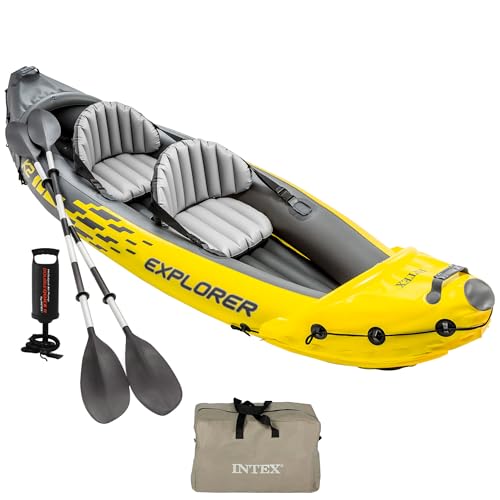
The Intex Explorer K2 costs about $199 at time of writing, sold by Amazon AU, and returns #1 in Amazon AU's Kayaking Equipment category and #879 overall when I checked, the best rank of the five picks. It's a two-person kayak, and it's my top pick because it's the most bought inflatable kayak on Amazon AU at the moment and comes as a complete kit, with paddles, seats, a pump and a carry bag, so there's nothing else to buy before the first paddle except a lifejacket and a dry bag. A #1 category rank usually also means spare valves, skegs and patches for it are easy to find later.
The listing describes rugged vinyl construction, an inflatable I-beam floor, a low-profile deck, high-buoyancy side chambers and a removable skeg for tracking. It quotes a 181kg maximum load and an inflated size of 3.14m by 0.91m by 0.55m, slightly different from the 312cm in the title, which I'd read as the same kayak measured differently. The kit includes two 2.18m paddles, two inflatable seats with backrests, grab handles and lines, two Boston valves, a high-output pump and a repair patch, all of which pack into the carry bag. Two seats and two paddles in the box means a second paddler doesn't need to buy anything extra, which isn't true of every two-person kayak here.
Vinyl is the weak point. It stretches more than laminated PVC, so the K2 goes softer on a hot day and won't feel as stiff as the Costway, and 181kg for two adults plus gear doesn't leave much margin. The listing data shows a 30 day warranty against manufacturer defects, which is short. Rinse the Boston valves after every trip, keep the caps on while it's on the sand, and take the skeg off before you drag it up a ramp. Keep the pump and the patch in the carry bag.
Honest caveats: Vinyl stretches and softens in heat more than laminated PVC. The 181kg load is tight for two adults with gear. The listing data shows only a 30 day warranty. The title and feature text give slightly different lengths. The bright yellow is easy to spot, but it fades in years of sun.
Best for: A first two-person kayak for lakes, lagoons and calm rivers.
Seats: 2 • Hull: Vinyl, I-beam floor • Max load: 181kg (listing) • Inflated size: 3.14m x 0.91m x 0.55m (listing) • Valves: 2 Boston valves • Tracking: Removable skeg • Included: 2 paddles, 2 seats, pump, repair patch, bag • Warranty: 30 days (listing data) • Rank: #1 in Kayaking Equipment (Amazon AU)
View on Amazon AU
Costway 2-Person Inflatable Kayak Set, 230kg, Aluminium Oars
ASIN B0DRN9ZQC4 • $305.95 • Sold by COSTWAY-AU on Amazon AU
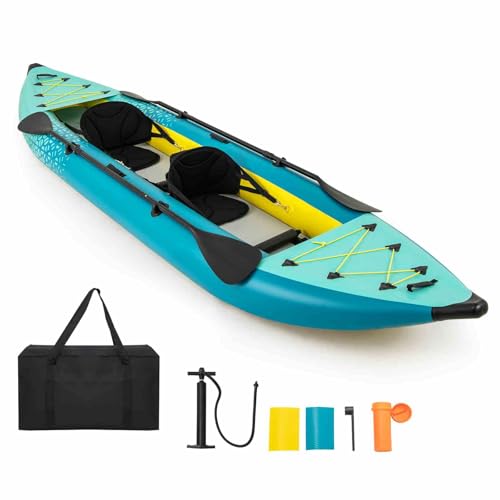
The Costway two-person inflatable kayak set costs about $306 at time of writing, sold by COSTWAY-AU, and returns #29 in Kayaking Equipment and #6,601 overall on Amazon AU when I checked. It's the two-seater I'd pick for two adults who'll actually carry gear, because its listing quotes a 230kg load, the highest of the five, and it's built from reinforced laminate PVC with mesh, which holds its shape better than plain vinyl. The trade-off is weight and bulk: a laminated hull packs bigger and heavier than vinyl, so think about who's carrying it from the car. It's the kayak I'd look at for regular weekend use rather than a couple of trips a year.
The listing describes three separate air chambers, an anti-slip high-pressure floor, two fins for direction control, two adjustable EVA seats with high backs and a three-level adjustable footrest. It inflates to a maximum of 2.18 PSI, with a pressure gauge on the valve so you're not guessing. You also get two double-bladed aluminium paddles that come apart into three sections and stow on the sides with buckles, four carry handles, elastic cargo ropes front and rear, a drain hole, a carry bag and a repair kit with a patch and a valve wrench. The pressure gauge is the detail I like most, because it takes the guesswork out of pumping it up and stops you over-inflating it on a hot day.
The listing data shows a six-month warranty, longer than the Intex but still short, and the feature text doesn't state a length or a kayak weight, so check those before you plan how to carry it. A Goplus listing carried the same feature text word for word, so I've treated them as one kayak and kept the Costway. Rinse the valves and the drain hole after salt water, and dry the EVA seats before you pack them. Pack the paddles in their buckles so they don't rattle, and keep the wrench with the patch so a loose valve can be fixed at the water.
Honest caveats: No length or kayak weight is stated in the feature text. The warranty in the listing data is six months. A Goplus listing carries the same feature text, so treat them as one kayak. A heavier laminated hull takes longer to dry and is heavier to carry than vinyl.
Best for: Two adults with gear, or one paddler with a heavy fishing load.
Seats: 2, adjustable EVA • Hull: Laminate PVC with mesh • Chambers: 3 • Max load: 230kg (title) • Max pressure: 2.18 PSI, gauge on valve • Tracking: 2 fins • Included: 2 paddles, pump, repair kit, bag • Warranty: 6 months (listing data) • Rank: #29 in Kayaking Equipment (Amazon AU)
View on Amazon AU
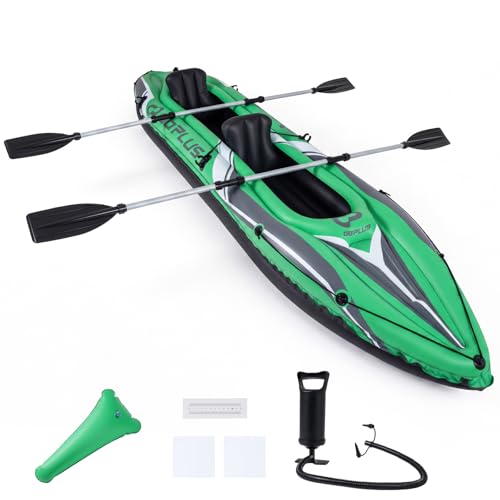
Goplus 11.5 ft Two-Person Inflatable Kayak, 160kg
ASIN B0H1WLYQCZ • $139.95 • Sold by Goplus AU on Amazon AU
The Goplus 11.5 ft two-person kayak costs about $140 at time of writing, sold by Goplus AU, and returns #271 in Kayaking Equipment and #33,915 overall on Amazon AU when I checked. It's the lowest-priced of the five picks, and a reasonable start for two lighter paddlers on protected water, or for one adult who wants room for gear without paying for the Intex or the Costway. At 11.5 ft it works out to about 3.5m long. It's the sort of kayak I'd buy to find out whether you'll actually use one before spending more, and it's light enough in a carry bag for one person to manage from the car park to the water.
The listing describes reinforced heavy-duty PVC, three independent air chambers, two inflatable backrests and an inflatable footrest, a manual pump, oar holders, fish rulers and grab lines all round. It quotes a 160kg load (352 lbs on the listing) for two adults and gear, and it's careful to say the chambers should be inflated in order, valves 1, 2 and 3. The model code in the listing data is SU-10017GN-TF, which is the one to quote if you need parts or a warranty answer. The oar holders and fish rulers suggest it's aimed at people fishing from it, and the grab lines all round make it easier to hold onto if you end up in the water beside it.
Read the paddle line carefully: the listing describes one five-piece aluminium paddle, so if two of you are paddling, budget for a second. The feature text doesn't mention a fin, only a streamlined hull, and it doesn't state a warranty. With 160kg for two adults plus gear, the margin is thin, so I'd treat it as a two-person kayak for an adult and a child, or one adult and an esky. Dry it inflated before you pack it away, and pump the chambers in the stated order every time.
Honest caveats: The listing describes one paddle, so a second paddler needs another. No fin or warranty is mentioned in the feature text. 160kg is tight for two adults with gear. The listing quotes pounds alongside kilograms. Plain PVC softens more in heat than the laminated Costway.
Best for: An adult and a child, or a solo paddler with gear, on a tight spend.
Seats: 2 inflatable backrests • Hull: Reinforced PVC • Chambers: 3 • Max load: 160kg (listing) • Length: 11.5 ft (about 3.5m) • Paddle: 1 five-piece aluminium • Warranty: Not stated • Seller: Goplus AU • Rank: #271 in Kayaking Equipment (Amazon AU)
View on Amazon AU
Bestway Hydro-Force Cove Champion X1 One-Person Inflatable Kayak
ASIN B0CDYP3QK5 • $166.34 • Ships from Amazon AU
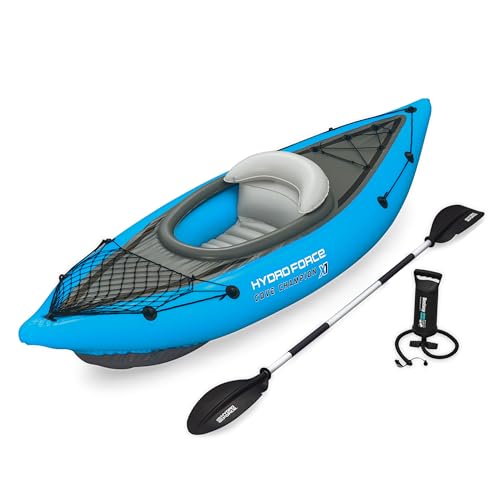
The Bestway Hydro-Force Cove Champion X1 costs about $166 at time of writing, sold by Amazon AU, and returns #532 in Kayaking Equipment and #59,880 overall on Amazon AU when I checked. It's a one-person kayak, 2.75m by 81cm according to the listing, and the one I'd pick for a solo paddler who wants something light and quick to pump up for a lagoon or a calm stretch of river. It also lists the most complete box contents of the two Bestway picks, including a gear bag. For a single paddler under 100kg, it gives you most of what the two-person kits offer in a smaller, lighter package that pumps up quickly and fits easily in a small car boot.
The listing describes Bestway's Inflata-Shield material, which it says resists punctures and limits stretching, a firm, rigid inflatable floor, an inflatable seat with a backrest, an interlocking quick release valve and a drain valve. You get a 230cm aluminium paddle, an Air Hammer hand pump, two removable fins you can swap for different water, oar clasps to hold the paddle, a storage cord and net, carry handles, a wraparound grab rope, a gear bag, a carry bag and a repair patch. The model number in the listing data is 65115. Swappable fins are useful: a longer fin for open water and a shorter one for shallow lagoons, where a long fin catches on sand and weed.
The load limit is 100kg, so a heavier adult or anyone carrying much gear should look at a two-person kayak instead. Bestway has a second listing under the same model number with much thinner feature text, so I kept this one. No warranty is stated in the listing data, and a narrow 81cm hull is less stable than the wider two-seaters, so practise getting in and out at the edge in shallow water first. Rinse the quick release valve after every trip, and keep the spare fin in the gear bag.
Honest caveats: The 100kg load limit is low for heavier paddlers or gear. No warranty is stated in the listing data. A narrow 81cm hull is less stable than the wider two-seaters. A second Bestway listing shares the same model number, so treat them as one kayak.
Best for: Solo paddlers under 100kg on calm water.
Seats: 1 • Hull: Inflata-Shield, rigid inflatable floor • Max load: 100kg (listing) • Size: 2.75m x 81cm (listing) • Valves: Quick release valve plus drain valve • Tracking: 2 removable fins • Included: Paddle, pump, gear bag, carry bag, patch • Warranty: Not stated • Rank: #532 in Kayaking Equipment (Amazon AU)
View on Amazon AU
Bestway Ventura 2.8m Inflatable Kayak, Coated Nylon
ASIN B08CB6SJ25 • $784.17 • Ships from Amazon AU
The Bestway Ventura costs about $784 at time of writing, sold by Amazon AU, and returns #1,318 in Kayaking Equipment and #120,013 overall on Amazon AU when I checked, so it hasn't sold anything like the others. It's a one-person sit-on kayak, 2.8m by 86cm by 40cm inflated according to the listing, and it's on this list for one reason: its listing names a coated nylon skin, the toughest hull material of the five against scrapes and abrasion. A sit-on kayak is also easier to climb back onto from the water than a sit-in one, which counts on a hot day when you've jumped in for a swim, and it drains water off the top rather than holding it inside.
The listing says the coated nylon is puncture resistant, UV resistant and oil and water resistant, and it describes an adjustable seat with a storage compartment, built-in oar clasps and two removable fins. The contents are the kayak, one paddle, a hand pump, the two fins, the seat, a storage bag and a repair patch. The model number in the listing data is 65118. If you paddle around oyster beds, rock shelves or rough boat ramps, a tougher skin is the feature that matters. The storage compartment on the seat is handy for keys and a phone pouch, though I'd still keep the phone on a lanyard, since a compartment only helps until the kayak tips.
The trade-off is a big one. It costs about four times the Cove Champion X1 for the same stated 100kg one-person load, and the listing doesn't give a chamber count, a kayak weight or a warranty. I'd only buy it if abrasion is your main worry, and I'd check the warranty terms before ordering at that price. Rinse the nylon skin after salt water and dry it before storing it. Store it away from direct sun, fold it loosely, and check the warranty terms with the seller before you order at this price.
Honest caveats: It costs about four times the X1 for the same 100kg one-person load. No chamber count, kayak weight or warranty is stated in the listing data. Its sales rank is far behind the others. One paddle only, as it's a one-seater.
Best for: Solo paddlers in rocky or oyster-bed water who want a tougher hull.
Seats: 1, adjustable with storage • Hull: Coated nylon • Max load: 100kg (listing) • Size: 2.8m x 86cm x 40cm (listing) • Tracking: 2 removable fins • Included: Paddle, pump, seat, storage bag, patch • Warranty: Not stated • Seller: Amazon AU • Rank: #1,318 in Kayaking Equipment (Amazon AU)
View on Amazon AUSide-by-side comparison
| Product | Price | Best for |
|---|---|---|
| Goplus Inflatable Kayak 2 Person | ~$140 | |
| Bestway Hydro-Force Cove Champion X1 Kayak | ~$166 | |
| INTEX 68307NP Explorer K2 Kayak | ~$199 | |
| Costway Inflatable Kayak Set | ~$306 | |
| Bestway Ventura Kayak 2.80m x 86cm | ~$784 |
What we see fail in the workshop: kayak days and the phones that come with them
We don't patch kayaks, but kayak trips produce more wet phones than almost anything else we see over summer, and the kayak faults below are the ones people describe while we're drying their phone out. These are the failures I'd plan around before buying an inflatable kayak, and the habits that put them off. None of them needs special tools, just a few minutes after each trip.
Phones in salt water
This is the one that lands on our counter. A phone goes in when someone tips getting in or out at the edge, or it sits for hours in the puddle that collects in the bottom of every kayak. Salt water is much harder on a phone than fresh water, because the salt keeps corroding the board after the phone dries. Turn it off, don't charge it, rinse the salt off with fresh water, and get it to a repairer quickly. A floating pouch with a lanyard stops most of these before they happen.
Slow leaks at valves and seams
An inflatable that goes soft over an afternoon usually has sand in a valve or a seam starting to let go, not a hole. Heat and UV weaken the glued seams, and sand stops valves seating. Rinse the valves and seams after every trip, keep the caps on while the kayak is on the beach, and don't leave it fully inflated in full sun. Find a slow leak with soapy water on the seams and valves, and patch it on a clean, dry surface with the kit that came with it.
Mould from packing it away damp
A kayak rolled up wet and left in its bag goes mouldy surprisingly quickly in a Central Coast summer, and the seats and footrests are the first to smell. Mould on PVC is mostly a cleaning job, but it's much easier to prevent. Rinse it, dry it inflated in the shade, then fold it loosely and store it somewhere cool and dry. Foam or EVA seats should come out and dry separately, because they hold water long after the hull feels dry. A loose fold and a dry cupboard are most of the job.
Decision tree: which one should you actually buy?
- First kayak for two on a lake or lagoon? → The Intex Explorer K2 at about $199 is the best-ranked of the five and comes complete with two paddles, seats and a pump.
- Two adults with gear? → The Costway two-person set at about $306 quotes 230kg, three chambers and a laminated PVC hull.
- Lowest spend for an adult and a child? → The Goplus 11.5 ft at about $140, but its listing describes one paddle, so budget for a second.
- Paddling on your own and under 100kg? → The Bestway Cove Champion X1 at about $166 is light, with two removable fins and a quick release valve.
- Worried about oyster beds and rocks? → The Bestway Ventura at about $784 has a coated nylon skin, but costs about four times the X1 for the same 100kg load.
- Phone went in the water? → Turn it off, don't charge it, rinse off salt water and bring it into our Erina workshop quickly; we'll tell you what it needs before you spend anything.
Frequently asked questions
Are inflatable kayaks any good?
For calm lakes, lagoons and slow rivers, a good inflatable kayak is fine, and it fits in a car boot and a cupboard, which a hard-shell kayak doesn't. They're slower and catch more wind than a hard-shell, and they don't track as well without a fin. Look for more than one air chamber, a fin or skeg, a load limit with margin for your weight plus gear, and a hull that isn't plain thin vinyl if you'll use it often.
How much weight can an inflatable kayak hold?
It depends on the model, and the stated limit covers everything in the kayak, not just the paddlers. Of these five, the one-person Bestway kayaks state 100kg, the Goplus 160kg, the Intex K2 181kg and the Costway 230kg. Two average adults are often 160 to 180kg before gear, so for two adults with an esky or fishing gear, I'd pick a kayak with a stated limit well above that. A kayak loaded near its limit sits low and takes on water in chop.
Can an inflatable kayak pop?
They're tougher than most people expect, and a sudden pop is rare. Most leaks are slow ones from a valve with sand in it or a seam weakened by heat and sun. Sharp oyster shells, rocks and fishing hooks are the real puncture risks. Kayaks with several separate air chambers stay afloat if one chamber is damaged, which is why I'd avoid any kayak with only one. Four of the five picks here list a repair patch in the box.
Do I need a lifejacket in an inflatable kayak in NSW?
Wear one every time, whatever the rules say for the water you're on. NSW Maritime sets the lifejacket rules for paddle craft, and they depend on where you're paddling, if you're on your own and the time of day, so check its current rules before you go rather than relying on what someone told you at the boat ramp. A lifejacket that fits and that you'll actually wear matters more than the rating on the label.
How do I stop my inflatable kayak going in circles?
Fit the fin or skeg that came with it, since that's what holds a short, flat hull on a line. Then paddle with longer, even strokes close to the side of the kayak, with the blade fully in the water, and switch sides evenly. Make sure the kayak is pumped up to the pressure the instructions give, because a soft kayak bends in the middle and is much harder to keep straight.
How should I store an inflatable kayak?
Rinse it with fresh water, dry it fully while inflated in the shade, then deflate it and fold it loosely. Store it somewhere cool and dry, not in a hot roof space or in the sun. Take foam or EVA seats out to dry separately, keep the valve caps on, and keep the pump, fins and repair kit in the carry bag with it. Pump it up the night before the first trip of the season to check for slow leaks.
Related buying guides
Phone went over the side?
Salt water keeps corroding a phone after it looks dry, and trying to charge it is what does the lasting damage. If your phone went in the lagoon, sat in the bottom of the kayak or won't charge after a day on the water, turn it off and bring it into our Erina workshop quickly, and we'll tell you what it needs before you spend anything.
Visit our Erina workshop Book Online