Prices from Amazon AU, updated daily. Swipe or use the arrows for more.
Disclosure: This article contains affiliate links to amazon.com.au. If you buy through one of these links iFix may earn a small commission at no extra cost to you. It doesn't change which products we recommend. We focus on what actually lasts based on 16 years of repair-shop experience.
Quick summary5 picks
- Entry PickGarmin Vivofit Jr. 3 about$147
- imoo Z1 4G Kids Smart Watch | This Watch… about$186
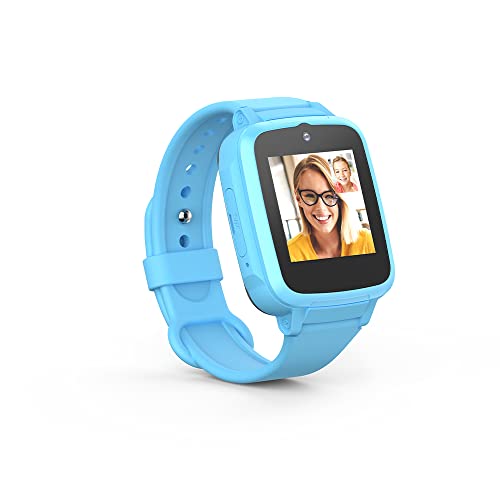
- Pixbee Kids Smart Watch with Video Calls about$198
- imoo Z3 Kids Smart Watch about$299740mAh.
- Most PremiumSPACETALK Adventurer 2 Smartwatch about$347
Watch phone, tracker or neither
Kids smartwatches split into two quite different things, and it's worth deciding which one you want before you look at brands. The first is a watch phone: it takes a SIM card, makes and receives calls, sends messages and reports its location over the mobile network. The second is an activity tracker, which counts steps, runs timers and chore lists, and has no mobile connection at all. They look similar on a wrist and they're priced in a similar range, but they solve completely different problems.
A watch phone makes sense when a child is old enough to be somewhere without you, like walking home from school or staying at a friend's place, but you're not ready to hand over a full phone. It gives them a way to call a short list of approved people and gives you a rough idea of where they are. A tracker makes sense for younger kids who are always with an adult and just want something on the wrist that feels like their own. Neither replaces supervision.
Three of the four picks here are 4G watch phones and one is a Garmin activity tracker with no calling or GPS. If your child already has a phone, a kids watch phone usually doubles up on the same job, and a simple tracker or one of the value adult smartwatches might suit an older child better. For tracking a bag or a bike rather than a person, the GPS and item trackers guide covers the tag-style devices.
What's on Amazon AU right now
Search Amazon AU for a kids GPS watch and the first page is mostly no-name 4G watches from overseas marketplace sellers, many with the same photos under different brand names. I left all of those out. They rarely state which Australian networks they've been tested on, the warranty is hard to claim, and some still list 2G or 3G bands that no longer work here. What's left is a short list from brands with an Australian presence, sold by their own AU stores or by Amazon AU.
imoo sells through two AU storefronts on Amazon, imoo-Australia and IMOO Direct, both shipped from Amazon's warehouses with delivery in a few days to the Central Coast. Spacetalk is an Australian kids watch brand selling through its own AU store, also shipped by Amazon. The Garmin Vivofit Jr. 3 is sold and shipped by Amazon AU directly. All four list a manufacturer warranty, which matters more than usual here because kids are hard on watches.
Ranks quoted are Amazon AU's category sales ranks, checked on the day of writing. The three watch phones sit in the broad Smartwatches category alongside adult watches, so their ranks look low, while the Garmin sits in Activity Trackers where it ranks much higher. Don't read too much into the gap between them. Prices run from $147 to $347 at time of writing, before any mobile plan, and the plan is where the real running cost of a watch phone sits.
4G calling and the 3G shutdown
Australia's 3G networks have been switched off, so any watch phone that relies on 3G for calls is now a paperweight for calling, even if the listing still describes it as 4G. What you need is VoLTE, which is voice calling over the 4G network. Both imoo listings name VoLTE explicitly. Spacetalk says the Adventurer 2 has been tested on Telstra and Optus 4G networks, which is the more useful claim, because it means the brand has actually checked it works here.
This is the single biggest reason I'd avoid the no-name watches. Many of them advertise 4G for data but fall back to older networks for voice, and in a lot of cases that fallback no longer exists. The result is a watch that shows signal bars and can send messages but can't make a call, which is exactly the thing you bought it for. It's also a support problem, because there's usually no local contact to ask which bands the watch supports.
Coverage is the other half. A watch has a much smaller antenna than a phone, so in fringe areas it'll drop signal sooner than your own handset on the same network. If you're in a patchy part of the Central Coast hinterland or a regional area, test the watch at home, at school and on the walk between before you rely on it. If it struggles, a watch on a different network may do better, which is a good argument for the SIM-free imoo models.
SIM cards, plans and the running cost
Every 4G kids watch needs an active mobile service, and that's a cost that keeps going after the watch is paid for. The two imoo watches take a standard nano-SIM, and the imoo Z3 listing says there's no mandatory subscription or network lock and names Telstra, Optus and Vodafone as compatible. That means you can use a low-cost prepaid or post-paid SIM from whichever network works best where you live, and change later if a better plan turns up.
Spacetalk works differently. The Adventurer 2 includes a SIM, but the listing says a Spacetalk Mobile plan is required for calling, messaging and GPS, and the plan is sold separately. That bundles the service with the brand's app and support, which some parents prefer, but it also means you can't shop around for a SIM. Check the current Spacetalk plan price before you buy and add it to the watch price over two or three years.
When you're comparing, work out the total over the time you expect the child to wear it. A watch that costs less up front but locks you into a dearer plan can easily end up costing more by the time it's replaced. Most kids use a watch for two to three years before they move to a phone, so a three-year sum is a fair way to compare. The Garmin tracker has no plan cost at all, which is a real advantage if calling isn't the point.
Whichever SIM you choose, set it up with a PIN and turn off anything the watch doesn't need, like data roaming. Most SIM-based watches can only call and receive from contacts approved in the parent app, which keeps out spam calls, but check that setting is on once the watch is working. I'd also keep a note of the SIM number somewhere other than your phone, because it's the first thing a network asks for if the watch is lost.
GPS: what it can and can't tell you
Kids watches combine several ways of working out where they are. The imoo Z3 lists GPS, GLONASS, Wi-Fi and mobile tower positioning, and the others describe GPS and real-time tracking. Outdoors with a clear sky, GPS is usually good to within a few metres. Indoors, in a shopping centre or a classroom, the watch falls back to Wi-Fi and tower positioning, which can be out by a block or more. That's normal and it's not a fault.
Location updates also aren't truly continuous. To save battery, most watches report their position every few minutes rather than every second, and some only update when you ask through the app. So the dot on your map is where the watch was recently, not necessarily where it is now. Faster updates are usually available but they cost battery life, and on a small watch battery that trade-off is noticeable by the end of a school day.
So treat the location as a guide rather than a guarantee. It's good for checking a child got to school or is at the park they said they'd be at. It isn't good enough to find them in a crowd, and it won't work if the watch is flat, off or out of coverage. Teach kids to keep it charged and on, and talk to them about why it's there, because a watch that gets left in a bag isn't telling you much.
Class mode, contacts and parental controls
Schools are the main reason class mode exists. Both imoo watches let parents set school hours in the app, during which calls and messages are blocked and the watch behaves more like a plain watch. Spacetalk has similar school-mode features through its app. Check your school's policy before buying, because some schools ban watch phones outright and others require them to be in class mode during lessons. A watch that gets confiscated every day isn't doing anyone any good.
Contact control is the feature I'd look at hardest. All three watch phones are built around an approved contact list, so the child can only call and receive from people you've added. The imoo Z1 also lists stranger call rejection, which blocks unknown numbers automatically. imoo's friend feature lets two kids add each other by touching their watches together, which is a nice touch that avoids sharing phone numbers. Spacetalk notes the Adventurer 2 has no social media or web browser.
The parent app is the part you'll live with every day, and it's where these watches differ most. Before you buy, look at the app's reviews in the Google Play or Apple App Store and check it's been updated recently. An app that's left to go stale is a bigger problem than any hardware fault, because the watch is only as useful as the app that manages it. If the app stops being supported, the watch usually stops working properly too.
Water ratings and tough screens
Water resistance on kids watches is listed as an IP rating, and the numbers matter. Both imoo watches are rated IPX8, but their own listings say they're suited to hand washing, rain and splashes, not hot showers or diving. The Spacetalk Adventurer 2 is IP67 and described as splashproof. The Garmin doesn't give an IP rating in its listing data. In practice, none of these should go swimming, and hot water is the quickest way to weaken the seals.
IP ratings are tested on new seals in fresh water at room temperature. Soap, sunscreen, chlorine and heat all degrade the seals over time, and a watch that survived a dunking in the first month may not in the second year. A knock that cracks the screen or lifts the back also breaks the seal, often without it being obvious. Our guide on whether your phone is really waterproof covers the same rules, and they apply just as much to a watch.
Screens get a lot of punishment on a child's wrist, from monkey bars to bike falls to the edge of a desk. Spacetalk lists Gorilla Glass on the Adventurer 2, which is the only pick here that names its screen glass. The imoo listings don't state the glass type. A basic film screen protector is worth adding on day one, because it's much easier to replace a scratched film than a cracked watch screen, and many kids watches don't have screen replacement parts available.
Batteries, charging and what to check
Battery life is the spec I'd treat most carefully on any watch phone. The imoo Z3 lists a 740mAh battery with one to two days of moderate use, and Spacetalk claims up to 36 hours of typical use. The imoo Z1 listing doesn't state a battery figure. In real use, with location updates on and a couple of calls, expect to charge a watch phone every night. Video calls use the battery faster than anything else, so keep them short on school days.
Most kids watches charge through small magnetic or spring-loaded contacts on the back. Those contacts are the weak point, because sweat and water leave a film that corrodes them, and a corroded contact stops the watch charging even though the battery is fine. Wipe the back with a dry cloth before charging, keep the charger dry and don't charge a watch that's just come out of the rain. If it starts charging only at certain angles, the contacts need cleaning.
The Garmin Vivofit Jr. 3 avoids most of this. Its listing says it runs up to a year on a battery the user can replace, with no recharging, which is why it's popular for younger kids. If a watch phone stops charging, swells, gets hot or won't hold a charge past lunch, stop using it and bring it in. Our Erina workshop can check the contacts and battery and tell you whether it's worth fixing before you buy another.
The 4 picks, $147 to $347
Prices are Amazon AU at time of writing (27 October 2026) and move week to week. Ranks are Amazon AU category sales ranks, checked the same day.

imoo Z1 4G Kids Smart Watch with GPS, Video Calls and Class Mode
ASIN B0H5C1S4V2 • $186.00 • Sold by imoo-Australia on Amazon AU
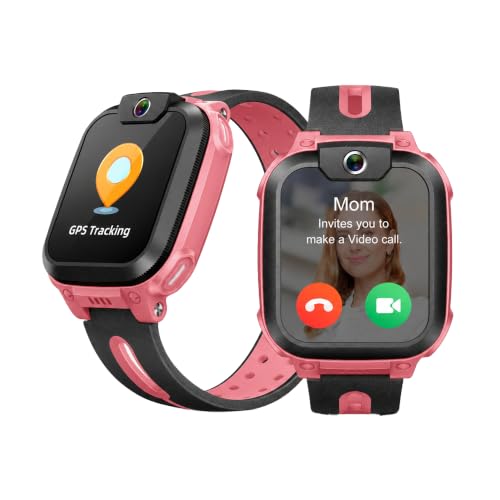
The imoo Z1 is the best-ranked 4G kids watch phone I found on Amazon AU from a local seller, sitting at #85 in the broad Smartwatches category. It's sold by imoo-Australia and shipped by Amazon, at $186 at time of writing. It takes a 4G SIM card and the listing names VoLTE for calls, so it works on Australia's 4G networks now that 3G is gone. There's a 2MP wide-angle camera for video calls and a family group chat for messages. Location is reported through GPS and other positioning methods. It's the most sensible starting point for a first watch phone. That's why it leads. The listing describes it as a birthday or Christmas gift, and it's priced like one.
The safety features are well thought out for younger kids. To call emergency contacts, a child draws a letter C on the screen, which is easier under stress than finding a small button. Class mode lets parents block calls and messages during school hours through the app. There's built-in rejection of stranger calls and messages, so unknown numbers don't get through. Kids can add friends by touching two imoo watches together, which avoids handing out phone numbers. The listing rates it IPX8 but says it's not suitable for hot water or diving. It comes with a two-year manufacturer warranty. Group chat runs through the family app rather than a phone number, so kids aren't handing their number around.
What the listing doesn't tell you is the battery size, the screen glass or which networks it's been tested on, so I'd check imoo's Australian site for those before you buy. Because it takes a standard SIM, you can choose your own network and plan, which keeps running costs under your control. Charge it nightly and keep the contacts on the back dry. A film screen protector is worth fitting on day one. The rank caveat is that it sits among adult watches. It's the right pick for a first watch phone on a sensible budget.
Honest caveats: The listing doesn't state battery capacity, screen glass or tested networks. IPX8 is listed, but imoo says it's not for hot water or diving, so keep it out of the shower and pool. You'll need your own nano-SIM and plan, which is an ongoing cost on top of the watch.
Best for: A first 4G watch phone for a primary school child, using a SIM and plan you choose yourself.
Network: 4G with VoLTE calling • SIM: Your own 4G SIM • Camera: 2MP wide-angle • Location: GPS multi-positioning • Safety: Draw-C SOS, class mode, stranger rejection • Water: IPX8 (not hot water or diving) • Model: Z1 • Warranty: 2 years (listing) • Rank: #85 in Smartwatches (Amazon AU)
View on Amazon AU
imoo Z3 Kids Smart Watch with 4G, GPS, Video Calls and SOS
ASIN B0FNWFQ2FP • $298.99 • Sold by IMOO Direct on Amazon AU
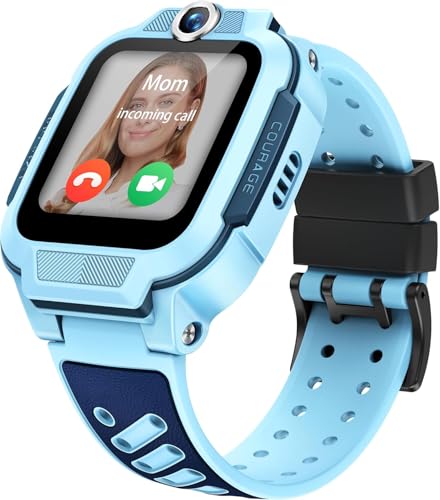
The imoo Z3 is the step up from the Z1, with a bigger 1.5-inch HD display, 8GB of storage and a battery the listing gives as 740mAh. It's sold by IMOO Direct and shipped by Amazon, at $299 at time of writing, and ranks #192 in Smartwatches on Amazon AU. Its listing is the most detailed of the three watch phones. It names GPS, GLONASS, Wi-Fi and mobile tower positioning, and says it works on Telstra, Optus and Vodafone with a standard active nano-SIM. Calls use VoLTE. There's a 2MP front camera for video calls. It suits a slightly older child who'll use it more. It's also the only watch here with a stated storage figure.
The most useful line in the listing is the one about carrier freedom: there's no mandatory subscription or network lock, so you can choose any compatible plan and change later. That makes the long-term cost easier to control than a bundled plan. The listing says the battery lasts one to two days with moderate use, and suggests turning off Wi-Fi and dropping brightness outdoors to stretch it. Class mode blocks calls and messages during school hours, and the same draw-C gesture triggers SOS. It's rated IPX8 for hand washing and rain, not hot water or diving. The warranty is two years. SOS alerts go to the parents listed in the app, so set those contacts up before the first school day.
I'd pick the Z3 over the Z1 if the child is older, will use video calls often or you're in an area where you want the extra positioning methods. The larger screen is easier to read, but it's also a bigger target for knocks, so fit a screen protector and consider a sturdier strap. The listing doesn't state the screen glass. Charge it nightly, keep the contacts clean and dry, and check the parent app is up to date. The rank is lower than the Z1 mostly because it's newer. It's the right pick for families who want to choose their own network.
Honest caveats: Screen glass isn't stated, and a bigger display is a bigger target on a child's wrist. Battery life of one to two days means nightly charging in practice. IPX8 is listed, but not for hot water or diving. You'll still need your own SIM and plan, so add that to the cost.
Best for: An older primary or early high school child, on whichever network works best where you live.
Network: 4G with VoLTE calling • SIM: Nano-SIM, Telstra, Optus, Vodafone • Display: 1.5-inch HD • Battery: 740mAh, 1 to 2 days • Location: GPS, GLONASS, Wi-Fi, LBS • Storage: 8GB • Water: IPX8 (not hot water or diving) • Warranty: 2 years (listing) • Rank: #192 in Smartwatches (Amazon AU)
View on Amazon AU
Spacetalk Adventurer 2 4G Kids Smartwatch with GPS, Frost
ASIN B0CKWPD3SL • $347.00 • Sold by Spacetalk AUS on Amazon AU
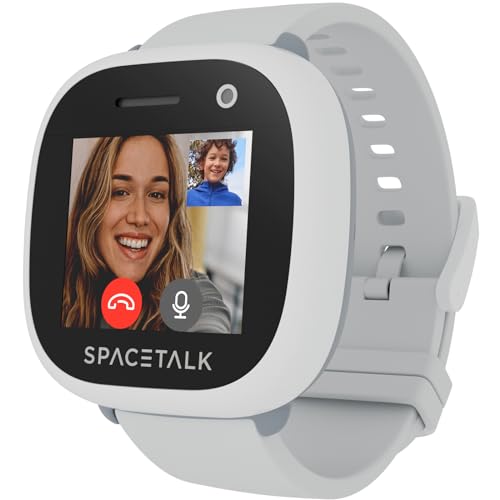
Spacetalk is an Australian kids watch brand, and the Adventurer 2 is its 4G watch phone with GPS, sold by Spacetalk AUS and shipped by Amazon, at $347 at time of writing. It ranks #200 in Smartwatches on Amazon AU. It supports video calls, voice calls and SMS over 4G, with a 5MP camera, the highest-resolution camera here. The listing says it's been tested on Telstra and Optus 4G networks, which is the most reassuring network claim of any pick. The screen is Gorilla Glass and the body is rated IP67 splashproof. It has no social media or web browser. That suits families who want the simplest setup. The model code on the listing is ST3-4G-1.
The big difference is the plan. A SIM is included, but the listing says a Spacetalk Mobile plan is required for calling, messaging and GPS, sold separately. That means the watch, the network service and the parent app all come from one company, which makes setup and support simpler, but you can't swap in a different SIM to save money. Check the current plan price before you buy and work out the total over two or three years. Battery life is listed at up to 36 hours of typical use and up to three days on standby. It has a physical SOS button. Spacetalk's own app handles contacts, school mode and location in one place.
I like the Adventurer 2's build for active kids. Gorilla Glass on the screen is the only named glass in this guide, and the listing weight works out at about 58g, which is light enough not to bother most kids. The warranty is one year from the manufacturer, which is shorter than imoo's two years. Charge it nightly and dry the back before charging. Colour versions are separate listings with the same price. The rank sits among adult watches. It's the right pick for parents who want one Australian company handling the watch and the service.
Honest caveats: A Spacetalk Mobile plan is required for calls, messages and GPS and is sold separately, so you can't use your own SIM. The warranty is one year, shorter than imoo's. IP67 means splashproof, not swim-proof. Check the current plan price before you buy.
Best for: Families who want an Australian brand handling the watch, the network service and the app together.
Network: 4G, tested on Telstra and Optus • SIM: Included, Spacetalk plan required • Camera: 5MP • Screen: Gorilla Glass • Battery: Up to 36 hours typical • Water: IP67 splashproof • Weight: About 58g (listing) • Warranty: 1 year (listing) • Rank: #200 in Smartwatches (Amazon AU)
View on Amazon AU
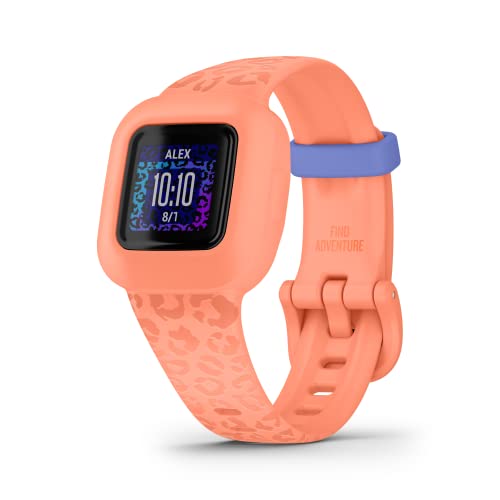
Garmin Vivofit Jr. 3 Kids Activity Tracker, Peach Leopard
ASIN B09VY551JF • $146.85 • Ships from Amazon AU
The Garmin Vivofit Jr. 3 isn't a watch phone, and that's the point of including it. It has no SIM, no calling and no GPS, so there's no plan to pay for and nothing to track. Instead it counts steps and estimated distance, runs timed activities for things like soccer practice, and saves them to the Garmin Jr. app. It ranks #13 in Activity Trackers on Amazon AU, by far the strongest rank of the four, and it's sold and shipped by Amazon AU at $147 at time of writing. It's the pick for younger kids. It's also the one I'd buy for a child who wants a watch of their own.
The feature parents mention most is the battery. Garmin's listing says it runs up to one year with no recharging, and the battery is user-replaceable. That removes the nightly charging routine and the charging contacts that cause so much trouble on watch phones. There's an in-case-of-emergency widget that shows emergency contact details on the watch. The app rewards active minutes with games and icons, and lets parents set up activities. It comes in a range of band styles. Garmin gives a local support number on the listing, and the warranty is 12 months. Because there's nothing to charge, there are no charging contacts to corrode either, which is the most common fault on the other three. When the battery finally runs down, it's a battery swap rather than a repair.
The limits are clear: it can't call anyone, it won't tell you where your child is, and it isn't meant to. For a child under about eight who is always with an adult, that's usually fine. For an older child walking to school alone, one of the imoo or Spacetalk watches does the job this can't. The listing doesn't give a water rating, so check it on Garmin's site before swimming. Swap the battery when the screen dims. It's the right pick for younger kids who just want a watch that feels like theirs.
Honest caveats: It has no calling, no GPS and no mobile connection, so it can't help you find your child. The listing data doesn't give a water rating, so check Garmin's site before swimming. Band styles are separate listings and can vary in price. The warranty is 12 months.
Best for: A younger child who wants a watch of their own without a SIM, a plan or nightly charging.
Type: Activity tracker, no SIM or GPS • Battery: Up to 1 year, user-replaceable • Tracking: Steps, estimated distance, timed activities • Safety: ICE emergency contact widget • App: Garmin Jr. • Model: 010-02441-24 • Warranty: 12 months (listing) • Rank: #13 in Activity Trackers (Amazon AU)
View on Amazon AUSide-by-side comparison
| Product | Price | Best for |
|---|---|---|
| Garmin Vivofit Jr. 3 | ~$147 | |
| imoo Z1 4G Kids Smart Watch | This Watch… | ~$186 | |
| Pixbee Kids Smart Watch with Video Calls | ~$198 | |
| imoo Z3 Kids Smart Watch | ~$299 | |
| SPACETALK Adventurer 2 Smartwatch | ~$347 |
What we see fail in the workshop: kids smartwatches
Kids watches live hard lives, and the faults that bring them in are fairly predictable. Most aren't electronic failures in the way people expect. They're physical damage, water and charging problems that build up over months of school days, sport and bath times. Here's what we see most and how to avoid it. None of it needs specialist tools to prevent.
Corroded charging contacts
The small metal contacts on the back of a watch phone are the most common fault by a long way. Sweat and water leave a film on them, and charging a damp watch speeds up the corrosion. The symptom is a watch that only charges at certain angles or not at all, while the battery itself is fine. A careful clean with isopropyl alcohol on a cotton bud often brings it back. If the contacts are pitted or green, the charge board may need replacing, which isn't always possible on kids watches.
Cracked screens and lifted backs
Monkey bars, bike falls and desk edges crack screens and lift the back cover away from the body. A lifted back looks harmless, but it breaks the water seal, and the next wet day finishes the watch. If you see a gap around the edge, keep the watch dry until it's looked at. Screen parts for kids watches are often hard to find, so a film protector on day one is the best defence. Spacetalk's Gorilla Glass helps, but it still breaks if it lands on concrete. A silicone bumper case adds a little protection too.
Water damage from showers and pools
Despite IPX8 and IP67 ratings, the watches we see with water damage have nearly always been worn in a hot shower, a bath or a pool. Heat and chlorine weaken the seals, and once water is in, it corrodes the board within days. If a watch gets wet inside, turn it off, don't charge it and bring it in quickly. Our guide to water damage explains why speed matters. Rice won't help, and charging it to check whether it works often does the most damage. Leave it powered off until it's been opened and dried.
Decision tree: which one should you actually buy?
- Want a first watch phone on your own SIM? → The imoo Z1 at $186 has 4G VoLTE calling, GPS, class mode and stranger call rejection, with a two-year warranty.
- Older child who'll use video calls and wants a bigger screen? → The imoo Z3 at $299 has a 1.5-inch display, a 740mAh battery and works on Telstra, Optus or Vodafone SIMs.
- Prefer one Australian company for the watch and the plan? → The Spacetalk Adventurer 2 at $347 is tested on Telstra and Optus and has Gorilla Glass, but needs a Spacetalk plan.
- Younger child who doesn't need calls or tracking? → The Garmin Vivofit Jr. 3 at $147 has no SIM or plan and runs up to a year on a replaceable battery.
- Child already has a phone? → Skip the watch phone and look at the value smartwatches guide or the Garmin tracker instead.
- Watch not charging, cracked or got wet inside? → Stop charging it and bring it to our Erina workshop. We'll check the contacts, battery and seals and tell you whether it's worth repairing before you spend anything.
Frequently asked questions
Do kids smartwatches still work after the 3G shutdown?
Only if they support 4G calling, known as VoLTE. Australia's 3G networks have been switched off, so a watch that relies on 3G for voice can no longer make calls, even if it advertises 4G for data. Both imoo watches in this guide list VoLTE, and Spacetalk says the Adventurer 2 has been tested on Telstra and Optus 4G. Be careful with no-name watches from overseas sellers, because many don't say which bands they use, and some simply won't make calls here.
Do I need a separate phone plan for a kids smartwatch?
For a 4G watch phone, yes. The imoo Z1 and Z3 take a standard nano-SIM, so you choose any compatible plan from Telstra, Optus, Vodafone or a reseller on those networks. The Spacetalk Adventurer 2 includes a SIM but requires a Spacetalk Mobile plan, sold separately. The Garmin Vivofit Jr. 3 doesn't need a plan at all because it has no mobile connection. Add the plan cost over two or three years to the watch price when you compare them.
How accurate is the GPS on a kids watch?
Outdoors with a clear view of the sky, GPS is usually accurate to within a few metres. Indoors, the watch falls back to Wi-Fi and mobile tower positioning, which can be out by a block or more. Most watches also only report their position every few minutes to save battery, so the location you see may be a little out of date. Treat it as a guide to whether your child got where they were going, not a precise live map.
Can kids wear these watches swimming or in the shower?
I wouldn't. The imoo watches are rated IPX8 but their listings say they're not for hot water or diving, and the Spacetalk Adventurer 2 is IP67 splashproof. Ratings are tested on new seals in cool fresh water, and heat, soap, sunscreen and chlorine all weaken seals over time. Most of the water-damaged kids watches we see have been worn in the shower or the pool. Take it off for swimming and bath time and keep it for rain and hand washing.
Are kids smartwatches allowed at school?
It depends on the school. Some ban watch phones, some allow them only in class mode, and some leave it to the teacher. Both imoo watches and the Spacetalk have a school or class mode that blocks calls and messages during set hours, which most schools that allow them will expect. Check the school's policy before you buy, and set class mode up in the parent app from day one so the watch doesn't become a distraction or get confiscated.
What age is right for a kids smartwatch?
There's no fixed age, but the decision usually follows independence. A child who is always with an adult rarely needs a watch phone, and an activity tracker like the Garmin Vivofit Jr. 3 suits them better. Once a child starts walking to school, catching a bus or visiting friends on their own, a 4G watch phone with an approved contact list gives them a way to call home without a full phone. Most kids move from a watch to a phone in early high school.
Related buying guides
Kids watch not charging or cracked?
Most kids watch faults are corroded charging contacts, cracked screens, lifted backs and water that got in through a weakened seal. Bring it into our Erina workshop and we'll check the contacts, battery and seals, then tell you whether it can be fixed and what it'll cost before you spend anything on a replacement.
Visit our Erina workshop Book Online