

Prices from Amazon AU, updated daily. Swipe or use the arrows for more.
Disclosure: This article contains affiliate links to amazon.com.au. If you buy through one of these links iFix may earn a small commission at no extra cost to you. It doesn't change which products we recommend. We focus on what actually lasts based on 16 years of repair-shop experience.
Quick summary8 picks
- AILRINNI Car Battery Charger 10-Amp about$45.99
- Entry PickTEKXDD Car Battery Charger 10-Amp about$39.99
- AstroAI B8 Car Battery Jump Starter Power Bank about$58.97
- NOCO GENIUS1: 1A 6V/12V Smart Battery… about$64.99
- Lucklike 7000A Jump Starter with Air… about$89.9918W.
- NOCO GENIUS5: 5A 6V/12V Smart Battery… about$135.00
- CTEK MXS 5.0 about$148.57
- Most PremiumNOCO GENIUS10: 10A 6V/12V Smart Battery… about$189
The $300 battery you keep buying
A car battery runs $250 to $400 fitted now for a lot of common cars, more again for the AGM stop-start type, and it's a bill people are wearing more often than they should because batteries are dying young. The pattern behind it is simple: cars are driving less. Fuel prices have trimmed the discretionary trips, the second car does two school runs a week, and labour rates are dear enough that people defer everything on the car until the roadside assist bloke is standing in the driveway delivering a verdict.
Every one of those parked weeks costs battery. A lead-acid battery self-discharges on its own, the car's electronics pull a little more around the clock, and a battery that sits below full charge starts sulfating, which is the slow chemical process that ends with a Tuesday morning click instead of a start. None of the machines in this guide are exciting purchases. What they do is intercept a $300 replacement with a $46 to $189 one and a powerpoint, and the arithmetic on that is short enough to do while the kettle boils.
The band for this guide is $40 to $250 from the queue, and the five picks land between $46 and $189: a high-amp unit from an AU storefront, three NOCOs covering maintenance pace through to big-battery pace, and the CTEK that dealership workshops keep recommending. All five are sold as condition New with real Amazon AU sales ranks, checked the same day as the prices. If what you actually need today is rescue rather than prevention, that's a different tool entirely, and I'll point at the right guide for it further down.
Why a parked car flattens its own battery
A modern car never really switches off. The alarm, the keyless entry receiver, the ECU's memory and the phone-home module in anything recent all sip from the 12V battery around the clock, and the industry calls it parasitic drain because that's exactly what it is. Anything wired in aftermarket makes the sipping worse, a dash cam in parking mode being the classic case, which is why the dash cam hardwire guide spends most of its word count on voltage cutoffs. A good battery shrugs this off for a fortnight or two. A tired one doesn't get the fortnight.
The chemistry is the unforgiving part. A lead-acid battery held below full charge starts converting its active plate material into lead sulfate crystals, and the longer it sits low, the harder those crystals get. Early on, the process reverses with a proper charge. Left for months, the crystals coarsen until plate area is permanently gone, and the battery that cranked fine before Christmas won't hold a charge by February. Heat accelerates all of it, which is why Australian summers are quietly brutal on batteries and why temperature compensation shows up on four of the five listings in this guide.
Low voltage also makes cars weird before it makes them dead. Modern vehicles throw electrical gremlins when the battery sags: warning lights with nothing behind them, infotainment reboots, stop-start systems that quietly disable themselves. If a car is behaving strangely and its recent history includes a lot of sitting, check voltage before chasing anything expensive, and a $30 OBD2 scanner will read what the car thinks is wrong while you're at it. Nine times out of ten the mystery fault and the tired battery turn out to be the same fault.
Amps set the speed, not the quality
Charger current works like tap flow into a tank. A typical car battery is 40 to 80 amp-hours, so a 1 amp charger refilling a properly flat 60Ah battery needs somewhere past 60 hours once you allow for charging losses, and that's not a defect in the charger, it's division. Five amps brings the same job into overnight territory, and ten amps suits the 100Ah-plus batteries in 4WDs, boats and caravans. Nothing about a bigger number makes the charge itself better, the smart circuitry decides that; the number just decides how long you wait.
That's why the most useful question is what the machine is actually for. A maintainer's job is holding a charged battery at full for weeks or months at a time, and 1 amp is plenty for that on anything short of a truck. A charger's job is putting real charge back on a schedule, and that's where 5 or 10 amps earn their price. The picks here split cleanly along that line, the GENIUS1 on the maintenance side, the GENIUS5, GENIUS10 and AILRINNI on the charging side, with the CTEK straddling both, and I'd choose by which job your driveway actually generates most often.
The third tool people confuse with both is the jump starter, which doesn't charge anything: it's a lithium pack that shoves cranking current in for the ten seconds the starter motor needs, and then the alternator does what it can. I covered those in the jump starter guide, and the honest relationship between the two purchases is that the jump starter is the ambulance and the charger is the diet. Households with recurring flat-battery mornings usually buy the ambulance first and the diet never, and then they buy a third battery.
AGM, EFB and why the mode button matters
Car batteries stopped being one thing about a decade ago. Stop-start cars run AGM or EFB batteries built to survive constant cycling, and they cost enough, often $300 to $500 fitted, that the charger question stops being academic. AGM wants a slightly different charge voltage profile than an old flooded battery, and a charger without an AGM setting will still put charge in, it'll just chronically undercharge the battery a little every time, and chronic undercharge is exactly the sulfation condition from two sections back. The mode button isn't marketing on these batteries; it's the difference between maintaining one and slowly starving it.
The listings split usefully on this. The NOCO units state the full modern spread, AGM, EFB, gel, SLA, VRLA and start-stop, plus LiFePO4 lithium, across 6V and 12V. The CTEK states a dedicated AGM program and a recond mode, but no lithium or 6V support appears in its listing copy. The AILRINNI states 12V and 24V with no chemistry modes named at all, which is the main thing separating its $46 from the others' money. Match the charger to the most expensive battery you own, not the one that costs least, because the expensive one is the one a wrong profile quietly damages.
Two edge cases decide it for some sheds. Anything with a 6 volt system, older classics, some mowers and bikes, needs the NOCOs, because nothing else here states 6V. And lithium house batteries in caravans, LiFePO4 almost always, need a lithium profile, because lead-acid voltages and lithium battery management systems disagree in ways that end charging sessions early or not at all. If your fleet is one modern flooded-battery car, any pick here works and the decision comes down to speed and money. The moment AGM, lithium, 6V or 24V enters the driveway, the stated modes make the choice for you.
What desulphation can and can't bring back
Every listing in this guide makes some version of the recovery claim: repair mode, recond mode, precision pulse desulphation. The mechanism behind all of them is real enough. Pulsed charging can knock early, soft sulfate crystals back into the electrolyte and recover capacity that ordinary charging leaves stranded, and CTEK holds patents in exactly this area. What the marketing leaves out is the word early. Sulfation that's had months to harden doesn't dissolve on command, and no pulse pattern ever reattaches plate material that's already shed to the bottom of the case.
My rule of thumb from the adjacent trade: battery chemistry forgives neglect once, reluctantly, and never twice. We tell people the same thing about phone batteries at the bench in Erina, because a lithium pack that's been run flat and left in a drawer has the same one-way character even though the chemistry differs. So run the recovery mode on the mower battery that sat all winter, expect a partial win, and treat success as a reprieve rather than a repair. A battery that needs desulphating every month is telling you something, and what it's telling you is to budget for its replacement.
The practical use of these modes is more modest and more valuable than the marketing suggests. The battery that gets recovered isn't usually the car's, it's the second string: the ride-on mower, the jet ski, the boat that overwintered flat. Those are exactly the sitting-flat cases where soft sulfation builds, which is where pulse modes do their best work, and a single saved $150 mower battery pays for the GENIUS1 twice over. Just don't let a recovery feature talk you into running a worn-out battery for a second summer: a load test at a battery shop settles it, and numbers beat hope.
Clamps, gassing and charging safely
Lead-acid batteries give off hydrogen while charging hard, which is why the old advice about charging in a ventilated space has survived every generation of smart charger: modern units gas far less because they control voltage properly, but a shed with the doors shut is still not where you want spark sources near a battery on a heavy charge. Connect the leads to the battery before switching the charger on, keep the clamps off painted metal, and never charge a battery that's cracked, swollen or leaking. Swollen ones turn up every summer around here, usually after a heatwave and a long stint parked in the sun.
The picks handle most of the spark risk for you, on paper at least. The CTEK listing states spark-free connection and reverse polarity protection, the NOCOs state overcharge protection and are built for permanent connection, and the AILRINNI lists its protections in a block. Eyelet terminals are the underrated accessory in the NOCO boxes: bolted to the battery once, they turn every future charge into plugging in a connector, no bonnet gymnastics, no clamp placement decisions, and no temptation to clip onto whatever bare metal looks close enough. For a bike or caravan battery that gets maintained monthly, fit the eyelets on day one.
General power hygiene applies too. These are low-draw appliances, so powerboards aren't the issue they are with heaters, but the leads live in a hostile environment of heat, vibration and battery fumes, so inspect the cord and clamp boots yearly and retire anything stiff, cracked or growing green crust. Buy units with stated protections rather than the $15 unbranded object from a marketplace listing, for the same reasons I bang on about in the bad chargers explainer: a power supply that cuts corners fails downstream, and downstream here is a $300 battery and the car's electronics.
How I picked the five
Same screen as the rest of this series. Condition New, price inside the $40 to $250 band, no import-version titles, no foreign export sellers, and a real Amazon AU category sales rank on the day of checking. Four of the five are sold by Amazon AU directly; the AILRINNI comes via its own AU storefront, which the screen allows but flags, and its caveat box says so plainly. The ranks came out unusually strong this time, the five picks hold positions one, two, three, five and six in Amazon AU's Battery Chargers category, so this is less a hunt through the long tail and more the top of the category with the import junk sieved out.
Specs come off the listings and nowhere else, which produces some honest gaps: the CTEK listing never states its charge current, the AILRINNI names no chemistry modes, and nobody states charge times, so every charge-time figure in this guide is division with the assumption shown. Prices are the day-of snapshot, and the NOCO line in particular moves week to week, so treat the dollars as a bearing rather than a promise. Ranks were checked the same day. Where a claim smelled like marketing, desulphation especially, I've kept the claim, named who's making it, and told you what I reckon it's worth.
The 5 picks, $46 to $189
Prices are Amazon AU at time of writing (14 September 2026) and move week to week. Ranks are Amazon AU category sales ranks, checked the same day.

AILRINNI 10-Amp Smart Battery Charger, 12V and 24V
ASIN B0BQF24WX6 • $45.99 • Sold by AILRINNI AU Store on Amazon AU
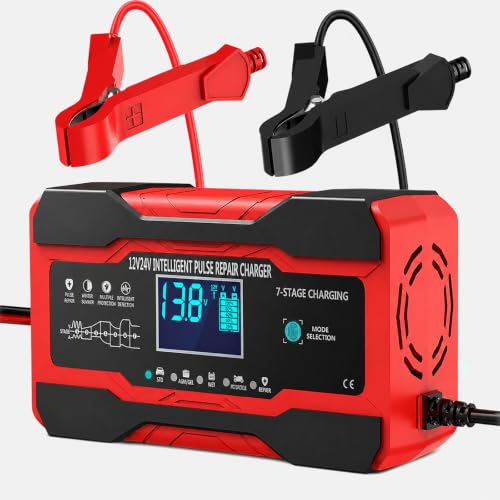
The AILRINNI is the odd one out in this list: a 10 amp charger with a 24V mode for less money than NOCO's 1 amp unit, sold by an AU storefront rather than Amazon directly, and sitting at number one in Amazon AU's Battery Chargers category anyway. The listing states DC output of 10A at 12V and 5A at 24V, a backlit LCD showing charging status and battery status, and an integrated thermal sensor for temperature compensation, which is the feature that stops a hot tin shed from cooking a battery on float. That's a lot of stated capability for $46, and the rank says plenty of people have already done that arithmetic. For utes, tractors and anything with a 24V system, it's also the only one of the five picks that covers it.
Two stated features earn their keep. The repair mode claims to help recover old or idle batteries, the same pulse-style promise the desulphation section covers, so hold it to the same standard: worth trying on a battery that's been sitting, not a resurrection service. The memory function is more practical than it sounds, because a charger that wakes up in the mode you left it in after a power interruption is one you can leave on a caravan or shed battery without rechecking it after every storm. The listing also states overcharge, overvoltage and overcurrent protection, and describes the leads as heat-resistant copper, which I'd read as an intention rather than a test report.
The honest frame is that this is the most charger per dollar here, from the least-known brand. The listing copy reads like it was translated in a hurry, it doesn't state AGM or lithium modes the way the NOCO and CTEK listings do, and no warranty term is stated, so what you're buying is amps, a screen and a sales rank rather than a pedigree. For a flooded-battery ute, a 24V truck or a shed of machinery that just needs bulk charge on tap, that trade reads fine to me. For an expensive stop-start AGM battery, I'd spend up.
Honest caveats: Sold by an AU storefront rather than Amazon directly, so check the current seller before ordering. The listing states no dedicated AGM or lithium mode and no warranty term, and the copy is rough enough that I'd treat the protection claims as a list of intentions. The 24V mode halves the current to a stated 5A.
Best for: Flooded-battery utes, 24V gear and sheds that want the most stated amps for the least money.
Type: Charger and maintainer, 12V and 24V • Output: Stated DC 10A at 12V, 5A at 24V • Display: Backlit LCD, charging and battery status • Temp compensation: Integrated thermal sensor, stated • Repair mode: Stated, for old or idle batteries • Protections: Overcharge, overvoltage, overcurrent, stated • Seller: AILRINNI AU Store, condition New • Price: $46 at time of writing • Rank: #1 in Battery Chargers (Amazon AU)
View on Amazon AU
NOCO GENIUS1 1A 6V/12V Smart Battery Charger and Maintainer
ASIN B08D6WV445 • $70.95 • Ships from Amazon AU
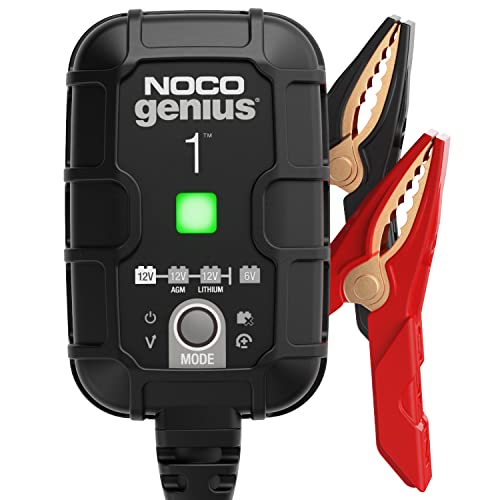
The GENIUS1 is a 1 amp charger the size of a soap bar, and the point of it is the word maintainer rather than the word charger. The listing covers 6V and 12V lead-acid in every flavour on the modern label, AGM, EFB, gel, SLA, VRLA and start-stop, plus 12V LiFePO4 lithium, and states the unit can be left connected indefinitely while it monitors the battery and holds it at full. That's the whole job for a motorbike, a classic or a weekend car, anything that sits more than it drives. At $71 it holds rank two in Battery Chargers, which for a 1 amp unit tells you how many parked vehicles this country is maintaining.
The stated party tricks matter more at this size than the amp figure does. It'll start charging a battery pulled down as low as 1 volt, and a force mode will push charge into one at zero volts, which is deeply flat territory where a lot of chargers simply refuse to engage. Temperature compensation via a built-in thermal sensor trims the charge in hot and cold weather, which matters in an Australian shed more than the brochure lets on. The pulse desulphation claim is present too, and the box includes both clamps and eyelet terminals on a stated 110 inch lead, so a bike can get a permanent fly lead and every future top-up becomes a two-second plug.
What it won't do is hurry. One amp into a 60Ah car battery that's properly flat is a couple of days of charging, and that's arithmetic rather than a defect: tank divided by tap. Buy it as the thing that stops the battery going flat in the first place, not the thing you reach for the night before a road trip. The warranty is a stated three years, the body plugs straight into the wall, and for the vehicle that sits under a cover eleven weekends out of twelve, this is the pick I'd default to.
Honest caveats: One amp is maintenance pace: a flat 60Ah battery is roughly two to three days of charging, so it's the wrong unit for hurry-up jobs. The wall-plug body occupies the socket directly, and the listing states nothing about BMS wake-up behaviour on lithium packs, so check your battery's manual before relying on the LiFePO4 mode.
Best for: Motorbikes, classics and weekend cars that sit for weeks: permanent low-fuss maintenance, not fast charging.
Type: 1A smart charger and maintainer, 6V/12V • Chemistries: Lead-acid incl AGM, EFB, start-stop; LiFePO4, stated • Flat recovery: From 1V, force mode to 0V, stated • Temp compensation: Integrated thermal sensor, stated • Leads: Clamps plus eyelet terminals, stated 110 inch cable • Warranty: Stated 3 years • Seller: Amazon AU, condition New • Price: $71 at time of writing • Rank: #2 in Battery Chargers (Amazon AU)
View on Amazon AU
NOCO GENIUS5 5A 6V/12V Smart Battery Charger and Maintainer
ASIN B08D6WMGXZ • $135.00 • Ships from Amazon AU
The GENIUS5 is the same NOCO platform with five times the current, and that ratio change is what moves it from maintainer to the default charger for a household's daily car. Five amps turns an overnight connection into a genuinely useful recharge on a standard car battery rather than a multi-day project, and everything that made the small one likeable carries over per the listing: the full 6V and 12V lead-acid chemistry list including AGM, EFB and start-stop, LiFePO4 lithium support, charging from 1 volt with a force mode for dead-flat packs, and the thermal sensor trimming the charge to the weather. At $135 it sits one rank behind its little brother, at number three in Battery Chargers.
The hardware grows up with the current. Instead of a wall-plug body there's a stated 72 inch AC cable and an 80 inch DC lead with clamps and eyelet terminals, plus a mounting bracket and screws in the box, so it can live screwed to the garage wall with the leads dressed properly rather than dangling off a powerpoint. The stated pulse desulphation and the indefinite-connection maintenance mode are the same story as the GENIUS1, and the three-year warranty matches too. It's the configuration I'd pick for one car that mostly drives but sometimes sits: fast enough to fix a flat-battery morning by evening, gentle enough to babysit the battery over the holidays.
Against the CTEK at $152 the choice is closer than the spec sheets admit. The NOCO states broader chemistry coverage, 6V and lithium included, and costs $44 less; the CTEK answers with a dedicated AGM program, a recond mode and a five-year warranty. I'd send a household with one modern flooded-battery car either way and not lose any sleep over it, but the GENIUS5's mounting kit and lithium coverage make it the more flexible garage fixture for a mixed fleet of car, bike and mower batteries, and that's the situation most driveways eventually turn into.
Honest caveats: Five amps is still measured against battery size: a big 4WD or deep-cycle battery will want the GENIUS10's headroom. The listing states no charge-time figures, so my overnight framing is arithmetic from the amp rating, not a manufacturer promise, and prices on this line move around noticeably week to week.
Best for: The household default: one daily car, occasional flats, and a garage wall to mount it on.
Type: 5A smart charger and maintainer, 6V/12V • Chemistries: Lead-acid incl AGM, EFB, start-stop; LiFePO4, stated • Flat recovery: From 1V, force mode to 0V, stated • Temp compensation: Integrated thermal sensor, stated • Cables: Stated 72 inch AC, 80 inch DC, clamps and eyelets • Mounting: Bracket and screws included • Warranty: Stated 3 years • Price: $135 at time of writing, Amazon AU, New • Rank: #3 in Battery Chargers (Amazon AU)
View on Amazon AU
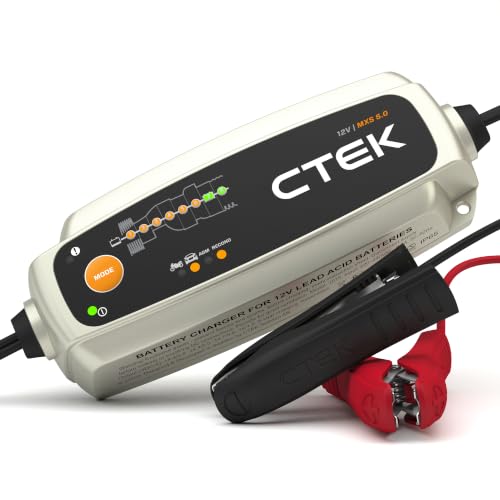
CTEK MXS 5.0 12V Battery Charger with AGM and Recond Modes
ASIN B075XSPGM7 • $152.15 • Ships from Amazon AU
CTEK is the brand the dealership battery blokes bring up unprompted, and the MXS 5.0 is the unit that reputation rides on: the listing leans on the claim that over 40 vehicle manufacturers use CTEK's charging technology, which is the sort of evidence I'll actually accept. It's a 12V charger and maintainer with a dedicated AGM program for faster, fuller charging on that chemistry, a recond mode the listing states restores deeply discharged and out-of-condition batteries, patented pulse desulphation, and built-in temperature compensation for hot and cold extremes. At $152 it holds rank five in Battery Chargers, and it's the pick here for anyone whose car carries an expensive stop-start AGM battery.
The design details are where the money went. The listing states it's splash and dustproof, short-circuit proof, spark free and reverse-polarity protected, and that it's designed so you don't need to disconnect the battery from the car before charging, which protects the radio presets, the ECU's learned values and your knuckles all at once. The patented float and pulse maintenance is stated suitable for long-term connection, so it does the garage-queen job as well as the recovery one. The warranty is the quiet headline: a stated five years, against three on the NOCOs and nothing stated at all on the AILRINNI, and warranty length is one spec a manufacturer can't fake.
The gaps are worth naming. The listing never states the charge current in its feature copy, the model name implies five amps but I only quote what's written, and there's no stated lithium mode or 6V support, so LiFePO4 caravan packs and vintage 6V systems are NOCO territory. It's also the most money here for the least stated versatility. What you're paying for is the AGM program, the recond cycle, the sealed housing and the five-year warranty, and for one good car kept a long time, I reckon that's the right place to spend.
Honest caveats: No stated lithium or 6V support, so mixed fleets with LiFePO4 or vintage batteries need the NOCOs instead. The feature copy doesn't state the charge current outright, which is an odd omission at this price. Recond claims deserve the same scepticism as every desulphation promise: sound plates recover, worn-out plates don't.
Best for: Stop-start AGM batteries and one good car kept long enough for the five-year warranty to matter.
Type: 12V charger and maintainer • AGM: Dedicated charge program, stated • Recond: Stated mode for deeply discharged batteries • Desulphation: Patented pulse function, stated • Housing: Splash and dustproof, spark free, stated • In-car charging: Stated safe without disconnecting the battery • Warranty: Stated 5 years • Price: $152 at time of writing, Amazon AU, New • Rank: #5 in Battery Chargers (Amazon AU)
View on Amazon AU
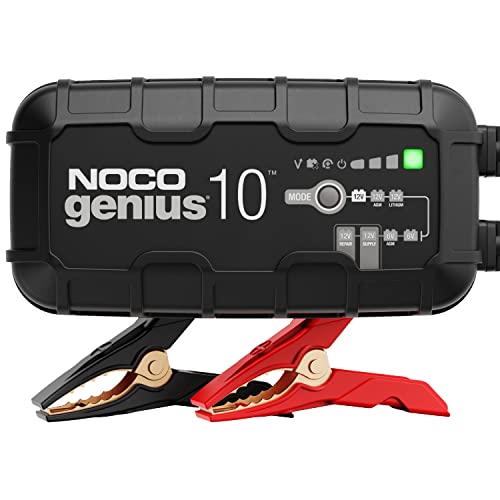
NOCO GENIUS10 10A 6V/12V Smart Battery Charger and Maintainer
ASIN B08D6W3K1L • $189.00 • Ships from Amazon AU
The GENIUS10 is the GENIUS5 with the current doubled and the same everything else, and the doubling is the entire purchase decision. Ten amps is the rate at which big batteries stop being a planning exercise: the 4WD's oversized flooded battery, the caravan's deep-cycle bank, the boat that gets used one month a year. The listing keeps the full platform intact: 6V and 12V, the complete lead-acid chemistry list with AGM, EFB and start-stop, LiFePO4 lithium, recovery from 1 volt with force mode to zero, thermal-sensor temperature compensation and the indefinite maintenance connection. At $189 it sits at rank six in Battery Chargers, one spot behind the CTEK at nearly the same money.
Sizing is the reason to buy it and the reason not to. Ten amps into a 100Ah deep-cycle battery is roughly a day from flat, which is the difference between the caravan being ready this weekend or next, while the same current pointed at a small motorbike battery is more machine than the job wants, even though the smart circuitry will throttle it back. The box matches the GENIUS5's: stated 72 inch AC cable, 80 inch DC lead, clamps, eyelet terminals, mounting bracket and a three-year warranty. Bolted to a shed wall next to the caravan bay with the eyelet lead left on the house battery, it's about as close to fit-and-forget as 12V power gets.
Most households don't need it, which is exactly the sort of thing this series is supposed to say out loud. A daily car with a standard battery is fully served at the GENIUS5's price, and a parked bike is served at the GENIUS1's, so the extra $54 would be buying current those batteries can't use. The GENIUS10 earns its $189 when the batteries are big, multiple or deep-cycle: tow vehicles, dual-battery utes, boats, caravans with lithium house packs. If that list sounds like your driveway, buy the amps once and stop thinking about it.
Honest caveats: Overkill for a single standard car battery, and the $54 over the GENIUS5 buys nothing except current. The listing states no charge-time figures, so the day-from-flat framing is arithmetic on the amp rating with losses ignored. Like every NOCO here, the stated warranty is three years against CTEK's five.
Best for: 4WDs, boats, caravans and dual-battery setups where the amp-hours are big and the queue is real.
Type: 10A smart charger and maintainer, 6V/12V • Chemistries: Lead-acid incl AGM, EFB, start-stop; LiFePO4, stated • Flat recovery: From 1V, force mode to 0V, stated • Temp compensation: Integrated thermal sensor, stated • Cables: Stated 72 inch AC, 80 inch DC, clamps and eyelets • Mounting: Bracket and screws included • Warranty: Stated 3 years • Price: $189 at time of writing, Amazon AU, New • Rank: #6 in Battery Chargers (Amazon AU)
View on Amazon AUSide-by-side comparison
| Product | Price | Best for |
|---|---|---|
| AILRINNI Car Battery Charger 10-Amp | ~$45.99 | Flooded-battery utes, 24V gear and sheds |
| TEKXDD Car Battery Charger 10-Amp | ~$39.99 | The lowest price for a 12V and 24V charger |
| AstroAI B8 Car Battery Jump Starter Power Bank | ~$58.97 | A jump start in the glovebox, not a charger |
| NOCO GENIUS1: 1A 6V/12V Smart Battery… | ~$64.99 | Bikes, classics and weekend cars on maintenance |
| Lucklike 7000A Jump Starter with Air… | ~$89.99 | Starting big diesels and inflating tyres |
| NOCO GENIUS5: 5A 6V/12V Smart Battery… | ~$135.00 | A daily car that needs a proper top-up |
| CTEK MXS 5.0 | ~$148.57 | Expensive stop-start AGM batteries |
| NOCO GENIUS10: 10A 6V/12V Smart Battery… | ~$189 | Big, multiple or deep-cycle batteries |
What we see fail at the bench: car battery chargers
Car chargers don't get booked into a phone repair shop, but we live inside the same physics all day: lithium packs, charge circuits, corroded connectors and the damage bad power does downstream. The charger grief people describe to me sorts into three patterns, and all three are avoidable at purchase time or with a five-minute habit. None of them start with the electronics inside the charger, which are usually the last thing to die.
Sulfation builds while nobody's looking
The battery failures blamed on chargers are mostly failures of sitting. A battery parked below full charge grows sulfate crystals from day one, soft and recoverable early, hard and permanent after months, and by the time the symptom shows up as a slow crank, the damage has been compounding for a season. The fix is boring: get a maintainer on anything that sits more than a couple of weeks, and get it on before winter or a long trip away, not after. Recovery modes are a second chance, not a habit, and a battery that keeps needing them is already on its way out.
Leads and clamps go before the electronics
A charger's weak points are mechanical. The DC lead gets flexed at the same spot every session, clamp springs fatigue, and copper near a battery grows green-white corrosion that quietly adds resistance until the charger works harder for less result. Check where the cable enters the body and the clamps yearly, keep the contact faces clean, and store the unit off the floor somewhere dry rather than draped over the battery it feeds. The eyelet leads in the NOCO boxes dodge most of this by making the connection a bolted, weather-tolerant fitting instead of a clamp that lives under tension.
The wrong mode undercharges quietly
An AGM battery charged on a flooded profile doesn't fail loudly, it just never quite reaches full, and the shortfall becomes sulfation on a schedule. The same slow damage runs the other way when a lithium house battery meets a lead-acid profile: the battery management system and the charger argue about voltage, sessions end early, and the pack lives perpetually short. Read the battery's label before buying the charger, set the mode once, and if a maintained battery still loses ground over a month, suspect the mode setting before the battery. It's a ten-second check that's saved a few expensive guesses.
Decision tree: which one should you actually buy?
- Motorbike, classic or weekend car that mostly sits? → The NOCO GENIUS1 at $71. One amp of set-and-forget maintenance, eyelet terminals for a permanent fly lead, and stated recovery from deeply flat.
- One daily car and the occasional flat morning? → The NOCO GENIUS5 at $135: five amps brings a flat standard battery back in roughly a day, and the mounting bracket makes it garage furniture.
- Expensive stop-start AGM battery in a car you're keeping? → The CTEK MXS 5.0 at $152. Dedicated AGM program, recond mode, sealed housing and a stated five-year warranty.
- 4WD, boat, caravan or a lithium house battery? → The NOCO GENIUS10 at $189: ten amps of deep-cycle pace with stated LiFePO4 support and the same mounting kit.
- 24V gear in the shed, or the most current for the least money? → The AILRINNI at $46 states 10 amps at 12V and covers 24V as well, with the seller and mode caveats its write-up lists.
- Car electronics acting up since a flat battery or a jump start? → Deep discharges and jump-start spikes are hard on the gear wired into a car. If a dash cam, tracker or anything else that rides with you has been odd since, bring it in to our Erina workshop and we'll test the device before you replace it.
Frequently asked questions
Can I leave a battery maintainer connected all the time?
With the smart units in this guide, yes, that's the design intent. The NOCO listings state the chargers can stay connected indefinitely while they monitor the battery and hold it at full, and the CTEK states its float and pulse maintenance suits long-term connection. The habit I'd add is a monthly glance: check the clamps or eyelets for corrosion, check the status light says what it should, and make sure the battery case isn't warm or smelling of rotten eggs. Old-style dumb trickle chargers are a different animal, they'll happily overcharge a battery for a month, so this answer applies to chargers with a stated maintenance mode, not the rusty thing on the shelf from 1998.
What size battery charger do I need?
Divide the battery's amp-hour rating by the charger's amps and you've got a rough charge time from flat, before losses. A 1 amp unit like the GENIUS1 suits maintenance, keeping a charged motorbike or weekend car topped up, where speed is irrelevant. Five amps suits a daily car, because a flat 60Ah battery comes back in roughly a day rather than three. Ten amps earns its money on 100Ah-plus batteries in 4WDs, boats and caravans, or when several vehicles queue for the same charger. More amps than that isn't better for a small battery, the smart circuitry throttles back anyway; you're just paying for headroom you won't use.
Will a desulphation or repair mode fix a dead battery?
Sometimes, partially, and the odds depend on how the battery died. Pulse desulphation works on soft, recent sulfate buildup, the kind a battery grows over a few flat months in a shed, and on those it can claw back real capacity. It does nothing for hardened long-term sulfation, shed plate material, internal shorts or a dry cell. Run the mode on a battery that sat flat over winter and you might get another season out of it; run it monthly on a battery that keeps dying and you're watching a battery fail in slow motion. A load test at a battery shop tells you which case you have, and it's worth doing before you spend anything.
Is it safe to charge a car battery without disconnecting it?
With a modern smart charger, generally yes, and the CTEK listing states outright that disconnection isn't needed and vehicle electronics are protected. The old warning came from unregulated chargers that could push voltage spikes into the car's systems. Good practice still applies: connect the leads before powering the charger up, positive first then negative, keep clamps clear of fuel lines and moving parts, and switch the charger off before disconnecting. If the battery is swollen, cracked or smells of rotten eggs, don't charge it at all, in the car or out of it. And give an enclosed garage some airflow during a long charge, because a hard-working battery still gasses a little.
What's the difference between a battery charger and a jump starter?
A jump starter is an emergency tool: a lithium pack that supplies the few hundred amps a starter motor needs for a few seconds, and it puts essentially no charge into your battery. A charger is the planned tool: it refills the battery properly over hours and, in maintainer form, stops it going flat in the first place. The pattern I see in driveways is owning only the jump starter, which turns every start into a rescue while the battery quietly sulfates its way to death underneath. Ideally the jump starter lives in the glovebox for the day something goes wrong, and the charger lives near a powerpoint doing the job that stops that day arriving.
Why does my car battery keep going flat overnight?
Three suspects, in order. First, parasitic drain: something in or added to the car is drawing too much while parked, a dash cam in parking mode, an aftermarket accessory, a boot light that never quite switches off, or a module that isn't sleeping. Second, the battery itself: a sulfated or worn battery can charge to a normal-looking voltage and still hold almost nothing, which looks identical from the driver's seat. Third, charging: a weak alternator or corroded terminals mean the battery never actually reaches full. An auto electrician can measure the drain in minutes, a battery shop can load test for the second case, and the terminals you can check yourself by eye.
Related buying guides
The gear in your car hates flat batteries too
Deep discharges and jump-start spikes are hard on everything wired into a car: dash cams, trackers, head units and the chargers feeding your phone. If something that rides in your car has been glitchy since a flat-battery episode, bring it in. We'll test it in the workshop and tell you whether it's the device, the lead or the car before you spend anything.
Visit our Erina workshop Book Online