Prices from Amazon AU, updated daily. Swipe or use the arrows for more.
Disclosure: This article contains affiliate links to amazon.com.au. If you buy through one of these links iFix may earn a small commission at no extra cost to you. It doesn't change which products we recommend. We focus on what actually lasts based on 16 years of repair-shop experience.
Quick summary8 picks
- Entry PickPyle Pull Down Projector Screen about$79.75
- Projection Screen with Stand 120 inch… about$81.59
- Pyle 101.6cm Tripod Projector Screen about$94.99
- Projector Screen and Stand about$117.19
- Pyle Manual Pull Down Projector Screen -… about$124.02100" screen.
- VEVOR Manual Pull Down Projector Screen about$146.98
- AWOL VISION 120" Fixed Frame Projector Screen about$420120" screen.
- Most PremiumElite Fixed Sable Frame B2 Cinewhite 16:9… about$799
Why a repair shop is writing about projector screens
Most of the projectors we see come in for the same few faults: a fan full of dust, a dead lamp, an HDMI port that's been yanked once too often. But a lot of the complaints about a projector's picture have nothing to do with the projector. A grey, patchy or wavy image is very often a painted wall, a creased screen or a screen with the wrong shape for the source, and no repair to the projector will fix it.
This guide covers the three kinds of screen most homes buy: manual pull-down screens that mount on a wall or ceiling, portable screens on a folding stand for the backyard, and fixed frame screens that stretch the material flat on an aluminium frame. If you're still choosing the projector itself, start with our 4K projector picks, because its brightness and throw decide which screen suits it.
The six picks run from $79.75 to $799 at time of writing. Four are sold by Amazon AU, one by AWOL VISION AU Direct and one by stusgo_2AU, and all six passed my retail check. Amazon AU's API returned no category rank for any of them, so the ranks I quote are each listing's overall Amazon AU rank, checked the same day.
I've left out motorised screens and inflatable screens on purpose, for reasons the power section explains, and I've left out a JFHID manual screen whose listing describes a motor the title says it doesn't have.
Size, aspect ratio and how far you sit
Screen sizes are quoted as the diagonal in inches, even on Australian listings, so a 100-inch screen is about 221cm wide and 125cm tall in the 16:9 shape, and a 120-inch is about 266cm by 149cm. Measure the wall first, then allow for the black border and the case or frame, which add several centimetres each side. The stusgo listing says plainly that the room should be wider than 140 inches, about 3.6m, for its 120-inch screen and stand.
Aspect ratio matters as much as size. Streaming, TV and games are 16:9, and a 16:9 screen fills with them edge to edge. The Pyle 100-inch screen lists a viewing area of 59.8 by 79.9 inches, which is the squarer 4:3 shape used for older presentations. A 16:9 movie on that screen leaves blank bands above and below, so the picture is closer to a 92-inch 16:9 image on a 100-inch screen.
How far you sit decides how big is too big. A common rule of thumb is to sit about one and a half times the screen's width away for a 4K source, so roughly 3.3m from a 100-inch screen and 4m from a 120-inch. Sit closer and you'll turn your head to follow the action. Sit much further back and a bigger screen does more for the picture than a brighter projector would.
The projector's throw ratio sets the other distance: multiply it by the screen width to get how far the lens must sit from the screen. Check it before you buy a screen size, because a projector that can't sit far enough back will never fill a 120-inch screen.
Gain, viewing angle and room light
Gain is how much light a screen sends back compared with a standard white reference, which is 1.0. The Elite Sable Frame B2 lists a gain of 1.1 for its CineWhite material, and the AWOL Vision screen's title lists 1.3, written as "1.3 dB Peak Gain". Gain is a ratio, not decibels, so read that as a gain of 1.3. The Pyle, GAINVANE and stusgo listings don't state a gain figure.
Higher gain makes the picture brighter for the people sitting straight in front, but the brightness falls away faster for people at the sides, and a high gain screen can show a brighter spot in the middle. A gain close to 1.0 spreads the light evenly across a wide couch. For most living rooms with a projector of reasonable brightness, a matte white screen between 1.0 and 1.3 is the safe choice.
Room light is the bigger enemy. A white screen reflects every lamp and window as well as the projector, so blacks turn grey in a bright room. Ambient light rejecting screens, sold as ALR or CLR, use layered or ridged surfaces to bounce ceiling light away from the viewer, and they suit ultra short throw projectors in rooms you can't darken. I didn't find one from an Australian seller on Amazon AU in this price range, so none made the picks.
If you can't buy an ALR screen, close the curtains, turn off lights behind the screen and paint the wall around it a darker colour. That costs less than any screen upgrade and does more for contrast.
Pull-down, stand or fixed frame
A manual pull-down screen rolls up into a case on the wall or ceiling. You pull it down to a height, let it go gently, and a self-locking ratchet holds it there. Both Pyle pull-down screens work this way and hang from two loops on the case onto screws or hooks. It's the right choice for a lounge room that's a lounge room first, since the screen disappears when you're not using it.
A portable screen on a stand is a folding fabric screen clipped or pulled onto a frame and held up by a tripod or two legs. The GAINVANE and stusgo 120-inch screens are this type, both packed into a carry bag, and both can be set up in the backyard for a movie night and stored in a cupboard. The GAINVANE listing includes ground stakes, ropes and sandbags for outdoor use, which you'll need on the Central Coast, where an evening sea breeze turns a big screen into a sail.
A fixed frame screen stretches the material tight across an aluminium frame on the wall, like a giant picture frame. It gives the flattest surface of the three, with no waves or curl at the edges, which matters with 4K projectors and with ultra short throw projectors that sit close to the wall and show every ripple. The AWOL Vision and Elite picks are this type. Assembly takes an hour or two and a second pair of hands, and once it's up it stays up.
If you're watching movies weekly in one room, a fixed frame is worth the extra. If the screen comes out for a party twice a year, a stand screen does the job for a fraction of the price.
Why motorised and inflatable screens aren't here
A motorised screen has a small tubular motor in its roller, limit switches that stop it at the top and bottom, and a remote receiver, all running from mains power. Those are the parts we see fail: a limit switch that drifts so the screen rolls too far and tears off the roller, a remote receiver that stops responding, and a motor that hums but won't turn. A manual screen has none of those parts to fail.
The motorised listings I checked on Amazon AU from Australian sellers didn't state an Australian plug, a voltage or an RCM electrical safety mark, so I couldn't confirm they're built for Australian power. I leave out any mains product whose listing can't confirm that. A motorised screen also needs power at the ceiling, and wiring a new power point or hardwiring a screen in NSW is licensed electrician work, not a DIY job.
Inflatable outdoor screens need a mains blower running the whole film, and the ones I found didn't state an Australian plug or an RCM mark either. A blower running for two hours on an extension lead across a damp lawn at night is not something I'd recommend without that information, so they're left out too.
If you want a motorised screen, buy one from a retailer that states the plug and the RCM mark in writing, and have an electrician install the power point.
Mounting it safely
A pull-down screen's case is long and heavy at the ends, and the Pyle cases hang from two top loops. Screw those into a wall stud or a ceiling joist, not bare plasterboard, or use plasterboard anchors rated well above the screen's weight. A stud finder costs less than a screen pulled off a ceiling, and a falling case can land on someone sitting under it.
Mount the case level, because a screen that hangs even a few millimetres out of level shows a tilted picture you'll notice on every film. Leave enough clearance at the bottom of the pulled-down screen that people don't kick it, and keep the bottom of the image near seated eye height.
A fixed frame screen hangs from wall brackets supplied in the box. Locate studs for each bracket, and check behind the plasterboard for cables and pipes before you drill. If your projector is going on the ceiling too, plan the HDMI and power runs at the same time. A long HDMI run through the ceiling is where we see picture drop-outs, and a fibre optic HDMI cable is the usual fix for runs past about 10 metres.
For sound, a projector's built-in speaker won't fill a room with a 120-inch picture. An AV receiver or one of our soundbar picks sits under the screen and does the job.
Creases, curl and cleaning
Portable fabric screens fold into a bag, and the folds leave creases that show as lines in a bright scene. Both the GAINVANE and stusgo listings describe wrinkle-free or anti-crease material, but any folded fabric creases if it's packed tightly or left folded for months. Roll it loosely rather than folding it hard, and hang it on its stand for an hour before the film so the creases relax. A cool hair dryer from the back helps stubborn lines.
Pull-down PVC screens curl at the edges over time, especially in a warm room or one that gets afternoon sun. Store the screen rolled up when you're not using it, keep it out of direct sun, and roll it up slowly by hand rather than letting it snap up. Letting it snap is also the fastest way to wear out the spring and ratchet.
Clean any screen gently. The AWOL listing says its screen can be cleaned with mild soap and water. For the others, use a soft brush or a dry microfibre cloth for dust, and a damp cloth with a drop of mild soap for marks, then let it dry fully before rolling or folding it. Never use solvents, glass cleaner or a scrubbing pad, which can strip the coating.
Checking it on arrival
Unroll or assemble the screen the day it arrives and look at it with the projector on a plain white or grey test image. Check for creases that won't relax, marks on the surface, a bent frame bar or a ratchet that won't hold. If a pull-down screen won't lock at a height, or a stand wobbles at full height, return it while you can, because those faults don't improve with use.
Measure it too. Listings quote the diagonal, and the shape can surprise you, as the 4:3 Pyle 100-inch shows. Check the viewing area against your projector's image with the projector's zoom and keystone set to neutral, because heavy keystone correction softens a 4K picture more than any screen difference.
Most people stream to a projector, and a slow streaming stick is often what makes a good projector look bad. Our streaming device picks cover the sticks that keep up. If you're casting from a phone with a failing charge port or a cracked screen, our Erina phone repair workshop can sort that before movie night.
The 6 picks, $79.75 to $799
Prices are Amazon AU at time of writing (2026-11-17) and move week to week. Amazon AU's API returned no category rank for these six listings, so the ranks shown are each listing's overall Amazon AU rank, checked the same day.

Pyle 84-Inch Manual Pull-Down Projector Screen, 213.5cm
ASIN B00EVVO03M • $79.75 • Ships from Amazon AU
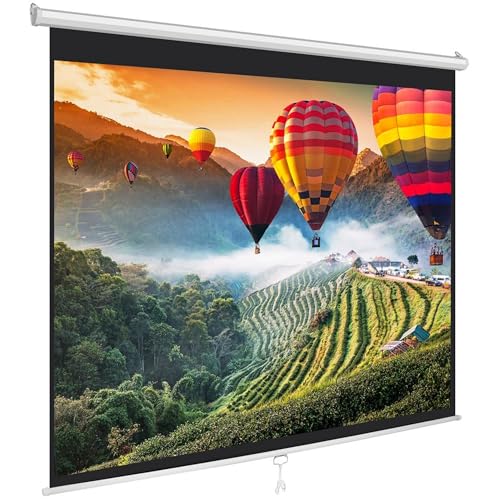
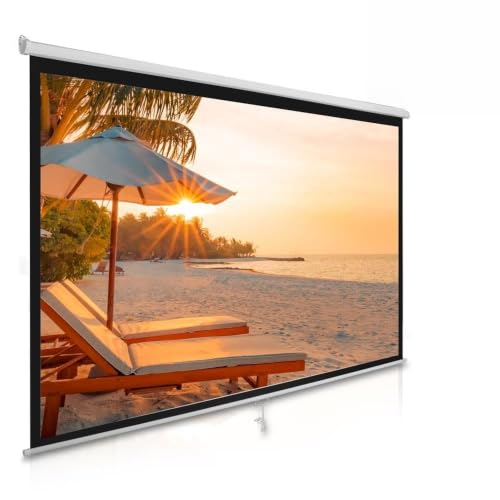
The Pyle 84-inch pull-down screen is the one I'd start most lounge rooms with, because it's a wall or ceiling screen sold by Amazon AU at the lowest price of the six. It's listed at $79.75 and ranks #447 overall on Amazon AU, the second best rank of the six and close to the stusgo stand screen at #435. Its part number is PRJSM9406, and the listing gives a 1 year limited warranty. The 213.5cm in the title is the diagonal, the same 84 inches given in its size field, so it suits a smaller room or a shorter throw projector. Amazon AU sells it directly, so a return goes through Amazon rather than a marketplace shop, which matters for a long case that's awkward to send back.
The listing describes a fully retractable pull-down screen with a self-locking mechanism: you pull it down, release it softly and it locks in place. It has a matte white surface with a black border frame, which helps the picture's edges look sharp and keeps stray light off the wall. It mounts on a wall or ceiling from two top loops that hook onto screws, nails or bolts. The listing doesn't state the aspect ratio or a gain figure, so check the screen's shape against your projector before you mount it, and measure the case length against the wall. The black border is worth more than it sounds, because it gives a projected image a crisp edge to land on and hides small overspill when the zoom isn't perfect.
Screw the loops into a stud or joist rather than plasterboard, and mount the case level. Roll it up slowly by hand rather than letting it snap, and store it rolled up away from afternoon sun so the edges don't curl. If the ratchet won't hold a height on arrival, return it, since that's the part that wears. Check the case length against the wall before you drill, and mark both loop positions with a level. Dust the surface with a soft brush every few months while it's pulled down. If it starts to creep up during a film, the ratchet is wearing, and that's a sign you've been letting it snap up.
Honest caveats: The listing doesn't state the aspect ratio, gain or viewing area, so measure before you mount it. At 84 inches it's the smallest of the six picks. Its listing gives no stated way to adjust the ratchet if it wears. Mount it into a stud or joist.
Best for: A low-cost wall or ceiling screen for a smaller lounge room, sold by Amazon AU.
Price: $79.75 (Amazon AU) • Type: Manual pull-down, wall or ceiling • Size: 84 inch, 213.5cm diagonal • Surface: Matte white, black border • Aspect: Not stated on the listing • Gain: Not stated on the listing • Warranty: 1 year limited • Part number: PRJSM9406 • Rank: #447 overall on Amazon AU
View on Amazon AU
stusgo 120-Inch Projector Screen with Stand, 16:9, Foldable
ASIN B0FS1GDPWD • $81.59 • Sold by stusgo_2AU on Amazon AU
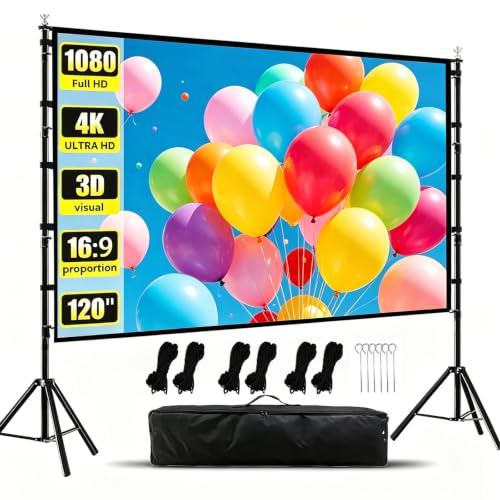
The stusgo 120-inch screen is the value pick, a big 16:9 screen on its own stand for well under the price of the frame screens. It's listed at $81.59, sold by stusgo_2AU, which passed my retail check, and ranks #435 overall on Amazon AU, the best overall rank of the six picks. Its listing gives a 1 year warranty. It's the pick for a family that wants a big picture for backyard movie nights and a screen that packs away into a cupboard afterwards, rather than a screen fixed to a wall. Its rank, the best of the six, suggests plenty of local buyers for the size and price.
The listing describes a 120-inch 16:9 polyester screen of 2.65m by 1.48m, with a 160 degree viewing angle and support for front and rear projection. It's held on a stand with a detachable crossbar and a tripod that opens without tools, and it packs into a matching storage bag. The listing gives its weight as 9.8 pounds, about 4.4kg, and its carry size in inches, so it was written for an overseas buyer, though nothing in it depends on the market. It says the room must be wider than 140 inches, about 3.6m, for indoor use. Rear projection means the projector can sit behind the screen out of the way, though the picture then shows mirrored unless you flip it in the projector's settings.
Roll the fabric loosely into its bag rather than folding it hard, and hang it on the stand an hour before the film so creases relax. Outdoors, weigh the legs down, since the stand has no stakes listed. Wipe marks off with a damp cloth and dry it fully before packing. Bring the stand inside straight after the film, since dew settles on fabric quickly on the coast. Let the fabric dry fully before it goes in the bag, or it can mark and smell. Check the crossbar clips each time you pack it, because a lost clip leaves the screen sagging in the middle.
Honest caveats: The listing states no gain and no ground stakes or ropes, so a breeze can push it over outdoors. It gives weight and carry size in pounds and inches. Folded fabric creases, so expect to let it hang before use. Bring it in before dew settles.
Best for: A big 16:9 backyard screen on a stand for the lowest price among the 120-inch picks.
Price: $81.59 (stusgo_2AU) • Type: Portable fabric screen on stand • Size: 120 inch, 2.65 x 1.48m • Aspect: 16:9 • Viewing angle: 160 degrees (listing) • Projection: Front and rear • Weight: 9.8 lb, about 4.4kg (listing) • Warranty: 1 year • Rank: #435 overall on Amazon AU
View on Amazon AU
GAINVANE 120-Inch Portable Projector Screen and Stand, 16:9
ASIN B0C6TRKB5P • $117.19 • Ships from Amazon AU
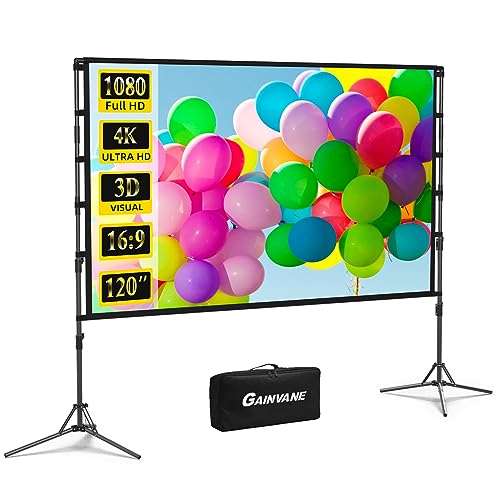
The GAINVANE 120-inch screen is the outdoor pick, because it's the stand screen whose listing includes the ground stakes, ropes and sandbags you need to keep a big screen upright in a breeze. It's listed at $117.19, sold by Amazon AU, and ranks #2,378 overall on Amazon AU. It costs more than the stusgo screen of the same size, and the difference is that tie-down kit and a seller that handles returns directly. For a coastal backyard, where the evening breeze picks up just as the film starts, that kit is worth having. Amazon AU sells it directly, so returns are straightforward if the stand arrives bent.
The listing describes a 120-inch 16:9 screen in a thick polyester the maker calls milk silk, with a 160 degree viewing angle and support for front and rear projection. It says the fabric is foldable, washable and wrinkle-free, and not see-through. The tripod stand is detachable, the crossbar assembles without tools, and it comes with an instruction manual and a carry bag. The listing gives the screen's weight as 7.4 pounds, about 3.4kg. It states no gain figure, and its model field just reads 120 projector screen with stand. Front and rear projection support means the projector can sit behind the screen on a table, away from guests walking past, as long as you flip the image in the projector's menu.
Peg the stakes and ropes out every time you use it outdoors, even when the air feels still. Wash it gently and dry it fully before it goes back in the bag. Store it rolled loosely rather than folded tight, so the creases don't set over winter. Pack the stakes and sandbags in the bag with the screen, so they're never left behind in the shed. Bring it in before dew settles, and dry it fully before packing. If a leg joint loosens over time, check it before every use rather than finding out when the screen tips.
Honest caveats: The listing states no gain, and its model number is a description rather than a code. Weight is given in pounds. It's ranked well below the stusgo stand screen overall, and folded fabric still creases if packed tightly. Bring it in before dew settles on the fabric.
Best for: Backyard movie nights in a breeze, with stakes, ropes and sandbags in the box.
Price: $117.19 (Amazon AU) • Type: Portable fabric screen on tripod stand • Size: 120 inch • Aspect: 16:9 • Viewing angle: 160 degrees (listing) • In the box: Stand, stakes, ropes, sandbags, bag • Weight: 7.4 lb, about 3.4kg (listing) • Gain: Not stated on the listing • Rank: #2,378 overall on Amazon AU
View on Amazon AU
Pyle 100-Inch Manual Pull-Down Projector Screen, Auto-Locking
ASIN B0HFQ7V5NK • $124.02 • Ships from Amazon AU
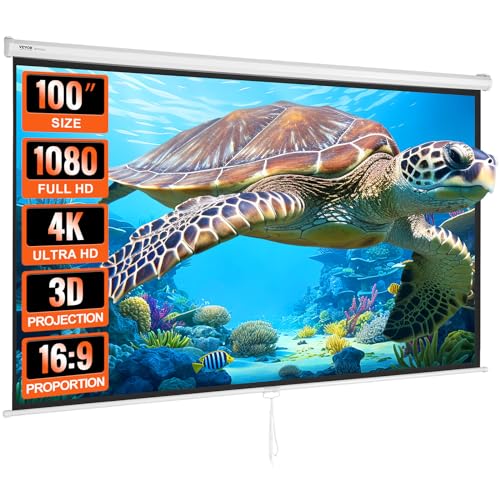
The Pyle 100-inch pull-down screen is the bigger of the two Pyle wall screens, for a room that needs more than 84 inches on the wall. It's listed at $124.02, sold by Amazon AU, and ranks #15,491 overall on Amazon AU, a much weaker rank than its 84-inch sibling, likely because it's a newer listing. Its part number is AU-PRJSM1006, and the AU in that code marks the Australian listing. The listing gives a 1 year warranty. The catch is its shape: it's a 4:3 screen, the squarer format used for presentations. Amazon AU sells it directly, which makes a return simpler if the shape doesn't suit your projector once it's on the wall.
The listing gives a viewing area of 59.8 by 79.9 inches, which is a 4:3 screen of 100 inches diagonal. A 16:9 movie fills its width and leaves blank bands above and below, so the image is closer to 92 inches in 16:9. It has an auto-locking pull-down mechanism with an adjustable height, a matte white surface and a black masking border, and it mounts on a wall or ceiling from two top loops onto screws, nails or bolts. It suits an office, a classroom or slides as much as films. The adjustable height is what makes the 4:3 shape workable for films, since you can stop the screen at the bottom of a 16:9 picture rather than pulling it all the way down.
Mount it into a stud or joist, level, and roll it up slowly by hand. For films, pull it down only far enough for a 16:9 image, which keeps the blank band at the bottom out of sight. Store it rolled up away from direct sun. Check the case length against the wall before drilling, since a 100-inch case is long. Dust it with a soft brush while it's pulled down, and treat marks with a damp cloth only. If it starts creeping up mid-film, the ratchet is wearing, so roll it up gently from then on.
Honest caveats: It's a 4:3 screen, so a 16:9 film leaves blank bands and uses about 92 inches of it. It's ranked well below the 84-inch Pyle, and the listing states no gain figure. Its case is long, so measure the wall before buying, and mount it into a stud or joist.
Best for: A 100-inch wall screen for slides and films, with an AU-coded part number.
Price: $124.02 (Amazon AU) • Type: Manual pull-down, wall or ceiling • Size: 100 inch • Aspect: 4:3 (59.8 x 79.9 in viewing area) • Surface: Matte white, black border • Gain: Not stated on the listing • Warranty: 1 year • Part number: AU-PRJSM1006 • Rank: #15,491 overall on Amazon AU
View on Amazon AU
AWOL VISION 120-Inch Fixed Frame Projector Screen MW-120
ASIN B0CPDYTDLY • $420 • Sold by AWOL VISION AU Direct on Amazon AU
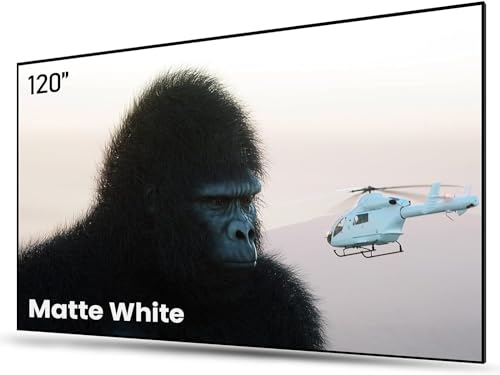
The AWOL Vision MW-120 is the fixed frame pick, the step up for a room where the screen stays on the wall and the picture needs to be flat. It's listed at $420, sold by AWOL VISION AU Direct, the brand's Australian storefront, which passed my retail check, and ranks #8,577 overall on Amazon AU. Its model is MW-120, and the listing gives a one year warranty. It's sold as a match for AWOL's own LTV-2500 ultra short throw projector, but the listing says it suits standard, short throw and ultra short throw projectors. Of the six picks, it's the one sold by a projector brand's own Australian storefront.
The listing describes a 120-inch matte white screen in PVC on a fixed frame with a black baked finish that cuts reflections at the edges, and a 170 degree viewing angle. Its title lists a gain of 1.3, written as dB, which should be read as a gain ratio. It's tensioned with a rod system the listing says goes together in minutes, and it's rated for 4K, 8K and active 3D. It can be cleaned with mild soap and water. The listing's claim of an 80 percent picture improvement is marketing, so I don't rank on it. A fixed frame suits ultra short throw projectors in particular, because they sit centimetres from the wall and show every ripple or wave in a pull-down or fabric screen.
Find studs for each wall bracket, check behind the wall for cables before drilling, and assemble the frame on a clean floor with two people. Keep it out of afternoon sun. Clean marks with mild soap and water and a soft cloth, as the listing describes, and never use glass cleaner. Keep the packing until the frame is assembled and checked, since a bent frame bar is easier to return in its box. Tension the material evenly from the middle of each side outwards. Dust it with a soft brush, and keep fingers off the surface while you hang it.
Honest caveats: It's a matte white screen, not ambient light rejecting, so a bright room still greys the picture. The gain is printed as dB, which isn't how gain is measured. Its picture improvement figure is a marketing claim. Assembly needs two people.
Best for: A flat, permanent 120-inch screen for a lounge or media room at a mid price.
Price: $420 (AWOL VISION AU Direct) • Type: Fixed frame, wall mounted • Size: 120 inch • Surface: PVC matte white • Gain: 1.3 (listed as dB) • Viewing angle: 170 degrees (listing) • Projectors: Standard, short and ultra short throw • Model: MW-120 • Rank: #8,577 overall on Amazon AU
View on Amazon AU
Elite Screens Sable Frame B2 120-Inch CineWhite 16:9 Fixed Frame Screen
ASIN B00Y7XA2OA • $799 • Ships from Amazon AU
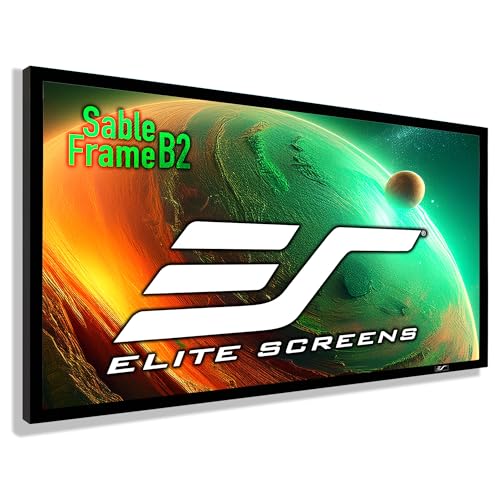
The Elite Screens Sable Frame B2 is the premium pick, from the best-known screen maker among the six, sold by Amazon AU. It's listed at $799, the highest price of the six, and ranks #9,991 overall on Amazon AU. Its part number is SB120WH2. Elite is a dedicated screen brand rather than a projector brand selling a matching screen, and its CineWhite material is one of the common reference whites in home theatre. It's the pick for a dedicated media room where the screen is a permanent fixture and the projector is a serious 4K unit. Amazon AU sells it directly, so a return goes through Amazon if the frame arrives damaged.
The listing describes the Sable Frame B2 series with Elite's CineWhite front projection material at a gain of 1.1, in a 16:9 aspect ratio at 120 inches. It says it holds resolution and brightness at any viewing angle, it's rated for 4K and 8K Ultra HD, HDR and active 3D, and it suits ultra short, short and standard throw projectors. A gain of 1.1 is close to the 1.0 reference, so the picture stays even across a wide couch. The listing is short: it doesn't list the frame width, the brackets or a warranty. In a dark room, a CineWhite screen at 1.1 gain shows a projector's colour and contrast close to how it was calibrated, which is why it suits a serious 4K projector.
Assemble it on a clean floor with two people and gloves, since skin oil marks the surface. Locate studs for the brackets and level the frame. Dust it with a soft brush, and treat marks with a damp cloth and mild soap only, never solvents. Keep the packing until the frame is up and checked. Clip the material on evenly so it doesn't wrinkle at the corners. Keep the room dark for films, since a matte white screen shows every lamp behind you, and keep afternoon sun off it so the material doesn't fade or warp.
Honest caveats: It's the highest-priced pick, and the listing doesn't state a warranty, frame width or what brackets are included. Like the AWOL screen, it's matte white rather than ambient light rejecting, so it needs a dark room to shine. Assembly needs two people.
Best for: A dedicated media room with a 4K projector and a screen that stays on the wall.
Price: $799 (Amazon AU) • Type: Fixed frame, wall mounted • Size: 120 inch • Aspect: 16:9 • Surface: CineWhite • Gain: 1.1 • Rated for: 4K, 8K, HDR, active 3D • Part number: SB120WH2 • Rank: #9,991 overall on Amazon AU
View on Amazon AUSide-by-side comparison
| Product | Price | Best for |
|---|---|---|
| Pyle Pull Down Projector Screen | ~$79.75 | |
| Projection Screen with Stand 120 inch… | ~$81.59 | |
| Pyle 101.6cm Tripod Projector Screen | ~$94.99 | |
| Projector Screen and Stand | ~$117.19 | |
| Pyle Manual Pull Down Projector Screen -… | ~$124.02 | |
| VEVOR Manual Pull Down Projector Screen | ~$146.98 | |
| AWOL VISION 120" Fixed Frame Projector Screen | ~$420 | |
| Elite Fixed Sable Frame B2 Cinewhite 16:9… | ~$799 |
What we see fail in the workshop: projector screens and setups
Projector screens are simple, but the setups around them aren't. Most of the picture faults people bring us trace back to the screen's mounting, its ratchet or roller, or the cables and power running to the projector rather than the projector itself. A good screen in a badly planned room still gives a poor picture, so these are the faults worth knowing before you mount anything.
Pull-down ratchets that won't hold
A manual screen locks with a small spring ratchet in the roller. Letting the screen snap up, or tugging it down hard, wears the ratchet until the screen creeps up mid-film or won't lock at all. Roll it up slowly by hand every time and never let it fly. A screen that won't lock from new should go straight back, because the ratchet is sealed inside the case on most low-cost screens and isn't a simple fix.
Motorised screens that tear themselves off the roller
On motorised screens, the limit switch that stops the roller can drift, so the screen rolls past its stop and pulls away from the roller, or winds up crooked. Remote receivers fail too, and a motor that only hums usually has a failed start capacitor or a jammed roller. These are mains parts sealed in a ceiling case, which is one reason the picks here are manual and one reason any power at the ceiling belongs to a licensed electrician.
HDMI drop-outs on long ceiling runs
A picture that flickers, goes black or drops to a lower resolution on a ceiling projector is usually a long or low-grade HDMI cable, not the projector or screen. Standard copper HDMI struggles past about 10 metres at 4K, and a cable kinked behind a ceiling joist gets worse over time. A fibre optic HDMI cable usually fixes it. A loose or damaged HDMI port on the source is also common, and that's a board level repair we do in the workshop.
Decision tree: which one should you actually buy?
- A wall screen for a smaller lounge room? → The Pyle 84-inch pull-down at $79.75 is sold by Amazon AU and hangs from two top loops on a wall or ceiling.
- Big backyard screen for the least? → The stusgo 120-inch screen with stand at $81.59 is 16:9 and has the best overall rank of the six.
- Outdoors in a breeze? → The GAINVANE 120-inch at $117.19 comes with ground stakes, ropes and sandbags, sold by Amazon AU.
- Slides as well as films? → The Pyle 100-inch pull-down at $124.02 is a 4:3 screen with an AU part number, so 16:9 films use about 92 inches of it.
- A flat permanent screen? → The AWOL Vision MW-120 fixed frame at $420, or the Elite Sable Frame B2 at $799 with CineWhite at 1.1 gain for a dedicated media room.
- Casting from a phone that won't charge? → A failing charge port is a common repair. Bring it into our Erina workshop and we'll check it before movie night and before you spend anything.
Frequently asked questions
Do I need a projector screen or can I use a wall?
A smooth, matte white or light grey wall works for casual viewing, but most walls aren't flat enough. Texture, paint sheen and small dents show up as patches and waves, especially with 4K and ultra short throw projectors that sit close to the wall. A screen gives an even, neutral surface with a black border that sharpens the picture's edges. If you test on a wall first, use a plain white test image to see how flat it really is.
What size projector screen should I buy?
Measure the wall, then work from where you sit. A common rule of thumb for 4K is to sit about one and a half times the screen's width away, so about 3.3m from a 100-inch 16:9 screen and 4m from a 120-inch. Then check your projector's throw ratio, multiplied by the screen width, to see how far back it must sit. Allow for the border and case, and check the aspect ratio, since a 4:3 screen of the same size gives a smaller 16:9 picture.
What does screen gain mean?
Gain compares how much light a screen reflects with a standard white reference of 1.0. A higher gain looks brighter to people sitting straight in front but dimmer at the sides, and very high gain screens can show a bright spot in the middle. A gain between 1.0 and 1.3, like the Elite at 1.1 and the AWOL at 1.3, suits most lounge rooms. Gain is a ratio, so a listing that prints it as dB is using the wrong unit.
Is an ambient light rejecting screen worth it?
In a bright room with an ultra short throw projector, often yes. ALR screens bounce light from above away from the viewer, so blacks stay darker with the lights on. They cost more than matte white, they narrow the viewing angle, and the type has to match the projector, since some only work with ultra short throw models. I didn't find one from an Australian seller on Amazon AU in this range, so if your room can't be darkened, buy one from a specialist retailer that states the projector type it suits.
Are motorised projector screens worth it?
They're convenient, but they add mains power, a motor, limit switches and a remote receiver, which are the parts that fail. The listings I checked from Australian sellers on Amazon AU didn't state an Australian plug, voltage or RCM safety mark, so none made these picks. If you buy one, get it from a retailer that states the plug and RCM mark in writing, and have a licensed electrician install the power at the ceiling, which is required in NSW.
How do I get creases out of a projector screen?
Hang a fabric stand screen on its frame for an hour before use and most creases relax. For stubborn lines, a hair dryer on cool, held well back from the rear of the screen, helps. Store fabric screens rolled loosely rather than folded hard, and pull-down screens rolled up out of direct sun, which stops edge curl. Never iron a screen or use heat on its front surface, since that can mark or melt the coating.
Related buying guides
HDMI port loose or picture dropping out?
A worn HDMI port on a console or laptop is one of the most common faults we fix. Bring it into our Erina workshop and we'll check the port and the cable and tell you what it needs before you spend anything.
Visit our Erina workshop Book Online