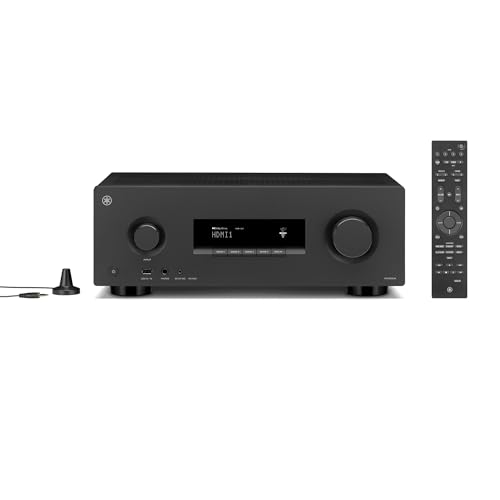
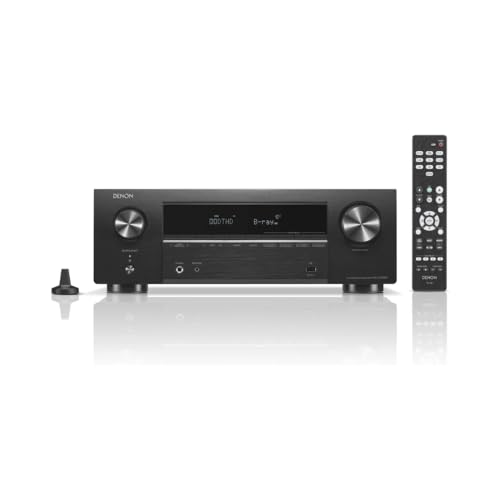
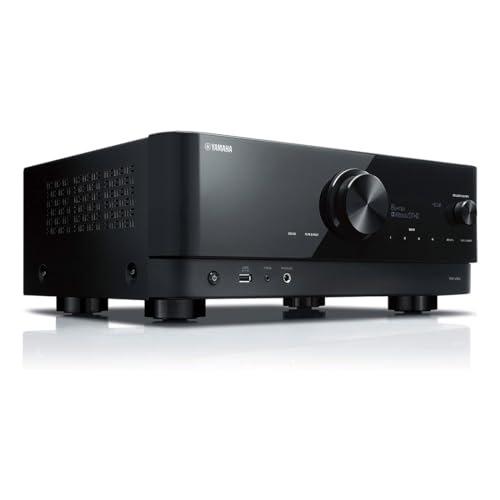
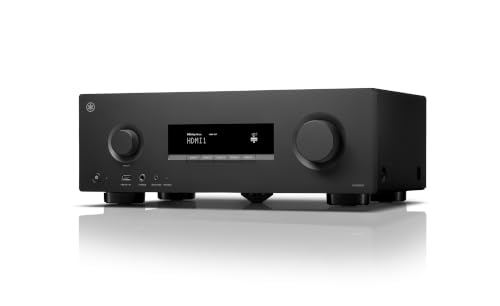
Prices from Amazon AU, updated daily. Swipe or use the arrows for more.
Disclosure: This article contains affiliate links to amazon.com.au. If you buy through one of these links iFix may earn a small commission at no extra cost to you. It doesn't change which products we recommend. We focus on what actually lasts based on 16 years of repair-shop experience.
Quick summary5 picks
- Entry PickYamaha RX300A 5.2-Channel Audio Video Receiver about$698
- Denon AVR-X580BT AV Receiver about$70370W.
- Yamaha RX-V6A 7.2-Channel AV Receiver with… about$1,09860Hz refresh.
- Yamaha RX500A 7.2 Channel AV Receiver with… about$1,199
- Most PremiumDenon AVR-X1800H AV Receiver about$1,29560Hz refresh.
Do you need an AV receiver, or will a soundbar do?
A soundbar is a single box under the TV. An AV receiver is the box that sits in the cabinet, takes every HDMI source you own, decodes the surround sound and powers five, seven or more separate speakers around the room. It's more work to set up and more wiring to hide, and that's exactly why most people should think twice before buying one. If you've never run speaker wire around a lounge before, it's worth knowing what you're signing up for before the box arrives.
Where a receiver wins is flexibility and lifespan. Speakers outlast electronics by a long way, and a decent pair of floorstanders bought today can still sound right in twenty years. With a receiver you replace the box in the middle when HDMI standards move on, and you keep the speakers. With a soundbar, the speakers, amplifiers and electronics all go to the tip together. A receiver also lets you build up one piece at a time, starting with a pair of speakers and a sub and adding rear and height speakers later.
The soundbar wins on simplicity, and in rooms where you can't run wire to the back of the couch. Renters, open-plan rooms with the couch in the middle of the floor and lounges with a lot of glass usually suit a soundbar better. My soundbars under $1,000 are the place to start if that sounds like your room. The rest of this guide assumes you've got, or are planning, separate speakers.
One more thing to settle before you spend: what's already in the cabinet. Plenty of people buying a receiver are replacing an old one that's died and keeping the speakers. If that's you, the main things to check are that your speakers' impedance suits the new receiver, which I cover below, and that the new receiver has the right outputs for any powered subwoofer you already own. Every receiver in this guide has two subwoofer outputs, shown by the .2 in its channel count.
What's on Amazon AU between $700 and $1,300
I went through Amazon AU's AV receiver listings on 26 October 2026, looking for units sold new by Amazon AU or an Australian storefront, with no grey imports and no overseas sellers. Four surround receivers made it through, two each from Denon and Yamaha: the Denon AVR-X580BT at $703, the Yamaha RX-V6A at $1,098, the Yamaha RX500A at $1,199 and the Denon AVR-X1800H at $1,295. Most of the other listings in this price range were stereo amplifiers, two-channel network receivers or home theatre packages.
Above about $1,300 the Amazon AU range thins out quickly, which is why this guide stops there. Higher-end receivers from Denon, Marantz and Yamaha are usually sold through specialist hi-fi stores in Australia. For most lounges that's no loss, because the jump from a $1,100 receiver to a $2,500 one mostly buys more channels and more power, and those generally only matter in a large dedicated cinema room.
Amazon AU doesn't publish a subcategory rank for AV receivers, so I've used the site-wide rank it does publish, written as #N overall on Amazon AU. The Yamaha RX-V6A was the best-ranked at #6,139, followed by the Denon X580BT at #12,873 and the Denon X1800H at #21,587. The Yamaha RX500A only came out in July 2026 and had no rank at all. Those numbers look large, but receivers sell in small volumes, and they're still a fair guide to which ones people are actually buying.
Channels, Dolby Atmos and the numbers on the box
The channel count tells you how many speakers a receiver can power. The first number is main speakers and the second is subwoofer outputs, so 5.2 means five speakers and two subs, and 7.2 means seven speakers and two subs. A 5.1 layout is left, centre and right at the front, two surrounds beside or behind the couch, and a sub. That's still the setup I'd recommend for most lounges, because it covers almost every film and show you'll watch.
Dolby Atmos and DTS:X add height. On a 7.2-channel receiver like the Yamahas and the X1800H, you'd usually run a 5.1.2 layout, which is the standard five speakers and a sub plus two height speakers, either in the ceiling or sitting on top of the front speakers firing upwards. Ceiling speakers give the better effect but mean cutting holes, which is a job for an electrician or installer if there's wiring in the way. Up-firing modules are easier, but they depend on a flat, hard ceiling to bounce off.
The Denon X580BT is a 5.2 receiver and its listing doesn't mention Dolby Atmos at all, so I'd treat it as a plain surround receiver. The RX-V6A also offers Atmos height virtualisation through a firmware update, according to its listing, which uses processing to imitate height from ordinary speakers. Virtual height is better than nothing, but it isn't the same as a real speaker above you. If Atmos is the reason you're buying a receiver, plan for real height speakers from the start.
HDMI 2.1, eARC and the TV in the middle
Modern receivers sit in the middle of your video chain, and that's where most setup problems start. If a PS5 or Xbox Series X goes through the receiver, the receiver has to pass 4K at 120Hz with VRR on to the TV, which needs HDMI 2.1 on its inputs and its output. The Yamaha RX-V6A and the Denon X1800H both state 8K at 60Hz and 4K at 120Hz support on their listings. The RX500A and the X580BT don't state either, so I wouldn't route a console through them.
The simpler setup for gaming is to plug the console straight into the TV and send the sound back to the receiver over eARC. That keeps the receiver out of the video path, and it's how I'd set up most lounges with a newer TV anyway, because TV apps like Netflix send their sound back the same way. eARC is stated on the X1800H listing, so check the others on the maker's spec sheet. If you're shopping for the TV as well, my 85-inch TV guide covers which big sets have HDMI 2.1 ports.
HDMI ports also wear, and receivers get more cable changes than most gear. A heavy HDMI cable pulling down on a port at the back of a cabinet cracks the solder joints over time, and the result is a picture that drops out on one input. It's the same failure I see on consoles, written up in my guide to HDMI port repair. Leave slack in every cable, and don't drag the receiver forward without unplugging the back first.
Matching speakers without cooking the amp
Speaker impedance is the number that matters most when you're pairing speakers with a receiver, and it's the one these Amazon AU listings leave out. Most home theatre speakers are rated at 6 or 8 ohms, and most mainstream receivers are designed around that. Some floorstanders and bookshelf speakers are rated at 4 ohms, and a 4-ohm speaker draws more current from the receiver at the same volume, which means more heat in the output stage.
None of the four listings states a rated speaker impedance, so check the maker's spec sheet before you buy if your speakers are rated below 6 ohms. Some receivers have an impedance setting in the menu that lowers the supply voltage for 4-ohm speakers. It reduces the maximum volume, but it also reduces heat, and I'd use it if your speakers call for it. Running 4-ohm floorstanders hard on a receiver that isn't designed for them is one of the more common reasons receivers go into protection.
Speaker wire is simpler than the marketing suggests. For runs of a few metres in a lounge, ordinary 16-gauge copper wire (around 1.3 mm²) is plenty, and thicker cable mostly matters for long runs to the rear speakers. What matters more is the ends. A single stray strand of copper touching the next terminal can short the output and trip the protection circuit, so twist the ends tight, use banana plugs if you can, and check every terminal before you power up.
Heat: why receivers come in for repair
Heat is the main thing that shortens an AV receiver's life. A receiver packs a lot of amplification, a power supply and digital processing into one box, and most of them run warm even at idle. The worst setup I see is a receiver pushed into a closed cabinet with a set-top box sitting on top of it. The heat has nowhere to go, the electrolytic capacitors dry out faster, and the HDMI and processing boards spend their lives hotter than they were designed for.
The fix is space. I'd leave at least 10 cm clear above a receiver and a few centimetres at the sides and back, and never stack anything on top of it. If it lives in a cabinet, take the back panel off or cut a vent, and consider a quiet USB cabinet fan if the cabinet is fully enclosed. Dust is the other half of it. Every year or so, with the receiver switched off and unplugged, vacuum the vents gently from the outside without opening the case.
The early warning signs are worth knowing. A receiver that shuts itself off after a long film, smells hot, or loses the HDMI picture once it's warmed up is telling you it's running too hot. Moving it somewhere with more air often fixes it before anything fails. If it keeps happening after that, get it looked at, because heat damage usually gets worse rather than better. The Erina workshop can check whether it's a heat problem or a part that's on its way out.
Room calibration: YPAO and Audyssey
The 7.2 receivers here come with automatic room calibration, and it's worth doing properly. Yamaha uses YPAO, listed with Reflected Sound Control on the RX-V6A, and the Denon X1800H uses Audyssey MultEQ XT. You plug in a measurement microphone, put it where your head goes on the couch, and the receiver plays test tones through each speaker. It then sets levels, distances and EQ so the sound arrives balanced at the listening spot. The RX500A listing doesn't state which calibration system it uses.
Two things make the difference. First, put the microphone at ear height on a tripod or a stack of books, not on the couch cushion, where it picks up reflections from the fabric. Second, take every measurement position the receiver asks for, spread across the seats rather than bunched in one spot. People skip this step and then wonder why the dialogue sounds thin. Keep the room quiet while it runs, so switch off ceiling fans and the air conditioning.
After calibration, check the subwoofer crossover and levels by ear. Automatic systems sometimes set the sub too low, or the crossover too high for small speakers. A crossover around 80Hz suits most bookshelf and satellite speakers. If dialogue still sounds muddy after that, raise the centre channel by a decibel or two rather than turning up the whole system, which only makes the explosions louder.
Power, standby and storms
Receivers usually die after storms in the same way TVs do: a surge comes in on the mains, or through the antenna lead and along the HDMI connection from the TV, and takes out the power supply or the HDMI board. A surge-protected powerboard for the whole TV cabinet helps, and my surge powerboard guide covers which ones carry a meaningful rating. During a big electrical storm, unplugging the receiver and the TV antenna is still the most effective protection.
None of the four listings states a power draw, so here's the arithmetic rather than a guess. At the Australian average tariff of roughly 33c/kWh, a device drawing 100W costs about 3.3c an hour. A receiver averaging 100W for four hours a day would use 0.4 kWh, which is about 13c a day or around $48 a year. Network standby is the hidden part, because a receiver left in network-ready standby keeps drawing power all night so a phone app can wake it.
If you don't use voice control or app wake-up, turn network standby off in the settings, or put the cabinet on a switched powerboard. My guide to cutting standby power covers the smart plugs that do this automatically. Switch the receiver off with the remote first, so it saves its settings, before cutting the power at the wall.
The 4 picks, $703 to $1,295
Prices are Amazon AU at time of writing (26 October 2026) and move week to week. Ranks are Amazon AU sales ranks, checked the same day; Amazon AU publishes only a site-wide rank for AV receivers.

Yamaha RX-V6A 7.2-Channel AV Receiver with Dolby Atmos and MusicCast
ASIN B08HYCVWN2 • $1,098.00 • Ships from Amazon AU
Yamaha's RX-V6A is the receiver I'd point most people to first, and it was the best-ranked AV receiver I found, at #6,139 overall on Amazon AU when I checked. Amazon AU doesn't publish a subcategory rank for receivers, so that site-wide figure is the fairest comparison available, and it's well ahead of both Denons. At $1,098 it's a 7.2-channel receiver with Dolby Atmos and DTS:X, sold and shipped by Amazon AU. The listing gives it 7 HDMI inputs and 1 output, with 8K at 60Hz and 4K at 120Hz support. There's also Zone2 for a second listening area. It's been on sale since September 2020 according to the listing, so it's a known quantity. For a lounge with a 5.1 or 7.1 speaker set and a console or two, it covers everything.
The streaming side is where it's easy to live with. The listing gives Wi-Fi, Bluetooth, AirPlay 2, Spotify Connect and Yamaha's MusicCast multi-room system, all run from a phone app. Room setup uses YPAO with Reflected Sound Control, which measures your room and sets levels, distances and EQ, and also tunes Yamaha's CINEMA DSP modes to the room's reflections. Gaming features (ALLM, VRR, QMS and QFT) and Dolby Atmos height virtualisation arrived through firmware updates, according to the listing. That means the first job after unboxing is updating the firmware, before you run the room calibration. The warranty listed is 24 months. The model code on the listing is RXV6A.
Its age is the catch. Several brands' 2020 HDMI 2.1 receivers shipped with an early HDMI chipset that had trouble passing 4K at 120Hz from the then-new consoles, and the makers fixed it in later production. Stock sold new in 2026 should be later production, but if you're buying for a PS5 or Xbox at 4K 120, check the serial with Yamaha Australia after it arrives. The listing doesn't state power output per channel or rated speaker impedance. Check Yamaha's spec sheet before you match speakers. Like most receivers it runs warm, so give it space above. For most lounges, it's still the receiver I'd buy.
Honest caveats: It's a 2020 design, so update the firmware first and, for 4K 120Hz consoles, confirm with Yamaha Australia that your unit isn't early-production stock. Power per channel and rated speaker impedance aren't stated on the listing. Gaming features and Atmos height virtualisation arrive by firmware update.
Best for: A 5.1 or 7.1 lounge that wants Atmos, plenty of HDMI inputs and easy streaming.
Channels: 7.2, Dolby Atmos, DTS:X • HDMI: 7 in, 1 out, 8K 60Hz, 4K 120Hz • Gaming: ALLM, VRR, QMS, QFT (firmware) • Streaming: Wi-Fi, Bluetooth, AirPlay 2, Spotify Connect, MusicCast • Calibration: YPAO R.S.C. • Extras: Zone2, Atmos height virtualiser (firmware) • Model: RXV6A • Warranty: 24 months (listing) • Rank: #6,139 overall on Amazon AU
View on Amazon AU
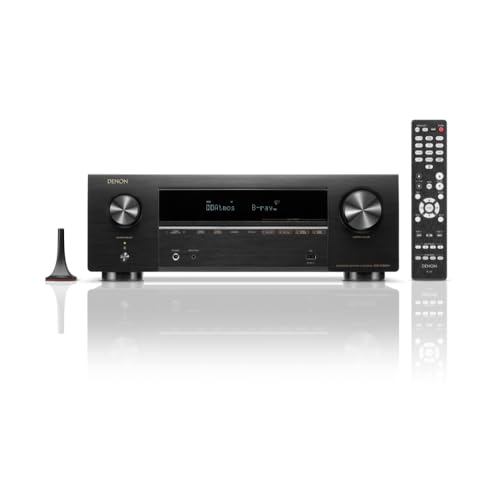
Denon AVR-X1800H 7.2-Channel AV Receiver with HEOS
ASIN B0D1G1G5PY • $1,295.00 • Ships from Amazon AU
Denon's AVR-X1800H is the most fully featured receiver here, and at $1,295 it's also the most expensive. It ranked #21,587 overall on Amazon AU when I checked, which is well behind the Yamaha, so fewer buyers have one so far. It's a 7.2-channel receiver with Dolby Atmos and DTS:X, sold by Amazon AU. The listing states HDMI 2.1 with 8K at 60Hz and 4K at 120Hz pass-through, plus HDR10+, Dolby Vision, HLG and eARC. That's the most complete video spec list in this guide. The model code on the listing is AVRX1800HBKEA, and the warranty is listed as 2 years from the manufacturer. If you want one receiver that handles everything you'll plug into it, this is the one.
Denon's HEOS system handles streaming, with Spotify, Tidal and Amazon Music HD listed, plus Wi-Fi, AirPlay 2 and Bluetooth. You can play the same track in every HEOS room or different music in each one. Room calibration is Audyssey MultEQ XT, which sets speaker levels, distances and EQ automatically from measurements around your listening spot. There's a phono input for a turntable, which none of the other receivers here mentions, plus USB playback and voice assistant support. The listing gives it as about 43.4 cm wide, 33.9 cm deep and 15.1 cm tall, and about 8.5 kg. Measure your cabinet depth before ordering, because the cables add several centimetres at the back.
What the listing doesn't give is a power figure per channel or a rated speaker impedance, and those are the two numbers I'd want before pairing it with floorstanders. Check Denon's spec sheet for both. It also doesn't state the number of HDMI inputs, only that there are several, so count your sources and confirm on Denon Australia's site. The app that opens up Audyssey's finer controls has been a paid extra on Denon receivers before, so check that before counting on it. Like any receiver, it needs air above it. At $197 more than the Yamaha, it's worth it for the phono input, HDR10+ and HEOS. Otherwise the Yamaha does the same core job.
Honest caveats: Power per channel, speaker impedance and the HDMI input count aren't stated on the listing, so check Denon's spec sheet. Its rank is well behind the Yamaha's. Audyssey's finer controls have needed a paid app on Denon receivers before. Allow cable room behind its 33.9 cm depth.
Best for: Home theatres that want the fullest HDMI 2.1 and HDR spec, a phono input and multi-room streaming.
Channels: 7.2, Dolby Atmos, DTS:X • HDMI: HDMI 2.1, 8K 60Hz, 4K 120Hz pass-through, eARC • HDR: HDR10+, Dolby Vision, HLG • Streaming: HEOS, Wi-Fi, AirPlay 2, Bluetooth • Calibration: Audyssey MultEQ XT • Inputs: Phono, USB, multiple HDMI • Size and weight: 43.4 x 33.9 x 15.1 cm, about 8.5 kg (listing) • Model: AVRX1800HBKEA • Rank: #21,587 overall on Amazon AU
View on Amazon AU
Yamaha RX500A 7.2-Channel AV Receiver with Dolby Atmos and Network Audio
ASIN B0HCVQZJHF • $1,199.00 • Ships from Amazon AU
Yamaha's RX500A is the newest receiver here, released in July 2026 according to the listing, and that's why Amazon AU hadn't published any sales rank for it when I checked. At $1,199 it sits between the RX-V6A and the Denon X1800H on price, and it's sold by Amazon AU. It's a 7.2-channel receiver with Dolby Atmos and DTS:X. The streaming list is the most up to date in this guide: Wi-Fi, Bluetooth 5.3, AirPlay 2, Google Cast, Spotify Connect and TIDAL Connect. Google Cast is the useful addition, because it lets Android phones send music straight to the receiver the way AirPlay does for iPhones. The listing gives a 2 year warranty, and the part number is VJJ3480. If you want a receiver designed this year rather than in 2020, this is the one.
The video side is where it gives ground to the RX-V6A. The listing states 4 HDMI inputs and Dolby Vision compatibility, but it doesn't state HDMI 2.1, 8K or 4K at 120Hz pass-through. Four inputs is enough for a console, a streaming box and a Blu-ray player, but not much more. If you're running a PS5 at 4K 120, you can plug the console straight into the TV and send the sound back to the receiver over eARC, although the listing doesn't state eARC either, so confirm it with Yamaha. The listing gives it as about 43.4 cm wide, 31.9 cm deep and 15.7 cm tall. That's a little shallower than the Denon, which helps in a standard TV cabinet.
Being brand new, it has no track record yet, and I'd normally want a few months of owners reporting firmware bugs before calling a receiver proven. The listing doesn't state power per channel, rated speaker impedance or the room calibration system. Check Yamaha's spec sheet for those before matching speakers. Update the firmware before the first setup, as with any new receiver. Give it at least 10 cm of clear space above for ventilation. If streaming from a mix of phones matters more than HDMI inputs, it's the better Yamaha for you. If you've got more than four HDMI sources or want stated 4K 120 support, the RX-V6A is $101 less and covers more.
Honest caveats: No sales rank yet and no track record, as it was released in July 2026. HDMI 2.1, 4K 120Hz pass-through, eARC, power per channel, speaker impedance and the room calibration system aren't stated on the listing. It has only 4 HDMI inputs.
Best for: Music-first setups in mixed iPhone and Android households that want a current 2026 receiver.
Channels: 7.2, Dolby Atmos, DTS:X • HDMI: 4 inputs, Dolby Vision • Streaming: Wi-Fi, Bluetooth 5.3, AirPlay 2, Google Cast • Services: Spotify Connect, TIDAL Connect • Size: 43.4 x 31.9 x 15.7 cm (listing) • Released: July 2026 (listing) • Part number: VJJ3480 • Warranty: 2 years (listing) • Rank: Not published by Amazon AU (checked 26 October 2026)
View on Amazon AU
Denon AVR-X580BT 5.2-Channel AV Receiver with Bluetooth
ASIN B0BVYMMXX5 • $703.39 • Ships from Amazon AU
Denon's AVR-X580BT is the entry point, at $703, and it ranked #12,873 overall on Amazon AU when I checked, ahead of the X1800H. It's a 5.2-channel receiver, which means five main speakers and two subwoofer outputs, and the listing gives up to 70W per channel. That's the only power figure stated on any listing in this guide. It's sold by Amazon AU, with a 2 year manufacturer warranty listed. Connections are HDMI, RCA analogue and optical digital, with Bluetooth for streaming from a phone. The model code is AVR-X 580BT. For a first 5.1 system, or to replace a dead receiver in an existing one, it does the core job for about two thirds of the price of the Yamaha.
The listing doesn't mention Dolby Atmos or DTS:X, so I'd treat it as a 5.1 surround receiver without height channels. For most lounges that's fine, because adding ceiling or up-firing speakers is a big job and plenty of people never get around to it. It doesn't list Wi-Fi, AirPlay or a multi-room system either, only Bluetooth, so music streaming is from a phone in the room rather than an app across the house. The number of HDMI inputs and the HDMI version aren't stated, so check Denon's spec sheet if you've got several sources. The listing gives it as about 43.4 cm wide, 33 cm deep and 15.1 cm tall, and about 7.6 kg. It fits most standard TV cabinets.
It makes the most sense with a TV that does the streaming and switching itself. Run your sources into the TV and send the sound to the receiver over HDMI, and it'll handle the surround from Netflix or a Blu-ray played through the TV. The listing doesn't state ARC or eARC, so confirm on Denon's spec sheet that it can take sound back from your TV before you plan around it. The 70W figure doesn't come with a test method, so treat it as a guide rather than a comparison point. Keep the speaker wire ends tidy, because a stray strand across the terminals trips any receiver's protection. For a plain 5.1 setup, it's the one I'd start with.
Honest caveats: No Dolby Atmos, DTS:X, Wi-Fi or AirPlay is listed, so it's a 5.1 receiver with Bluetooth only. HDMI input count, HDMI version and ARC or eARC support aren't stated. The 70W per channel figure has no stated test method behind it.
Best for: A first 5.1 surround system, or a straight swap for a dead older receiver.
Channels: 5.2 • Power: Up to 70W per channel (listing) • Inputs: HDMI, RCA analogue, optical digital • Streaming: Bluetooth • Size and weight: 43.4 x 33 x 15.1 cm, about 7.6 kg (listing) • Model: AVR-X 580BT • Warranty: 2 years manufacturer (listing) • Seller: Amazon AU • Rank: #12,873 overall on Amazon AU
View on Amazon AUSide-by-side comparison
| Product | Price | Best for |
|---|---|---|
| Yamaha RX300A 5.2-Channel Audio Video Receiver | ~$698 | |
| Denon AVR-X580BT AV Receiver | ~$703 | |
| Yamaha RX-V6A 7.2-Channel AV Receiver with… | ~$1,098 | |
| Yamaha RX500A 7.2 Channel AV Receiver with… | ~$1,199 | |
| Denon AVR-X1800H AV Receiver | ~$1,295 |
What we see fail in the workshop: AV receivers
AV receivers fail in a few predictable ways, and nearly all of them trace back to heat, speaker wiring or the power coming in from the wall. Here's what comes in most often and what you can do about each one before it becomes a repair. Don't open the case yourself, though, because the power supply's capacitors can hold a charge well after the receiver is unplugged.
Overheating and the HDMI board
The most common receiver fault I see is heat damage, and the HDMI board is usually where it shows first. It's a dense board with chips that run warm, and in a closed cabinet it spends years hotter than it should. The symptoms are a picture that drops out, a black screen on some inputs but not others, or HDMI that only works once the receiver has cooled down. Sometimes it's a failing part on the board, sometimes dry solder joints from years of heat cycling. Ten centimetres of clear air above the receiver prevents a lot of it.
Protection mode and speaker wiring
A receiver that clicks off or flashes a protection warning is usually protecting itself from a short or an overload. Nine times out of ten it's a stray strand of speaker wire touching the next terminal, a pinched cable under a rug, or 4-ohm speakers driven hard on a receiver set up for 8 ohms. Turn it off, check every terminal at both ends, and try again with one pair of speakers at a time. If it still goes into protection with nothing connected, the output stage itself has a fault and needs to be looked at.
Dead power supplies after storms
Receivers that won't turn on at all, with no standby light, usually have a power supply fault, and those cluster around storms and blackouts. A surge on the mains, or one that came in through the TV antenna and travelled along the HDMI cable, can take out the fuse, the standby supply or the main supply. Plug the whole cabinet into a surge-protected powerboard, unplug the antenna and receiver during big storms, and don't keep switching a dead receiver on and off at the wall, because a partly failed supply can damage other parts.
Decision tree: which one should you actually buy?
- Want the best all-round receiver for a 5.1 or 7.1 lounge? → The Yamaha RX-V6A at $1,098. It's the best-ranked AV receiver on Amazon AU, with 7 HDMI inputs, Atmos and stated 4K 120Hz support.
- Want the fullest HDMI and HDR spec, or a turntable input? → The Denon AVR-X1800H at $1,295, with HDMI 2.1, eARC, HDR10+, Dolby Vision, HEOS and a phono input on the listing.
- Streaming from both iPhones and Android phones? → The Yamaha RX500A at $1,199, the only receiver here listing both AirPlay 2 and Google Cast, plus Spotify and TIDAL Connect.
- Just want plain 5.1 surround without height speakers? → The Denon AVR-X580BT at $703. It's a 5.2 receiver with Bluetooth and the only stated power figure here, up to 70W per channel.
- Can't run speaker wire around the room? → Skip the receiver and look at a soundbar instead; the Dolby Atmos soundbar guide covers the best of them.
- Receiver cutting out, losing HDMI picture or dead after a storm? → That's usually heat, a wiring short or a power supply fault, and most are fixable. Bring it to our Erina workshop and I'll tell you what's wrong before you spend anything.
Frequently asked questions
Do I need an AV receiver for Dolby Atmos?
Not necessarily. A Dolby Atmos soundbar with up-firing drivers will give you a version of it in one box. A receiver gives you real Atmos with separate height speakers, either in the ceiling or on top of your front speakers, which sounds more convincing but is a bigger job to install. In this guide, the Yamaha RX-V6A, Yamaha RX500A and Denon AVR-X1800H all list Dolby Atmos. The Denon AVR-X580BT doesn't mention Atmos on its listing, so treat it as a 5.1 surround receiver.
What's the difference between 5.2 and 7.2 channels?
The first number is how many main speakers the receiver can power and the second is how many subwoofer outputs it has. A 5.2 receiver powers five speakers and has two sub outputs; a 7.2 receiver powers seven and has two sub outputs. The two extra channels on a 7.2 receiver are usually used either for rear surround speakers in a 7.1 layout or for two height speakers in a 5.1.2 Dolby Atmos layout. Two sub outputs help even out the bass in a larger room, but one sub is fine for most lounges.
Can I use 4-ohm speakers with an AV receiver?
Sometimes, but check first. Most mainstream receivers are designed around 6 or 8-ohm speakers, and a 4-ohm speaker draws more current at the same volume, which means more heat. None of the listings in this guide states a rated speaker impedance, so check the maker's spec sheet before you buy. If the receiver has an impedance setting in its menu, set it to match your speakers. It lowers the maximum volume a little but runs the amplifier cooler, which matters more over the years than the last few decibels.
Why does my AV receiver keep shutting off?
Usually it's protecting itself. The most common causes are a stray strand of speaker wire touching the next terminal, a damaged speaker cable, low-impedance speakers driven hard, or the receiver overheating in a closed cabinet. Check every speaker terminal at both ends, give the receiver at least 10 cm of clear air above it, and try it with one pair of speakers connected. If it still shuts off with no speakers connected, or smells hot, stop using it and have it checked, because the fault can get worse.
Is an AV receiver better than a soundbar?
For sound quality and lifespan, usually yes, because separate speakers can be much better than anything that fits in a bar, and you can replace the receiver later while keeping the speakers. The trade-off is setup: a receiver needs speaker wire run around the room, a cabinet with good ventilation and some time spent on calibration. For renters, open-plan rooms with the couch in the middle, or anyone who wants one box and one remote, a soundbar is often the better choice in practice.
Do I need HDMI 2.1 on a receiver for a PS5?
Only if you want to run the PS5 through the receiver at 4K and 120Hz with VRR. In this guide, the Yamaha RX-V6A and Denon AVR-X1800H both state 4K at 120Hz support. The simpler option is to plug the console straight into an HDMI 2.1 port on the TV and send the sound back to the receiver over eARC, which keeps the receiver out of the video path completely. Check that both your TV and receiver support eARC before you plan around it.
Related buying guides
Receiver cutting out or losing picture?
Most receivers that come in shutting themselves off have a heat or wiring problem, and most that lose HDMI picture have a failing HDMI board or a cracked port. Plenty are worth fixing, because the speakers and the rest of your system are fine. Bring it into our Erina workshop and I'll tell you what's wrong and whether it's worth repairing before you spend anything.
Visit our Erina workshop Book Online