Prices from Amazon AU, updated daily.
Disclosure: This article contains affiliate links to amazon.com.au. If you buy through one of these links iFix may earn a small commission at no extra cost to you. It doesn't change which products we recommend. We focus on what actually lasts based on 16 years of repair-shop experience.
Quick summary4 picks
- ZVCXOE 2 Pack Magnetic Rechargeable Hand Warmers Electric about$18.99Snaps into one, 3 heat levels, AI heat sensor.
- Entry PickXICEN Hand Warmers Rechargeable 2 Pack about$15.19
- Philips DLP2136VG Hand Warmer 5000mAh about$34
- Stated run timesPhilips 5200mAh Hand Warmer Power Bank about$34
A hand warmer is a power bank that has been told to misbehave
Strip the marketing off a rechargeable hand warmer and what is left is a small lithium-ion power bank with a resistive heating element glued to the inside of the shell, plus a controller that decides how hard to drive it. That is the whole product. The same pouch or cylindrical cell you would find in a phone charger, the same USB charging circuit, and a film or wire heater that turns stored energy into warmth at close to 100 per cent efficiency, because heat is the one thing electronics are genuinely good at producing by accident.
That matters for how you judge them. A power bank is designed to push energy out slowly over hours into a phone. A hand warmer is asked to dump the same energy into a resistor at a rate that keeps a lump of plastic at 50 °C against cold skin and cold air. That is a harder duty for the cell, and it happens in a pocket next to your leg. People bring swollen ones into the Erina workshop expecting us to swap the cell, and the honest answer is usually that the cell was not the weak point. The shell, the controller and the charging port are where the design either earns its keep or does not.
So this guide is not about which one feels nicest. It is about what I would carry, which is a shorter list than what I would sell. Four products, all under $35 at time of writing, all from Amazon AU's Camping Hand Warmers & Foot Warmers category. I will tell you which ones state a capacity you can check and which ones make claims I cannot check against the listing.
Claimed mAh versus the heat you actually get
Capacity on these things is quoted in milliamp-hours because that is how the cell is labelled, and it makes the number look big. It tells you almost nothing about warmth until you multiply by voltage. A 3,000 mAh cell at a nominal 3.7 V holds about 11 watt-hours. That is the energy. The heater then draws somewhere between 2 and 6 watts depending on the level, so at full heat you are looking at two to three hours before the pack is flat, and at the lowest setting you stretch toward the upper end of the claim.
The ZVCXOE pair quotes 3 to 8 hours across three levels and states no capacity at all, which is the more common case and the more annoying one, because with no mAh figure there is no arithmetic to run. Read the 8 as the lowest level indoors with the unit in a pocket where it is not losing heat to wind. Outside at a 6 am kids' footy session in July on the Central Coast it will be nearer the 3. That is not the listing lying. It is the listing quoting the best case, which every listing in this category does. The 5200 mAh Philips is the opposite case: it states a capacity and separate run times of about 4 hours on low and 3.5 on high, and about 19 watt-hours over that time is roughly 5 watts, which is believable for a pocket heater.
Something else the mAh figure hides: the controller cannot use all of it. Lithium cells are cut off around 3.0 V to protect them, and the heater needs enough voltage to keep the element hot, so the last 10 to 15 per cent of the rating is never turned into warmth. Usable energy is always below the label. Temperature matters too. A cold cell delivers less, and these are used cold by definition. Charging, on the other hand, is close to free. At the AU average tariff of roughly 33c per kilowatt-hour, refilling 11 watt-hours costs well under half a cent even allowing for charger losses. The cost of ownership is the cell's cycle life, not the electricity.
Cell quality and certification: why I care what sits in a pocket
I will carry a lithium device in a trouser pocket if I know who made the cell and that someone independent has tested the pack. I will not carry one on the strength of a nice matte finish. The reason is plain physics: a pocket is the worst place for a lithium cell to fail, because there is nowhere for the heat to go and your leg is the heatsink.
Of the four here, none names a certification I can check. The ZVCXOE pair claims UL certification but gives no file number. The 5000 mAh Philips mentions six-layer protection, the 5200 mAh Philips lists an IPX2 water-resistance rating, and the XICEN pair says explosion-proof with multiple safety protections, but none of them names a certification or a test. A UL file number is a real thing. You can look it up in the UL Product iQ database and see which manufacturer holds it and for what, and that is what I look for. That is not an accusation. It is just absence, and on a cell that lives against your body I treat absence as a reason to look harder. What the two Philips units do offer is a stated capacity, which at least lets me check the runtime claims against the arithmetic.
In Australia the mark you want to see is on the charger, not the warmer. The warmer takes 5 V over USB, so it sits below the voltage where our electrical safety scheme gets involved. The wall brick that feeds it does not, and that brick should carry the RCM triangle. Use an RCM-marked USB charger from a phone or tablet and you have done the part that matters. If you do not know what a bad USB brick looks like on the inside, I have pulled a few apart and photographed them.
In the workshop, cell quality shows up as two things. First, how fast capacity drops over the first 50 cycles; a good cell loses a few per cent, a poor one can lose a quarter. Second, whether the cell is a branded cell with its own protection strip or an unmarked pouch relying entirely on the controller board. You cannot tell from a listing. You can guess from the price, roughly, and from whether anyone was willing to put a file number on the box.
Thermal cut-outs, controllers and the ways they fail
Every one of these has at least two layers of protection if it is built sensibly. The first is a thermistor on the heater or the shell feeding a small microcontroller, which pulses the heater on and off to hold the set temperature. That is why the smart temp control language exists. The ZVCXOE listing says its AI sensor chip reads the heat between the shell and your skin, which in practice means the thermistor reads a different temperature curve when the shell is against a hand and the controller adjusts the duty cycle. Clever enough, and also the first thing to drift.
The second layer is a one-shot thermal fuse or a PTC device in series with the heater. It is there for the day the controller locks up with the transistor stuck on. A thermal fuse opens once and the unit is dead. That is the correct outcome. A hand warmer that goes cold is an annoyance; one that climbs past 70 °C in a pocket is a burn. When someone asks why their warmer charges fine, shows full LEDs, and never gets warm, I look for that fuse first.
What fails and how: controllers on the lower-priced units use a single transistor driving the heater directly, and when that part shorts the only thing left is the fuse. Thermistors come unglued from the heater film and then the controller reads the air inside the case instead of the element, so the element runs hotter than the indicator claims. Solder joints on the USB port crack because the unit is dropped onto concrete at a building site. Those are not exotic faults. They are the same three faults I see on the Central Coast repair workshop every week in other shapes: a sensor that drifts, a switch that shorts, a connector that cracks.
The practical check before you buy is short. Look for a stated maximum temperature (only the XICEN pair gives temperatures here, 45, 55 and 60 °C, and the ZVCXOE and Philips listings state none). Look for stated protection that names a part (none of the four does; the XICEN and Philips listings mention protection layers without saying what they are). And prefer a unit with a low setting you would actually use, because the lower the duty cycle, the less work the protection ever has to do.
USB-C versus micro-USB, and charging without drama
Only one of the four listings here, the 5000 mAh Philips, says it is USB-C compatible. The XICEN, ZVCXOE and 5200 mAh Philips listings do not say which connector they use, so treat that as unknown until you see it in the box. I would not buy a micro-USB one in 2026 unless it was a gift I could not return. Not because micro-USB charges slower (on a 5 W heater it makes no difference) but because the socket is mechanically weaker, the plug only goes in one way in the dark at 5 am, and everything else you own is already USB-C. One cable in the car, one at the desk, done.
Charging safely is about the brick, not the cable. These units negotiate nothing. They draw 5 V at 1 to 2 A and a decent phone charger provides that all day. What you should avoid is the free brick that came with a $12 gadget, because those are the ones with a millimetre of creepage between mains and the USB side, and those are the ones that put 240 V on the shell when the insulation gives up. Charge on a hard surface, not under a pillow or in the glovebox, and let it finish. Whatever protection a listing mentions, such as the six layers on the 5000 mAh Philips, is cell-side; it protects the cell, it does not protect you from a bad brick.
The ZVCXOE listing states neither a capacity nor a recharge time, so there is no charge rate to work out, and it does not name the USB connector either. Check that before you order if you have standardised on USB-C. Slow charging is kind to lithium. Fast charging is how you get a warm pack, and a warm pack is how you get early swelling. If you want to see what a charger is pulling from the wall, a plug-in meter from our energy monitor guide will show you, and the number will be tiny.
One more. Do not charge a warmer while it is also running, and do not charge it inside a jacket pocket. Charging and discharging at once doubles the heat in the cell, and the controller on a $30 unit is not designed to referee that.
Swollen cells: how they happen and what to do
A swollen cell is a lithium pouch that has started generating gas inside. It happens through three routes and I see all three. Age: electrolyte slowly breaks down and the cell puffs over years even if treated well. Heat: a cell held above about 45 °C while charging degrades much faster, and a hand warmer is by definition a device that runs warm with a cell inside. Over-discharge: leave it flat in a drawer from August to the next June and the cell can drop below its safe floor, and the first charge after that is the risky one.
The tell is a shell that no longer sits flat, a seam that has opened, or a case that creaks when you press it. Stop using it. Do not charge it. Do not puncture it, and do not throw it in the red bin, because it will meet a compactor. Put it in a metal container or on a concrete floor away from anything that burns and take it to a battery drop-off; Central Coast council waste facilities and the larger hardware and electronics retailers have bins for embedded-battery devices.
In the workshop, swollen hand warmers almost always arrive with one of two stories. It was charged in the car on a summer afternoon, or it was stored flat for a season. Neither is the product's fault. Both are preventable: store it at around half charge, top it up every couple of months over summer, and charge it in the room you are sitting in. If moisture got into the port, the corrosion looks like the same thing we document in our water damage explainer, green deposits on the USB pins, and that is a different problem that presents as a unit that will not charge.
Who these suit on the Central Coast
Most of the people I know using these are not winter campers. They are parents standing on the sideline at Wyong or Terrigal at 7 am while a child does jiu-jitsu or football; commuters waiting on the platform at Gosford; tradies and site workers doing first-fix in a frame with no walls at the start of a July day. Those cases differ. A sideline parent wants two to three hours at a middling setting and a unit thin enough to go in a jacket pocket, which is the XICEN pair's shape. Two people sharing one bag want a pair that splits, which is the ZVCXOE's pitch. A commuter who also wants to top up a phone wants a stated capacity, which is the 5000 mAh Philips.
If you are thinking bigger, a pair of pocket warmers competes with a heated jacket on price but not on coverage. A jacket heats your core and runs off a separate power bank; a hand warmer heats two palms. For site work or long sideline mornings, read our heated jacket guide as the other half of the same decision. For everyone else, a warmer you can charge from the same brick as your phone, that names its battery certification, and that has a low setting you will actually use, is the right tool. That is the list below.
The 4 picks, $15.19 to $34.00
Prices are Amazon AU at time of writing (10 October 2026) and move week to week. Ranks are Amazon AU category sales ranks, checked the same day.

XICEN Rechargeable Hand Warmers 2 Pack, Owl Design
ASIN B0F1F43NGT • $15.19 • Sold by cssmall-AU on Amazon AU
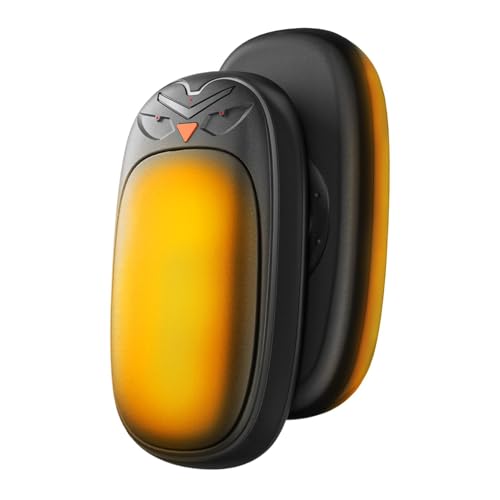
The XICEN pair is the lowest-priced thing in this guide: $15.19 for two units at time of writing, ranked #44 in Amazon AU's Camping Hand Warmers & Foot Warmers category. Each unit is a double-sided slab listed at 5 x 9 x 1.6 cm, owl-shaped, so it slides into a glove or a jacket pocket without filling a hand. The listing quotes three heat levels at 45, 55 and 60 °C and a 3 second heat-up. Both faces warm, so you can cup one in two hands or keep one in each pocket.
What the listing does not say matters as much as what it does. There is no capacity in mAh, no runtime, no named battery certification and no charging connector. It does promise explosion-proof technology and multiple safety protections, which is marketing language rather than a spec, because it names neither a certification nor a protection part such as a thermal fuse or a cell-side cut-off. With no mAh figure there is no watt-hour arithmetic to run, so I cannot tell you whether a runtime claim is plausible. I would live on the 45 °C level for anything longer than an hour and keep 60 °C for a glove.
This suits someone who wants two warmers for a school bag or a car glovebox and is still finding out whether rechargeable hand warmers suit them. Charge it from an RCM-marked phone brick, never under a pillow, and store it at around half charge over summer. If a stated capacity matters to you, the Philips units later in this guide state one.
Honest caveats: The listing states no capacity, runtime, battery certification or charging connector, so check the current page before ordering. Explosion-proof is a claim, not a test result. It is sold by a third-party seller (cssmall-AU) under a brand I cannot point to a track record for.
Best for: Someone who wants a pair of pocket warmers for the lowest outlay and will check the current listing for the charging connector.
Heat: Double-sided; heats in 3 seconds (listing) • Levels: 3 levels, 45, 55 and 60 °C (listing) • Size: 5 x 9 x 1.6 cm, owl-shaped • Pack: 2 units • Capacity: Not stated on the listing • Runtime: Not stated on the listing • Battery certification: Not stated • Charging: Fast charging claimed; connector not stated • Price: $15.19 at time of writing (sold by cssmall-AU) • Rank: #44 in Camping Hand Warmers & Foot Warmers (Amazon AU)
View on Amazon AU
Philips DLP2136VG Portable Hand Warmer and Power Bank, 5000mAh
ASIN B0CMTQT11G • $34.00 • Sold by Probuy-au on Amazon AU
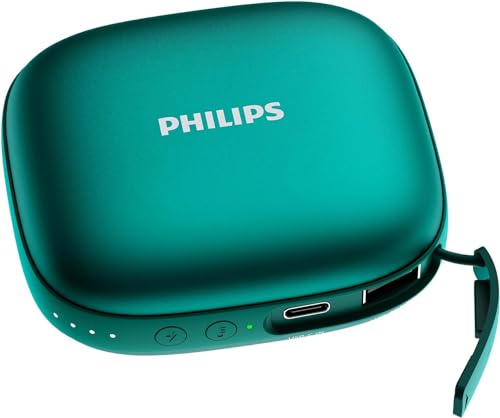
This is the one I would carry now, and the reason is arithmetic rather than warmth. It is the only pick in this guide whose title states a capacity, 5000 mAh, which at a nominal 3.7 V is about 18.5 watt-hours, so you can run the numbers the way I did earlier. The listing quotes about 4 hours of heating from a full charge, which works out at roughly 4 to 5 watts and sits inside the range I gave for a pocket heater. It is a single unit rather than a pair, $34.00 at time of writing, ranked #27 in Amazon AU's Camping Hand Warmers & Foot Warmers category, and sold under the Philips name by Probuy-au.
It is a power bank first. The same cell heats your hands and charges a phone over USB, which is a second job the slab warmers in this guide do not do. You get two heat levels only, an aluminium alloy heating surface, and a listed 177 g at 84.7 x 76 x 34 mm. That makes it a lump next to the thin pairs: it lives in a jacket pocket, not a glove. The listing says it recharges over USB in about 4 hours and is USB-C compatible, and it mentions six-layer protection and a 30 minute auto shut-off without saying what the layers are.
Because it doubles as a power bank, the charging rules apply twice over. Do not charge it while it is heating, use an RCM-marked phone brick, and store it at around half charge over summer. Pick this one if you want a capacity you can check and a phone top-up from the same unit. Pick one of the pairs if you want two warmers for two people.
Honest caveats: The listing text contradicts itself in places. The title says 5000 mAh, one bullet says 5200 mAh, and it describes Bluetooth call control while also saying the unit has no Bluetooth. Treat the capacity as roughly 5000 mAh and confirm on the current page. No battery certification is named. One unit per box, two heat levels only.
Best for: Anyone who wants a stated capacity they can check and a phone top-up from the same unit, and is happy with one heavier unit rather than a pair.
Capacity: 5000 mAh in the title (one bullet says 5200 mAh) • Levels: 2-stage temperature adjustment • Runtime: About 4 hours of heating (listing) • Surface: Aluminium alloy • Weight and size: 177 g, 84.7 x 76 x 34 mm • Charging: USB, listed as USB-C compatible; about 4 hours to fill; also charges phones over USB • Protection: Six-layer protection and 30 minute auto shut-off (listing wording); no certification named • Units per box: One • Price: $34.00 at time of writing (sold by Probuy-au) • Rank: #27 in Camping Hand Warmers & Foot Warmers (Amazon AU)
View on Amazon AU
ZVCXOE 2 Pack Magnetic Rechargeable Hand Warmers Electric
ASIN B0GVXQW5HS • $18.99 • Sold by ZVCXOE - AU on Amazon AU
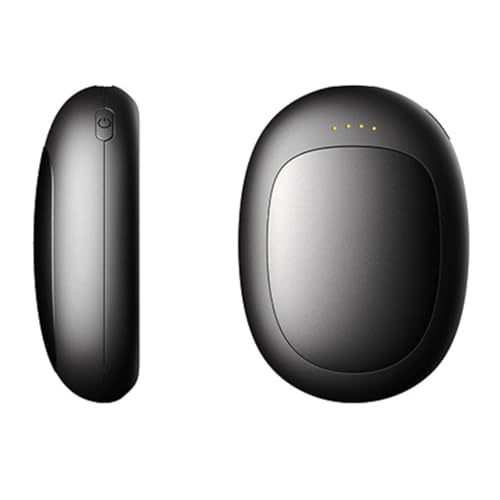
This is the pair I would buy when two people have to get warm out of one bag. The magnets are the whole point: snap the two units together and you get a single double-sided block to cup between both palms, or pull them apart and hand one to somebody else. Nothing else here does both. The listing quotes three heat levels and 3 to 8 hours, an AI sensor chip that reads the heat between the shell and your skin, and a clear battery status indicator so you know what is left before you leave the house.
It is also a slim pair, which matters more than it sounds. A slim unit sits flat in a glove or a jacket pocket without pressing a hard edge into your hand, and less mass means less thermal inertia, so it comes up to temperature quickly and cools quickly when you switch it off. The trade is capacity. At 3 to 8 hours across three levels you are getting a commute and an evening, not a full day on site, and I would treat the 8 as the lowest level indoors rather than anything you will see in a July wind.
On certification the listing says UL-certified, but it does not name a file number, so I cannot look it up. A claim with a number is checkable and a claim without one is marketing, and I would rather have the number. It is still a claim the XICEN and Philips listings do not even make. Buy it for the sharing trick and the slim shell, use the lower two levels for anything longer than an hour, and stop using it the moment either unit stops sitting flat on a table.
Honest caveats: The listing states no capacity in mAh, so you cannot do the watt-hour arithmetic that tells you whether a runtime claim is plausible. It also states no recharge time, no weight or dimensions, no warranty term, and it does not say which USB connector it uses, which is worth checking if you have standardised on USB-C. The UL claim carries no file number.
Best for: Two people sharing one bag, or anyone who wants a slim pair that doubles as a single double-sided warmer.
Pack: 2 units • Levels: 3 heat levels • Runtime: 3 to 8 hours claimed • Magnetic: Snaps together as one double-sided heater, or splits into two • Control: AI sensor chip, battery status indicator • Certification: UL-certified claimed, no file number named • Charging: USB, connector not specified on the listing • Price: $18.99 at time of writing • Seller: ZVCXOE - AU
View on Amazon AU
Philips 5200mAh Rechargeable Hand Warmer and Power Bank
ASIN B0CSPLN37Y • $34.00 • Sold by Probuy-au on Amazon AU
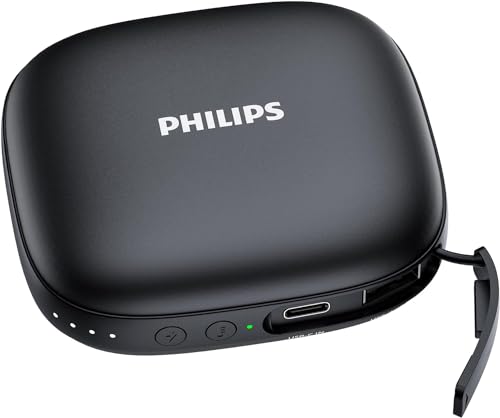
The second Philips is the one with the cleanest runtime numbers. The listing quotes a 5200 mAh battery, which at a nominal 3.7 V is about 19 watt-hours, and two settings with separate run times: 4 hours on low and 3.5 hours on high. Heat-up is quoted at 3 seconds. The gap between the two levels is small, which suggests the low setting is not a gentle one, but a narrow range that lines up with the arithmetic is more believable than a 3-to-8-hour headline. It is a single unit at $34.00 at time of writing, ranked #63 in Amazon AU's Camping Hand Warmers & Foot Warmers category, and sold under the Philips name by Probuy-au.
It doubles as a power bank, and the listing says it will charge a phone over USB. Water resistance is stated as IPX2, which covers vertical drips: a damp jacket pocket is fine, a wet sideline is not something it has been rated for. The box holds the unit and a USB charging cable. The listing gives the weight as under 100 g, which looks light for a 5200 mAh cell when the other Philips here lists 177 g at a similar capacity, so check the current page before assuming it disappears into a glove.
Pick this one over the first Philips if you want a high-setting run time to plan a morning around and a plainer black unit. Same rules as any pocket cell: charge it from an RCM-marked brick, not under a pillow, do not charge it while it is heating, and store it at around half charge over summer. If the shell swells or a seam opens, stop using it and take it to a battery collection point.
Honest caveats: No battery certification is named and the listing does not say which USB connector the cable uses. The listing also carries Bluetooth and call-control wording that contradicts its own statement that the unit has no Bluetooth, so ignore that text. The under-100 g weight looks optimistic for the stated capacity. Two heat levels only, one unit per box.
Best for: Someone who wants a stated capacity and separate low and high run times to plan a morning around, from a single compact unit.
Capacity: 5200 mAh (listing) • Levels: 2 temperature settings • Runtime: About 4 hours on low, 3.5 hours on high (listing) • Heat-up: 3 seconds (listing) • Water resistance: IPX2 (listing) • Weight: Listed as under 100 g • Charging: USB cable in the box; connector not stated; also charges phones over USB • Battery certification: Not stated • Units per box: One • Price: $34.00 at time of writing (sold by Probuy-au) • Rank: #63 in Camping Hand Warmers & Foot Warmers (Amazon AU)
View on Amazon AUSide-by-side comparison
| Product | Price | Best for |
|---|---|---|
| XICEN Hand Warmers Rechargeable 2 Pack | ~$15.19 | A: Lowest-Priced Pair, Thin Enough for a Pocket |
| Philips DLP2136VG Hand Warmer 5000mAh | ~$34 | B: Best Overall, a Stated Capacity You Can Check |
| Philips 5200mAh Hand Warmer Power Bank | ~$34 | D: Stated Run Times on Low and High |
| ZVCXOE 2 Pack Magnetic Rechargeable Hand Warmers Electric | ~$18.99 | C: The Pair to Share, One Each |
What we see fail in the workshop: rechargeable hand warmers
These come across the counter in Erina a few times each winter, usually with the same three complaints: it will not charge, it charges but never gets warm, or the case has gone fat. None of those is a mystery once you have the lid off. Here is what is behind each one, what can be fixed, and what should go straight in the battery bin.
Cracked USB port solder joints
The charging socket is soldered to a small board and that board is held in the shell by two plastic posts. Drop the unit onto concrete a few times, or yank the cable out sideways, and the solder fillets on the port legs fracture. The symptom is a unit that charges only when you hold the cable at an angle, then not at all. On a USB-C port we can sometimes reflow or replace it if the board pads are intact. On micro-USB the pads often lift with the port, and the repair costs more than the warmer. Short cable, gentle hand, and do not let it dangle from a powerboard.
Open thermal fuse or a shorted heater transistor
A warmer that shows a full battery and produces no heat has usually blown its thermal fuse, and the fuse blew because the controller's drive transistor shorted and left the heater on until something gave. The fuse did its job. Replacing the fuse alone brings it back for one more cycle and then it blows again, so the fix is both parts, and on a sub-$35 product that is rarely sensible. The prevention is to run the lower heat levels, which keep the transistor cooler and the duty cycle short, and to stop using a unit that ever seems hotter than its setting.
Swollen or over-discharged cells
A fat case is a gassing cell, and it comes from heat during charging, from being charged in a hot car, or from sitting flat through summer and dropping below its safe voltage. We do not re-cell these. The shells are glued, the cells are bespoke pouches, and the economics do not work against a $30 replacement. What we do is tell you how to stop it happening to the next one: store at half charge, charge in the room you are in, never charge while it is running, and if the port is corroded from a wet pocket, it is usually the same green crust we see on phones.
Decision tree: which one should you actually buy?
- I want a thin pair for a coat pocket and nothing more? → The XICEN pair at $15.19. Double-sided, 5 x 9 x 1.6 cm, three levels up to 60 °C. Check the current listing for the charging connector because it is not stated.
- I carry one in a jacket pocket every morning and want a capacity I can check? → The 5000 mAh Philips at $34.00. It states its capacity, about 4 hours of heat and a phone-charging mode. No battery certification is named, so keep it on the lower of its two settings.
- Two of us need warm hands out of one bag? → The ZVCXOE pair at $18.99. The magnets let it run as one double-sided block or split into two, with three heat levels and 3 to 8 hours claimed. Run it on the lower levels.
- I want run times for low and high that I can plan a morning around? → The 5200 mAh Philips at $34.00. It states about 4 hours on low, 3.5 on high and a 3 second heat-up. Confirm the cable connector with the seller first; the listing does not state it.
- I am not sure a pocket warmer is enough for long sideline mornings? → It probably is not. Read the heated jacket guide first; a jacket heats your core off a separate power bank and pairs well with any of these for hands.
- Mine has stopped charging, runs cold with full LEDs, or the case has gone fat? → Stop charging it. If the case is swollen, take it to a battery collection point. If it is a port or heater fault and the unit is otherwise sound, bring it to our Erina workshop and we will tell you honestly whether a repair is worth it against a $30 replacement.
Frequently asked questions
Are rechargeable hand warmers safe to carry in a pocket?
They are a lithium cell with a heater, so treat them like a power bank that runs warm. The risk is lower when the pack has stated overheat and overcharge protection, you use a lower heat setting, and the unit is not damaged or swollen. None of the four picks here names a battery certification file I can check, though the 5000 mAh Philips listing mentions six-layer protection and the ZVCXOE listing claims UL certification without a number. Never carry one that has a bulging case, an open seam, or a charging port that only works at an angle, and never charge one while it is in your pocket or running.
Why does the claimed runtime never match what I get?
The headline hours are the lowest heat level in still air. At the top setting the heater draws several watts and a 3,000 mAh cell, which holds about 11 watt-hours, is flat in two to three hours. Cold also reduces what a lithium cell can deliver, and the controller cuts off before the cell is empty to protect it, so 10 to 15 per cent of the rated capacity is never turned into warmth. Use the lowest setting that does the job and you will get closer to the figure on the box.
USB-C or micro-USB, does it matter on a hand warmer?
For charging speed, no; a 5 watt heater pack charges at about 1 amp either way. For the life of the product, yes. Micro-USB sockets are mechanically weaker, the plug is directional, and the board pads lift more easily when the port is stressed. USB-C also means one cable for your phone, warmer and everything else. Only one of the four listings here, the 5000 mAh Philips, says it is USB-C compatible; the other three do not say which connector is supplied, so ask before you order.
Which charger should I use?
Any USB charger from a phone or tablet that carries the Australian RCM mark. These units do not negotiate fast charging, so a 5 volt, 1 or 2 amp brick is all they need. Avoid unbranded bricks that came free with other gadgets; the separation between the mains side and the USB side is often too small, and that is how 240 volts ends up on the shell of something you are holding. Charge on a hard surface in the room you are in, not in the car or under bedding.
My hand warmer has swollen. Can you replace the cell?
Usually not at a sensible price. The shells are glued, the cells are custom pouches, and a replacement unit is around $30. A swollen cell is gassing and should not be charged or punctured. Put it in a metal tin or on concrete away from anything flammable and take it to a battery collection point at a council waste facility or a participating retailer. Do not put it in the kerbside bin, where it will be crushed in a compactor. If a unit is not swollen but will not charge, bring it in and we will look at the port.
How do I make one last more than a winter?
Run it on the lowest level that does the job, because duty cycle is what wears the cell and the transistor. Charge it slowly from a decent brick and let it finish. Never charge while it is running or inside a pocket. Over summer store it at about half charge and top it up every couple of months so it never sits below its safe voltage. Keep the cable short and plug in gently so the port solder does not crack. Those five habits cover almost every failure we see.
Related buying guides
Warmer stopped charging, runs cold, or has gone fat?
The three faults we see on these are cracked USB port solder, a blown thermal fuse behind a shorted heater transistor, and a swollen cell from heat or a flat summer in a drawer. A swollen one goes to a battery bin. The other two, walk in to Erina and we will open it, tell you what failed, and say plainly whether a fix beats a new one. Sixteen years of board-level work, and we would rather be honest than busy.
Visit our Erina workshop Book Online