Prices from Amazon AU, updated daily. Swipe or use the arrows for more.
Disclosure: This article contains affiliate links to amazon.com.au. If you buy through one of these links iFix may earn a small commission at no extra cost to you. It doesn't change which products we recommend. We focus on what actually lasts based on 16 years of repair-shop experience.
Quick summary8 picks
- Entry PickBlukar Camping Light Rechargeable about$26.993600mAh, 5W.
- Glocusent Survival Camping Lantern about$39.995000mAh.
- Glocusent Camping Light about$38.995000mAh.
- Glocusent 135 LEDs Camping Lantern about$43.995000mAh.
- Lepro Collapsible Camping Lantern, 2 Pack about$32.993000mAh.
- Rechargeable Camping Light about$38.996000mAh.
- LE Camping Lantern about$59.99
- Most PremiumLepro Camping Lantern about$69.99
The torch in the drawer is always flat
When the street goes dark, nearly everyone does the same thing: reaches for the phone torch. It works, for a while, and then you've spent the one battery that also carries your outage updates, your contact with the energy company and your only way of calling anyone if the night gets complicated. The phone is the worst possible light source in a blackout precisely because it's the most valuable thing you own that night. A $22 lantern exists so the phone doesn't have to do a $22 lantern's job.
The other standard failure is the torch that does exist. It's in a drawer, the cells in it went in during a previous federal government, and when the moment comes it gives you a brown flicker and dies. Blackout lighting isn't a gear problem, it's a readiness problem, and the fix is boring: two or three lights that live in known places, on a charging habit, with at least one that runs on cells you can buy at any servo. This guide picks the lights; the habits are in the sections below. If that sounds like your house, you're the person this page was written for, and the fix costs less than the pizza you ordered during the last outage.
It's worth saying where lanterns sit in the bigger blackout picture. They're the first hour. Anything past that, the fridge, the modem, the CPAP-sized loads of life, needs stored watt-hours, and that's the territory of our blackout-ready power stations guide. Lights first though, because every other decision that night gets made by whatever light you have.
Rechargeable or cells: buy both, on purpose
Rechargeable lithium lanterns are better lights: brighter, dimmable, recharged from any USB socket for cents, and the good ones double as small power banks. Their weakness is quiet self-discharge. A lithium pack left in a cupboard loses charge slowly, a few percent a month is a fair working figure, so the lantern that was full at Christmas is half-flat by winter, and one that was half-charged when it was put away might be stone dead. A rechargeable lantern is a pet: not much work, but it does need feeding on a schedule. None of the picks here need more than a few hours on a USB socket to come back, so the schedule is light duty.
Cell-powered lanterns invert the trade. A lantern running on D cells, like the Lepro 1000-lumen pair here, has no pack to age and nothing to self-discharge inside it; fresh alkaline cells hold most of their capacity for years on the shelf. The catch is that alkalines left inside a device eventually leak, and the crusty white-and-green mess they leave across contacts is one of the most common ways emergency gear dies in storage. Keep the cells beside the lantern, not in it, and that whole failure mode disappears.
The honest answer for a household is both, on purpose rather than by accident. Rechargeables as the daily drivers and the first hour of any outage, one cell-powered unit as the deep reserve that works after a week of no mains, and a dual-power unit like the bigger Lepro, which charges over USB but also takes AA cells, as the bridge between the two. That mix survives every version of a blackout I can think of, including the long ones. It also splits the shopping sensibly: the reserve gets bought once and forgotten, and only the daily drivers ever need replacing.
Runtime claims: 200 hours is the setting you won't use
Every lantern listing leads with its biggest runtime number, and that number is always measured at the dimmest setting the firmware allows. Glocusent quotes up to 200 hours from its 5000mAh pack, and I don't doubt it, at a glow you'd struggle to read by. Lepro is unusually upfront about the spread: 12 hours at full brightness, 240 hours at the lowest setting, on the same three D cells. That's a twenty-to-one ratio between the number in the headline and the number at the brightness you'll actually sit in, and it's typical of the whole category.
The practical move is to test on night one. Charge the lantern, set it to the level that makes your kitchen usable, and note the time. Whatever it delivers at that setting is your real number for planning, and it'll usually land somewhere between the two ends of the listing's range, a lot closer to the small one than the big one. In my experience a mid setting on a 4000 to 6000mAh lantern gives you somewhere in the region of a night or two of useful light, which is fine, as long as you knew that before the second night.
Runtime also explains why multiple small lights beat one big one. Two lanterns at half brightness in two rooms give more usable coverage than one at full brightness in a hallway, and you're not carrying your only light source with you every time you leave the room. It's the same reason electricians put more than one downlight in a ceiling. Spreading the light also spreads the risk: one flat pack in a two-lantern house is an inconvenience, not a blackout inside a blackout.
Lumens and colour temperature for an actual room
Lantern marketing is a lumen arms race, and the numbers are mostly beside the point. Two thousand lumens will flood a double garage; a kitchen is comfortable at a few hundred, and a bedside light at far less. The reason to buy a high-lumen lantern isn't to run it flat out, it's headroom: a 2000-lumen unit loafing at 300 lumens runs cooler and far longer than a 300-lumen unit at its limit. Buy more lumens than you need and then don't use them, which is the same advice I give about laptop chargers. The specs tables below quote the listed figures per mode where the listings state them, and those are the numbers that matter more than the headline.
Colour temperature earns more attention than raw brightness. The Glocusent and Eocean picks both switch between roughly 3000K warm, 4500K neutral and 6000K cool white, and that range covers the two moods of an outage: warm light that makes a dark lounge liveable for an evening, and cool bright light for finding the switchboard or cooking safely on gas. All-cool-white lanterns make a blackout feel like a loading dock. If the household is going to spend hours with the thing, the warm setting is what makes those hours pleasant.
Beam shape matters too, and lanterns are the right shape for rooms. A torch throws a disc of light at one wall; a 360-degree lantern with a hook on it lights the whole space evenly, and several picks here fold, hang or rotate to aim their light where the job is. For working on the car or the meter box, the Eocean pair converts to a focused handheld beam, which covers the torch job without buying a torch.
The power bank question
Several rechargeable lanterns now carry a USB-C or USB-A output and market themselves as emergency power banks, and this is genuinely the feature to sort the category by. In a blackout the phone is your information line, and a lantern with a 5000mAh pack, like the Glocusent here, holds roughly one phone charge alongside its light duty. The listing pitches exactly that use, keeping you connected during storms and power cuts, and it's the right pitch. One device covering both jobs is one charging habit instead of two.
Two cautions before you plan a night around it. Every watt-hour sent to the phone is light you no longer have, so a 5000mAh lantern that fully charges a phone is now a dim lantern; decide which job matters more before the pack decides for you. And output quality varies across this category; a dedicated bank from our power banks guide remains the better phone charger if you're buying gear anyway, for the reasons covered in the bad chargers explainer. The lantern's output is the backup plan, and it's a good one at $35.
If the household already runs on power banks, look at it from the other side: the lantern is the light that can also rescue the bank's job in a pinch, and the bank is the charger that can also refill the lantern. USB-C on both ends of that equation is what makes the whole kit interchangeable, which is why I'd quietly avoid anything still charging over micro-USB in 2026. Every rechargeable pick in this guide charges over USB-C except where the listing leaves the port unstated, and I'd let that steer any tiebreak.
Sealed batteries and year three
Read the fine print on the Blukar listing and you'll find a detail most buyers skip: the pack is a built-in, non-removable battery, not a replaceable cylindrical cell. That's normal at this price across the whole category, and it means the lantern's lifespan is the pack's lifespan. Lithium packs age fastest when stored full, stored flat, or stored hot, and a lantern lives most of its life in storage, so the storage habits are the whole game. Somewhere around half charge, topped up every few months, in a cupboard rather than a hot shed or car, is the regime that gets a sealed pack to year five instead of year two. The half-charge rule sounds fussy until you price a new lantern against thirty seconds with a cable four times a year; the maths isn't close.
The other mortality point is the charge port. A lantern gets plugged and unplugged in the dark, at odd angles, by whoever grabbed it, and USB sockets on lighting gear are rarely the armoured kind. A wiggling connector that only charges at certain angles is the early warning, and it's worth acting on while the pack still holds charge. Port repairs and pack assessments on this kind of gear are bread and butter at our workshop in Erina, and the earlier a flaky port comes in, the more likely it's a small job rather than a write-off.
Where to keep them so they're there in the dark
Placement beats specs. The night the power drops, nobody remembers where the good lantern is; they remember where the light switch is. So put the lights where the habits already are: one in the kitchen within arm's reach of the bench, one on or near the bedside, and one in the car or garage where it covers breakdowns as well as blackouts. A hook or a fold-out hanger, which most of these picks have, means the kitchen one can go up over the bench and light the whole room while hands stay free.
Heat is the placement rule people miss. A parked car in an Australian summer cooks the interior well past what lithium packs enjoy, so the car lantern should be the cell-powered one, with its cells stored beside it, and the lithium units stay indoors. The last piece is a charging ritual that survives real life: pick something you already do quarterly and top the lanterns up the same day. The smoke alarm test button is a good anchor, and if your outdoor lighting already runs on the sun, as covered in our solar security lights guide, the lanterns are the only lighting maintenance left on the list.
None of this costs anything, and it's the difference between owning emergency lighting and owning camping gear that happens to be in the house. The picks below are all good lights. Placed and charged, they're a system. And write the purchase date on the base of each one in marker; future-you will want to know how old a pack is when it starts behaving oddly.
The 5 picks, $22 to $56
Prices are Amazon AU at time of writing (29 September 2026) and move week to week. Ranks are Amazon AU category sales ranks, checked the same day.

Blukar Rechargeable Camping Lantern
ASIN B09XXQC2K3 • $21.79 • Sold by Blukar Products AU on Amazon AU
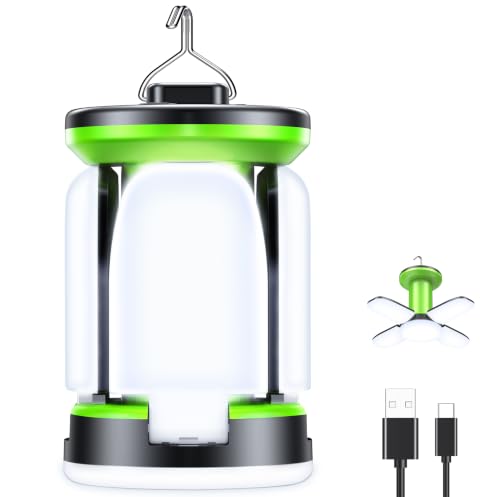
The category's best seller, sitting at #1 in Electric Camping Lanterns, and at $22 it's the answer to the most common version of this purchase: something on hand for the next outage that costs less than a takeaway dinner for two. The design is more considered than the price suggests. Four side panels fold down to turn it from a compact handheld into a spread of small pendant lights, there are hooks on top for hanging it over a tent pole or a kitchen rail, and the 60 LEDs throw light through a full 360 degrees rather than in one direction. Folded or hung, it behaves like room lighting instead of a torch, which is exactly what a blackout calls for.
The battery is a built-in 3600mAh pack that Blukar quotes at ten-plus hours per charge, with the LEDs drawing only 5W at full noise, and it charges over USB with the cable included. Seven modes cover the sensible ground: strong and weak side light, high and low from the bottom panel, everything at once, plus strobe and SOS. Realistically you'll use two of those modes and forget the rest exist, but the low settings are what stretch that ten-hour figure across a couple of evenings, and the switching is one button rather than an app or a gimmick. It's simple enough to hand to anyone in the house, and that matters more than it sounds at 2am.
The listing is also upfront that the pack is non-removable, an integrated unit rather than a swappable cylindrical cell, so the storage habits from earlier in this guide apply in full: keep it around half charge, top it up on your quarterly ritual, and don't leave it baking in a car. Treated that way, it's a lot of preparedness for $22, and the sales rank says plenty of households have reached the same conclusion. Its one real gap is water resistance, which the listing simply doesn't state, so it earns the indoor postings and leaves the weather work to the IPX4-rated picks below.
Honest caveats: The pack is sealed and non-removable, so when the battery eventually fades the lantern fades with it. Runtime is quoted at ten-plus hours without stating the brightness level, so plan around the lower settings for multi-night outages. There's no stated water resistance rating on the listing, so treat it as an indoor and under-canvas light.
Best for: The kitchen drawer and the bedside: maximum readiness per dollar for households starting from nothing.
Battery: 3600mAh, built-in non-removable • Power draw: 5W, 60 LEDs • Quoted runtime: 10+ hours per charge • Modes: 7, including SOS and strobe • Design: Folding side panels, top hooks, 360-degree beam • Charging: USB, cable included • Rank: #1 in Electric Camping Lanterns (Amazon AU)
View on Amazon AU
Lepro 1000 Lumen Battery Camping Lanterns, 2 Pack
ASIN B07D4GS3NL • $47.99 • Sold by Lepro AU on Amazon AU
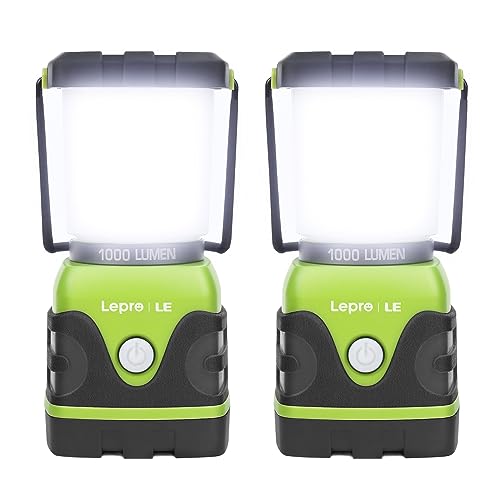
This is the deep reserve of the guide: a pair of 1000-lumen lanterns that run on three D cells each, no lithium pack, no charger, no self-discharge sitting in the cupboard. Ready the moment cells go in, which is the listing's own pitch, no waiting hours for a charge, and it's the property that makes cell power the right technology for the light you might not touch for a year. Keep a boxed set of D cells beside them, not inside them, and this pair will work identically next month or next decade. At $48 for two units it's also quietly the lowest cost per covered room here. That's not nothing when you're placing lights in three rooms.
The light itself is properly specified for house duty. A 360-degree beam at up to 1000 lumens will light a full room, and the four modes map to real use: a 700-lumen daylight setting, a 300-lumen warm white that makes an evening tolerable, the full 1000-lumen mixed mode, and a flasher. Brightness is adjustable with a long press, and the runtime spread is stated with unusual honesty, 12 hours at maximum down to 240 hours at minimum, which tells you exactly what dimming buys you. IPX4 splash resistance means rain on the way to the switchboard won't trouble it. Between those modes, one pair of lanterns covers reading, cooking and moving through a dark house.
The trade is running cost and waste: alkaline D cells aren't rechargeable, and a household that burns through outages regularly would spend less feeding a lithium lantern. That's the wrong frame for this product though. It's insurance, the cells last years in their packaging, and the two-pack means the kitchen and the garage are both covered by hardware that's immune to the failure modes of everything else in this guide. If the rest of your kit is lithium, this pair is the hedge, and hedges are supposed to be boring. Buy it, tape the cell packet to the base, and forget it exists until it matters.
Honest caveats: Cells aren't included, so the lantern is only as ready as the packet of D cells you remember to buy with it. Alkalines left inside will eventually leak and corrode the contacts, so store them beside the light. And there's no USB output or recharging of any kind; this is purely a light, not a power bank.
Best for: The long-outage reserve and the hot car, where lithium packs age fast and shelf life is everything.
Power: 3x D cells per lantern (not included) • Brightness: Up to 1000 lumens, 360-degree beam • Modes: Daylight 700lm, warm 300lm, mixed 1000lm, flashing • Runtime: 12h at full, up to 240h at lowest • Water resistance: IPX4 • Pack: 2 lanterns, $24 per light • Rank: #4 in Electric Camping Lanterns (Amazon AU)
View on Amazon AU
Glocusent 135 LED Camping Lantern with Power Bank
ASIN B0FL22QSGP • $34.99 • Sold by Glocusent-au on Amazon AU
The Glocusent is the pick for the person whose real blackout worry is the phone going flat, because it's a proper lantern and a 5000mAh power bank in one 299-gram unit. The Type-C port works both directions: a full recharge takes 3.5 hours in, and the same port tops up a phone out, which the listing pitches squarely at storms, roadside stops and power cuts. One device, one cable type, both of the first-hour blackout problems covered. At $35 it costs less than most standalone banks did a few years ago, and it's sitting at #6 in its category on the strength of exactly that combination. It's also the lightest pick here, which settles more arguments than spec sheets do.
As a light it's specced past its price. The 135 LEDs cover a stated 20 square metres with a 360-degree beam across five brightness levels, and the three colour modes, 3000K warm, 4500K neutral and 6000K cool, are the feature I'd actually buy it for, since warm light is what makes a long evening in a dark house liveable. On top of that sit a 1500-lumen boost mode for flooding a space and a red SOS strobe for the situations you hope stay hypothetical. The claimed ceiling is 200 hours at the lowest setting, which follows the usual rule: real-world planning numbers live at the middle settings, not the headline.
Build-wise it's compact, light enough for a school bag, and IP44 rated, so splashes and weather on the way to the meter box are fine while submersion is not. The pack is built in, so the storage-charge habits apply, but with USB-C in and out it slots into the same charging kit as every modern phone and bank in the house, which in practice means it actually gets topped up. The colour modes hold their value over time too: a lantern the household likes using is a lantern that stays charged, and warm light is most of why one gets liked.
Honest caveats: Charging the phone spends the same 5000mAh that runs the light, so heavy bank use leaves you with a dim lantern; it's one battery doing two jobs. The 200-hour figure is the lowest setting only. IP44 covers splashes, not immersion, and the pack is sealed, so its lifespan is the lantern's lifespan.
Best for: One-device blackout cover: room light, phone charge and a red SOS mode in a 299g package.
Battery: 5000mAh, USB-C in and out • Charge time: 3.5 hours to full • LEDs: 135, 360-degree beam, stated 20 m2 coverage • Colour modes: 3000K / 4500K / 6000K, 5 brightness levels • Boost: 1500 lumens, plus red SOS strobe • Weight: 299g, IP44 rated • Rank: #6 in Electric Camping Lanterns (Amazon AU)
View on Amazon AU
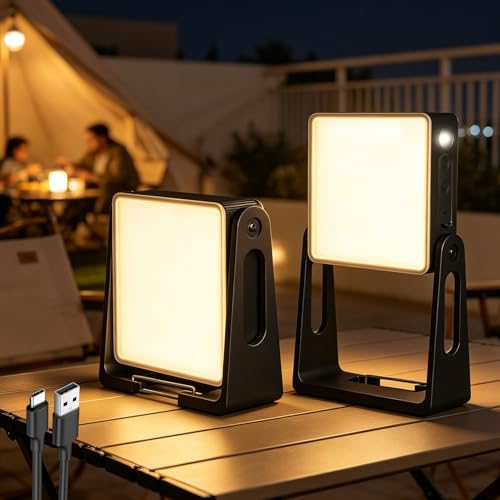
Eocean Rechargeable Camping Lanterns with Rotating Stand, 2 Pack
ASIN B0GX94YT25 • $42.49 • Sold by Eocean-au on Amazon AU
The Eocean pair exists to solve the multi-room problem: a blackout doesn't happen in one room, and carrying a single lantern from kitchen to bathroom to bedroom all night is how people fall over furniture. Two units at $42 means $21 per light, each with its own 6000mAh pack, which is the largest capacity quoted in this guide. The listing claims 12 hours of continuous light at the high setting and multiple nights at lower ones, and with the biggest pack here doing the work those numbers are at least built on the right foundation. Park one in the kitchen and one wherever the household gathers, and the blackout gets navigated instead of managed.
The party trick is the 360-degree rotating stand, which turns a lantern into something closer to an adjustable work light: sit it in the workshop and aim the light at the stove, the switchboard or the page rather than accepting an even glow in all directions. Stepless dimming and three colour temperatures, warm through neutral to bright white, cover the same comfort ground as the Glocusent, and each unit also converts to a focused handheld beam for the torch jobs, checking the meter box or walking to the car, so the pair covers lantern duty and torch duty without a third purchase. The stands also mean neither unit needs a hook or a rail to be useful, which matters in rooms that have neither.
The picks either side of this one are more specialised, and that's the point of this pack: it's the general-purpose answer. No cell storage to manage like the Lepro pair, no single point of failure like a lone lantern, and enough capacity per unit that a two-night outage doesn't require rationing. For a household buying once to cover the whole house, this is where I'd start. The one homework item is charging: two packs means two top-ups on the quarterly ritual, and a two-port charger by the kitchen bench turns that into a single gesture instead of a chore.
Honest caveats: The listing doesn't state a water resistance rating or a phone-charging output, so treat these as indoor lights and assume the packs only feed the LEDs. Packs are built in and non-removable as far as the listing states, so the usual storage-charge habits apply to both units.
Best for: Covering two rooms at once with adjustable, aimable light for $21 a unit.
Battery: 6000mAh per lantern, rechargeable • Quoted runtime: 12h high, multiple nights on low • Stand: 360-degree rotatable, aimable • Dimming: Stepless, 3 colour temperatures • Extra: Converts to focused handheld beam • Pack: 2 lanterns, $21 per light • Rank: #7 in Electric Camping Lanterns (Amazon AU)
View on Amazon AU
Lepro 2000 Lumen Rechargeable Lantern, USB or AA Power
ASIN B0FJQVKCTP • $55.99 • Sold by Lepro AU on Amazon AU
The dearest pick here at $56, and the one that resolves the rechargeable-versus-cells argument by refusing to pick a side. It charges over USB for everyday use and also runs on three AA cells when the pack is flat or the mains has been gone for days, which makes it the only single light in this guide with a genuine plan B built in. That dual supply is the whole value case: it's the lantern you can hand to a household that will never maintain a charging ritual, because even fully neglected, it's three AAs away from working. AAs being the one cell every house already has in a drawer somewhere is the quiet part of the design.
It's also the brightest thing here by a margin: up to 2000 lumens through a 360-degree beam, with the five modes covering a 1800-lumen cool white, a 220-lumen warm white for long evenings, the full mixed mode, and steady or flashing red for signalling. Stepless dimming fills the gaps between, so in practice it runs at whatever level the room needs and holds its headroom in reserve. The styling is the traditional wire-handle lantern shape, which sounds cosmetic until you're hanging it from a gazebo or carrying it upstairs, and IPX4 splash resistance covers the outdoor moments. Nothing on the spec list reads like a gimmick; it's five modes and a dimmer, all of which get used.
Where it sits in the system: this is the light for the biggest room in the house, the one that also gets grabbed for camping, with the Blukar and the cell-powered Lepros filling the satellite roles. If the plan is one serious lantern rather than a fleet, the dual power supply makes this the safest single choice in the guide. It's also the pick I'd take camping first, which is a fair tiebreak: emergency gear that earns its keep between emergencies is the gear that turns out to be charged when the real thing arrives.
Honest caveats: AA cells aren't included, and 2000 lumens at full brightness will run any battery down quickly, so treat maximum as a burst mode rather than the evening setting. The listing doesn't state pack capacity in mAh or exact runtimes per mode, so build your own baseline on night one. IPX4 means splashes only.
Best for: The one-lantern household: bright enough for the main room, with AA cells as the built-in plan B.
Brightness: Up to 2000 lumens, 360-degree beam • Power: USB rechargeable or 3x AA cells (not included) • Modes: Mixed 2000lm, cool 1800lm, warm 220lm, red steady, red flashing • Dimming: Stepless, long-press • Water resistance: IPX4 • Style: Wire-handle lantern, hangable • Rank: #30 in Electric Camping Lanterns (Amazon AU)
View on Amazon AUSide-by-side comparison
| Product | Price | Best for |
|---|---|---|
| Blukar Camping Light Rechargeable | ~$26.99 | |
| Glocusent Survival Camping Lantern | ~$39.99 | |
| Glocusent Camping Light | ~$38.99 | |
| Glocusent 135 LEDs Camping Lantern | ~$43.99 | |
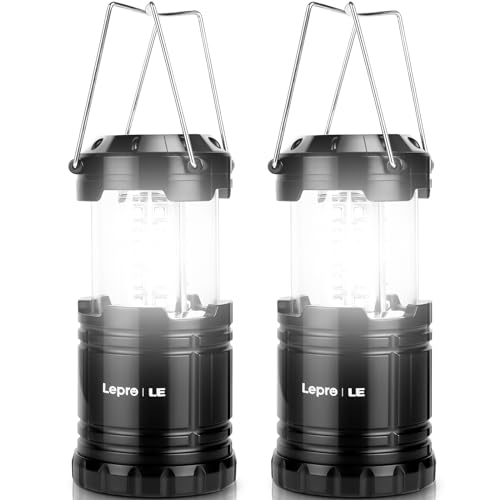
| Lepro Collapsible Camping Lantern, 2 Pack | ~$32.99 | |
| Rechargeable Camping Light | ~$38.99 | |
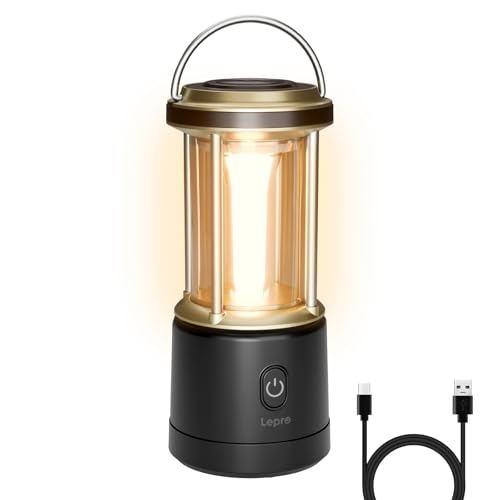
| LE Camping Lantern | ~$59.99 | |
| Lepro Camping Lantern | ~$69.99 |
What we see fail at the bench: rechargeable lanterns
Emergency lighting fails in storage, not in use, and the failures follow the battery chemistry almost every time. Lithium packs age on the shelf, alkaline cells leak where they sit, and the charge port cops abuse in the dark that no other socket in the house gets. All three failure modes are visible early if you know the warning signs, and two of the three are preventable outright with storage habits that cost nothing.
Swollen packs in sealed lights
A lithium pouch cell stored flat, stored full or stored hot swells as it degrades, and in a sealed lantern the first sign is often a case that's started to bulge or a diffuser that no longer seats. A swollen pack is not a keep-using-it situation: pressure on a damaged cell is how small problems become smoky ones. The storage regime that avoids it is the one this guide keeps repeating, half charge, quarterly top-ups, never in a hot car or shed. If a lantern is bulging, stop charging it and have the pack looked at before deciding anything.
Leaked alkalines and green contacts
The most common dead emergency light we see isn't broken at all: it's a battery compartment full of leaked alkaline crust, with the spring contacts corroded green and the circuit open. Alkaline cells left installed for years vent potassium hydroxide, which wicks along springs and traces and eats them. Mild cases clean up and the light lives; bad ones have corrosion into the switch or the LED board and aren't worth the labour. The prevention is free and total: store cells beside the device in their packaging, and load them when the lights go out, not years before.
Charge ports that give up first
On rechargeable lanterns the USB port usually dies before the pack does. It gets plugged blind, at an angle, by feel, and lighting gear rarely uses the reinforced connectors that phones get. The early symptom is charging that only works when the cable is held just so, or a connector with visible wobble. At that stage it's usually a straightforward re-termination or port swap; after months of wiggling it can lift pads off the board and turn a small job into a marginal one. USB-C ports tolerate this life better than the old micro-USB, which is one more reason to buy current designs.
Decision tree: which one should you actually buy?
- Just want something on hand for the next blackout, under $25? → The Blukar at $22. It hangs, it folds, it lasts a couple of evenings on the low settings, and it's the top seller in the category for a reason.
- Most worried about the phone dying mid-outage? → The Glocusent at $35. Its 5000mAh pack charges a phone over USB-C and still runs the light, with a red SOS mode as the last resort.
- Need to cover more than one room at once? → The Eocean two-pack at $42. Two 6000mAh lanterns with aimable stands, $21 a light, so the kitchen and the lounge are both sorted.
- Want a light that still works after a year of total neglect? → The Lepro D-cell pair at $48. No pack to fade and nothing to charge; keep a packet of D cells beside them and they're ready this decade and next.
- One serious lantern for the whole house? → The Lepro 2000-lumen at $56. USB rechargeable day to day, and it falls back to three AA cells when the pack or the planning runs out.
- A lantern that won't charge, won't hold charge, or has a swollen case? → Bring it to the bench at our Erina shop. We'll test the pack and the port and tell you whether it's a fix or a replacement before you spend anything, and a swollen pack should come in sooner rather than later.
Frequently asked questions
How many lumens do I need for a blackout?
Less than the marketing suggests. A few hundred lumens lights a kitchen comfortably, warm settings around 200 to 300 lumens make a lounge liveable for an evening, and 1000-plus is for flooding a garage or a yard, not for sitting with. The reason to buy a high-lumen lantern is headroom rather than habit: a big lantern running at a low setting is cooler, quieter on its battery and lasts several times longer than a small one working at its limit. Buy bright, run dim, and the runtime problem mostly solves itself.
Are rechargeable lanterns better than battery-powered ones?
Better lights, worse insurance. Rechargeables are brighter, dimmable and cost nothing to refill, but lithium packs self-discharge in storage and age fastest when kept full, flat or hot, so an unmaintained one can be dead exactly when it's needed. Cell-powered lanterns invert that: alkaline D or AA cells hold most of their charge for years in their packaging, so a neglected cell lantern still works, provided the cells were stored beside it rather than inside it. The strongest setup is a mix, rechargeables for daily use and the first hours, one cell-powered unit as the deep reserve.
How long will a lantern really run in a blackout?
Plan on the middle of the listing's range, not the headline. Runtime claims are measured at the dimmest setting, which is why the same Lepro quotes 12 hours at full brightness and 240 hours at minimum on one set of cells. At the levels people actually sit in, expect a night or two of useful light from a 4000 to 6000mAh rechargeable, and more from big alkaline cells at modest brightness. The honest method is to test it once at home: set your comfortable level, note when it fades, and treat that as the planning number.
Can I charge my phone from a camping lantern?
If it has a power output, yes, and it's a feature worth paying for. The Glocusent pick here has a USB-C port that both recharges the lantern and tops up a phone from its 5000mAh pack, which is roughly one phone charge. The catch is that light and phone are drawing on the same pack, so a full phone charge leaves a much shorter-lived lantern. Use low light settings while charging, or charge the phone in bursts to keep some capacity for both jobs. A dedicated power bank is still the better phone charger if you own one; the lantern is the backup.
How should I store lanterns between blackouts?
By chemistry. Rechargeable lithium units store best around half charge, topped up every three months or so, somewhere cool indoors; full, flat or hot storage is what ages packs into early retirement. Cell-powered units store best empty, with their alkaline cells kept beside them in the packaging, because cells left installed for years eventually leak and corrode the contacts, which is the single most common way emergency lights die. Then placement: kitchen, bedside, and one in the garage or car, with the car unit being the cell-powered one, since summer cabin heat is brutal on lithium.
Why won't my lantern charge any more?
Two usual suspects. The charge port is the most common: lantern sockets get plugged blind in the dark and work loose, and the early sign is charging that only happens at certain cable angles. Caught early that's usually a modest repair; left wiggling, it can damage the board. The other is the pack itself, which after years of storage abuse may no longer hold useful charge, and in a sealed lantern the pack's retirement is the light's. If the case has begun to swell, stop charging it entirely and have it assessed, since a swollen lithium pack shouldn't stay in service.
Related buying guides
When the lantern's dead and the blackout isn't
A lantern that won't charge, cuts out at an angle, or has a case starting to swell is usually a port or a pack, and one of those is a quick fix while the other is a decision. Bring it in to the workshop at Erina and we'll test both and tell you which you've got before you spend anything. Swollen packs in particular: sooner is better, and we'll say so honestly if the light isn't worth saving.
Visit our Erina workshop Book Online