



Prices from Amazon AU, updated daily. Swipe or use the arrows for more.
Disclosure: This article contains affiliate links to amazon.com.au. If you buy through one of these links iFix may earn a small commission at no extra cost to you. It doesn't change which products we recommend. We focus on what actually lasts based on 16 years of repair-shop experience.
Quick summary8 picks
- Entry PickSONGMICS Stainless Steel Airer about$34.99
- Leifheit Rollfix 210 Wall Dryer about$55.25
- SONGMICS Clothes Drying Rack about$66.99
- SONGMICS Clothes Drying Rack about$62.99
- SONGMICS Clothes Drying Rack about$49.19
- SONGMICS Clothes Drying Rack about$85.99
- SONGMICS Clothes Drying Rack about$79.99Stainless rods, adjusts to 48in high.
- Most PremiumJoseph Joseph AirFrame 3-Tier Clothes Airer… about$119.97
What a dryer load actually costs now
Electricity prices are the reason this category ranks where it does on Amazon AU, and the arithmetic is short. A vented tumble dryer pulls around 2,400W flat out, which is close to the most a standard 10A Australian socket will give anything. At the AU average tariff of roughly 33c/kWh, that's about 79c an hour, and a heavy winter load that runs 90 minutes lands near $1.20. A household doing five dryer loads a week is spending around $300 a year turning water into window condensation. Those are my assumptions stated plainly, so you can rerun the sum against your own tariff, but the shape of it doesn't change much whichever plan you're on.
A heat pump dryer cuts that per-load figure to very roughly a third, and if you already own one the money argument for a rack gets thinner. The catch is that a heat pump dryer costs four figures to buy, while every rack in this guide costs between $30 and $200 once, uses no power at all, and has no consumables. There's no filter, no cartridge, no battery. In a series where I spend most of my time warning about running costs hiding behind box prices, this is the rare category where the box price is the whole price. The trade you make instead is time, space and moisture, and the moisture part gets its own section because it's the one that catches people.
If you want the real number for your dryer rather than my assumption, put a metering smart plug on it for a fortnight and read the kWh off the app. I did the same exercise for standby loads in the smart plug guide and the pattern holds here: people guess their dryer costs either double or half what it does, and almost nobody guesses right. Measure once, then decide whether the rack is replacing the dryer entirely or just taking the low-value loads: towels, sheets, work clothes, the stuff nobody needs fluffy.
Where three litres of water goes when you dry inside
A washing machine on a decent spin leaves roughly two to three litres of water in a full load, and every gram of it ends up in your house when the load dries on a rack in the lounge room. Warm air holds that water invisibly right up until it touches a cold surface, and then it doesn't. It lands on window glass, aluminium frames and the cold south wall behind the wardrobe, and it does it every day through winter. The result I care about for this guide is what that does to the room and the stuff in it: paint, plaster, timber sills, and mould growing on surfaces and possessions that never used to see moisture.
The bench angle is corrosion. Electronics living in a persistently damp room grow the same green crust on connectors and board contacts that proper liquid damage leaves behind, just slower, and those devices end up on our bench in Erina every winter. A games console or amp on a shelf in the room where the washing dries nightly sits in high humidity for months at a stretch, and condensation doesn't need a puddle to start working on solder joints and plated contacts. I'm not telling you not to dry inside, most of the Central Coast does it all winter. I'm telling you to treat the moisture as real, and to move it out of the room on purpose rather than letting the walls absorb it.
The clean fix is pairing the rack with a compressor dehumidifier in a closed room, and it changes the economics less than you'd think. A mid-sized unit drawing around 300W costs about 10c an hour at the same 33c/kWh assumption, so even six hours of assistance is around 60c, still under the vented dryer's figure, and it dries the room as well as the clothes. I wrote up the machines themselves in the dehumidifier guide, and the pairing is honestly the strongest version of this whole setup: rack in a small closed room, dehumidifier running, door shut, laundry dry by morning with the moisture in a tank instead of the plaster.
Steel, coatings and why racks rust
Nearly every rack under $100 is powder-coated or plastic-wrapped steel, and the coating is the product. Steel rusts the day water reaches it, and a drying rack's entire job is holding wet fabric, so the corrosion clock starts at the first scratch. The failure pattern is always the same: a coating chip at a weld, a fold joint or a clip point, a rust bloom spreading under the coating, then brown marks on a white school shirt that trace back to one rod. The SONGMICS racks here are upfront about their materials, a mix of steel, stainless and plastic depending on the model, and the stainless models are the ones to look at if rust is your worry.
The mechanical failures are the moving parts, because it's always the moving parts. Fold hinges and rivets loosen and eventually shear on racks that get folded daily, caster stems bend when a loaded rack gets dragged sideways over a door threshold, and the little plastic corner caps and clip strips go brittle and crack after a few years near a sunny window. None of this is exotic and none of it should scare you off a $54 rack, but it's why I weight listings that state load capacities and materials over listings that just say sturdy in five languages. A stated 35kg limit means someone did the sums on the tube walls. Sturdy means nothing.
Indoor and outdoor ratings deserve one caution for this region. Most of these listings say indoor and outdoor, and structurally that's true, but salt air is its own physics and the Central Coast has plenty of it. A coated steel rack that lives permanently on a coastal balcony will rust years before the same rack indoors, at the chips and welds first, and while the Leifheit is listed for outdoor use, its housing still appreciates being under cover. My rule is simple: dry outside on the good days by all means, store the thing inside. The racks that die young are the ones that live outside.
Towers, wings and wall lines: pick a shape
The 4-tier tower is the family answer, and the SONGMICS tower here ranks third in its category because of it. Vertical tiers stack a lot of drying into a small footprint, about 64cm deep by 126cm wide in this case, with wings for long items and a bottom shelf that ends up holding shoes. Casters matter more than they sound: a loaded tower is heavy and awkward, and rolling it from the laundry to the sunny window, or into the dehumidifier room, is how it actually gets used. The trade is height. A tall loaded tower carries its weight high, so load the heavy wet stuff low and the socks up top.
The winged flat racks, the classic X-frame with fold-out ends, dry sheets and towels better than towers because nothing hangs above anything else, so air reaches the whole load at once. The stainless SONGMICS adds height adjustment up to about 120cm, which is what lets a long coat or a dress hang without folding, and it collapses to under 8cm flat, the difference between a rack you keep behind a door and a rack you trip over. The winged LLR052C01 goes the other way: 33 rods and 27 clips on one level, a lot of small-item capacity, at the cost of nearly a metre and a half of floor when open.
The Leifheit is the different animal: a wall-mounted box with five retractable lines giving 21 metres of drying length, wound back into the housing when you're done. It's the only pick that takes zero floor space, which makes it the small-laundry owner's first choice, though it needs a proper fixing into something solid. Over a bath, along a laundry wall, across a balcony, it disappears when it's not working. The Joseph Joseph is the design-led take on the flat rack: staggered tiers so long items hang between levels, a proper lock so it doesn't fold itself with washing on it, and a price that reflects the design work.
Capacity claims: metres, rods and kilograms
Capacity in this category gets quoted three different ways and they're not interchangeable. Metres of line is the honest one, the total length of rod or wire you can actually drape fabric over: 21m on the Leifheit, over 16m on the Joseph Joseph. Rod counts sound bigger, 33 rods, 24 rods, but rod length varies, so use them to compare within a brand and not across brands. Kilogram ratings are about structure rather than space: the SONGMICS tower states about 35kg and the stainless model about 15kg, and a load of wet washing weighs a lot more than the same load dry, which is exactly why those numbers exist and why three of these five listings stating no rating at all is worth noticing.
The listings themselves need the usual translation pass. SONGMICS quotes dimensions in inches because the copy is written for the US market first, so bring a calculator: 68.1 inches is 173cm of rack height, and that matters in a laundry with overhead cupboards. One of the five listings here is a single bullet point long, which says nothing bad about the rack but plenty about how much attention the AU listing gets. Where a listing is thin or metric-free I've done the conversions in the specs tables and marked them as conversions, and anything a listing doesn't state, I haven't invented.
Running a drying room that doesn't grow mould
The no-spend version of doing this properly is airflow plus separation. Dry in one room, not spread through the house, and give that room either an open window on a dry day or a dehumidifier on a wet one. Mould on walls and sills needs sustained surface moisture, and the difference between a room that gets it and a room that doesn't is usually ventilation habit rather than the rack. Cross-flow beats still air by a wide margin for drying time too: washing in a closed still room can take two days in winter, and two-day-damp fabric in a cold room is exactly the timeline surface mould enjoys.
If you want to know rather than guess, a hygrometer or one of the units from the air quality monitor guide with a humidity readout will tell you what the drying room is actually doing. The number I'd watch is relative humidity holding above about 70 per cent for days at a time, because in a cool room that's when condensation on glass and steel becomes constant rather than occasional. A monitor also settles the nightly argument about whether the dehumidifier needs to run, and it pays for itself in the hours it tells you not to bother.
How I picked these racks
Same screen as every guide in this series. Condition New, price inside a $30 to $250 band, sold by Amazon AU or a named AU storefront, and holding a real Amazon AU category sales rank on the day I checked. Of the five written up below, three are sold by the SONGMICS HOME AU storefront and two by Amazon AU directly, and the lead pick sits at number three in its category. The rank caveat this time is the Leifheit, which Amazon files at number 1,314 in Laundry, Steaming & Ironing, a much broader category than the rack lists, so that number is not comparable with the others.
Specs come off the listings and nowhere else, and the thin listing gets called out rather than padded. Prices are the day-of snapshot, and the storefront-sold items move around more than the Amazon-sold ones. The general advice holds from every other category I cover: pick the shape that fits the space you'll actually use it in, because the rack that's wrong for the room ends up in the garage inside a month, and a $120 rack in the garage dries exactly as much washing as no rack at all. If it's between two, take the one that folds thinner. You'll fold it more often than you think.
The 5 in-depth picks, $54 to $200
Want one answer? For most homes it’s the SONGMICS 4-tier tower at about $54. It was the number three seller in Amazon AU’s Clothes Drying Racks category when I checked, it holds a full week’s washing on a small footprint, and it rolls out of the way on wheels. No floor space at all? The Leifheit wall line at the end of the list winds away to nothing.
Prices are Amazon AU at time of writing (16 October 2026) and move week to week. Ranks are Amazon AU category sales ranks, checked the same day. The quick summary and comparison table also list three more racks from the same shortlist: two more SONGMICS 4-tier steel airers with wheels at $60 and $67, and a SONGMICS stainless airer with three rotating arms at $30.

SONGMICS 4-Tier Foldable Clothes Drying Rack with Wheels
ASIN B0C39QXNJN • $53.54 • Sold by SONGMICS HOME AU on Amazon AU
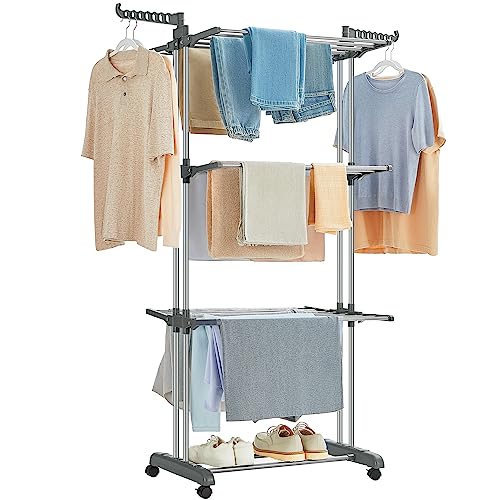
This is the number three seller in Amazon AU's Clothes Drying Racks category, and it's the most drying per square metre of floor in the guide. Four tiers stack three shelves of rod space over a bottom tier the listing pitches for shoes, with two rotating wings carrying 14 slots for the long stuff, all in a footprint about 64cm deep and 126cm wide, standing 173cm tall. The listing states a capacity of about 35kg, which is a genuine family-wash number, and the frame is heavy-duty stainless steel and thick plastic by the listing's account, with what SONGMICS describes as reinforced double rods on both sides. At $54 from the SONGMICS HOME AU storefront, it's the obvious default pick for a household.
The casters are the feature that makes it work day to day. Four wheels, two with brakes, mean a fully loaded rack rolls from the laundry to the sunny end of the house, or into the small room where the dehumidifier lives, without unloading anything. Assembly is stated at about ten minutes with labelled parts, which matches the flat-pack simplicity of the thing, and the whole rack folds up for storage when the weather turns good. Tiered racks dry slower than flat ones because the upper shelves shade the lower ones from airflow, so give it a fan or a cross-breeze for the dense winter loads and rotate the slow movers to the top tier.
The trades are the tower trades. It's tall, so it wants the heavy wet items loaded low and the light stuff high, and it prefers being rolled gently over thresholds rather than dragged. The listing calls the frame stainless steel, which helps against rust, but the plastic parts and joints still age in permanent weather, so bring it in. For $54 it replaces a dryer for the bulk of a family's loads, and the bottom-shelf-for-shoes idea sounds like listing padding right up until you've used it once, after which it's permanent.
Honest caveats: The listing says stainless steel, but the plastic parts and joints still age outdoors, so retire it from permanent outdoor duty. Upper tiers shade lower ones, so dense loads dry slowly without a cross-breeze or fan. Dimensions on the listing are in inches, and it's 173cm tall assembled, so check clearance under laundry cupboards.
Best for: Families doing the whole week's washing on one rack, ideally paired with a dehumidifier in a closed room.
Type: 4-tier tower with rotating wings • Footprint: About 64 x 126 cm, 173 cm tall (stated 25.2 x 49.6 x 68.1 in) • Capacity: About 35 kg stated (77 lb) • Extras: 2 wings with 14 slots, bottom shoe tier • Mobility: 4 casters, 2 with brakes • Assembly: Stated about 10 minutes • Seller: SONGMICS HOME AU storefront, condition New • Price: $54 at time of writing • Rank: #3 in Clothes Drying Racks (Amazon AU)
View on Amazon AU
SONGMICS Free-Standing Winged Drying Rack LLR052C01
ASIN B0BSKWJV77 • $68.79 • Sold by SONGMICS HOME AU on Amazon AU
The LLR052C01 is the winged single-level rack, and its listing leads with the two numbers that define it: 33 hanging rods and 27 clips. Everything dries on one level, which is the quiet advantage over the towers, because nothing shades anything and a room with any air movement dries the whole load at once. The clips are the detail I'd actually pay for: socks, underwear and the general small-item chaos of a family wash get pegged straight to the rack instead of eating rod space or needing a separate peg basket that's never where the rack is. At $69 from the SONGMICS HOME AU storefront it holds rank one in Standing Dry Racks.
Open, it's a big rack, about 148cm long and a metre high, and that's the honest cost of single-level drying: the space comes from your floor instead of from stacking. The wings fold down independently, so it runs at half size for small loads, and the whole thing folds flat for storage between washes. The listing here is the thinnest of the five, a single bullet point, so beyond the rod and clip counts and the dimensions there's not much stated: no load rating, no materials breakdown. What's visible in the photos is the usual SONGMICS coated-steel-and-plastic construction, but the listing doesn't state it, so I won't either, and the specs table says not stated where that's the truth.
That thin listing is why it sits third here rather than second, because the rack itself is a sensible shape for the money. If your washing skews small, kids' clothes, gym gear, the endless sock economy, the clip strips and rod count fit that load better than the tower does, and the one-level layout means it all dries at the same speed. If you also hang long dresses and coats regularly, the stainless model's adjustable height is the better fit, and here they'd have to fold over a rod instead.
Honest caveats: The listing is one bullet point long: no stated load rating and no materials breakdown, so I'm treating it as standard coated steel and plastic and hedging accordingly. It's nearly a metre and a half long open, which is real floor space, and long garments have to fold over a rod rather than hang.
Best for: Households whose washing runs to lots of small items, with the floor space to open a metre-and-a-half rack.
Type: Winged single-level, free-standing • Drying: 33 rods, 27 clips • Size open: About 55 x 148 x 100 cm (stated 21.7 x 58.3 x 39.4 in) • Model: LLR052C01, white and green • Load rating: Not stated on the listing • Seller: SONGMICS HOME AU storefront, condition New • Price: $69 at time of writing • Rank: #1 in Standing Dry Racks (Amazon AU)
View on Amazon AU
SONGMICS Foldable Stainless Steel Clothes Drying Rack
ASIN B07BLSJDKT • $79.99 • Sold by SONGMICS HOME AU on Amazon AU
This is the rack for anyone who read the rust section and decided to opt out of the problem. The rods are stainless steel rather than coated, which the listing pairs with thickened tube for stability, and stainless is the difference between a coating you're protecting and a material that shrugs off wet fabric for a decade. Two tiers and 24 rods give it a proper drying area, 27 clips handle the small stuff, and the height adjusts up to about 120cm, which is the spec that lets dresses, coats and long pants hang straight instead of folding over a rod with a crease line. At $80 from the SONGMICS HOME AU storefront it holds rank one in Standing Dry Racks.
The stated load capacity is about 15kg, less than half the tower's 35kg, and that's the honest structural difference between this X-frame geometry and a braced four-post tower rather than a quality problem. Fifteen kilograms is still a decent spun load spread across 24 rods, but doonas, blankets and a full family wash in one go belong on the tower. Where this one wins is the fold: down to under 8cm thick, stated at about 60 by 108cm folded, which slides behind a laundry door or beside a wardrobe, and that's the reason a rack like this keeps getting used in year three while bulkier ones migrate to the garage and stay there.
It's also the pick I'd give the best odds of outliving its price difference. The failure modes on coated racks, chips and rust bloom, mostly don't apply, and what's left is the hinge hardware and the plastic end fittings, a much shorter list. If the choice is between this and the tower, it comes down to load size versus lifespan: the tower carries more than twice the weight, this one will still look right after five years of daily fold-and-open. For one to three people washing regularly rather than in weekend mega-loads, this is where I'd put the $80.
Honest caveats: The stated capacity is about 15kg, so it's not the rack for doonas or a whole family's washing in one hang. The height adjuster and hinges are the moving parts to treat gently. The listing quotes everything in pounds and inches, and its marketing copy is florid, but the material claims are the ones that matter.
Best for: One to three people who fold the rack away daily and want it still presentable in five years.
Type: 2-tier winged X-frame • Rods: 24 stainless steel rods, 27 clips • Height: Adjustable up to about 120 cm (stated 48 in) • Capacity: About 15 kg stated (33 lb) • Folded: About 60 x 108 x 7.5 cm (stated 23.8 x 42.5 x 2.9 in) • Seller: SONGMICS HOME AU storefront, condition New • Price: $80 at time of writing • Rank: #1 in Standing Dry Racks (Amazon AU)
View on Amazon AU
Joseph Joseph AirFrame 3-Tier Clothes Airer, 16m
ASIN B0G3XJ83Z3 • $199.95 • Ships from Amazon AU
The AirFrame is what happens when a design house that usually works in kitchenware takes the flat rack seriously, and it earns its $200 in ways the listing can actually state rather than imply. Over 16 metres of drying space is the headline, the most line length of any rack in this guide, arranged across three staggered tiers rather than stacked ones, and the stagger is the clever bit: it creates six dedicated long-hanging rails where shirts and dresses drop between levels instead of draping over a rod with a crease across the middle. Sold by Amazon AU at $199.95, it holds rank nine in Standing Dry Racks against competition at a quarter to a half of its price, a respectable showing at several times the category's usual money.
The engineering details are the ones frequent folders will notice. A stated locking mechanism keeps it rigid when loaded, aimed straight at the classic flat-rack failure of the frame folding itself when a wet towel lands wrong, and collapse is a lift-and-click action rather than the finger-pinching scissor fold of the $60 class. The legs form a carry handle when folded, so it moves between rooms one-handed, and the listing rates it for indoor and outdoor use. Two numbers the listing doesn't give are a folded dimension and a load rating in kilograms, so both stay unstated in my specs table, and the capacity claim rests on line metres rather than weight.
Whether it's worth $120 or more over the SONGMICS options comes down to how much the long-hanging rails and the fold quality matter to you. Purely on drying metres it posts the best number of any rack here, and the stagger dries mixed loads noticeably better than stacked tiers. It's also the rack most likely to live in view of guests without apology, which sounds shallow and is actually the whole game: the rack that's acceptable in the living room is the rack that gets used. If the washing routine is daily and the rack lives out, this is the one I'd buy once.
Honest caveats: No stated load rating and no folded dimensions on the listing, so I can't promise it fits your gap behind the door. The staggered layout trails the $54 tower on sheer capacity even with more line metres. And a premium price for a drying rack is still a price for a drying rack.
Best for: Daily users who want the best-drying flat rack in the guide and one that can live in sight.
Type: 3-tier staggered flat airer • Drying length: Over 16 m stated • Long hanging: 6 dedicated rails between tiers • Fold: Lift-and-click collapse, legs form carry handle • Rated use: Indoor and outdoor • Load rating: Not stated on the listing • Seller: Amazon AU, condition New • Price: $200 at time of writing • Rank: #9 in Standing Dry Racks (Amazon AU)
View on Amazon AU
Leifheit Rollfix 210 Wall-Mounted Retractable Line Dryer, 21m
ASIN B0002AE8DI • $55.25 • Sold by Amazon AU
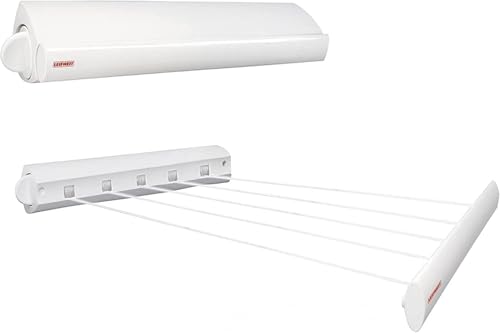
The Rollfix 210 is the pick for anyone whose answer to a floor-standing rack is that there's no floor to stand it on. It's a wall-mounted box with five extendable lines, each pulling out to about 4.2 metres, for 21 metres of drying length in total, that retract when you're done. Fit it in a bathroom, a utility room or across a balcony and the drying space exists only while it's being used, which is a trick no folding rack can manage. At $55 sold by Amazon AU it carries more line than any rack here, including the $200 Joseph Joseph, and its sales rank needs an asterisk: Amazon files it at number 1,314 in Laundry, Steaming & Ironing, a broad catch-all category rather than one of the rack lists.
The mechanism is the product. The listing describes a smooth retraction and re-tensioning system that keeps the lines taut, prevents sagging and lets the lines tuck away when not in use, and it calls the lines tear proof, the right promise for lines that get pulled out and wound back in every wash day. The listing says it suits bathrooms, balconies, utility rooms and gardens, indoors or out, so a short pull for a couple of shirts and a full stretch for sheets are both in play. Installation is the real task: the housing needs solid fixings into something structural, because 21 metres of wet washing puts real tension on the wall.
Value-wise it's hard to argue with. There's nothing to fold, nothing to store and no footprint, and the failure modes are few: a retraction mechanism and lines that can eventually fray, in a housing that costs about what six weeks of daily vented-dryer loads costs to run. The trade is that a long span can still sag under heavy items in the middle, so doonas and denim want the rack picks instead, and renters need to be comfortable putting screws into a wall, which not every lease smiles on. For a small laundry or a covered balcony it's the tidiest answer in the guide.
Honest caveats: Mounting is everything: it needs solid fixings and, in a rental, a landlord's blessing. Long spans can sag under heavy wet items like jeans and towels even with the re-tensioning, so it suits shirts, smalls and sheets folded over the line. The listing gives no line weight rating, so treat heavy loads conservatively.
Best for: Small laundries, covered balconies and anyone who wants the drying space to vanish between washes.
Type: Wall-mounted retractable, 5 lines • Drying length: 21 m total (up to 4.2 m per line) • Lines: Tear proof, re-tensioning • Rated use: Indoor and outdoor • Colour: White • Seller: Amazon AU, condition New • Price: $55 at time of writing • Rank: #1,314 in Laundry, Steaming & Ironing (Amazon AU)
View on Amazon AUSide-by-side comparison
| Product | Price | Best for |
|---|---|---|
| SONGMICS Stainless Steel Airer | ~$34.99 | Light loads for one or two people on the smallest budget. |
| Leifheit Rollfix 210 Wall Dryer | ~$55.25 | No floor space: a wall-fixed retractable line. |
| SONGMICS Clothes Drying Rack | ~$66.99 | A tall 4-tier tower with wheels and a shoe shelf. |
| SONGMICS Clothes Drying Rack | ~$62.99 | Families doing the whole week's washing on one rack. |
| SONGMICS Clothes Drying Rack | ~$49.19 | A 4-tier tower with a stated 35kg capacity. |
| SONGMICS Clothes Drying Rack | ~$85.99 | Lots of small items: 33 rods and 27 clips on one level. |
| SONGMICS Clothes Drying Rack | ~$79.99 | One to three people who want stainless rods and a thin fold. |
| Joseph Joseph AirFrame 3-Tier Clothes Airer… | ~$119.97 | Daily users who want the best-drying flat rack and one that can live in sight. |
What we see fail at the bench: drying racks
A clothes rack has no board to corrode and no battery to swell, so no, nobody has ever booked one in. But indoor drying crosses the bench constantly in disguise: the consoles, amps and laptops that live in the room where the washing dries are the damp-environment corrosion jobs we open every winter. The racks themselves fail simply and physically. Both halves are worth two minutes before you buy.
Damp-room electronics
Sustained humidity does slow-motion liquid damage. We open winter-season devices with green corrosion on connector pins, fuzz around board shields and rust on internal screws, from rooms that never saw a spill, just months of washing drying two metres from the TV cabinet. Condensation forms inside cold electronics when warm damp air reaches them, dries off, then forms again the next night. If the lounge is the drying room, at least run the gear regularly, a warm board sheds condensation, and think hard about moving the drying to a closed room with a dehumidifier instead. It's a lot less money than a logic board.
Chips, hinges and casters
Racks die at their moving and coated parts. The sequence on coated steel is scratch, bubble, bloom, then rust stains on washing, and it starts wherever the rack gets knocked: fold joints, feet and the rods you clip things to. Hinges and rivets loosen with daily folding, and the fix is tightening them early rather than tolerating the wobble for a year until something shears. Caster stems bend from sideways drags over door thresholds, so lift the rack the last centimetre instead. Sun-exposed plastic clips go brittle inside two or three summers; spares exist for the big brands, so you lose the clip, not the rack.
The dehumidifier that makes it all work
The compressor dehumidifier is the appliance half of this guide, and its failure modes are worth knowing before you pair one. They're refrigeration circuits with fans, filters and float switches: filters clog with lint precisely because the machine works next to drying laundry, float switches stick and stop the unit mid-night, and a unit run hard against a wall recirculates its own humid exhaust. Clean the filter monthly during drying season, give the intake clearance, and empty the tank on a schedule rather than on discovery. A maintained drying-room dehumidifier is the hardest-working appliance per dollar in a winter house.
Decision tree: which one should you actually buy?
- No floor space, or a tiny laundry? → The Leifheit Rollfix at $55. Twenty-one metres of line on the wall, zero footprint, gone when it retracts. Just make sure the fixings go into something solid.
- One rack for a family's whole weekly wash? → The SONGMICS 4-tier tower at $54: about 35kg of stated capacity, wings for the long items, wheels to chase the sun. A top-three seller in its category for a reason.
- Washing that's mostly small stuff: kids' clothes, gym gear, socks? → The winged SONGMICS LLR052C01 at $69. Thirty-three rods and 27 clips on one level, so everything dries at the same speed.
- Want the rack that won't ever rust-stain a shirt? → The stainless SONGMICS at $80. Stainless rods, adjustable height for long garments, folds to under 8cm. The lower 15kg capacity is the trade.
- The rack lives in view and gets used daily? → The Joseph Joseph AirFrame at $200: over 16 metres of line, proper long-hanging rails and the nicest fold action in the guide.
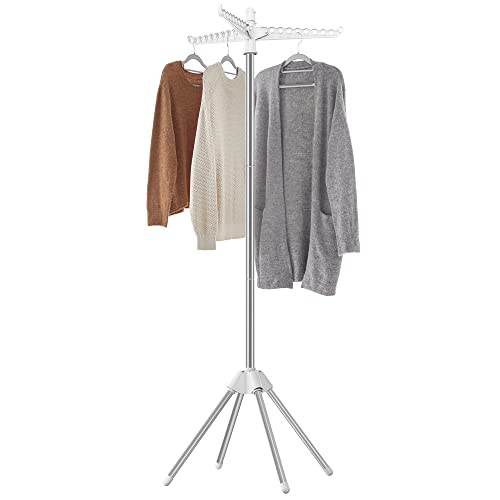
- Just need somewhere to hang a light load on the smallest budget? → The SONGMICS stainless airer with three rotating arms at $30. Stainless pole and legs, space for 27 items on hangers, and it folds down slim. The stated 33 lb limit is the trade, so it suits one or two people rather than a family wash.
- Console, laptop or amp gone glitchy in a damp room? → That's likely corrosion, and it compounds. Power it down and bring it in to our Erina workshop: we'll open it, assess the boards and tell you what's recoverable before you spend anything on replacements.
Frequently asked questions
Is it bad to dry clothes inside on a rack?
It's fine if you manage the moisture and a slow problem if you don't. A full load carries roughly two to three litres of water, and all of it ends up in the room's air, then on its coldest surfaces. Do it in one room with either ventilation or a dehumidifier and the house never notices. Do it every night in a closed lounge through winter and you'll meet condensation on the glass each morning, then mould on sills, wall corners and the backs of furniture. The rack isn't the problem, the unmanaged litres are. A closed room, a compressor dehumidifier and a shut door is the tidy version of indoor drying, and it usually gets the load done overnight.
How much does a tumble dryer load actually cost to run?
Depends on the dryer, so here are the assumptions: a vented dryer drawing around 2,400W at the AU average tariff of roughly 33c/kWh costs about 79c an hour, so a 90-minute heavy load lands near $1.20. Heat pump dryers cut that to very roughly a third. Five vented loads a week works out around $300 a year. Your tariff and your dryer will move those numbers, which is why I'd put a metering smart plug on the dryer for a fortnight and read the real figure before deciding how much rack the arithmetic justifies. Every load that moves to a rack costs nothing beyond the space it takes up.
Do drying racks rust, and can I stop it?
Coated steel racks rust eventually, and the timeline is set by coating damage rather than age. The sequence is a chip at a weld, hinge or clip point, moisture creeping under the coating, then a bloom that ends up striping your washing. You slow it by not storing the rack outdoors, wiping it down now and then, and treating chips early: clear nail polish over a fresh chip is the old trick and it works. Stainless rod racks like the SONGMICS stainless model here opt out of the problem for the surfaces that touch fabric, which is most of what matters. Aluminium and plastic racks don't rust but flex more under load.
How much washing can I actually hang on one?
Go by the stated kilogram rating and remember that wet washing is much heavier than dry, roughly half as heavy again for a well-spun load and worse for towels and denim. The tower here states about 35kg, the stainless X-frame about 15kg, and three of the five listings state no rating at all, which I've flagged in the specs. Overloading shows up as bowed rods and a rack that walks or folds itself, and it's the fastest way to find a hinge's limit. If a whole family wash regularly goes on one rack, buy the capacity for it or split the load across two racks.
Should I run a dehumidifier with an indoor drying rack?
In winter, on the coast, yes: it's the difference between indoor drying working and indoor drying slowly damaging the room. A mid-sized compressor unit drawing around 300W costs about 10c an hour at a 33c/kWh tariff, pulls litres out of a closed drying room overnight, and the room stays dry instead of the moisture settling into plaster and sills. Rack in a small room, door shut, unit running: the load is usually wearable by morning. In summer, or on windy dry days, an open window does the job for free. The dehumidifier guide on this site covers the machines themselves and their own maintenance habits.
Can I leave a drying rack outside permanently?
The listings mostly say indoor and outdoor, and structurally they're right, but permanent outdoor life is what kills coated steel racks early, especially near salt air. UV makes plastic clips and caps brittle inside a few summers, and constant moisture finds every coating chip. The pattern I'd suggest is the one the folding design invites: dry outside on the good days, then fold it and bring it in. The Leifheit wall unit is the partial exception, its lines are listed for indoor and outdoor use and they retract into a housing, but even that housing lasts longer under a covered balcony than in open weather.
Related buying guides
Damp rooms send us their electronics eventually
The devices that live where the washing dries are the ones that arrive with corrosion nobody can explain: no spill, no swim, just a winter of damp air. If a console, laptop or amp from a drying room is playing up, power it off and bring it in to Erina. We'll open it, check the boards and tell you honestly whether it's a clean-up, a repair or not worth your money, before you spend anything.
Visit our Erina workshop Book Online