Prices from Amazon AU, updated daily.
Disclosure: This article contains affiliate links to amazon.com.au. If you buy through one of these links iFix may earn a small commission at no extra cost to you. It doesn't change which products we recommend. We focus on what actually lasts based on 16 years of repair-shop experience.
Quick summary3 picks
- Entry PickIonmax Q10 Air Quality Monitor about$149
- bonoch 16-in-1 Air Quality Monitor with… about$179.997" screen, 2500mAh.
- Most PremiumECOWITT WH45 Indoor 5-in-1 Air Quality Sensor about$199.99
The stuffy room has a number
Sleep two adults in a closed bedroom through a Central Coast winter night and by 5:30am the CO2 concentration in that room has usually tripled. Outside air sits around 420 parts per million. A sealed bedroom with the door shut and a draught stopper jammed against it will crest 2,000ppm before the alarm goes off, sometimes 3,000. You cannot feel the number directly. What you notice is the thick-air quality of the room when you walk back into it from the hallway, and the condensation sheet on the inside of the window. The room was breathing all night with nowhere to exhale, and sixteen years of fixing the gear that lives in rooms like it has taught me the rooms are half the story. A monitor puts a figure on that, and once you have the figure you can test fixes: door open a hand-width, window cracked 20mm, heating timed differently. Guessing stops.
An air quality monitor is a small box of sensors: a CO2 sensor, usually a laser particle counter for PM2.5, sometimes extra channels for TVOC or formaldehyde, plus temperature and humidity. The marketing wraps this in numbers like 16-in-1, which on close reading of one listing here turns out to mean nine measured parameters and seven alert buzzers. The hardware underneath is what matters, and the gap between a sensor that measures and a sensor that estimates is the whole game in this category. The three units on this page run $149 to $200, all from Amazon AU or Australian storefront sellers, and each takes a different position on that hardware question. None of them needs a subscription. One of them needs an extra box, and I will be blunt about that when we get there. All three run happily on a phone charger's worth of power.
What the CO2 number actually tells you
CO2 indoors is a proxy for exhaled air. People are the main indoor source, so the reading tracks how much of the room's air has already been through someone's lungs and how little fresh air is replacing it. That makes it the single most useful ventilation gauge you can own. The scale is simple. Around 420ppm is outdoor air. Under 800 means the room is exchanging air well. Push past 1,500 and the room is running mostly on recycled air. Overnight bedroom peaks of 2,000 to 3,000ppm are common in winter, and a reading like that is not a malfunction, it is an honest report on a shut door and a sealed window. The number gives you a target: change one thing, watch the curve move. Watch it for one normal week and the pattern of your house appears by itself.
What you do with it costs nothing. A door left open a hand-width can knock a four-figure overnight peak down by a third. A window cracked at the top does more, at the price of heat. This is where the monitor pays for itself, because ventilation and heating pull in opposite directions all winter and without data you always choose badly in one direction. The same trade shows up in moisture: a sealed warm room loads its air with water that condenses on the coldest surface it can find. If the humidity channel on your monitor lives above 65 per cent all winter, the fix is airflow first, and if that fails, the compressor units in my dehumidifier guide are the mechanical answer. Either way you are acting on a measurement instead of a mood, which is the entire argument for owning one of these boxes.
NDIR or nothing: the sensor that matters
There are two ways a consumer box arrives at a CO2 number. The honest way is NDIR, nondispersive infrared: an infrared source shines through a sample chamber and the sensor measures how much light the CO2 molecules absorb at their signature wavelength. It is a direct physical measurement of the actual gas. The other way is estimation, usually badged eCO2: a metal-oxide sensor smells reducing gases (the TVOC family), and firmware guesses what the CO2 might be if humans were the source of those gases. Spray deodorant near an eCO2 unit and the carbon dioxide reading rockets, which tells you everything about what it is really measuring. The very low end of this market is almost entirely estimation, which is why those units were never in contention for this page. The price floor for real NDIR keeps falling, but it has not reached the no-name boxes yet.
Of the three picks, the Ecowitt states NDIR outright on the listing, and it is the only one here with a documented calibration function. The bonoch describes external high-precision sensor pods and quotes a 0.001 resolution figure, which is a listing claim I pass on rather than endorse; resolution is not accuracy. The Ionmax listing names its parameters and its response times but does not state the CO2 sensor technology at all, so I will not state it either. My general rule after years of pulling gadgets apart: when a listing will not name the sensor, price for the possibility that it is the estimating kind, and run the outdoor test below before you trust a single reading. All three units here get the same test on arrival.
Drift, ABC and the 420 test
Every NDIR sensor drifts. The light source ages, the chamber picks up contamination, and the baseline slides by tens of ppm per year. Manufacturers cope with automatic baseline calibration, ABC: the firmware assumes the room sees fresh air at some point each week, takes the lowest reading in that window, and quietly relabels it 420. In a house that gets aired, this works well. In a sealed office or a bedroom that never drops near outdoor levels, ABC recalibrates against stale air and the whole scale shifts optimistic. That is the hidden failure mode of this product category: a monitor that has spent a month in a shut room can read 600 when the truth is 900, while looking perfectly healthy.
So run the 420 test. Put the unit outside somewhere sheltered, or on a windowsill with the window wide open, give it ten minutes to settle, and it should sit within about 50ppm of 420. Repeat once a season. The Ecowitt adds a manual calibration button for exactly this situation, which is the sort of feature that tells you the engineers expected the instrument to be treated as an instrument. Two handling rules keep the drift slow: never poke anything into the sensor openings, and keep solvents away. In the workshop we clean boards with isopropyl alcohol all day, and any TVOC-adjacent sensor within two metres pegs its scale, then takes an hour to calm down. Perfume and surface spray do the same thing in a bedroom. Do that outdoor check twice a year and a mid-range unit stays trustworthy for the life of its sensors.
PM2.5 and the other numbers
The particle side of these boxes is a small laser counter: a fan drags room air through a beam and the electronics count the scattered flashes by size, PM1.0 up to PM10. In an Australian winter this channel earns its place. Wood heater smoke settles into coastal valleys on still nights, hazard reduction burns drift for days, and bushfire seasons have taught everyone what a smoke haze does to an indoor number even with the windows shut. Cooking is the other big source: searing a steak will spike PM2.5 tenfold in minutes, and watching the number fall afterwards is a direct, honest test of whether your rangehood actually vents or merely hums. The units in my air purifier picks are bought on faith and a room-size figure; a particle counter is how you verify one is doing anything.
TVOC and formaldehyde channels need more scepticism. HCHO shows up in the bonoch's parameter list, and the classic source is new flat-pack furniture and fresh paint off-gassing for weeks. The reading is useful as a trend line: assemble a wardrobe, watch the number climb, air the room, watch it fall. Treat the absolute figure loosely, because these sensors cross-react with cleaning sprays, alcohol and cooking vapours, and two brands will disagree by a factor of three on the same afternoon. Trend, not truth. The bonoch's HCHO channel is the only one on this page, which is worth knowing if a flat-pack furniture delivery is imminent. If a number refuses to move for days regardless of what you do to the room, that is not stability, that is a stuck sensor, and it is the first thing I would check before believing anything else on the screen.
Condensation, mould and the electronics angle
The humidity channel is the one this repair bench cares about most. Warm indoor air holds water; every cold surface in the room is a condenser waiting for it. When the monitor says 70 per cent at 21 degrees, the inside of a single-glazed window at 8 degrees is already past dew point and streaming. That water ends up in window tracks, curtain hems, wardrobe corners and cardboard boxes of stored gear, and mould follows it onto all of them. The same moisture works on electronics slowly: I see the white residue and green corrosion on phone and laptop boards from damp rooms often enough that the pattern is boring, and the mechanism is the same one explained in our water damage explainer, just running at one hundredth speed.
Winter habits make it worse. Drying a load of washing on a rack in the lounge pushes roughly two to three litres of water into the air of that room, and a closed room keeps all of it. A monitor with a humidity trend turns that from an argument into a graph. The gear consequences are real: game consoles in coastal garages, laptops that live in beach-facing bedrooms, cameras stored in cupboards against external walls. A surprising share of the corroded machines that reach the computer bench never met a spilled drink, they just lived in wet air for two years. Sensor, then airflow, then dehumidifier if the numbers insist: that order costs the least and fixes the most.
How I picked these three
Every candidate had to clear the same gates I use for all these guides: sold new by Amazon AU or an Australian storefront seller, priced $149 to $200 as of the day I checked, no import-version listings, no overseas dropshippers, and a real category sales rank on Amazon AU rather than a five-sales wonder. The band is narrow because the field is: below it the sensors estimate, above it you pay for laboratory badges no listing here can verify. That filter removed most of the field, including a parade of anonymous eCO2 boxes under $60 that would have made this page longer and worse. What survived splits into three honest use cases rather than three price tiers: a plug-in desk unit from an Australian air-treatment brand, a big-screen family display, and a proper sensor node for people who want the data logged somewhere.
Match the box to the job. The Ionmax Q10 is the simple one: one screen, five numbers, powered by USB-C, sold by Amazon AU itself. The bonoch is the one you mount where the household can see it, with a seven-inch panel and enough battery to walk it room to room hunting the worst offender. The Ecowitt WH45 is the instrument: NDIR stated, manual calibration, and a 433MHz radio that reports into an Ecowitt gateway, which you must buy separately and which most buyers of this page will not want. Three boxes, three jobs. The picks below go through each in detail, with the caveats the listings would rather you skimmed past.
The 3 picks, $149 to $200
Prices are Amazon AU at time of writing (27 August 2026) and move week to week. Ranks are Amazon AU category sales ranks, checked the same day.

Ionmax Q10 Air Quality Monitor
ASIN B0F66K94YL • $149.00 • Ships from Amazon AU
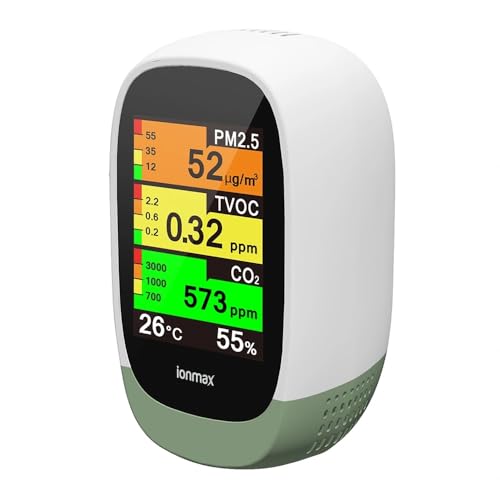
The Q10 is the only pick here sold and shipped by Amazon AU itself, and it comes from Ionmax, an Australian air-treatment brand that has been selling purifiers and dehumidifiers into this market for years. It reads the five numbers that matter for a normal house: CO2, PM2.5, TVOC, temperature and humidity, all on one screen at once, with no app, no account and no pairing ritual. Power is 5V over USB-C, so it runs from any decent phone charger or a spare port on a desk hub. The listing quotes fast response times, two seconds for PM2.5 and one second for TVOC and CO2, which in practice means the display reacts while you are still holding the door open rather than a minute after you closed it.
The listing is thin on engineering detail, and I count that as the honest weakness of an otherwise easy recommendation. The CO2 sensor technology is not stated, no accuracy figures are published, and no battery is mentioned, so treat it as a plugged-in instrument that lives in one room. What you are buying instead is simplicity with local accountability: an AU brand, AU consumer guarantees through Amazon AU as the seller, and a box whose entire user interface is looking at it. For a bedroom, a home office or an elderly parent's lounge room, that is precisely the right amount of technology. Nothing to update, nothing to unpair, nothing to subscribe to. Plug it in, glance at it, open a window when the number says to.
Run the outdoor test when it arrives: ten sheltered minutes outside, expect roughly 420ppm, and repeat each season. Then put it where the people are, not where the power point is convenient, because CO2 stratifies surprisingly little but PM2.5 near a kitchen doorway reads very differently from a bedside table. Pair the PM2.5 channel with whatever air cleaner you already own and you finally get a feedback loop: filter on, number falls, filter clogged, number stops falling. At $149 it is the lowest-priced instrument on this page and the one I would gift.
Honest caveats: The listing does not state the CO2 sensor type, publish accuracy figures or mention a battery, so assume mains-only operation and verify readings against outdoor air on arrival. There is no app or data logging: if you want history and graphs, this is the wrong pick. Screen brightness control is not stated on the listing either.
Best for: One room, one glanceable screen, zero setup: the bedroom or home office unit you can hand to anyone.
Measures: CO2, PM2.5, TVOC, temperature, humidity • Stated response: PM2.5 in 2 s, TVOC and CO2 in 1 s • CO2 sensor type: Not stated on the listing • Power: 5V DC via USB-C • App required: None, standalone display • Sold by: Amazon AU • Price: $149 at time of writing • Rank: #384 in Air Purifiers (Amazon AU)
View on Amazon AU
bonoch 16-in-1 Air Quality Monitor with 7-inch Display
ASIN B0GSR47FR5 • $179.99 • Sold by iVANKY | Bonoch AU on Amazon AU
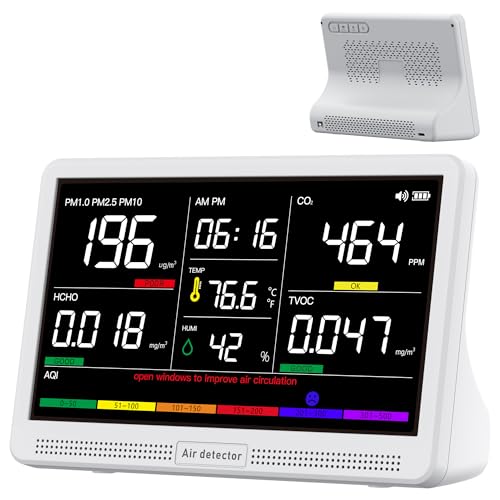
The bonoch's pitch is the panel: a seven-inch LED display that shows nine parameters simultaneously, CO2, PM2.5, PM1.0, PM10, HCHO, TVOC, temperature, humidity and an AQI rollup, big enough to read from across the room. The 16-in-1 branding is marketing arithmetic, and to the listing's credit it says so in the fine print: nine measured values plus seven alert buzzers equals sixteen. Those buzzers fire when individual channels cross thresholds, and there is a mute button for the night, which you will use. It currently sits at #32 in Amazon AU's indoor thermometer category, the strongest rank of the three picks, and at $180 it lands in the middle of this page's band.
Two hardware details separate it from the desk-box crowd. First, the sensors are external pods rather than buried inside the case, which the listing argues gives faster response from direct air sampling; it also means you must not touch them or park the unit next to perfume, a point the listing makes and my bench experience with solvent-drunk sensors seconds. Second, there is a real battery, 2,500mAh for a stated eight hours cordless. That turns the unit into a survey tool: carry it room to room over an evening and you will find the house's worst corner in one lap, usually the closed bedroom or wherever the washing rack lives. Charging is USB-C, and unlike some rivals both the cable and the wall adapter ship in the box.
The claimed 0.001 sensing resolution is a listing figure I quote without endorsing, because resolution and accuracy are different things and only the temperature and humidity channels carry stated tolerance bands, plus or minus one to three degrees Fahrenheit and two to three per cent RH. That is honest enough for a household display. Mount it centrally, let the family argue with it, and use its numbers to time ventilation rather than to win laboratory debates. As a picture of a whole house breathing, it is the best screen here.
Honest caveats: Sold by a marketplace storefront (iVANKY | Bonoch AU) rather than Amazon AU directly, so warranty runs through the seller. The CO2 sensor technology is not named on the listing, accuracy bands are only stated for temperature and humidity, and the exposed sensor pods must be kept away from fingers, perfume and cleaning sprays.
Best for: The household wall display: nine numbers readable from the couch, with enough battery to survey every room in an evening.
Measures: CO2, PM2.5, PM1.0, PM10, HCHO, TVOC, temperature, humidity, AQI • Display: 7-inch LED, three brightness settings • Alerts: 7 threshold buzzers with mute • Battery: 2,500mAh, stated 8 hours cordless • Charging: USB-C, cable and adapter included • Stated tolerance: ±1 to ±3 °F, ±2 to ±3% RH • Sold by: iVANKY | Bonoch AU • Price: $180 at time of writing • Rank: #32 in Indoor Thermometers (Amazon AU)
View on Amazon AU
ECOWITT WH45 Indoor 5-in-1 Air Quality Sensor
ASIN B08TMC66B1 • $199.99 • Sold by ecowitt au on Amazon AU
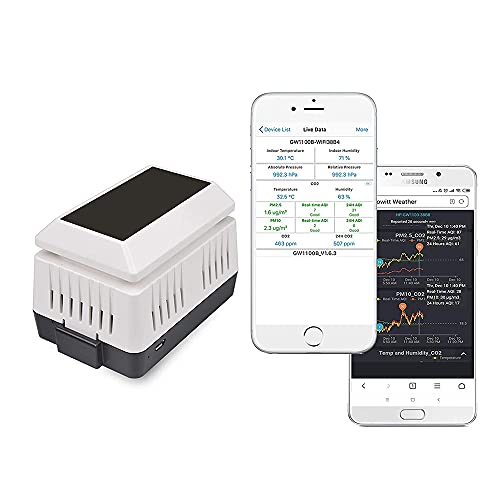
The WH45 is not trying to be furniture. It is a sensor node from Ecowitt's weather station ecosystem: NDIR CO2 stated plainly on the listing, plus PM2.5 and PM10 particle channels, temperature and humidity, five measurements from one puck. On USB power it samples every 60 seconds; on batteries alone, every ten minutes, so treat it as a mains device that tolerates a blackout rather than a portable one. It talks over a 433MHz radio with a stated 100 metre range in open areas to the rest of the Ecowitt family, and at $200 from the brand's own AU storefront it is the most instrument-like thing you can buy in this band.
Here is the catch, stated as bluntly as the runbook demands: there is no screen on this one, the radio needs a receiver, and neither is in the box. The WH45 has to pair with a GW1100 wifi gateway or an HP2551, HP2553, HP3500 or HP3501 console, bought separately, before you see a single number. Do that and the readings land on the free Ecowitt weather server with history, graphs and email alerts you configure yourself, readable from a phone or a laptop. The listing is upfront about the pairing requirement and I am repeating it because it is the whole buying decision. If you already run an Ecowitt weather station, this drops straight in and becomes the indoor arm of a system you own. If you do not, add the gateway cost to the $200 before comparing it against the bonoch, and be sure you actually want logged data rather than a glanceable screen.
For the right buyer none of that is a complaint. This is the only pick with a documented manual calibration routine: sit the sensor outside in open air away from any exhaust, give it half an hour, and it should read 420ppm within about ten. If it does not, the back housing comes off and a pin held on the calibrate button for thirty seconds re-baselines it. PM2.5 calibration comes with the pairing too. That is exactly the control an instrument should expose, and it is also the only pick that yields downloadable history, which turns arguments about the stuffy bedroom into a CSV. Indoor use only, and the sensor wants a ventilated spot rather than a bookshelf corner. Keep it on USB power so the 60 second sampling stays active. Data people, this one is yours.
Honest caveats: There is no display on the WH45 itself, so nothing is readable until you add an Ecowitt gateway or console sold separately, which makes the real entry cost higher than the $200 sticker. It reads two particle sizes rather than four, it is indoor use only and not weatherproof, and a 433MHz sensor network is a commitment to one brand's ecosystem.
Best for: Anyone who wants air data logged, graphed and exportable, especially existing Ecowitt weather station owners.
Measures: CO2 (NDIR), PM2.5, PM10, temperature, humidity • CO2 sensor: NDIR with manual calibration button • Update rate: 60 s on USB, 10 min on battery • Radio: 433 MHz, stated 100 m range in open areas • App and cloud: Requires Ecowitt gateway or console, sold separately • Battery backup: Stated 2 days • Operating range: -10 °C to 50 °C, indoor use • Sold by: ecowitt au • Rank: #96 in Weather Stations (Amazon AU)
View on Amazon AUSide-by-side comparison
| Product | Price | Best for |
|---|---|---|
| Ionmax Q10 Air Quality Monitor | ~$149 | |
| ECOWITT WH45 Indoor 5-in-1 Air Quality Sensor | ~$199.99 | |
| bonoch 16-in-1 Air Quality Monitor with… | ~$179.99 | The family display |
What we see fail at the bench: air quality monitors
Monitors themselves cross the bench rarely; what crosses the bench is the gear from the rooms they would have warned about. Corroded laptop boards from damp bedrooms, dust-choked consoles from rooms that never saw a PM reading, and the occasional monitor with a stuck sensor that has been confidently lying for a year. The failure patterns below are the ones worth designing around when you buy.
Particle sensors clog into optimism
The laser counter is the one moving-air part of these boxes: a small fan drags room air through the optical chamber, and everything airborne eventually coats the chamber walls and the fan blades. A clogged sensor fails optimistic, readings sag toward zero and stay flat while the room fills with cooking smoke. If your PM2.5 channel has not spiked during a fry-up in months, suspect the sensor before you celebrate the air. A short blast of clean dry air through the intake, gently and from a distance, recovers many of them. Units in kitchens and workshops clog fastest, which is exactly where people put them.
The power brick dies before the box
These are 5V devices drawing a watt or two, and the component that actually fails is the anonymous wall adapter feeding them. A sagging or noisy supply causes reboots, frozen screens and sensor readings that jump when the compressor fridge on the same circuit kicks in. Before declaring a monitor dead, swap the adapter for a known-good phone charger and try a different cable. The same electrolytic-capacitor decay that kills no-name chargers everywhere is explained in our charger teardown resource, and it applies without modification here. A monitor that must run continuously deserves a supply you would trust with a phone.
Batteries cooked on windowsills
Battery-equipped units like the bonoch get carried to the brightest room in the house and left on the windowsill, because that is where the condensation problem is. A north-facing sill in full winter sun will push a dark plastic case well past comfortable lithium territory, and the pack answers with reduced runtime first and swelling second. If the case seams start to gape or the unit rocks on a flat table, retire the battery side of it immediately. Park monitors in shade, near the people, away from glass. The sensor does not need a view, and the battery actively resents one.
Decision tree: which one should you actually buy?
- One bedroom, one honest screen, no setup? → Ionmax Q10, $149. Five numbers, USB-C power, sold by Amazon AU, nothing to pair. Run the outdoor 420 test on arrival and put it beside the bed, not beside the door.
- Whole household needs to see the numbers? → bonoch 16-in-1, $180. The seven-inch panel reads from the couch, and the 8-hour battery lets you survey every room in one evening to find the worst one.
- Already running an Ecowitt weather station, or want logged data? → Ecowitt WH45, $200. NDIR stated, manual calibration, and logged history through the gateway you either own already or must budget for separately.
- Want to verify a purifier is actually working? → Either PM-capable pick does it, but the bonoch's three particle sizes make the before-and-after clearest. Filter on, PM2.5 falls within minutes, or you have your answer.
- Monitor reads 400ppm forever, or a channel never moves? → Run the 420 test outdoors, then try a known-good charger. A flatlined channel after both is a stuck sensor, and on a sealed unit that is a warranty conversation, not a repair.
- Gadget dead, USB port loose, or a board that met moisture? → That is bench work. Bring it to our Erina workshop and we will test the supply, the port and the board before anyone talks about replacement.
Frequently asked questions
Why does my air quality monitor read about 400ppm all the time?
Two possibilities, one good and one bad. If the room is genuinely well ventilated, 400-something is simply the truth: you are near outdoor levels. The bad version is a sensor problem. Estimation-based eCO2 units default to a baseline near 400 when they have nothing to work with, and even real NDIR sensors that have auto-calibrated in a sealed room can pin low. Test it: breathe gently near the intake and the number should climb within a minute, then shut the unit in a small room with you for twenty minutes and expect a clear rise. If it never moves off its baseline, the sensor is stuck or the unit is estimating rather than measuring.
What CO2 level should make me open a window?
Use 800ppm as the comfortable ceiling and 1,500 as the act-now line. Below 800 the room is exchanging air well. Between 800 and 1,500 ventilation is lagging, and a door open a hand-width usually pulls it back. Past 1,500 the room is running mostly on recycled air, and overnight bedroom peaks of 2,000 or more are common with the door shut in winter. These are ventilation working numbers, not medical thresholds: the point of the monitor is to show which zero-cost change, a door gap, a cracked window, a timer tweak, actually moves your room's curve.
Do these monitors need Wi-Fi or an app?
The Ionmax and the bonoch are fully standalone: plug in, read the screen, done. Neither asks for an account, a pairing step or a network, which is a feature in a device meant to run for years. The Ecowitt is the exception and it is deliberate: the WH45 carries no screen of its own, and the readings, cloud history, graphs and email alerts all arrive through an Ecowitt gateway or console that is sold separately and talks to the sensor over 433MHz radio. If your Wi-Fi changes or the internet drops, the Ecowitt sensor keeps reporting to its receiver regardless, which is more resilient than Wi-Fi-native gadgets that sulk when the router reboots.
Why did the reading spike when I cleaned my desk?
Because the TVOC family of sensors reacts to almost any volatile chemical: isopropyl alcohol, surface spray, deodorant, nail polish remover, even a strongly scented candle. On our bench, cleaning a circuit board with isopropyl will peg any TVOC-adjacent sensor within a couple of metres, and it can take an hour to settle. On units that estimate CO2 from the same sensor, the CO2 number spikes too, which is the giveaway that you own an estimating unit rather than a measuring one. The spike is not damage, it is cross-sensitivity. Let the room air out and the reading will walk back down. Keep solvents and sprays away from the intake as standing practice.
How accurate are the temperature and humidity channels?
Good enough for decisions, not for laboratories. The bonoch is the only pick that states tolerances, plus or minus one to three degrees Fahrenheit and two to three per cent relative humidity, and that is typical of the sensor modules this whole category uses. Placement moves the numbers more than sensor error does: a unit in sunlight, above a heater or against a cold external wall can read several degrees away from the middle of the room. Mount it at person height, in shade, with some airflow, and treat day-to-day trends as solid even where absolute values are approximate. For the humidity decisions that matter, mould risk and dehumidifier timing, a two or three per cent error changes nothing.
Which of these works with a weather station or home dashboard?
The Ecowitt WH45 is the systems pick. It transmits on 433MHz to Ecowitt gateways and display consoles, and once a gateway is in place the readings appear in the Ecowitt app and web dashboard with downloadable history and configurable email alerts. The listing is explicit that the gateway or console is a separate purchase, so cost it into the comparison. The Ionmax and bonoch are standalone displays by design: no radio, no export, no integration path stated on their listings. If graphs, logs and automation hooks matter to you, buy the instrument; if a glanceable number is the whole job, the standalone units do it with less to configure and less to go wrong.
Related buying guides
Damp rooms corrode electronics. We fix what the air got to.
A monitor tells you the room is wet; the bench tells you what the wet room did. Green corrosion on connectors, drink-free water damage, laptops that lived two years in a beach-facing bedroom: 16 years of board-level work in Erina means we clean, repair and test at component level instead of quoting a replacement. Walk it in, or book ahead.
Visit our Erina workshop Book Online