Prices from Amazon AU, updated daily. Swipe or use the arrows for more.
Disclosure: This article contains affiliate links to amazon.com.au. If you buy through one of these links iFix may earn a small commission at no extra cost to you. It doesn't change which products we recommend. We focus on what actually lasts based on 16 years of repair-shop experience.
Quick summary8 picks
- Entry PickSportneer Bike Lock: 5-Digit High Security… about$25.99
- Folding Cable Lock about$29.99
- ROCKBROS Bike Phone Front Frame Bag for Men… about$34.99
- Sportneer Bike Chain Lock 8mm Thick 1m Long… about$36.99
- KirbyBear Combo U-Lock with Cable about$36.99
- Sportneer Bike Lock: Heavy Duty Anti Theft… about$37.99
- Fischer Terra Waterproof Pannier Bag Bike… about$69.99
- Most PremiumKryptonite 3281 Keeper 790 7mm Chain Combo… about$86.62
Why e-bike theft hurts more than bike theft ever did
An e-bike isn't a bicycle with a motor bolted on, it's transport. Most of the people riding them around the Coast are replacing car trips: the station run, the commute, the shopping loop. When a $3,000 e-bike disappears from outside the shops you haven't lost a hobby, you've lost your way to work, and you're back to paying for fuel and parking the next morning. That changes the maths on security. On a $600 pushbike a $40 lock feels about right. The old rule of spending somewhere near ten percent of the bike's value on locks still holds up, and yet most riders I talk to are running a $2,500 machine on the thin coil cable that came free with it. This guide covers the security half properly, then the carry gear that turns a bike into a daily driver, and the charging habits that keep the expensive half of the bike alive.
The other thing that's different is partial theft. A thief doesn't need to take the whole bike when the battery alone resells for $600 and pops off with a crude bent-wire pick or a screwdriver. We get the aftermath in the shop: cut battery looms, snapped display mounts, levered rack bolts, and owners hoping the wiring can be saved. It usually can, but a decent lock through the frame and a battery you take with you would've cost less than the repair, and the wait for replacement wiring looms out of Europe can stretch past a month. I went through the same buy-it-once logic in our commuter e-scooter guide, and the short version holds here: the vehicle is the asset now, so protect it like one.
Theft ratings that mean something (and the ones that don't)
The phrase anti-theft on a listing means nothing. It's not a standard, nobody tests it, and I've seen it printed on cable locks I can open with garden secateurs. The ratings that do mean something come from independent test houses. Sold Secure in the UK grades locks Bronze, Silver, Gold and Diamond by attacking them with the same tools thieves use, on the clock. ART in the Netherlands does similar work with a star system, and some insurers overseas won't pay out on a bike theft unless the lock carried the right tier. Australia doesn't run its own scheme, so those two labels are the closest thing we have to an honest benchmark.
None of the listings in this guide state a Sold Secure tier, so I'm not going to invent one. What you can read straight off the listing is shackle and chain thickness, and that's a fair proxy. Around 12mm of hardened steel is where hand-held bolt croppers start losing the fight. At 17mm you're generally past anything that fits in a jacket. A battery grinder will eventually beat any lock on this page, and pretending otherwise is how locks get oversold. The real game is time and noise: every extra minute of sparks in a public spot raises the odds the thief walks away and picks an easier bike, which is usually the one next to yours on the rail.
U-lock, chain or cable: what each one actually stops
A U-lock is the best steel-per-dollar you can buy. The closed shape gives a pry bar nothing to work with, and a hardened shackle forces a thief into either a grinder or a very long, very public struggle. The trade-off is reach: a U-lock wants the frame close to the rail, and on a fat-tube e-bike frame that can be a squeeze. A chain buys you reach and flexibility, wrapping through wheels and around awkward street furniture, but weight climbs fast, and a 7mm chain is a commuter convenience, not a fortress. Cables are the one I want people to stop trusting outright. On their own they're a visual suggestion, and croppers go through most of them in one bite.
How you lock matters nearly as much as what you lock with. Put the shackle through the frame and the rear wheel, not just the wheel, or you'll come back to a wheel and no bike. Keep the lock off the ground so it can't be hammered against concrete, and fill the shackle so there's no room to fit a jack inside it. A cable earns its keep only as a second layer, looped through the front wheel and back to the main lock. And use two different lock types if the bike lives outside regularly, because a thief carrying the right tool for one is often not carrying the tool for the other.
Chargers and battery care: protect the expensive half
The battery is usually a third to half the value of the whole e-bike, and it's the part that dies quietly. Charge it with the charger that came with the bike, or an identical replacement from the maker, and nothing else. The no-name 42V bricks floating around online are the same story I laid out in bad chargers explained: loose voltage regulation, optimistic current ratings and thin isolation, feeding a pack that cost four figures. Look for the RCM mark on anything you plug into an Australian wall, charge on a hard surface rather than carpet or a couch, and unplug once it's full rather than leaving it floating for days.
If the bike is parked for weeks, store the pack somewhere around half charge and out of the heat, not at 100 percent in a hot shed. Full and hot is the fastest way to age lithium cells that I know of. In winter, let a cold pack come up to room temperature before charging it, because charging near freezing damages cells in a way no balancing charge will undo. None of this costs a cent, and it's the difference between a pack that holds range for five years and one that's begging for replacement at two. Take the battery with you when you park in public, if it's removable. It's the one accessory a thief wants most and it rides home in a backpack.
Lights: the legal minimum and what's actually visible
Riding at night in NSW, the law wants a white light showing to the front and a red light to the rear, each visible from 200 metres, plus a red rear reflector that shows up in low beam from about 50 metres. Flashing counts. The other states run close variants of the same rule, so check yours, but the shape of it is national. Plenty of riders are running lights that tick the box on brightness and fail on mounting: a light that's rotated skyward after every kerb, or one that pops off its bracket on the first pothole, isn't visible from anywhere. A solid mount matters more than another hundred lumens.
For an e-bike doing 25km/h in traffic I'd treat the legal minimum as exactly that, a minimum. Run the rear light day and night, because the daytime running pattern is where the low-end units fall over first, usually the button or the USB port rather than the LEDs. Speaking of which, buy lights that charge from USB-C so you're not hunting one more special cable, and get in the habit of topping them up when you top up the bike. A dead rear light on a dark commute is the kind of failure you don't notice until someone behind you does. Two smaller rear lights beat one big one for the same money, partly for redundancy and partly because a light on the seatpost and another on the helmet or rack sit at different heights, which reads better to a driver than a single bright dot.
Bags and panniers: keeping water off your electronics
Once the bike is transport, it carries things: a phone running maps, a spare battery, a laptop some days. Water is the enemy, and bag makers know two honest ways to fight it. The better one is welded construction, where TPU panels are fused rather than stitched, so there's no seam for water to wick through. That's roll-top pannier territory. The lighter approach is coated fabric with sealed zips, which shrugs off spray and short showers but will eventually let a proper downpour through the stitching. Both are fine as long as you know which one you're holding and pack accordingly. The tell on a listing is the wording: waterproof with welded seams is a claim you can hold the maker to, while water resistant means the zips will give up somewhere between drizzle and downpour, and nobody will tell you exactly where.
I see the failure case in the workshop weekly: a phone that rode through a storm in a not-quite-waterproof top-tube bag, now with corrosion creeping across the board. Our water damage explainer covers why the damage keeps spreading after the phone dries out. If your phone lives on the bike, a bag with a proper touch window keeps it usable and out of the weather, and a zip-lock bag inside the bag is a free insurance policy on genuinely wet days. For laptops and anything with a lithium pack, welded and roll-top or it stays home. Reflective panels on the bag are a bonus that costs nothing and adds a bit of side-on visibility.
Serial numbers, photos and the insurance conversation
Locks lower the odds, they don't zero them, so spend ten minutes on the paperwork before you need it. Photograph the frame number, which usually lives under the bottom bracket or on the headstock, along with the battery serial and a shot of the whole bike as it's actually set up. Keep the purchase receipt somewhere that isn't the drawer of things you'll never find again. If the bike walks, that's what turns a police report from a shrug into something with a chance, and it's what a contents or standalone bike insurer will ask for in the first email.
While you're at it, read the theft conditions on whatever policy covers the bike. Some contents policies cap bicycles at a figure an e-bike sails past, some want the bike named on the policy, and some spell out that it must've been locked to an immovable object with the receipt for the lock to show for it. Better to find that clause on a quiet Sunday than after the rack is empty. A distinctive frame marking helps too: an engraved licence number or even a hard-to-miss sticker under clear coat makes a bike harder to fence and easier to hand back when it turns up.
How I picked these five
Same gates as every guide in this series. Every pick is sold new, priced inside the $30 to $400 band the queue set for this category, and stocked either by Amazon AU directly or by an Australian storefront seller, because grey imports are where warranty claims go to die. Import-version listings and overseas export sellers got binned on sight. Ranks are real Amazon AU category sales ranks pulled the same day, not bestseller badges, and the lead lock sits at number one in its category, which tells you plenty of other riders did this maths already. I've also kept the list deliberately mixed: two U-locks at different shackle weights, a chain for the reach, and two carry options, because most riders end up wanting one of each rather than five variations on the same thing.
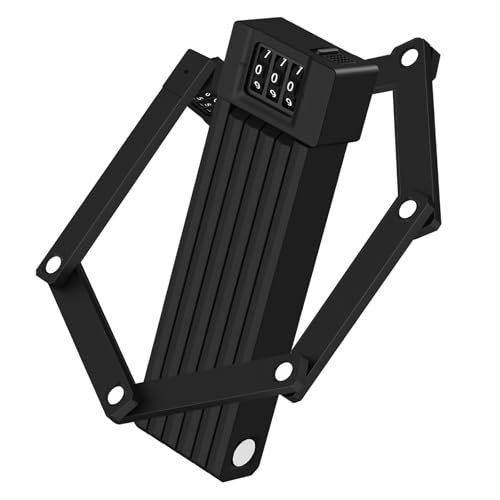
What didn't make it: folding locks, because the AU-stocked options in band were thin on the day I ran the data, and smart locks with alarms and apps, because a siren that needs charging and pairing is one more thing to fail before the steel even gets tested. If you want electronics guarding the bike, a hidden tracker does more good than a beeping lock, and our GPS tracker guide covers the options that actually recover bikes. Prices below were right on the day; they'll drift, so treat the numbers as a snapshot rather than a promise.
The 5 picks, $35 to $87
Prices are Amazon AU at time of writing (16 September 2026) and move week to week. Ranks are Amazon AU category sales ranks, checked the same day.

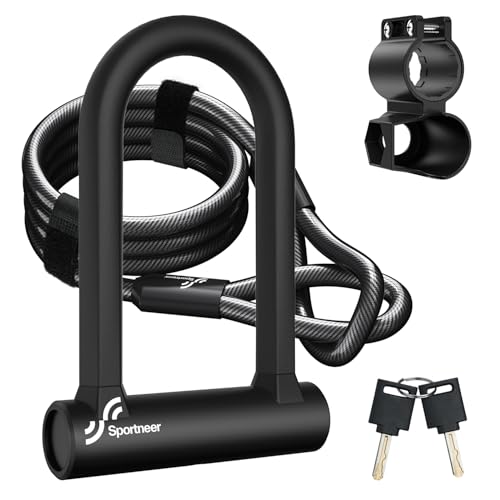
Sportneer 17mm U-Lock with 150cm Steel Cable
ASIN B081DHQDQG • $39.99 • Sold by Ohuhu AU on Amazon AU
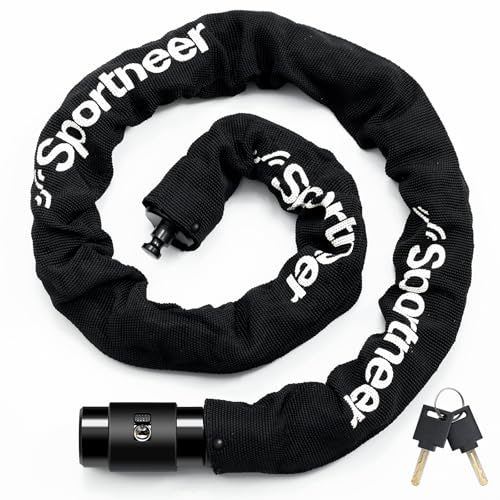
This is the number one seller in Amazon AU's Bike U-Locks category, and the reason is simple: it's a 17mm shackle at a price where most locks give you 12 or 13. That extra steel matters. Seventeen millimetres of hardened shackle is past what hand-held bolt croppers deal with, which pushes a thief straight to a grinder, and grinders are loud, slow and conspicuous in a shopping centre rack. The listing quotes a polygonal lock body and a zinc alloy core with an alloy steel head, and claims resistance to hydraulic shear up to 12 tons. I treat that number as marketing until a test house repeats it, but the shackle diameter alone puts this ahead of most of the category.
The kit includes the bits that usually cost extra: a 150cm steel cable for looping the front wheel, a frame bracket so the lock rides on the bike instead of digging into your back, and two keys so losing one isn't a crisis. The listed weight is 1.64lb, about 744 grams, which is light for the shackle size and honestly makes me suspect the steel is worked thinner in places than the headline number suggests. Even so, for a bike parked at the station all day you're getting the right shape of security: a proper shackle through frame and rear wheel, cable through the front, and nothing for a lever to bite on.
Fit the bracket properly and check it after the first week of commuting, because brackets loosen and a dropped U-lock at 25km/h is a wheel-jam waiting to happen. The listing says the bracket suits common tube sizes, but e-bike downtubes run fat, so measure yours before assuming. At $40 with the cable included, this is the pick I'd start with for any e-bike that parks in public. It's also the one I'd buy a second of for the other end of the commute, one lock living at home and one locked to the rack at work.
Honest caveats: No Sold Secure or ART rating is stated on the listing, so the 12-ton claim is the maker's own. The included cable is a deterrent layer only, not primary security. Keyed core rather than combination, so a lost second key means a new lock.
Best for: The e-bike that parks at a station or shopping centre every day and needs the most steel per dollar.
Shackle: 17mm alloy steel • Cable: 150cm steel, included • Mount: Frame bracket included • Keys: 2 supplied • Listed weight: 1.64lb (about 744g) • Lock body: Polygonal, zinc alloy core • Sold by: Ohuhu AU (AU storefront) • Rank: #1 in Bike U-Locks (Amazon AU)
View on Amazon AU
KirbyBear Combo U-Lock, 15.5mm Shackle with Cable
ASIN B0FC1W8QN7 • $36.99 • Ships from KirbyBear-AU
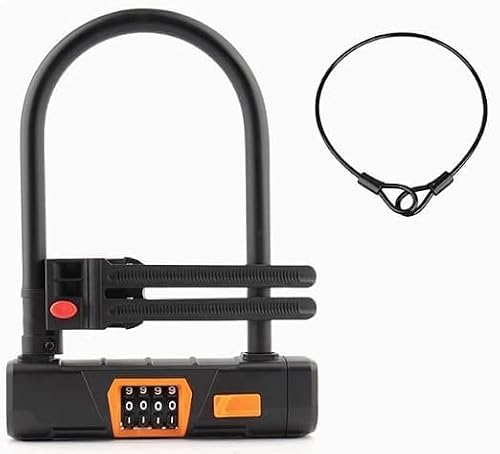
KirbyBear's combination U-lock is $37 from the brand's Australian storefront on Amazon AU and sits at #77 in the Bike U-Locks category. It's a U-lock with a 4-digit resettable code instead of a key. The listing gives a 15.5mm hardened alloy steel shackle with a protective coating to keep it off your paint, which clears the 12mm floor I'd set for a bike worth stealing. It describes the inner locking area as larger than a standard U-lock's but doesn't give dimensions, so hold your frame tube and rim up against it before assuming a fat e-bike downtube fits. A steel cable comes in the box for running through the front wheel.
The combination is the real reason to pick this one. Keys get lost, and on a shared bike, a family e-bike or a work fleet, the person riding is never the person holding the key. A resettable code means the school-run bike and the station bike can share a number everyone knows. The listing says the lock starts on 0000 and resets by turning the reset dial 90 degrees, entering the new code, then turning the dial back, so change it the day it arrives and write the new number somewhere that isn't the bike. The listing mentions no code recovery service and no warranty terms, so a forgotten code is yours to sort out.
The honest trade-off is that combination mechanisms are the weaker link on any lock: they can be decoded by a patient thief with good fingers in a way a decent keyed core can't, and the listing quotes no independent security rating. For a daily commuter in a busy public rack that risk is mostly theoretical, patience being in short supply out in the open. I'd still take the keyed Sportneer for an overnight street park, and this one for the convenience parks: shops, station, school run, anywhere the bike sits for hours in daylight and three people might need to move it.
Honest caveats: Combination locks give up some security against a patient, skilled attacker compared with a good keyed core, and the listing states no independent rating or warranty terms. It gives the cable as 1.2m in the title and 5ft in the bullet points, so don't count on more than the shorter figure, and it doesn't mention a bike mount.
Best for: Shared bikes and daylight parking, where a code beats hunting for whoever has the key.
Shackle: 15.5mm hardened alloy steel, coated • Locking: 4-digit resettable combination (starts on 0000) • Cable: steel cable included (5ft in the bullets, 1.2m in the title) • Lock head: Zinc alloy • Sold by: KirbyBear-AU • Rank: #77 in Bike U-Locks (Amazon AU)
View on Amazon AU
Kryptonite Keeper 790 7mm Combo Chain Lock
ASIN B078HHS3N9 • $86.57 • Ships from Amazon AU
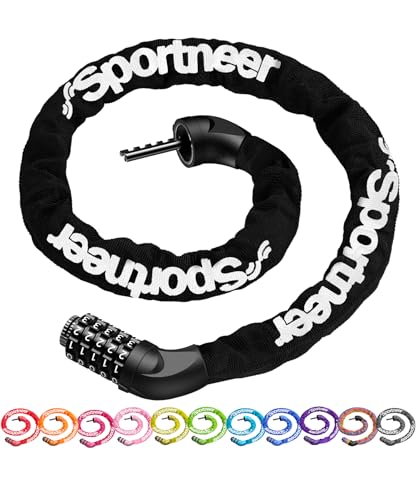
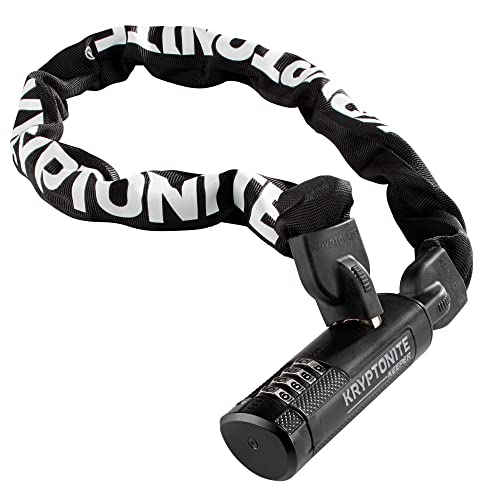
A U-lock's weakness is reach, and this chain is the answer for the parking spots where nothing sits close enough to the frame: verandah posts, awkward street furniture, the fat end of a power pole. The Keeper 790 is a 7mm chain with a 4-digit resettable combination barrel, over 10,000 possible codes per the listing, wrapped in a sleeve that stops it chewing your paint. Seven millimetres is commuter grade, not overnight-street grade, and Kryptonite themselves position the Keeper line as exactly that. What you're buying is flexibility: it wraps through both wheels and the frame on most e-bikes, which a standard U-lock, even a long-shackle one, simply can't manage in a single pass around the anchor.
Chains also solve a carrying problem U-locks create. A chain drapes around a seatpost or lies flat in a pannier, no bracket needed, and doesn't rattle against the frame the way a badly mounted U-lock does. Combined with the combination barrel, that makes this the lowest-friction lock in the list: nothing to mount, nothing to lose, no key to find. The price is the highest here at $87, which is the Kryptonite name plus the convenience, and I'll note it ranks 25th in Bike Cable Locks on Amazon AU, a category that lumps chains in with cables, so read that sales rank in its mixed context rather than directly against the U-locks above.
My suggested use is as the second lock, not the only one. Chain through both wheels and around the anchor, U-lock through frame and rear wheel, and a thief now needs two different attacks to take the whole bike. For a $3,000 e-bike that combination still costs less than five percent of the bike. If it's your only lock, keep it for shorter, visible stops rather than the all-day station park, because 7mm links ask a lot less of a decent bolt cutter than a hardened 12mm shackle does, and thieves know the difference on sight.
Honest caveats: At 7mm the links are lighter than the chain locks serious overnight security calls for, and the listing states no Sold Secure tier. It's also the priciest pick here, and a combination barrel shares the same patient-attacker weakness as any dial lock.
Best for: The second layer, or the flexible lock for stops where nothing parks close enough for a U-lock.
Chain: 7mm, sleeved • Locking: 4-digit resettable combination • Codes: Over 10,000 combinations (listed) • Mount: None needed, wraps or bags • Fit: Universal • Sold by: Amazon AU • Rank: #25 in Bike Cable Locks (Amazon AU)
View on Amazon AU
ROCKBROS Top Tube Phone Frame Bag
ASIN B07NSVJC4X • $34.99 • Sold by ROCKBROS AU on Amazon AU
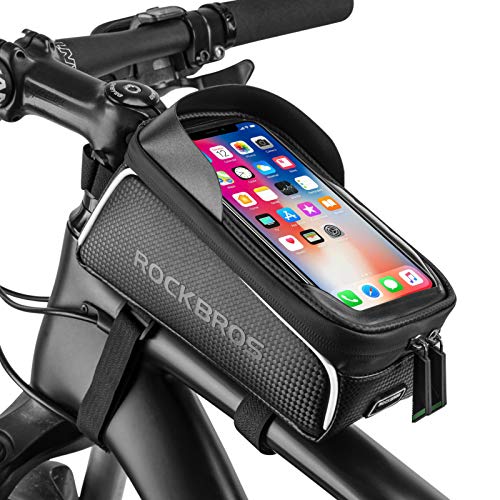
Every e-bike commuter I know runs navigation, and holding a phone at 25km/h is a fine way to donate it to the road. This ROCKBROS top tube bag is the number one seller in Amazon AU's Bike Handlebar Bags category and it earns the spot by doing the boring things right: a TPU window sensitive enough to run maps and music through, sealed double zips against spray, and a cable port underneath so a power bank inside can feed the phone on top. That last detail matters more on e-bikes than pushbikes, because a phone running navigation with the screen on all commute will flatten itself, and the bike's own USB port, if it has one, is usually feeble.
Mounting is three adhesive-backed straps plus velcro, no tools, and reflective tape runs along both sides. The listing calls the shell a carbon fibre material, which I'd read as carbon-look coated fabric rather than actual laminate, and that's fine at this price. Inside there's enough room for the commuter loadout: phone, keys, a small pump, a tube, a snack. It's water resistant with sealed zips rather than waterproof with welded seams, which per the wording rule earlier means it will handle spray and a shower but shouldn't be trusted with a phone through a proper storm without a zip-lock bag riding inside as the second and far more trustworthy layer of defence.
One fitting note from the bench: strap-mounted bags move a little on rough surfaces no matter how tight you cinch them, and over months the movement polishes the paint under the straps. A strip of clear frame protection tape under the contact points costs a few dollars and saves the resale photos. Check the strap spacing against your frame too, because e-bike top tubes are often deeper than the acoustic bikes these are shaped around. At $35 it's the least glamorous pick in the list and probably the one you'll touch every single ride.
Honest caveats: Water resistant, not waterproof: sealed zips and TPU shrug off spray, but the listing makes no welded-seam claim, so storms call for a zip-lock inside. Touch response through any window film drops in heavy rain, and thick cases can make the fit tight.
Best for: Navigation and small-kit carry on any commuter, with a cable path for charging on the move.
Window: High-sensitivity TPU touchscreen panel • Closure: Sealed double zips • Charging: Cable port in base • Visibility: Reflective tape both sides • Mount: 3 adhesive straps plus velcro, tool-free • Shell: Carbon-look coated fabric (listed as carbon fibre material) • Sold by: ROCKBROS AU (AU storefront) • Rank: #1 in Bike Handlebar Bags (Amazon AU)
View on Amazon AU
Fischer Terra Waterproof Pannier, 30L
ASIN B0CY13YVRF • $69.99 • Sold by MiBike Australia on Amazon AU
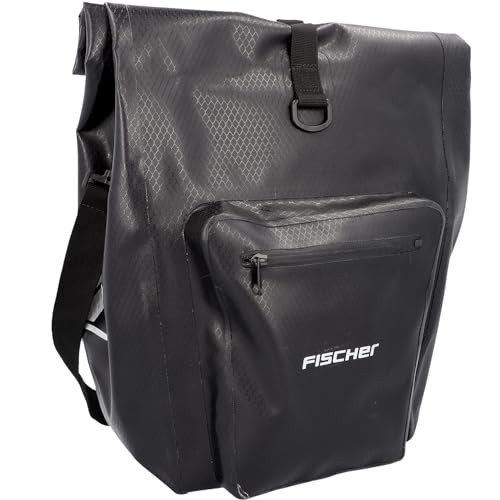
This is the welded-seam bag the earlier section was pointing at. The Fischer Terra is a 30L single pannier in TPU with welded seams, which is the construction that actually keeps a laptop dry through a Central Coast downpour rather than merely delaying the soak. It clips to a rear rack with a tool-free mount, comes off in one motion with a carry handle and a detachable shoulder strap for the office end of the trip, and carries reflective logos for a bit of side-on presence at night. It ranks third in Amazon AU's Bike Panniers and Rack Trunks category, sold through an Australian storefront, and at $70 it's the least money here that buys a genuinely waterproof way to move real cargo.
Thirty litres is a proper load: the work bag, a change of clothes and the shopping on the way home, or a fortnight of the small errands that used to justify taking the car. That's the quiet economics of e-bike cargo, every pannier trip is fuel and parking not spent. The external zip pocket is the spot for the things you grab at every stop, keys and lock and wallet, so the main roll stays sealed. One thing the listing doesn't state is the exact rack-rail diameter the clips take, so if your rack is unusually chunky, check fitment questions on the listing before ordering rather than finding out at the letterbox.
Load it with the heavy items low and against the rack side, or the bag swings and the bike steers like it's had a big lunch. A single pannier offset is fine for commuting weight, but if you're regularly carrying 10kg-plus, budget for a second bag to balance the axle. And keep electronics in the middle of the load, padded by the soft stuff: welded seams stop water, not the shock of a loaded rack bag bouncing hard off a kerb cut or a pothole edge taken at commuting speed.
Honest caveats: Note it's a single pannier, not a pair, so heavy loads ride offset unless you buy a second. Rack-rail compatibility isn't fully specified on the listing, and TPU shells scuff visibly with rough treatment even though they keep sealing fine.
Best for: The commuter who actually carries things: laptop, clothes, shopping, all of it dry through real rain.
Capacity: 30L • Construction: TPU with welded seams • Mount: Tool-free click system, rear rack • Carry: Handle plus detachable shoulder strap • Extras: External zip pocket • Visibility: Reflective logos • Sold by: MiBike Australia (AU storefront) • Rank: #3 in Bike Panniers & Rack Trunks (Amazon AU)
View on Amazon AUSide-by-side comparison
What we see fail at the bench: e-bikes and their add-ons
E-bikes bring us a steady trickle of work, and very little of it is the motor. It's the edges of the system that fail: chargers, connectors, displays and the accessories bolted on afterwards. Most of it is preventable with the habits above, and most of what isn't prevented is repairable at board level for far less than the dealer quotes for a whole replacement part.
Chargers and charge ports
The most common e-bike electrical fault we see isn't the pack, it's the path into it. Charge ports fill with road grime and corrode, pins bend, and then someone forces the plug and the socket lets go of the board behind it. Aftermarket chargers make it worse: loose voltage regulation stresses the battery management system every single charge. Keep the port capped, seat the plug gently, and if charging becomes intermittent, stop wiggling it and get it looked at, because a worn port is a small fix and a burnt one isn't.
Water in connectors and displays
E-bikes live outside and their wiring looms run low, through the spray zone. Water finds the display connector and the controller plugs, sits there, and grows green crust that turns into ghost faults: error codes on damp mornings, displays that flicker over bumps, motors that cut out then come good. Riders chase phantom software problems for months when the fix is opening the connector, cleaning the corrosion properly and sealing it against the next storm. If your bike only ever misbehaves in the days after rain, it isn't haunted and it isn't the software, it's wet.
Locks that seize and keys that snap
Locks are consumables if you never service them. A U-lock that lives on a rack in salt air seizes within a year, and the usual response, forcing the key, leaves half the key in the core. We've drilled out more seized locks than picked ones. A few drops of proper lock lubricant twice a year, graphite or PTFE rather than cooking-oil substitutes, keeps the core turning, and dial locks want the grit rinsed out of the wheels occasionally. Do it when you service the chain and the lock outlives the bike.
Decision tree: which one should you actually buy?
- One lock, one e-bike, parked at the station all day? → The Sportneer 17mm at $40. Most shackle for the money, cable included for the front wheel, and the bracket keeps it off your back.
- Family bike, three riders, keys always missing? → The KirbyBear Combo U-Lock at $37. One code everyone knows, a 15.5mm shackle behind it, and a steel cable in the box for the wheel.
- Bike worth $3,000-plus, or parked outside overnight? → Two locks, two types: the Sportneer through frame and rear wheel plus the Keeper 790 chain at $87 through both wheels and the anchor. Different tools to beat each, about $127 all up.
- Phone runs the navigation every ride? → The ROCKBROS top tube bag at $35, with a power bank inside feeding the phone through the cable port on longer days.
- Carrying a laptop through real weather? → The Fischer Terra 30L at $70. Welded seams are the only construction I'd trust with a laptop in a proper downpour, and it comes off the rack in one motion at the other end.
- E-bike cutting out after rain, display flickering, or a charger that only works at certain angles? → That's corrosion or a worn port, not a mystery, and it's usually a board-level fix rather than a new controller. Bring it in to our Erina workshop and we'll tell you what's actually wrong before you spend anything.
Frequently asked questions
Are cable locks completely useless?
As the only lock, close to it. Common bolt cutters go through most coiled cables in one squeeze, quietly, which is why cables feature in so much theft footage. Where they earn a place is as the second layer: looped through the front wheel and back to a proper U-lock or chain, they force a thief to deal with two problems instead of one. The 150cm cable bundled with the Sportneer pick is exactly that kind of accessory. If a cable is all you have today, park where people actually walk past, and move a real lock up the shopping list.
What do Sold Secure ratings actually mean?
Sold Secure is a UK test house that attacks locks with the tools thieves really carry and grades survivors Bronze, Silver, Gold or Diamond by how long they resist. ART in the Netherlands runs a similar star scheme. The ratings matter because they're earned in destructive testing rather than written by a marketing department. Australia has no local equivalent, and plenty of locks sold here, including some good ones, have simply never been submitted for testing. When a listing states no rating, shackle or chain thickness in millimetres is the next best guide: 12mm resists bolt croppers, 17mm generally beats hand tools outright.
Is it safe to leave an e-bike battery charging overnight?
I wouldn't make a habit of it. The risk isn't huge with the original charger and an undamaged pack, but every serious e-bike battery fire I've read the report on involved one of three things: a non-genuine charger, a pack that had been dropped or dented, or charging unattended on a soft surface. Charge on hard flooring, away from the exit path, while you're home and awake, and unplug at full. If a pack ever swells, rattles, smells sweet or gets unusually hot in use, stop charging it entirely and have it assessed.
What bike lights are legal for night riding in NSW?
The rule for riding at night or in low visibility is a white light visible from 200 metres at the front, a red light visible from 200 metres at the rear, and a red rear reflector visible from about 50 metres in low beam. Steady or flashing both count. Other states run close variants, so check locally if you cross borders. Note the reflector is its own requirement, a rear light alone doesn't technically satisfy it, which is worth knowing because plenty of sleek aftermarket setups delete the reflector for looks.
Will my home contents insurance cover a stolen e-bike?
Sometimes, and the details decide it. Contents policies often cover bikes at home but cap the payout per bicycle well below e-bike money, and cover away from home is frequently an optional extra with its own conditions, like being locked to a fixed object. Some insurers ask for the bike to be listed individually with its serial number. Read your policy's bicycle clause before you need it, keep the receipt and serial photos somewhere safe, and if the numbers don't stack up, standalone bike insurance exists and prices roughly with the bike's value.
Should I take the battery with me when I park?
If it's removable and you'll be gone more than a few minutes, yes. The battery is the most resellable part of the bike and the easiest to carry away, and a missing battery also makes the rest of the bike far less attractive to steal, since a replacement pack costs serious money and doesn't always pair without dealer tools. Carrying it also keeps it out of the weather and away from car-park heat, which the cells appreciate. It's a small habit that removes the single most tempting target from the rack.
Related guides
E-bike electrics playing up?
Cut-outs after rain, flickering displays, chargers that only work at an angle: that's corrosion and worn connectors, not a dead bike. Most of it is board-level repairable for far less than a replacement controller or loom. Bring it in to the workshop in Erina and we'll diagnose what's actually wrong and tell you honestly whether it's worth fixing before you spend anything.
Book Online