Prices from Amazon AU, updated daily. Swipe or use the arrows for more.
Disclosure: This article contains affiliate links to amazon.com.au. If you buy through one of these links iFix may earn a small commission at no extra cost to you. It doesn't change which products we recommend. We focus on what actually lasts based on 16 years of repair-shop experience.
Quick summary5 picks
- Entry PickYOPOWER Electric Meat Grinder about$140500W.
- Mixer attachmentKenwood Food Mincer Attachment KAX950ME about$140
- Large platesEuroChef MG850 Commercial Meat Grinder about$209Three extra large plates.
- Best mid-pricedKenwood Pro 1400W Food Mincer MG450 about$2251400W.
- Most PremiumKenwood Pro 2000W Excel Meat Grinder MG700 about$3992000W.
What a mincer actually does inside
An electric meat grinder is a motor driving a gearbox, which turns a long screw called the auger inside a metal tube. The auger pushes meat forward against a spinning cross-shaped blade pressed flat against a perforated plate, and the meat gets cut as it's forced through the holes. That's it. Every machine on this page does the same job in the same way, and the differences come down to how strong the gearbox is, how sharp the blade and plate stay and how hot the motor gets.
Because it's a cutting job, sharpness matters more than raw power. A blunt blade or a plate with rounded hole edges doesn't cut, it squashes, and you get smeared mince with the fat pushed out and white sinew wrapped around the blade. People often blame the motor for that, when the real fix is a new blade and plate. They're a common part on the Kenwood models and usually cost far less than a new machine.
Most of the grinders we see come in for the same few reasons: a stripped gear after a jam, a sheared drive coupling, or a motor that's overheated after a long session of sausage making. None of those are mysterious, and most can be avoided with how you load the machine. I've written this guide around those failures, because the cutting part is simple and the gearbox is where the money goes.
I've kept this guide to electric grinders and one mixer attachment, sold new by Amazon AU or sellers on the Amazon AU storefront. Hand-crank mincers work and they're nearly unbreakable, but most people who search for a meat grinder want a motor doing the work. I've also left out butcher-shop commercial units, which need more counter depth than most kitchens have and often draw more than a household circuit is happy to supply for long. If you're processing a whole beast every season, that's a different conversation with a butcher's supplier.
Metal gears against plastic gears
If I had one question to ask about any meat grinder, it'd be what the gears are made of. A lot of lower-priced grinders use nylon or other plastic gears in the gearbox, which are quiet and cost little to make, but they strip when a piece of sinew or gristle jams the auger. Metal gears handle that shock load much better. That's why a listing that actually names its gear material is worth noticing.
The catch is that none of the five listings on this page say. Kenwood describes die-cast bodies, a die-cast metal hopper and a die-cast mincing head on the MG700 and MG450, but neither listing states the gear material. YOPOWER talks about a pure copper motor, which tells you about the motor windings rather than the gears, and the EuroChef lists a die-cast aluminium housing but says nothing about the gears. I'd treat a grinder that doesn't name its gear material as having at least one plastic part somewhere in the drive train.
That isn't always a bad thing. Many grinders are designed with one deliberately weak part, a plastic gear or a drive sleeve, that breaks before the motor or the metal gears do. It acts like a mechanical fuse. If yours stops turning with the motor still humming, that's usually the part that's gone, and it's usually a small, inexpensive spare rather than the end of the machine.
Where you'll feel the difference is with tougher meat. Tougher cuts with lots of connective tissue, game meat and partly frozen meat all load the gearbox harder. If you're mincing a whole shoulder for sausages a few times a year, a machine with a metal gearbox and a known spare parts supply is worth the extra cost. If you just want fresh burger mince now and then, a lighter grinder or a mixer attachment will do the job.
Wattage on the box, and what the motor really does
The wattage figures on meat grinder listings are mostly peak numbers, and some of them don't make sense for a household plug. A standard Australian 10A socket can only supply about 2,400W continuously, so anything bigger on a box is almost certainly a locked-rotor or startup peak, not what the motor draws while mincing. YOPOWER is more honest, listing 500W rated and 1,500W maximum, and the EuroChef listing gives no wattage at all.
Kenwood's titles say 2,000W for the MG700 and 1,400W for the MG450, and again I'd read those as maximum figures rather than continuous draw. What matters more is the throughput, and Kenwood quotes 3kg per minute for the MG700 and up to 1.8kg in 60 seconds for the MG450. Those are best-case numbers with well-trimmed, cold meat, but they're a more useful comparison than wattage.
Running cost is tiny either way. Even if a grinder really drew 2,000W, at roughly 33c per kWh that's about 66c for a full hour flat out, and nobody minces for an hour straight. The electrical thing I'd watch is the cord and plug: grinders get moved around a wet kitchen counter, and a cracked plug or a cord pinched under the base is the kind of fault worth getting checked rather than taped up.
Noise is the other thing the wattage doesn't tell you. A grinder with a big motor and a die-cast body, like the Kenwood MG700, is usually quieter under load than a lighter machine straining at its limit, because the motor isn't running flat out. Kenwood says the MG700 is quiet in use, and none of the other listings give a decibel figure. If a grinder suddenly gets louder or starts to whine, that's usually a sign of extra load from a blunt blade or a dry gearbox rather than a motor fault.
Plates, blades and auger wear
The plate and the blade are the wear parts, and they wear together. The blade's cutting edges rub against the plate's face every time it turns, and over time both lose their sharp edges. That's why most butchers replace or sharpen them as a matched pair. If you only replace the blade, a worn plate face can still leave a gap that smears the meat.
Grinder heads are sized by a number, and the MG450 listing calls its head a no.8 mincer. Plate sizes and blade shapes are shared across many brands at the same number, which is handy when it's time to replace them. Kenwood supplies three plates with both the MG700 and MG450, for fine, medium and coarse mince, and the MG700 uses larger 10cm plates rather than the usual 8cm, which means more cutting area per turn.
The auger wears too, more slowly. Its end usually locates into the blade, and that square drive can round off over years of use. Check it whenever you replace the blade. Stainless or coated steel parts last much longer if they're dried straight after washing, because surface rust on a plate face is enough to make it drag against the blade.
Reverse, jams and how to load it
Almost every grinder jams eventually, and it's nearly always sinew or silver skin wrapping around the blade. A reverse switch backs the auger off and frees the jam without opening the head. The MG700, MG450 and YOPOWER listings all state a reverse function, the EuroChef listing doesn't, and I wouldn't buy an electric grinder without one. Don't hold the switch in forward and force it, because that's how gears strip.
The biggest single thing you can do to avoid jams is trim the meat and keep it cold. Cut it into strips that fit easily down the feed tube, remove as much silver skin as you can, and chill it in the freezer for 20 to 30 minutes until it's firm but not frozen. Cold fat cuts cleanly. Warm fat smears, coats the plate holes and makes the motor work harder.
Never push meat down with your fingers or a utensil that isn't the supplied pusher, and switch off at the wall before you open the head to clear anything. If you're vacuum packing the mince afterwards, our vacuum sealer picks cover the machines that work well for flat-packed portions in the freezer.
Heat, duty cycle and long sessions
Most domestic grinders are designed for short bursts, not hours of continuous mincing. None of the listings on this page state a duty cycle, which is the ratio of running time to resting time, so I'd assume ten to fifteen minutes of running followed by a rest. If the body gets hot to touch, stop and let it cool before carrying on.
Many grinders have a thermal cutout that switches the motor off when it overheats, though none of the listings on this page describe one. If yours stops and won't restart, leave it to cool for half an hour before assuming it's broken. If it keeps cutting out early, the usual causes are blunt blades, warm fatty meat or a partly blocked plate, all of which make the motor work harder for the same output.
Big batch days are where the lighter machines struggle. If you're doing a whole lamb or a big sausage day, split the job into batches, keep the meat in the fridge between them, and give the motor rest breaks. It's also worth having a spare blade on hand, because one blunt blade halfway through a big job can double the time it takes.
The motor's cooling vents matter more than people think. Most grinders pull air in through slots in the base or the side of the body, and if those are blocked by a tea towel or pushed against a wall, the motor heats up much faster. Give the grinder a few centimetres of clear space on every side while it runs. Flour and fine crumbs from making breadcrumbs also get drawn into the vents over time, so a quick blow-out with dry air now and then helps the motor run cooler.
A mixer attachment or a standalone grinder?
If you already own a Kenwood Chef or Chef XL stand mixer, the KAX950ME mincer attachment is worth a look before buying a separate machine. It uses the mixer's slow speed outlet and the mixer's motor, so you're not storing another appliance. Our stand mixer guide covers the Kenwood and KitchenAid machines that run these attachments.
The trade-off is load. A stand mixer's gearbox is designed for dough and mixing, and a long mincing session puts a steady heavy load through it. For occasional burgers and a small batch of sausages, it's fine. For regular large batches, I'd rather wear out a dedicated grinder than the gearbox in a mixer that does everything else in the kitchen as well. A mixer that's started to smell hot or slow down under load is telling you to stop and let it rest.
Food processors are the other option people consider. Pulsing meat in a processor gives you a chopped texture rather than true mince, which is fine for some dishes. Our food processor picks include machines that do that well, but if you want sausages, consistent burger mince or kibbeh, a proper grinder with plates is the right tool.
Cleaning, drying and storage
Clean the head straight after use, before fat and meat dry onto the plate holes. Run a slice of bread through at the end to push out most of the remaining meat, then take the head apart and wash each part in warm soapy water. A small brush clears the plate holes. Check each listing's care notes before putting aluminium parts in a dishwasher, because harsh detergent can discolour die-cast aluminium.
Dry everything completely before you put it away, especially the plates and blade, which can rust quickly if they're left damp. A light wipe of food-grade oil on the blade and plates helps if you only use the grinder a few times a year. Store the head separately from the motor so moisture isn't trapped inside the assembly.
If the motor hums but won't turn, the cord's damaged, or it trips the safety switch, stop using it and bring it into our Erina workshop. A stripped drive gear or sleeve is often a straightforward repair, and we'll tell you whether it's worth fixing before any money's spent.
The 5 picks, $140 to $399
Prices are Amazon AU at time of writing (2 November 2026) and move week to week. Ranks are Amazon AU category sales ranks, checked the same day.

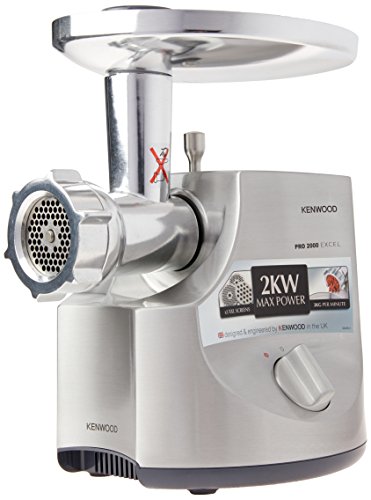
Kenwood Pro Excel Meat Grinder MG700, Electric Mincer and Sausage Maker
ASIN B076HMKCZT • $399.00 • Ships from Amazon AU
This is the meat grinder I'd buy if you mince regularly and want something that'll last. It's sold and shipped by Amazon AU at $399, and the model and part number are both MG700, which matches the title. Kenwood is one of the few grinder brands with a long track record and easy spare parts in Australia, and that's the main reason it's my lead pick. It's the best-selling grinder here by Amazon AU's overall rank, at #7,798 site-wide, and #93 in Speciality Appliances. The body is die-cast aluminium, and it comes with a die-cast metal hopper, a meat tray and a dust cover. The listing says it's quiet in use, which fits Kenwood's reputation.
Kenwood quotes 3kg of mince per minute, which is a best-case figure but still well ahead of the lighter machines here. The headline feature is the plate size. The MG700 uses extra large 10cm plates instead of the usual 8cm, which gives more cutting area for each turn of the auger and helps it keep up with a big batch. You get three plates for fine, medium and coarse mince, along with attachments for sausages and kebbe. It has a reverse function for clearing sinew jams. The title says 2,000W, which I'd read as a peak figure, since that's close to what a standard 10A socket can supply. There's a dust cover for storage, which keeps the plates and head clean between uses.
The listing gives a one-year warranty, which is shorter than I'd like for the price. It doesn't state the gear material, so I can't tell you whether the drive train is all metal, although Kenwood's design normally protects the motor with a replaceable drive part. The listed weight looks wrong, so check it on delivery. Dry the plates and blade straight after washing to stop rust. Keep the meat cold and trimmed to protect the gearbox. The rank is shared with the MG450 listing, so treat it as a guide. If you make sausages a few times a year or mince your own burger meat every week, this is the one I'd choose.
Honest caveats: The listing gives only a one-year warranty, and the listed weight looks like a data error. The gear material isn't stated. The 2,000W in the title is a peak figure, not continuous draw. The rank is shared with the Kenwood MG450 listing. At $399 it's the most expensive standalone grinder here, so it only makes sense for regular use.
Best for: Regular mincing and sausage making, where large plates and Kenwood's spare parts supply earn the price.
Power: 2,000W (title, peak) • Throughput: 3kg per minute (listing) • Plates: Three XXL 10cm plates, fine to coarse • Attachments: Sausage and kebbe makers • Reverse: Yes • Body: Die-cast aluminium, metal hopper • Warranty: 1 year (listing) • Model: MG700 • Rank: #93 in Speciality Appliances (Amazon AU), listing shared with MG450
View on Amazon AU
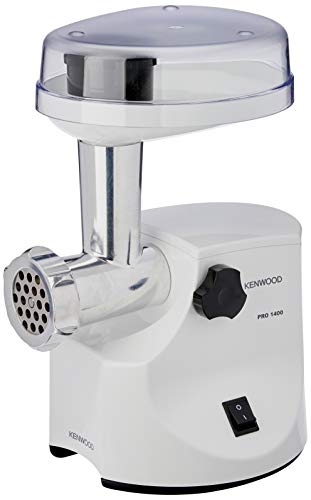
Kenwood Pro Food Mincer MG450, 1400W, Die-Cast No.8 Head
ASIN B07G6ZTKGP • $224.95 • Ships from Amazon AU
The MG450 is the Kenwood grinder I'd point most home cooks to. It's sold and shipped by Amazon AU at $225, and the model and part number are both MG450, matching the title. It uses a die-cast no.8 mincing head, which is a common head size, so plates and blades are easy to find. You get a carbon steel cutter and three plates: fine at 3mm, medium at 4.5mm and coarse at 8mm. Kenwood says it'll mince up to 1.8kg of ingredients in 60 seconds. The title says 1,400W, which I'd treat as a peak figure. It also handles fish, vegetables and fruit, and Kenwood suggests it for making breadcrumbs as well as mince.
The switch is a combined on, off and reverse control, which is the right setup for clearing sinew jams without opening the head. The hopper and tray are plastic, and there's a hygienic plastic pusher with a storage space for the accessories inside it, which is handy because small plates and blades go missing. The carbon steel cutter is sharp and holds an edge well, but it'll rust if you leave it wet. Dry it straight after washing and wipe it with a drop of food-grade oil if you only use it now and then. The listing doesn't mention sausage or kebbe attachments, so check what's in the box if you want to make sausages.
The listing doesn't state a warranty period or the gear material, so check the paperwork when it arrives. Its weight is listed at around 5kg, which is light enough to bring out of the cupboard without a struggle. The die-cast head is the part I'd trust most, because a cracked plastic head is a common failure on lighter grinders. Keep the meat cold and well trimmed and run it in short sessions. The rank is shared with the MG700 listing, so take it as a guide. For burger mince, meatballs and the odd batch of sausages, this is the sensible middle choice.
Honest caveats: The listing doesn't state a warranty, the gear material or whether sausage attachments are included. The carbon steel cutter needs to be dried promptly to avoid rust. The 1,400W figure is a peak number. The Amazon AU rank is shared with the MG700 listing, so it's not this model's own figure.
Best for: Home cooks who mince for burgers and meatballs most weeks and want Kenwood parts without the MG700 price.
Power: 1,400W (title, peak) • Throughput: Up to 1.8kg in 60 seconds (listing) • Head: Die-cast no.8 • Plates: 3mm, 4.5mm and 8mm • Cutter: Carbon steel • Reverse: Yes, on/off/reverse switch • Model: MG450 • Seller: Amazon AU • Rank: #275 in Blenders, Mixers & Food Processors (Amazon AU), listing shared with MG700
View on Amazon AU
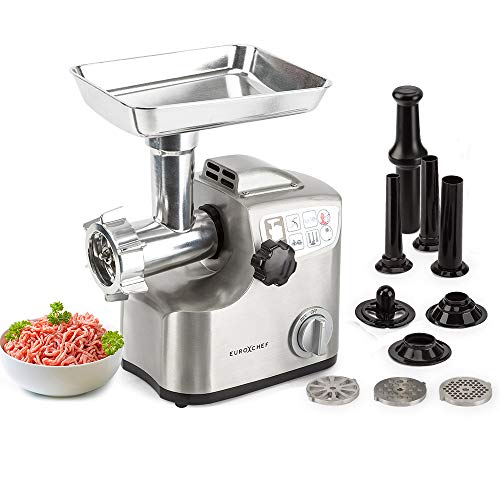
EuroChef MG850 Meat Grinder, Die-Cast Housing and Three Extra Large Plates
ASIN B075R96BQD • $209.00 • Ships from Amazon AU
The EuroChef MG850 is the grinder I'd look at if you want a die-cast machine with large plates and you'd rather buy from Amazon AU directly than from a marketplace seller. It's $209, sold and shipped by Amazon AU, and it ranks #252 in Speciality Appliances. The listing says the housing is brushed die-cast aluminium and that you get three extra large grinding plates for fine, medium and coarse mince, the same plate set-up as the Kenwoods. The word "Commercial" is in the title, but the listing describes the machine as suited to families and parties and gives no duty rating, so I'd treat it as a home machine and keep sessions short.
The blanks are the problem. The listing gives no wattage, no throughput figure, no plate sizes in millimetres, no reverse function, no warranty period and no gear material. Next to the Kenwood MG450 at $225, which states a reverse switch, three named plate sizes and a die-cast head, that is a lot of unknowns for $16 less. When it arrives, check the box contents, look for a reverse switch and find the warranty card, and keep the receipt.
Without a stated reverse, clearing a jam may mean opening the head, so trim the meat, keep it cold and don't push a jammed machine. Switch off at the wall before you open anything. Dry the plates and blade straight after washing. I'd buy it if you want a die-cast body and three large plates at a lower price than the MG450 and you're comfortable with a thin listing. If stated specs and parts support matter more, the Kenwoods are the safer buy.
Honest caveats: The listing states no wattage, throughput, plate sizes, reverse function, warranty or gear material. "Commercial" in the title isn't backed by a duty rating on the listing. I can't tell what parts support exists, and it is unlikely to match Kenwood's. Its site-wide Amazon AU rank, #36,467, is well behind the two Kenwood grinders' #7,798.
Best for: Home cooks who want a die-cast body and three large plates from Amazon AU for a little under the MG450.
Housing: Brushed die-cast aluminium (listing) • Plates: Three extra large, fine, medium and coarse (listing) • Power: Not stated • Reverse: Not stated • Gear material: Not stated • Brand: EuroChef • Seller: Amazon AU • Rank: #252 in Speciality Appliances (Amazon AU)
View on Amazon AU
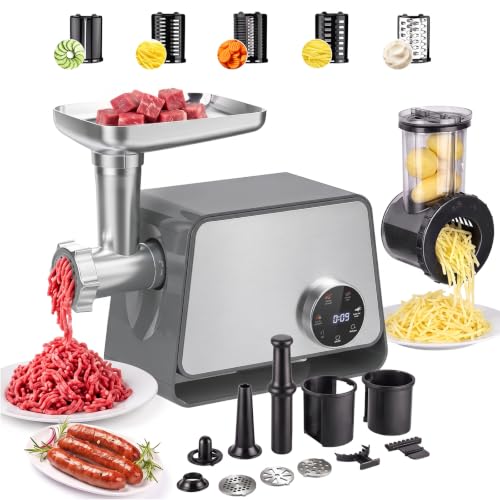
YOPOWER Electric Meat Grinder and Food Processor with Fries Cutter
ASIN B0HDBYK3LK • $139.88 • Sold by YOPOWER on Amazon AU
The YOPOWER is the one for people who want a grinder that also does vegetable prep. It's $140 from YOPOWER on Amazon AU, and it ranks #26 in Food Processors, the best category rank of any machine here. As well as mincing with three plates, it slices, shreds and dices vegetables with seven blades, cuts chips, stuffs sausages and makes kubbe. The motor is rated at 500W with a 1,500W maximum, and I like that the listing gives both figures, because it's more honest than most. It has a colour touchscreen with four preset programs, a reverse function and manual torque adjustment. The torque adjustment is unusual at this price, and it lets you slow the auger for softer foods. It's sold by YOPOWER directly rather than Amazon AU.
The listing claims it'll grind small, soft bones such as chicken wings and small chicken bones when used as directed. I'd be cautious with that. Bone is the hardest load you can put through a grinder, and it's what usually strips gears or shears a drive part, so I wouldn't make it a habit even if the machine copes. YOPOWER says the parts are food-grade stainless steel and PP plastic, and several accessories are dishwasher safe. The metal parts and the pusher need hand washing and drying straight away to prevent oxidation, which the listing mentions too. The copper motor windings are a good sign for heat handling, but the gear material isn't stated.
The model code on the listing is 140601000#Y, which doesn't help much if you need a manual or parts later, so keep the paperwork. The listing doesn't state a warranty period, a weight or a duty cycle. Touchscreens on kitchen appliances can be a weak point if water gets past the seal, so wipe it with a damp cloth rather than spraying it. Run it in short bursts and let it cool on long jobs. I'd buy it if you want one machine for mince and veg prep on a smaller kitchen counter. For a big sausage day, a Kenwood will cope better.
Honest caveats: The listing doesn't state a warranty period, weight, duty cycle or gear material. The model code isn't a clear product name, which can make parts harder to find. Grinding bones is hard on any grinder's drive parts. A touchscreen panel needs care around water in a busy kitchen.
Best for: Small kitchens that want mince, chips and vegetable prep from one machine.
Motor: 500W rated, 1,500W max • Plates: Three mincing plates • Extras: Seven veg blades, fries cutter, sausage and kubbe • Controls: Touchscreen, four presets, reverse • Materials: Stainless steel and PP • Model: 140601000#Y • Seller: YOPOWER • Rank: #26 in Food Processors (Amazon AU)
View on Amazon AU
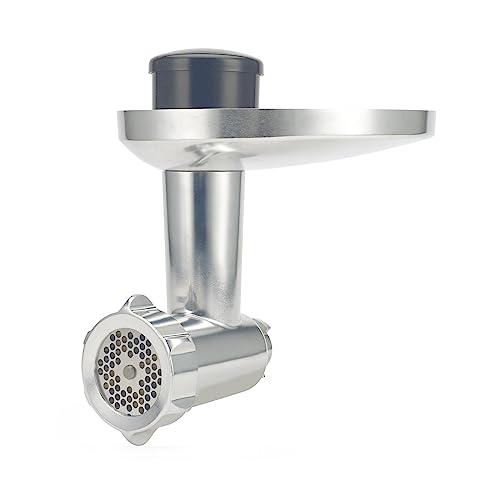
Kenwood KAX950ME Food Mincer Attachment for Chef and Chef XL
ASIN B00R6BO42G • $139.95 • Ships from Amazon AU
If you already own a Kenwood Chef or Chef XL stand mixer, this attachment is the first thing I'd look at. It's $140, sold and shipped by Amazon AU, and it ranks #92 in Blenders, Mixers and Food Processors. It fits the mixer's slow speed outlet and uses the mixer's motor, so there's no second appliance to store. It comes with three plates, fine at 3mm, medium at 4.5mm and coarse at 8mm, along with a sausage maker and a kebbe maker. The listing also names the Chef Sense and kMix ranges, so check your mixer's model and outlet before you order, because fit is everything with an attachment. The attachment weighs about 2kg according to the listing.
The main limit is the mixer itself. A stand mixer's gearbox is built for dough and mixing, and long mincing sessions put a steady heavy load through it. For burgers, meatballs and a small batch of sausages, that's fine. For a big sausage day, I'd rather wear out a dedicated grinder than the gearbox in a mixer that does everything else in the kitchen. Keep the meat very cold and well trimmed so the mixer isn't straining, and give it a rest between batches if the mixer body warms up. Use the slow speed setting rather than pushing the speed up to go faster. Fit and remove it with the mixer switched off at the wall.
The listing's model code is AW20011012, and it shows a five-year warranty figure, but check how that applies to an attachment rather than a mixer. It doesn't give a material for the head, though Kenwood attachments are usually metal. Dry the plates and blade straight after washing. Keep the attachment in its box so the plates don't get scratched or lost. I'd buy it if you've got a compatible Kenwood mixer and mince now and then. If you don't own one, the MG450 is the better buy at a similar total cost.
Honest caveats: It only works with compatible Kenwood mixers, so check your model and outlet first. Long mincing sessions load the mixer's own gearbox. The listing doesn't state the head material. The five-year warranty figure on the listing should be confirmed for an attachment. It needs a mixer, so it isn't a lower-cost route for people who don't already own one.
Best for: Kenwood Chef and Chef XL owners who mince occasionally and don't want another appliance.
Type: Stand mixer attachment • Fits: Kenwood Chef and Chef XL (listing also names Chef Sense, kMix) • Plates: 3mm, 4.5mm and 8mm • Extras: Sausage filler, kebbe maker • Outlet: Slow speed outlet • Model: AW20011012 • Seller: Amazon AU • Rank: #92 in Blenders, Mixers & Food Processors (Amazon AU)
View on Amazon AUSide-by-side comparison
| Product | Price | Best for |
|---|---|---|
| YOPOWER Electric Meat Grinder | ~$140 | Small kitchens that want mince, chips and vegetable prep from one machine. |
| Kenwood Food Mincer Attachment KAX950ME | ~$140 | Kenwood Chef and Chef XL owners who mince occasionally. |
| EuroChef MG850 Commercial Meat Grinder | ~$209 | Die-cast body and three large plates from Amazon AU, a little under the MG450. |
| Kenwood Pro 1400W Food Mincer MG450 | ~$225 | Weekly burgers and meatballs with Kenwood parts support. |
| Kenwood Pro 2000W Excel Meat Grinder MG700 | ~$399 | Regular mincing and sausage making with large plates. |
What we see fail in the workshop: meat grinders
Meat grinders that come in usually haven't failed electrically. Most of them have a broken drive part, a motor that's overheated on a long session, or a damaged cord from being dragged around a wet kitchen. The fixes are often simple and far less than a new machine, so it's worth checking before you replace one. Here's what I'd check first, and what usually fixes it.
Stripped gears and sheared drive parts
The most common fault is a motor that runs but an auger that won't turn. That's usually a stripped plastic gear or a sheared drive sleeve after a jam, often from sinew or a bone fragment. Many grinders are designed this way on purpose, with a low-cost part that breaks to protect the motor. On models with good spare parts support, like the Kenwood range, it's usually a quick and inexpensive repair. On no-name grinders the part can be hard to find, which is why I lean towards brands with a parts supply.
Overheated motors and thermal cutouts
A grinder that stops halfway through a big job and won't restart has often tripped its thermal cutout. Leave it for half an hour to cool. If it keeps happening, the cause is usually extra load: a blunt blade, a partly blocked plate or warm, fatty meat. Repeated overheating can damage the motor's windings over time, and a burning smell or a motor that hums without turning is the point to stop and get it checked rather than trying again. A quick blow-out of the vents with dry air also helps a motor that runs hot.
Cords, plugs and switches
Grinders get moved around wet kitchen counters, and the cord often gets pinched under the base or tugged out at an angle. A cracked plug, a loose cord grip or a reverse switch that's become intermittent are all common faults. A switch full of dried meat juice can stick or arc. Don't tape a damaged cord and keep using it. A proper replacement cord or switch is a small job, and it's a safety issue, not just a nuisance. Wipe the switch area with a barely damp cloth after each use so juice doesn't dry into it.
Decision tree: which one should you actually buy?
- Mince regularly or make big batches of sausages? → The Kenwood MG700 at $399, with large 10cm plates, 3kg per minute and Kenwood's parts supply.
- Want a solid Kenwood for weekly burgers and meatballs? → The Kenwood MG450 at $225, with a die-cast no.8 head and three plates.
- Want a die-cast grinder with large plates from Amazon AU for a little under the MG450? → The EuroChef MG850 at $209, with three extra large plates, though the listing leaves out wattage and reverse.
- Short on counter space and want veg prep too? → The YOPOWER 7-in-1 at $140, which minces, slices, dices and cuts chips.
- Already own a Kenwood Chef or Chef XL? → The Kenwood KAX950ME attachment at $140 uses your mixer's motor.
- Grinder humming but not turning, or cutting out? → Bring it into our Erina workshop and we'll check the drive parts and motor before you replace it.
Frequently asked questions
Should I buy a meat grinder with metal gears?
If you mince often or make big batches of sausages, yes. Metal gears handle the shock of a jam much better than plastic ones, which can strip when sinew or gristle catches the auger. Many listings don't state the gear material, so look for one that names the material, and be wary of one that doesn't. Some grinders use a plastic drive part on purpose so it breaks before the motor does, and on brands with spare parts that's a quick repair rather than a reason to avoid the machine.
How powerful does a meat grinder need to be?
Wattage figures on grinder listings are mostly peak numbers, so they're a poor guide. A standard Australian 10A socket supplies about 2,400W continuously, so a claim above that is a startup or locked-rotor figure. Throughput, like Kenwood's 3kg per minute for the MG700, is a better comparison. For home use, a sharp blade and plate, cold trimmed meat and a sturdy gearbox matter far more than the number on the box.
Why does my meat grinder keep jamming?
It's nearly always sinew or silver skin wrapping around the blade, or warm fat smearing across the plate. Trim the meat, cut it into strips that fit the feed tube and chill it until it's firm but not frozen. Use the reverse switch to clear a jam instead of forcing it forward. If it jams constantly with cold trimmed meat, the blade and plate are probably blunt and need replacing as a pair.
Can I put meat grinder parts in the dishwasher?
It depends on the materials, so check the care notes for your model. Die-cast aluminium heads can discolour in a dishwasher because of harsh detergents, and carbon steel blades can rust if they're not dried straight away. Some plastic and stainless accessories are dishwasher safe, as on the YOPOWER. The safest routine is to hand wash the head, plate and blade in warm soapy water, then dry everything completely before storing it.
Is a stand mixer mincer attachment as good as a standalone grinder?
For occasional use, yes. An attachment like the Kenwood KAX950ME uses the mixer's motor and saves counter space, and it comes with the same three plate sizes as the MG450. The limit is the mixer's own gearbox, which is designed mainly for dough and mixing. For big batches or regular sausage days, a dedicated grinder is the better choice because it takes the load instead of your mixer. Check your mixer's model and outlet before you order, because fit is everything with an attachment.
How often should I replace the blade and plate?
There's no fixed interval, because it depends on how much you mince and how well the parts are dried. Replace them when the mince starts to look smeared rather than cut, sinew wraps around the blade more often, or the motor works harder than it used to. Replace the blade and plate together, because they wear against each other. On common head sizes like no.8, replacement parts are easy to find.
Related buying guides
Grinder humming but not turning?
A grinder that hums without turning usually has a stripped gear or sheared drive part, not a dead motor. Bring it into our Erina workshop and we'll check the drive, the motor and the cord, then tell you what's wrong and what it'll cost before you spend anything on a new machine.
Visit our Erina workshop Book Online