Prices from Amazon AU, updated daily. Swipe or use the arrows for more.
Disclosure: This article contains affiliate links to amazon.com.au. If you buy through one of these links iFix may earn a small commission at no extra cost to you. It doesn't change which products we recommend. We focus on what actually lasts based on 16 years of repair-shop experience.
Quick summary5 picks
- Entry PickINKBIRD Wifi Slow Cooker Sous Vide Machine… about$139.99300W.
- Inkbird WiFi Sous Vide Cooker Culinary Slow… about$139.99100W.
- CHUCII WiFi Sous Vide with 11L Sous Vide… about$1691100W.
- Laica Sous Vide Water Oven about$247.36
- Most PremiumAnova Culinary Sous Vide Precision Cooker 3.0 about$337.95
What a sous vide machine actually does
A sous vide machine is a heater, a small pump and a temperature sensor in one stick. You clamp it to the side of a pot of water, set a temperature, and it heats the water and keeps it moving so the whole pot sits within a fraction of a degree of that number. The food goes in a sealed bag, and because the water never gets hotter than the target, a steak set to 56°C comes out the same from edge to edge. Then you sear the outside in a hot pan for a minute.
The five in this guide sit between $140 and $338 on Amazon AU at time of writing, from Anova, INKBIRD, CHUCII and Laica. Four are clamp-on immersion circulators, and one is a water oven with its own tank. Three are sold by Amazon AU or the brand's own Australian storefront, and the CHUCII comes from a marketplace seller. I've said on each card which seller you're buying from and what the listing leaves out.
I've judged them on the parts that decide how well they cook and how long they last. That means the heater power, the pump, how far the unit can sit underwater, the clamp, the low-water cutout and how much of the cooker only works through an app. These are simple machines, but the ones that come into the shop usually fail in the same few places.
One thing I'd check on any sous vide cooker before you buy is the rating plate or the listing for 220 to 240V. A lot of sous vide sticks on Amazon are built for the US, and a 120V heater plugged into an Australian socket through an adapter will burn out quickly and can be a fire risk.
Heater power and how fast it gets to temperature
Most home sous vide sticks have a heater of about 1,000 to 1,100W. The Anova and the CHUCII list 1,100W, and both INKBIRDs list 1,000W. That difference is small. What actually decides how long you wait is how much water you're heating and where it starts from, because a big pot of cold tap water takes a lot longer to come up to 60°C than a small pot of warm water.
As a rough guide, a 1,000W heater raises about 14 litres of water by one degree per minute in theory, and less in practice because the pot loses heat as it warms. Starting with hot water from the tap cuts the wait a lot. A lid, or cling wrap over the pot, makes a bigger difference than an extra 100W, because it stops the heat and water escaping while it cooks.
Pump flow matters as well, and it's the spec most listings leave out. The Anova lists a flow rate of 8 litres per minute, which keeps a big pot even. The others describe 3D or 360-degree circulation without giving a figure. In a deep pot with several bags in it, weaker flow can leave a cooler spot at the bottom, so don't pack the bags in tightly against each other.
Once the water is at temperature, the heater only switches on in short bursts to make up for heat lost through the sides and the top. That's why a covered, insulated container costs much less to run over a long cook than an open stockpot.
Room temperature matters as well. A pot on a cold tiled floor in a Central Coast winter loses heat faster than one on a timber counter in summer, so the same cook can take longer to come up and use more power to hold. Wrapping the container in an old towel or a neoprene sleeve, while keeping the cooker's head clear, is the easiest way to steady the temperature and shorten the heat-up on a cold night.
Water ratings and what happens when they get wet
A sous vide stick lives half in water and half out of it, with steam rising past the electronics the whole time. That makes the water rating more important than on most kitchen gear. The INKBIRD ISV-300W lists an IPX7 rating, which means the whole unit can survive being dropped into the pot. The older INKBIRD ISV-100W says outright that it isn't waterproof, and the water must stay below its maximum line.
The other listings don't state a rating. That doesn't mean they'll fail, but it does mean you should treat the head of the unit as something that mustn't go underwater. Most of the dead sous vide sticks we see have one of two problems: water that's crept into the control head from steam or an overfilled pot, or a heater that's burnt out after running with too little water.
Steam is the slow version of the same fault. On a long cook, condensation forms inside the head and runs down onto the control board, and over months that leaves corrosion on the board and the connectors. A lid that covers the pot but leaves the head out in the open air helps a lot. If you want to know more about how water damages boards, see what water does to electronics.
Clamps, pots and minimum water depth
Every immersion circulator has a minimum and a maximum water line marked on its side. Below the minimum, the heater and pump aren't covered properly, and above the maximum, water gets too close to the electronics. That means the pot has to be deep enough to hit the minimum line with the cooker clamped on, which is the thing that catches people out with shallow saucepans.
The Anova lists an adjustable clamp that fits nearly any pot deep enough to reach its minimum water depth. The INKBIRDs say they fit any pot with water. A clamp that doesn't grip properly lets the cooker tilt, and a tilted cooker can pull air into the pump or let water reach the head. A tall stockpot or a dedicated container with a lid and a cut-out for the cooker is the most reliable setup.
The CHUCII comes with its own 11 litre container, lid and rack, which solves the pot problem for you. The Laica is a water oven, so the tank is built in and there's no clamp at all. Those two are the easier setups for someone who doesn't already own a big pot.
Whatever you use, keep the pot on a heatproof board rather than a bare laminate counter. The pot sits warm for hours, and over a long cook that can mark some surfaces.
Low-water cutouts and long cooks
Sous vide cooks can run a long time. A tough cut like brisket or beef cheeks might sit in the water for 24 to 48 hours, and on a cook that long, a fair bit of water evaporates if the pot isn't covered. If the level drops below the heater, the cooker can overheat and damage itself. That's what the low-water cutout is for.
Both INKBIRDs list low-water protection that stops the cooker and sounds an alarm when the water drops below the minimum line, and the ISV-300W says it also stops if the temperature probe malfunctions. The Apuro I left out lists a low-water alarm too. The Anova, the CHUCII and the Laica listings don't mention a low-water cutout, so check the manual before you leave one running overnight.
The timer is the other part of a long cook. The ISV-300W lists a timer up to 100 hours, and the ISV-100W lists up to 99 hours and 59 minutes. A timer that starts counting only once the water has reached temperature is the one you want, and the ISV-100W listing says it works that way. For long cooks, a lid or a layer of floating plastic balls cuts evaporation down to almost nothing.
Apps, Wi-Fi and what works without them
Every cooker in this guide except the Laica lists Wi-Fi and an app. The app lets you start and watch a cook from your phone, browse recipes and get an alert when the water's ready. That's useful, but it's also the part most likely to stop working first, because apps get updated, servers get switched off and Wi-Fi modules don't like the steam above a pot.
Before you buy, I'd check that the cooker can be set and started from its own buttons or screen without the app. If the only way to change the temperature is through your phone, a dropped Wi-Fi connection or a discontinued app turns a working heater into a paperweight. Both INKBIRDs list 2.4GHz Wi-Fi, which suits most home routers, but check your router hasn't been set to 5GHz only.
Anova is the one to think about here. In my experience its app is the most polished of the group, but Anova started charging new users a subscription for parts of the app in 2024. The cooker still works without paying, but check what's free on the current terms before you buy.
The ISV-100W listing names the InkbirdSmart app, and Inkbird sells thermometers and temperature controllers as well as cookers. That's no guarantee of support forever, but a brand with a bigger product family usually keeps its app going longer than one selling a single cooker.
Running cost and food safety
A sous vide cooker uses most of its power heating the water at the start, then much less to hold it there. As an example, if a cooker averaged 150W across a 24 hour brisket cook in a covered container, that's 3.6kWh, or about $1.19 at the Australian average tariff of roughly 33c/kWh. An open pot loses far more heat, so the real figure could easily be double that. an energy-monitoring smart plug will show you exactly what your setup uses.
Food safety matters more with sous vide than with most cooking, because the water sits at temperatures where bacteria can grow if the time is wrong. The rule is to follow tested time and temperature tables for each food, chill bagged food quickly if you're not eating it straight away, and never let a long cook sit in water that's dropped to room temperature. The apps include tables, but any well-tested sous vide guide will do.
Good bags matter too. Zip-lock bags with the air pushed out work for short cooks, but for long cooks or anything that sits in the fridge afterwards, a vacuum sealer gives a much better seal and stops bags floating. A floating bag cooks unevenly because part of it sits out of the water.
What I left out and why
I left out the multicookers and slow cookers that list a sous vide mode, because most of them can't hold a temperature as precisely as a dedicated circulator. If you want one appliance for stews and soups, a slow cooker is the better guide. I also left out an Apuro portable circulator at around $450, because its listing gives almost no specs for the price.
I didn't include the cookers listed with 110V or 120V ratings or US plugs, because they won't run safely on Australian power. I stuck to sellers based in Australia, so a return or a warranty claim doesn't mean posting a cooker overseas. Supply is thin in this category on Amazon AU, and these five were the only sous vide cookers from Australian sellers that passed every check when I searched.
If you've already got a kitchen full of appliances, it's worth knowing that sous vide is one of the few that doesn't replace anything else. You'll still need a hot pan to finish the meat. If you're after a simpler appliance that does one job well, the guide to rice cookers is a good example of how much a dedicated tool can beat a multi-use one.
I also didn't include the sous vide container kits sold without a cooker. They're useful, but they're an accessory rather than a sous vide machine, and the CHUCII pick already comes with one.
The 5 picks, $140 to $338
Prices are Amazon AU at time of writing (4 November 2026) and move week to week. Ranks are Amazon AU category sales ranks, checked the same day.

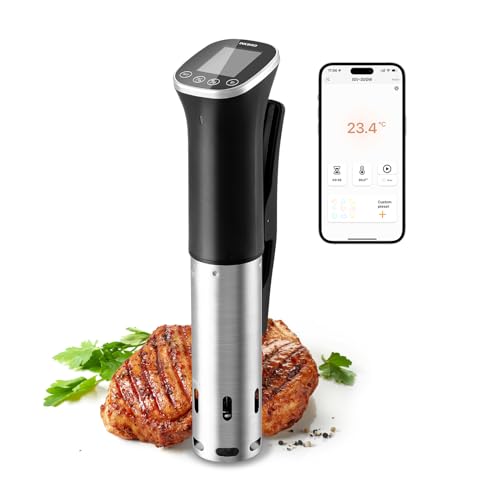
Anova Culinary Sous Vide Precision Cooker 3.0 (WiFi), 1100W, Black
ASIN B0CW82J3DL • $337.95 • Ships from Amazon AU
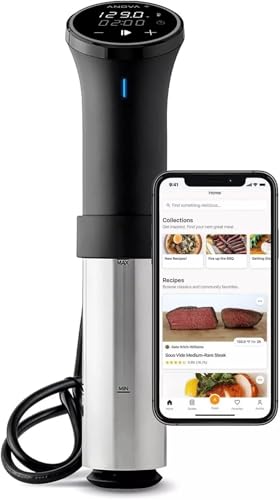
The Anova Precision Cooker 3.0 is the sous vide stick I'd point most people to first. It's $338 on Amazon AU at time of writing, sold by Amazon AU, and it's #59 in Amazon AU's Countertop Cooktops, Electric Pans and Hot Plates category. It lists 1,100W and a flow rate of 8 litres per minute, the only pick here that gives a pump figure at all. Anova calls this the third generation of its flagship cooker, which first launched in 2014. The listed weight is about 1.6kg, and it stands about 32cm tall. This listing is black. Being sold by Amazon AU means returns are simple if anything's wrong on arrival, which matters on a cooker that can't be properly tested until it's in water.
The adjustable clamp fits nearly any pot deep enough to reach the minimum water line, and the stainless steel skirt on the lower half twists off for cleaning by hand or in the dishwasher. That skirt is where scale and food residue build up around the heater and impeller, so being able to take it off easily is a real advantage. The 8 litre per minute flow keeps a big pot even, which suits batch cooks with several bags. It connects to the Anova app over Wi-Fi for remote control and recipes. Anova is also the most widely sold sous vide brand, which usually means better documentation and more people who've solved the same problem before you. A removable skirt also lets you check the impeller for anything caught in it.
The listing doesn't state the voltage, a water rating, a low-water cutout or the warranty, so check the rating plate says 220 to 240V and read the manual before a long unattended cook. Anova started charging new app users a subscription for some features in 2024, so check what's free now. Descale the skirt and heater with a vinegar soak every few months if your water is hard. Keep the head out of the steam with a lid. For precise control, strong flow and a skirt you can clean, it's the one.
Honest caveats: Honest caveats: the listing doesn't state the voltage, water rating, low-water cutout or warranty. It's more than twice the price of the INKBIRDs. Some app features now sit behind a subscription for new users. Check the rating plate says 220 to 240V. The listing gives no part number.
Best for: Cooks who want the strongest stated flow, a cleanable skirt and the most widely supported brand.
Heater: 1,100W • Flow rate: 8 L/min • Connectivity: Wi-Fi, Anova app • Clamp: Adjustable • Cleaning: Removable stainless skirt, dishwasher safe • Size: About 32cm tall, 1.6kg (listed) • Seller: Amazon AU • Rank: #59 in Countertop Cooktops, Electric Pans and Hot Plates (Amazon AU)
View on Amazon AU
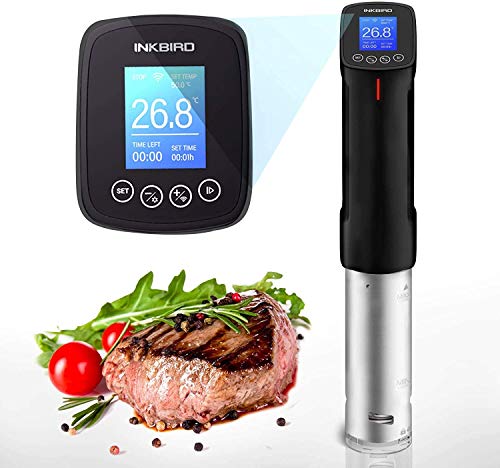
INKBIRD ISV-300W Wi-Fi Sous Vide Cooker, 1000W, IPX7, Low Water Protection
ASIN B0GQGZCYSM • $139.99 • Sold by inkbirdau on Amazon AU
The INKBIRD ISV-300W is the pick for most people who don't need the Anova. It's $140 on Amazon AU at time of writing, sold by inkbirdau, Inkbird's own Australian storefront, and it's #233 in Amazon AU's Speciality Appliances category. It lists 1,000W, a temperature range of 0 to 90°C and an accuracy of ±0.1°C, with a calibration function to correct the reading if it drifts. The model is listed as ISV-300W-INKAUMODEL, which points to an Australian version. This listing is black and silver. Inkbird makes a wide range of thermometers and temperature controllers, so the sensor side of a cooker is something it knows well. It's less than half the Anova's price.
The standout feature is the IPX7 rating, which the listing says covers the whole machine. That's the best protection here against the steam and splashes that kill most sous vide sticks, and it means a slip into the pot isn't the end of it. The low-water protection stops the cooker and sounds an alarm if the water falls below the minimum line, and the listing says it also stops if the temperature probe malfunctions. That second feature is a good sign, because a failed probe that reads low is exactly how a heater cooks itself. The timer runs up to 100 hours, and the app has a booking function, alarms and recipes over 2.4GHz Wi-Fi. That covers even the longest brisket cooks.
The listing doesn't state a flow rate, the clamp type or the warranty, so check those on the current listing. The 90°C top temperature is lower than the ISV-100W's 99°C, which only matters for some vegetable and egg recipes. Descale it every few months and rinse it after every cook. Leave the clamp loose between cooks so the spring doesn't fatigue. Inkbird's own storefront selling it makes a warranty claim simpler than going through a third party. For a waterproof cooker with a proper low-water cutout at a modest price, it's the best value in the guide.
Honest caveats: Honest caveats: the listing doesn't state the flow rate, the clamp type or a warranty period. The 90°C maximum is lower than the older ISV-100W's. It relies on 2.4GHz Wi-Fi for the app features. The rank is in a broad category, so it's hard to compare directly with the Anova's.
Best for: Most home cooks wanting a waterproof cooker with a low-water cutout at a modest price.
Heater: 1,000W • Temperature: 0 to 90°C, ±0.1°C • Water rating: IPX7 (whole unit) • Timer: Up to 100 hours • Safety: Low-water and probe-fault stop • Connectivity: 2.4GHz Wi-Fi app • Model: ISV-300W-INKAUMODEL • Seller: inkbirdau • Rank: #233 in Speciality Appliances (Amazon AU)
View on Amazon AU
Inkbird ISV-100W Wi-Fi Sous Vide Cooker, 1000W, 16L Capacity
ASIN B08XB8XRY7 • $139.99 • Sold by inkbirdau on Amazon AU
The Inkbird ISV-100W is the older INKBIRD, and it's here because it does a couple of things the newer one doesn't. It's $140 on Amazon AU at time of writing, the same price as the ISV-300W, sold by inkbirdau, and it's #55 in Amazon AU's Slow Cookers category. It lists 1,000W, a temperature range of 25 to 99°C, accuracy to 0.1°C and a calibration range of ±10°F to keep the reading accurate over time. The listing says it handles up to 16 litres of water. The model number isn't given in the listing data, but the title names it as the ISV-100W. Being sold by Inkbird's Australian storefront helps if you need support or a replacement.
The 99°C top end is the reason to choose it over the ISV-300W. Some vegetable, egg and dessert recipes call for temperatures in the 90s, and the newer model stops at 90°C. The timer runs up to 99 hours and 59 minutes, and the listing says the timer only starts once the water reaches the set temperature, which is the way it should work. It has low-water protection that stops it and sounds an alarm, plus an alert when the water reaches the target. The body is stainless steel, which the listing says is easy to clean. The listing names the InkbirdSmart app for remote control, and the app can share the device with other people in the house.
The listing says outright that this unit isn't waterproof and that the water mustn't go over the maximum line, so it's the one most at risk from steam and overfilling. Keep the head well clear of the water and use a lid that leaves it in the open air. The listing doesn't state the flow rate or warranty. At the same price as the ISV-300W, I'd only choose it if you need temperatures above 90°C. Rinse it after every cook and descale it every few months. Store it upright and dry so any water inside can drain away from the head.
Honest caveats: Honest caveats: the listing says it isn't waterproof, so steam and overfilling are real risks. It costs the same as the newer, waterproof ISV-300W. The listing doesn't state the flow rate, the clamp type or a warranty. The model number isn't in the listing data.
Best for: Cooks who need temperatures up to 99°C for vegetables, eggs and desserts.
Heater: 1,000W • Temperature: 25 to 99°C, 0.1°C accuracy • Capacity: Up to 16L (per listing) • Timer: Up to 99h 59m, starts at temperature • Water rating: Not waterproof (per listing) • Safety: Low-water stop and alarm • Seller: inkbirdau • Rank: #55 in Slow Cookers (Amazon AU)
View on Amazon AU
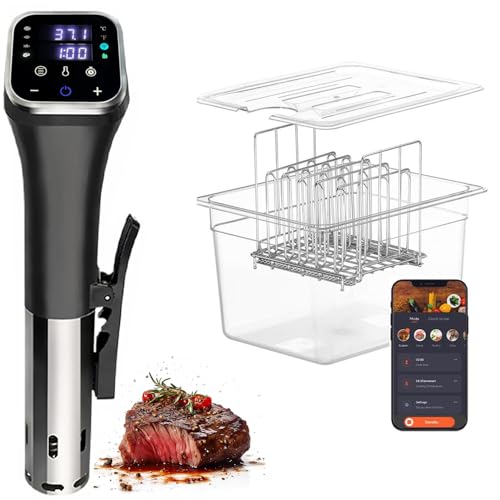
CHUCII Wi-Fi Sous Vide Kit, 1100W, 11L Container with Lid and Rack (VDV002)
ASIN B0FKGQQ5W1 • $169 • Sold by ZH-AU on Amazon AU
The CHUCII kit is the pick for someone starting from nothing. It's $169 on Amazon AU at time of writing, sold by ZH-AU, a marketplace seller rather than Amazon AU or a brand storefront, and it's #315 in Amazon AU's Containers category. It lists 1,100W, and the box includes the cooker, an 11 litre clear container with a lid, a stainless steel rack, 10 vacuum bags, a hand vacuum pump and two bag clips. The model is listed as VDV002. This listing is black. Buying the container, lid and rack separately would cost a fair share of the kit's price, so the value is mostly in the extras. The listing data has a better sales rank across the whole site than any other pick here.
The container solves the two problems that catch new users, a pot that isn't deep enough and steam escaping all over the head. A lid with a cut-out for the cooker cuts evaporation and running cost on long cooks, and the rack keeps bags upright so the water can circulate around each one. The cooker lists a waterproof touch screen, 304 stainless steel, overheating protection, 3D water circulation and a Wi-Fi app with preset menus. The hand pump and bags get you started, though for long cooks a proper vacuum sealer gives a better seal. The clear container also lets you see whether a bag has started to float. Overheating protection is a good sign, though the listing doesn't explain how it works.
The listing doesn't state the temperature range, the accuracy, a water rating for the whole unit, a low-water cutout or a warranty, and its feature list calls the cooker a slow cooker, which is confusing. Being sold by a marketplace seller means returns and warranty claims go through them, so read the seller's page first. Check the plug and rating plate say 220 to 240V. Rinse the container and cooker after every cook, and dry the container before you put the lid on for storage. Keep the hand pump's valve clean, because food in the valve stops it sealing. For a complete starter setup in one box, it's the easiest place to start.
Honest caveats: Honest caveats: it's sold by a marketplace seller, not Amazon AU or a brand storefront. The listing doesn't state the temperature range, accuracy, a low-water cutout or a warranty. Its features call it a slow cooker. The hand pump and bags are basic. Check the rating plate for 220 to 240V.
Best for: First-time sous vide cooks who want the cooker, container, rack and bags in one box.
Heater: 1,100W • In the box: Cooker, 11L container, lid, rack, 10 bags, hand pump, 2 clips • Screen: Waterproof touch screen • Connectivity: Wi-Fi app with presets • Body: 304 stainless steel • Model: VDV002 • Seller: ZH-AU (marketplace) • Rank: #315 in Containers (Amazon AU)
View on Amazon AU
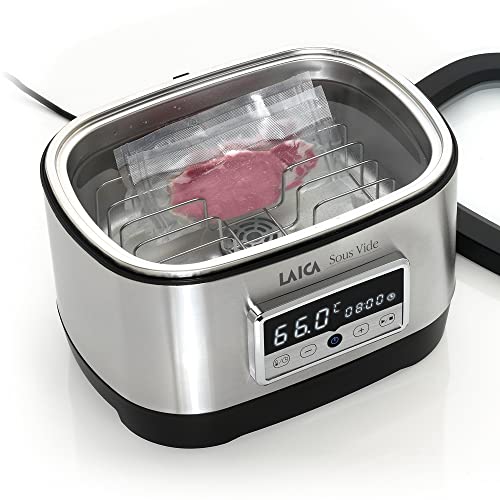
Laica Sous Vide Water Oven SVC200, Silver
ASIN B077HPZ9WB • $247.36 • Ships from Amazon AU
The Laica SVC200 is the one pick that isn't a clamp-on stick. It's a water oven, with the tank, heater and controls built into one box, so there's no pot to find and no clamp to fit. It's $247 on Amazon AU at time of writing, sold by Amazon AU, and it's #52 in Amazon AU's Dutch Ovens category. The model number SVC200 matches the listing. It's silver, the listed weight is about 3.9kg, and the listed size is about 36 by 24 by 28cm. Laica is an Italian brand that sells kitchen scales and small appliances, and the listing has been up since 2022. Amazon AU selling it directly makes returns simple.
The appeal of a water oven is that it's tidy. It sits on the counter like a small slow cooker, the lid keeps steam and evaporation in, and the electronics sit away from the water rather than hanging over it. That design removes the two most common sous vide faults, water in the head and a heater running dry from a pot that's lost water overnight. It also means nothing to clamp or knock over. The listing says it has high precision automatic temperature control. The downside is that there's no pump on the listing, so the water isn't stirred the way a circulator stirs it, which can leave small temperature differences in a full tank.
The listing is very thin. It doesn't state the wattage, the tank capacity, the temperature range, the accuracy, a timer, a low-water cutout or a warranty, so read the manual or the manufacturer's page before you buy. It also takes up permanent counter or cupboard space in a way a stick doesn't. Empty, rinse and dry the tank after every cook to stop scale and smells building up. Check the plug and rating plate say 220 to 240V when it arrives. For someone who wants a set-and-forget box with no pot or clamp, it's the tidiest option here.
Honest caveats: Honest caveats: the listing doesn't state the wattage, tank capacity, temperature range, timer, low-water cutout or warranty. There's no pump on the listing, so water circulation may be weaker than a stick's. It's bulky to store. It has no Wi-Fi or app.
Best for: Cooks who want a tidy counter-top water oven with no pot, clamp or app.
Type: Water oven (built-in tank) • Weight: About 3.9kg (listed 8.6 lb) • Size: About 36 x 24 x 28cm (listed) • Connectivity: None stated • Model: SVC200 • Colour: Silver • Seller: Amazon AU • Rank: #52 in Dutch Ovens (Amazon AU)
View on Amazon AUSide-by-side comparison
| Product | Price | Best for |
|---|---|---|
| INKBIRD Wifi Slow Cooker Sous Vide Machine… | ~$139.99 | |
| Inkbird WiFi Sous Vide Cooker Culinary Slow… | ~$139.99 | |
| CHUCII WiFi Sous Vide with 11L Sous Vide… | ~$169 | |
| Laica Sous Vide Water Oven | ~$247.36 | |
| Anova Culinary Sous Vide Precision Cooker 3.0 | ~$337.95 |
What we see fail in the workshop: sous vide machines
Sous vide sticks are simple, but they live in steam and water, so the faults that bring them in are nearly always about water. Steam gets into the control head and corrodes the board, the heater burns out after running with too little water, and scale builds up on the heater and impeller until the pump slows down. The clamp spring and the Wi-Fi module are the other two.
Water and steam in the control head
The head of a sous vide stick sits just above hot water for hours at a time. Steam condenses inside it, runs down onto the control board and leaves corrosion on the connectors and the board itself. An overfilled pot or a cooker knocked into the water does the same thing in seconds. The signs are a screen that flickers, buttons that stop working or a cooker that won't turn on. Unplug it straight away, let it dry out completely and bring it in, because powering on a wet board often does the real damage.
Burnt-out heaters
The heater is designed to sit fully under moving water. When the level drops below the minimum line on a long cook, the heater runs in air, gets far too hot and burns out. A failed temperature sensor that reads too low causes the same thing, because the controller keeps the heater on trying to reach a target it thinks it hasn't hit. A low-water cutout and a probe-fault stop, like the INKBIRD ISV-300W lists, prevent most of these. A lid on the pot is the other easy fix, because it stops most of the evaporation in the first place.
Scale on the heater and impeller
Every cook leaves a little mineral scale on the heater and the small impeller that moves the water. Over time it insulates the heater, slows the impeller and makes the motor work harder, and you'll notice the cooker taking longer to reach temperature. Soaking the lower half in a mix of vinegar and water every few months dissolves most of it. The Anova's removable skirt makes this much easier. A noisy or grinding pump usually means scale or something caught in the impeller, like a loose bag clip or a bit of food from a split bag.
Decision tree: which one should you actually buy?
- Want the best-supported cooker with the strongest stated flow? → The Anova Precision Cooker 3.0 at $338, with 1,100W, 8 L/min and a removable skirt.
- Want a waterproof cooker with a low-water cutout for less? → The INKBIRD ISV-300W at $140, IPX7 with low-water and probe-fault protection.
- Need temperatures above 90°C for vegetables and eggs? → The Inkbird ISV-100W at $140, with a 25 to 99°C range, though it isn't waterproof.
- Starting from scratch with no big pot? → The CHUCII kit at $169, with an 11 litre container, lid, rack and bags in the box.
- Want a tidy box with no clamp, pot or app? → The Laica SVC200 water oven at $247, with its own tank and lid.
- Your sous vide cooker won't heat, won't turn on or got wet? → Unplug it and let it dry. If it's still not right, bring it into our Erina workshop and we'll check the board, the heater and the sensor, and tell you whether it's worth fixing before you spend anything.
Frequently asked questions
Is a sous vide machine worth it?
If you cook steak, chicken, pork or fish often and want it cooked the same way every time, yes. A sous vide cooker holds water at an exact temperature, so food can't overcook past that point, and you finish it in a hot pan. It's also very good for tough cuts that need long, low cooks. It's less useful if you mostly cook stir-fries, soups or baked dishes, because it doesn't replace a stove or an oven.
Do I need a vacuum sealer for sous vide?
Not to start. Zip-lock freezer bags with the air pushed out, using the water displacement method, work well for short cooks. For long cooks, food you want to freeze, or anything with a lot of liquid, a vacuum sealer gives a much better seal and stops bags floating. A floating bag cooks unevenly because part of it sits out of the water. The CHUCII kit includes a hand pump and bags as a middle option.
What's the difference between an immersion circulator and a water oven?
An immersion circulator is a stick that clamps onto your own pot, with a heater and a pump to keep the water moving. A water oven has its own tank with the heater and controls built in. Circulators are smaller to store, work with any deep pot and usually stir the water better. Water ovens are tidier, keep the electronics away from the water and don't need a clamp, but they take up more space and usually cost more.
How much power does a sous vide cooker use?
Most home cookers have a heater of about 1,000 to 1,100W, but they only run flat out while heating the water. Once it's at temperature, the heater switches on in short bursts. As an example, if a cooker averaged 150W over a 24 hour cook in a covered container, that's 3.6kWh, or about $1.19 at roughly 33c/kWh. An open pot can easily double that, so a lid makes a real difference.
Why did my sous vide stick stop working?
The most common causes are water or steam getting into the control head, a heater that burnt out after the water dropped too low, or scale slowing the pump. Unplug it and let it dry fully before trying it again, because powering on a wet board can do lasting damage. If it still won't heat or turn on, the board, heater or sensor needs checking. A lid and keeping the water between the lines prevents most of these faults.
Can I use a US sous vide cooker in Australia?
Only if it's rated for 220 to 240V. Many sous vide sticks sold on Amazon are built for the US at 120V, and plugging one into an Australian socket with a plug adapter will usually burn out the heater or the board straight away, and it's a fire risk. Check the rating plate or the listing for 220 to 240V, an Australian plug and ideally an RCM mark before you buy.
Related buying guides
Sous vide cooker dead, wet or not heating?
Most sous vide faults are steam in the control head, a heater that ran dry or scale on the heater and impeller. Bring it into our Erina workshop and we'll check the board, the heater and the sensor, find out why it failed, and tell you whether it's worth fixing before you spend anything.
Visit our Erina workshop Book Online