Prices from Amazon AU, updated daily. Swipe or use the arrows for more.
Disclosure: This article contains affiliate links to amazon.com.au. If you buy through one of these links iFix may earn a small commission at no extra cost to you. It doesn't change which products we recommend. We focus on what actually lasts based on 16 years of repair-shop experience.
Quick summary8 picks
- CheapestBraun Essentials MultiFry 3 HF3030BK about$891500W.
- Russell Hobbs Satisfry Air Extra Large 8L about$129
- Ninja Air Fryer Pro about$128.97
- Philips Air Fryer 2000 Series 4.2L about$143.00
- Philips Air Fryer 2000 Series 6.2L about$148.001700W.
- Ninja Foodi Dual Zone Air Fryer about$199.00
- Philips Air Fryer 3000 Series Dual Basket about$198.00
- Most PremiumNinja XXXL FlexDrawer Air Fryer about$399.95
The running cost claim, with the arithmetic shown
An air fryer is a small fan-forced oven with the cavity shrunk down to roughly the size of the food. That's the whole trick. The element sits close to the basket, the fan moves the air hard, and you're not paying to heat sixty-odd litres of air and several kilos of steel before dinner starts cooking. With power prices where they've been these past couple of years, that pitch has moved a lot of units, and the physics behind it is sound. The numbers want stating properly, though. At the average tariff of roughly 33c per kilowatt hour, the 1,700W Philips below would cost about 56c an hour with the element running flat out, and the 1,500W Braun about 50c. Elements cycle on and off once the box reaches temperature, so real cooks land under those ceilings.
A 60cm oven is the other side of the comparison. A 2,000W appliance at the same tariff runs about 66c an hour flat out, and the first stretch of any oven session is pure preheat, spent warming the cavity and the racks before food goes anywhere near it. A twenty-minute air fryer run that never left full power has a ceiling of about 19c on that Philips. Do that four nights a week instead of an hour of oven time and the gap adds up to real money across a year, without anyone changing what they eat. The catch is sizing: buy a fryer too small for the household and the second batch of chips erases both the saving and the goodwill. Nothing above assumes bulk cooking or any change in habits either, which is the fair way to run the comparison, because an appliance that only saves money when the household changes around it mostly doesn't.
Litres are the most abused number on the box
Capacity is where this category plays games. The litre figure measures the drawer as a bucket, but air frying doesn't cook buckets, it cooks layers. The food wants to sit shallow with moving air around it, and a drawer loaded to the brim steams in the middle while the edges scorch. So the litre number and the amount of food that cooks properly in one pass are different quantities, and the gap between them is where most air fryer disappointment lives. Credit to Philips for publishing the honest version on its own listing: the 6.2L pan holds 800g of fries or 8 drumsticks. That's a realistic single-layer figure, and it's a long way from what '6.2 litres' suggests to someone picturing a stockpot. Once you read capacity as layers rather than litres, the price ladder in this guide makes more sense too, because you're paying for cooking area and zones, not for bucket volume.
Shape matters as much as volume. The Ninja Dual Zone totals 7.6L, but that's two separate 3.8L drawers, which is excellent for cooking two foods at once and no help at all for one large item, because nothing bigger than a 3.8L space ever fits. The FlexDrawer runs the logic the other way: 10.4L as one wide zone, with a divider you drop in when you want two. The Braun calls its 4.3L 'family size' and claims 1.2kg of chicken. Read every figure like that as the maker's number for food packed to the limit rather than cooked at its best, and buy one size up from whatever the box says feeds your headcount. This litre inflation isn't unique to air fryers, the same game runs through eskies and camping fridges, but nowhere else does the gap between the number and the result show up on the dinner table quite so directly.
Basket, dual zone or one big drawer
The single-basket unit is the default, and for one to three people it's still the right call. One drawer, one element, one fan, fewer parts to clean and fewer parts to fail. The Braun and the Ninja Pro are that shape, and the Philips adds volume and a window to the same idea. A single basket also heats the least total air, so it's the thriftiest of the shapes per run for small quantities. Cleaning is quickest on this format too, and the cleaning burden is what actually decides whether an appliance is still in use a year after purchase.
Dual zone is the family answer to the one-drawer problem, which is that chips and chicken want different temperatures and the same finish time. Two independent drawers with sync features handle exactly that, and the Ninja Dual Zone has been the pick of that format here for years. The trade is bench space and the shape limit above: two medium spaces, never one big one. The FlexDrawer's removable divider is the current best answer to that trade, giving one wide zone for a tray of wings and two zones on the nights that need them.
The third format, the oven-style unit with shelves and a door, cooks well and suits dehydrating trays, but the drawer formats have mostly won the Australian market, and this list reflects that. Ovens with doors lose more heat per opening, take longer to wipe down, and their racks multiply the cleaning. If you want shelves, you may already own an oven doing a fine impression of one. The one place oven-style wins outright is dehydrating in volume, where trays beat drawers on area; if that's the real use case, buy for it deliberately rather than as a side-feature.
What to look for before you pay
The spec sheets here are thin, and six of the eight listings don't even state a wattage, so the buying decision leans on a short list of things that actually predict satisfaction:
- Stated power. Wattage sets how fast the box recovers when cold food lands in it. The 6.2L Philips states 1,700W and the Braun 1,500W; the Ninja, Russell Hobbs and other Philips listings don't state a figure, which is common and worth knowing before you assume.
- Temperature range at both ends. A 200°C ceiling covers most jobs; the Ninja Pro states 210°C and the Russell Hobbs 220°C, which helps crackling and wings. The low end matters too, and the Braun's stated 80°C floor covers gentle reheating.
- Dishwasher-safe removables. Most of the listings claim it for baskets or plates. It's real, with a caveat covered below in the section on coatings.
- A window and light. Only the 6.2L Philips lists one. Every drawer opening drops heat and stretches the cook, so seeing in without opening is worth more than it sounds.
- Controls you'll actually use. Presets are one-touch shortcuts to time and temperature pairs. Fine, but manual control is what you'll use by week three, so make sure it's not buried.
None of this requires the top of the range. It requires matching the format and the honest capacity to your household, then refusing to pay for functions you can name no use for. Dehydrate and Proof on the bigger Ninjas are good functions that most buyers never touch twice. The eight below span $89 to $400 and each earns its spot at its price; the wrong purchase in this category is nearly always the wrong size or format rather than the wrong brand.
Powerboards, sockets and the 10A ceiling
A standard Australian socket is 10A, which is 2,400W at 240V, so every unit here runs comfortably from a wall socket on its own. The rule that matters is the same one I give for heaters: the air fryer plugs into the wall, not into a powerboard, and never into a powerboard that's already feeding the kettle, the toaster or a microwave. Kitchen benches are the worst offenders for this in any house, because sockets are scarce exactly where the high-draw appliances cluster. If the bench offers one free socket and it's already shared, that's a wiring conversation, not a powerboard purchase. Boards that spend their mornings passing kettle-plus-fryer current run hot, and hot is how they die; I've been through the failure mechanics and the joule-rating fine print in the surge powerboard guide.
Two more electrical habits worth keeping. Check the cord and plug now and then, because a kitchen appliance cord lives a hard life pressed against benches and warm metal, and any discolouration around the pins means stop using it. And give the intake and exhaust vents clear air: an air fryer jammed under an overhead cupboard is recycling its own exhaust, working its thermal protection harder than the designer intended, and slowly cooking the cupboard's underside as a bonus. The RCM compliance mark applies to these like any mains appliance sold in Australia, and all eight picks come from established brands shipped through Amazon AU, which is the boring, checkable provenance you want on something that runs at 200°C while you watch television.
The coating is the consumable
Non-stick coating on the basket and crisper plate is the part of an air fryer that wears out on schedule, and no listing prints that schedule. Metal tongs, abrasive scourers and hard scraping shorten it; so does the dishwasher, in my experience, even on parts rated for it, because detergent and heat age the surface faster than a soft cloth ever will. Dishwasher-safe means it survives the cycle, not that the coating loves it. Hand washing the basket takes two minutes and is the single habit that most extends one of these appliances. When the coating does let go, check for replacement baskets and plates before writing the whole unit off, because the big brands sell spares and a $30 basket beats a $170 rebuy. None of the listings prints a separate coating warranty, so assume the coating's lifespan is in your hands rather than the maker's.
The other wear points are mechanical and simple to understand. The drawer slams home a thousand times a year against a small interlock switch that tells the controller it's safe to heat, and when that switch gives up, the symptom looks like a dead appliance rather than a $2 part. Fan bearings pick up vaporised oil over the years and get noisy about it. None of that is a reason to bin a unit that's out of warranty, and diagnosing which of them you're looking at is quick work for our workshop in Erina; there's more on that in the bench section below.
Prove the savings on your own meter
Every running cost figure above is arithmetic from stated wattages and an assumed 33c per kilowatt hour tariff, and your house will differ, so measure it. A metering smart plug handles this perfectly: any 10A-rated plug carries a 1,700W fryer without drama, and a week of real dinners gives you actual kWh per meal instead of my estimates. Cook the usual menu, read the history, multiply by your own tariff. A week's data also settles which household member's cooking style is the expensive one, which I mention because the meter doesn't care about kitchen politics, and someone in every house is opening the drawer every ninety seconds. If you want the oven side of the comparison too, a whole-house energy monitor at the switchboard catches the circuits a plug can't reach, since most ovens are hard-wired.
What you'll usually find is that the air fryer costs 10c to 25c a run in the real world and the oven several times that once preheat is counted, at which point the appliance has justified itself and you can stop doing sums at the dinner table. If the exercise gets you interested in what the rest of the house is drawing, that's a rabbit hole I've already mapped: the power savings rundown sorts the changes that genuinely move an Australian bill from the gadget-drawer filler. The fryer, run instead of the oven most nights, sits solidly in the first category.
The 8 picks, $89 to $400
Prices are Amazon AU as of 15 October 2026 and move week to week. Ranks are Amazon AU category sales ranks, checked the same day.

Braun Essentials MultiFry 3 HF3030BK, 4.3L
ASIN B0DCZWM34G • $89.00 • Ships from Amazon AU
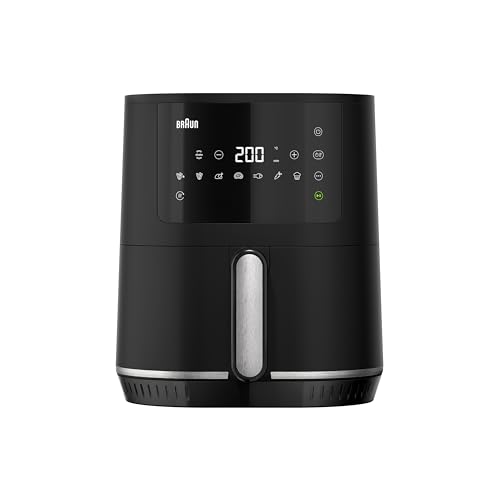
At $89 this is the least expensive credible unit on the page, and it covers the actual job description: a 4.3L drawer, a stated 1,500W element, digital temperature control from 80 to 200°C, and eight one-touch programs for the usual suspects from frozen fries through to reheat. The listing claims the drawer takes 1.2kg of chicken or 1kg of frozen fries, which, per the capacity section above, I'd read as a packed-to-the-limit figure rather than the ideal single layer. For one or two people, and plenty of three-person households, that's dinner most nights. At the assumed 33c per kilowatt hour, 1,500W flat out is about 50c an hour, and a normal twenty-minute cook cycles well below that ceiling.
Braun's RealAir circulation is the standard hot-air-moved-hard arrangement, and the non-stick basket comes out and goes in the dishwasher per the listing, though my advice on coatings further up still applies: the two-minute hand wash is the habit that keeps a unit like this alive. The 80°C floor on the temperature dial is more useful than it looks, covering gentle reheats that a 120°C-minimum unit turns into a drying exercise. Controls are digital and plain, which I count as a feature; there's no app, no subscription and nothing to pair, so the failure surface is the element, the fan, the switch and the board, and that's the whole list. A shorter parts list is also a shorter list of things that can strand the appliance once the warranty runs out.
It sits at number 15 in Amazon AU's Air Fryers category at time of checking, shipped by Amazon AU itself, which for an $89 appliance from a known brand is exactly the sort of boring, verifiable purchase I like. The alternative at this money is the no-name tier, and a mains appliance that runs unattended at 200°C is the last place in the house I'd shop on mystery brands. There's a practical repair angle too: an appliance this simple either works or it doesn't, and when it doesn't the fault is one of four parts, which keeps any diagnosis short and the repair-versus-replace call easy to make at this price.
Honest caveats: No window, so checking progress means opening the drawer and losing heat. 1,500W is the lowest stated power here, which means slower recovery when a full cold load lands in it. One drawer means one food at a time, and the 4.3L 'family size' claim deserves the scepticism the capacity section explains.
Best for: One to three people who want the running cost benefit from a known brand without paying for capacity they won't use.
Capacity: 4.3L drawer • Power: 1,500W (stated) • Temperature: 80 to 200°C, digital control • Programs: 8 presets including reheat • Cleaning: Dishwasher-safe non-stick basket • Airflow: RealAir circulation • Price: $89.00 at time of writing • Rank: #15 in Air Fryers (Amazon AU)
View on Amazon AU
Russell Hobbs Satisfry Air Extra Large 27170AU, 8L
ASIN B0BWHBLV7P • $129.00 • Ships from Amazon AU
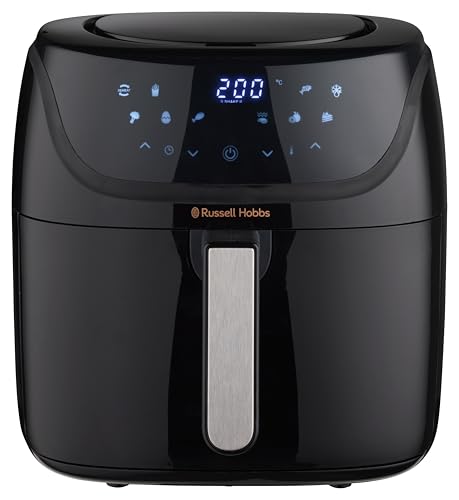
Russell Hobbs' Satisfry Air Extra Large is the single-basket unit on this page that puts the most room behind one drawer for the money: the listing puts the capacity at 8L, with a dishwasher safe fry basket and crisping plate. It's model 27170AU, a digital touchscreen shows the time, temperature and cooking method at a glance, and the listing quotes temperatures up to 220°C, above the 210°C stated on the Ninja Pro. Per the capacity section above, read 8L as a bucket figure and plan around layers, but a large single basket is the right shape for a tray of wings or a big batch of vegetables, which a 3.8L Dual Zone drawer can't take in one piece.
Ten pre-set functions are listed, covering chips, fish, prawn, chicken, steak, pork chop and bake, all set from the touchscreen. Russell Hobbs also claims up to 47 per cent less energy than a conventional oven, which I'd pass along as the maker's figure rather than mine, and the coating advice earlier still applies: dishwasher safe, per the listing, means it survives the cycle, not that the coating loves it.
It sits at number 19 in Amazon AU's Air Fryers category (and number 9 in Heating) at time of checking, at $129 from Amazon AU directly, which puts it four dollars above the Ninja Pro for over three litres more basket.
Honest caveats: Power isn't stated on the listing, so the running cost arithmetic above can't be applied precisely. It's a single basket, so one food at a time, and the 47 per cent energy saving and the 220°C ceiling are the maker's figures, not measurements of mine.
Best for: Two to four person households that want one roomy 8L basket rather than two drawers.
Capacity: 8L basket • Power: Not stated on the listing • Presets: 10 pre-set functions • Top temperature: 220°C (stated) • Controls: Digital touchscreen • Cleaning: Dishwasher-safe basket and crisping plate • Price: $129.00 at time of writing • Rank: #19 in Air Fryers (Amazon AU)
View on Amazon AU
Ninja Air Fryer Pro AF141ANZ, 4.7L
ASIN B0DM5K93FW • $125.00 • Ships from Amazon AU
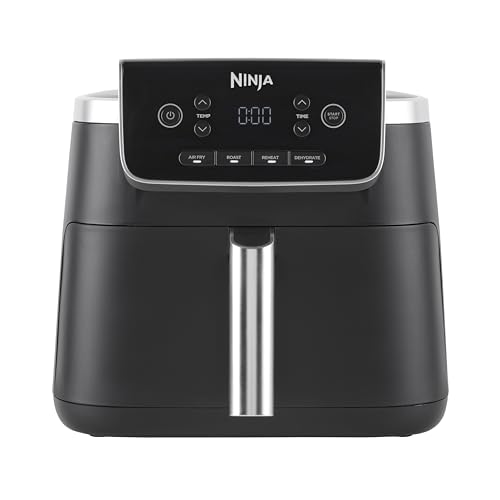
Ninja is one of the biggest names on Amazon AU's air fryer chart, and this is its compact workhorse: a 4.7L single drawer sitting at number 7 in the category at time of checking. The listing pitches it at apartments and small kitchens, and the space-saving case is legitimate, because you get marginally more drawer than the Braun in a unit designed not to annex the whole bench. Capacity claims run to 1.8kg of fries or 2.3kg of wings, which are the most aggressive packed-drawer numbers on this page relative to the litres behind them, so apply the usual discount and think of it as comfortable dinner for two or three cooked properly in a single layer.
The stated 210°C Air Crisp ceiling is the spec I'd actually pay attention to, since it is second only to the Russell Hobbs' 220°C among the listed temperatures here and the extra degrees matter for wings, crackling and anything that wants a hard finish. Four cooking functions cover air fry, and the crisper plate and drawer are dishwasher safe per the listing, with the same coating caveat as everything else in this guide. Like the Braun it's control-panel simple: no app, no cloud, nothing to update, and as someone who spends his days on devices that stopped working because software somewhere changed, I rate that as a durability feature, not a limitation. Note the listing describes functions rather than auto presets, so the expectation is that you set time and temperature yourself and get on with it.
The gap between this at $125 and the Braun at $89 buys the higher ceiling, the Ninja drawer design and the brand's parts and accessory ecosystem, which is deeper than most in Australia. Worth it if the kitchen is small and the household is two or three; not worth it if the extra $36 is stretching toward a dual zone you actually need. Ninja's chart position isn't an accident either: the brand's Australian accessory and spares availability is the deepest in the category, and the availability of a replacement basket in three years is worth more than a fifth cooking function today.
Honest caveats: Power isn't stated on the listing, so the running cost arithmetic above can't be applied precisely to this unit. Four functions is the shortest list here, with no dehydrate or proof, and one drawer still means one food at a time. Capacity claims deserve the standard packed-drawer scepticism.
Best for: Two to three person households short on bench space who want the strongest small single-drawer unit going.
Capacity: 4.7L drawer • Power: Not stated on the listing • Top temperature: 210°C Air Crisp (stated) • Functions: 4 • Cleaning: Dishwasher-safe drawer and crisper plate • Design: Space-saving footprint • Price: $125.00 at time of writing • Rank: #7 in Air Fryers (Amazon AU)
View on Amazon AU
Philips Air Fryer 2000 Series, 4.2L, 13-in-1
ASIN B0D9JTSCSB • $143.00 • Ships from Amazon AU
This is the smaller sibling of the 6.2L Philips, and it keeps the part that matters: the RapidAir system with the starfish design that circulates hot air for even, crisp results with minimal oil. The 4.2L pan is listed as fitting up to six chicken drumsticks or 500g of fries, a grams-and-drumsticks figure rather than a litre boast, so you can size it against your own household without guessing. Thirteen cooking modes run from air fry, bake, grill and roast through defrost, dehydrate, stir-fry, sauté and toast, driven from a touchscreen with one-touch presets.
The non-stick StarPlate and dishwasher-safe parts keep cleaning quick per the listing, and Philips claims up to 90 per cent less fat than conventional frying, which I'd pass along as the maker's figure rather than mine. It holds number 2 in Amazon AU's Air Fryers category at time of checking, at $143 from Amazon AU directly, which makes it the cheapest way into the Philips parts and accessories channel on this page.
Honest caveats: Power isn't stated on the listing. At 4.2L it's the smallest pan here, and the 500g of fries figure means a family of four will be cooking in batches. Single basket, one food at a time, and thirteen modes is more one-touch shortcuts than most people will ever cycle through.
Best for: One to three people who want a compact Philips with plenty of one-touch modes.
Capacity: 4.2L pan (500g fries, 6 drumsticks stated) • Power: Not stated on the listing • Modes: 13-in-1 with one-touch presets • Controls: Touchscreen • Airflow: RapidAir, starfish design • Cleaning: Dishwasher-safe parts, non-stick StarPlate • Price: $143.00 at time of writing • Rank: #2 in Air Fryers (Amazon AU)
View on Amazon AU
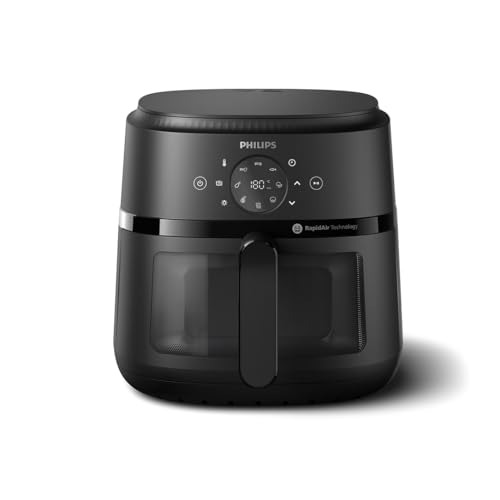
Philips Air Fryer 2000 Series, 6.2L, 1700W
ASIN B0D86W47GX • $148.00 • Ships from Amazon AU
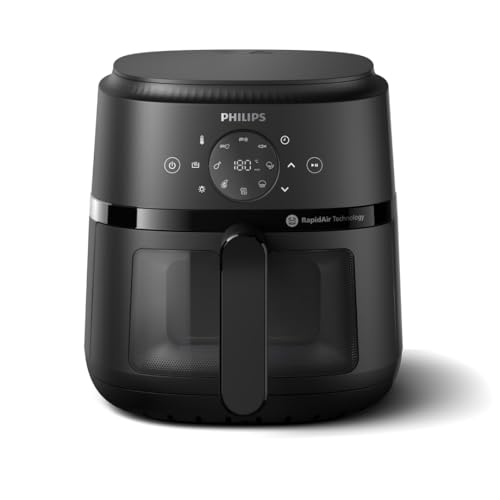
Philips built the domestic air fryer category, and this 2000 Series shows the accumulated polish: 6.2L pan, a stated 1,700W, thirteen cooking modes from air fry through bake, grill, roast, defrost and keep warm, and a touchscreen with nine presets. Two things on this listing earn my respect before the unit even switches on. There's a viewing window, the only one on this page, and every drawer opening you avoid keeps the temperature where the recipe assumed it was. And Philips states its capacity in grams like it's making a confession: 800g of fries, 8 drumsticks, 800g of vegetables, which is the honest single-layer arithmetic every other maker buries under a litre figure.
The RapidAir system with the starfish-pattern pan floor is Philips' airflow arrangement for even cooking with minimal oil, and it's had more generations of refinement than anyone else's. At the assumed 33c per kilowatt hour, 1,700W flat out is about 56c an hour, and a twenty-minute cook that never left full power has a ceiling of roughly 19c, with cycling putting real dinners under that. The window means you'll hit those numbers rather than stretching every cook with progress checks, which sounds minor until you've watched someone open a drawer four times chasing one tray of chips towards done. That habit is also the biggest hidden variable in every running cost estimate, so the window quietly protects the arithmetic that justified the purchase.
It holds number 2 in Amazon AU's Air Fryers category at time of checking, at $148 from Amazon AU directly. Between the stated wattage, the stated grams and the window, this is the listing that treats the buyer most like an adult, and the hardware backs the paperwork. If I had to pick one machine on this page for a buyer who hates surprises, it's this: the listed numbers are conservative, the controls need no manual, and Philips' replacement parts channel in Australia is mature enough that a worn coating in year four is an order rather than a crisis.
Honest caveats: The 6.2L headline versus the 800g fries figure is exactly the litres-versus-layers gap this article keeps warning about, so don't buy it expecting family-roast volume. Single basket, one food at a time, and thirteen modes is more one-touch shortcuts than most people will ever cycle through.
Best for: Two to four person households that want the most refined single-drawer unit and a window instead of guesswork.
Capacity: 6.2L pan (800g fries stated) • Power: 1,700W (stated) • Modes: 13-in-1 with 9 presets • Controls: Touchscreen • Window: Yes, with view of the pan • Airflow: RapidAir, starfish pan design • Price: $148.00 at time of writing • Rank: #2 in Air Fryers (Amazon AU)
View on Amazon AU
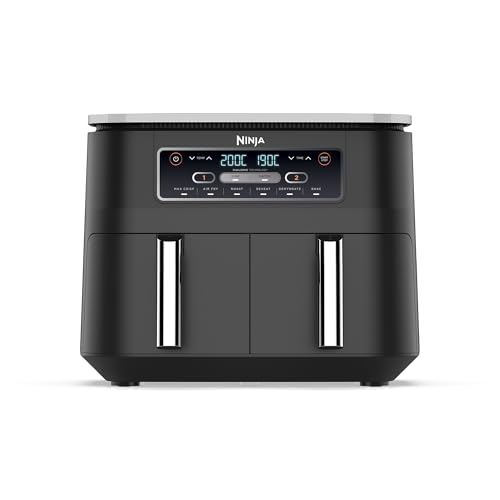
Ninja Foodi Dual Zone Air Fryer AF300ANZ, 7.6L
ASIN B08X8LC2PZ • $199.00 • Ships from Amazon AU
This is the unit that made dual-drawer normal in Australian kitchens, and it sits at number 3 in Amazon AU's Air Fryers category years into its run, which almost never happens in small appliances. The design solves the actual weeknight problem: chips want 200°C and the chicken wants less, and everything should land hot at the same moment. Two independent 3.8L drawers each run their own function, time and temperature, and Ninja's Match and Sync features either mirror the settings across both or stagger the starts so two different cooks finish together. That second one is the feature families end up using nightly. Years of sustained chart dominance also mean the recipes, timings and community answers for this exact model are everywhere you look.
Six functions cover Max Crisp, air fry, roast, reheat, dehydrate and bake, and the ceramic-coated baskets and crisper plates go through the dishwasher per the listing, with my standing suggestion to hand wash anyway if you want the coating to see year five. The 7.6L total is genuine as a volume of cooking space and misleading as a shape, exactly as covered in the capacity section: nothing larger than one 3.8L drawer ever fits, so this is the wrong machine for a whole bird and the right machine for almost every other family dinner. It's also a wide unit, and it wants clear air around it, so measure the bench spot under the cupboards before ordering.
At $199 shipped by Amazon AU it's the default answer for a household of four, and the years of accumulated parts, accessories and recipes around this exact model reduce the ownership friction in a way a newer clone can't match. There's a quiet running cost bonus in the format as well: on nights when only one drawer is needed you run one 3.8L zone rather than a whole large cavity. For most four-person households the real question isn't whether to go dual zone, it's whether the FlexDrawer's single big space is worth another $200, and unless whole birds are routine, it usually isn't.
Honest caveats: Power isn't stated on the listing. The 7.6L figure is two 3.8L spaces, not one, so single large items are out. It's a wide bench footprint, and two drawers mean two baskets and two plates to wash, which the dishwasher-safe claim softens but doesn't remove.
Best for: Families of three to five cooking two different foods to a single dinnertime, most nights of the week.
Capacity: 7.6L total, 2 x 3.8L independent drawers • Power: Not stated on the listing • Functions: 6 including Max Crisp and dehydrate • Dual zone: Match and Sync cooking across drawers • Cleaning: Dishwasher-safe ceramic-coated plates • Finish: Non-stick ceramic baskets • Price: $199.00 at time of writing • Rank: #3 in Air Fryers (Amazon AU)
View on Amazon AU
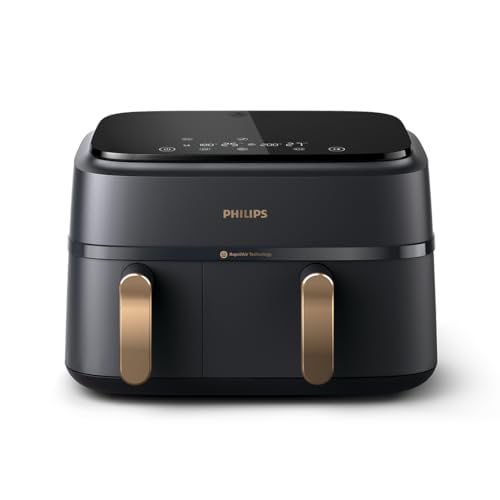
Philips Air Fryer 3000 Series Dual Basket, 9L, 8-in-1
ASIN B0D2XXZJKD • $198.00 • Ships from Amazon AU
The Philips 3000 Series is this page's answer for buyers who want two drawers without paying FlexDrawer money. Two baskets share a 9L capacity, so you can cook two meals at once, and the Sync function lines up the finish times while Copy mirrors one basket's settings onto the other with a single touch, the same dual-drawer jobs the Ninja Dual Zone covers with Match and Sync. RapidAir Plus is Philips' upgraded air circulation, which the listing pitches as crisp outside and tender inside with virtually no added oil.
Eight presets cover fresh fries, frozen fries, chicken, meat, fish, veggies, cake and reheat, from a touchscreen that lets you customise each setting, and the HomeID app adds a recipe library with step-by-step guidance. I'd rate the plain presets as the durable part of that package and treat the app as a bonus. It holds number 8 in Amazon AU's Air Fryers category at time of checking, at $198 from Amazon AU, which puts it level with the Dual Zone on price and well under the FlexDrawer.
Honest caveats: Power isn't stated on the listing, and neither is dishwasher safety, so check the manual before putting the baskets through a cycle. The 9L is a total across two baskets rather than one large space, so single big items are out, and two baskets mean two lots of washing.
Best for: Families of three to five who want two drawers and sync cooking at a lower price than the FlexDrawer.
Capacity: 9L total across two baskets • Power: Not stated on the listing • Modes: 8 presets, adjustable on the touchscreen • Dual basket: Sync and Copy functions • Airflow: RapidAir Plus • App: HomeID recipes • Price: $198.00 at time of writing • Rank: #8 in Air Fryers (Amazon AU)
View on Amazon AU
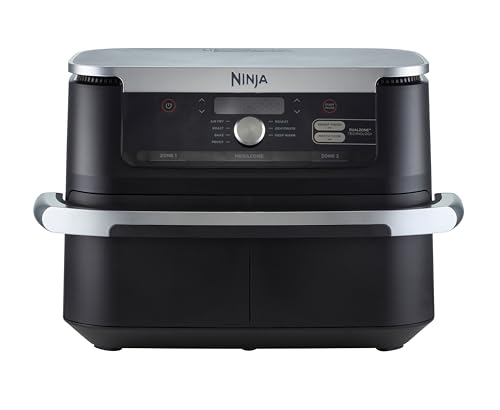
Ninja XXXL FlexDrawer Air Fryer AF500ANZ, 10.4L
ASIN B0CGH4Y9L2 • $399.95 • Ships from Amazon AU
The FlexDrawer is Ninja's answer to the one genuine complaint about its own Dual Zone: two medium spaces are sometimes the wrong shape. Here the 10.4L drawer is one wide MegaZone that takes larger proteins and full meals in a single space, with a removable divider that splits it into two independent zones when the chips-and-chicken night comes around. Per the listing it feeds eight or more people in MegaZone form, and while I'd apply the usual maker's-number discount, the underlying point stands: this is the only unit on the page where a large tray of food cooks as one piece, and that flexibility is what the extra money buys.
Seven functions add Proof to the usual list, pointing at bread dough, and two heating fans drive the oversized space; the listing claims meals cook up to 40 per cent faster than a traditional oven, which I'll pass along as the maker's figure rather than mine. Divider in, it behaves like the Dual Zone with independent functions, times and temperatures per side and the same sync logic to land everything together. The drawer, divider and plates are dishwasher safe per the listing, and the same coating economics apply at this price with more force: a replacement part is always going to beat replacing a $400 appliance. Divider out, remember you're heating the full 10.4L for whatever's cooking, so solo meals do better with the divider in and a single zone running.
It holds number 5 in Amazon AU's Air Fryers category at time of checking, which is remarkable at more than four times the price of the category's entry points. For a household of five-plus, or anyone routinely cooking for a crowd, it's the one to buy once instead of outgrowing something smaller in a year. The buy-once logic cuts both ways though: it earns its price at a full table and squanders it in a small household, where the Dual Zone or the Philips does the same nightly work while heating less space. Size to the table you actually set, not the one you host twice a year.
Honest caveats: It's a physically large bench commitment, and at 10.4L you're heating more space than a small household needs most nights, which works against the running cost case. Power isn't stated on the listing, and the feeds-8+ and 40-per-cent-faster figures are the maker's claims, not measurements of mine.
Best for: Households of five or more, and anyone who regularly needs one large cooking space rather than two medium ones.
Capacity: 10.4L MegaZone with removable divider • Power: Not stated on the listing • Functions: 7 including Proof and dehydrate • Heating: Two fans (stated) • Modes: Single MegaZone or two independent zones • Cleaning: Dishwasher-safe drawer, divider and plates • Price: $399.95 at time of writing • Rank: #5 in Air Fryers (Amazon AU)
View on Amazon AUSide-by-side comparison
| Product | Price | Best for |
|---|---|---|
| Braun Essentials MultiFry 3 HF3030BK | ~$89 | One to three people on a tight budget |
| Russell Hobbs Satisfry Air Extra Large 8L | ~$129 | Two to four people who want one roomy basket |
| Ninja Air Fryer Pro | ~$128.97 | Small kitchens, two to three people |
| Philips Air Fryer 2000 Series 4.2L | ~$143.00 | One to three people wanting a compact Philips |
| Philips Air Fryer 2000 Series 6.2L | ~$148.00 | Two to four people who want a window and stated numbers |
| Ninja Foodi Dual Zone Air Fryer | ~$199.00 | Families cooking two foods to one dinnertime |
| Philips Air Fryer 3000 Series Dual Basket | ~$198.00 | Families wanting two drawers for less than the FlexDrawer |
| Ninja XXXL FlexDrawer Air Fryer | ~$399.95 | Five or more people, or big single items |
What we see fail at the bench: air fryers
Electrically, an air fryer is about the simplest appliance in the kitchen: a heating element, a fan, a thermostat and thermal fuse, a controller board, and a small interlock switch that confirms the drawer is home. That short parts list means failures are predictable, and most of the dead units people describe to us come down to one of three things, usually the inexpensive one.
Thermal fuses that do their job once
The thermal fuse is a one-shot safety device sitting near the element, and it opens permanently if the cavity overheats, taking the whole appliance dead with it. Blocked vents are the usual trigger: the unit shoved back under a cupboard, recycling its own exhaust until the fuse lets go. The fuse itself costs very little, and a unit that died this way is often perfectly fine otherwise. The lesson that prevents the repeat is airflow, because a fuse that blew once in a cramped corner will blow again in the same corner after the fix.
The drawer interlock microswitch
Every time the drawer slides home it clicks a small switch that tells the controller it's safe to heat, and that switch takes a mechanical hit with every slam, thousands of times a year. When it wears or the actuator tab cracks, the symptoms mislead: the display may light while the element never fires, or the unit behaves as if the drawer is forever open. People bin working appliances over this constantly, because the symptom reads as a dead machine rather than a worn $2 part doing exactly what worn switches do. It's among the first things checked on any air fryer that heats intermittently.
Fan bearings and a decade of oil vapour
The fan is the appliance's other moving part, and it spends its life in hot air loaded with vaporised oil. That vapour condenses on the motor shaft and blades, picks up dust, and gradually turns into the sticky lacquer that makes an older unit rattle, whine on startup, or slow down enough that food cooks unevenly. Regular cleaning of the basket does nothing for this, since the buildup is behind the cavity wall where cloths don't reach. A noisy fan is worth addressing early, because a fan that stalls takes the temperature control down with it and invites the thermal fuse to end things.
Decision tree: which one should you actually buy?
- Cooking for one or two, want the running cost benefit at minimum outlay? → The Braun MultiFry 3 at $89: stated 1,500W, 4.3L, and nothing on it you won't use.
- Want a roomy single basket at a low price? → The Russell Hobbs Satisfry Air Extra Large at $129: an 8L basket with 10 presets, a touchscreen and a stated 220°C ceiling.
- Small kitchen, two or three people, want the strongest compact unit? → The Ninja Air Fryer Pro at $125, with a stated 210°C ceiling for crisp skin and wings.
- Want a window, stated wattage and the most refined single drawer? → The Philips 2000 Series 6.2L at $148, whose listing even states capacity in honest grams.
- Want a compact Philips with plenty of one-touch modes? → The Philips 2000 Series 4.2L at $143: 13 cooking modes and a listing that states what fits in grams.
- Family of four cooking two foods to one dinnertime? → The Ninja Dual Zone at $199: two independent 3.8L drawers with sync to finish together.
- Want two drawers for less than the FlexDrawer? → The Philips 3000 Series Dual Basket at $198: 9L across two baskets, with Sync and Copy functions.
- Five or more mouths, or need one big space for large items? → The Ninja FlexDrawer at $400: a 10.4L single zone that splits in two when needed.
- An air fryer that lights up but won't heat, or died mid-cook? → Odds favour the interlock switch or thermal fuse rather than the element. Bring it in to our Erina workshop and we'll tell you which, and what it's worth, before you rebuy.
Frequently asked questions
Does an air fryer really cost less to run than an oven?
For the food that fits in it, usually yes, and the arithmetic is simple enough to check. At an assumed 33c per kilowatt hour, the 1,700W Philips costs about 56c an hour flat out, so a twenty-minute cook has a ceiling around 19c, and cycling brings real cooks in lower. A 2,000W oven at the same tariff is about 66c an hour flat out, plus preheat spent heating a much larger cavity before food goes in. The saving disappears when you run multiple air fryer batches to feed a crowd, which is why sizing to the household matters more than the tariff.
What size air fryer does a family of four actually need?
In drawer terms, more than the litre figure suggests. Air frying cooks food in a shallow layer, so usable capacity is well under the bucket volume on the box, and a 4 to 5L single drawer that sounds family-sized becomes a batch-cooking exercise for four people. The honest answer for most four-person homes is a dual-drawer unit around 7 to 8L total, like the Ninja Dual Zone, or the 10.4L FlexDrawer if large single items are a regular event. Philips stating 800g of fries for its 6.2L pan shows how big the gap between litres and dinner really is.
Can I plug an air fryer into a powerboard?
Plug it into the wall socket instead. A standard Australian socket is rated 10A, or 2,400W at 240V, and while every fryer here fits inside that on its own, kitchen powerboards rarely carry just one appliance. A board feeding a kettle and a fryer in the same breakfast rush is passing serious current through a $15 part, and sustained high current is exactly what makes boards run hot and fail. The fryer, the kettle, the toaster and any heater each earn their own wall socket, and that habit costs nothing.
Why did my air fryer stop heating even though the display works?
That symptom pattern usually points away from the element. The two common causes are the drawer interlock switch, a small part that wears after thousands of drawer slams and stops telling the controller the drawer is closed, and the thermal fuse, a one-shot safety that permanently opens after an overheat, often caused by blocked vents. Both are inexpensive components, and either can make a working appliance read as dead. It's worth a proper diagnosis before replacing the unit, especially on the dearer dual-zone machines where the gap between a small repair and a rebuy is wide.
Is the dishwasher bad for air fryer baskets?
The listings here all rate their baskets or plates dishwasher safe, and that claim is true as far as survival goes. What it doesn't promise is coating lifespan. Dishwasher detergent and heat age non-stick surfaces faster than hand washing, and the basket coating is already the part of an air fryer that wears out first. A two-minute hand wash with a soft sponge is the single habit that most extends these appliances. When a coating does fail, check the maker's spare parts before replacing the machine, because the big brands sell replacement baskets and plates for a fraction of a new unit.
Are the capacity claims on air fryer listings trustworthy?
Treat them as maximum-fit numbers rather than cooks-well numbers. The litre figure measures the drawer as a container, but air frying wants food shallow with air moving around it, so the quantity that cooks properly in one pass is always less than the drawer physically holds. Claims like 1.2kg of chicken or 2.3kg of wings describe a packed drawer. The more useful listing habit is Philips stating 800g of fries for a 6.2L pan, which is close to the real single-layer figure. My working rule: buy one size up from whatever the box claims feeds your household.
Related buying guides
Air fryer lights up but won't heat?
Nine times out of ten that's a worn drawer switch or a blown thermal fuse, not a dead appliance, and both are quick to confirm. Bring it in to the Erina workshop and we'll diagnose which part failed and whether the fix makes sense against replacement, before you spend anything on a new unit.
Visit our Erina workshop Book Online