Prices from Amazon AU, updated daily. Swipe or use the arrows for more.
Disclosure: This article contains affiliate links to amazon.com.au. If you buy through one of these links iFix may earn a small commission at no extra cost to you. It doesn't change which products we recommend. We focus on what actually lasts based on 16 years of repair-shop experience.
Quick summary8 picks
- Entry PickAIYIMA 800X 8 Inch Powered Subwoofer about$2348" driver, RCA, AUX and LFE.
- Edifier T5 Powered Subwoofer - 70w RMS… about$26938Hz, 70W RMS, 8" driver.
- Edifier T5s Powered Active Subwoofer with… about$28935Hz, 70W RMS, 8" driver.
- Yamaha NS-SW200 Subwoofer, 20cm Cone about$499130W, 20cm cone, auto standby.
- Audioengine S8 250W Powered Subwoofer about$423250W, 8-inch down-firing driver.
- Yamaha NSSW050 Powered Subwoofer, 8-Inch about$431.90Twisted Flare Port, 20cm cone.
- Most PremiumYamaha NS-SW100 Subwoofer Speaker with 100W… about$576.9525cm woofer, 25 to 180 Hz.
- Bose Bass Module 500 - Black - Wireless about$529Wireless, for Bose soundbars.
What a powered subwoofer actually does
A subwoofer handles the lowest notes, roughly everything under 80 to 120 Hz, so your main speakers don't have to. Bass takes far more air movement than mid and treble, which is why small bookshelf speakers and soundbars run out of puff on explosions, organ notes and kick drums. Hand that job to a dedicated box with a bigger driver and its own amplifier, and the whole system usually sounds cleaner, not just louder.
Every sub in this guide is powered, which means the amplifier is built into the cabinet on a plate or board at the back. You feed it a line-level signal from a receiver, amplifier or soundbar and plug it into the wall. That's very different from a passive sub, which needs a separate amplifier, and from car subwoofers, which run on 12V and don't belong anywhere near a lounge room. I've left both of those out.
If you already have an AV receiver from the AV receiver guide, any of the wired subs here will plug straight into its sub out. If you've got a stereo amplifier from the stereo amplifier guide, check it has a sub or pre out first. The one exception is the Bose, which only talks wirelessly to Bose soundbars, and I'll come back to that.
Driver size, power ratings and what they mean
Driver size is the number most people look at first. The subs here run from 20cm, roughly 8-inch, drivers like the one in the Yamaha NS-SW200 to a 25cm, roughly 10-inch, driver in the Yamaha NS-SW100. A bigger driver moves more air for the same amount of travel, so it can play lower and louder before it runs out of excursion. That's why a 10-inch sub usually suits a large living room better than an 8-inch one.
Power ratings are messy. Some brands quote continuous output, some quote dynamic or peak, and a few don't say which. Edifier quotes 70W RMS for the T5s, which is a continuous figure. Yamaha quotes 100W of dynamic power for the NS-SW100 and 130W of output power for the NS-SW200, and lists no wattage for the NSSW050. Audioengine quotes 250W for the S8 without saying how it's measured. Don't compare those numbers directly, because they aren't measured the same way.
What the power rating does tell you is how hard the amplifier works near its limit. A sub that's run flat out for long periods, in a big room with the volume knob at maximum, runs its amp hot, and heat is what ages the capacitors on the plate amp. Picking a sub with some headroom for your room, rather than the smallest one you can get away with, is the easiest way to make it last.
Ported, sealed, front-firing and down-firing
A ported sub has a tube or slot that uses the air inside the cabinet to reinforce the lowest notes, so it plays deeper and louder for its size. The Yamaha's Twisted Flare Port and the Edifier's side port are both examples. The downside is that a poorly designed port can chuff or whistle at high volume, which is exactly what Yamaha says its twisted, flared shape is meant to reduce.
A sealed sub has no port. It usually sounds tighter and stops more cleanly, but it needs more amplifier power and a larger driver to reach the same depth. None of the listings here clearly describe a sealed design, so I can't say which of the smaller units are ported without the manufacturer's spec sheet. It's worth checking if you're putting a sub very close to a wall, because some ports need breathing room.
Front-firing subs point the driver into the room, and down-firing subs point it at the floor. The Audioengine S8 is down-firing, and the rest here are front-firing. Down-firing makes the sub easier to hide and less fussy about which way it faces, but it couples to the floor more, so on a suspended timber floor you may feel it through your feet more than hear it. Put it on a solid pad if that happens.
Cabinet build matters more than people think. Edifier states an 18mm MDF cabinet for the T5s, which is thick enough to keep the box from buzzing along with the driver. A thin cabinet rattles at high volume, and that rattle often gets blamed on the driver. If you hear a buzz from a sub, check that nothing's loose on top of it and that the grille is seated before you assume it's faulty.
Placement and crossover settings
Where you put a sub changes how it sounds more than which sub you buy. Bass waves are long enough to bounce around a room and either pile up or cancel out in different spots. A corner gives you the most output but can sound boomy. A spot along the front wall, a third of the way in from a corner, is often smoother. Moving it a metre can change the bass at your seat completely.
The trick that works in most rooms is the subwoofer crawl. Put the sub on your listening seat, play something with steady bass, then crawl around the front of the room and listen for where the bass sounds even and tight. That's where the sub goes. It looks silly, but it's quicker than guessing, and it usually beats any auto-calibration on its own.
Set the crossover so the sub and the main speakers hand over cleanly. If you've got a receiver, set your speakers to small and the crossover to around 80 Hz, then turn the sub's own low-pass knob all the way up so the receiver does the work. On a stereo amp with no bass management, set the sub's low-pass filter just below where your main speakers start to roll off. The T5s gives you 30 to 160 Hz to play with.
The phase switch fixes the last bit. If the bass sounds thin at your seat even though the sub is clearly working, flip the phase from 0 to 180 degrees and listen again. The setting that sounds fuller is the right one, because the sub and speakers are then pushing air together instead of against each other.
Inputs, auto-standby and wireless kits
Check the inputs before you buy. Most subs take a single RCA line-level input, which is what a receiver's sub out uses. The Edifier T5s has dual RCA inputs and outputs, so you can feed it from an amp and pass the signal on to a second sub or another device. If your amplifier only has speaker outputs and no pre out, you'll need a sub with speaker-level inputs, and the listings here don't mention any.
Auto-standby turns the sub off after a period with no signal and wakes it when sound comes back. Edifier says the T5s sleeps after 15 minutes and Audioengine lists a sleep mode on the S8. It's useful, but a sub that's set too sensitive will drop out during quiet scenes and miss the first second of bass when it wakes. Yamaha's system control terminal lets the NS-SW100 switch on and off with a compatible Yamaha amplifier, which avoids the problem entirely.
Wireless kits remove the long RCA lead across the room. Audioengine's S8 works with its W3 wireless adapter, sold separately, and the Bose Bass Module 500 is wireless out of the box but only pairs with Bose soundbars. Many of the bars in the Atmos soundbar guide lock you to their own sub in the same way. Wireless still needs a power point near the sub. It can also add a tiny delay, so if the bass feels slightly behind the picture, check the receiver or soundbar's distance and delay settings.
Hum, ground loops and noise
A low hum from a sub with nothing playing is one of the most common complaints, and it's rarely a faulty sub. It's usually a ground loop, where the sub and the receiver are earthed through different power points and the RCA lead's shield carries a small current between them. Plug the whole system into the same powerboard or wall outlet first and the hum often disappears.
Cable TV and antenna leads are the other usual cause. The antenna or cable box connects the system to a separate earth through the coaxial shield, and the sub picks it up as hum. A ground loop isolator on the antenna line fixes that cleanly. Never remove the earth pin from a plug to stop hum, because that takes away the safety earth on a mains-powered appliance.
A buzz that gets louder with the volume knob is different. That can be a loose panel, a damaged driver surround or a dry joint on the amp board. Turn the sub down, press gently on the cabinet panels while it plays and see if the buzz changes. If it doesn't, it's worth getting the amp checked before it gets worse.
Old drivers can buzz too. Foam surrounds on subs from the 2000s and earlier perish and crumble with age, and once the surround splits the cone rubs or flaps at high excursion. You can usually see it by taking the grille off. Re-foaming a driver is a common repair and much less than a new sub, but the newer rubber surrounds on most current subs, including the ones here, last far longer.
What a storm does to a subwoofer
The plate amp is the part that fails, and power surges are the main reason. A subwoofer has a mains power supply on the same board as a high-current amplifier, and it's often left on standby all year, plugged straight into the wall and connected by a long signal lead to a receiver that's also plugged into the antenna. That gives a surge two ways in, through the mains and through the signal ground.
After a storm we see blown fuses, failed power supply chips, damaged output transistors and burnt tracks on sub amp boards. Some are a simple fuse and a component or two. Others take out the whole board, and on a lower-priced sub, the board alone can cost close to the price of the sub. A good surge-protected powerboard for the whole AV system is a small cost against that.
If a sub stops working after a storm, don't keep turning it on and off to test it. Unplug it, check whether the power light comes on at all and whether the receiver still works into other speakers. Then bring it into our Erina workshop and we'll tell you whether it's the amp board, the fuse or the receiver before you spend anything.
Power, running cost and electrical safety
A sub's power rating isn't what it draws from the wall most of the time. At normal listening levels a home sub uses a fraction of its rated output, and in standby it uses very little. As a rough guide, if a sub averaged 50W over a three-hour movie, at the AU average of roughly 33c per kWh that's about 5c. Running cost isn't the reason to pick one sub over another.
Standby is where the hours add up. A sub left on standby 24 hours a day draws power even when nothing's playing, which is why auto-standby and system control matter more than the headline wattage. Our guide to standby power savings covers how to put a whole AV setup on one switched outlet so the sub goes fully off with the TV.
Look for an RCM mark and an Australian plug on any sub you buy. Check the listing for 230V Australian mains on any powered speaker, and all eight here are sold by Amazon AU or Australian sellers. Keep the sub's back panel clear of curtains and walls so the amp can shed heat, and never stack anything on top that blocks its vents. Hot amps are short-lived amps.
The 8 picks, $249 to $598
Prices are Amazon AU at time of writing (8 November 2026) and move week to week. Ranks are Amazon AU category sales ranks, checked the same day.

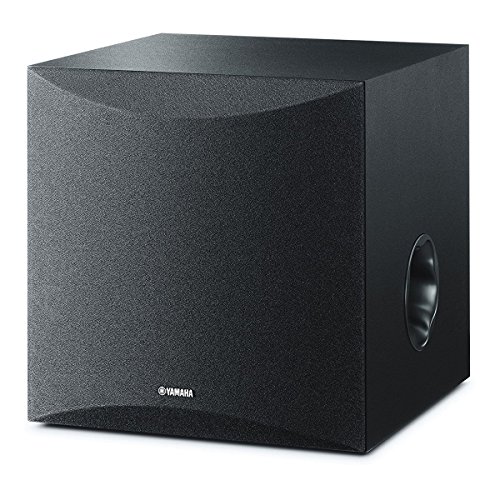
Yamaha NS-SW100 Subwoofer, 25cm Driver
ASIN B07CTQW9DW • $576.95 • Ships from Amazon AU
The Yamaha NS-SW100 is $577 from Amazon AU and ranks #1 in Amazon AU's Hi-Fi Subwoofers category, the highest rank of any sub here. It has a 25cm woofer, the biggest driver in this guide, plus the Twisted Flare Port and Advanced YST II servo drive. Yamaha lists a frequency response of 25 to 180 Hz, a dynamic power figure of 100W at 5 ohms and an output power of 50W at 100 Hz with 10 percent distortion.
System control and auto-standby are both listed, so with a compatible Yamaha receiver the sub can switch on and off with the amp. The rounded cabinet with a slanted front is designed to be unobtrusive, which counts in a living room where the sub sits in plain view.
This is the one I'd pick for a medium to large living room with a receiver. Plug it into a surge-protected powerboard with the rest of the system, and leave a hand's width between the port and the wall. The listing doesn't state the weight, the input types or the warranty, so check Yamaha Australia's terms before you order.
Honest caveats: it costs $147 more than the NSSW050. The 100W figure is a dynamic rating and the output power is 50W, so don't compare it directly with the bigger numbers quoted for the Audioengine S8. The listing doesn't state the weight, the inputs or the warranty.
Best for: Medium to large living rooms with an AV receiver, especially a Yamaha one.
Driver: 25cm woofer • Power: 100W dynamic (5 ohms), 50W output at 100 Hz • Frequency response: 25 to 180 Hz • Port: Twisted Flare Port • Drive: Advanced YST II • Extras: System control, auto-standby • Model: NS-SW100 • Seller: Amazon AU • Rank: #1 in Hi-Fi Subwoofers (Amazon AU)
View on Amazon AU
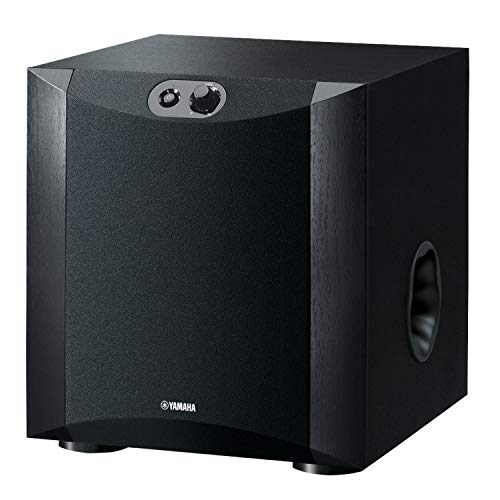
Yamaha NSSW050 Powered Subwoofer, 20cm Driver
ASIN B01K7KQWQS • $431.90 • Ships from Amazon AU
The Yamaha NSSW050 is $429 from Amazon AU and ranks #88 in Amazon AU's Hi-Fi Subwoofers category, so it is far less of a crowd favourite than the NS-SW100 at #1. The case for it is price inside the Yamaha range: it costs $147 less than the NS-SW100 and still gets Yamaha's port and servo tech. The listing gives a 20cm (8-inch) cone woofer, the Twisted Flare Port and Advanced YST II, and not much else.
The Twisted Flare Port is Yamaha's answer to port noise. A plain round port can chuff when a lot of air moves through it, and the flared, twisting shape is meant to smooth that airflow so you hear bass rather than wind. Advanced YST II is Yamaha's servo drive system, which keeps tighter control of the cone. Together they are why I'd look at a Yamaha before a no-name 8-inch box at a similar price.
This is the one I'd pick for a small to medium living room with a receiver or stereo amp that has a sub out. The listing doesn't state the wattage, frequency response, inputs, weight or warranty, so check those on Yamaha Australia's spec sheet before you order. Plug it into a surge-protected powerboard with the rest of the system, and leave a hand's width between the port and the wall.
Honest caveats: the listing doesn't state the amplifier power, the frequency response, the input types or the warranty. The rank of #88 is well behind the NS-SW100. An 8-inch cone won't fill a large open-plan room at movie volume the way the 25cm NS-SW100 will.
Best for: Small to medium living rooms with a receiver or stereo amp that has a sub out, for anyone who wants Yamaha's port and servo tech at a lower price than the NS-SW100.
Driver: 20cm (8-inch) cone woofer • Port: Twisted Flare Port • Drive: Advanced YST II • Model: NSSW050 • Seller: Amazon AU • Rank: #88 in Hi-Fi Subwoofers (Amazon AU)
View on Amazon AU
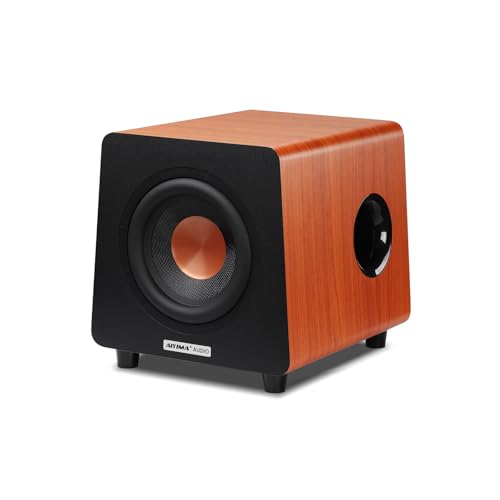
AIYIMA 800X Powered Subwoofer, 8-Inch
ASIN B0DL9LZS33 • $234 • Ships from Amazon AU
The AIYIMA 800X is $249 from Amazon AU, the lowest price on the list, and ranks #6 in Amazon AU's Hi-Fi Subwoofers category. It's an 8-inch powered sub with a TPA3116 amplifier chip, RCA, AUX and LFE inputs and a dense wood cabinet. The listing says it can withstand 100 to 150W and gives no continuous output rating.
The cabinet is a sloped trapezoid that the listing says lowers the centre of gravity so the box sits steadier, and the cone is a glass fibre paper cone. The LFE input is the one to use if your receiver has a dedicated sub out, while the RCA and AUX inputs cover stereo amps and desktop setups. The listing pitches it at home theatre, music, games and small stage use.
It's the sub to try when $250 is the ceiling and you still want an 8-inch driver with proper inputs. Keep it on a surge-protected powerboard and leave space behind the port. The listing doesn't state a frequency range, a low-pass control, the weight or a warranty, so check the seller's terms.
Honest caveats: no frequency range, crossover, weight or warranty is stated. The 100 to 150W figure is a handling claim, not a continuous rating. AIYIMA is a lesser-known brand and the listing doesn't mention Australian service.
Best for: Small rooms and tight budgets that still want an 8-inch driver and an LFE input.
Driver: 8-inch, glass fibre paper cone • Amplifier: TPA3116 chip, handles 100 to 150W (listing) • Inputs: RCA, AUX, LFE • Cabinet: Dense wood, sloped trapezoid • Seller: Amazon AU • Rank: #6 in Hi-Fi Subwoofers (Amazon AU)
View on Amazon AU
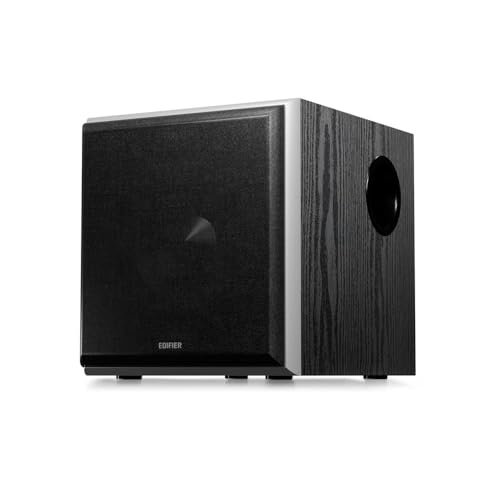
Edifier T5 Powered Subwoofer, 70W RMS, 8-Inch
ASIN B07MC6D6NZ • $269 • Sold by Ventchoice Australia on Amazon AU
The Edifier T5 is $269 from Ventchoice Australia and ranks #13 in Amazon AU's Hi-Fi Subwoofers category. It's the older sibling of the T5s, with the same 8-inch driver and 70W RMS rating, and bass down to 38 Hz where the T5s claims 35 Hz. The listing describes a thick MDF enclosure, a low-pass filter and automatic standby.
Edifier quotes 70W RMS, a continuous figure, so it's easier to compare than the peak numbers some brands print. The low-pass filter is the control that matters when you blend the sub with bookshelf speakers: set it just below where they roll off. The listing doesn't mention a phase switch, which the T5s has.
It's $20 less than the T5s, and the T5s documents more controls and 3 Hz more claimed depth, so I'd take the T5s unless that $20 matters. Ventchoice is an Australian storefront, but keep your order details for the warranty. Run it from a surge-protected powerboard.
Honest caveats: the listing doesn't state the warranty, the inputs or a phase control. 70W RMS and an 8-inch driver won't fill a large room at movie volume.
Best for: Small rooms and bookshelf speaker systems on a $270 budget.
Driver: 8-inch • Amplifier: 70W RMS • Frequency response: Down to 38 Hz • Controls: Low-pass filter, automatic standby • Cabinet: Thick MDF • Seller: Ventchoice Australia • Rank: #13 in Hi-Fi Subwoofers (Amazon AU)
View on Amazon AU
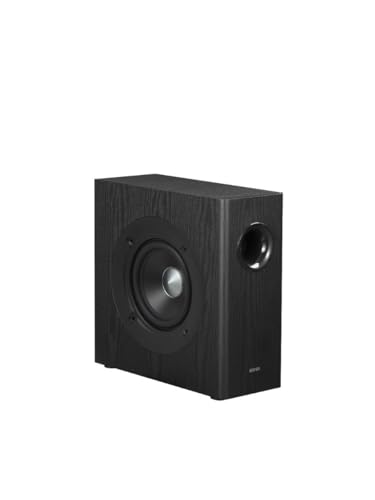
Edifier T5s Powered Subwoofer, 70W RMS, 8-Inch
ASIN B0F6NH4373 • $289 • Sold by Ventchoice Australia on Amazon AU
The Edifier T5s is an entry-level sub at $289, sold by Ventchoice Australia, and it ranks #5 in Amazon AU's Hi-Fi Subwoofers category, a rank shared with the brown version. The part number is T5S-BK and the listing states a 1-year warranty. It uses an 8-inch long-throw driver and a Class-D amplifier rated at 70W RMS, which is the only continuous power figure quoted by any brand in this list. Edifier claims bass down to 35 Hz. The cabinet is 18mm MDF with a front-firing driver and a side-firing port, and it weighs about 10 kg according to the listing. It's designed to sit alongside Edifier's R-series powered bookshelf speakers, but it works with any line-level source.
The controls are the best on a sub at this price. You get a low-pass filter adjustable from 30 to 160 Hz and a phase switch for 0 or 180 degrees, which are exactly the two settings you need to blend a sub with a stereo amp or powered speakers. There are dual RCA inputs and outputs, so you can chain it to other gear, and Edifier includes a 3.5mm-to-RCA cable and an RCA cable in the box. Auto-standby turns it off after 15 minutes of silence. For a desk setup, a bedroom or a small lounge with bookshelf speakers, it covers the basics properly, and the side port makes it a little easier to fit close to a wall.
It's not a big-room home theatre sub. An 8-inch driver at 70W RMS will run out of headroom in a large open-plan space at movie volume, and pushing it hard there is how amps get cooked. Keep it for small and medium rooms. Ventchoice is an Australian storefront, but keep your order details for the warranty. Set the low-pass just below where your speakers roll off. Keep its vents clear and don't run it at full volume for long periods. Use the supplied RCA cable rather than a long thin lead. For a first sub on a modest system, it's good value.
Honest caveats: 70W RMS and an 8-inch driver won't fill a large room at movie volume. The warranty is 1 year. It's sold by Ventchoice Australia rather than Amazon AU. The rank is shared with the brown version. There are no speaker-level inputs, so your amp needs a line out.
Best for: Small rooms, desks and bookshelf speaker systems that need a sub with proper controls.
Driver: 8-inch long-throw, front-firing • Amplifier: 70W RMS Class-D • Low-pass filter: 30 to 160 Hz • Phase: 0 or 180 degrees • Inputs: Dual RCA in and out • Cabinet: 18mm MDF, side port • Warranty: 1 year • Seller: Ventchoice Australia • Rank: #5 in Hi-Fi Subwoofers (Amazon AU)
View on Amazon AU
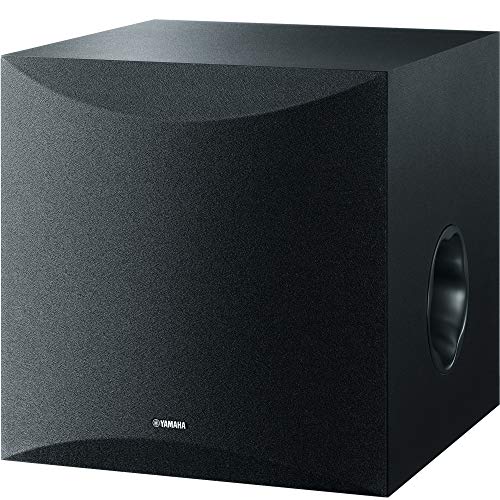
Yamaha NS-SW200 Subwoofer, 130W, 20cm Cone, Black
ASIN B077ZMLQRK • $499 • Sold by Amazon AU
The Yamaha NS-SW200 is $499 and sold by Amazon AU, and it ranks #1 in Amazon AU's Hi-Fi Subwoofers category at time of writing. The listing gives a built-in amplifier with a stable 130W of output, a 20cm cone woofer and Yamaha's twisted flare port, which is shaped to smooth the airflow at the port and cut port noise. It sits between the NSSW050 and the NS-SW100 in this guide, with a bigger amplifier than the first and a smaller driver than the second.
The listing describes Yamaha's Advanced YST II, which drives the cone with tighter control for more stable low-end response. The power and volume buttons are on the front panel, angled at 45 degrees so they are easy to reach with the sub on the floor, and an LED above the power button shows whether it's on. The system control terminal can be linked to the amplifier's power, so the sub switches on and off with the rest of the system. If no signal arrives for a set period it drops into standby, and it wakes when a signal is detected.
The listing doesn't state the weight, the dimensions, the frequency response or a warranty term, so check the details on the listing before you order. Give the rear panel and port some air, keep the sub off a wobbly shelf, and plug it into a surge-protected board with the rest of the system.
Honest caveats: The listing doesn't state the weight, dimensions, frequency response, crossover or warranty. The 130W figure isn't described as continuous or peak. A 20cm driver will not fill a large room the way the 25cm NS-SW100 can. Wireless isn't mentioned, so plan on a cable run.
Best for: <strong>Best for:</strong> Small to medium lounges that want a mid-sized Yamaha with automatic standby and an amplifier link.
Driver: 20cm cone woofer • Amplifier: 130W output (as listed) • Port: Twisted flare port • Technology: Advanced YST II • Standby: Automatic, with system control terminal link • Colour: Black • Model: NS-SW200 • Seller: Amazon AU • Rank: #1 in Hi-Fi Subwoofers (Amazon AU)
View on Amazon AU
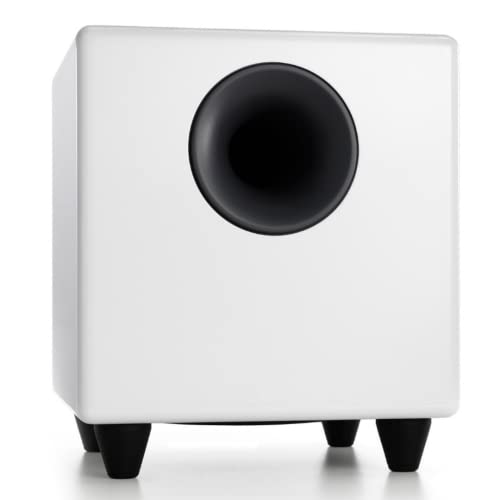
Audioengine S8 250W Powered Subwoofer, 8-Inch, White
ASIN B002XRS0T6 • $423 • Sold by Computer Alliance Pty Ltd on Amazon AU
The Audioengine S8 in white is $549 from Computer Alliance Pty Ltd, an Australian seller on Amazon AU, and it ranks #2 in Amazon AU's Hi-Fi Subwoofers category. It has an 8-inch down-firing driver and a built-in amplifier rated at 250W, which the listing doesn't say how it measures. The listing calls out easy positioning and says it works with Audioengine's W3 wireless subwoofer adapter if you want to lose the RCA lead. It's one of the dearer subs here, so it's the one to pick for the down-firing design rather than the price.
Down-firing is the reason to pick it. The driver points at the floor, so the sub is less fussy about which way it faces and easier to tuck beside a couch or behind a cabinet without the grille showing. The trade-off is that it couples more to the floor. On a slab it's fine, but on a suspended timber floor you can end up feeling the bass through the boards more than hearing it in the room. A solid isolation pad underneath usually sorts that out. The listing also mentions a sleep mode that powers it down when there's no signal, which helps with standby power over a full year.
The listing doesn't state the frequency response, crossover range, phase control, inputs, weight or warranty, so check Audioengine's spec sheet and ask the seller about the warranty before you buy. Leave space around it for the driver to breathe, because a down-firing sub pushed onto thick carpet loses output. Don't stack anything heavy on top. Keep it on a surge-protected board. Use the phase setting on your amp or receiver if the sub has none of its own. Budget for the W3 adapter if you want it wireless. For a medium room where you want the sub out of sight, it's a good middle option.
Honest caveats: the listing doesn't state frequency response, crossover, phase control, inputs, weight or warranty. The 250W figure isn't described as continuous or peak. Down-firing subs can boom through suspended timber floors, so a pad may help. It's sold by Computer Alliance Pty Ltd, not Audioengine AU.
Best for: Medium rooms where the sub needs to hide beside a couch or cabinet.
Driver: 8-inch down-firing • Amplifier: 250W (as listed) • Standby: Sleep mode • Wireless: Compatible with Audioengine W3 (sold separately) • Colour: White • Model: S8 • Seller: Computer Alliance Pty Ltd • Rank: #2 in Hi-Fi Subwoofers (Amazon AU)
View on Amazon AU
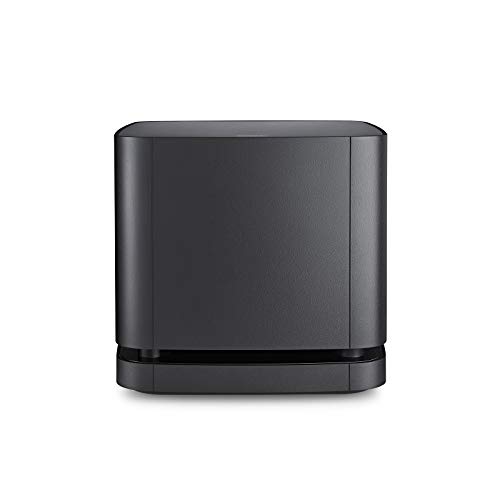
Bose Bass Module 500, Wireless Compact Subwoofer
ASIN B07G9N7CFL • $529 • Ships from Amazon AU
The Bose Bass Module 500 is $598 from Amazon AU and ranks #2 in Amazon AU's Hi-Fi Speaker Systems category. The part number is 796145-5110. It's a wireless subwoofer built to pair with Bose soundbars, and that's both its strength and its limit. If you already own a compatible Bose soundbar, it connects without a cable to the bar and adds the bass that a soundbar on its own can't produce. If you don't, it's not the sub for you, because it won't plug into a receiver or a stereo amp the way the other four here will. It's a 25.4cm cube and weighs about 5 kg according to the listing.
The compact cube is the selling point for people who want bass without a big box in the room. It's a compact cube, and because it's wireless, it can go anywhere near a power point. Bose pitches it as sound you can feel, and in a typical lounge with a soundbar that's a fair description of what a sub adds. Pairing is handled through the soundbar, so there's no crossover or phase knob to set, which suits people who don't want to fiddle. It's also the easiest sub here to set up, as long as you've got the right Bose bar to pair it with.
The listing doesn't state the driver size, amplifier power, frequency response or warranty, and it doesn't list which Bose soundbars it supports, so check that on Bose's site before you buy. Being locked to Bose means it's only as useful as your soundbar, and if the bar fails or you change brands, the sub goes with it. Keep it on a surge-protected board. Keep the firmware on the soundbar up to date, because pairing problems are often fixed there. Place it within the range Bose recommends for the wireless link. Keep the box until you've confirmed it pairs. If you've got a Bose bar, it's the clean answer.
Honest caveats: it only works wirelessly with compatible Bose soundbars, not receivers or amps. The listing doesn't state driver size, power, frequency response, warranty or the compatible soundbar list. There's no crossover or phase control on the unit. It's the highest-priced pick here. Check compatibility before you order.
Best for: Owners of a compatible Bose soundbar who want wireless bass with no setup.
Type: Wireless compact subwoofer • Connection: Wireless to compatible Bose soundbars only • Size: 25.4 x 25.4 x 25.4 cm • Weight: About 5 kg (listing) • Driver and power: Not stated on the listing • Warranty: Not stated on the listing • Model: 796145-5110 • Seller: Amazon AU • Rank: #2 in Hi-Fi Speaker Systems (Amazon AU)
View on Amazon AUSide-by-side comparison
| Product | Price | Best for |
|---|---|---|
| AIYIMA 800X 8 Inch Powered Subwoofer | ~$234 | Tight budgets and small rooms with an LFE input |
| Edifier T5 Powered Subwoofer - 70w RMS… | ~$269 | Small rooms and bookshelf speakers on a budget |
| Edifier T5s Powered Active Subwoofer with… | ~$289 | Desks and bookshelf speakers with phase and crossover |
| Yamaha NS-SW200 Subwoofer, 20cm Cone | ~$499 | Small to medium lounges |
| Audioengine S8 250W Powered Subwoofer | ~$423 | Medium rooms with the sub out of sight |
| Yamaha NSSW050 Powered Subwoofer, 8-Inch | ~$431.90 | Small to medium rooms with a receiver |
| Yamaha NS-SW100 Subwoofer Speaker with 100W… | ~$576.95 | Medium to large living rooms with a receiver |
| Bose Bass Module 500 - Black - Wireless | ~$529 | Owners of a compatible Bose soundbar |
What we see fail in the workshop: subwoofers
Subwoofers are mostly a box, a driver and an amp, and it's nearly always the amp that brings them in. The driver itself is tough unless it's been badly overdriven or the surround has perished with age. Most sub faults can be traced quickly once the plate amp is out of the cabinet, and a fair few are worth fixing.
Dead after a storm
No power light, or a light with no output, after a storm is the classic sub fault. A surge through the mains or the signal lead takes out the fuse, the power supply chip or the output devices on the plate amp. Sometimes it's just the fuse and a protection component, and sometimes the whole board has gone. A surge-protected powerboard for the whole AV system, including the antenna lead where possible, prevents most of these. If it's already happened, get the amp checked before you buy a new sub, because the board is often repairable.
Hum and buzz that won't go away
Hum with nothing playing is usually a ground loop from the antenna or a second power point, and it's fixed with wiring rather than repairs. A buzz that tracks the volume is different. It's often a dried-out capacitor in the amp's power supply, a cracked solder joint on a heavy component or a loose part rattling in the cabinet. Older subs that have run hot for years are prone to the capacitor fault. That's a repairable one, and much less than a new sub. Leaving room behind the sub for airflow slows it down.
Cutting in and out
A sub that drops out during quiet scenes is usually auto-standby set too sensitive, and the fix is turning auto off or using a system control link. A sub that cuts out at high volume is different. That's usually the amp's thermal or overload protection tripping, which happens when the sub is pushed past its limit in a big room or its vents are blocked. If it keeps happening at normal levels, the protection circuit or the amp itself may be failing, and that needs a look. Clearing the vents is the first thing to try.
Decision tree: which one should you actually buy?
- Want one sub for a medium to large home theatre? → The Yamaha NS-SW100 at $577 has the biggest driver here, a 25cm woofer, and a system control link to Yamaha receivers.
- Want Yamaha's port and servo tech for less? → The Yamaha NSSW050 at $429 has a 20cm cone, the Twisted Flare Port and Advanced YST II.
- Want a sub for a small room or bookshelf speakers? → The Edifier T5s at $289 has proper low-pass and phase controls and dual RCA in and out.
- Want a mid-sized Yamaha that switches itself on and off? → The Yamaha NS-SW200 at $499 has a 130W amplifier, a 20cm cone and automatic standby.
- Want the sub hidden beside the couch? → The Audioengine S8 at $549 fires down, so it's less fussy about which way it faces.
- Already own a compatible Bose soundbar? → The Bose Bass Module 500 at $598 pairs wirelessly with no setup, once you've checked compatibility.
- Sub dead after a storm, humming or cutting out? → Bring it to our Erina workshop. We'll check the plate amp, fuse and power supply and tell you whether it's worth fixing before you spend anything.
Frequently asked questions
Do I need a subwoofer with a soundbar?
It depends on the soundbar and the room. Most soundbars can't move enough air for deep bass, so films and music sound thin without a sub, especially in a larger lounge. Many soundbars come with a wireless sub in the box. If yours didn't, check which subs it supports, because many soundbars only pair with their own brand's sub, like the Bose Bass Module 500. A soundbar with a sub out can take a wired sub like the Yamaha or Edifier here.
Where is the best place to put a subwoofer?
Start with the subwoofer crawl. Put the sub on your listening seat, play something with steady bass, then move around the front of the room at floor level and listen for the spot where the bass sounds even and tight. Put the sub there. Corners give the most output but can sound boomy, and a spot along the front wall about a third of the way from a corner is often smoother. Keep the port and amp vents clear of walls and curtains.
What crossover setting should I use for a subwoofer?
With an AV receiver, set your main speakers to small and the crossover to around 80 Hz, then turn the sub's own low-pass knob to maximum so the receiver handles it. With a stereo amp and no bass management, set the sub's low-pass filter just below where your main speakers start to lose bass, often 50 to 80 Hz for bookshelf speakers. Then try the phase switch both ways and keep the setting that sounds fuller at your seat.
Why does my subwoofer hum?
Hum with nothing playing is usually a ground loop. The sub and the rest of your system are earthed through different power points, or the antenna lead brings in a second earth, and a small current flows through the RCA lead's shield. Plug everything into the same powerboard first. If the hum stays, a ground loop isolator on the antenna lead usually fixes it. Never remove the earth pin from a plug. A buzz that changes with volume is a different problem and may be the amp.
Is a bigger subwoofer always better?
Not always. A bigger driver can play lower and louder, so a 10-inch sub like the Yamaha NS-SW100 suits a large living room better than an 8-inch one. In a small room, a big sub can overload the space and make the bass boomy, and it's harder to place. Match the sub to the room: an 8-inch sub for desks, bedrooms and small lounges, and a 10-inch or larger for medium and large rooms. Placement matters as much as size.
Can a subwoofer be repaired after a power surge?
Often, yes. Surges usually damage the plate amplifier rather than the driver, and the damage can be as small as a fuse and a protection component or as large as the whole board. Repair is usually worth it on a mid-priced or better sub, and less so on a low-priced one where a new board costs close to a new sub. Don't keep switching it on to test it. Unplug it and get the amp checked by an electronics repair shop first.
Related buying guides
Subwoofer dead after a storm, humming or cutting out?
Most subwoofer faults are on the plate amp: a blown fuse or power supply after a surge, a tired capacitor causing hum, or protection tripping on a failing output stage. Bring it into our Erina workshop and we'll check the amp and tell you whether it's worth fixing before you spend anything.
Visit our Erina workshop Book Online