Prices from Amazon AU, updated daily. Swipe or use the arrows for more.
Disclosure: This article contains affiliate links to amazon.com.au. If you buy through one of these links iFix may earn a small commission at no extra cost to you. It doesn't change which products we recommend. We focus on what actually lasts based on 16 years of repair-shop experience.
Quick summary6 picks
- Entry PickSunbeam EMM0500BK Cafe Series Conical Burr… about$218
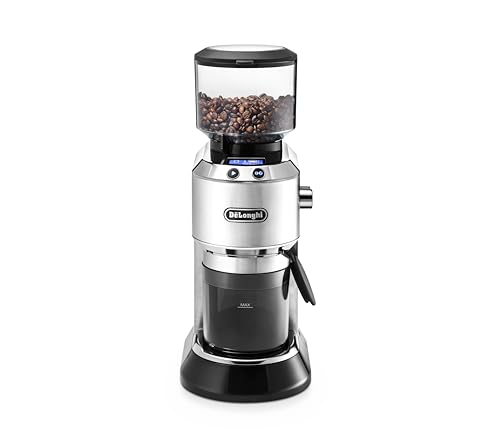
- De'Longhi Dedica Electric Coffee Grinder… about$247
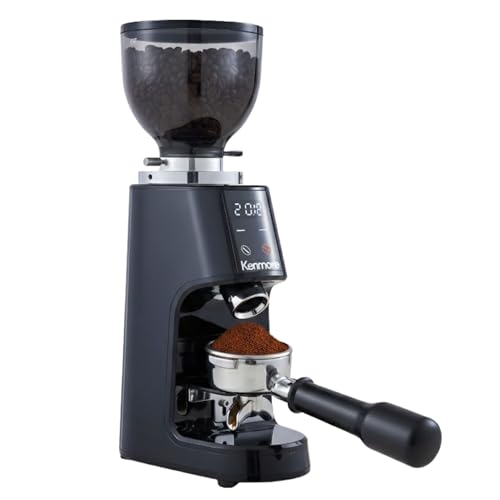
- Kenmore 64mm Flat Burr Coffee Grinder about$250260W.
- Fellow Opus Conical Burr Coffee Grinder -… about$299
- Baratza about$309
- Most PremiumBreville BCG820BSS the Smart Grinder Pro about$347
Why the grinder matters more than the machine
Most people buy the espresso machine first and treat the grinder as an accessory, and I reckon that's backwards. A machine can only push water through whatever you've packed into the basket, so if the grounds are a mix of boulders and dust you'll get a shot that runs fast through the big bits and bitter through the fine stuff. A decent burr grinder fixes that before the machine even warms up, and in my experience it's the upgrade that shows in the cup fastest, often more than a dearer machine would.
Pre-ground coffee goes stale quickly once the bag's open, mostly because the aromatics escape from all that exposed surface area within days. Grinding just before you brew keeps more of what you paid for in the bean. It also lets you adjust. Every new bag of beans behaves a little differently, and with an espresso machine you'll often need to go one or two steps finer or coarser to get the shot running at the right speed again. You can't do that with a bag of pre-ground.
If you're still choosing the machine, the espresso machines under $500 guide covers the Bambino and Dedica class, which all need a separate grinder. If you'd rather have one box that does everything, the bean-to-cup machines have a grinder built in, though that grinder is then the part you can't easily replace. This guide is for people who want the grinder as its own piece of kit.
What's on Amazon AU right now
I looked at every burr grinder Amazon AU lists between about $200 and $800, then knocked out anything sold by overseas sellers, anything without a stated AU voltage or AU model code, and the blade grinders that turn up under every coffee search. What's left is a fairly tight group sitting between $218 and $347, sold by Amazon AU itself or by the brand's own Australian store. That's a narrower range than I expected, and it means the decision is mostly about how you brew rather than how much you spend.
Above $400 there are some lovely single-dose grinders listed, but the ones I checked either ship from overseas with a two-week delivery window, or the listing gives so little detail that I couldn't confirm the plug, the burr size or the warranty. I'd rather leave a grinder out than guess at what's in the box. If you want one of those, buy it from an Australian coffee retailer who'll handle the warranty locally, and check it carries an RCM mark for the Australian market.
All four picks here are electric conical burr grinders, which suits home espresso and filter brewing. Two lean towards espresso, one splits the difference and one is the best all-rounder if you mostly make pour-over or plunger coffee and want the option of espresso later. Ranks quoted are Amazon AU's Electric Coffee Grinders category, checked on the day of writing, and they move around every week.
Conical or flat burrs, and what the size tells you
Burr grinders crush beans between two hardened rings, one fixed and one turning. Conical burrs have a cone inside a ring and flat burrs are two discs facing each other. At this price nearly everything is conical, because conical burrs can run at lower speeds and they're more forgiving of a small motor. Flat burrs tend to show up on bigger, heavier grinders where the motor and the alignment are built to match, though a few newer flat burr models now sit closer to $250.
Burr diameter is the number worth reading on a listing. A bigger burr usually grinds faster and stays cooler, and it often gives a more even grind at the fine end. The Baratza and the Fellow both list 40mm burrs, which is a sensible size for home use. Sunbeam and Breville don't state the burr diameter on their listings, so I can't compare them on that, and I won't guess. What I can say is that all four use steel burrs rather than ceramic.
Burr material matters more for longevity than for taste. Hardened steel stays sharp for years of home use, while ceramic burrs can chip if a small stone sneaks through in a bag of beans. That happens more often than you'd think, even with good roasters. A steel burr usually survives a stone with a scratch, and the grinder just complains loudly for a second. A chipped ceramic burr needs replacing, and on some no-name machines the part isn't sold separately.
Stepped, stepless and how many settings you need
The number of grind settings on the box sounds like a quality measure, but it isn't really. What matters is how many of those settings fall in the narrow espresso range. A grinder with 60 settings where only six are fine enough for espresso gives you less control than one with 40 settings where 20 are in the espresso zone. That's why the Baratza's split adjustment is clever, and why the bare number on a listing doesn't tell you much on its own.
Stepped grinders click from one setting to the next, which makes it easy to remember where you were and to swap between brew methods. Stepless grinders let you turn to any point, which gives finer control for espresso but makes it harder to get back to the exact spot after you've changed to filter. For most people at home, a stepped grinder with fine espresso steps is the easier thing to live with, and all four picks here are stepped.
If you're only ever going to make plunger, drip or pour-over coffee, the espresso steps don't matter and you'll spend most of your time in the middle of the range. If you're running an espresso machine with a pressurised basket, the grinder has a bit of slack too, because the basket does some of the work. It's the unpressurised baskets on machines like the Barista Express or a Bambino Plus that need the fine steps, and that's where the Breville and the Baratza earn their place.
Timers, dosing and retention
Dosing is how much coffee comes out each time. The Sunbeam and Fellow are mostly manual: you load beans, grind and stop. The Breville and its timer let you set a time and repeat it, and the Smart Grinder Pro adjusts in 0.2 second steps, which is fine enough to land within a gram or so of your target once you've dialled it in. Timers are handy when you're making two coffees every morning, but they drift as the hopper empties and as beans change.
Retention is the coffee that stays inside the grinder after each grind, sitting in the chute and around the burrs. A few tenths of a gram doesn't matter much. A couple of grams does, because that stale coffee ends up in your next shot. Grinders that drop straight from the burrs into the catch, like the Fellow Opus, generally hold less. Grinders with a longer chute and a portafilter fork hold more, and a quick tap or a short purge grind clears most of it.
If you weigh your beans and grind each dose fresh (single dosing), retention matters more, because you're expecting what goes in to come out. If you fill the hopper and run the timer, a bit of retention is just part of the routine. I'd buy a set of kitchen scales that read to 0.1 gram before I'd worry about an expensive dosing system. Scales cost far less than the difference between grinders, and they'll tell you straight away whether your timer is accurate.
Static, chaff and the mess on the counter
Static is the reason fine coffee clings to the catch cup and sprays around the outlet. It's worst in dry weather and with dark, oily beans, and it's more noticeable on plastic catch cups. The Baratza Encore ESP ships with an anti-static dosing cup and the Fellow Opus lists anti-static technology in its catch. Neither will stop it completely, and you'll still see some fines on the kitchen counter, but it's noticeably tidier than a plain plastic bin.
A common trick is a single drop of water stirred through the beans before grinding, which cuts static a lot. It works, but go easy. Too much water and you'll build up damp coffee paste in the chute, which then dries hard and starts restricting the flow. That's one of the more common reasons grinders come into the shop with the motor straining. A light spray, not a splash, and only on the beans you're about to grind, not the full hopper.
Chaff is the papery skin that comes off lighter-roasted beans. It's harmless but it collects around the outlet and in the catch, and it'll find its way into the gaps around the adjustment collar if you never clean them. A soft brush after every few days of use is enough. The Breville includes a cleaning brush, and any small paintbrush or old toothbrush will do the same job on the others.
Motors, gearboxes and what wears out
Inside every burr grinder there's a motor, a gear or belt reduction to slow it down, and a coupling that drives the lower burr. The motor itself rarely fails at home use levels. What wears are the plastic gears and couplers, which are designed as the weak link so they strip before the motor burns out if something jams. That's a sensible design, but it only helps if the part is sold separately and you can get at it.
Baratza is the standout here. The Encore line has been around for years, Baratza sells spare burrs, gears and switches, and the Encore ESP's burr now comes out without tools. That's the sort of grinder that can run for a decade with a couple of small parts along the way. The Fellow Opus lists a 6Nm motor and a 2-year warranty, which is generous for its price, though spare parts support in Australia is less established than Baratza's.
Breville and Sunbeam are both well supported locally for warranty claims, and Breville sells replacement burrs for the Smart Grinder Pro through its own parts channel. Outside warranty, the plastic gears and hopper switches are the usual fault, and they're worth repairing rather than binning if the motor still spins. Running cost is tiny. The Smart Grinder Pro is rated at 165W, so a 20 second grind at roughly 33c/kWh costs well under a cent.
The best way to protect a grinder's drivetrain is to never start it with beans already jammed between the burrs, and never adjust from coarse to very fine while it's stopped and full of coffee. On most conical grinders it's safest to make fine adjustments with the motor running. That one habit saves more stripped couplers than anything else I can tell you.
Cleaning, beans and keeping it running
Every few weeks, empty the hopper, run the grinder until it's clear, unplug it and pull the top burr out. Brush the burrs, the chute and the area around the lower burr, then reassemble on the same setting. All four picks here let you remove the top burr without tools. Grinder cleaning tablets are fine as an occasional extra, but they don't replace a proper brush-out, and they're not a fix for a chute that's packed hard with old grounds.
Dark, oily roasts are the hardest on a grinder. The oils coat the burrs and the chute, go rancid, and build into a sticky layer that slows the grind and traps fines. If you love very dark beans, clean twice as often. Flavoured beans are worse again, because the flavouring oils are often thicker and they'll leave a smell in the grinder that carries into your next bag. I'd keep flavoured coffee out of a good grinder altogether.
If the grinder slows down, gets louder or starts tripping off, stop using it and check the burrs and chute for a blockage before anything else. Forcing it usually strips the coupler. If it's still under warranty, contact the seller or the brand. If it's out of warranty, our Erina workshop can tell you whether it's a cleaning job, a small part or a motor before you spend anything on a replacement.
The 4 picks, $218 to $347
Prices are Amazon AU at time of writing (27 October 2026) and move week to week. Ranks are Amazon AU category sales ranks in Electric Coffee Grinders, checked the same day.

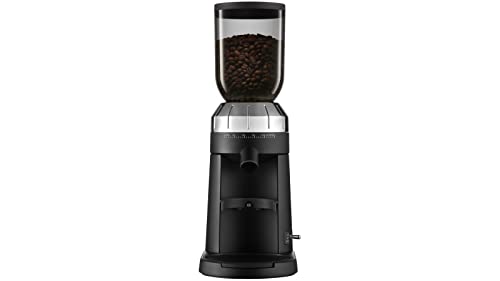
Sunbeam Cafe Series EMM0500BK Conical Burr Coffee Grinder
ASIN B0BBV4VBY6 • $218.00 • Ships from Amazon AU
The Sunbeam Cafe Series EMM0500BK is the best-ranked burr grinder I found on Amazon AU, sitting at #4 in Electric Coffee Grinders, and it's sold and shipped by Amazon AU at $218 at time of writing. It uses stainless steel conical burrs with 24 grind settings, which the listing says covers everything from filter to espresso and Turkish coffee. It grinds straight into the portafilter, so you don't need a separate dosing cup or a catch bin for espresso. The bean hopper holds 250g, which is about a week of coffee for most households. It's a sensible first grinder for someone moving off pre-ground. Sunbeam has a long-standing Australian service network, which matters on a kitchen appliance. That's why it leads.
Twenty-four steps is a modest number, and it's worth being straight about what that means for espresso. With a pressurised basket, like the ones that come with most entry machines, you'll have plenty of room to get a good shot. With an unpressurised basket you may find the right setting sits between two steps on some beans, and you'll adjust the dose or the tamp to make up the difference. For plunger, drip and pour-over it's plenty. The direct-to-handle design is handy because it means fewer bits to clean. It also means less chance of spilling grounds moving from a cup to the basket. The listing doesn't state burr size or motor wattage.
In the shop, the faults we see on grinders in this class are almost always blockages and worn drive parts rather than burnt motors. Keep the chute clean, don't let oily beans sit in the hopper for weeks, and make fine adjustments with the motor running. The listing doesn't state the warranty period, so check it on the current listing before you order. Sunbeam's local service network is the main reason I'm comfortable leading with it. Its rank is the strongest of any grinder I checked. It's the right pick for most homes starting out.
Honest caveats: Twenty-four steps gives less fine control in the espresso range than the Breville or Baratza, so an unpressurised basket may need the dose adjusted on some beans. The listing doesn't state burr diameter, motor wattage or warranty period, so check those on the current listing.
Best for: A first burr grinder for a home espresso machine with pressurised baskets, or for plunger and filter coffee.
Burrs: Stainless steel conical • Settings: 24 stepped • Hopper: 250g • Dosing: Direct to portafilter • Brew range: Turkish and espresso to filter • Model: EMM0500BK • Seller: Amazon AU • Rank: #4 in Electric Coffee Grinders (Amazon AU)
View on Amazon AU
Breville BCG820BSS the Smart Grinder Pro, Brushed Stainless Steel
ASIN B071F7C193 • $347.00 • Ships from Amazon AU
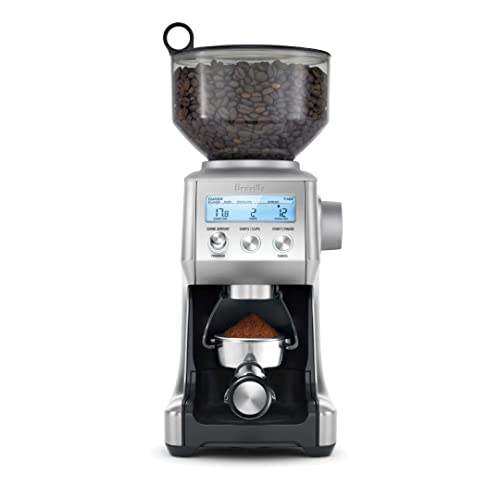
The Breville Smart Grinder Pro is the grinder I see most often next to a Breville espresso machine, and there's a good reason. It has 60 grind settings, a digital timer that adjusts in 0.2 second steps, and an LCD showing the setting, the grind time and the number of shots or cups. It ranks #14 in Electric Coffee Grinders on Amazon AU and sells for $347 at time of writing, shipped by Amazon AU. The listing says it's rated at 165W on 220 to 240 volts, which confirms the Australian model. The hopper holds 450g, the largest here. It's the pick if you want repeatable doses every morning. It's also the most featured grinder in this guide.
In the box you get two portafilter cradles, a small one for 50 to 54mm baskets and a large one for 58mm, plus a grinds container with a sealing lid and a cleaning brush. That covers almost every home espresso machine sold in Australia, including the Bambino, Barista Express and Dual Boiler. It also grinds into a gold-tone filter basket or a paper filter for drip coffee. The 60 settings include a lot of fine steps, so it suits unpressurised baskets better than the Sunbeam. The timer means you set your dose once and repeat it with one press. On busy mornings that's the main reason to pay the extra.
The listing is a little confused on warranty: the feature list says one year limited, while the product details say two years, so check the current listing and keep your receipt. The parts that wear on this grinder are the upper burr, the plastic drive coupler and the hopper safety switch. Breville sells replacement burrs through its own parts channel, and that keeps it worth repairing. Clean the chute regularly, because the longer path holds a little more coffee than the Fellow. It's an easy grinder to live with for years. It's the right pick for a Breville espresso owner who wants repeatable shots.
Honest caveats: The listing gives both a one-year and a two-year warranty, so confirm on the current listing. Burr diameter isn't stated. The chute holds a little more coffee than the Fellow's drop-through design, so a short purge grind helps when you change beans.
Best for: A Breville or other home espresso machine owner who wants a repeatable timed dose every morning.
Burrs: Stainless steel conical • Settings: 60 stepped • Timer: 0.2 second steps, LCD • Hopper: 450g • Cradles: 50 to 54mm and 58mm • Power: 165W, 220 to 240V • Model: BCG820BSS • Warranty: 1 or 2 years (listing gives both) • Rank: #14 in Electric Coffee Grinders (Amazon AU)
View on Amazon AU
Baratza Encore ESP 230V Coffee Grinder, Black
ASIN B0CM61Z8ZS • $308.95 • Ships from Amazon AU
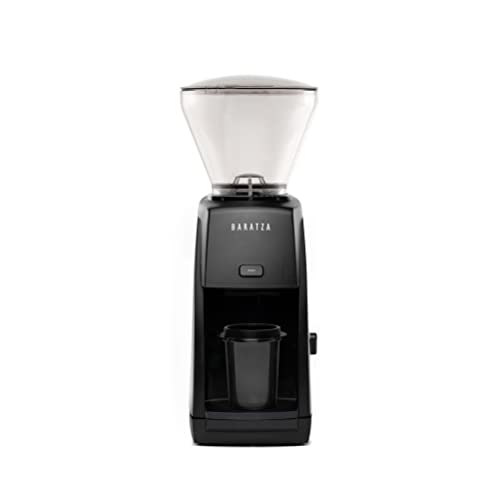
The Baratza Encore ESP is the grinder I'd buy if I wanted it to last ten years. It's the espresso version of the long-running Encore, with a dual-range adjustment: settings 1 to 20 are small micro-steps for espresso, and 21 to 40 are bigger steps for filter brewing. That's the split I talked about earlier, and it puts far more of the adjustment where espresso needs it. It ranks #20 in Electric Coffee Grinders on Amazon AU and sells for $309 at time of writing, shipped by Amazon AU. The listing names this as the 230V model, so it's built for Australian power. It's also the most repairable grinder in this guide. That's why I rate it so highly.
The burrs are 40mm hardened alloy steel, made in Liechtenstein according to the listing, driven by a DC motor. The burr now comes out without tools for cleaning, which is a real improvement on older Encores. You adjust it by twisting the hopper and start it with a front pulse button or the on/off switch. It comes with an anti-static dosing cup that fits 54mm baskets, and 58mm baskets with the included adapter. There's no timer, so you'll weigh your beans or grind to the cup. The listing gives a two-year warranty. Baratza's spare parts are easy to find, and that's the main reason it's here. I'd budget for a set of 0.1 gram scales alongside it.
I like this grinder because the brand treats it as a machine to be maintained, not a sealed appliance. Burrs, gears and switches are sold as spares, so a fault several years in is usually a small part rather than a replacement. The trade-off is a plainer, more plasticky body than the Breville and no timer or display. If you single dose, that won't bother you. If you want a grind-and-go timer, the Breville suits you better. Keep the chute clear and it'll keep going. It's the pick for anyone who values repairability over features.
Honest caveats: There's no timer or display, so you'll weigh beans or dose by eye. The body is mostly plastic, which is lighter and less sturdy-feeling than the Breville. The listing doesn't state motor wattage. Colour versions are separate listings and can differ in price.
Best for: Someone who wants fine espresso control and a grinder they can keep repairing for years.
Burrs: 40mm hardened alloy steel conical • Settings: 40 (1 to 20 espresso micro-steps) • Motor: DC • Burr removal: Tool-free • Dosing cup: Anti-static, 54mm, 58mm adapter • Model: ZCG495BLK, 230V • Warranty: 2 years (listing) • Rank: #20 in Electric Coffee Grinders (Amazon AU)
View on Amazon AU
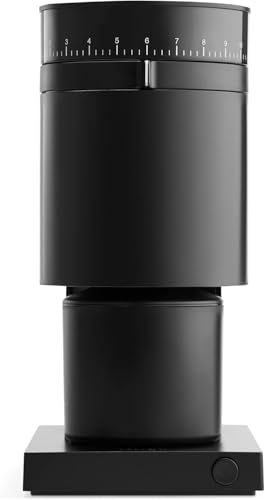
Fellow Opus Conical Burr Coffee Grinder, Matte Black
ASIN B0DTJNSWP4 • $299.00 • Sold by Fellow Australia on Amazon AU
The Fellow Opus is the pick for a household that drinks mostly pour-over, drip or plunger coffee but wants espresso as an option. It has 41 or more adjustable settings with an inner ring for finer steps, a 40mm stainless steel conical burr set with six blades, and a motor the listing rates at 6Nm of torque. It ranks #66 in Electric Coffee Grinders on Amazon AU and sells for $299 at time of writing. It's sold by Fellow Australia and shipped by Amazon. The model code ends in AU, which confirms the Australian version. The listing gives a two-year warranty. It's the best-looking grinder here, though that's not why it's in the guide.
Its strengths are the details that make daily brewing easier. A volumetric dosing lid measures beans for up to 12 cups of brewed coffee, so you don't strictly need scales for filter. The load bin lid has a grind guide printed inside, which helps when you switch methods. The beans drop straight from the bin through the burrs into the catch, so less coffee is held inside the grinder. The catch has a spout and anti-static treatment to cut down on mess. Calibration doesn't need tools. The listing weight is about 2.3kg, so it's light and easy to move. There's no portafilter cradle in the box, so for espresso you'll grind into the catch and tip it into your basket.
The Opus is a newer design than the Baratza, and spare parts support in Australia isn't as established yet, so I've placed it below the Encore ESP on long-term repairability. For espresso it will work, but the Breville and Baratza give finer control in the fine range, so if you're running an unpressurised basket daily I'd pick one of those. For everything else it's a lovely grinder to use. The rank is lower than the others because it's a newer listing. Keep the catch dry and brush the burrs out monthly. It's the right pick for filter coffee drinkers.
Honest caveats: Espresso adjustment is less fine than the Baratza or Breville, so daily unpressurised espresso is better served by those two. Spare parts support in Australia is newer than Baratza's. There's no timer, and the listing doesn't state motor wattage. Check the colour on the listing too, because the white version is a separate listing with its own price.
Best for: A filter, pour-over or plunger household that wants low retention and the option of espresso later.
Burrs: 40mm stainless steel conical, 6-blade • Settings: 41+ with inner fine ring • Motor: 6Nm torque • Dosing: Volumetric lid, up to 12 cups • Retention: Direct drop-through design • Weight: About 2.3kg (listing) • Model: 1221MB-AU • Warranty: 2 years (listing) • Rank: #66 in Electric Coffee Grinders (Amazon AU)
View on Amazon AUSide-by-side comparison
What we see fail in the workshop: coffee grinders
Grinders don't fail often, but when they come into the shop it's nearly always the same three things. None of them are electrical in the way people expect, and most of them are avoidable with a bit of routine. Here's what goes wrong, why, and what you can do to keep your grinder out of the repair queue for as long as possible.
Jammed burrs from stones and old coffee
A small stone in a bag of beans, or a chute packed hard with old damp grounds, is the most common reason a grinder stops. The motor hums, the burrs don't turn, and if you keep pressing the button the coupler or gear gives way. If your grinder suddenly sounds strained, stop and unplug it straight away. Pull the top burr, clear what's in there and check the burr edges for chips. Steel burrs usually survive a stone with minor marks. Running it while jammed is what turns a five-minute clean into a parts order.
Stripped gears and drive couplers
Most home grinders use plastic gears or a plastic coupler between the motor and the lower burr. They're designed to fail before the motor burns out, which is sensible engineering, but it means a jam or a habit of adjusting fine while full of beans wears them down. The giveaway is a motor that spins freely while the burrs don't move. On Baratza and Breville, these parts are usually available. On no-name grinders they often aren't, which is why I've kept those out of this guide. Replacing a coupler is usually a short job once the burrs are out.
Hopper switches and timers
Many grinders have a small safety switch that only lets the motor run when the hopper is locked in place. Coffee dust and oils build up around it, and eventually it stops making contact, so the grinder appears dead. A careful clean usually brings it back. Timer and button faults on the Breville class tend to come from moisture getting in, often from a wet cloth wiped around the controls. Wipe the outside with a barely damp cloth and keep water away from the buttons. If the switch is the fault, it's usually a small part on the popular brands.
Decision tree: which one should you actually buy?
- Starting out with an entry espresso machine? → The Sunbeam Cafe Series EMM0500BK at $218 grinds straight into the handle and has plenty of range for pressurised baskets.
- Want the same dose every morning with one press? → The Breville Smart Grinder Pro at $347 has a 0.2 second timer, a display and cradles for 50 to 58mm baskets.
- Want a grinder you can keep repairing for years? → The Baratza Encore ESP at $309 has espresso micro-steps, tool-free burr removal and spare parts that are easy to find.
- Mostly drink pour-over, drip or plunger coffee? → The Fellow Opus at $299 has a dosing lid, low retention and an anti-static catch, with espresso there if you want it.
- Running an unpressurised basket every day? → Pick the Baratza Encore ESP or the Breville Smart Grinder Pro, both of which put more fine steps where espresso needs them.
- Grinder humming, slowing down or tripping off? → Stop using it, unplug it and clear the burrs and chute. If that doesn't fix it, bring it to our Erina workshop and we'll tell you whether it's worth repairing before you spend anything.
Frequently asked questions
Is a burr grinder really better than a blade grinder?
Yes, for almost every brewing method. A blade grinder chops beans with a spinning blade, so you get a mix of large pieces and fine dust that extracts unevenly and tastes muddy or bitter. A burr grinder crushes beans between two rings set a fixed distance apart, which gives a far more even grind. For espresso a blade grinder simply can't get fine enough or consistent enough. For plunger coffee you can get away with one, but a burr grinder still makes a noticeable difference in the cup.
Which grinder here is best for a Breville Bambino or Barista Express?
The Breville Smart Grinder Pro is the obvious match because it ships with cradles for Breville portafilters and has plenty of fine steps. The Baratza Encore ESP is just as capable for espresso and is the better pick if you care more about long-term repairs than a timer. The Sunbeam will work well with the pressurised baskets that come with the Bambino. If you've upgraded to unpressurised baskets, go for the Breville or the Baratza for finer control in the espresso range.
How often should I clean a coffee grinder?
Brush the outlet and catch every few days, and do a proper clean every two to four weeks. That means emptying the hopper, running the grinder until it's clear, unplugging it, removing the top burr and brushing out the burrs and the chute. If you use dark, oily roasts, clean twice as often because the oils build into a sticky layer. Cleaning tablets are fine as an occasional extra, but they don't replace taking the burr out and brushing it properly.
Why is my grinder making a loud noise or straining?
Usually it's a blockage. A small stone in the beans, a lump of compacted grounds in the chute, or a very fine setting with oily beans can all make the motor strain. Stop straight away and unplug the grinder, because running it while jammed is how drive gears and couplers get stripped. Remove the top burr, clear the burrs and the chute, check the burr edges for chips and reassemble. If it's still loud with nothing in it, the gears or bearings may be worn and it needs a look.
Can I grind spices or tea in a coffee burr grinder?
I wouldn't. Spices leave strong oils and smells that carry into your coffee for weeks, and hard spices can damage burrs designed for roasted beans. Loose-leaf tea tends to clog the chute and isn't what these burrs are made for. Keep a separate inexpensive blade grinder for spices and leave your burr grinder for coffee only. The same goes for flavoured coffee beans, which leave thick oils behind that are hard to clean out of a good grinder.
Do I need a grinder with a timer?
Not necessarily. A timer is handy if you make the same coffee every morning and want one-press doses, which is where the Breville Smart Grinder Pro shines. If you weigh your beans and grind each dose fresh, a timer doesn't add much, and a grinder like the Baratza Encore ESP or Fellow Opus is just as good. Timers also drift as the hopper empties and as beans change, so even with one it's worth checking your dose on kitchen scales now and then.
Related buying guides
Grinder jammed, humming or dead?
Most grinder faults are a blockage, a worn coupler or a hopper switch clogged with coffee dust, and many are small parts rather than a replacement. Bring it into our Erina workshop and we'll check the burrs, drive and switches, then tell you what it needs and whether it's worth doing before you spend anything.
Visit our Erina workshop Book Online