Prices from Amazon AU, updated daily. Swipe or use the arrows for more.
Disclosure: This article contains affiliate links to amazon.com.au. If you buy through one of these links iFix may earn a small commission at no extra cost to you. It doesn't change which products we recommend. We focus on what actually lasts based on 16 years of repair-shop experience.
Quick summary8 picks
- CheapestBreville BES500BSS the Bambino Plus Coffee… about$487
- De'Longhi La Specialista Arte EC9155.W about$497
- Breville BES500BTR the Bambino Plus Coffee… about$487
- De'Longhi La Specialista Arte EC9155.YE about$799
- Breville BES875BSS the Barista Express… about$699.95
- Breville BES876BTR the Barista Express Impress about$798
- Breville BES878BSS the Barista Pro Espresso… about$948
- Most PremiumBreville BES920BSS the Dual Boiler Espresso… about$1,199.00
What $500 to $1,500 actually buys you
I did a guide on espresso machines under $500 a while back, and the question I kept getting afterwards was what the next grand actually buys. The honest answer is temperature control and steam. Under $500 you're mostly getting a pump, a small thermoblock and a pressurised basket that hides your mistakes. Between $528 and $1,398, which is where all five picks in this guide sit, you get PID temperature control on every machine, proper 54mm or 58mm portafilters, and steam wands that can texture milk instead of just heating it.
PID control is the one spec I'd treat as non-negotiable at this money. It's a feedback loop that holds the brew water at a set temperature instead of letting it swing between too hot and too cold, and every pick here has it. Espresso is fussy about temperature, and a machine that can't hold it steady wastes coffee every morning while you chase a moving target with your grind. The under-$500 machines mostly can't hold it. These can, and that's most of what you're paying for.
The other thing this band buys is dose size. Four of the five run a 54mm portafilter, and the listings state a 19 gram dose for the Bambino Plus. The Dual Boiler steps up to a commercial-style 58mm basket with a 22 gram dose. Bigger baskets are more forgiving to distribute and tamp, and 58mm accessories are everywhere because that's the cafe standard. It's not a reason on its own to spend $1,398, but it matters if you ever want to use standard cafe tooling.
A quick note on the ranks quoted through this guide, because Amazon runs two overlapping categories here. The three lower-priced picks lead the steam espresso machines list, where the Bambino Plus sits at #1 and the Express at #2. The Barista Pro and Dual Boiler are ranked in the broader espresso and cappuccino machines category at #43 and #52, which sounds worse but is a much bigger pond with every pod machine in it. Read the ranks as proof these are volume sellers with parts and support behind them, not as a quality ladder.
Built-in grinder or separate: decide this first
Three of the five picks (the Barista Express, the Impress and the Barista Pro) have a conical burr grinder built into the machine. The Bambino Plus and the Dual Boiler don't, so you're buying a grinder separately or using pre-ground, and pre-ground defeats the point of spending this much. That single decision shapes the whole purchase, so make it before you look at anything else.
The built-in grinder is convenient and it saves bench space, but from a repair point of view it also puts the two most failure-prone systems in one box. Grinders jam on stones and oily beans, burrs wear, and the impeller drive under the hopper takes a beating. When a built-in grinder dies outside warranty, you're weighing repair against the whole machine, not against a $200 grinder. A separate grinder fails on its own and gets fixed or replaced on its own. I generally reckon the split setup is the better long-term engineering, and the all-in-one is the better kitchen appliance. Both positions are defensible, which is why the picks cover both.
One detail worth knowing: the Barista Express Impress lists 25 grind settings and an assisted tamping system that applies a stated 10 kilograms of pressure with a 7 degree finishing twist. That's Breville automating the two steps beginners get wrong, dosing and tamping. If the person using the machine has no interest in learning those skills, the Impress earns its extra $153 over the standard Express. If you enjoy the process, save the money.
Whichever way you go, start on the dual wall baskets that ship with the all-in-one machines. They restrict the flow to fake a decent extraction while your grind and tamp are still all over the place, and they make the first fortnight far less discouraging. The single wall baskets in the same box are the graduation: swap to them once your shots run somewhere near the 25 to 30 second mark, and you'll taste the difference fresh grounds and honest pressure make. Plenty of owners never swap, and that's fine too, the coffee's still better than pods.
ThermoJet, Thermocoil and the dual boiler
Breville uses three different heating systems across this band, and the differences are real rather than marketing. The Bambino Plus and Barista Pro use ThermoJet, which the listings state reaches extraction temperature in 3 seconds. The Express and Impress use a Thermocoil, which takes longer to warm up but holds heat well once it's there. The Dual Boiler has two actual stainless steel boilers plus a heated group head, all under PID control.
Why care? Because the heating system decides whether you can steam milk and pull a shot at the same time, and how long the machine spends hot. Single-heater machines switch between brew and steam temperatures, so you pull the shot, then wait while the heater climbs for steaming. ThermoJet makes that transition quick. The Dual Boiler doesn't transition at all: one boiler brews while the other steams, which is why it's the only pick here that works like a cafe machine when you're making four milk drinks in a row.
There's a durability angle too. A heater that's only hot while it's working spends less of its life cooking its own seals and sensors. The flip side is that the Dual Boiler's heated group head keeps the brew path at temperature, which is part of why its shots are so repeatable. You're trading standby wear for consistency. For one or two coffees a day, the fast-heating machines make more sense to me. For a household queueing up drinks every morning, the Dual Boiler's approach is the one that doesn't leave someone waiting.
Milk: the automatic wand against the manual ones
The Bambino Plus is the only pick with an automatic steam wand. You set milk temperature and texture, park the jug, and it does the rest, then purges the steam path automatically afterwards. The listing is upfront that this is adjustable rather than fixed, so you can still chase silkier microfoam as you learn. For a machine that's likely to be used by more than one person in the house, automatic milk is the feature that stops the machine being yours alone.
The Express, Impress, Pro and Dual Boiler all run manual wands, and manual is what you want if latte art is the goal. You control the stretch and the whirlpool, and the machine just supplies steam. The catch nobody mentions: manual wands get left unpurged. Milk gets drawn back into the tip as the wand cools, dries into the pinholes, and steam pressure drops off over weeks until someone blames the machine. A pin and thirty seconds fixes it, but I've seen wands so blocked the owner was convinced the boiler had failed.
If you're weighing the Bambino Plus against the Barista Express at $147 more, the real question is grinder versus milk automation. The Express gives you the grinder and takes away the automatic wand. The Bambino Plus gives you hands-off milk and leaves grinding to a separate unit. Neither is wrong, they're just different mornings. My only firm advice is to be honest about who'll actually use the machine: the fanciest manual wand in the house makes no coffee at all if the person standing in front of it at 6am doesn't want to learn it.
Water is what kills them
Almost every espresso machine that dies before its time is killed by water, not electronics. Scale builds up in the thermoblock or boiler, flow drops, temperatures drift, and eventually a passage blocks or a sensor reads wrong and the machine throws errors or just stops getting hot enough. The repair at that point is a teardown and a chemical soak, and on a glued-together thermoblock it's often not worth doing. Prevention costs almost nothing, which is what makes the failures frustrating to see.
Two of the picks ship with water filtration in the box: the Impress lists a water filter holder with a filter, and the Express lists cleaning tablets and a cleaning disc alongside its kit. Use them, and replace the filter on schedule instead of when you remember. If your tap water is hard, it's worth filtering what goes into the tank regardless of which machine you buy; I covered jug-style options in the water filter guide and any of them beats running scale through a $900 machine.
Descale on the schedule in the manual, not the schedule that suits you. And when you do, rinse thoroughly: descaler left in the tank corrodes the very passages you were trying to protect. Nine times out of ten the machine that comes back to life after a proper descale was one flush away from a dead thermoblock.
Power, the bench and the switchboard
These are serious loads. The listings state 1600 watts for the Bambino Plus, 1850 for the Barista Express and 1680 for the Barista Pro. A standard Australian wall socket is good for 10 amps, about 2,400 watts, so any one of these machines is fine on its own. The trouble starts when the espresso machine shares a double socket with a kettle and both run at once. That's a tripped breaker on a good day and a cooked socket on a bad one. Give the machine its own outlet, and don't run it through a flimsy powerboard.
If you're curious what your machine actually costs to run, a metering plug answers it in a week; I rounded up the ones I use in the smart plug guide. At the AU average tariff of roughly 33c per kWh, an 1850 watt machine flat out costs about 61c an hour, but espresso machines only heat in bursts, so real-world daily cost is a fraction of that. Measure it rather than guessing; standby heating on some machines surprises people, and there's more on hunting those loads in our power savings rundown.
Two more practical points while we're on power. All of these carry proper Australian compliance marks since they're sold by Amazon AU as local stock, which is one of the quieter reasons this guide only includes Amazon AU listings rather than grey imports: a 220-240 volt machine from the right market, with a plug that hasn't been through an adaptor. And keep the machine's cord and plug dry. The bench around an espresso machine gets wet daily, and a soaked outlet or powerboard behind the machine is how a coffee habit trips the whole kitchen circuit.
What I skipped and why
The Barista Touch was sitting at $1,499 on Amazon AU when I checked, inside the band, and I left it out. You're paying the extra over the Barista Pro mostly for a touchscreen and drink presets, and touchscreens are the part of an appliance I trust least at year six. The coffee hardware underneath is close to the Pro at $948. If the screen dies out of warranty, the repair quote will make your eyes water, and the machine is a brick without it. Buttons and dials fail one at a time; a screen fails all at once.
I also skipped the original Barista Express BES870, which was listed at $698 within a few dollars of the newer BES875 that replaced it. Same money, older platform, no reason to pick it unless the colour matters to you. The Infuser at $699 went the same way: it's the Express without the grinder, and at that price the Bambino Plus does the espresso side for $171 less while a separate grinder does the grinding better.
Nothing outside Breville made the cut this time, and that's the supply talking rather than loyalty. The gate for this guide was Amazon AU stock, new condition, sold by Amazon itself rather than an importer, and a sales rank that shows real volume. Breville filled every slot that qualified on the day I pulled the data. When the supply picture changes, the picks will too.
The 5 picks, $528 to $1,398
Prices are Amazon AU at time of writing (24 September 2026) and move week to week. Ranks are Amazon AU category sales ranks, checked the same day.

Breville the Bambino Plus (BES500BTR)
ASIN B07KQCDQCR • $528.00 • Ships from Amazon AU
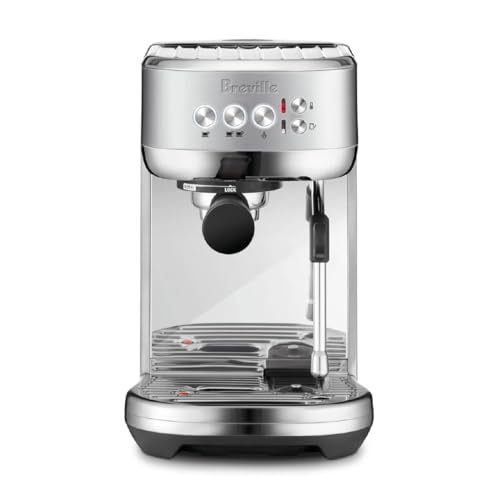
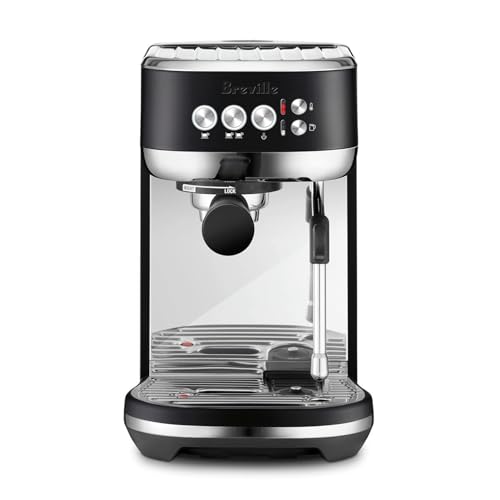
The Bambino Plus is the smallest and simplest machine here, and it's ranked #1 in Amazon AU's steam espresso machine category for a reason. You get the same 54mm portafilter and 19 gram dose as the bigger Brevilles, digital PID temperature control, and the ThermoJet heater that the listing states hits extraction temperature in 3 seconds. There's no warm-up ritual and no planning your morning around the machine: walk up, press the 1 or 2 cup button, coffee. For a machine at $528 that's a shot quality most people won't out-taste, provided the grind coming into it is right. It makes no attempt to grind for you, and that's the whole trade to understand before buying it.
The automatic steam wand is what separates it from everything else at this price. Set the milk temperature and texture level on the panel, sit the jug under the wand, and it textures the milk to that setting and then purges the steam path afterwards on its own. The listing calls out the auto purge specifically, and it deserves the attention: purging is the maintenance step manual-wand owners forget, the one that quietly blocks steam tips over months, and here it's built into the machine's behaviour rather than left to memory. Anyone in the house can make a flat white on this machine without being taught, which you can't honestly say about any of the manual-wand picks below.
Budget for a grinder in the plan, because pre-ground coffee will waste everything this machine does well. Its low pressure pre-infusion and PID are tuned for fresh, properly ground coffee, and with a decent burr grinder alongside it the pair still lands under the price of a Barista Pro while giving you a grinder you can service separately. The 1600 watt element runs happily on any standard socket, the small footprint fits benches where the bigger machines simply don't, and if the coffee bug doesn't bite as hard as expected, you've risked the least money of the five finding out.
Honest caveats: No grinder, so price one into the total or this becomes an expensive way to make average coffee. The listing states a 1 year warranty, shorter than the Express's 2 years. The small drip tray fills fast and the compact body means a small water tank you'll refill often.
Best for: A household that wants hands-off milk and quick heat-up in a small footprint, with a separate grinder doing the grinding.
Price: $528 at time of writing • Heating: ThermoJet, 3 second heat-up (listed) • Temperature: Digital PID control • Portafilter: 54mm, 19g dose • Milk: Automatic steam wand, adjustable temp and texture, auto purge • Power: 1600W, 220-240V • Warranty: 1 year (listed) • Rank: #1 in Steam Espresso Machines (Amazon AU)
View on Amazon AU
Breville the Barista Express (BES875BSS)
ASIN B09VG598FH • $675.00 • Ships from Amazon AU
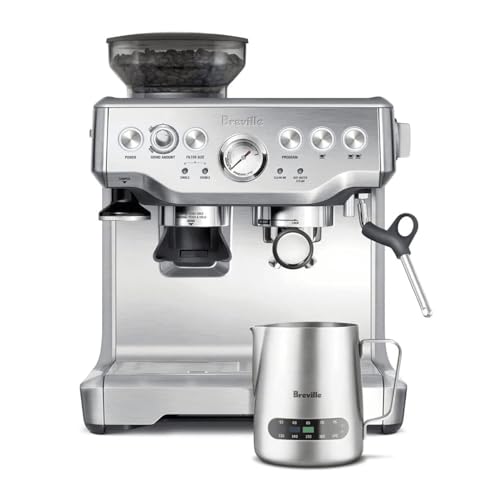
The Barista Express is the default answer to "one machine, whole setup" and its #2 rank in the steam espresso category says most buyers agree with that. The integrated conical burr grinder grinds on demand straight into the 54mm stainless portafilter, with a grind size dial on the side and dose control on the front, so beans go in the top and espresso comes out the bottom with nothing else in the workshop. Add the digital PID temperature control and low pressure pre-infusion and you've got the full espresso chain in one stainless box for $675. The 250 gram hopper and 2 litre tank are listed sizes, and both are big enough that a two-coffee household isn't topping up daily.
The accessory kit is unusually complete and worth counting when you compare prices against anything else: the listing includes the Razor dose trimming tool, single and dual wall filter baskets in both cup sizes, a stainless thermal milk jug, a coffee scoop, an integrated tamper, and a cleaning disc with tablets. Bought separately that lot is real money, and most of it is the stuff other brands quietly leave out of the box. The dual wall baskets are also the honest on-ramp: they fake some of the pressure while your technique is rough, then you move to the single wall baskets once your grind and tamp are dialled in and the machine stops forgiving you.
The steam wand is manual, which is the right call for anyone who wants to learn milk texturing properly rather than have it done for them, and the listing states a 2 year repair, replace or refund guarantee, the longest coverage of the five picks and worth something on a machine whose grinder works this hard. At a listed 1850 watts it's also the hungriest machine here, so give it its own wall socket rather than sharing a double outlet with the kettle. And the cleaning disc and tablets are in the box because Breville expects them to get used, so use them, a backflushed machine is a machine that keeps tasting right.
Honest caveats: The built-in grinder is the convenience and the risk in one part: if it fails outside warranty you're servicing the whole machine, and oily dark-roast beans will clog any integrated grinder faster than a separate unit you can strip down. Manual milk also means someone has to learn the wand.
Best for: One-box setup for someone who wants to learn real espresso without buying a separate grinder.
Price: $675 at time of writing • Grinder: Integrated conical burr, grind size dial, dose control • Temperature: Digital PID control • Portafilter: 54mm stainless steel • Capacity: 250g hopper, 2L tank (listed) • Milk: Manual steam wand, thermal jug included • Power: 1850W, 220-240V • Warranty: 2 years (listed) • Rank: #2 in Steam Espresso Machines (Amazon AU)
View on Amazon AU
Breville the Barista Express Impress (BES876BTR)
ASIN B09W44KC2J • $828.00 • Ships from Amazon AU
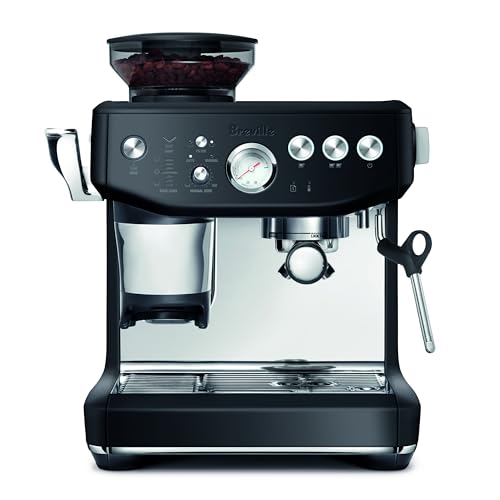
The Impress is the Barista Express with the two beginner-killers automated: dosing and tamping. The smart dosing system measures the grind, auto-corrects the next dose if the last one ran light or heavy, and the assisted tamping lever presses with a stated 10 kilograms of force and a 7 degree twist for a polished puck. Those are the steps that take weeks to get consistent by hand, and inconsistency there is why most new owners think their machine is broken when it's actually their prep. At $828 and ranked #8 in the steam espresso category, it's the machine I'd point at anyone who wants good espresso without wanting a hobby.
Underneath the assistance it's a proper machine, not a toy. Twenty-five grind settings on the integrated conical burr grinder give you finer adjustment than the standard Express dial, the Thermocoil heating system runs under PID control over temperature, flow and contact time per the listing, and you get the same 54mm stainless portafilter and manual steam wand as the rest of the family. The box includes a 480ml stainless milk jug, both filter basket types, the Razor trim tool and a water filter with its holder, which is the one accessory in any of these kits I'd actually call essential given what scale does to these machines over a few years of hard tap water.
The volumetric shot control and preset single or double buttons mean the machine repeats itself day to day rather than drifting with your mood, and the auto dose correct quietly absorbs the variation that creeps in as beans age and dry out in the hopper. You still steam milk yourself on the manual wand, so there's a real skill left in the process and latte art stays available to you. But the espresso side, the part that actually decides whether the cup tastes right, is about as close to foolproof as a real 54mm machine currently gets.
Honest caveats: You're paying $153 over the standard Express for assistance a patient owner develops by hand inside a month. The tamping mechanism is another mechanical system to go wrong eventually, and like every all-in-one, a grinder fault outside warranty puts the whole machine in the workshop, not just the grinder.
Best for: Someone who wants consistent espresso from week one and has no interest in learning to dose and tamp by feel.
Price: $828 at time of writing • Grinder: Integrated conical burr, 25 settings • Dosing: Auto dose-correct, assisted tamp, 10kg with 7 degree twist (listed) • Heating: Thermocoil with PID control • Portafilter: 54mm stainless steel • Capacity: 250g hopper, 2L tank (listed) • Milk: Manual steam wand, 480ml jug included • Rank: #8 in Steam Espresso Machines (Amazon AU)
View on Amazon AU
Breville the Barista Pro (BES878BSS)
ASIN B07NS3PZYH • $948.00 • Ships from Amazon AU
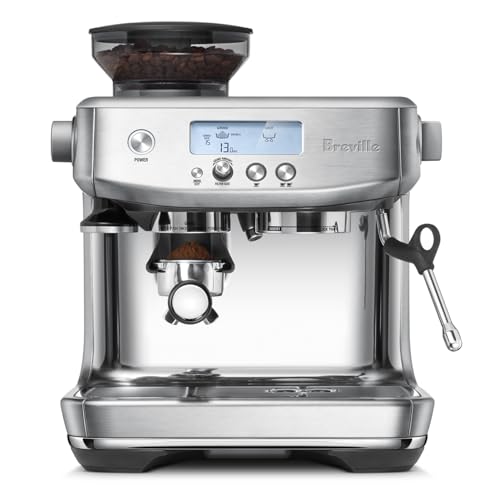
The Barista Pro is the Express platform rebuilt around speed. The ThermoJet heater reaches extraction temperature in a listed 3 seconds and, more usefully, the listing describes an instantaneous transition from espresso to steam, so the shot-then-milk sequence flows without the pause the Thermocoil machines make you sit through. If the machine serves a morning queue, that pause is the difference between four coffees before work and three. It carries the same integrated conical burr grinder with single-touch dose control, digital PID temperature management and low pressure pre-infusion as its siblings, with an intuitive LCD giving grind and shot feedback where the Express runs analogue dials and a bit of guesswork.
In the hand it's the nicest of the all-in-ones to actually use every day. The interface tells you what the machine is doing while it does it, the 1 and 2 cup volumetric controls repeat shots accurately once you've set them, and the manual wand has the steam grunt to texture a jug quickly rather than eventually. The listed kit covers the essentials without padding: 54mm portafilter, single and dual wall baskets in both sizes, the Razor dose trimming tool, a 480ml stainless milk jug, a cleaning kit and a water filter. Hopper and tank match the Express at a listed 250 grams and 2 litres, so capacity isn't part of the upsell.
It's ranked #43 in Amazon AU's espresso and cappuccino machines category, which reads worse than the other picks' numbers until you notice that category is a far bigger pond with every pod machine swimming in it. At $948 the honest question is whether the speed and the LCD justify $273 over the standard Express, and the answer tracks your household: for one unhurried coffee a day it doesn't, and for a two-plus coffee morning on a work-day clock I reckon it clearly does, because the time it saves is the exact time you're shortest of.
Honest caveats: The listing states a 1 year warranty, half what the less expensive Express carries, which is worth weighing at this price. No assisted tamping, so your prep skills still decide shot quality. Same all-in-one caveat as the others: the grinder and machine share one warranty claim and one repair bill.
Best for: The multi-coffee household where the wait between shot and steam actually costs time every morning.
Price: $948 at time of writing • Heating: ThermoJet, 3 second heat-up (listed) • Temperature: Digital PID control • Grinder: Integrated conical burr with dose control • Interface: LCD, 1 and 2 cup volumetric control • Portafilter: 54mm stainless steel • Capacity: 250g hopper, 2L tank (listed) • Power: 1680W, 220-240V • Rank: #43 in Espresso & Cappuccino Machines (Amazon AU)
View on Amazon AU
Breville the Dual Boiler (BES920BSS)
ASIN B072BV6R66 • $1,398.00 • Ships from Amazon AU
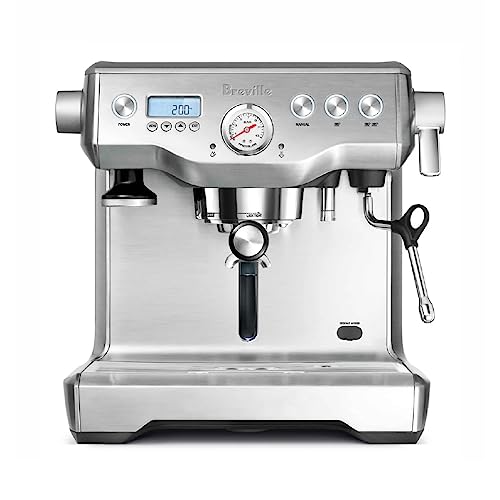
The Dual Boiler is a different class of machine wearing the same badge. Two stainless steel boilers run under PID control, one dedicated to brewing and one to steam, with a heated group head keeping the whole brew path at temperature rather than letting the first shot of the day land cold. That means you pull a shot and steam milk at the same time, which no other pick here can do, and shot temperature doesn't wobble because someone just steamed a jug thirty seconds ago. The listing describes low pressure pre-infusion stepping up to a full 9 bar extraction, with an LCD and an actual pressure gauge showing you what's happening through the shot instead of asking you to trust it.
The 58mm stainless portafilter holding a listed 22 gram dose is the other structural difference, and it changes more than it sounds like it would. That's the commercial standard size, so baskets, tampers, distribution tools and bottomless portafilters from any cafe supplier fit without hunting for 54mm versions, and the wider, shallower puck is noticeably more forgiving to distribute and tamp evenly. Volumetric or timed shot control means the machine repeats whatever you dialled in. There's no grinder on board, and at this level that's a feature rather than a gap: pair it with a good standalone grinder and each machine gets serviced, upgraded or replaced without touching the other.
At $1,398 and ranked #52 in the espresso and cappuccino category, this is the pick for someone who already knows they'll still be pulling shots in ten years. Of the five machines here it has the most repairable architecture, the most conventional parts, and the closest resemblance to the cafe equipment its owners are usually trying to reproduce at home. It asks for more from you up front, in money, in bench space and in the grinder you'll buy beside it, and it gives back a machine that treats espresso as a craft rather than a button. Nothing else in the guide is a lifetime purchase; this one can be.
Honest caveats: No grinder, and a machine this capable deserves a serious one, so budget the real total well past $1,398. It's big, heavy and slower to fully warm than the ThermoJet machines since two boilers and a group head all come up to temperature. Overkill for a one-flat-white-a-day house.
Best for: The committed home barista making multiple milk drinks back to back who wants cafe-standard 58mm tooling.
Price: $1,398 at time of writing • Heating: Dual stainless boilers, heated group head, PID • Extraction: Low pressure pre-infusion, 9 bar (listed) • Portafilter: 58mm stainless steel, 22g dose • Shot control: Volumetric or timed • Interface: LCD plus pressure gauge • Grinder: None, pair with a standalone • Rank: #52 in Espresso & Cappuccino Machines (Amazon AU)
View on Amazon AUSide-by-side comparison
What we see fail at the bench: espresso machines
Espresso machines combine mains power, a pump, a heater and hot water in a steel box that gets used twice a day for years, so the failure patterns are consistent. Most of what kills them is preventable, some of it is design, and knowing which is which before you buy is worth more than any spec sheet. Here's where they die.
Scale chokes the heater first
Hard water leaves mineral scale wherever water gets hot, and in these machines that's the thermoblock or boiler. Flow drops, the PID starts overshooting because its sensor is reading through a crust, and eventually a passage blocks entirely. By the time the symptoms are obvious the block is usually well established. Machines that ship with a tank filter, like the Impress, are Breville quietly telling you what the warranty data says. Filter the water, descale on schedule, and this failure mostly never happens. Skip both and the machine's lifespan is set by your postcode's water hardness, not by anything Breville did.
Steam paths gum up and seals give out
Milk is the second killer. Residue gets drawn back into the wand tip and solenoid as things cool, dries hard, and steam performance fades so gradually the owner doesn't notice until it's gone. The auto purge on the Bambino Plus exists precisely because of this. On manual machines, purge and wipe the wand after every jug, and poke the tip clear the moment a hole blocks. O-rings around the group head and steam valve also harden with heat cycles; a machine that starts weeping water around the portafilter usually needs a $5 seal, not a new machine.
Pumps, switches and tired electronics
The vibration pumps in domestic machines are consumables on a long timer: after some years of daily shots they get loud, then weak, then done. They're a replaceable part, and on the Dual Boiler's layout that swap is a reasonable job. Buttons and rotary switches fail from a decade of morning jabs, and control boards sitting above a hot, damp boiler eventually suffer corroded connectors. This is where build architecture matters: machines assembled with fasteners can be opened and fixed, and the more the machine costs, the more that repairability should weigh in the decision.
Decision tree: which one should you actually buy?
- First real machine, small kitchen, everyone in the house makes their own? → The Bambino Plus at $528. Automatic milk means nobody needs training, and it takes up half the bench of the others.
- Want the complete setup in one box without buying a grinder? → The Barista Express at $675. Grinder, PID and the full accessory kit, with the longest listed warranty of the five.
- Want good shots immediately with zero interest in technique? → The Barista Express Impress at $828. Auto dosing and assisted tamping remove the two skills that take longest to learn.
- Morning queue of three or more coffees on a work-day clock? → The Barista Pro at $948 for its 3 second heat-up and quick swap to steam, or the Dual Boiler at $1,398 to brew and steam at once.
- Chasing cafe-grade consistency and planning to keep it a decade? → The Dual Boiler at $1,398 with a standalone grinder beside it. 58mm tooling and the most serviceable layout here.
- Machine's already misbehaving, tripping the safety switch, or a liquid spill got into the electronics? → Stop running it and get it looked at. Bring it past our Erina workshop and we'll tell you honestly whether it's a seal, a descale or a goodbye before you spend anything.
Frequently asked questions
Is the Barista Express worth the extra $147 over the Bambino Plus?
They're solving different problems, so it depends which one you have. The Express includes a burr grinder; the Bambino Plus doesn't, so its true cost includes a separate grinder, which usually lands the pair above the Express's $675. But the Bambino Plus has the automatic steam wand and heats up in a listed 3 seconds, so it wins on convenience and shared use. If one person owns the coffee ritual and wants to learn, get the Express. If several people just want a decent flat white with no training, the Bambino Plus plus a standalone grinder is the better household machine.
Do I really need the Dual Boiler, or is the Barista Pro enough?
For most kitchens the Barista Pro is enough. Its ThermoJet swaps between brew and steam quickly, so making one milk drink at a time is smooth, and it has a grinder built in. The Dual Boiler earns its extra $450 in two situations: you regularly make several milk drinks back to back, where brewing and steaming simultaneously genuinely halves the time, or you're deep enough into espresso that the 58mm commercial portafilter, pressure gauge and rock-steady shot temperature matter to you. If neither of those describes your mornings, the Pro does the job for less.
Should I buy a machine with the grinder built in or separate?
Built-in is more convenient and saves bench space; separate is better engineering for the long haul. An integrated grinder shares the machine's warranty and its repair bill, so a grinder fault in year five is a decision about the whole unit. Separates fail independently and upgrade independently. Cost-wise the all-in-ones win at the start: the Express at $675 undercuts most machine-plus-good-grinder pairings. My rule of thumb is under $1,000 total, buy integrated; at Dual Boiler money, always separate, because that machine will outlive two or three grinders.
What actually fails first on these machines?
Scale, almost every time, unless you filter and descale. Mineral buildup in the thermoblock or boiler chokes flow and cooks temperature accuracy long before any electronic part wears out. After scale it's the steam path gumming up from unpurged milk, then perishable rubber: group head gaskets and steam valve o-rings that harden after years of heat cycles. Pumps get noisy and weak somewhere down the track, and they're replaceable. Genuine electronics failures are rarer than people assume, and when they do happen it's usually corrosion on connectors from living above a hot wet boiler rather than a dead board.
Do I need to use filtered water?
If your tap water is hard, yes, and it's the highest-value habit in this whole hobby. Scale is the number one killer of espresso machines, and prevention costs a fraction of the repair. Two of the picks acknowledge this in the box: the Impress ships with a tank filter and holder, and Breville sells replacements. A jug filter refilling the tank works fine too. Whatever you use, keep descaling on the manual's schedule, because filters slow scale rather than stopping it. Soft-water areas can be more relaxed, but check your water authority's hardness figures before deciding you're one of them.
Can iFix repair an espresso machine?
We're an electronics workshop first, so board-level faults, dead displays, switch failures and liquid damage are the parts of these machines we're at home with. Mechanical coffee-side work like boiler descaling teardowns is often better done by a dedicated coffee machine service agent, and on a newer machine your first stop should always be the warranty: the listings here state 1 to 2 years depending on model, and Breville honours them. What we'll always do is diagnose honestly. If the fix isn't worth the money against replacement, we'll tell you that before you commit to anything.
Related buying guides
Espresso machine playing up? Diagnose before you replace
Most "dead" espresso machines are a blocked steam tip, a hardened seal or scale, not a failed board. If yours is tripping the safety switch, leaking around the group head or refusing to heat, bring it in to Erina. We'll test the electronics, tell you what's actually wrong and what it costs to fix, and be straight with you if replacement is the smarter spend.
Visit our Erina workshop Book Online