Prices from Amazon AU, updated daily. Swipe or use the arrows for more.
Disclosure: This article contains affiliate links to amazon.com.au. If you buy through one of these links iFix may earn a small commission at no extra cost to you. It doesn't change which products we recommend. We focus on what actually lasts based on 16 years of repair-shop experience.
Quick summary8 picks
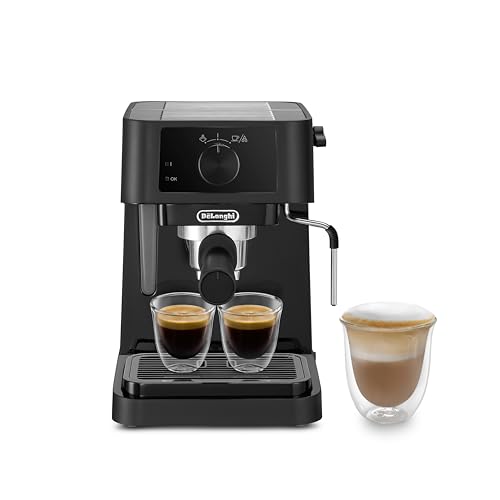
- Entry PickDe'Longhi Stilosa Manual Espresso Coffee… about$129.00
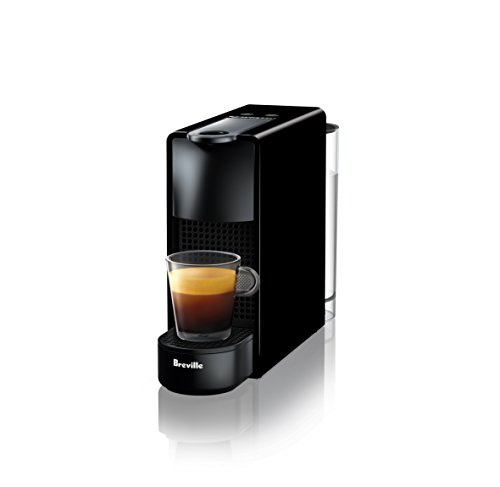
- Nespresso Essenza Mini Coffee Machine by… about$159
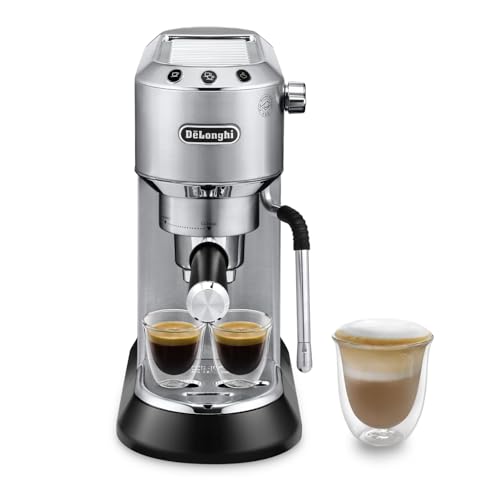
- De'Longhi Dedica Arte about$196.95
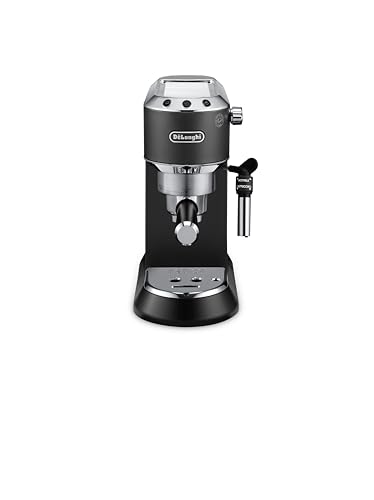
- De'Longhi Dedica Pump Espresso about$249.00
- Breville the Bambino Espresso Machine about$397
- De'Longhi La Specialista Arte Espresso… about$444
- Breville Bambino Plus Espresso Machine -… about$487
The takeaway maths, done properly
A flat white on the Central Coast is sitting around $5.50 these days, and I'll use that number for the arithmetic. One a day is close to $2,000 a year. Two a day, and plenty of people are two a day people, is near $4,000. Every machine in this guide costs under $500 once. Beans are the ongoing cost, so call them $18 for a 250g bag: at the 19 gram double dose Breville states for its 54mm baskets, that's about 13 doubles a bag, or roughly $1.40 a coffee before milk and power. The gap between $1.40 and $5.50, multiplied by a daily habit, is the entire reason this category is selling the way it is right now.
I won't pretend the machine pays for itself in a month, because it doesn't work like that. You still buy milk, you'll waste beans while you learn, and the first fortnight of shots from any manual machine mostly goes down the sink. What actually happens, in my experience, is the default flips: the machine coffee becomes the everyday and the takeaway becomes the treat, and somewhere around month three the numbers quietly tip your way. It's the same cost-per-serve thinking as the air fryer guide and the bread maker arithmetic, except coffee is the strongest case of the three, because the markup on an espresso shot is the biggest markup in the building.
The timing isn't mysterious either. When household spending tightens, the daily takeaway is one of the first line items people look at, because it's frequent and easy to substitute. The sales ranks show it this year: four of the five machines here sit in the top five of their Amazon AU subcategories, which for kitchen appliances north of $150 is busy. People aren't quitting coffee. They're moving where it gets made, and the machine you buy for that job will either be an appliance you use twice a day for five years or a benchtop ornament, depending mostly on choices you make before you order.
Pressurised versus unpressurised baskets
This is the spec that decides what kind of machine you're actually buying, and most listings bury it. A pressurised basket has a small valve or a single tiny exit hole that builds pressure artificially, so it'll produce something crema-looking from stale preground supermarket coffee. An unpressurised basket is just a metal filter with a few hundred holes, and it gives you nothing unless the grind is right: too coarse and you get sour water in ten seconds, too fine and the machine chokes. Every cafe machine runs unpressurised baskets. The catch is that unpressurised baskets demand a proper grinder, which is a second purchase most people don't see coming.
The listings are cagey here. Neither Dedica listing states which basket type is in the box, so if you care, and you should, check before you order or plan on buying an unpressurised basket separately. Breville states a 54mm portafilter with a 19 gram dose and low pressure pre-infusion on both Bambinos, and machines pitched that way reward a proper grinder from day one. Either way, know which owner you are before you spend. If you'll feed a machine preground from the supermarket, that's fine and normal, but buying a machine built around fresh-ground dosing and feeding it stale preground is the most common mismatch I hear about, and it produces months of disappointing coffee that gets blamed on the machine.
Cup clearance and the long black question
A small spec that ruins more mornings than any other: whether your cup actually fits under the group head. The Dedica Arte lists clearance for cups up to 13 centimetres and its listing makes a point of fitting a coffee mug. None of the other four state a clearance figure at all, so if your household drinks from one particular oversized mug, measure it before you order rather than after. It sounds trivial until you find yourself pulling shots into a small glass and tipping them into the mug you actually wanted, twice a day, for years, over 15 missing millimetres.
If your order is a long black, any of these machines will do it the honest way: pull the shot, then add hot water over it. None of these listings claim a dedicated hot water outlet, so plan on the kettle staying part of the routine. That's not a mark against them at this price, it's just worth knowing before you picture the workflow, because the machine replaces the coffee, not the kettle beside it. A 200ml mug of hot water off the boil, poured over a fresh double shot, is the same drink the cafe charges $5 for, and the kettle was boiling anyway.
The grinder is the purchase nobody plans for
Espresso punishes a wrong grind harder than any other way of making coffee, because pressurised water finds the easiest path through the coffee bed and takes it. Too coarse and the shot gushes through thin and sour. Too fine and the machine strains against a puck it can't push through. Supermarket preground is milled for drip filters and it's usually weeks past roasting by the time you open the bag, so it behaves differently to fresh-ground even in the same machine on the same day. That's not a reason to panic, it's the trade: preground in a pressurised basket gives you consistency without effort, fresh-ground in an unpressurised basket gives you a higher ceiling in exchange for fiddling.
If a separate grinder is never going to happen, the La Specialista Arte is De'Longhi's answer: the grinder is built in, with 8 grind settings and two sensors the listing says are there to keep the dose consistent, plus a dosing and tamping guide so the bench stays clean. One box, one power point, no grinder shopping. The honest caveat is that 8 settings is a narrow adjustment range compared with a dedicated grinder, and when one half of an all-in-one develops a fault, the whole bench setup goes off for service with it. I'd still rather see someone on an integrated grinder than see a $377 machine fed year-old preground, which happens more than anyone admits.
Descaling: the service schedule nobody reads
Every espresso machine dies of the same disease if you let it: scale. Tap water carries dissolved minerals, and every time the machine heats water, a little of that mineral load stays behind in the thermoblock and the narrow passages around it. You can watch it happen inside a kettle. You can't watch it happen inside an espresso machine, which is exactly how it gets away with it. Flow slows over months, the pump works harder pushing water through shrinking passages, brew temperature drifts, and one day the shot is a trickle. Both Dedica listings are upfront that descaling is a manual routine on these machines, and that's fine. What matters is that you actually run it, on a schedule, instead of waiting for the trickle.
How often depends on your water: the harder it is, the faster the buildup, and if you're on tank water the maths changes again. My rule for customers is simple. Put a recurring reminder in your phone the day the machine arrives, monthly if you make several coffees a day, and use the descaler the manufacturer specifies rather than whatever's under the sink, because the wrong acid attacks seals. A machine that arrives at the workshop in Erina with no flow is nearly always a scale problem that a $15 bottle of descaler would have prevented six months earlier, and by the time it's blocked completely, the fix is a teardown rather than a rinse.
Power draw, sockets and where it sits
Breville states 1600 watts for both Bambinos, and that sounds scarier than it is. At the average AU tariff of roughly 33c/kWh, 1600 watts flat out is about 53c an hour, but an espresso machine only pulls full power in short bursts while it heats, so a morning's coffee costs a cent or two in electricity. The number that matters more is heat-up behaviour. The ThermoJet system in both Brevilles is stated at about 3 seconds to extraction temperature, which means there's no reason to leave the machine on all day. An older machine idling from 6am to 6pm spends more keeping metal warm than it ever spends making coffee.
The practical electrical rules are the same ones I give for every kitchen appliance. A standard AU socket is good for 2,400 watts, so the machine is fine on its own, but don't stack it on a powerboard with the kettle and the toaster, because that combination will trip something or cook the board. Check for the RCM compliance mark, keep the cord clear of the drip tray, and if you're curious what the machine actually draws across a week, a metering smart plug will tell you in dollars. There's a longer version of that argument in my power savings rundown, but the short version is that espresso machines cost very little to run, and the worry about them is mostly misplaced.
The thirty seconds of milk cleaning that decides everything
Milk is the maintenance item nobody warns you about. Every time you steam, milk proteins bake onto the wand tip, and if they sit there they block the steam holes and start to smell. The routine is thirty seconds: purge the wand into the jug the moment you finish, then wipe it with a damp cloth. Skip that for a fortnight and you'll be soaking the tip and picking the holes clear with a pin. The Bambino Plus automates part of this with an auto purge after steaming, per the listing, which is a small feature that quietly rescues a lot of wands from their owners.
The wand designs here split by brand. The Dedica Arte lists a My Latte Art wand aimed at microfoam, and the EC685 lists De'Longhi's Adjustable Cappuccino System, a frothing sleeve that trades ceiling for ease. The Brevilles both list adjustable milk temperature and texture, with the Plus doing the texturing automatically. None of that changes the cleaning routine. In the workshop, a seized steam valve or a wand that's stopped swivelling is usually years of milk residue plus a hardened o-ring, and it's the kind of small fix that's worth doing on a machine this side of $500. Seals cost a few dollars, and the difference between a wand that swivels and one that doesn't is the difference between using the machine and resenting it.
How I picked the five
The screen was mechanical, same as every guide in this series. Condition New, sold by Amazon AU itself, priced between $150 and $500, and ranked near the top of its Amazon AU subcategory on the day I checked, because sales rank is the closest thing to a real-world popularity signal I can get from the outside. The five that survived are two slim De'Longhi pumps, two Breville dose-control machines and one all-in-one with a grinder, which covers the actual decisions at this price. I left capsule machines out on purpose: they're simpler, but pods cost several times what the equivalent shot costs in beans, and this guide exists because of per-cup arithmetic.
Prices and ranks move, so treat the numbers as the day-of snapshot they are. Specs come straight off each listing, and where a listing goes quiet on something that matters, like which baskets ship in the box, I've said so in the caveats rather than guessing. One thing I'd flag before you scroll: the right machine is the one that matches how you'll actually use it on a wet Tuesday in July, not the one with the best spec sheet. A $197 Dedica used daily beats a $487 Bambino Plus gathering dust, and I've seen both outcomes more than once.
The 5 picks, $197 to $487
Prices are Amazon AU at time of writing (10 September 2026) and move week to week. Ranks are Amazon AU category sales ranks, checked the same day.

De'Longhi Dedica Arte EC885.M Pump Espresso Machine
ASIN B09R51R982 • $196.95 • Ships from Amazon AU
The Dedica Arte is the machine I'd hand most first-timers, and the price is only part of it. It's a 15 bar pump machine in a body 15 centimetres wide, which means it fits kitchens where a Breville simply doesn't, and at $197 it's the entry point to this whole guide. The listing pitches control from tamping through to shot volume, there's a metal tamper in the box, and the steam side runs De'Longhi's My Latte Art wand for microfoam. It holds rank 3 in Amazon AU's Manual Espresso Machines category at the time of writing, one spot behind its own stablemate, which tells you how thoroughly the Dedica platform owns the slim-machine niche.
In use, the Arte is a manual machine in the honest sense: you dose, you tamp with the supplied tamper, you decide when the shot ends. The listing highlights cup clearance up to 13 centimetres, so a normal mug fits under the group, which sounds minor until you've owned a machine where it doesn't. Descaling is a manual routine, stated plainly on the listing, and on a thermoblock machine this slim I'd treat it as a monthly appointment rather than a suggestion. The high capacity filter baskets the listing mentions are aimed at a stronger, more intense shot, and the wand will texture milk well enough for latte art practice once you learn to keep the tip just under the surface.
The value argument is straightforward. This is the least expensive machine in the guide, from the brand that defines the slim espresso category, sold and shipped by Amazon AU as new stock. It gives you a real pump, real steam and a real learning curve, and if you outgrow it, the resale market for Dedicas stays healthy because the footprint suits so many kitchens. If you never outgrow it, you've spent $197 on a machine that replaced a $2,000-a-year habit. Either outcome is a win, which is more than most $197 appliances can claim.
Honest caveats: The listing doesn't state which filter baskets ship in the box, the water tank capacity, or the wattage, so check the current listing if any of those decide it for you. Manual descaling means you actually have to do it, and a slim thermoblock gives scale less room to hide. No grinder, so plan for preground or a separate purchase.
Best for: First espresso machine for a narrow bench, used with preground while you learn.
Pump: 15 bar (stated) • Width: 15 cm • Steam: My Latte Art manual wand • Cup clearance: Up to 13 cm (stated) • In the box: Metal tamper • Descaling: Manual routine • Seller: Amazon AU, condition New • Price: $197 at time of writing • Rank: #3 in Manual Espresso Machines (Amazon AU)
View on Amazon AU
De'Longhi Dedica Pump Espresso EC685BK
ASIN B06X3Z9MF3 • $249.00 • Ships from Amazon AU
The EC685 is the original slim Dedica, and its sales rank does the talking: number 2 in Amazon AU's Manual Espresso Machines category at the time of writing, on a model that's been on the market for years. Nothing holds a rank like that by accident. It's the same 15 bar pump and the same 15 centimetre width as the Arte, with De'Longhi's Adjustable Cappuccino System on the steam side instead of the Arte's bare wand, and the listing gives you control over temperature and shot length. At $249 it costs more than the newer Arte, which looks upside down until you remember that a long-running model with an installed base this size has parts, spares and second-hand knowledge everywhere.
The Adjustable Cappuccino System is the practical difference between the two Dedicas. It's a frothing sleeve over the wand that helps texture milk with less technique, where the Arte's bare My Latte Art wand assumes you want to learn the skill yourself. If your household drinks cappuccinos and nobody's interested in latte art as a hobby, the sleeve approach gets a decent result faster. The rest of the ownership experience matches its sibling: manual descaling stated on the listing, a compact drip tray that needs emptying more often than you'd expect, and a footprint that leaves room for a grinder beside it, which is exactly the upgrade path I'd expect a keen owner to follow within a year.
Between the two Dedicas, I'd put it this way: the Arte is the better learning machine and the EC685 is the better appliance. The EC685 asks less of you per coffee, tolerates preground cheerfully and has years of proven service behind the design. It's sold new by Amazon AU, sits mid-band at $249, and if you told me it was the machine in this guide least likely to generate a complaint, I'd believe you. The trade is a lower ceiling, because owners who get serious about milk texture tend to fight the sleeve eventually.
Honest caveats: Basket types in the box aren't stated on the listing, and neither is wattage or tank size, so check the current listing before ordering. Black EC685BK is the variant priced here, and other colours can sit at different prices. The frothing sleeve that makes milk easy also limits how far your technique can take it.
Best for: Households that want consistent coffee from preground and easy milk, no hobby attached.
Pump: 15 bar (stated) • Width: 15 cm • Steam: Adjustable Cappuccino System sleeve • Variant: EC685BK, black • Descaling: Manual routine • Seller: Amazon AU, condition New • Price: $249 at time of writing • Rank: #2 in Manual Espresso Machines (Amazon AU)
View on Amazon AU
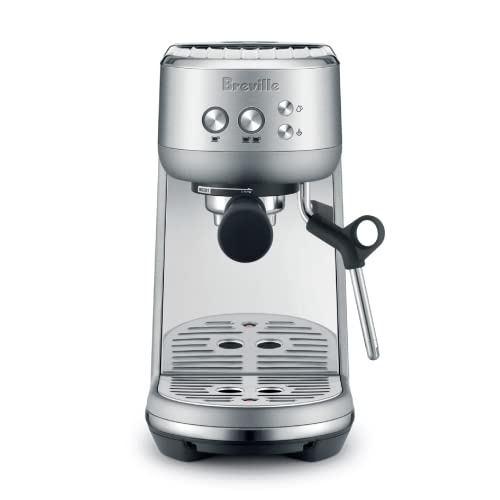
Breville the Bambino Espresso Machine BES450BSS
ASIN B08N5MKX9P • $377.00 • Ships from Amazon AU
The Bambino is where the guide changes character. Breville builds it around a 54 millimetre portafilter with a stated 19 gram dose, low pressure pre-infusion at the start of the shot, and PID digital temperature control holding the water where it should be, and that's the same recipe as machines costing three times as much, cut down to $377. The ThermoJet heating system is stated at about 3 seconds to extraction temperature, so the machine is ready before your cup is. It holds rank 5 in Amazon AU's Espresso and Cappuccino Machines category, sold new by Amazon AU, and it's the pick here for anyone who already knows they'll end up buying a grinder.
The dose-control front end matters because it standardises the variables that beginners fight. Nineteen grams in a 54 millimetre basket, tamped level, is a repeatable starting point, and the pre-infusion soaks the puck gently before full pressure arrives, so an imperfect tamp doesn't blow a channel through the coffee. PID temperature control removes the guessing older machines force on you, where shot two ran hotter than shot one for no visible reason. Steam runs off the same fast heating system, with the listing offering adjustable milk temperature and texture settings. It's a machine that meets a learner halfway: it won't make the coffee for you, but it quietly removes the reasons a decent attempt goes wrong.
Value-wise the Bambino is the sweet spot of the Breville range for this price band, provided you accept the grinder assumption. Fed fresh grounds, it will outperform both Dedicas on shot quality and consistency, and the temperature control means winter mornings don't change the coffee. Fed stale preground, it's an expensive way to make the same coffee a Dedica makes. The 1600 watt element and the 1 year repair, replace or refund warranty are stated on the listing, and the brushed stainless body survives benchtop life well in the ones I've seen.
Honest caveats: Breville's listing recycles copy between Bambino models, including an auto purge bullet that names the Bambino Plus, so confirm the exact steam wand behaviour for the BES450 on the current listing before you buy. No clearance figure is stated for tall cups, and the promotional bean offer in the listing carries its own terms.
Best for: Owners pairing a grinder with dose control and stable temperature at mid-band money.
Portafilter: 54 mm, 19 g dose (stated) • Heat-up: About 3 seconds (ThermoJet, stated) • Temperature: PID digital control • Pre-infusion: Low pressure (stated) • Power: 1600 W, 220-240 V • Warranty: 1 year repair, replace or refund • Seller: Amazon AU, condition New • Price: $377 at time of writing • Rank: #5 in Espresso & Cappuccino Machines (Amazon AU)
View on Amazon AU
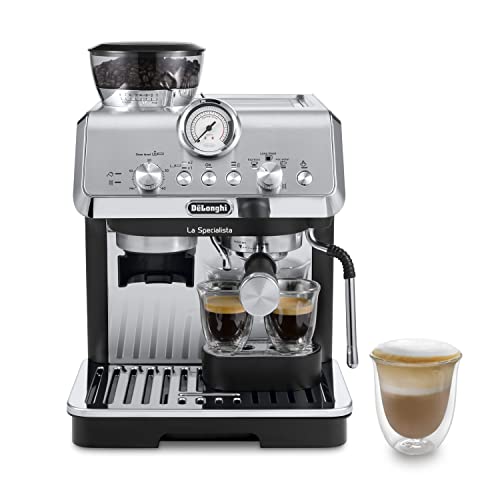
De'Longhi La Specialista Arte EC9155.MB with Grinder
ASIN B09C1B988X • $444.00 • Ships from Amazon AU
The La Specialista Arte answers the grinder problem by absorbing it. There's a bean grinder built into the machine with 8 settings, and the listing says two sensors manage the dose so the amount of coffee coming out stays consistent between shots. Around it, De'Longhi packs the accessories that usually cost extra: a barista-style metal tamper, a tamping mat, a dosing and tamping guide that keeps grounds off the bench, and a stainless steel milk jug. At $444, sold new by Amazon AU and ranked 4 in the Manual Espresso Machines category, it's the one machine in this guide that goes from whole beans to a finished flat white with nothing else in the workshop.
The brewing side runs a thermoblock with what the listing calls active temperature control and multiple temperature profiles, which is De'Longhi's route to the same goal as Breville's PID: stable water temperature and a way to adjust it for different beans. The steam side is the same My Latte Art bare wand as the Dedica Arte, and it rewards technique the same way. Fresh-ground coffee is the entire point of this machine, and the difference against preground through a slim Dedica isn't subtle, because grinding thirty seconds before the shot keeps the aromatics that leave preground within weeks of roasting. For one appliance doing two jobs, the workflow stays tidy, with the dosing guide doing more work than it looks like it should.
The all-in-one trade cuts both ways and I'll be straight about it. You get the bench space back, you skip a second purchase, and the integrated dosing removes the messiest part of the hobby. But 8 grind settings is a narrow range next to a dedicated grinder, and if either half develops a fault, the whole machine goes in for service. In its favour: a single warranty covering the lot, and a shot ceiling above anything else in this guide short of adding a separate grinder you'd pay real money for. For a lot of kitchens, that maths settles it.
Honest caveats: The listing doesn't state hopper capacity, tank size or wattage, so check the current listing if those matter to your bench. Eight grind settings limits fine-tuning for unusual beans. An integrated grinder also means grinder and brew hardware share one chassis, so a fault in either side takes the whole machine off the bench.
Best for: Fresh-ground espresso from a single appliance, with no separate grinder purchase.
Grinder: Built in, 8 settings, dual-sensor dosing • Heating: Thermoblock, active temperature control • Profiles: Multiple temperature profiles (stated) • Steam: My Latte Art manual wand • In the box: Tamper, tamping mat, dosing guide, milk jug • Seller: Amazon AU, condition New • Price: $444 at time of writing • Rank: #4 in Manual Espresso Machines (Amazon AU)
View on Amazon AU
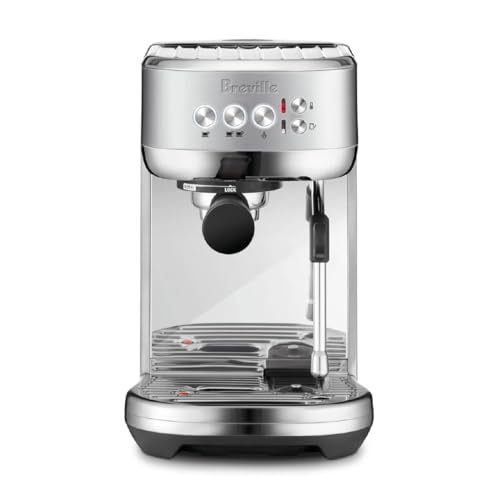
Breville Bambino Plus Espresso Machine BES500BSS
ASIN B07KQBV3N6 • $487.00 • Ships from Amazon AU
The Bambino Plus is the number 1 machine in Amazon AU's Steam Espresso Machines category at the time of writing, and the ranking makes sense once you watch one work. The espresso side matches the standard Bambino: 54 millimetre portafilter, stated 19 gram dose, low pressure pre-infusion, PID temperature control and the ThermoJet system heating to extraction temperature in about 3 seconds. The difference is the steam wand, which textures milk automatically to your chosen temperature and texture level, then purges itself after steaming so the next job isn't fighting leftover milk in the tip. At $487 it's the most expensive machine in this guide, and for milk drinkers it's the easiest to justify.
Automatic milk texturing sounds like a gimmick until you consider who actually uses these machines. The wand skills behind proper microfoam take weeks to learn and thirty seconds of attention per coffee forever after, and in most households exactly one person ever learns them. The Plus removes that bottleneck: anyone in the house can put the jug under the wand and get the same result, at the same texture setting, every time. The auto purge matters more than it reads, too, because purging after steaming is the single most skipped step in home espresso, and skipping it is how wands end up blocked. This is the machine that keeps working properly for households that won't baby it.
Against the standard Bambino, you're paying $110 for the automatic steam side, the stated auto purge and the extra texture and temperature settings, on otherwise matching numbers: 1600 watts, the same portafilter, the same warranty terms. Whether that's worth it comes down to milk. A household of flat white drinkers will use the automation twice a day and never regret it. A long black drinker is paying for hardware they'll never switch on, and should buy the Bambino or a Dedica instead and pocket the difference. Sold new by Amazon AU, brushed stainless, and the drip tray annoys me less than the category average.
Honest caveats: The same recycled listing copy as the standard Bambino applies here, and no cup clearance is stated, so measure your mug first. Automatic texturing adds sensors and valves to the steam path, which is more to go wrong years down the track than a bare wand. The bean promotion in the listing has its own conditions.
Best for: Milk-drink households that want consistent microfoam from anyone's hands, not just the hobbyist's.
Portafilter: 54 mm, 19 g dose (stated) • Heat-up: About 3 seconds (ThermoJet, stated) • Temperature: PID digital control • Milk: Automatic wand, adjustable temperature and texture • Auto purge: Yes (stated) • Power: 1600 W, 220-240 V • Seller: Amazon AU, condition New • Price: $487 at time of writing • Rank: #1 in Steam Espresso Machines (Amazon AU)
View on Amazon AUSide-by-side comparison
| Product | Price | Best for |
|---|---|---|
| De'Longhi Stilosa Manual Espresso Coffee… | ~$129.00 | |
| Nespresso Essenza Mini Coffee Machine by… | ~$159 | |
| De'Longhi Dedica Arte | ~$196.95 | |
| De'Longhi Dedica Pump Espresso | ~$249.00 | |
| Breville the Bambino Espresso Machine | ~$397 | |
| De'Longhi La Specialista Arte Espresso… | ~$444 | |
| Breville Bambino Plus Espresso Machine -… | ~$487 |
What we see fail at the bench: espresso machines
An espresso machine is a pump, a heater and a handful of valves living over a drip tray, and the failures follow that layout. We're a phone and computer shop first, so I won't pretend espresso machines queue out the door, but small appliances obey the same physics as everything else in the workshop, and the ones I've opened have failed in the same three places often enough to call it a pattern.
Scale-choked thermoblocks
The classic. Water gets slower over months, then one day it's drips. Inside, the thermoblock's narrow water path has furred up with mineral deposit until there's almost nothing left to flow through. Caught early, a proper descale reverses it completely. Caught late, the block needs to come out and soak, and on machines held together with clips and single-use seals, that teardown can cost more than the machine is worth. The infuriating part is that it's the most preventable fault in this guide: start a descale routine in week one, run it on schedule, and most of these machines simply never develop the problem.
Pumps and solenoids
Most machines at this price run a small vibratory pump, and you can hear its health. A healthy pump buzzes steadily, while a dying one rattles, hammers or goes quiet mid-shot. Pumps hate two things: running dry because the tank emptied mid-pull, and pushing against a scale-blocked path, which loads them far harder than a normal shot ever does. The solenoid valves that route water can also stick, usually from the same mineral buildup, which shows up as water going where it shouldn't or pressure that won't release. A pump is a replaceable part and not an expensive one. The labour to reach it is the real cost.
Steam wands, seals and switches
Steam is hot water vapour being sent, on purpose, through a box full of electrics, and over the years it finds the weak points. Wand o-rings harden, and the wand stops swivelling or starts weeping at the joint. Front-panel switches and control boards live in the splash-and-steam zone, and corrosion on their contacts shows up as buttons that need two presses. On the Brevilles the steam side is more automated, which is more convenient and also more parts in the steam path. None of this is a reason to avoid milk drinks. It's a reason to wipe the machine down like it owes you money.
Decision tree: which one should you actually buy?
- First machine, and you'll use supermarket preground? → The Dedica Arte at $197. Slim, forgiving, and the tamper's in the box. If it turns out you're a daily user, you'll know exactly what to upgrade to and why.
- Milk drinks are the whole point? → The Bambino Plus at $487. The automatic wand textures the milk to your setting and purges itself afterwards, which removes the two steps people always skip.
- Want fresh-ground but a separate grinder is never happening? → The La Specialista Arte at $444 puts the grinder inside the machine, with dosing and tamping guides to keep the routine tidy.
- Want the grinder-ready Breville without paying for automatic milk? → The Bambino at $377 has the same 54mm dose-control front end and PID temperature control, and you drive the wand yourself.
- Tight bench and you just want the proven one? → The Dedica EC685 at $249. It's 15cm wide, it's held a top rank in its category for years, and the frothing sleeve makes milk easy.
- Machine's gone to a trickle, lost pressure, or the wand's seized? → Don't bin it. It's usually scale, a pump or a seal, and all three are fixable. Bring it in to our Erina workshop and we'll tell you if it's worth doing before you spend anything.
Frequently asked questions
Do I need a grinder straight away?
No. Every machine here will make coffee with preground, and the two Dedicas are arguably at their best used that way. What I'd avoid is spending Breville money and then feeding the machine stale preground forever, because you're paying for a dose-control front end designed around fresh grounds. A sensible path is to start with preground, see whether the habit sticks, and buy a grinder once you're pulling shots daily. If a separate grinder is never going to happen, that's what the La Specialista Arte is for: the grinder's built in and the dose is managed for you.
How often should I descale an espresso machine?
It depends on your water hardness and how many coffees you make, which is why the listings call it a manual routine rather than promising an interval. My rule: set a recurring phone reminder the day the machine arrives, monthly for a daily-use machine, and stretch the interval only if the descaler comes out clean every time. Use the descaling product the manufacturer specifies, not vinegar, because the wrong acid attacks seals and aluminium. Waiting for the machine to slow down is the expensive version of this decision, because by the time flow drops, the buildup is well established.
Is a 15 bar pump better than 9 bar?
Treat pump bar ratings as a spec-sheet convention rather than a quality ladder. The number quoted is what the pump can produce at its maximum, and both De'Longhi machines here quote 15 bar. Espresso extraction itself happens at much lower pressure than pump maximums, which is why machines with different bar ratings can pull near-identical shots. What separates machines in practice is temperature stability, basket and dose design, and how the shot starts, like the low pressure pre-infusion Breville lists on both Bambinos. I wouldn't choose between any two machines in this guide on the bar number.
Should I use the pressurised or unpressurised basket?
Match the basket to your coffee. Preground supermarket coffee wants a pressurised basket, which compensates for stale, drip-ground coffee and gives a consistent result with no technique. Fresh beans through a decent grinder want an unpressurised basket, which rewards a good grind with a noticeably better shot and punishes a bad one. Check what actually ships in the box before you order, because the listings here don't spell out basket types. If a machine only ships with pressurised baskets and you want the unpressurised experience, aftermarket baskets exist, but confirm the size first: the Brevilles run 54mm.
Wouldn't a capsule machine be simpler?
It is simpler, and I won't pretend otherwise. The trade is per-cup cost and lock-in. Pods cost several times what the equivalent shot costs in beans, and once you own the machine you're buying that brand's capsules for its lifetime, which is the printer-ink model applied to coffee. Capsule machines also produce one fixed style of coffee, where a manual machine's ceiling rises with your technique. If one-button convenience matters most and your volume is low, a capsule machine is a reasonable appliance. If you're doing the takeaway-replacement arithmetic this guide is built on, beans win it comfortably.
Are these machines worth repairing when they fail?
Usually, and more often than people expect. The common failures are scale blockage, a worn pump, a stuck solenoid or a hardened seal, and all of those are known, reachable faults rather than mysteries. A pump is a modest part, and a descale-and-service can bring a no-flow machine back completely. The cases that aren't worth it are cracked chassis plastics on discontinued models, and all-in-one machines where the grinder and brew side fail together. The right move is a diagnosis before a decision: find out what failed and what the fix costs, then compare that against replacement.
Related buying guides
No flow, weak shots or a seized wand? Diagnose before you replace
When an espresso machine slows to a trickle it's nearly always scale or the pump, and both are fixable for less than a new machine. Bring it in to the shop in Erina and we'll open it, find what actually failed and quote the fix honestly. If it isn't worth repairing, we'll say so before you've spent anything, and you'll at least know what killed this one before you buy the next one.
Visit our Erina workshop Book Online