Prices from Amazon AU, updated daily. Swipe or use the arrows for more.
Disclosure: This article contains affiliate links to amazon.com.au. If you buy through one of these links iFix may earn a small commission at no extra cost to you. It doesn't change which products we recommend. We focus on what actually lasts based on 16 years of repair-shop experience.
Quick summary8 picks
- CheapestMaze 14lt Indoor Composter- Airtight… about$65
- Joseph Joseph Stack 4 Food Waste Caddy with… about$63.96
- Goplus Compost Bin about$75.95
- Goplus Compost Bin about$85.95
- Costway 130L Garden Composting Tumbler Dual about$82.95
- Goplus Compost Tumbler about$76.4628" screen.
- Maze Outdoor Compost Tumbler Bin about$139
- Most PremiumVEVOR Compost Tumbler about$167.99
Why food scraps became a hardware problem
The garden cluster on this site started with raised beds and worked through grow lights and hydroponics, and a composter is the piece that closes the loop. Everything the garden produces that you don't eat, plus most of what the kitchen throws out, can go back into the soil you paid real money to fill those beds with. That's the pitch anyway. The reason I'm covering it as hardware is that a composter is a machine: it has doors, latches, a crank, bearing surfaces and a lot of plastic sitting in full sun. The difference between the unit that's still turning in three years and the one that's seized solid behind the shed comes down to the same build details I'd look for in anything else that lives outdoors.
There's a straight money angle too. Bagged compost runs about $10 for 25L at any hardware chain, and a decent veggie bed swallows hundreds of litres a year between top-ups, slumping soil and new plantings. A tumbler that converts scraps into usable compost even a few times a season quietly pays for itself, and a bokashi bucket does a version of the same job for a kitchen with no yard at all. None of it works if the unit fights you though. If the door jams, the crank strips or rats move in underneath, the whole project gets abandoned by spring. So the picks below are judged mostly on the boring mechanical stuff: how the doors lock, what the frame is made of, and what two summers of UV will do to the plastic.
Tumbler, open bin or bokashi: three different machines
A tumbler is a sealed barrel on an axle. You load it, you turn it every few days, and the tumbling does the mixing your back would otherwise do with a garden fork. Because the barrel is sealed and up off the ground it holds heat and moisture better than a heap, and it keeps animals out by design rather than by hope. The trade is capacity. Even the 200L VEVOR below is small next to a plain open bay, so a tumbler suits a household's kitchen scraps and light garden trimmings, not a whole autumn's worth of leaves in one go. For most suburban blocks that's the right size problem to have, and the dual-chamber layouts mean one side can finish while the other fills.
Bokashi is a different process entirely. It's an airtight bucket that ferments scraps rather than composting them, using a bran dosed with microorganisms, and because it's fermentation it happily takes cooked food, meat and fish, which are exactly the things you should keep out of a tumbler. What comes out isn't finished compost. It's fermented material that still needs burying in soil or feeding to a conventional pile to break down fully, plus a liquid you drain off through a tap. I reckon the honest framing is that bokashi is a pre-processor for the kitchen and the tumbler is the finisher outside. Run both and there's very little a household throws out that can't go through one of them.
Rodent proofing is the spec that matters
Rats don't come for the compost, they come for the food scraps in it, and an open heap on the ground is an invitation with a roof. This is the strongest argument for a tumbler. The barrel sits up on a steel frame with nothing touching the ground, the doors slide shut and latch, and there's no burrowing route in from underneath. The Goplus listing makes a point of its tightly locking sliding doors keeping rodents and insects out, and the VEVOR's raised base is doing the same job. When mice do get into a tumbler it's nearly always because a door has warped or a latch has cracked, so a quick check of the door hardware every couple of months is worth more than any amount of bait.
If you're set on a ground bin instead, the usual fix is aviary mesh under the base, but I'd steer anyone with an active rodent problem straight to a tumbler or bokashi. The bokashi bucket lives inside with an airtight seal, so there's nothing outside for anything to smell in the first place. Worth saying plainly: keep meat, dairy and cooked food out of any outdoor composter, tumbler included. The listings that claim rodent resistance are describing the hardware, not granting permission to load it with roast chicken. Fermented bokashi material that's been buried is a different story, and that's the loophole that makes running the two systems together work so well.
The sizing maths: litres in is not litres out
Composting shrinks things, usually by a lot. A chamber packed with fresh scraps and trimmings cooks down to a fraction of its volume as the water leaves, so the 130L on the Costway or the 160L on the Goplus is the input side, not what you'll shovel out at the end. For a two-person household feeding mostly kitchen scraps in, the mid-size tumblers are honestly plenty. The constraint you'll actually hit first is browns: dry leaves, shredded cardboard, straw. Wet scraps on their own turn to sludge in a sealed barrel, and you generally want somewhere around two or three parts dry material to one part wet to keep a batch moving, which is more cardboard than most people expect to be hoarding.
The dual-chamber layout is what makes any of these sizes workable. Fill one side over a month or so, then let it finish while you start the other, and you get a steady rotation instead of a single barrel that never finishes because fresh material keeps going in. The VEVOR's 200L across two chambers is the pick for a household that also generates steady garden waste, the 130L Costway suits kitchen scraps plus a bit, and the Goplus splits the difference at 160L for less outlay than either. Buy against the waste you actually produce each week, not the garden you're planning to have one day, because an oversized half-empty chamber runs cold and slow.
What fails first: doors, cranks and UV
Every tumbler here is the same basic recipe, a PP barrel on a coated steel frame, and the failure points are just as consistent. Sliding doors go first. They're the thinnest plastic on the unit, they get levered sideways by impatient hands when the barrel's overfull, and once the track chips the door either jams or falls out entirely. Treat the door as the fragile part it is: brush grit out of the track occasionally and never force it. Crank hardware is second, and the VEVOR's ratchet and crank shaft is the one geared mechanism on this list. Forcing a crank against an overloaded or frozen barrel is how it strips, so turn more often with less in it and the loads stay small.
UV is the slow killer. The same chalking and embrittlement we see on the housings of solar garden lights that come through our Erina workshop happens to composter barrels, usually starting at door edges and vent slots where the plastic is thinnest. Black PP with decent wall thickness holds up for years; thin panels in constant northern sun can start cracking in two or three summers. Siting matters more than brand here. A spot with morning sun and afternoon shade keeps the batch warm without cooking the plastic, and it's usually closer to the kitchen door as well, which is the thing that actually decides if a composter gets used past March.
Assembly, and the bolts that come loose
All three tumblers arrive flat-packed, and the barrels assemble from moulded panels held by a couple of dozen screws into plastic bosses. The single most common way people wreck one on day one is overtightening those screws with a drill driver until the boss splits. Use a hand screwdriver, stop when it's snug, and the plastic lives. The steel frames are simpler, but the frame fasteners work loose over the first month of turning as everything settles, so plan on going around them once with a spanner after a few weeks. It's a five minute job that stops the wobble that eventually cracks welds and panels.
Keep the manual, or at least photograph it, because the spare-part story on this class of hardware is thin. VEVOR and Costway both run AU storefronts and do respond on parts, but a cracked door panel two years in usually means improvising or replacing the unit, which is another reason not to abuse the doors. If a bolt goes missing, match the thread at any hardware store rather than running the barrel with a fastener short. An unbalanced barrel loads the remaining fixings unevenly, and that's how a small rattle turns into a bent axle mount by the end of a season.
Getting a batch to actually cook
The listings all quote compost in four to six weeks, and that's a real number in summer with a full chamber, a decent mix and regular turning. A half-full barrel in a Central Coast winter is more like three months, and that's fine, it isn't a race. What actually stalls a batch is moisture at either extreme. Squeeze a handful and it should feel like a wrung-out sponge. Too wet and the chamber goes anaerobic and smells sour, which is your cue to add dry browns and crank it a few extra turns. Too dry and nothing happens at all, which a watering can and a turn fixes in a day or two. The VEVOR's adjustable vents and the drainage holes on the Costway and Goplus exist for exactly these two failure modes, so use them rather than fighting the lid.
Heat is the other tell. A working batch feels noticeably warm when you open a door on a cold morning, and a cold batch is a stalled one. Small chambers shed heat faster, which is why the bigger barrels forgive more neglect. Once you've got finished compost the garden side of this site takes over. It's the easiest way to keep a raised bed topped up as the soil slumps through its first seasons, and seedlings raised under grow lights go straight into it. If you got into gardening through the water-restrictions angle, wicking beds fed with your own compost are about as closed as a suburban loop gets.
The kitchen end of the loop
None of the outdoor hardware matters if scraps never make it out of the kitchen, and the piece that fixes that is deliberately low-tech: a caddy in the workshop. The Joseph Joseph below is a small bin with an odour filter and a liner-retaining hole, nothing more, but it means the decision to compost gets made once when you set it up instead of every time someone peels a carrot. Empty it every day or two into the tumbler or the bokashi bucket and the kitchen never smells. Leave it a week and it will, filter or not, which is the honest limit of every caddy ever made.
The bokashi bucket can replace the caddy entirely if bench or cupboard space allows, since it's airtight and takes everything, including the meat scraps a caddy shouldn't hold for long. Drain the tap every few days once fermentation gets going, dilute the liquid well before it goes anywhere near plants, and bury the fermented solids in a spare corner of a bed or feed them to the tumbler to finish. One warning for the indoor growers: if your herbs live in a countertop hydroponic kit, keep bokashi liquid out of the reservoir and stick to the kit's own nutrients. It's for soil, not pumps. Rinse the caddy or the bucket outside rather than in the kitchen sink, and the whole arrangement stays welcome indoors.
The 5 picks, $65 to $168
Prices are Amazon AU at time of writing (28 September 2026) and move week to week. Ranks are Amazon AU category sales ranks, checked the same day.

VEVOR 200L Dual Chamber Compost Tumbler
ASIN B0GDDJ3P8Z • $167.99 • Sold by VEVOR Store AU on Amazon AU
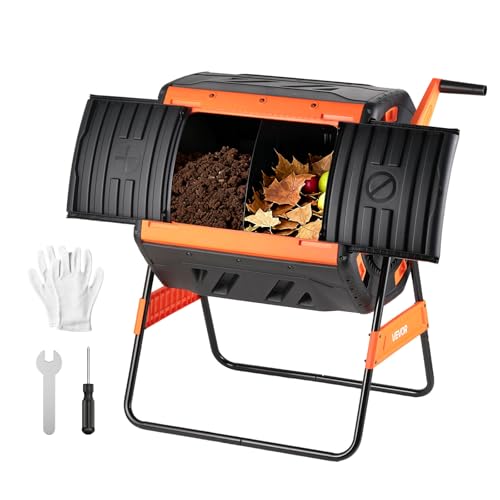
This is the biggest barrel on the list at 200L (the listing calls it 53 gallons) split across two chambers, and it's the only one here with a proper hand crank rather than a grab-and-roll barrel. That matters at this size. A full chamber of wet material is heavy, and the crank shaft with its lockable ratchet lets you turn it in controlled clicks instead of wrestling the whole drum past the tipping point. Deep internal fins break up the clumps as it rotates, which is the mixing work you'd otherwise be doing with a fork, and the ratchet lock holds the barrel at whatever position suits loading or emptying. It's currently sitting at #6 in Amazon AU's Outdoor Waste Bins category, which for a $168 unit in a category full of $80 ones says something.
The support hardware is the better half of the story. The frame is powder-coated steel with a raised base, so nothing organic touches the ground and there's no burrowing route in for rodents. The two sliding doors are wide enough to get a bucket's worth in without spilling, and the adjustable air vents are a genuinely useful touch: closed down in winter to hold heat, opened up in summer when a batch runs wet and needs airflow. The listing quotes compost in about four to six weeks, which I'd read as a summer number with a full chamber and regular turning rather than a promise. The barrel itself is heavy-duty plastic and the whole thing is pitched as an all-season unit.
At $168 at time of writing from VEVOR's AU storefront, this is the pick for a household that generates real garden waste on top of kitchen scraps. The 200L capacity means the browns-to-greens mix has room to breathe, the two chambers give you a fill side and a finish side, and the crank means the person who empties it isn't always the strongest one in the house. If your input is mostly a caddy of kitchen scraps a week, it's more barrel than you need and the Costway below does that job for half the outlay.
Honest caveats: The crank gearing is the one mechanism that can strip, so don't force it against an overfull chamber. Flat-pack assembly with plenty of screws into plastic bosses wants a hand screwdriver, not a drill. The four to six week claim is a best case, and a half-full barrel in winter will run months.
Best for: A household producing steady garden waste plus kitchen scraps that wants one tumbler to handle the lot.
Capacity: 200L (53 gal), dual chamber • Turning: Hand crank, lockable ratchet • Mixing: Deep internal fins • Aeration: Adjustable air vents • Doors: 2 wide sliding doors • Frame: Powder-coated steel, raised base • Claimed cycle: About 4 to 6 weeks • Rank: #6 in Outdoor Waste Bins (Amazon AU)
View on Amazon AU
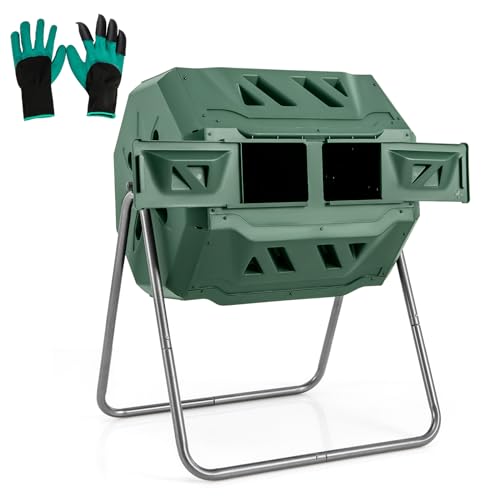
Costway 130L Dual Chamber Composting Tumbler
ASIN B0GQ9P8M2M • $89.95 • Sold by COSTWAY-AU on Amazon AU
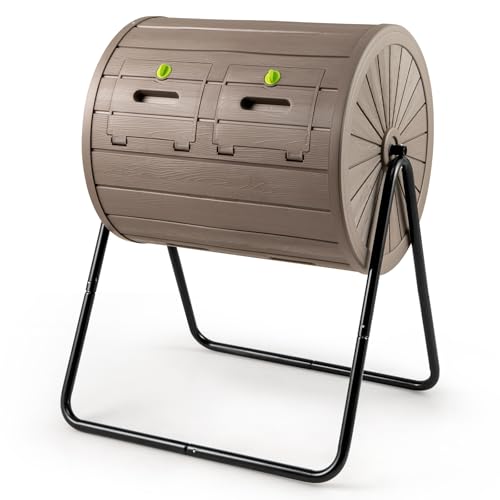
The Costway is the sensible middle of this list: 130L across two independently rotating chambers, sitting at #10 in the same Outdoor Waste Bins category the VEVOR leads, at $90 at time of writing. Each chamber spins 360 degrees on its own, so you can turn the finishing side without disturbing the side you're still filling, and side buckles lock the drums in place when you're loading. There's no crank here, you grab the drum and roll it, which is completely manageable at this size. The sliding doors are generous enough to tip a caddy straight in, and the whole barrel geometry makes pulling finished compost out the bottom door less of a shovel fight than a ground bin ever is.
Construction is BPA-free PP on a rustproof metal frame with a triangular stance, and that triangle matters more than it sounds: tumblers get rocked hard in use, and the three-point geometry keeps the legs planted instead of walking across the paving. Aeration is handled by ventilation holes through the panels plus drainage holes underneath to let excess liquid out, which is the detail that saves a wet batch from going sour. The listing quotes the same four to six weeks as everyone else, and adds the honest note that hot weather runs faster, which matches how these actually behave. It also carries a sensible warning that chemical waste, plastics and paper don't belong in it.
This is the tumbler I'd point most two-person households at. It's big enough that a weekly caddy habit plus lawn-edge trimmings never fills it, small enough that a batch heats evenly, and the $90 price leaves room in the budget for the bokashi bucket that handles everything this shouldn't take. If your green waste regularly includes actual prunings and armfuls of leaves, step up to the VEVOR instead. Costway also runs an established AU storefront that's been shipping garden hardware here for years, so a parts question or a warranty claim at least lands with a local seller rather than a mystery importer.
Honest caveats: No crank, so a full 65L chamber takes a decent shove to get rolling. The panel-built barrel means plenty of assembly screws into plastic bosses, and overtightening them is the classic day-one mistake. Vent and drainage holes will drip, so site it over ground or gravel rather than a sealed balcony floor.
Best for: Two-person households composting kitchen scraps plus light garden trimmings who want set-and-rotate simplicity.
Capacity: 130L, dual chamber • Turning: 360° roll, chambers rotate independently • Locking: Side buckles • Aeration: Ventilation holes plus drainage holes • Material: BPA-free PP barrel • Frame: Rustproof metal, triangular structure • Claimed cycle: 4 to 6 weeks, faster in hot weather • Rank: #10 in Outdoor Waste Bins (Amazon AU)
View on Amazon AU
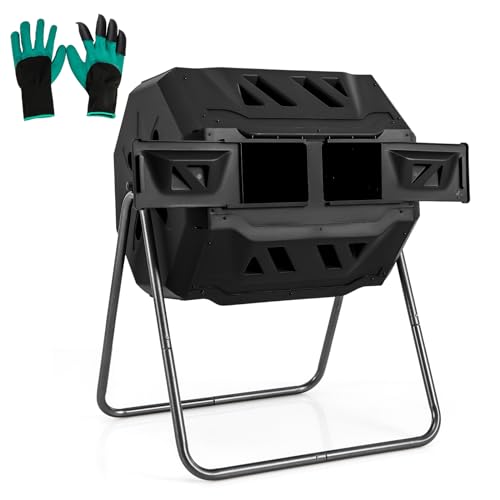
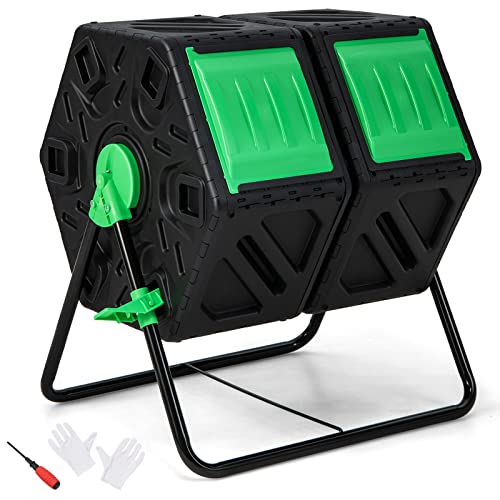
Goplus 160L Dual Chamber Composting Tumbler
ASIN B0D3GVM3HD • $75.95 • Sold by Goplus AU on Amazon AU
The Goplus is the capacity-per-dollar play: 160L (42 gallons in the listing's terms) across dual chambers for $76 at time of writing, which is more volume than the Costway for less money. It ranks #37 in Outdoor Waste Bins, so it's selling steadily rather than leading the category, and the build follows the same proven recipe: BPA-free PP panels on a rustproof metal frame with the stable triangular base, two large sliding doors, and a 360 degree roll to turn the contents. The doors are the standout detail here, because the listing specifically pitches them as tightly locking against rodents, insects and other pests, and that latching is exactly what you want checked and working if food scraps are going in.
Aeration comes from ventilation holes in each panel, and the dual chambers run the usual fill-one-finish-one rotation with a claimed four to six weeks in warm weather. At 160L you're getting real headroom for the browns that make a batch work, which is the practical advantage over 130L class units: a chamber with space for the cardboard and dry leaves alongside the wet scraps is a chamber that cooks instead of slumping into sludge. The same size cuts the other way when input is thin. If you only generate a small caddy of scraps a week, a half-empty 80L chamber runs cold, so match this to a household that actually produces the volume.
For a first tumbler bought on a maybe, this is the one I'd suggest, because the worst case is losing $76 to the experiment rather than $170. The steel is thinner than the VEVOR's and there's no crank, but the fundamentals that matter, sealed drum, latched doors, off-the-ground frame, are all present and doing their jobs. The rank tells the same story: #37 is a steady seller in a category whose top ten is mostly dearer units, which usually means the people who bought one kept it. Goplus and Costway leapfrog each other on price week to week, so check both listings on the day.
Honest caveats: Thinner gauge frame than the VEVOR and no crank, so a full barrel is a two-hand job to roll. Same flat-pack assembly cautions as the others: hand-tighten the panel screws. The listing's pest-resistance claim depends entirely on the door latches staying intact, so check them each time you load.
Best for: First-time composters who want the most chamber volume for the outlay and are willing to roll the drum by hand.
Capacity: 160L (42 gal), dual chamber • Turning: 360° roll • Doors: 2 large sliding doors, tight locking • Pest control: Latched doors, raised frame • Aeration: Ventilation holes on each panel • Material: BPA-free PP barrel • Frame: Rustproof metal, triangular structure • Rank: #37 in Outdoor Waste Bins (Amazon AU)
View on Amazon AU
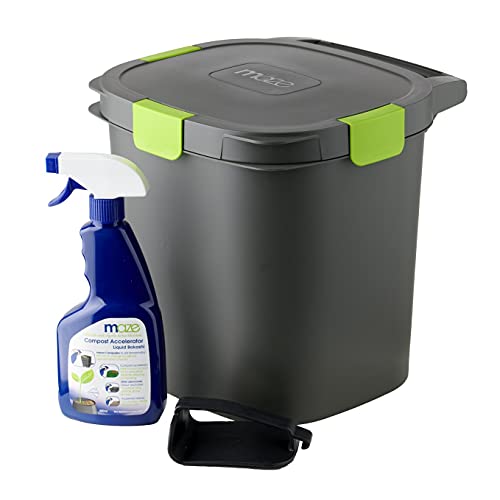
Maze 14L Indoor Composter, Airtight Bokashi System
ASIN B09TPBFS8H • $65.00 • Sold by Maze Products Australia on Amazon AU
The Maze is the indoor half of the system: a 14L airtight bucket that ferments food waste rather than composting it, sold by Maze Products Australia at $65 at time of writing. The lid seals on a silicone gasket held down by three locking clips, and that seal is the whole product. Bokashi is anaerobic fermentation, so air is the enemy, and a bucket that holds its seal is one that works without smells or fruit flies, which is exactly what the listing promises. Because it ferments instead of rotting, it takes the things every outdoor composter refuses: cooked food, meat, fish, the lot, alongside fruit and veg. For a kitchen that wants nothing edible going to landfill, this is the missing piece.
The hardware details are small but right. The tap thread is moulded into the bucket rather than relying on an external nut, which is one less joint to weep, and there's a carrying handle for the trip to the garden when a batch is done. You drain the fermentation liquid off through the tap every few days, and the listing pitches that liquid as a nutrient-rich fertiliser, which it is once it's diluted well down. The fermented solids that come out at the end aren't finished compost, they need burying in a bed or feeding to a tumbler to break down fully, so treat this as stage one of two rather than a complete solution on its own.
It ranks #346 in Amazon AU's Garden Fertilizers category, which is respectable for what's honestly a niche product class in Australia. Budget for the bokashi bran as an ongoing consumable, because the microbes in the bran are what run the fermentation, and a bucket without bran is just a sealed bin. Two buckets in rotation is the comfortable setup once you're committed. Maze sells the bran alongside the buckets on the same storefront, so put a bag in the cart with the bucket rather than discovering the dependency a fortnight in with a full kitchen caddy waiting.
Honest caveats: Fermentation needs the bran, an ongoing consumable the bucket doesn't include long-term, and output still needs soil or a tumbler to finish. The tap wants draining every few days or the liquid pools and the batch sours. The seal and clips are the wear parts, so close them gently rather than snapping them down.
Best for: Apartments and kitchens that want meat, fish and cooked scraps handled indoors without smells.
Capacity: 14L • Seal: Airtight silicone, 3 locking clips • Tap: Built-in thread, no external nut • Accepts: Cooked and uncooked food incl. meat and fish • Output: Fermented solids plus liquid fertiliser via tap • Handle: Carry handle fitted • Seller: Maze Products Australia on Amazon AU • Rank: #346 in Garden Fertilizers (Amazon AU)
View on Amazon AU
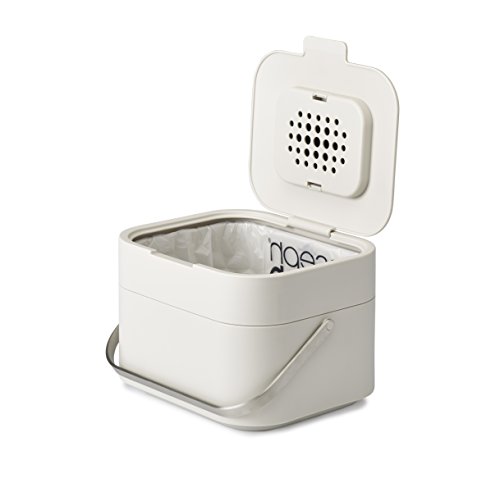
Joseph Joseph Stack 4 Food Waste Caddy with Odour Filter
ASIN B01BPDY0HE • $66.85 • Ships from Amazon AU
The Stack 4 is the smallest spend in the whole system and arguably the one that decides whether the system runs at all, because scraps that don't get collected at the bench never reach the tumbler. It's a small caddy in a stone finish, sold and shipped by Amazon AU at $67 at time of writing, sitting at #73 in the Kitchen Waste Bins category. The two details that separate it from an ice cream container are the odour filter in the lid and the liner-retaining hole inside, which pins the liner so it doesn't slump into the bin the moment something heavy lands on one side. Small thing, but it's the difference between a caddy you tip and re-line in five seconds and one you're fishing peelings out of.
Ventilated caddy designs with filters work on the principle that airflow keeps the contents drier and the filter deals with what escapes, and in practice a filtered caddy emptied every day or two simply doesn't smell. The filter is a consumable, so check replacement availability on the current listing and price a year of them before committing, the same way you'd price printer ink. The listing doesn't state the capacity in litres, so if exact volume matters to your bench layout, check the dimensions on the live listing before ordering. Country of origin is listed as China, and the product type is listed plainly as a trash can, which is refreshingly free of marketing.
If $67 sounds like a lot for a small bin, the alternative most households actually run is a plastic bag hanging off a cupboard door, and that's the version that leaks, smells and gets the whole composting habit cancelled by whoever cleans the kitchen. Pair it with either tumbler above, or with the Maze bucket if the bokashi route suits your kitchen better. It's also the purchase most likely to survive a change of heart, because even if the tumbler experiment fizzles, a filtered caddy keeps earning its bench space feeding the council green bin instead.
Honest caveats: The listing doesn't state litre capacity or filter life, so check both on the live listing and price replacement filters before you order. A caddy only stays odour-free if it's emptied every couple of days, filter or not, and the filter itself is a recurring consumable rather than a one-off purchase.
Best for: Any kitchen feeding a tumbler or bokashi bucket that wants scrap collection to happen without thinking about it.
Type: Benchtop food waste caddy • Odour control: Replaceable odour filter • Liner: Liner-retaining hole • Colour: Stone • Capacity: Not stated on the listing • Origin: China, per the listing • Seller: Amazon AU • Rank: #73 in Kitchen Waste Bins (Amazon AU)
View on Amazon AUSide-by-side comparison
| Product | Price | Best for |
|---|---|---|
| Maze 14lt Indoor Composter- Airtight… | ~$65 | |
| Joseph Joseph Stack 4 Food Waste Caddy with… | ~$63.96 | |
| Goplus Compost Bin | ~$75.95 | |
| Goplus Compost Bin | ~$85.95 | |
| Costway 130L Garden Composting Tumbler Dual | ~$82.95 | |
| Goplus Compost Tumbler | ~$76.46 | |
| Maze Outdoor Compost Tumbler Bin | ~$139 | |
| VEVOR Compost Tumbler | ~$167.99 |
What we see fail at the bench: compost tumblers
A compost tumbler never lands on an actual repair bench, but its failure modes are the same ones we chase in outdoor electronics every week: UV-embrittled plastic, fasteners that walked loose, seals that stopped sealing. The pattern below is drawn from the same physics that kills solar lights and irrigation controllers, applied to a barrel that lives in worse conditions than either.
Door tracks and latches
The sliding doors are the thinnest, most handled plastic on a tumbler, and they fail from the corners in. A door forced against grit in its track chips at the corner, the chip becomes a crack along the track edge, and within a season the door either jams shut or drops out. Once the latch side goes, the rodent proofing goes with it, and that's usually when owners notice. Brush the tracks out when you load, never lever a sticking door with a trowel, and if a corner does chip, a small file to smooth the edge stops the crack propagating for a long while.
Fasteners and frame wobble
A tumbler is a machine that vibrates by design, and every screwed joint on it loosens over the first weeks of use as the plastic bosses settle. Left alone, the wobble concentrates load on the axle mounts, and a bent or oval axle mount is effectively the end of the unit because nobody stocks that part. The fix costs nothing: go around every fastener with a screwdriver and spanner a month after assembly, then again at the start of each season. While you're there, check the frame feet haven't sunk unevenly into soft ground, because a racked frame is what makes doors bind.
Seals, taps and the bokashi bucket
On the bokashi side the wear parts are the silicone lid seal, the three latch clips and the tap. The seal takes a set after a year or two of clamping and stops holding vacuum-tight, which shows up as smell and fruit flies where there were none. The clips crack if they're snapped down hard rather than eased on. The tap is a moulded plastic valve that blocks with sediment if the liquid isn't drained regularly, and clearing it means an unpleasant disassembly. Drain on schedule, close the clips gently, and wipe the seal clean each time and the bucket outlasts its price several times over.
Decision tree: which one should you actually buy?
- Kitchen scraps plus a steady stream of garden waste? → The VEVOR at $168. The 200L split chambers give the mix room to work, and the crank with its ratchet lock means turning a full barrel doesn't need shoulders.
- Two people, a weekly caddy of scraps and a few trimmings? → The Costway at $90. The 130L twin chambers heat evenly at that input rate, and the independently rotating drums make the fill-and-finish rotation painless.
- First tumbler and not sure the habit will stick? → The Goplus at $76. Most chamber litres on the list for the least outlay, and every fundamental that matters, latched doors, sealed drum, raised frame, is present.
- Apartment, no yard, or meat and cooked food in the waste stream? → The Maze bokashi at $65. Airtight fermentation indoors takes everything a tumbler can't, and the output feeds a garden bed, a community garden or a mate's compost.
- The scraps keep going in the rubbish out of habit? → The Joseph Joseph caddy at $67. Collection at the bench is the step every failed composting attempt skipped, and the odour filter keeps the household on side.
- A dead tap timer, a solar light that quit or a phone that went into the garden bed? → That's our side of the fence. Bring it in to our Erina workshop and we'll tell you whether it's worth fixing before you spend anything.
Frequently asked questions
Do compost tumblers attract rats?
Far less than open bins or heaps, and that's most of the reason to buy one. The barrel sits off the ground on a steel frame, so there's no burrowing route in, and the sliding doors latch shut. Rats are after food scraps, not compost itself, so the risk window is a door left ajar or a latch that's cracked with age. Check the door hardware every couple of months and keep meat, dairy and cooked food out of the barrel and a tumbler gives rodents nothing to work with. If you've got an active rat problem already, a tumbler or an indoor bokashi bucket is the right call over any ground-contact bin.
Can I put meat and cooked food in a compost tumbler?
I wouldn't. A tumbler runs an aerobic composting process that's slow to deal with meat and fats, and in the meantime they smell and advertise the barrel to every rat and fly in the suburb. Meat, fish, dairy and cooked leftovers belong in a bokashi system like the Maze bucket, which ferments in an airtight container indoors and handles all of it happily. The fermented output can then be buried in a bed or added to the tumbler, where it breaks down quickly without the smell phase. Run the two systems together and nothing edible needs to hit the red bin.
How long does a compost tumbler really take?
The listings on all three tumblers here quote four to six weeks, and that's achievable in an Australian summer with a full chamber, a decent browns-to-greens mix and turning every few days. Treat it as the best case rather than the schedule. A half-full chamber in winter can take three months, because small cold batches just don't generate the heat that drives the process. The practical fix is the dual-chamber design: stop adding to one side, let it finish at whatever pace the season allows, and keep loading the other. If a batch seems stalled, it's nearly always moisture, too wet and sour or too dry and inert, and both are fixable in a day or two.
What's the difference between bokashi and composting?
Composting is aerobic: microbes plus oxygen break material down into finished compost, which is what the tumblers do. Bokashi is anaerobic fermentation: scraps are packed into an airtight bucket with an inoculated bran, and the microbes pickle the contents rather than decomposing them. Fermentation is why bokashi handles meat, fish and cooked food that composting can't, and why it works indoors without smell as long as the seal holds. The catch is that bokashi output isn't finished compost. It needs burying in soil or feeding to a compost system to break down fully, so bokashi is stage one and the tumbler or garden bed is stage two.
Why do compost tumblers have two chambers?
Because a single chamber never finishes. If you keep adding fresh scraps to a working batch, the newest material is always weeks behind the oldest, and you can never empty the barrel without wasting the half-done majority. Two chambers fix the logistics: fill one side until it's full, then leave it to finish while you start filling the other. By the time side two is full, side one is compost and gets emptied into the garden. Every tumbler in this guide runs that layout, and on the Costway the chambers even rotate independently so turning the finishing side doesn't disturb the filling side.
What size compost tumbler do I need?
Size against what your household actually throws out each week, not the garden you're planning. A benchtop caddy of kitchen scraps per week is comfortably handled by the 130L Costway. Add regular garden trimmings, lawn edges and autumn leaves and the 160L Goplus or 200L VEVOR earns its space. Remember the volume quoted is input capacity, and a batch shrinks to a fraction of that as it cooks. Oversizing has a real cost: a chamber that's only ever a quarter full runs cold and slow, so the biggest barrel is only the right barrel if you'll actually feed it.
Related buying guides
Garden tech dies young out there
Tap timers, solar lights, irrigation controllers and the phone that slipped out of a pocket into the mulch: the garden is the hardest environment most electronics ever see. Before you bin anything or buy a replacement, bring it in to the workshop in Erina. We'll open it up, tell you what actually failed and whether fixing it makes sense, before you spend a dollar.
Visit our Erina workshop Book Online