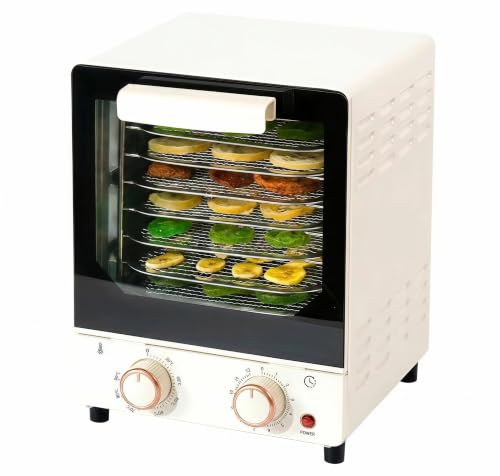
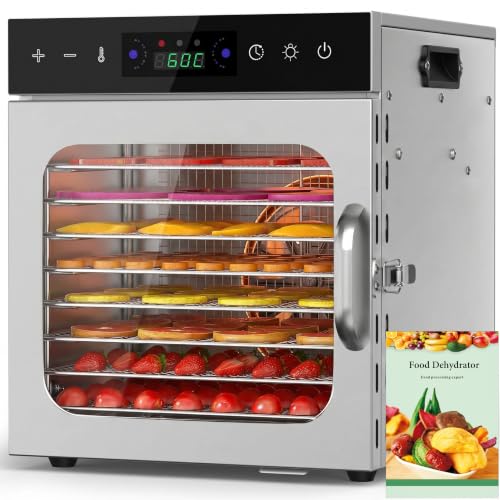
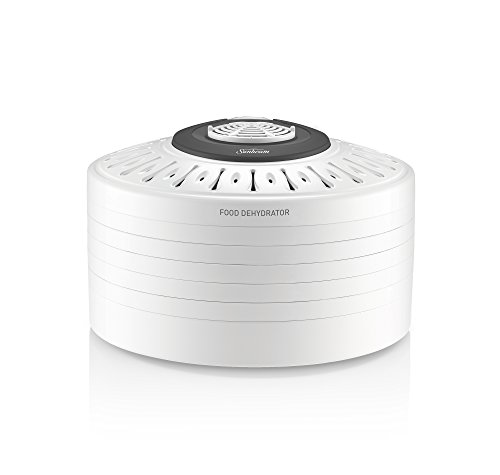
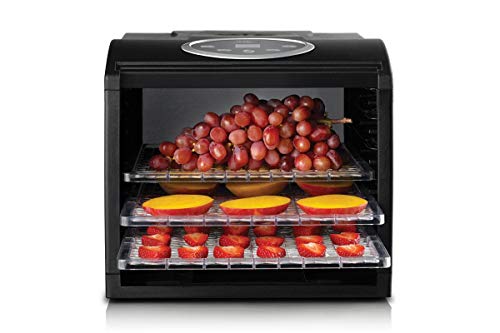
Prices from Amazon AU, updated daily. Swipe or use the arrows for more.
Disclosure: This article contains affiliate links to amazon.com.au. If you buy through one of these links iFix may earn a small commission at no extra cost to you. It doesn't change which products we recommend. We focus on what actually lasts based on 16 years of repair-shop experience.
Quick summary6 picks
- Entry PickMZDMY Food Dehydrators with 8 Trays… about$95.99250W.
- Mellerware Biltong Maker Stainless Steel… about$149.99
- Sunbeam DT5600 Food Dehydrator about$143.20
- Kisfam 8-Tray Food Dehydrator about$169.99
- Sunbeam Food Lab Electronic Food Dehydrator… about$198500W.
- Most PremiumVEVOR Food Dehydrator Machine about$295.991000W.
Why a food dryer earns its bench space
Most of the interest in dehydrators arrives in late spring, and the timing isn't an accident. Anyone with a couple of fruit trees or a decent vege patch knows the problem: the garden produces nothing for months, then buries you in tomatoes across three weeks. You can only give away so many. A dehydrator turns that surplus into jars of dried tomatoes, apple rings and herbs that keep for months on a shelf, with no freezer space spent on any of it. With the grocery basket sitting roughly 31 per cent above 2019 levels, more households are growing food on purpose, and preserving gear is riding along behind it. I covered the freezer half of that plan in the vacuum sealer guide; this is the pantry half.
The appeal for me is that a dehydrator is about as simple as a mains appliance gets. There's a heating element, a fan, a thermostat and a timer, and that's the whole machine. Nothing in there should be expensive to run or quick to die, which makes the price spread on Amazon AU interesting: the five picks below run $96 to $296, and the gap is mostly capacity and build rather than extra electronics. Simple also means the failure points are predictable. The fan is a wear item, the thermal fuse is the usual sudden death, and the control board is fine until someone stores the machine in a damp shed over winter. I'll get to all three further down, because they should shape what you buy.
None of this works if the machine can't hold a temperature or move air evenly, and that's where the listings get slippery. The spec sheet for a dehydrator is three numbers, wattage, temperature range and tray count, and two of the three are routinely dressed up. So before the picks, it's worth spending a few minutes on what the numbers actually mean, because the difference between a $96 tower and a $296 cabinet isn't the electronics, it's area and airflow, and you can read both off a listing once you know where to look.
Tray area beats tray count every time
The headline spec on every listing is the tray count, and it's close to meaningless on its own. Eight trays tells you nothing until you know the size of each tray. The VEVOR in the picks states its tray size plainly at 37 by 28 centimetres, which is roughly a tenth of a square metre per layer, and ten layers of that is about a square metre of drying area. Most smaller units don't state tray dimensions at all, and the honest reading of that silence is that the trays are small. When a listing won't give you a number, assume the number wouldn't have helped the sale. What actually limits a batch is area: apple rings and tomato halves get laid out in a single layer with air gaps between them, so a season's picking goes further on fewer, bigger trays than on a tall stack of little ones.
Capacity claims in litres are worse. A dehydrator isn't a bucket; you don't fill the volume, you cover the shelf. So when you're comparing two units, look for stated tray dimensions first, and if neither listing gives them, use the machine's footprint and wattage as a rough proxy, because a 1,000 watt cabinet generally carries more usable area than a 250 watt tower. It's the same trick air fryer listings pull with basket litres, which I went through in the air fryer guide: the marketing number and the cooking number are rarely the same number, and the gap is widest at the bottom of the price ladder where the listing has the most to hide.
Fan placement decides how much babysitting you do
There are three layouts in this category. Bottom-fan towers push air up through the stack, which means the bottom tray runs hotter and drier than the top one, and you end up rotating trays halfway through a run. Rear-fan cabinets blow air horizontally across every tray at once, so each layer sees roughly the same airflow and you can load the machine and walk away. The third layout is the biltong-box style, which barely heats at all: a low-wattage light fitting and a small fan move gently warmed air past hanging meat over a few days, the traditional South African way. Of the five picks, the MZDMY is the bottom-fan tower, the Kisfam, Sunbeam and VEVOR are horizontal-airflow designs, and the Mellerware is a purpose-built biltong box. That one difference explains most of the price ladder.
Does the tower layout make bad food? No, it makes uneven food, and unevenness matters more for some jobs than others. Herbs and apple slices forgive a lot. Jerky doesn't, because strips that finish at different times mean some are still soft in the middle when others are done, and you either pull the whole batch early or dry the thin ones to leather. If jerky or biltong is the main reason you're buying, spend on horizontal airflow or the purpose-built box. If you're mostly saving a tomato glut and drying rosemary, the tower does the job for a hundred dollars less.
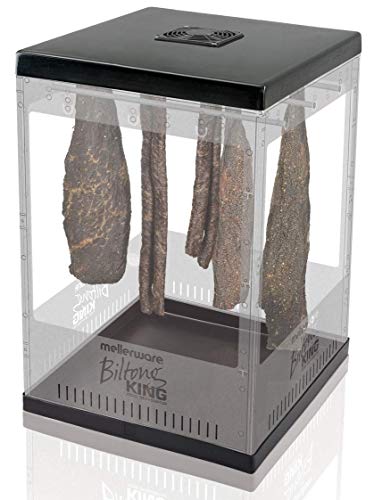
The Mellerware's listing is refreshingly plain about its own approach: a built-in 240 volt fan for continuous airflow, a light fitting to reduce moisture, a removable base plate for cleaning, and that's the machine. Biltong is traditionally an air-dried product rather than a cooked one, so low and slow is the whole method. Don't buy it expecting fruit leather by dinner, and don't buy a 1,000 watt cabinet expecting traditional biltong texture either; they're different tools for different jobs, and the picks treat them that way.
What a drying run costs at the wall
Drying is slow, so people assume it's expensive to run, and the arithmetic mostly says otherwise. Take the Sunbeam at its stated 500 watts. Flat out, that's half a kilowatt-hour every hour, which at the average AU tariff of roughly 33c/kWh is about 17c an hour. A long ten hour fruit run costs around $1.65 if the element never cycles off, and in practice the thermostat cuts the element in and out, so the real figure lands under that. Even the 1,000 watt VEVOR tops out near 33c an hour on the same assumption. Compare that against running a 2,000 watt oven on its lowest setting with the door cracked, the old way of drying fruit, which burns far more power to do a worse job with no airflow control and no timer.
If you want the real number rather than my assumption, put the machine on one of the metering smart plugs I wrote up and log one full run; the plug catches the thermostat cycling that the arithmetic can't. What I'd actually watch isn't the tariff, it's the timer. A machine with a proper auto shut-off finishes at 3am and goes cold. A machine without one runs until you remember it exists, and every extra hour is wasted power and over-dried food. Three of the five picks state a timer with auto shut-off; the Mellerware doesn't have one because its method doesn't want one, and I've flagged the details in the caveats so nobody buys it expecting a clock.
Stainless trays, plastic trays and the damp shed problem
Stainless trays have mostly won this category, and for once the upgrade the marketing pushes is the one I'd pay for. Plastic trays stain with tomato and beetroot, warp if you wash them too hot, and crack at the corners after a couple of years of flexing. The 304 stainless trays on the Kisfam and VEVOR listings shrug all of that off and go through the dishwasher. One honest detail worth reading closely: VEVOR states the trays are 304 but the body is 201 stainless, a lower grade that's fine in a kitchen and less fine in salty coastal air. On the Central Coast I'd keep any of these machines indoors regardless, because a dehydrator stored in a damp garage grows corrosion on its control board and heater terminals, and that's a slow killer no warranty covers.
Moisture works on these machines from the inside too. Every run pushes litres of water vapour out through the vents, and if the machine lives in a closed cupboard-sized space while it works, that vapour condenses on the closest cold surface, including the machine itself. Give it open bench space with air around it while it runs. If the room already struggles with condensation over winter, drying gear pairs sensibly with what I covered in the dehumidifier guide, because a wet room makes long drying runs slower and the room wetter.
Electrical safety for a machine that runs overnight
A dehydrator is a heater on a timer that you deliberately leave running while you sleep, so treat it with the same respect as any other heating appliance. Plug it straight into the wall, not into a powerboard already feeding half the kitchen. A standard AU socket is good for 10 amps, 2,400 watts, and while even the VEVOR draws less than half that, powerboards fail at their contacts when heating loads share them with everything else. Check the plug and cord for heat after the first few long runs; warm is normal, hot isn't. And look for the RCM compliance mark on the unit or the listing before you buy, because uncertified imports circulate in this category and the corners they cut are exactly the thermal protections you can't see from outside.
The protections worth having are the boring ones. The Sunbeam listing states overheat protection, and the usual mechanism behind that claim is a thermal fuse in series with the element, a one-shot device that opens the circuit if the cabinet overheats, say when a fan stalls under a load of wet fruit. That's the failure you want: the machine goes dead and nothing dramatic happens. It's also why a dead dehydrator is often a five dollar part away from working. More on that in the bench section below, because it's the most common fault in this whole appliance family, and the one where a quote saves people the most money.
How I picked the five
Every pick is condition New from an Australian storefront on Amazon AU, sitting inside the $80 to $400 band I set for the category, with no import-version stock and no overseas export sellers. I sorted what survived by Amazon AU's Food Dehydrators sales rank, which is as close to live AU demand data as you can get from outside Amazon. The lead pick ranks number 4 in that category at the time of writing and all five sit inside the top 34. Rank isn't quality, it's what people are actually buying, but in a category where honest capacity is this hard to read off a listing, a machine that sells in volume and holds its rank month after month tends to be one that isn't going straight back in the post.
Prices move, so treat the dollar figures here as the shape of the ladder rather than gospel. What I'd hold onto is the structure: under $100 buys a bottom-fan tower that does real work with some tray rotating, the $140 to $200 middle buys horizontal airflow and set-and-forget timers, and close to $300 buys commercial-style area and wattage for serious batch runs. If your produce arrives in gluts, buy area. If it arrives in herb bunches, buy small, keep the bench space and spend the difference on jars and labels. And if you're building out the whole preserving workflow, the batch cooking side of it is covered in the pressure and slow cooker guide.
The 5 picks, $96 to $296
Prices are Amazon AU at time of writing (9 September 2026) and move week to week. Ranks are Amazon AU category sales ranks, checked the same day.

MZDMY 8-Tray Stainless Steel Food Dehydrator
ASIN B0GZCC3437 • $95.99 • Sold by MZDMY-AU on Amazon AU
The MZDMY is the machine I'd point at anyone who wants to find out whether they'll actually use a dehydrator before spending real money. It's a $96 bottom-fan tower with eight stainless steel trays, a 250 watt element and digital control covering 30 to 90 °C with a one to 12 hour timer. The brand means nothing to me and probably nothing to you, but it's sold new through an AU storefront, and it holds rank 34 in Amazon AU's Food Dehydrators category at the time of writing, which for a no-name unit says plenty of people have taken the punt. The layout is the classic stacking tower: fan and element in the base, air pushed up through the tray stack, moisture out the top.
The listing states a brushless motor and quiet running, and 250 watts is a modest draw that suits overnight herb and fruit runs where you're in no hurry. Two preset modes sit alongside the manual control, though the listing doesn't explain what they're set to, so treat the manual dial as the real interface. The stainless trays are the notable inclusion at this price, because most towers under $100 ship with plastic ones that stain and warp. Being a bottom-fan design, the tray closest to the base runs warmest, so plan on swapping the top and bottom trays halfway through anything you care about finishing evenly, and load the thick pieces low. At 250 watts the running cost is around 8c an hour flat out at 33c/kWh, before the thermostat starts cycling.
Where it fits: first machine, herbs, tomato gluts, apple rings, and finding out what you'd want from a bigger unit. Where it doesn't: jerky in volume, because the wattage is modest and the airflow layout means uneven strips unless you rotate religiously. The honest comparison against the Kisfam at $140 is that the extra $44 buys horizontal airflow and a 24 hour timer, and if you already know you'll use the machine weekly, that's the better spend. As a first machine with trays that won't stain or warp, though, this is the pick.
Honest caveats: No stated tray dimensions and no stated capacity, so assume the trays run small for a tower. The two preset modes aren't explained on the listing. An unknown brand means unknown spare parts, so a failed fan or element outside warranty likely writes it off. Rotate trays for even results.
Best for: First-time buyers drying herbs, fruit and garden gluts who want stainless trays without spending past $100.
Power: 250W (stated) • Trays: 8, stainless steel • Temperature: 30 to 90 °C (stated as 86 to 194 °F) • Timer: 1 to 12 hours • Airflow: Bottom fan, air pushed up the stack • Motor: Brushless (stated) • Seller: MZDMY-AU storefront, condition New • Price: $96 at time of writing • Rank: #34 in Food Dehydrators (Amazon AU)
View on Amazon AU
Kisfam 8-Tray Food Dehydrator, Digital Control and 24H Timer
ASIN B0H6JHBYTQ • $139.99 • Sold by KISFAM-AU on Amazon AU
The Kisfam is the middle of the ladder done properly: eight 304 stainless trays in a cabinet with a rear-mounted fan, digital control from 30 to 90 °C, and a 24 hour timer with auto shut-off. The rear fan is the feature you're paying for here. Air moves horizontally across every tray at once, so a full load of jerky strips or tomato halves finishes together without the tray-swapping ritual the towers demand. It holds rank 14 in Amazon AU's Food Dehydrators category, sold new through an AU storefront at $140 at the time of writing. The listing also states operation under 48 decibels, which matters more than it sounds, because a dehydrator's whole job is running for ten hours while you do something else, often overnight in the next room.
The 24 hour timer is the practical difference from the MZDMY's 12 hours. Thick jerky, whole figs and anything dense can want 14 hours or more at low temperature, and a timer that can't cover the run means either finishing the batch manually or splitting it across two days. Set-and-forget with auto shut-off also means a run that finishes at 2am ends at 2am rather than cooking on until morning. The 304 stainless trays won't pick up beetroot stains and are straightforward to clean, and a recipe book ships in the box, which is more useful than it sounds for getting temperatures right in the first month. Wattage isn't stated on the listing, so the exact running cost is a metering-plug job rather than a spec-sheet read.
This is the machine for the household that's past experimenting. If the garden produces in gluts and you want jerky without babysitting, the rear-fan layout and the long timer cover both, and at $140 it undercuts the big-brand horizontal-airflow options while matching them on the layout that matters. Against the Sunbeam at $198 you give up the known brand, the stated 500 watts and the yoghurt and dough-proofing presets, and you keep $58. For a confident first machine or a working second one, I reckon that's a fair trade, and the rank suggests the market agrees.
Honest caveats: Wattage isn't stated on the listing, so batch times against the Sunbeam or VEVOR are guesswork until you run it. Tray dimensions aren't stated either. Kisfam has no local spare-parts trail, so a failed fan after warranty likely retires the unit. The 48 decibel figure is the manufacturer's, not a measurement.
Best for: Regular jerky and glut-preserving households that want horizontal airflow and a 24 hour timer without big-brand money.
Power: Not stated on the listing • Trays: 8 x 304 stainless steel • Temperature: 30 to 90 °C • Timer: 24 hours with auto shut-off • Airflow: Rear fan, horizontal across all trays • Noise: Under 48 dB (stated) • Seller: KISFAM-AU storefront, condition New • Price: $140 at time of writing • Rank: #14 in Food Dehydrators (Amazon AU)
View on Amazon AU
Mellerware Biltong Maker Stainless Steel Food Dehydrator
ASIN B07T95WXBL • $149.99 • Sold by Biltongboks AU on Amazon AU
The Mellerware Biltong Maker is the odd one out and the highest-ranked machine on this list, sitting at number 4 in Amazon AU's Food Dehydrators category. It isn't a general-purpose dehydrator, it's a biltong box: a stainless steel cabinet built for the South African method of air-drying spiced meat over days rather than hours. Inside there's a built-in 240 volt fan for continuous airflow and a light fitting whose job is gently reducing moisture, with a removable base plate for cleaning. That's the whole machine, and that's the point. Biltong is an air-dried product, and the gentle approach is what produces the traditional texture that a hot cabinet can't. At $150 through an AU storefront, it's a single-purpose tool that clearly has a following here.
What the listing doesn't state matters as much as what it does: there's no temperature control, no timer and no stated wattage, because the method doesn't call for any of them. You hang the meat, close the box and check it daily until it's where you like it. The fan runs continuously and the light provides the mild warmth that keeps moisture moving out. Assembly is described as light and easy, and cleaning comes down to that removable base plate. If you've been making biltong in a cardboard box with a desk lamp and a computer fan, which is how plenty of people start, this is that same rig done properly in stainless, with hygiene and airflow that don't depend on your handiwork.
Buy it if biltong or droëwors is the product you actually want, because its rank comes from people who wanted exactly that. Skip it if you're after apple chips, herbs or fruit leather, since with no thermostat and no timer it's the wrong tool for everything except slow-dried meat. It also runs for days per batch rather than hours, so give it a corner where it can sit undisturbed. Paired with a general-purpose cabinet like the Kisfam or Sunbeam you'd have the whole preserving spread covered, but as a first and only dehydrator it's a specialist.
Honest caveats: No timer, no thermostat and no stated wattage, so there's nothing to set and nothing to read but the meat itself. Batches take days, which suits the method and surprises first-timers. Spare fans and light fittings aren't listed as parts, so treat a component failure as a warranty conversation.
Best for: Biltong and droëwors makers who want the traditional slow air-dry done in stainless rather than a hot cabinet.
Type: Biltong box, air-drying cabinet • Build: Stainless steel, modern style • Fan: Built-in 240V, continuous airflow • Warmth: Light fitting to reduce moisture • Temperature control: None, not part of the method • Timer: None • Cleaning: Removable base plate • Price: $150 at time of writing • Rank: #4 in Food Dehydrators (Amazon AU)
View on Amazon AU
Sunbeam Food Lab Electronic Food Dehydrator DT6000
ASIN B076JQFB6Y • $198.00 • Ships from Amazon AU
The Sunbeam Food Lab DT6000 is the known-brand pick, sold and shipped by Amazon AU itself at $198 and ranked 12 in Food Dehydrators. It's a 500 watt horizontal-airflow machine with eight preset temperatures from 35 to 70 °C managed by an electronic temperature sensor, and a digital timer that runs to 19.5 hours in 30 minute steps with an LCD countdown and auto shut-off when time ends. The presets go beyond drying: the listing includes settings for culturing yoghurt and proofing dough, which quietly turns it into three appliances for anyone who bakes. Overheat protection is stated too, and this is the only listing of the five that states it, which as someone who has replaced a lot of thermal fuses is a line I notice.
Five hundred watts with a thermostat makes the running arithmetic easy: about 17c an hour flat out at 33c/kWh, less once the element starts cycling, so a ten hour run lands under $1.65. The 19.5 hour timer covers almost everything short of biltong, and horizontal airflow means the top and bottom trays finish together without swapping. Sensor-controlled presets rather than a bare dial are the detail separating it from the no-name cabinets; fruit set to 57 °C actually sits near 57 °C, which is the difference between predictable batches and poking at the trays every few hours. The recipe booklet covers jerky, dried fruit and vegetables, yoghurt and dough, and the controls are simple enough to hand to anyone in the house without a briefing.
This is the machine I'd buy for a mixed household that will dry fruit one week, culture yoghurt the next and proof pizza dough on Fridays. The $58 over the Kisfam buys the Sunbeam name and local support, the stated wattage, the overheat protection and those extra modes. What it doesn't buy is tray count or stated tray dimensions, so heavy jerky producers may still want more area. For everyone else this is the sensible ceiling, because past this point in the range you're paying for drying volume rather than better control.
Honest caveats: Tray count and tray dimensions aren't stated on the listing, an odd omission at the price, so don't assume it out-loads the eight-tray cabinets. Maximum temperature is 70 °C, plenty for drying but lower than the 90 °C machines. The housing is black plastic rather than stainless, if that matters to you.
Best for: Households that want one machine for drying, yoghurt culturing and dough proofing, with local brand support behind it.
Power: 500W • Temperature: 8 presets, 35 to 70 °C, sensor controlled • Timer: Up to 19.5 hours in 30 minute steps, auto shut-off • Airflow: Horizontal, no tray rotation needed • Extra modes: Yoghurt culturing, dough proofing • Protection: Overheat protection (stated) • Seller: Amazon AU, condition New • Price: $198 at time of writing • Rank: #12 in Food Dehydrators (Amazon AU)
View on Amazon AU
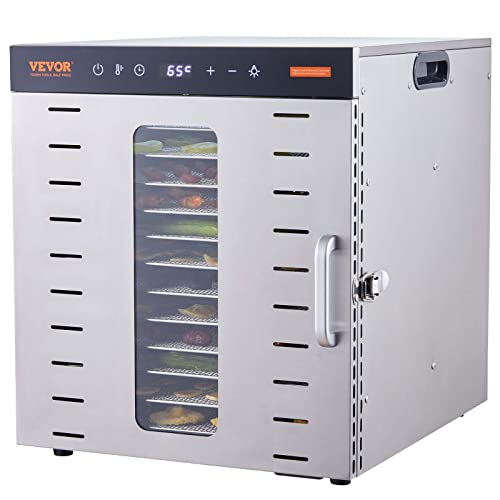
VEVOR 10-Tray Stainless Steel Food Dehydrator, 1000W
ASIN B0C5XK6ZT4 • $295.99 • Sold by VEVOR Store AU on Amazon AU
The VEVOR is the volume pick: ten 304 stainless trays at a stated 37 by 28 centimetres each, which works out to roughly a square metre of total drying area, driven by a 1,000 watt element and a rear fan pushing air across every layer at once. The listing states each tray carries up to 1.7 pounds, call it 770 grams, so a full load approaches seven kilos of produce in one run. Timer and temperature both sit on a digital panel, with the timer running from half an hour to 48 hours, the longest here by a wide margin. It's $296 through VEVOR's AU storefront and holds rank 24 in Food Dehydrators, which for a machine at three times the entry price tells you the big-batch crowd exists.
VEVOR is a workshop-equipment brand and this is built like it: 201 stainless body, 304 stainless trays that are stated dishwasher-safe, and the fan and element at the rear where a cabinet wants them. A 48 hour timer sounds like overkill until you're drying dense fruit at low temperature for storage rather than snacking, where long cool runs beat short hot ones. At 1,000 watts the worst case at the wall is about 33c an hour at 33c/kWh, and the thermostat cycles that down substantially in practice. The tray area is the real economics of the thing: one run here replaces about three runs on a small tower, and the power difference between those two plans is minor next to the time.
Buy it if you're preserving in serious volume: a fruit tree's worth at a time, jerky for a family, garden gluts that arrive in crates rather than bowls. The footprint is commercial-style and it wants permanent bench or shelf space, so measure before ordering. Against the Sunbeam you're trading the culture and proofing presets and the household brand for double the wattage and far more area. If the question is which machine gets through a 20 kilo tomato season fastest, this is the answer; if the question is what sits neatly on a kitchen bench, it isn't.
Honest caveats: The body is 201 stainless, a lower grade than the 304 trays, so keep it out of damp or salty storage. It's by far the biggest unit here and noise isn't stated on the listing. Overheat protection isn't stated either, and VEVOR support is web-based, so factor both into the price.
Best for: Big-batch preservers who measure produce in crates and want maximum tray area with a timer that covers two-day runs.
Power: 1,000W • Trays: 10 x 304 stainless, 37 x 28 cm each (stated) • Load: Up to 1.7 lb, about 770 g, per tray (stated) • Timer: 0.5 to 48 hours • Airflow: Rear fan, 360 degree circulation (stated) • Body: 201 stainless steel • Seller: VEVOR Store AU, condition New • Price: $296 at time of writing • Rank: #24 in Food Dehydrators (Amazon AU)
View on Amazon AUSide-by-side comparison
| Product | Price | Best for |
|---|---|---|
| MZDMY Food Dehydrators with 8 Trays… | ~$95.99 | |
| Kisfam 8-Tray Food Dehydrator | ~$169.99 | |
| Sunbeam DT5600 Food Dehydrator | ~$143.20 | |
| Sunbeam Food Lab Electronic Food Dehydrator… | ~$198 | |
| VEVOR Food Dehydrator Machine | ~$295.99 | |
| Mellerware Biltong Maker Stainless Steel… | ~$149.99 | The biltong specialist |
What we see fail at the bench: food dehydrators
A dehydrator is a fan heater that runs ten hours at a stretch, and its failure modes follow from that duty cycle. We don't see them in the shop in the numbers we see phones and laptops, but small appliances obey the same physics as everything else in the workshop, and the same three faults account for nearly every dead unit that's crossed mine. All three are worth knowing before you buy, because two are avoidable and one is a five dollar fix.
Stalled fans and worn bearings
The fan runs every minute the machine is on, and its bearings are the first thing to wear. The early symptom is a rattle or whine on startup that settles as the machine warms; the end state is a stalled fan, which turns a dehydrator into an oven with no circulation, scorching the trays nearest the element while the far ones stay wet. A brushless motor, which the MZDMY states, generally outlasts a brushed one because there are no brushes to wear down, but bearings still age either way. If a machine starts screeching, stop using it, because a stalled fan in front of a live element is how thermal fuses die and how tray plastics get cooked.
Thermal fuses: the five dollar sudden death
The most common dead-appliance fault in this family is a machine that suddenly won't heat, often with the fan still running. Nine times out of ten that's the thermal fuse, a one-shot safety device wired in series with the element that opens permanently if the cabinet overheats, usually after a fan stall, a blocked vent or a run with the unit backed hard against a wall. The fuse itself costs a few dollars; the labour is opening the housing and crimping the new one in, never soldering, because the iron's heat can blow the replacement on the way in. It's exactly the kind of fault worth a quote before the whole machine goes in the bin.
Control boards, steam and storage
The control panel lives directly above or beside a box that exhausts warm wet air for hours, and membrane keypads and their boards don't love that environment. The faults we see are stuck or dead buttons and displays with missing segments, usually on machines stored in garages and sheds between seasons, where months of damp do more harm than years of use. Corrosion on a board is slow and cumulative, the same mechanism I've written up for phones that got wet, just at lower stakes. Store the machine indoors, run it with clearance so the exhaust isn't washing over its own controls, and wipe it down dry before it goes back in the cupboard.
Decision tree: which one should you actually buy?
- First dehydrator and you're not sure you'll use it? → The MZDMY at $96. Eight stainless trays and proper digital control for under $100, and if it turns out you dry two batches a year, you haven't overcapitalised. Swap the trays around mid-run and it covers most jobs.
- Jerky most weekends without babysitting the machine? → The Kisfam at $140. Rear-fan horizontal airflow means the strips finish together, and the 24 hour timer with auto shut-off covers long low runs while you sleep.
- Biltong specifically, done the traditional way? → The Mellerware Biltong Maker at $150. It's a purpose-built air-drying box rather than a hot cabinet, and it holds rank 10 in the category because it does that one job properly.
- A known brand that also proofs dough and cultures yoghurt? → The Sunbeam DT6000 at $198. Stated 500 watts, sensor-controlled presets, a 19.5 hour timer and the only stated overheat protection of the five.
- A whole fruit tree to get through in a weekend? → The VEVOR at $296. Ten trays at 37 by 28 centimetres is roughly a square metre of drying area, and the 48 hour timer covers runs the smaller machines can't finish.
- Dehydrator stopped heating and you're about to bin it? → Don't yet. If the fan still spins, odds are it's the thermal fuse, which is a small fix on most units. Bring it in to our Erina workshop and we'll tell you whether it's worth doing before you spend anything.
Frequently asked questions
How much electricity does a food dehydrator use?
Less than the long run times suggest. Draw is the element wattage times the hours, cut down by the thermostat cycling on and off. The 500 watt Sunbeam costs about 17c an hour flat out at the average tariff of roughly 33c/kWh, so a ten hour fruit run is under $1.65 before cycling is counted. The 1,000 watt VEVOR peaks near 33c an hour but dries far more per run, so its cost per kilo of finished food is usually lower, not higher, and the 250 watt MZDMY runs around 8c an hour. If you want your machine's real number rather than my arithmetic, log one full run on a metering smart plug and read it off.
What's the difference between a $96 dehydrator and a $296 one?
Mostly drying area and airflow layout, not electronics. The entry towers already have digital temperature control and timers; what they lack is tray size, wattage and horizontal airflow. The $96 MZDMY pushes air up through a stack, so trays finish unevenly and get rotated by hand. The $296 VEVOR moves air across ten large trays at once with four times the element power, so one run does the work of about three tower runs with no rotating. If your batches are small, the tower is fine. If produce arrives by the crate, the area is what you're paying for.
Do I need to rotate the trays?
Depends entirely on the fan layout. Bottom-fan towers like the MZDMY heat the lowest tray hardest, so anything you want evenly finished needs the trays swapped around at least once mid-run, thick pieces loaded low. Rear-fan cabinets like the Kisfam, Sunbeam and VEVOR blow air horizontally across every tray at once, and on those you load the machine and leave it alone. Herbs and apple slices forgive uneven drying; jerky doesn't, because strips finishing at different times means pulling the batch early or over-drying the thin ones. If rotating trays at 9pm sounds like a chore you'll skip, buy horizontal airflow.
Are stainless steel trays worth it over plastic?
Yes, and it's one of the few upgrades in this category I'd call worth paying for on durability alone. Plastic trays stain permanently with tomato and beetroot, warp when washed too hot, and crack at the corners after a couple of years of loading and flexing. The 304 stainless trays on the Kisfam and VEVOR listings go through the dishwasher and come out the same shape they went in. One grade note from the VEVOR listing: its trays are 304 but the body is 201 stainless, a lower grade, so keep it out of damp storage, which is good advice for every machine here anyway.
Is it safe to run a dehydrator overnight?
They're designed for long unattended runs, and the sensible precautions are the same as for any heating appliance. Plug it straight into a wall socket rather than a loaded powerboard, give it clearance so the vents aren't blocked, and use the timer's auto shut-off so a run that finishes at 2am actually stops. Check the plug and cord after your first few long runs; warm is normal and hot is a fault. Look for the RCM compliance mark before buying, because uncertified imports do circulate in this category, and the thermal protections they skip are the ones that matter at 3am.
My dehydrator stopped heating. Is it worth repairing?
Often, yes. A machine that won't heat while the fan still runs is usually a failed thermal fuse, a one-shot part costing a few dollars that opens when the cabinet overheats, commonly after a fan stall or blocked vent. Replacing it is a short bench job on most units, and if the fan bearing caused the overheat, that gets sorted at the same time. The honest exception is the no-name machines, where spare fans and elements can be unobtainable and the fuse is the only economical fix. Get a quote before binning anything, because the gap between a small repair and a new machine is usually wide.
Related buying guides
Dead dehydrator? It's probably the five dollar part
When a dehydrator dies it's usually the thermal fuse or the fan, not the element, and both are small jobs on most units. Before you bin the machine or order its replacement, bring it in to the shop in Erina. We'll open it, tell you what failed and what the fix costs, and if it isn't worth doing we'll say so before you spend anything.
Visit our Erina workshop Book Online