Prices from Amazon AU, updated daily. Swipe or use the arrows for more.
Disclosure: This article contains affiliate links to amazon.com.au. If you buy through one of these links iFix may earn a small commission at no extra cost to you. It doesn't change which products we recommend. We focus on what actually lasts based on 16 years of repair-shop experience.
Quick summary8 picks
- CheapestvidaXL Galvanised Steel Raised Bed 152x40x36cm about$65.99
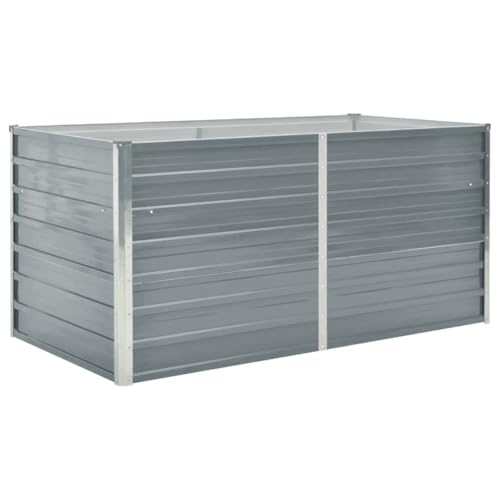
- vidaXL Raised Garden Bed 160x80x77 cm… about$75.59
- Costway 2 PCS Raised Garden Beds about$85.95
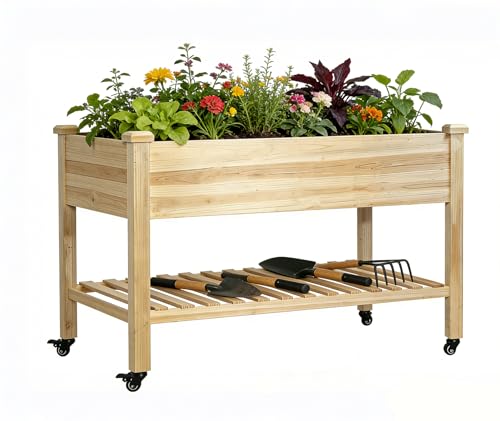
- WUTUSENT 48x22x32 inch Raised Garden Bed… about$89.95
- Costway Galvanized Raised Garden Bed with… about$96.95
- Costway Raised Garden Bed with Legs about$119.95
- WUTUSENT 74inch Raised Garden Bed with Arch… about$129.95
- Most PremiumCostway 183 CM Tall Large Raised Garden Bed… about$186.95
Why steel beds took over from timber
Ten years ago a raised bed meant sleepers or a pine kit, and now the top of Amazon AU's category chart is nearly all galvanised steel, which is what happens when a product's main failure mode gets designed out. Timber in permanent contact with damp soil is timber on a countdown: rot from the wet side, borers from the dry side, and fasteners working loose as the boards move through every wet winter and hot summer. Zinc-coated steel doesn't care about any of that. The wave-profile panels on the modern kits are pressed for stiffness the way a car panel is, so thin sheet ends up rigid once it's bolted into a ring and filled. The coating is doing all the work though, and that has consequences for how you treat the bed, which we'll get to.
Timber still has a real case, and the Wutusent pick below makes it. Wood looks better against a house than zinc sheet, it doesn't ring when you knock it, and its edges stay comfortable to lean on in January when a steel rim in full sun will genuinely surprise you. The price of that is maintenance. The Wutusent is fir, a softwood, and a softwood planter wants oil or sealer before its first winter and a top-up every year or so after, plus feet kept off constantly wet ground. Do that and it'll give you years. Skip it and the base plate goes spongy about the time the steel beds are just getting started. Pick the material to match the maintenance you'll honestly do, not the photo you like, because the bed you half-maintain always costs more than the one you chose correctly in the first place.
The soil volume maths nobody does before ordering
The bed is the small purchase. The soil is the big one, and almost nobody prices it before the box lands. Run the numbers with me, and I'll state the assumption: call a 25L bag of decent veggie mix about $10 at any hardware chain. The vidaXL bed is 152cm long, 40cm wide and 36cm deep, which is about 219L, so it wants around nine bags to fill, call it $90, which is more than the bed costs. The Costway legged pair lists 142L of soil capacity, so budget six bags or so there. Bulk landscape mix by the cubic metre drops the per-litre cost hard if you've got a trailer or a delivery-friendly driveway, and for anything over about 300L it's the way to go. Either way, do this sum before you click buy, because the soil bill deciding the project after the beds have already arrived is the most common way these plans stall in the shed.
Depth is where you can be smart instead of rich. Open-bottom beds sitting on soil don't need the full volume to be premium mix: fork the ground underneath, part-fill with coarse compost, aged manure and even rough prunings, then finish with 15 to 20cm of the good stuff up top, because that top layer is where the feeder roots of most veggies live. Legged planters get no such shortcut. Their full depth has to be actual growing mix, and heavy clay soil shovelled in to save money is the classic mistake, both for drainage and because of what it weighs once wet, which matters a lot on a bed standing on four legs. Expect any bed to slump 10 to 15 percent in the first season and plan a top-up bag into spring.
Waist height or ground level
The 81cm working height on both Costway beds is the whole argument for legs: watering, picking and weeding without bending, which is the difference between a garden that gets attention daily and one that gets attention when guilt wins. Legs also put the crop out of easy reach of rabbits, most possum approaches and a bored dog, and they're the only sensible option on a paved courtyard, a deck or a rental where digging is off the table. Drainage flips as well. A legged planter drains through pre-drilled holes and drips, so it wants a spot where dripping is fine, while an open-bottom bed like the vidaXL drains into the earth below it and roots follow that moisture down into the ground, effectively borrowing depth the bed doesn't have.
The trade against legs is structure. Wet growing mix is heavy, roughly 0.7 to 1kg a litre depending on how wet it's holding, so a filled legged bed is carrying serious load through four feet, and the listing numbers deserve a hard look before you fill anything to the brim. The Costway pair lists a 142L soil capacity against an 80kg load rating, and that arithmetic only works with a light mix that isn't waterlogged. Keep legged beds on firm, level ground so no single leg takes the load, use a light open mix rather than dug garden soil, and don't stand bags of mix on the rim while you work. Ground-level beds carry none of this risk, which is a big part of why they're so common, and why I'd default to ground level anywhere the ground itself is an option.
Wicking conversion: making a bed water itself
A wicking bed is a raised bed with a water reservoir built into its base: a lined lower section holding water, an overflow pipe setting the water level, and soil above drawing moisture upward as the plants use it. You water a fill pipe once or twice a week instead of the surface once or twice a day, evaporation drops because the surface stays drier, and the bed shrugs off a hot week or water restrictions that would wipe out a surface-watered crop. Nothing on this list ships as a wicking bed, but a ground-level steel bed converts well: pond liner up the inside walls, a reservoir layer of scoria or slotted pipe in gravel, geotextile fabric over that, an overflow drilled through the wall at reservoir height, then soil.
Keep the proportions honest and the conversion works. The wicking action of soil peters out beyond roughly 30cm above the water line, so a shallow bed with a shallow reservoir suits the physics better than a tall bed with a bucket in the bottom, and the vidaXL's 36cm wall lands close to that zone. I'd skip converting legged planters. The reservoir adds permanent water weight to a bed already carrying wet soil on four legs, and the 80kg-class ratings on these don't leave room for it. For a legged bed, a dripper line on a basic battery tap timer gets you most of the same hands-off result with none of the structural gamble, and you can raise seedlings for it indoors under the gear from our grow lights write-up while the bed settles.
The greenhouse cover: what spring buys you and summer costs you
The cover on the $97 Costway is the reason it's the category's top seller, and used right it's worth the fuss. A PE cover over a waist-height bed is a seed-raising machine in late winter and early spring: the soil warms weeks earlier, seedlings that would sulk outside get moving, and the zippered roll-up door means watering doesn't involve wrestling the whole tent off. It's also the only pick here with a built-in answer to possums, cabbage moths and scratching birds, which on the Central Coast is not a small feature. Frost isn't much of a factor near the coast, but a few kilometres inland into the valleys it is, and a covered bed takes the edge off a cold snap that would burn young leaves.
Then summer arrives and the same cover becomes a problem. A closed PE tent in full Australian sun cooks its contents, so from late spring the cover comes off or stays fully open, and the bed runs as a plain legged planter until autumn. Treat the cover as the sacrificial part of the purchase too. UV and wind finish every soft cover eventually, zips first, then the film itself going brittle, and the honest way to think about it is a steel bed you'll keep for many years wearing a cover you'll replace occasionally. Anchor it properly in any wind-exposed spot, because a covered bed is a kite frame with a zip, and check the cover's condition each spring before you trust it with a tray of seedlings you've spent six weeks raising. A failed zip discovered the morning after a windy night is a lesson everyone only needs once.
Where the electronics creep in
A modern veggie patch accumulates electronics fast: a battery tap timer on the dripper line, a moisture sensor if you've gone down the automation path, and a string of solar motion lights because the beds turned the side path into somewhere worth lighting. All of it lives outdoors in the splash zone of a hose, and all of it fails in the same two ways: water past a tired seal, and corrosion in the battery bay. Buy garden gear with replaceable standard batteries where you can, check seals when you change them, and pull batteries out of anything being stored over winter. If you're wiring anything mains-powered near beds, it belongs on an outdoor-rated circuit with an RCD, full stop, and that's a licensed sparky's job rather than a weekend one.
The other electronic casualty of gardening is the one in your back pocket. Phones get watered along with the seedlings, dropped on pavers while hauling soil bags, and left on the bed rim through a sprinkler cycle, and the ones that die usually die slowly, working fine for weeks while corrosion spreads, which is why wet phones fail later, not sooner. If yours cops a soaking, don't put it on the windowsill and hope. Power it down and bring it into the workshop in Erina early, while a clean-up is still a small job. And if the garden budget is competing with a bigger smart-home wishlist, our sensible-spend smart home guide covers what's worth automating first.
Assembly, rust and making a metal bed last
Every steel bed here arrives as a flat-pack of panels and a bag of bolts, and the assembly advice is the same across brands. Wear gloves, because pressed sheet edges are honest about being sheet metal, and the Costway legged pair even ships a pair in the box along with the tools. Bolt everything finger-loose first, square the bed up on level ground, then tighten, or you'll chase a twist around the frame for half an hour. A flexy, oil-canning panel firms up completely once the bed is filled, so don't judge rigidity empty. Legged beds deserve a minute with a spirit level before filling: 100-plus kilos of wet soil on a lean works the joints on the downhill legs every time you push a trowel in, and it never leans less over time.
Rust management on a coated steel bed is one job: protect the coating. The panels shrug off weather for years, but every scratch through to bare steel, every drilled hole for a wicking overflow, and every cut edge is a place rust can start, so touch those up with a zinc-rich primer the day you make them, not the season after. Keep mulch pulled back a few centimetres from the wall line so the metal isn't wearing a permanently damp poultice, and rinse fertiliser spills off the rim, because concentrated fertiliser salts sitting on any coating are a corrosion accelerant. The anti-slip feet on the legged models also keep bare leg-ends off wet pavers, which is where legged beds usually rust first. Ten minutes a year keeps a $100 bed a ten-year bed.
The 4 picks, $66 to $130
Prices are Amazon AU at time of writing (26 September 2026) and move week to week. Ranks are Amazon AU category sales ranks, checked the same day.

vidaXL Galvanised Steel Raised Garden Bed, 152x40x36cm
ASIN B0C3FFGSVP • $65.99 • Ships from vidaXL AU
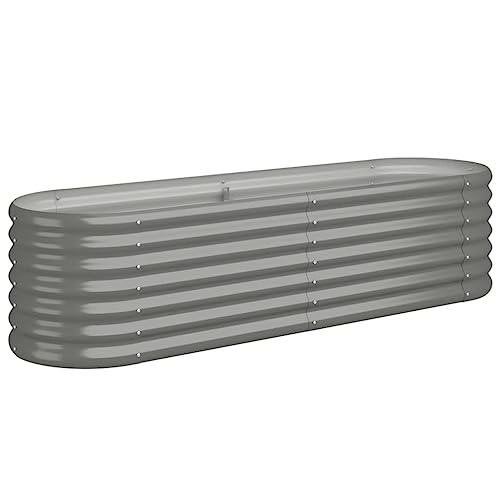
The vidaXL steel bed is the ground-level pick here, sold and shipped by vidaXL AU, and it sits at #39 in the Planter Raised Beds chart at time of writing. It measures 152cm long, 40cm wide and 36cm deep, in galvanised steel with interior support brackets and a powder-coated finish against rust and corrosion. At $66 it is the lowest outlay on this list, and the listing is plain about the trade: this planter does not include a bottom.
The open bottom is the quiet advantage. Sitting on forked-over ground, the bed drains into the earth and the roots follow that moisture down, so the plants effectively get far more depth than the 36cm wall suggests. The long, narrow shape suits a fence line or a path edge where a squarer bed wouldn't fit, and at 40cm wide you can reach the whole bed from one side. That geometry, a shallow steel bed on open ground, is also what a wicking conversion wants, and it's the bed I'd line and convert first if water restrictions are part of your planning.
Know what you're not getting. There's no working height, so it's knees and backs like any ground-level garden, and with no bottom it is a poor match for concrete, pavers or a deck, where it would sit in its own drainage and stain the surface. Filling it is the real cost: about 219L, so price the mix with the soil maths above before you order.
Honest caveats: Only 36cm deep, so it relies on the ground below for root depth, and with no bottom it is wrong for concrete or pavers. At about nine bags of mix to fill it, the soil costs more than the bed itself.
Best for: Planting into existing ground with a tidy edge, and the least outlay.
Configuration: 1 bed • Size: 152cm long, 40cm wide, 36cm deep • Material: Galvanised steel with interior support brackets, powder-coated • Bottom: None, open to the ground • Colour: Grey • Rank: #39 in Planter Raised Beds (Amazon AU)
View on Amazon AU
Costway Galvanised Raised Bed with Legs & Greenhouse Cover
ASIN B0D5XRF7WW • $96.95 • Sold by COSTWAY-AU on Amazon AU
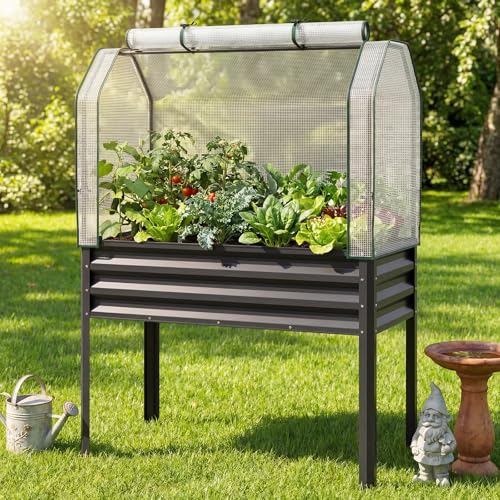
This is the category's top seller, #4 in Planter Raised Beds at time of writing, and it's not hard to see why: for $97 you get a legged steel planter and a mini greenhouse in one purchase. The bed itself is heavy-gauge metal with a rustproof electro-coating, reinforced with crossbars underneath and standing on anti-slip foot pads, with the work surface at 81cm, proper standing height. Over that goes a PE cover on a frame of electroplated tubes with tool-free connectors, closed by a large roll-up door on a zip. Cover on, it's a warm, sheltered box for raising seedlings and protecting young greens. Cover off, it's a straightforward waist-height planter for the warm months. It's sold through COSTWAY-AU, Costway's own AU storefront.
The cover is what separates it from every other pick here, and it earns its place twice a year. In late winter it brings seed-raising forward by weeks, holding warmth and shrugging off wind while seedlings establish, and the roll-up door means daily watering doesn't involve dismantling anything. Year-round, the same cover is a physical barrier against possums, cabbage moths and scratching birds, which anyone growing brassicas or strawberries on the Coast will immediately understand the value of. Come summer the cover has to come off or stay fully open, because a sealed PE tent in January sun cooks whatever's inside it, and the bed spends the hot months running as a plain legged planter, which it's perfectly good at.
Buy it with clear eyes about the cover's lifespan. PE film and zips living outdoors in Australian UV are consumables on a multi-year clock, however well you treat them, and the steel bed underneath will outlast several covers. The listing also doesn't state this model's planting dimensions or soil capacity, so check the option you're ordering and plan your soil-bag count once it lands. In wind-exposed spots the covered frame catches a lot of air, so anchor it properly or drop the cover when a blow is forecast. Treated as a steel bed with a bonus cover rather than a permanent greenhouse, it's the strongest all-rounder on this list.
Honest caveats: The PE cover is the sacrificial part: UV and wind will finish it long before the steel, so treat it as replaceable seasonal kit. The listing doesn't state planting dimensions or soil capacity for this configuration. With the cover on it catches wind, so it needs anchoring anywhere exposed.
Best for: Early seed raising and possum-proof greens at working height on a patio or courtyard.
Working height: 81cm • Cover: PE greenhouse cover with roll-up zip door • Cover frame: Electroplated metal tubes, tool-free connectors • Coating: Rustproof electro-coating • Stability: Reinforced crossbars, anti-slip foot pads • Soil capacity: Not stated on the listing • Rank: #4 in Planter Raised Beds (Amazon AU)
View on Amazon AU
Costway Raised Garden Bed with Legs, Metal Planter Box, 2 Pack
ASIN B0HGDWVJD8 • $119.95 • Sold by COSTWAY-AU on Amazon AU
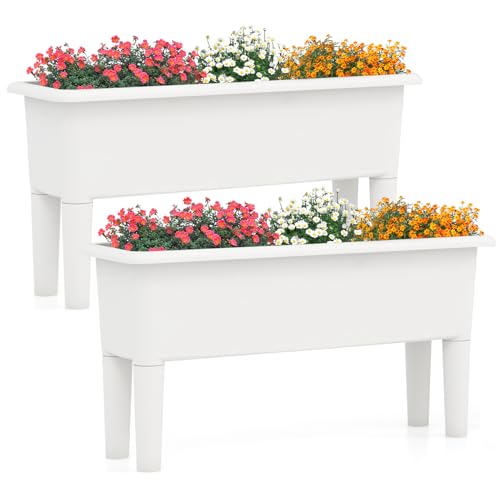
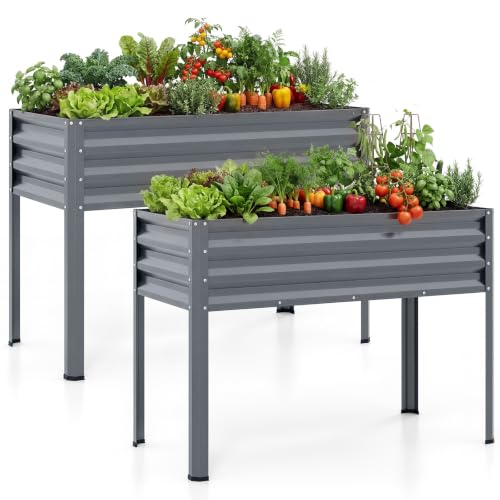
The second Costway pick is the straightforward one: two legged steel planters, no cover, $120 for the pair at time of writing. Each bed gives you a planting area of 112 by 55cm at the same 81cm working height as its covered sibling, with a listed soil capacity of 142L and a load rating of 80kg. Construction is the same recipe that works across the range: heavy-duty metal with rustproof electro-coating, four legs braced by three crossbars underneath, anti-slip foot pads, and pre-drilled drainage holes in the base. Costway even packs the assembly tools and a pair of gloves in the box, which tells you they've met their own panel edges. Ranked #75 in Planter Raised Beds at time of writing, sold through the same COSTWAY-AU storefront.
Two beds at waist height is the renter's and the paved-courtyard grower's setup. Nothing touches the ground, nothing digs, and the whole garden moves out when you do. The pair also buys you a rotation trick, one bed resting or reloading while the other produces, and 112cm of length is enough per bed for a serious herb bench or a dense salad rotation. Drainage through the base holes is quick, which the roots appreciate and the paving underneath may not, so give a thought to what lives below: on a deck or sealed balcony, trays under the legs at watering time save staining arguments later.
The number to respect is the 80kg load rating, because the listed 142L capacity sits oddly beside it. Run the arithmetic with a stated assumption, wet mix at roughly 0.7 to 1kg a litre, and a brim-full, freshly watered bed can pass 80kg with soil to spare. In practice that means a light, open potting-style mix rather than dug garden soil, filled to working depth rather than the rim, and watered to drain rather than to swamp. Treated that way the frame carries it comfortably. Filled with wet clay to the top edge, you're stress-testing someone else's weld schedule, and I wouldn't.
Honest caveats: The listed 80kg load rating sits tight against the listed 142L soil capacity: moist mix runs roughly 0.7 to 1kg a litre by my stated assumption, so a brim-full soaked bed can pass the rating. Use a light mix, don't waterlog it, and set the legs on firm level ground.
Best for: Ground-free growing at working height on a deck, patio or rental courtyard.
Configuration: 2 beds • Size each: 112 x 55 x 81cm (L x W x H) • Listed soil capacity: 142L • Load rating: 80kg • Drainage: Pre-drilled base holes • Structure: 4 legs, 3 bottom crossbars, anti-slip pads • In the box: Assembly tools and gloves • Rank: #75 in Planter Raised Beds (Amazon AU)
View on Amazon AU
Wutusent 74-Inch Timber Raised Bed with Arch Trellis
ASIN B0GD6YL7QR • $129.95 • Sold by Wutusent& AU on Amazon AU
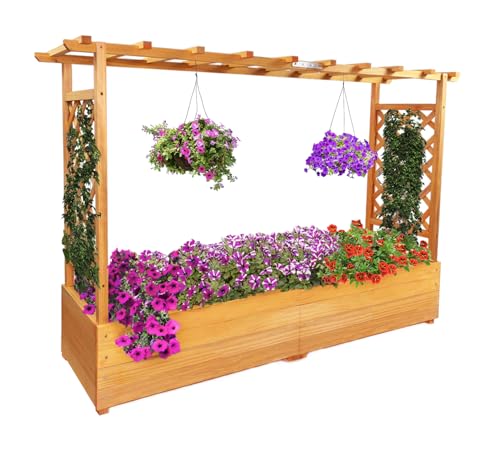
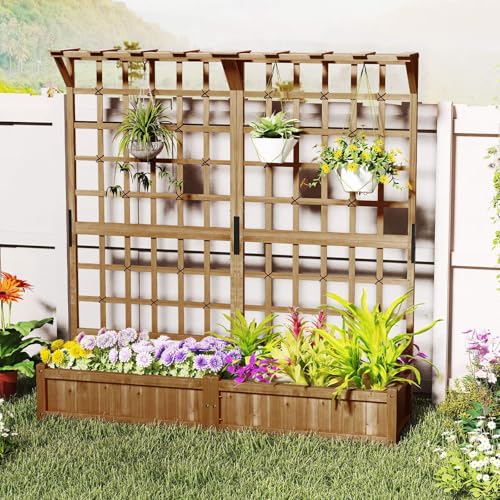
The Wutusent is the pick for anyone whose garden plans go up rather than out. It's a fir timber planter box carrying an arch trellis and a hanging roof, the whole structure standing 74 inches, about 188cm, which turns one bed's footprint into a wall of growing space for beans, peas, cucumbers and anything else that climbs. The planter itself gets drainage holes plus a removable bottom panel, so you can run it as a contained box on a patio or open the base over soil and let deep-rooted plants keep going into the ground. At $130 at time of writing it's the dearest pick here, sold through the Wutusent AU storefront, and it sits at #49 in the Planter Raised Beds chart.
The trellis is the feature you're paying for, and it changes what the bed can do. Climbing crops are the highest yield per square metre of anything a home gardener grows, and they're exactly what a plain raised bed can't support without you rigging stakes and string that sag by February. Here the frame is the structure: vines up both sides of the arch, hanging baskets or drying herbs off the roof rail, and the mature canopy throws afternoon shade you can park lettuce under through the hottest weeks. It's also, frankly, the best-looking thing on this list, and the one that reads as furniture rather than infrastructure against a deck or an entertaining area.
Timber asks for the maintenance steel doesn't, so go in with the schedule clear. Fir is a softwood: oil or seal it before the first winter, keep its feet from standing in permanent wet, and expect to refresh the finish yearly. The trellis and roof also add wind load, so in exposed spots site it against a wall or fix it back to one. Assembly is a proper flat-pack session with more panels than the steel beds, and the listing doesn't state soil depth or capacity, so plan your mix once it's built.
Honest caveats: Fir is a softwood, so plan on oiling or sealing it before the first winter and keeping the base off constantly wet ground. The listing doesn't state soil depth or capacity. The arch and roof add wind load in exposed spots, and assembly is a longer job than the steel beds.
Best for: Vines and climbers on a patio, and growers who'd rather look at timber than zinc.
Material: Fir timber • Overall height: 74 in (about 188cm) including arch • Trellis: Arch with hanging roof rail for climbers • Drainage: Holes plus removable bottom panel • Placement: Indoor or outdoor • Soil capacity: Not stated on the listing • Rank: #49 in Planter Raised Beds (Amazon AU)
View on Amazon AUSide-by-side comparison
| Product | Price | Best for |
|---|---|---|
| vidaXL Galvanised Steel Raised Bed 152x40x36cm | ~$65.99 | Ground level, least outlay |
| vidaXL Raised Garden Bed 160x80x77 cm… | ~$75.59 | Large steel bed |
| Costway 2 PCS Raised Garden Beds | ~$85.95 | Pair of legged beds |
| WUTUSENT 48x22x32 inch Raised Garden Bed… | ~$89.95 | Waist height, on wheels |
| Costway Galvanized Raised Garden Bed with… | ~$96.95 | Legged, greenhouse cover |
| Costway Raised Garden Bed with Legs | ~$119.95 | Legged steel bed |
| WUTUSENT 74inch Raised Garden Bed with Arch… | ~$129.95 | Timber, with trellis |
| Costway 183 CM Tall Large Raised Garden Bed… | ~$186.95 | Tall steel bed |
What we see fail at the bench: garden tech
We don't fix garden beds, but the garden sends us a steady stream of electronics all the same: tap timers, solar lights, moisture sensors, and the phones that were in a back pocket when the watering happened. Outdoor gear fails differently to indoor gear, slower and quieter, and nearly all of it comes down to water past a seal or corrosion in a battery bay. Here's what the bench sees once the garden gets going.
Tap timers and the corroded battery bay
Battery tap timers live in the wettest spot in the yard and run on two AAs behind a rubber seal, and the failure is nearly always the same: alkaline cells left in over winter leak, the leakage eats the terminals, and next spring the timer is dead with a green crust inside the door. The valve and electronics are usually fine. Pull the batteries out of anything you're not using for a season, wipe the terminals when you swap cells, and check the seal isn't pinched when you close the door. A timer that's already crusty can often be saved if the corrosion hasn't crept up the terminal spring into the board, so it's worth a look before it's binned.
Phones, watering cans and the delayed funeral
The garden is where phones get wet in the way that kills them slowly. A splash from the hose, a pocket dunk during watering, a screen left face-up through a sprinkler cycle: the phone works fine afterwards, so nobody worries, and three weeks later the charging port drops out or the screen grows a stripe. That's corrosion doing exactly what corrosion does, spreading across board connectors while everything still boots. The gear we save is the gear that comes in the same week it got wet, powered off, before the rot digs in. The windowsill-and-rice fortnight is how a $60 clean becomes a logic board job.
Solar garden lights that die at two years
Solar path and security lights fail on a schedule you can nearly set a calendar by, and it's almost never the panel or the LEDs. It's the cell inside, usually a single NiMH or a small lithium pack, cooked by two summers of daily full charge cycles in a hot housing, plus a seal that's gone chalky and started letting damp in. The lights sold as sealed units are throwaways by design. The ones with a screwed access door and a standard replaceable cell can be brought back for a few dollars, so check for that door before you buy, and clean the panel face twice a year, because grime quietly halves the charge the cell gets.
Decision tree: which one should you actually buy?
- Planting into real ground and want the least outlay? → The vidaXL 152cm steel bed at $66. Over forked soil it borrows depth from the ground below, and it costs less than any other bed here.
- Backs, knees, or a paved courtyard where digging is off the table? → The Costway legged pair at $120. Waist-height work surface, nothing touching the ground, and it moves out when you do. Just run a light mix and respect the 80kg rating.
- Raising seedlings early, or fighting possums and cabbage moths? → The covered Costway at $97. The PE greenhouse cover brings spring forward by weeks and is the only physical pest barrier on the list. Take it off before summer cooks things.
- Beans, peas, cucumbers, anything that climbs? → The Wutusent trellis bed at $130. The arch is the structure your climbers actually need, and the mature canopy shades summer lettuce as a bonus. Oil the fir before winter.
- Planning a wicking bed for water restrictions? → Convert the vidaXL steel bed: a shallow bed, open ground and about 30cm of soil over the reservoir suits the physics. I'd leave the legged beds out of wicking duty entirely, since the reservoir's standing water weight eats their load rating.
- A drowned phone, a dead tap timer or a solar light that quit? → Power the phone off and don't wait, because corrosion spreads while it still works. Bring it, or any other garden-tech casualty, into our Erina workshop and we'll tell you what a fix costs before you spend anything.
Frequently asked questions
Steel or timber, which raised bed lasts longer outdoors?
Coated steel, and it's not close if both are left alone. Galvanised or electro-coated panels in soil contact routinely run a decade or more with the coating intact, while untreated softwood in permanent damp contact can be structurally tired within a few seasons. Timber closes the gap with maintenance: sealed or oiled before the first winter, refreshed yearly, and kept from standing in water, a softwood bed gives you many good years and looks better doing it. The honest question is whether you'll actually do that maintenance. If the answer is no, buy steel and spend your ten minutes a year touching up scratches and drilled holes instead, because protecting the coating is the only job steel asks of you.
How much soil do I need to fill a raised bed?
Length times width times depth in metres gives cubic metres, and 1 cubic metre is 1,000L, so a bed 1.1m by 0.55m filled 0.25m deep wants about 150L, or six 25L bags. The vidaXL bed, 152cm by 40cm and 36cm deep, is roughly 219L. Price it before you order, with my assumption stated: at about $10 a 25L bag, bagged mix for a multi-bed setup can cost more than the beds, and bulk delivery by the cubic metre gets far better per-litre pricing once you're over about 300L. Open-bottom beds on forked ground can take coarse compost and rough organic fill in the lower layer with premium mix only in the final 15 to 20cm at the surface. Legged planters need proper mix the whole way down.
Can I turn one of these into a wicking bed?
The ground-level steel bed, yes, and it's a good candidate: pond liner up the inside, a reservoir layer of scoria or slotted drainage pipe in gravel, geotextile fabric over that, an overflow hole drilled through the wall at reservoir height, then soil above. Keep the soil column around 30cm, because wicking gets unreliable much beyond that height above the water line, and touch up the drilled overflow hole with zinc-rich primer so it doesn't become the bed's first rust point. I'd leave the legged planters as normal beds. A reservoir means permanent standing water weight added to wet soil on a four-legged frame with an 80kg-class rating, and a dripper line on a tap timer gets a legged bed most of the same benefit safely.
Will a legged planter hold the weight of wet soil?
Within its rating and with a sensible mix, yes, and the details matter. Wet growing mix runs roughly 0.7 to 1kg a litre depending on how much water it's holding, so the Costway pair's listed 142L capacity can pass its listed 80kg load rating when brim-full and soaked. The practical rules: use a light, open potting-style mix rather than dug garden soil or clay, fill to working depth instead of the rim, water so it drains rather than pools, and stand the bed on firm, level ground so all four legs share the load. Check the bolts after the first month of settling. A legged bed treated that way is carrying what it was designed for, not what the maths allows at worst case.
Do metal garden beds get too hot in summer?
The walls get hot, the soil mostly doesn't. Steel in full sun will be uncomfortable to touch on a January afternoon, but soil is a poor conductor and a big thermal mass, so the heat stays in the outer few centimetres of mix nearest the wall while the root zone in the middle barely notices. The practical moves: mulch the surface well, plant your most heat-sensitive crops toward the centre rather than hard against the northern and western walls, and keep the watering consistent, because moist soil buffers temperature swings far better than dry. In cool months the same effect runs in your favour, with the walls catching winter sun and warming the edge soil earlier than the open ground manages.
Where should I put a raised bed?
Sun first: most vegetables want six or more hours a day, so watch the spot through a full day before committing, remembering the shade pattern in September is not the pattern in January. Water second: a bed more than a hose-length from a tap gets neglected, and if a tap timer and dripper line are the plan, proximity matters even more. Ground third: level and firm for legged beds, open soil you can fork for the bottomless beds, and never against a timber fence you don't want staying permanently damp. Leave yourself working room on at least two sides. And check strata or rental rules before anything goes on a balcony, because a filled bed is a few hundred kilos of landlord conversation.
Related buying guides
Garden tech dies of water and corrosion, not age
Tap timers with crusted battery bays, solar lights that quit at two years, and phones that got watered along with the seedlings: most of it is fixable if it arrives before corrosion digs in. Bring the casualty into the shop at Erina and we'll open it, tell you what failed and what a repair costs against replacing it, before you spend anything. Wet phones especially: power off, come in that week, not next month.
Visit our Erina workshop Book Online