Prices from Amazon AU, updated daily. Swipe or use the arrows for more.
Disclosure: This article contains affiliate links to amazon.com.au. If you buy through one of these links iFix may earn a small commission at no extra cost to you. It doesn't change which products we recommend. We focus on what actually lasts based on 16 years of repair-shop experience.
Quick summary8 picks
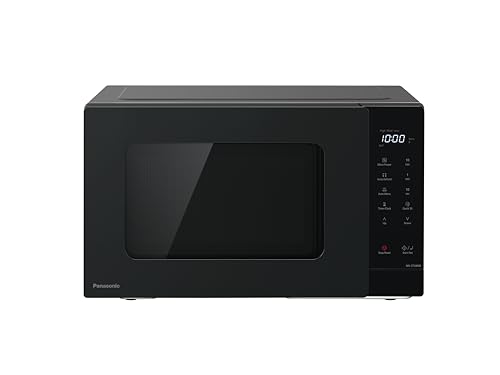
- Entry PickPanasonic 25L Compact Microwave Oven with 8… about$175.20900W.
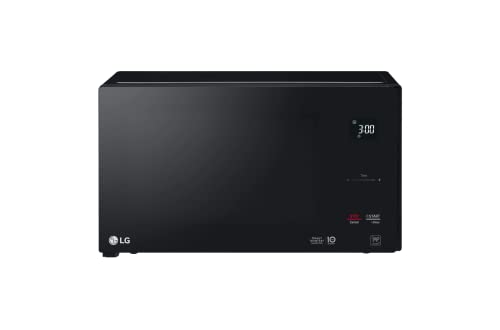
- LG NeoChef 25L Smart Inverter Microwave… about$1981200W.
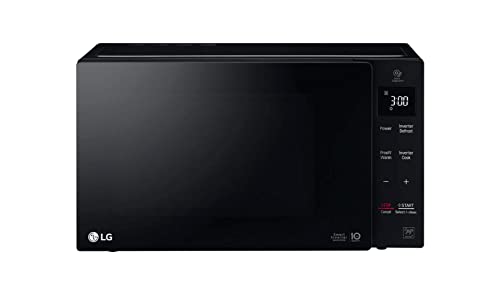
- LG NeoChef EasyClean Microwave Oven about$199
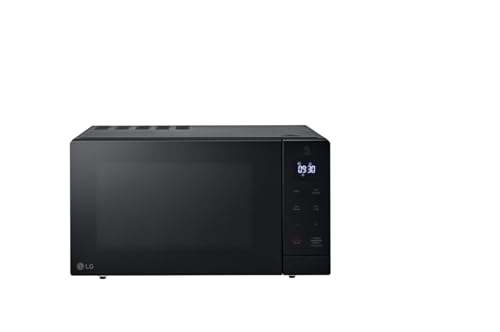
- LG NeoChef 23L Smart Inverter Microwave… about$218
- Russell Hobbs Microwave Oven Family Size about$2301100W.
- Breville LMO425BST the Easy Wave 25L… about$249900W.
- Panasonic 27L 1000W Flatbed Inverter… about$2981000W.
- Most PremiumPanasonic 32L 1100W Inverter Sensor… about$3281100W.
Inverter or standard: what the word actually changes
A standard microwave can only run its magnetron at full power. When you pick 50 percent, it switches the whole thing on and off in cycles of several seconds, so the food gets blasts of full power with rests in between. That's why the edge of a frozen lasagne goes rubbery while the middle is still icy. An inverter microwave replaces the heavy transformer with a switching power board that can actually turn the magnetron down, so 50 percent really is about half power the whole time.
In practice that shows up in three jobs: defrosting, softening butter or ice cream, and reheating something dense without the outside boiling. If you mostly zap a coffee or a bowl of soup on high, you won't notice much difference, and a standard machine is fine. If you defrost meat a couple of times a week, I reckon the inverter is worth the extra money, because it's the one feature on a microwave box that changes how food comes out.
Inverter boards are also lighter than a transformer, which is why the inverter models tend to weigh a little less for the same size. The trade-off is that the board is a more complex part, and when one fails it's usually a board swap rather than a simple fuse. In my experience they're not less reliable, just different, and Panasonic has been building them long enough that its inverter models are the ones I see the most of still going years later.
Size: litres, plate width and the turntable
The litre figure on a microwave box is the cavity volume, and it's a bit misleading because you can't use the corners. What matters is the width of the turntable or the flat floor, because that's what decides whether your dinner plate or casserole dish fits. A 23 to 25 litre microwave usually takes a plate around 25 to 27cm across. A 32 to 34 litre one gets you up to about 30cm, which is the size of most dinner plates in Australian kitchens.
Russell Hobbs is one of the few brands that says it straight on the listing: its 34 litre RHMO300 fits a 30cm dinner plate. The others list litres and leave you to guess. Measure your largest dish before you order, including the handles, and add a centimetre or two of clearance so it can turn without catching the walls. A dish that scrapes the side every rotation will eventually jam the turntable motor.
Bigger isn't free either. A 34 litre microwave takes up a lot of counter, and the outside dimensions can be 55 to 60cm wide. For one or two people, a 25 litre machine is usually plenty, and it sits in a corner without dominating the kitchen. For a family that reheats plates of dinner every night, the larger cavity saves doing two rounds, and that's where the 32 to 34 litre machines earn their space.
Watts on the box against watts at the wall
The 900W, 1000W or 1100W on a microwave box is usually the cooking output, not what it pulls from the socket. The wall draw is higher because no magnetron turns all its input into heat in the food, and the fan, light and turntable take a little too. The real input figure is on the rating plate, normally on the back or inside the door frame, and it's worth a look if you're planning to run it on the same circuit as a kettle.
For running cost, say a microwave draws around 1,500W at the wall (check your own rating plate, as this is an assumption). At the AU average tariff of roughly 33c per kWh, five minutes on high costs about 4c. Even with heavy daily use it's a small line on the power bill, and for reheating a single plate it's usually far less energy than heating a full oven. Our guide to smart home power savings covers where the bigger savings are hiding.
Higher output mostly means faster cooking, not better cooking. A 1200W machine boils a mug a little quicker than a 900W one, and auto menus are tuned to the wattage, so the presets still work either way. Where it does matter is following packet instructions, which are often written for an 800 to 1000W microwave. On an 1100W or 1200W machine, start at the low end of the time and check.
Flatbed or turntable
Most microwaves still use a glass turntable on a roller ring, driven by a small motor under the floor. It works well, but the motor, the coupler and the roller ring are all wear parts. A flatbed microwave, like the Panasonic NN-SF564W in this list, has no turntable at all. The antenna that spreads the microwave energy sits under a flat ceramic floor and does the stirring instead, so you can push a rectangular dish right into the corner.
Panasonic says its flat and wide design gives 31 percent more cooking area than its conventional turntable models, and that matches what you'd expect from using the corners. The other advantage is cleaning, because there's no ring or plate to lift out and no gap underneath for spills to collect and go sticky. If you've ever pulled a turntable plate out and found a brown crust underneath, you'll see the appeal straight away.
Flatbeds aren't perfect. Heating can be a bit less even near the edges, so stirring halfway still helps, and you can't put a heavy pot right at the front edge and expect the same result as in the middle. In my experience the trade-off is worth it for people who reheat in oblong containers or cook in a casserole dish, and less important for people who only ever heat a bowl or a mug.
Sensor cooking and auto menus
A sensor microwave measures the steam coming off the food and stops when it decides the food is hot, rather than just counting down the time you typed in. The Panasonic NN-ST665B is the sensor model in this list, with 19 auto menus that use it. It works well for reheating a plate or cooking frozen vegetables, as long as the food is covered loosely so the steam actually reaches the sensor.
Auto menus without a sensor are just preset times and power levels for a typical weight, and they're only as good as your guess at the weight. The Breville Easy Wave has eight of these, covering popcorn, butter, frozen meals, vegetables, potato, pasta and rice. The Russell Hobbs has six. They're handy for the jobs you do every day, but most people end up using two or three of them and the start button for everything else.
Whatever you buy, the single most used control is the quick start. Panasonic calls it Add Time or Quick 30, and Breville's is a press on the dial that adds 30 seconds each push. Try to see a photo of the control panel before you order. A clear one-touch start and an easy power level button matter more day to day than how many menus are printed on the door.
Where it sits: clearance, vents and powerboards
A countertop microwave needs to breathe. Most have vents on the top, back or sides, and the manual will give clearance figures, often around 10 to 20cm above and a few centimetres at the back and sides. Shoving one into a tight cupboard nook or stacking things on top of it traps heat, and heat is what cooks the magnetron, the fan motor and the control board over time. It's usually the first thing I'd change in a kitchen where a microwave keeps tripping its thermal cutout.
Plug it straight into a wall socket. A microwave pulls a lot of current in short bursts, and putting it on a powerboard with a kettle or toaster is a good way to overload the board, especially a thin no-name one. A standard AU socket is rated at 10A, which is about 2,400W, and a microwave plus a kettle can go over that. If you must use a board, use a good one, like the ones in our surge powerboard guide, and keep the kettle elsewhere.
Look for the RCM mark on the rating plate. Every model in this list comes from a major brand sold through Amazon AU with an Australian plug, and the Panasonic listings say so in writing. Grey-import microwaves with a different plug or an adaptor are a bad idea, because the adaptor becomes the weak point in a high-current appliance, and warranty support usually isn't there when you need it.
Why you should never open one at home
This is the one appliance I'd tell anyone not to take apart. A microwave has a high voltage capacitor that can hold a dangerous charge for a long time after the plug's pulled out, and the transformer and magnetron circuit run at thousands of volts. People see a blown fuse online and think it's an easy fix, but the fuse usually blew because something else failed, and the capacitor doesn't care that you've unplugged it.
What you can safely do is check the outside. Look at the door seal for food build-up, check that the door closes firmly and the latches line up, and look for burn marks on the small grey or mica panel inside the cavity wall. That panel is the waveguide cover, and grease or food splatter on it is the classic cause of sparks and a burning smell. A dirty one can often be cleaned, and a burnt one is a low-cost part, but it needs fitting properly.
If the door is bent, the glass is cracked or the hinges are loose, stop using it. The door and its seal are what keep the microwave energy inside, and a damaged door isn't something to tape up and keep going with. Most of the time, a microwave with a damaged door or a dead magnetron is a replacement job anyway, because the part and labour costs get close to the price of a new 25 litre model.
The faults that are often worth fixing are a dead door switch, a failed turntable motor or a loose control panel connection. Those are relatively small parts. The question is always whether the repair is worth it on a machine that cost a couple of hundred dollars, and it's better to ask before buying a new one, because sometimes the answer is a $20 part and sometimes it really is time for a new microwave.
What I left out and why
This guide is about countertop microwaves only. I've left out built-in models, because they need a trim kit and a cabinet cut-out and they're usually installed with the kitchen. I've also left out convection and combination microwaves that grill or air fry, because they're a different buying decision with a heating element, a second fan and a lot more to go wrong. If crisping is what you're after, our air fryer guide is the better place to start.
Every pick is new and sold by Amazon AU. I skipped renewed and refurbished microwaves on purpose, because the door seal and the interlock switches are the parts that wear, and you can't check either from a listing photo. I also left out a Westinghouse 40 litre model that ranked well but had very little feature detail on its listing, since I'd rather recommend machines where the specs are written down.
The five that made it cover the main choices: a sensor inverter model for people who want the best reheating, a well-priced inverter for small kitchens, a flatbed for oblong dishes, a compact inverter with simple controls, and a big 34 litre standard model for families. If you're kitting out a new kitchen at the same time, the food processor picks follow the same logic of buying for the job you'll actually do most.
The 5 picks, $198 to $328
Prices are Amazon AU at time of writing (29 October 2026) and move week to week. Ranks are Amazon AU category sales ranks, checked the same day.

Panasonic NN-ST665B 32L 1100W Inverter Sensor Microwave Oven, Black
ASIN B085TMR4FL • $328 • Ships from Amazon AU
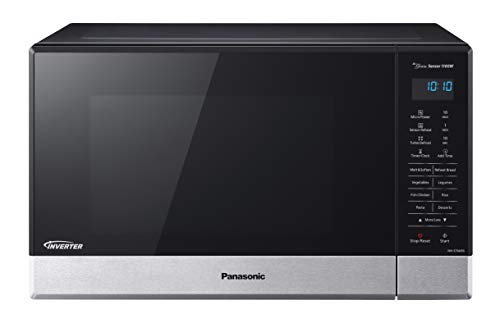
The Panasonic NN-ST665B is the #1 microwave on Amazon AU at time of writing, and it's sold and shipped by Amazon AU at $328. It's a 32 litre countertop model with 1100W of output, an inverter power supply and a steam sensor, which is the combination I'd point most households towards. The listing says it comes with an Australian plug and the Australian manufacturer's warranty, and it lists that warranty at 12 months. It's the only model in this list with sensor cooking, and that's the feature that makes the reheating so consistent. It has a stainless and black body with a smoked glass door, so it suits most kitchens without standing out. At 32 litres it's big enough for a family dinner plate without being the size of a small oven on the counter.
The sensor works through 19 preset auto menus. Pick the food type, press start, and the microwave reads the steam coming off the dish and adjusts the time and power itself, so you're not guessing at weights. The inverter side shows up in what Panasonic calls Inverter Turbo Defrost, which thaws meat more evenly than the on-off cycling of a standard machine, and in the precise power control setting for softening ice cream or melting chocolate and cheese without it splitting. There's an Add Time button for when something needs a little longer after it finishes. That's the button you'll press most, so it's good that it's a single touch. For a house that reheats leftovers every day and defrosts a few times a week, those features add up to food that comes out the way you expected.
My only real caution is that the model has been on sale since 2020, so it isn't the newest design, though a long-running listing usually means the parts and the quirks are well known. Keep the sensor working by covering dishes loosely rather than sealing them, because a sealed lid hides the steam from the sensor. Wipe the cavity and the waveguide cover after splatters so grease doesn't build up and arc. Leave the vents clear and plug it straight into the wall. For most households, it's the one I'd buy.
Honest caveats: The listing doesn't state the wall input wattage, so check the rating plate before sharing a circuit with a kettle. The listing's dimension figures don't look right, so measure your space against the official Panasonic spec sheet. It uses a turntable, not a flatbed. The warranty is listed at 12 months. It's also the dearest pick here.
Best for: Families who reheat and defrost often and want sensor cooking on an inverter machine.
Capacity: 32 litres • Output: 1100W • Power type: Inverter • Sensor cooking: Yes, 19 auto menus • Defrost: Inverter Turbo Defrost • Model: NN-ST665BQPQ • Warranty: 12 months (listing) • Seller: Amazon AU • Rank: #1 in Microwaves (Amazon AU)
View on Amazon AU
LG NeoChef 25L Smart Inverter Microwave Oven, Black
ASIN B077PR2B1P • $198 • Ships from Amazon AU
The LG NeoChef 25 litre is the #2 microwave on Amazon AU at time of writing, sold by Amazon AU at $198, and it's the least expensive inverter microwave in this list. It's a compact model with what LG calls Smart Inverter power, so the lower power levels are a real reduced output rather than full power switched on and off. That makes it a good fit for a small kitchen or an apartment where you still want proper defrosting. The listing quotes 1200W of power, which is quick for a 25 litre cavity. It has touch controls behind a tempered glass door, and the black finish keeps it plain. There's also a stainless version of the same machine on Amazon AU at a higher price at time of writing.
Two practical features stand out on the listing. The first is LG's anti-bacterial EasyClean interior coating, which is meant to let splatters wipe off without scrubbing. The second is what LG calls a Stable Turntable, designed to stop the plate rocking as it turns. Rocking plates are a common annoyance on light microwaves, and a stable plate also puts less strain on the turntable coupler over time. The touch controls are flush, so there are no buttons to collect grime. The 25 litre cavity suits one or two people, and the smaller footprint means it can sit in a corner or on a shelf without taking over the counter. For a first flat or a granny flat, it's the one I'd look at first.
Keep in mind that the listing is light on detail. It doesn't give a warranty period, the number of power levels or the number of auto menus, so check those on LG's own page before you buy. The listing's dimension figures don't look right either, so measure your space against LG's spec sheet rather than the Amazon numbers. Coating or not, wipe it after use rather than letting splatter bake on, because baked grease near the waveguide cover is what starts arcing. Check your largest plate fits a 25 litre cavity, as a full 30cm dinner plate usually won't. If it does fit, this is the best value inverter here, and the one I'd buy for a small kitchen.
Honest caveats: The listing doesn't state the warranty, power levels or auto menus. The 1200W figure is the listing's power claim, and the wall draw isn't stated. The dimension data on the listing looks wrong, so measure against LG's spec sheet. A 25 litre cavity won't take a large 30cm dinner plate. There's no sensor cooking.
Best for: Small kitchens and one or two people who want inverter defrosting without paying for a big machine.
Capacity: 25 litres • Power: 1200W (listing) • Power type: Smart Inverter • Interior: EasyClean anti-bacterial coating • Turntable: Stable Turntable • Controls: Touch, tempered glass door • Warranty: Not stated on the listing • Seller: Amazon AU • Rank: #2 in Microwaves (Amazon AU)
View on Amazon AU
Breville LMO425BST the Easy Wave 25L Inverter Microwave, Black Stainless
ASIN B0FV7KXRFN • $249 • Ships from Amazon AU
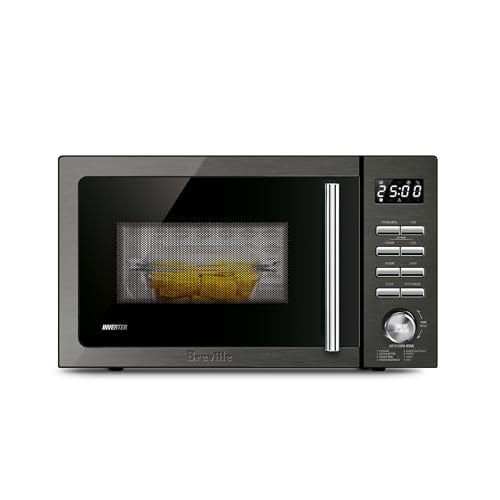
The Breville Easy Wave LMO425BST is a 25 litre inverter microwave sold by Amazon AU at $249 at time of writing, and it sits at #13 in Microwaves. It's a newer model than the Panasonic and LG picks, and Breville has built it around simple controls rather than a long list of functions. It has 900W of output, 10 power levels and eight auto cook menus, with an inverter power supply for more even heating. The finish is black stainless steel inside and out, which Breville says is built for daily use and easy cleaning. The part number on the listing is LMO425BST2IAN1. It's the model I'd suggest for someone who finds touch panels fiddly.
The standout feature is the dial. Press it once and the microwave starts straight away, and each extra press adds 30 seconds, so reheating a coffee is one push with no buttons to read. The eight auto menus cover the everyday jobs: popcorn, soften butter, frozen meal, frozen vegetables, green vegetables, potato, pasta and rice. There's defrost by weight or by time, and a reheat setting. The 10 power levels give finer control than the five on some compact models, and with the inverter, low power really is low power. For an older parent, a shared office kitchen or anyone who wants a microwave that just starts, the dial is a good choice.
At 900W it's the lowest output in this list, so expect slightly longer times than the 1100W and 1200W models. That's not a fault, just something to allow for when reading packet instructions written for a more powerful machine. The listing gives no dimensions or warranty, so check both on Breville's own page before ordering. It's also a newer listing with less sales history behind it than the Panasonic and LG picks, which is why it sits further down the rank. Stainless shows fingerprints, so a soft damp cloth after use keeps it looking right. For simple everyday reheating with a dial anyone can use, it's a solid choice.
Honest caveats: The listing doesn't state the warranty, dimensions or weight. At 900W it's slower than the higher-powered picks, so allow extra time on packet instructions. There's no sensor cooking. Stainless steel shows fingerprints and needs regular wiping. It's a newer listing, so it has less sales history than the other picks.
Best for: Anyone who wants a dial-start inverter microwave with simple, clear controls.
Capacity: 25 litres • Output: 900W • Power type: Inverter • Power levels: 10 • Auto menus: 8 • Controls: Dial, press to start, +30 seconds per press • Model: LMO425BST2IAN1 • Seller: Amazon AU • Rank: #13 in Microwaves (Amazon AU)
View on Amazon AU
Panasonic NN-SF564W 27L 1000W Flatbed Inverter Microwave Oven, White
ASIN B085TN773V • $298 • Ships from Amazon AU
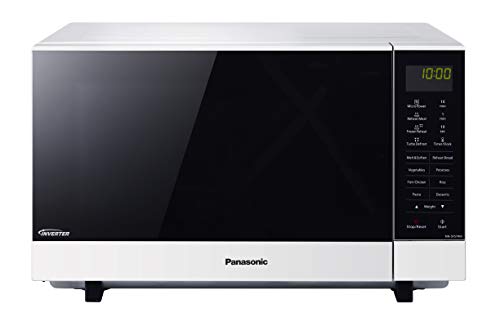
The Panasonic NN-SF564W is a 27 litre flatbed inverter microwave, sold by Amazon AU at $298 at time of writing and ranked #6 in Microwaves. It has no turntable at all, which is the reason to buy it. The antenna under the flat floor spreads the energy instead, and Panasonic says the flat and wide design gives 31 percent more cooking area than its conventional turntable models. It has 1000W of output and an inverter power supply, with precise power control for softening and melting. The listing says it comes with an Australian plug and the Australian manufacturer's warranty, listed at 12 months. The model number is NN-SF564WQPQ. It's a well-established listing, on sale since 2020.
Flatbed design matters most if you use oblong containers or a casserole dish, because they can go right into the corners instead of having to fit inside a circle. It also makes cleaning much easier, as there's no glass plate to lift out and no roller ring underneath to collect spills. There are 17 auto menus, including auto reheat, and the frameless door has an integrated open button. The listing dimensions work out to about 33cm high, 53cm wide and 42cm deep, so it's wider than its 27 litre capacity suggests. Panasonic also sells a trim kit, NN-TK510FWQP, separately for anyone wanting to set it into cabinetry, though I've judged it here as a countertop model.
Without a turntable, heating can be a little less even near the front edge, so stir dense foods halfway through and keep the dish towards the centre of the floor. Keep the flat floor clean, because baked-on splatter there sits right over the antenna and can scorch. A damp cloth after each messy reheat is all it takes, which is a lot easier than lifting out a glass plate. The white finish shows stains more than black, so it suits a kitchen that gets wiped down often. Check the width against your counter before you order, as it's wider than most 27 litre machines. For oblong dishes and easy cleaning, it's the one I'd pick.
Honest caveats: It's about 53cm wide on the listing figures, so it needs more counter width than its capacity suggests. There's no sensor cooking. Heating near the edges can be a bit less even than the centre, so stirring helps. The trim kit is a separate purchase. The white finish shows stains and marks more than black.
Best for: People who reheat in oblong containers or casserole dishes and want easy cleaning with no turntable.
Capacity: 27 litres • Output: 1000W • Power type: Inverter • Floor: Flatbed, no turntable • Auto menus: 17 • Size (listing): About 33 x 53 x 42cm (H x W x D) • Warranty: 12 months (listing) • Seller: Amazon AU • Rank: #6 in Microwaves (Amazon AU)
View on Amazon AU
Russell Hobbs RHMO300 34L 1100W Microwave Oven, Stainless Steel
ASIN B08K98QHQC • $230 • Ships from Amazon AU
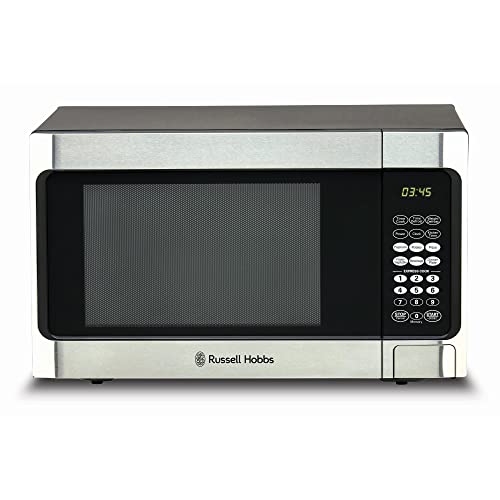
The Russell Hobbs RHMO300 is a 34 litre family size microwave sold by Amazon AU at $230 at time of writing, ranked #12 in Microwaves. It's the largest cavity in this list and the only standard, non-inverter model, so it suits a household that mostly reheats plates of dinner on high. Russell Hobbs says it fits a 30cm dinner plate, which is the most useful size figure on any listing I checked. It has 1100W of output, 10 power levels and six auto cook menus. The finish is stainless steel with an LED display that doubles as a clock. The listing gives a one year warranty, and the model number is RHMO300.
The six auto menus cover popcorn, potato, frozen vegetables, beverage and dinner plate, which are the jobs a family microwave does most. With 1100W in a 34 litre cavity, it heats a full plate quickly, and the bigger turntable means two smaller bowls can go in together. The listing dimensions work out to about 38cm high, 58cm wide and 46cm deep, so it takes up a fair bit of counter, and you should measure before ordering. It's a straightforward machine with no inverter board, which keeps the design simple and the price down for a cavity this size. For a family that wants space more than fine control, it's good value.
Because it's a standard microwave, low power settings work by cycling full power on and off, so defrosting will be less even than on the inverter picks. Turn and separate meat during defrost to help, and give it a rest halfway through. Keep the vents clear, because a large machine pushed into a tight space runs hot and that heat is hard on the fan and the controls over time. Check the width against your counter first, as it's the widest machine here. If what you mostly do is reheat full plates of dinner on high, the inverter doesn't matter much, and this is the pick for big plates.
Honest caveats: It's a standard microwave, not an inverter, so defrosting is less even than the other picks. It's about 58cm wide on the listing figures, which is a lot of counter. There's no sensor cooking. The listed weight is heavy for lifting onto a shelf. The warranty is one year.
Best for: Families who reheat full dinner plates every night and want the biggest cavity for the money.
Capacity: 34 litres, fits a 30cm plate • Output: 1100W • Power type: Standard (not inverter) • Power levels: 10 • Auto menus: 6 • Size (listing): About 38 x 58 x 46cm (H x W x D) • Warranty: 1 year (listing) • Seller: Amazon AU • Rank: #12 in Microwaves (Amazon AU)
View on Amazon AUSide-by-side comparison
What we see fail in the workshop: microwaves
Microwaves are simple on the outside, but they run at very high voltage inside, so I'm careful about what I suggest people check themselves. When one stops working, it's usually one of three faults, and only one of them is a big one. Here's what typically goes wrong, why, and what you can safely look at before deciding whether it's worth fixing.
Door switches and the blown fuse
A microwave has two or three microswitches in the door frame that tell it the door is shut. They're clicked every time the door opens, and after years of slamming, one usually wears out or a latch hook wears down so it doesn't press the switch properly. The classic symptom is a microwave that's completely dead, or one that stops when you lean on the door. Often the main fuse has blown as well, because one of the switches is designed to blow it if the others fail. Replacing the fuse alone without finding out why it went usually just blows another one, which is why it needs proper testing.
Sparks and arcing from the waveguide cover
Sparks inside the cavity and a burning smell are usually down to the waveguide cover, the small grey or mica panel on the inside wall. Grease and food splatter soak into it, carbonise, and then arc. Left alone, it can burn a hole in the panel and damage the paint around it, and eventually the waveguide behind it. Early on, a clean is often enough. A burnt cover is a low-cost part. Metal trim on plates, foil and twist ties cause the same sparks, so check what's inside first. Wiping the cavity after messy reheats is the simplest way to avoid this one entirely.
Runs but doesn't heat
When the light, fan and turntable all work but the food comes out cold, the fault is somewhere in the high voltage side: the magnetron, the high voltage diode, the capacitor, or on an inverter model, the inverter board. This is the part of a microwave nobody should open at home, because the capacitor can stay charged after it's unplugged. It's also the fault where the repair cost gets close to the price of a new machine, especially on a 25 litre model. Sometimes it's still worth fixing on a dearer inverter or flatbed model, so ask for a quote before buying a replacement.
Decision tree: which one should you actually buy?
- Want the best all-rounder for a family that reheats and defrosts often? → The Panasonic NN-ST665B at $328 is the #1 microwave on Amazon AU, with a 32 litre cavity, inverter power and sensor cooking.
- Small kitchen, one or two people, and want inverter defrosting? → The LG NeoChef 25 litre at $198 is the best value inverter here and the #2 microwave on Amazon AU.
- Want the simplest possible controls? → The Breville Easy Wave LMO425 at $249 starts with one press of the dial and adds 30 seconds per press, with inverter power.
- Reheat in oblong containers or a casserole dish? → The Panasonic NN-SF564W flatbed at $298 has no turntable, so dishes can go right into the corners.
- Need to fit a full 30cm dinner plate? → The Russell Hobbs RHMO300 at $230 has a 34 litre cavity that fits a 30cm plate, though it's a standard, non-inverter model.
- Microwave sparking, dead or running without heating? → Don't open it, as the capacitor can stay charged. Bring it to our Erina workshop and we'll tell you whether it's a switch, a waveguide cover or a bigger fault, and whether it's worth fixing, before you spend anything.
Frequently asked questions
Is an inverter microwave worth it?
For most households that defrost meat or soften butter and ice cream, yes. A standard microwave can only run at full power, so it gets lower settings by switching on and off in cycles, which cooks the edges while the middle stays frozen. An inverter actually turns the power down, so low settings stay low the whole time and defrosting is far more even. If you only ever heat drinks and soup on high, a standard model is fine. In this list, the Panasonic, LG and Breville picks are inverters and the Russell Hobbs is standard.
What size microwave do I need?
Size it by your largest plate or dish, not the litre figure. A 23 to 25 litre microwave usually takes a plate about 25 to 27cm across, which suits one or two people. A 32 to 34 litre model fits a plate around 30cm, the common Australian dinner plate size, and suits families. Measure your biggest dish with its handles and allow a little clearance so it can turn without scraping the walls. Also check the outside width, because a 34 litre microwave can be close to 60cm wide.
Why is my microwave sparking?
The most common cause is food and grease built up on the waveguide cover, the small grey panel on the inside wall. It carbonises and then arcs. Metal trim on a plate, foil and twist ties cause sparks too, so check what's inside first. Stop using it, let it cool, and clean the cavity and the cover gently. If the cover is burnt or has a hole in it, it needs replacing. If sparks continue after cleaning, or there's a burnt smell from inside the case, have it checked rather than keep using it.
Can I fix my microwave myself?
I'd tell anyone not to open the case. A microwave has a high voltage capacitor that can hold a dangerous charge for a long time after it's unplugged, and the high voltage circuit runs at thousands of volts. You can safely clean the inside, check the door closes firmly, look for burn marks on the waveguide cover and replace a turntable plate or roller ring. Anything inside the case, including the fuse, door switches and magnetron, should be left to someone with the right training and tools.
Is a flatbed microwave better than a turntable?
It depends on what you cook in. A flatbed has no turntable, so oblong containers and casserole dishes can go right into the corners, and there's no plate or roller ring to clean or wear out. Panasonic says its flatbed design gives 31 percent more cooking area than its turntable models. Heating can be slightly less even near the edges, so stirring halfway helps. If you mostly heat bowls and mugs, a turntable model is fine. If you use rectangular dishes, a flatbed like the Panasonic NN-SF564W is worth it.
Can I run a microwave on a powerboard?
It's better to plug it straight into a wall socket. A standard Australian socket is rated at 10A, roughly 2,400W, and a microwave draws more at the wall than its cooking output on the box. Running a microwave and a kettle on the same powerboard can overload it, especially a thin no-name board. If you have to use a board, use a good quality one with overload protection and keep other high-draw appliances like kettles and toasters off it. Check the rating plate on the back for the real input wattage.
Related buying guides
Microwave dead, sparking or not heating?
Most microwave faults are a worn door switch, a burnt waveguide cover or a high voltage part, and only some are worth fixing. Don't open it, because the capacitor can stay charged after it's unplugged. Bring it into our Erina workshop and we'll tell you what's failed and whether a repair makes sense against a new one, before you spend anything.
Visit our Erina workshop Book Online