Prices from Amazon AU, updated daily. Swipe or use the arrows for more.
Disclosure: This article contains affiliate links to amazon.com.au. If you buy through one of these links iFix may earn a small commission at no extra cost to you. It doesn't change which products we recommend. We focus on what actually lasts based on 16 years of repair-shop experience.
Quick summary8 picks
- Entry PickJBL Partybox Encore Essential: 100W Sound about$349100W.
- JBL PartyBox Encore Essential 2 about$395
- BlueAnt X5i 120W Bluetooth Party Speaker… about$47920800mAh, 120W.
- JBL PartyBox Club 120 about$495
- JBL PartyBox On-the-Go 2 about$498
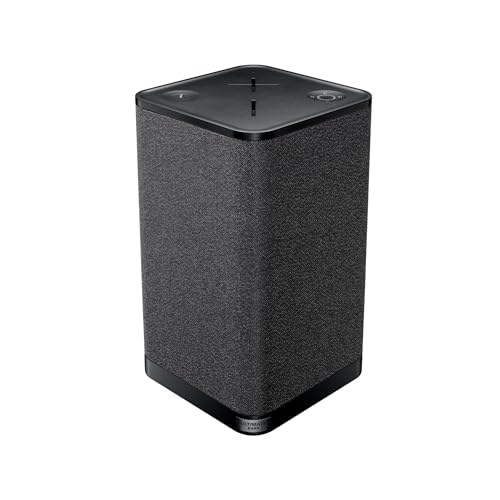
- ULTIMATE EARS HYPERBOOM about$499
- JBL PartyBox Stage 320 about$7456.5" screen.
- Most PremiumSony ULT Tower 9 Bluetooth Party Speaker about$880
What a party speaker is, and what it isn't
A party speaker is a big battery speaker built to be loud outdoors or in a full room, usually with a light show, a microphone input and a handle or wheels. It sits between a portable Bluetooth speaker you'd throw in a backpack and a proper PA system. Most of them weigh somewhere between 5 and 20 kilos, run on a lithium battery or the mains, and are tuned for bass that carries across a backyard rather than for careful listening.
That tuning is the trade. A party speaker sounds great at volume with a crowd talking over it, and it usually sounds a bit boomy at low volume in a quiet lounge room. If you mostly listen at home on your own, bookshelf speakers or a soundbar under $1,000 will sound better for the money. If you want something you can carry out to the deck for Christmas, take to the beach or drag to a mate's place for a birthday, this is the right kind of speaker.
The market's split into two camps on Amazon AU right now. JBL's PartyBox range covers everything from a shoebox-size speaker to a wheeled tower, and Sony's ULT range does the same with a different sound. Then there's BlueAnt, an Australian brand that bundles wireless microphones in the box at a price that undercuts the big two. Between them they cover most of the new party speakers I found sold by Amazon AU at this price.
I've judged these the way I'd judge one that comes in for a quote. How long the battery really lasts when it's turned up, because that's the number the box usually hides. Whether it has a microphone input and what's in the box. How well it handles a splash or a sandy beach. And what's most likely to fail after two or three summers, because a party speaker lives a harder life than almost anything else in the house.
Battery life at real volume, not the number on the box
Battery figures on party speakers are measured at moderate volume with the lights off or turned down, so the headline number is close to the best case. Turn it up for a party with the light show running and the real figure is often a third to a half of what's printed. BlueAnt is the only brand here that states both: up to 30 hours in normal use, and up to 7 hours at 100 percent volume. That second number is the honest one, and I wish every listing gave it.
The rest of the picks give one figure each. JBL lists up to 15 hours on the Encore Essential 2, 12 hours on the Club 120 and 18 hours on the Stage 320. Sony's listing for the ULT Tower 9 doesn't mention a battery at all, so I'd plan on it as a mains speaker unless Sony's own spec sheet says otherwise. For an afternoon barbecue any of the battery picks will do. For an all-day event away from power, plug in where you can.
Most of these speakers run straight off the mains while they charge, so the battery stops mattering if there's a power point within reach. If there isn't, a portable power station will run any of them for a long time, since a party speaker draws far less power than the box makes it sound. Use a proper outdoor-rated extension lead into a socket with RCD protection, keep the plug off wet grass, and don't run it through a powerboard sitting in a puddle.
Lithium-ion batteries in party speakers wear the same way phone batteries do. Heat ages them fastest, so don't leave the speaker in a car boot on a summer afternoon or in direct sun all day. Storing one flat for months is the other killer: charge it to about half before it goes in the cupboard over winter, and top it up every couple of months. A speaker that's left flat for a year sometimes won't take a charge at all, and the battery needs replacing.
Watts, woofers and how loud is loud enough
Watt figures on party speakers are mostly marketing. BlueAnt lists 120 watts peak for the X5i, and peak is the short burst the amplifier can manage, not what it does all night. JBL and Sony mostly don't list watts on these listings at all, and talk about woofer size and their own sound tuning instead. Comparing watt numbers between brands tells you very little, so I've judged these on size, woofer count and what the listing says about the speaker drivers.
Woofer size is a better guide. The JBL Stage 320 lists two 6.5-inch woofers and two 25mm tweeters, which is real hardware you can compare. Bigger woofers move more air and carry bass further outdoors, which is why the towers sound fuller across a backyard than the smaller speakers. The Sony ULT Tower 9 spreads its sound 360 degrees, which suits a speaker in the middle of a room or a deck rather than against a wall.
How loud you need depends on the space. For a courtyard or lounge room, the Encore Essential 2 or BlueAnt X5i is plenty, and you'll rarely push either past half volume. For a big backyard with thirty people talking, the Stage 320 or ULT Tower 9 has more headroom. Running a small speaker flat out all night is what wears it out, so buying one size up and running it at two thirds is easier on the amplifier and the woofers.
Microphones, karaoke and guitar inputs
Karaoke is half the reason a lot of people buy these, so check what's in the box. The BlueAnt X5i is the only pick that includes microphones: two wireless ones, so you can do duets without a cable across the floor. The JBL Encore Essential 2, Club 120 and Stage 320 list mic and guitar inputs, and the Sony ULT Tower 9 lists a mic input, but none of those listings say a microphone is included. Budget for a wired or wireless mic if you're buying one of those.
The inputs on most party speakers are 6.3mm jacks, the same size a guitar lead uses. They're simple and hard-wearing, but they're also the most common physical fault after the charging port, because a lead that's tripped over levers the jack and cracks its solder joints on the board. Run mic and guitar leads along the ground behind the speaker rather than across a walkway, and pull them out by the plug, not the cable.
Pairing two speakers is common across all three brands and works better than people expect. JBL uses Auracast on its newer PartyBox models, so several JBL speakers can play together. Sony pairs two of the same model for stereo, and BlueAnt pairs two X5i speakers in what it calls Duo Mode. If you think you'll want more sound later, buying a second of the same speaker is usually a better result than replacing the first one with something bigger.
Splash ratings and the beach
IP ratings tell you how much water a speaker can take. The JBL Encore Essential 2 lists IPX4, which means splashes from any direction are fine, the kind of thing a dropped drink or light rain does. The other JBL picks are listed as splash-proof without a number, and the BlueAnt and Sony Tower 9 listings don't state a rating at all. None of these is designed to sit in a downpour or be dunked, so treat all of them as covered-deck speakers.
The beach is harder on electronics than rain. Fine sand gets into buttons, jacks and woofer surrounds, and salt air corrodes the charging port and board over a few summers, especially here on the Central Coast. Keep the speaker up off the sand on a chair or a bag, cap or cover the ports if it has covers, and wipe it down with a barely damp cloth when you get home. Never rinse a speaker under a tap, even one with a splash rating.
If one does get properly wet, turn it off, unplug it and don't charge it to see if it still works. Water across a live board is what turns a drying-out job into a dead amplifier. Leave it somewhere warm and dry with the ports facing down for a couple of days, and if it acts up afterwards, bring it in, because corrosion carries on under the components after the outside looks dry. Our page on how water gets into electronics explains why.
What fails on a party speaker
The charging port is the number one fault I see on battery speakers of every size. These get carried around, plugged in at odd angles and knocked while charging, and the port either works loose or cracks off the board. The second is the battery itself, swollen or worn out after a few years of being left flat or cooked in the sun. Both are usually repairable on the bigger brands, and the JBL Club 120 makes the battery a user-swappable part, which I'd like to see on more speakers.
Amplifier boards fail mostly from heat. Running a speaker flat out with bass boost on, in direct sun, for hours, pushes the amplifier chips hard, and the speaker starts cutting out, crackling or shutting down to protect itself. That cutting out is often the first sign of trouble rather than the fault itself. Give it shade, keep the vents clear and turn the bass boost off when it's already loud enough. Blown woofers are usually from the same thing, driven past the point of distortion for too long.
Bluetooth faults are the other common complaint, and most aren't hardware. A speaker that won't pair with a new phone usually needs a reset, and the steps are in the manual or the brand's app. A speaker that drops out across a backyard is usually a range problem, since Bluetooth goes through people and walls poorly, so keep the phone within a few metres. If a reset doesn't fix it, bring it to our Erina workshop and we'll check the board before you replace the whole speaker.
Lights, apps and the extras that matter
Every pick has a light show, and they're mostly a matter of taste. They do draw power, so turning the lights off or down is the easiest way to get more hours out of a battery. JBL's PartyBox app and Sony's own app let you change the lights, adjust the sound and link speakers, and both update the speaker's firmware, which sometimes fixes pairing and sound faults. Install the app and run the updates when you first set it up.
A few extras matter more than the lights. The BlueAnt X5i has a built-in power bank, so it can charge a phone off its own battery, and it plays from USB and AUX as well as Bluetooth. The Sony ULT Tower 9 has a TV Sound Booster mode for using it with a television, and a 10-band equaliser. The JBL Stage 320 has wheels and a telescopic handle, which matters a lot once a speaker is heavy enough that you'd rather not carry it across a lawn.
Weight is the extra the listings usually leave out. BlueAnt states 4.8kg for the X5i, which is easy to carry with one hand. The JBL and Sony listings don't state a weight, so check the manufacturer's spec sheet if you'll be carrying it down to the beach. As a rule of thumb, anything with wheels is heavy enough that you'll want them, and anything with a shoulder strap or a single handle is one you can carry.
How I picked these five
I started with Amazon AU's party speakers between about $250 and $1,350, then kept only new units sold by Amazon AU or the brand's own Australian store with model codes that match their titles. Four are sold by Amazon AU and the BlueAnt by BlueAnt's own AU store. I left out small portable Bluetooth speakers, which are a different kind of product, and anything from overseas sellers, since a speaker with a battery is one you want to return locally if it arrives faulty.
I dropped one Sony listing I'd otherwise have looked at, the ULT Tower 7, because its part number is for a different model from the one in its title. I don't recommend a listing when I can't tell exactly which speaker turns up. The BlueAnt X5i leads because it has the best Amazon AU sales rank of the five at time of writing, it's the only pick that includes microphones, and it's the only one honest enough to state battery life at full volume.
The five picks run from $395 to $880 at time of writing. A few close contenders are in the extras below the picks. If you're after more general electronics repairs on the Central Coast, or a speaker that's stopped charging, cutting out or crackling, that's what we do, and it's often less than a new speaker. There's also a short read on what no-name chargers do to a battery if you're charging a speaker off an old phone brick.
The 5 picks, $395 to $880
Prices are Amazon AU at time of writing (5 November 2026) and move week to week. Ranks are Amazon AU category sales ranks, checked the same day.

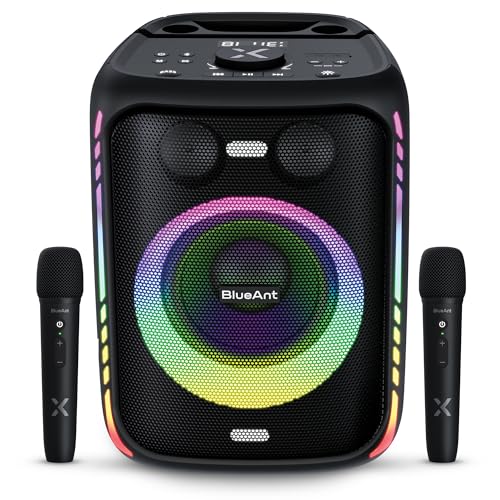
BlueAnt X5i 120W Bluetooth Party Speaker with Two Wireless Microphones
ASIN B0DQM367Y8 • $479 • Sold by BlueAnt AU on Amazon AU
The BlueAnt X5i ranks #23 in Amazon AU's Karaoke Portable Systems category at time of writing, the best rank of any pick here, and it's the only pick that comes with microphones in the box. You get two wireless mics, a 120-watt peak amplifier, a beat-driven light show with seven modes and a 20,800mAh battery, for $479. It's sold by BlueAnt's own Australian store on Amazon, and the model code X5i-BK matches the title. The listing states a one-year limited manufacturer warranty. It also ranks #1,749 across the whole Amazon AU site, the best overall figure of the five, and it's the only pick sold by an Australian brand's own store rather than by Amazon AU directly. It comes in black.
What I like most is that BlueAnt is honest about the battery. It lists up to 30 hours of playtime, then separately lists up to 7 hours at 100 percent volume, which is the number that matters at a party and the one other brands leave out. It weighs 4.8kg, so it's easy to carry by its handle, and it has Bluetooth 6.0 plus USB and AUX playback. A built-in power bank can charge a phone off the speaker's battery, and a Bass Boost button and Duo Mode pairing with a second X5i round it out. The battery charges from the mains with an AC lead rather than a small USB-C brick, so there's no separate charger to lose or mix up.
The wireless mics run on their own batteries, so charge them before the party, not just the speaker. Seven hours at full volume covers most backyard nights, and it plays from the mains when it's plugged in, so a power point nearby keeps it going. Keep it out of direct sun with the bass boost on for hours, because heat is what wears out the amplifier and battery. The listing doesn't state an IP rating, so keep it under cover if rain's about. For a karaoke night or a birthday in the backyard, it's the one I'd buy.
Honest caveats: Honest caveats: the warranty is one year, shorter than the two years JBL lists on the Club 120 and Stage 320. The listing doesn't state an IP rating, so keep it out of the rain. The 120-watt figure is peak, not continuous. The listing doesn't detail how the wireless mics charge.
Best for: Karaoke nights and backyard parties where you want microphones in the box and an honest battery figure.
Power: 120W peak • Battery: 20,800mAh; up to 30 hrs, up to 7 hrs at 100% volume • Microphones: 2 wireless mics included • Inputs: Bluetooth 6.0, USB, AUX • Weight: 4.8kg • Extras: Power bank, Bass Boost, Duo Mode pairing • Warranty: 1 year limited (listing) • Seller: BlueAnt AU • Rank: #23 in Karaoke Portable Systems (Amazon AU)
View on Amazon AU
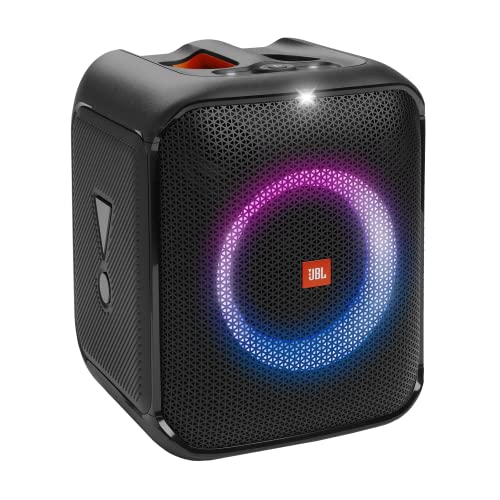
JBL PartyBox Encore Essential 2 Party Speaker (Black)
ASIN B0FS642K9R • $395 • Ships from Amazon AU
The JBL PartyBox Encore Essential 2 is the least expensive pick at $395 and sold by Amazon AU, and it's the best-ranked JBL party speaker here, at #5,884 overall on Amazon AU at time of writing. Amazon AU doesn't publish a category rank for it. It's the smallest PartyBox that still has proper party features: up to 15 hours of play time, a dynamic light show, mic and guitar inputs and an IPX4 splash rating. The model code JBLPBENCOREESS2AS matches the title. The listing's release date is September 2025, so it's the current model rather than the original Encore Essential, which is still listed separately for less. The listing states a one-year limited warranty.
JBL says the sound gets an AI Sound Boost, which JBL describes as the speaker adjusting its tuning to the music as it plays so the bass holds together when it's turned up. It supports Auracast, so it can play together with other newer JBL speakers, and it's controlled from the JBL PartyBox app. IPX4 means splashes from any direction are fine, so a dropped drink or light drizzle won't hurt it. JBL lists recycled plastic in the case and FSC-certified paper packaging. The listing doesn't state its weight or watts. It's the only pick here with a stated IP rating number, which is why I'd take it over the others for a deck by the pool or a courtyard that catches the weather.
Mic and guitar inputs are listed but no microphone, so budget for one if you want karaoke. Fifteen hours is JBL's best-case figure, so expect a lot less with the volume and lights up, and plug it in when you can. The 6.3mm input jacks are the part that wears first, so pull leads out by the plug. Run the app's firmware updates when you set it up. Wipe the grille dry after a splash rather than leaving it to sit. For a courtyard, deck or lounge room where you won't need huge volume, it's the one I'd pick.
Honest caveats: Honest caveats: no microphone is listed in the box. The listing doesn't state watts, weight or battery life at full volume, and the 15-hour figure is JBL's best case. The warranty is one year limited. It's sized for a courtyard or lounge rather than a big backyard.
Best for: A courtyard, deck or lounge room party where splash protection matters more than huge volume.
Battery: Up to 15 hrs (listing) • Water: IPX4 splash proof • Inputs: Bluetooth, mic and guitar inputs • Multi-speaker: Auracast • App: JBL PartyBox app • Model: JBLPBENCOREESS2AS • Warranty: 1 year limited (listing) • Seller: Amazon AU • Rank: #5,884 overall on Amazon AU
View on Amazon AU
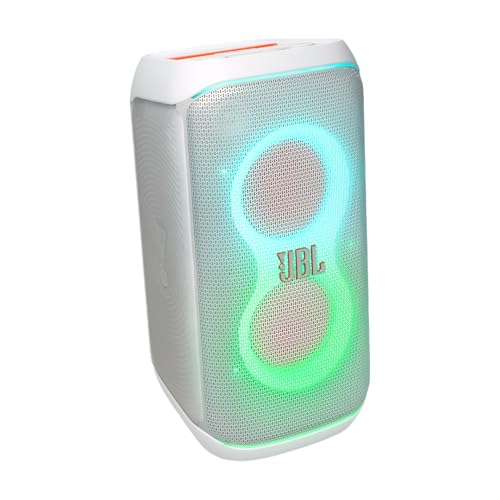
JBL PartyBox Club 120 Party Speaker with Replaceable Battery (White)
ASIN B0FHJRT5Y9 • $495 • Ships from Amazon AU
The JBL PartyBox Club 120 is the pick I'd point a repair-minded buyer at, because its battery is designed to be swapped out by the owner. That's the part that wears out first on every battery speaker, and on most of them replacing it means opening the case. It's $495, sold by Amazon AU, and ranks #23,432 overall on Amazon AU at time of writing; Amazon AU doesn't publish a category rank for it. The listing states up to 12 hours of play time and a two-year limited warranty, double the BlueAnt and Encore. The listing's release date is July 2025. It comes in white, and the model code is JBL's internal number rather than a model name.
It has a folding handle, a starry light show, splash-proof construction and the JBL Pro Sound tuning that runs across the PartyBox range. JBL's listing says you can swap out the battery and keep the music going, which means a spare battery turns 12 hours into a full day, and a worn battery in five years is a swap rather than a repair. The model code 6324664 is JBL's internal code and doesn't contradict the title. The white finish shows dirt more than black, so keep a damp cloth handy after a beach day. The folding handle keeps it compact for the car boot, and it's small enough to sit on a table rather than the ground, which keeps sand and grass out of the grille.
The listing doesn't state the battery's capacity, IP rating, watts or weight, and it doesn't say a spare battery or microphone comes in the box, so check JBL's spec sheet before you count on either. Twelve hours is JBL's best case, so expect less at full volume. Store the spare battery at about half charge in a cool cupboard, not fully charged in a hot shed. A battery swap also means no shipping a whole speaker off under warranty for a battery fault. For someone who wants the speaker to outlast its first battery, it's the one I'd buy.
Honest caveats: Honest caveats: the listing doesn't state IP rating, watts, weight or battery capacity. Splash-proof is stated without a number. No microphone or spare battery is listed in the box. Twelve hours is the shortest stated battery figure of the JBL picks.
Best for: A buyer who wants a mid-size party speaker whose battery can be swapped instead of repaired.
Battery: Up to 12 hrs, user-replaceable (listing) • Water: Splash-proof (rating not stated) • Handle: Folding • Inputs: Bluetooth • Colour: White • Model: 6324664 • Warranty: 2 years limited (listing) • Seller: Amazon AU • Rank: #23,432 overall on Amazon AU
View on Amazon AU
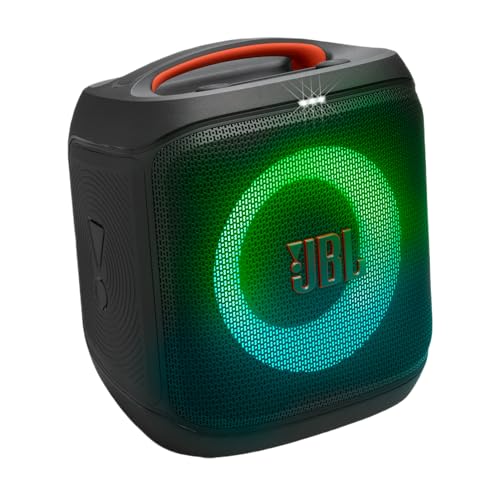
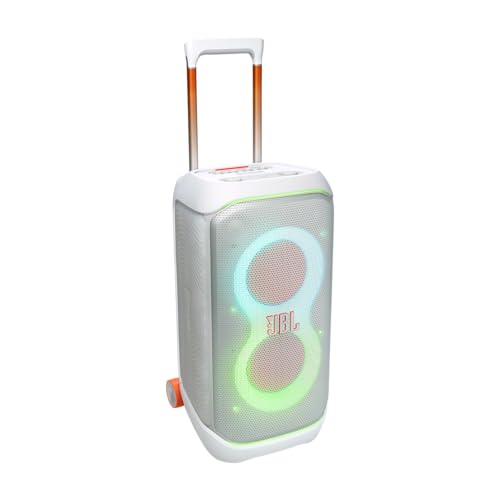
JBL PartyBox Stage 320 Party Speaker with Wheels and Telescopic Handle (White)
ASIN B0FHKS6JJ1 • $745 • Ships from Amazon AU
The JBL PartyBox Stage 320 is the backyard speaker in this list: two 6.5-inch woofers, two 25mm dome tweeters, wide wheels and a telescopic handle, for $745 sold by Amazon AU. It ranks #16,407 overall on Amazon AU at time of writing, a figure shared with the black version's listing, and Amazon AU doesn't publish a category rank for it. The listing states up to 18 hours of play time, the longest of the JBL picks, and a two-year limited warranty. The listing's release date is July 2025, and this white listing sits beside a black listing at the same price, so choose on colour alone. It's sold and shipped by Amazon AU.
The wheels and handle are the reason to buy it over the Club 120. Once a speaker gets to this size you don't want to carry it across a lawn, and JBL's wide wheels roll over grass better than small casters. Two woofers move enough air to carry bass across a big backyard, and the light show adds starry lights, light trails and strobe effects synced to the beat. There are mic and guitar inputs, and the black listing describes splash-proof construction that won't be troubled by a little rain. The 25mm tweeters are what keep vocals clear over the bass, which matters for karaoke more than people expect. Of the five, it's the one whose listing gives the most driver detail.
The listing doesn't state an IP rating number, watts, battery capacity or weight, and no microphone is listed in the box, so check JBL's spec sheet if any of those matter. The model code 6324975 is JBL's internal code and doesn't contradict the title. Wheels collect grass and grit, so clean them before you roll it back inside over a timber floor. Keep it in the shade on hot days, because a big amplifier makes heat. Check the wheel axles for grit now and then too. For a big backyard and a crowd, it's the one I'd pick.
Honest caveats: Honest caveats: no microphone is listed in the box. The listing doesn't state watts, weight or an IP rating number. Eighteen hours is JBL's best-case figure. At $745 it costs $250 more than the Club 120, and its battery isn't listed as user-replaceable.
Best for: A big backyard party where you need real bass volume and would rather roll the speaker than carry it.
Drivers: 2x 6.5-inch woofers, 2x 25mm dome tweeters • Battery: Up to 18 hrs (listing) • Mobility: Wide wheels, telescopic handle • Inputs: Bluetooth, mic and guitar inputs • Colour: White • Model: 6324975 • Warranty: 2 years limited (listing) • Seller: Amazon AU • Rank: #16,407 overall on Amazon AU (listing shared with the black version)
View on Amazon AU
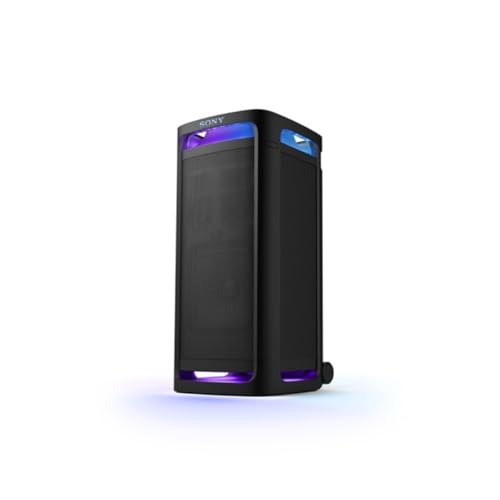
Sony ULT Tower 9 Bluetooth Party Speaker (SRSULT900AC)
ASIN B0FFSXYXT9 • $880 • Ships from Amazon AU
The Sony ULT Tower 9 is the biggest speaker in the list and the only one built to spread sound 360 degrees, for $880 sold by Amazon AU. It ranks #116,350 overall on Amazon AU at time of writing, and Amazon AU doesn't publish a category rank for it. The listing describes 360-degree sound and party lights, an ULT button for extra bass, a 10-band equaliser, a mic input for karaoke, a guitar input, USB and line-in playback, and a handle and casters for moving it. The listing's release date is July 2025, and it comes in black. It's the most expensive pick, and the only one designed to stand in the middle of a room rather than against a wall.
The 360-degree sound is the reason to choose it over the JBL Stage 320. Put it in the middle of a deck or a big room and everyone gets the same sound, rather than the people in front of the speaker getting all of it. It also has a TV Sound Booster mode, so it can double as a big speaker for the television, and it supports Bluetooth Fast Pair and multipoint, so two phones can stay connected and take turns. A second speaker can be added for stereo, and the X-Balanced speaker units are Sony's own driver design. Sony says they're shaped to keep bass clean at volume, and the 10-band equaliser lets you pull the bass back for a smaller room.
The listing doesn't mention a battery at all, so I'd treat it as a plug-in speaker unless Sony's own spec sheet says otherwise. It doesn't state watts, weight or an IP rating either. The listing states a 12-month warranty, and the code 25252910 is Sony's internal code. Casters suit a hard floor more than a lawn. Keep it on a hard, level surface, since a tall speaker on soft grass can tip. Leave a gap around it for airflow, because 360-degree speakers vent on every side. For a big indoor or covered-deck party near a power point, it's the one I'd buy.
Honest caveats: Honest caveats: the listing doesn't mention a battery, so check Sony's spec sheet before relying on battery power. No IP rating, watts or weight are stated, and no microphone is listed in the box. Its overall sales rank is the weakest of the picks. The warranty is 12 months.
Best for: A big indoor or covered-deck party near a power point, where sound needs to reach every side of the room.
Sound: 360-degree, X-Balanced speaker units • Power: Battery not mentioned on the listing; check Sony's spec sheet • Inputs: Bluetooth (Fast Pair, multipoint), USB, line-in, mic, guitar • Sound controls: ULT bass button, 10-band EQ • Extras: 360 party lights, TV Sound Booster, stereo pairing • Mobility: Handle and casters • Warranty: 12 months (listing) • Seller: Amazon AU • Rank: #116,350 overall on Amazon AU
View on Amazon AUSide-by-side comparison
What we see fail in the workshop: party speakers
Party speakers live a harder life than most electronics. They're carried, rolled, rained on, sanded and run flat out for hours. These are the three faults that come in most often, and what you can do before and after to keep one going. Most of them cost less to fix than a new speaker when they're caught early, and a few can be prevented outright with how the speaker is stored and charged.
Charging ports that work loose
The charging port takes more abuse than any other part. People plug in at odd angles, leave the lead in while the speaker's moved, and trip over the cable mid-party. Over time the port loosens on the board or cracks its solder joints, and the first sign is a speaker that only charges when the plug is held a certain way. Stop using it like that, because a loose port can short against the board. A port replacement is a common repair and usually well worth doing on a speaker this size.
Batteries that swell or won't hold charge
Lithium-ion batteries in party speakers wear out from heat and from being stored flat. A speaker left in a hot car or stored for a winter with a dead battery often comes back with a fraction of its old run time, or won't charge at all. A swollen battery can push the case apart, and that's one to stop using straight away. On most speakers the battery can be replaced, and the JBL Club 120 makes it a swap anyone can do. Store yours at about half charge somewhere cool.
Amplifiers that cut out or crackle
A speaker that cuts out at high volume, crackles on bass or shuts itself down after an hour in the sun is usually protecting its amplifier from heat. Sometimes it's just a hot day and a blocked vent. Sometimes the amplifier chips or the power supply on the board are failing, and crackling that gets worse over weeks is a sign of that. Turn off bass boost, give it shade and see if it settles. If it doesn't, bring it to our Erina workshop before a blown woofer adds to the bill.
Decision tree: which one should you actually buy?
- You want karaoke with microphones in the box? → The BlueAnt X5i at $479 includes two wireless mics, and it's the only pick that states battery life at full volume.
- You want a splash-rated speaker for a courtyard or deck at the lowest spend? → The JBL PartyBox Encore Essential 2 at $395 is IPX4 rated with mic and guitar inputs.
- You want the speaker to outlast its first battery? → The JBL PartyBox Club 120 at $495 has a user-replaceable battery and a two-year warranty.
- You're running a big backyard party and don't want to carry the speaker? → The JBL PartyBox Stage 320 at $745 has two 6.5-inch woofers, wheels and a telescopic handle.
- You want sound that reaches every side of a big room, near a power point? → The Sony ULT Tower 9 at $880 spreads sound 360 degrees and doubles as a TV speaker.
- Your speaker only charges at an angle, cuts out or crackles? → Stop charging it like that and bring it to our Erina workshop; we'll check the port, battery and amplifier and tell you the cost first.
Frequently asked questions
How long does a party speaker battery really last?
Less than the box says at party volume. Battery figures are measured at moderate volume, so with the volume up and the lights on expect roughly a third to a half of the headline number. BlueAnt states both figures for the X5i: up to 30 hours normally and up to 7 hours at full volume. Most party speakers play from the mains while they charge, so plugging in near a power point is the easiest way to keep one going all night.
Do party speakers come with a microphone?
Some do and most don't. Of the picks here, only the BlueAnt X5i lists microphones in the box, two wireless ones. The JBL PartyBox Encore Essential 2, Club 120 and Stage 320 list mic and guitar inputs, and the Sony ULT Tower 9 lists a mic input, but none of those listings say a microphone is included. Check the listing before you buy, and budget for a wired or wireless microphone if one isn't included.
Can I use a party speaker at the beach?
Yes, with care. Keep it up off the sand on a chair or bag, because fine sand gets into buttons, jacks and the woofer surrounds. Salt air corrodes charging ports and boards over a few summers. Wipe it down with a barely damp cloth when you get home, and never rinse it under a tap. A splash rating like IPX4 covers drinks and light rain, not waves or a soaking, so keep it well back from the water.
Is JBL or Sony better for a party speaker?
Neither is better across the board, and they sound different. JBL's PartyBox range is tuned for punchy bass, covers more sizes, and uses Auracast to link several newer JBL speakers. Sony's ULT range has a strong bass button and, on the Tower 9, 360-degree sound that suits the middle of a room. Pick on size, battery and features for your space. BlueAnt is worth a look too if you want microphones included.
Why does my party speaker cut out at high volume?
Usually it's protecting itself from heat or from a battery that can't supply enough power any more. Running flat out with bass boost on, in direct sun, makes the amplifier hot, and the speaker cuts out to protect it. Try turning off bass boost, moving it into shade and running it from the mains. If it still cuts out, or it crackles more over time, the battery or the amplifier may be failing and it's worth getting it checked.
How should I store a party speaker over winter?
Charge it to about half, switch it off and keep it somewhere cool and dry, not in a hot shed or a car. Lithium-ion batteries wear fastest when they're stored full and hot or left flat for months. Top it up to around half every couple of months. Before the first party of summer, charge it fully, run the brand's app to check for firmware updates, and test the inputs and Bluetooth so there are no surprises on the day.
Related buying guides
Party speaker not charging, cutting out or crackling?
Most party speaker faults we see are loose charging ports, worn or swollen batteries and amplifiers cooked by summer heat. Bring it into our Erina workshop and we'll check the port, the battery and the amplifier board, and tell you what it'll cost and whether it's worth fixing before you spend anything.
Visit our Erina workshop Book Online