Prices from Amazon AU, updated daily. Swipe or use the arrows for more.
Disclosure: This article contains affiliate links to amazon.com.au. If you buy through one of these links iFix may earn a small commission at no extra cost to you. It doesn't change which products we recommend. We focus on what actually lasts based on 16 years of repair-shop experience.
Quick summary8 picks
- Entry PickBigBlue 3 USB Ports 28W Solar Charger about$114.9628W.
- BigBlue Portable 35W Solar Panel Charger… about$129.9935W.
- BigBlue 60W Portable Compact Solar Panel… about$169.9960W.
- Renogy 16BB N-Type 175W Solar Panel about$206.99175W.
- Renogy 200 watt Portable Solar Panel for… about$359.99200W.
- Companion 300W Solar Blanket about$599.99300W.
- Solar Saga 100W Solar Panel about$398.98100W.
- Most PremiumRenogy 400W Watt Portable Solar Panel… about$726.99400W.
Why the panel matters more than the power station
Every storm season the same thing happens on the Coast. The grid drops out somewhere, power stations sell out of every camping store within a fortnight, and a month later half of them are sitting in garages flat. A power station without a panel is a one-shot battery, and most people who own one have never actually refilled it away from a wall socket. If you're going to put real money into stored power, and our guide to blackout-ready power stations covers that end of it, the panel is the piece that turns a big battery into something closer to a system.
The panels in this guide are all Amazon AU retail, either sold by Amazon itself or by the brand's own AU storefront, sitting between $115 and $727. That matters more with solar than with most gear, because this category is thick with grey imports carrying plugs and warranty terms for other markets. Every pick was checked for seller, condition and Amazon AU category sales rank on the same day, and the specs quoted come straight off the listings rather than a spec sheet from some other region.
The same panel does double duty, which is part of why they're worth buying properly. The one that holds the camp fridge up over Easter is the one that keeps the modem, a light and the phones going when the street goes dark in a southerly. Buy once, on the right connector, and it covers both jobs without you touching a generator. The picks below split by format for exactly that reason: what carries easily gets used, and what gets used pays for itself.
Rated watts against the watts you'll actually see
The number on the box is measured under standard test conditions: a lab flash at 1,000 watts per square metre with the cell held at 25 degrees. Outside, in actual Australian sun, the cell doesn't stay at 25 degrees for long. It heats up, and output falls as it does. Add a bit of haze, a panel angle ten degrees off, and a cable run with some loss in it, and a 200W panel delivering 130 to 150W in the middle of a clear day is normal, not faulty. In my experience most 'broken' panels are doing exactly what physics says they should.
That's the most useful thing to know before you buy, because it changes what size you order. If your maths needs 150W of real charging, buy 200W of rated panel, maybe more. Some panels on the market are bifacial and claim extra output from light reflected onto the rear face, but nothing in this guide leans on that, so plan around the rated figure and treat any extra as a pleasant surprise.
Cloud does more damage than heat. Under heavy overcast a panel can drop to a fifth of its rating or less, and no brand of panel escapes that, because the energy simply isn't arriving. Plan your battery capacity around the cloudy day and your panel wattage around the clear one, and the system stops surprising you. A quick habit worth building: on the first clear day you own the panel, note what your station reports as input watts at midday. That number is your healthy baseline, and any future fault shows up against it in seconds.
Connectors: where the weekend goes wrong
Most folding panels end in an MC4-style locking solar connector pair, the same plugs used on house arrays. Renogy's 400W suitcase lists IP68 solar connectors and says it fits most portable power stations, which is mostly true, except 'fits' usually means 'fits through an adapter cable that isn't in the box'. Power stations take solar in through all sorts of sockets: XT60 on a lot of current units, Anderson on some, barrel plugs on older and smaller ones. The panel and the station each speak their own connector, and the adapter between them is the part nobody thinks about until they're standing in a paddock holding both halves.
The Companion blanket goes the other way and ends in a 50A Anderson plug, the standard the 4WD and caravan crowd already run, so if your setup is Anderson through and through it drops straight in. Jackery's SolarSaga is the closed-garden option: it's built to plug into Jackery's own Explorer stations, and the listing says exactly that. Buy it inside that ecosystem and it's plug and play. Buy it expecting to feed another brand's station and you're back in the adapter drawer.
So sort the connector question before you order the panel, not after. Look up your station's solar input socket, find the adapter that goes from the panel's plug to that socket, and put it in the same cart. Adapters are small money and boring right up until the one you need is a week's postage away from the campsite.
Rigid, suitcase or blanket
A rigid panel like the Renogy 175W N-type is the lowest cost per watt in this list at $207, with no folding mechanism, no fabric and no hinge to wear out. The trade is bulk. It's a solid glass-and-frame module, happier screwed to a van roof, leaned against a shed wall or living semi-permanently where the sun is than being packed and unpacked every weekend. The listing pitches it at Class B vans, RVs and off-grid setups, and that's honest: it's portable in the sense that you can move it, not in the sense that you'd enjoy carrying it far.
The suitcase style, Renogy's 400W here, folds glass-and-frame panels against each other with kickstands built in, so you get serious wattage that still fits behind the back seat. Blankets like the Companion 300W trade cost per watt for packability: fabric-backed cells with a built-in stand and peg points that roll into the sort of space a sleeping bag takes. If your gear lives in a packed 4WD drawer system, the blanket earns its price. If the panel travels ten metres from garage to lawn, the suitcase is more watts for the same money.
Weight is worth reading off the listings while you're comparing, because the differences are real. Renogy quotes 30.2 pounds for the 400W suitcase, call it 13.7 kilos, while EcoFlow-class 220W folders advertise near 5 kilos and blankets sit somewhere between depending on size. A panel that's a pain to deploy gets deployed less, and a panel in the boot makes no power.
Match the panel to what your station will accept
Every power station has a ceiling on what it'll take from solar: a maximum input wattage, a voltage window and a current cap, and they live in the manual rather than on the front of the box. Feed a station more panel than its wattage ceiling and most modern units just clip the input, which wastes some panel but hurts nothing. Get the voltage wrong, usually by wiring two panels in series into a station with a narrow voltage window, and you can kill the input stage outright. We do see that one, and it's not a warranty job when the manual said not to.
The practical rule I give people: read the solar input line on your station's spec page before you pick a panel size, then buy panel wattage at or a bit above the station's ceiling, because real output runs well under rated anyway. A 400W panel on a station that accepts 200W of solar is only sensible if the voltage window allows it, while a 220 to 300W panel on that same station is nearly always a safe, productive match. For the whole-house end of this, the home backup power stations guide covers the bigger units and what they'll accept. And if a station and panel already refuse to talk to each other, check the voltage window first, then the adapter's polarity, in that order; those two cover nearly every dead-input call we get.
What a 200W panel earns in a real day
Run the numbers with stated assumptions, because the marketing won't. Take a 200W panel at 70 percent real-world output, a fair middle for a clear day with the panel re-aimed a couple of times, and give it four to five hours of strong sun. That's 200 x 0.7 x 4.5, call it 630 watt-hours into the battery, less a little for charging losses. A compressor fridge of the kind in our 12V car fridge guide averages somewhere around 40 to 60W once it's cycling, so a single 200W panel roughly holds a fridge plus phones on a sunny day, with nothing left over for the cloudy one that follows.
That nothing-left-over is why I'd rather see people over-panel than over-battery. A second day of cloud with a big station and a small panel just means a bigger flat battery. The panel is the income and the station is the bank balance, and most setups I get asked about are all savings and no wage, which works right up until the weather turns. If the money only stretches one way this year, stretch it toward panel wattage rather than a bigger battery; storage is easy to add later, and a starved station helps nobody mid-blackout.
Panels with USB ports built in
Renogy's 200W portable folder carries a solar connector for the station plus a USB-C and two USB-A ports on the junction box, which makes it the odd one out here: it can charge phones and small gear directly, no battery in between. Handy, with a caveat the listing won't spell out. A panel has no storage, so every passing cloud is a brownout, and phones don't love supply that comes and goes. I've written before about what dirty charging does to devices, and a direct solar USB port under broken cloud is a milder cousin of the same problem.
The fix costs nothing: charge a power bank off the panel, then charge the phone off the power bank. The bank doesn't care about interruptions, the phone gets clean steady power, and you've added a night-time charging option to the kit while you're at it. Direct panel-to-phone is fine in full stable sun; it's the in-between weather where the middle-man earns its keep. A 20,000mAh bank holds roughly 70 watt-hours, which a 100W panel refills in under two hours of decent sun, so the detour barely costs you time either.
What I'd check before paying
Seller first. Every pick here is Amazon AU first party or the brand's own AU storefront, and I'd hold anything else you're considering to the same standard, because the import listings carry plugs and warranty terms for other markets. Then the warranty paper itself: Renogy's 400W lists 3 years on materials with a 10-year guarantee that output stays above 80 percent, and its 175W rigid lists a 10-year product warranty and a 25-year guarantee of 80 percent output. That output-over-time number is the one worth having, since all panels fade, and a brand that puts a floor on the fade in writing is telling you something about its cells. The seller name on the buy box is worth a second look too, since listings can shift between sellers week to week; the tiers quoted here were correct on the day we checked.
Last, read the IP rating honestly. IP68 and IP67 on the Renogy folders mean weather is mostly a non-event. IP65 on the Companion blanket and the Renogy 200W portable means splash and rain resistance, and that Renogy listing itself tells you not to leave it soaking in pouring rain for long stretches. None of these ratings mean 'leave it out in hail'. Pack a panel down when the weather turns ugly and it'll likely see out its warranty; the ones that reach our workshop in Erina with water in the junction box mostly weren't.
The 8 picks, $115 to $727
Prices are Amazon AU at time of writing (29 September 2026) and move week to week. Ranks are Amazon AU category sales ranks, checked the same day.

Renogy 400W Portable Solar Panel Folding Suitcase
ASIN B0DNZ2P4FD • $726.99 • Sold by Renogy AU on Amazon AU
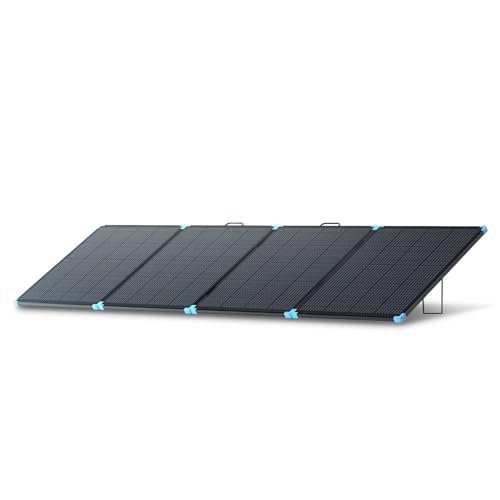
This is the panel for anyone who bought a serious power station and is tired of watching it refill at a trickle. Four hundred rated watts is a different class of input: even at the 65 to 70 percent you'll actually see, that's around 260W going into the station, which turns a two-day recharge into an afternoon. Renogy builds it as a folding suitcase with a compact cell layout, and the listing makes a point of it being smaller than the one-piece 400W laminated assemblies it replaces, at 30.2 pounds, which is about 13.7 kilos. That's a two-hands lift, but it's a size a normal boot swallows, and the folding aluminium kickstands make setup the one-minute job the listing claims.
The build story reads right for something that'll live outdoors: fibreglass reinforcement, ETFE coating over EL-tested Grade A+ cells, an aluminium backsheet and IP67 or better sealing per the listing, with IP68 rated solar connectors on the output. Renogy says it'll cop snow, rain and light hail, and while I'd still fold any panel down ahead of a Central Coast hailstorm, the materials list backs the general claim. It's pitched at camping, caravan and off-grid systems and says it connects to most portable power stations through standard solar connectors, which in practice means MC4-style plugs plus whatever adapter your particular station wants. Order that adapter with the panel, not after the first failed trip.
Warranty is 3 years on materials and workmanship with a 10-year guarantee that output stays above 80 percent, which is more paper than most portable panels carry. At $727 it's the dearest pick in this guide, and the right buyer already owns the station it'll feed. If you're still choosing the battery end, sort that first, because the station's solar input ceiling decides whether 400W is a shrewd buy or an oversized one. For a big LiFePO4 unit rated to take 400W or more of solar, this is the pick I'd make without much agonising.
Honest caveats: At 13.7 kilos it's luggable, not hikeable, and the folded panel is still a solid slab that needs a flat spot in the vehicle. The listing doesn't state open-circuit voltage or which adapter cables are included, so confirm your station's solar input window and connector before ordering. Materials coverage is 3 years; the 10-year figure covers output level only.
Best for: Refilling a large power station properly instead of trickling it back over two days.
Rated output: 400W • Weight: 30.2 lb (about 13.7 kg), per the listing • Cells: Grade A+ mono, EL tested • Build: Fibreglass reinforced, ETFE coating, aluminium backsheet • Kickstands: Folding aluminium alloy • Sealing: IP67 or better; IP68 solar connectors • Warranty: 3 years materials, 10-year 80% output guarantee • Rank: #63 in Solar Panels (Amazon AU)
View on Amazon AU
Renogy 200W Portable Solar Panel for Power Stations
ASIN B0CGZ7XGRC • $359.99 • Sold by Renogy AU on Amazon AU
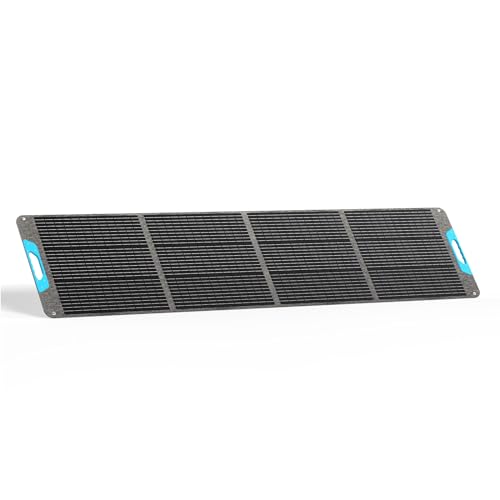
The middle Renogy is the one I'd hand most first-time buyers. It's a 200W foldable with an adjustable kickstand, Grade A cells under ETFE quoted at 23.5 percent conversion efficiency, and it's built specifically to feed a power station over a standard solar connector. Two hundred rated watts lands in the sweet spot for the 500Wh to 1kWh stations most households actually own: enough to put real charge back in over a day, not so much that you're paying for watts the station's input ceiling will refuse. At $360 from Renogy's own AU storefront it's about half the price of the 400W suitcase for half the output, so the maths is at least honest.
What separates it from the other folders here is the junction box: alongside the solar output there's a USB-C port and two USB-A ports, so it charges phones, lights and small gear directly with no station in the loop at all. The listing also gives it four mounting holes for tying onto a car roof or rack and a magnetic fold with a buckle to keep it shut in transit. That combination makes it the most flexible panel in the list: station charger on the weekend, direct USB supply at a day camp, and something you can lash to the ute when the ground is all shade and the roof isn't.
The sealing is the honest compromise. IP65 means splash and dust resistance, and Renogy's own listing tells you not to leave it soaking in pouring rain for long periods. Treated like the fabric-backed folder it is, packed down when the weather closes in, there's nothing here that worries me. The USB ports don't have output wattages stated on the listing, so plan on them for keeping devices topped up rather than any particular fast-charge figure. For a first panel that has to do a bit of everything, from blackout duty at home to a long weekend away, this is the one I'd point at, and the one I'd expect to still be earning its spot in five years.
Honest caveats: IP65 only, and the listing itself warns against long soaking in heavy rain. Panel weight isn't stated on the listing, and neither are the USB port wattages, so don't build charging plans around fast-charge numbers it never promises. As with all of these, the adapter from its solar connector to your station's input socket may be an extra purchase.
Best for: One panel that charges the station on the weekend and phones straight off the junction box.
Rated output: 200W • Cell efficiency: 23.5%, per the listing • Outputs: Solar connector, USB-C, 2x USB-A • Mounting: 4 mounting holes, magnetic fold with buckle • Sealing: IP65 splash and dust resistance • Form: 12V foldable with adjustable kickstand • Rank: #137 in Solar Panels (Amazon AU)
View on Amazon AU
Jackery SolarSaga 100W Solar Panel
ASIN B0B96LDQ7H • $399.00 • Ships from Amazon AU
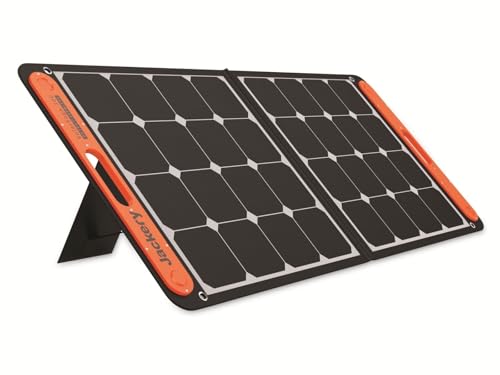
The SolarSaga 100W is the panel to buy if there's already a Jackery Explorer in the house, and I'd put it that bluntly. It's sold by Amazon AU first party, it folds flat with adjustable kickstands and a rubber carry handle, and the listing is upfront that it's designed to pair with Jackery's Explorer power stations, sold separately. Inside that ecosystem it's the closest thing in this guide to plug and play: unfold, stand, connect, done. No adapter research, no polarity questions, no drawer of pigtails. It's also the only folder here sold by Amazon directly rather than through a brand storefront. For the buyer who wants blackout backup that a non-technical household can deploy, that simplicity is worth real money.
The panel itself is monocrystalline with multi-layer cell tech quoted at up to 23 percent conversion efficiency, laminated in ETFE for weather resistance and longer life, with a zip pocket that keeps the cable and ports shielded from knocks and dust. It's the lightest, most packable format here short of the blanket, and the kickstands adjust so you can chase a decent angle through the day rather than leaving it flat on the grass, which on a 100W panel matters: at this size you want every one of those watts actually arriving. The zip pocket sounds minor until you've seen what a loose plug rattling around a boot for a year does to its pins; small protections like that are why some panels age well.
Be clear-eyed about what 100W buys. At the usual 65 to 70 percent real-world figure you're collecting around 65 to 70W in strong sun, which keeps phones, lights, a laptop and a small station happy, and will hold a modest fridge only with generous sunshine and patience. At $399 it's also the dearest cost per watt in this list. You're paying for the format, the finish and the fit with Jackery's plugs, and whether that trade makes sense depends entirely on what's already in your garage. With an Explorer in the house, buy it and stop thinking about it.
Honest caveats: Built around Jackery's own Explorer connections, so feeding another brand's station means adapters and homework the listing doesn't cover. It's also the highest price per rated watt in this guide by a wide margin, and 100W is a phones-and-lights panel, not a fridge panel. Output port details beyond the listing text aren't stated, so check the current listing for your use.
Best for: Jackery Explorer owners who want charging that works straight out of the bag.
Rated output: 100W • Cell type: Monocrystalline, up to 23% conversion • Laminate: ETFE, weather resistant • Form: Foldable, adjustable kickstands, rubber handle • Storage: Zip pocket for cable and ports • Pairs with: Jackery Explorer stations (sold separately) • Seller: Amazon AU • Rank: #90 in Solar Panels (Amazon AU)
View on Amazon AU
Companion 300W Solar Blanket
ASIN B0FN49RQKW • $599.99 • Ships from Amazon AU
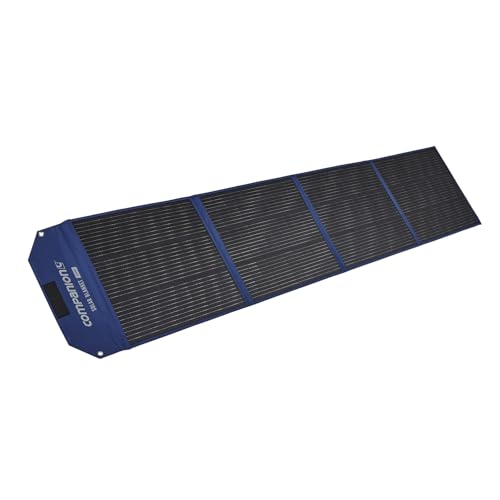
Companion is a name most Australian campers already have something from, and its 300W blanket is the packability play in this list. A-grade monocrystalline cells rated at 300W with up to 16.7A of output, sewn into rugged 1680D polyester with an ETFE coating and what the listing calls cell armour, folding down soft rather than into a rigid slab. In a 4WD drawer system or a packed wagon, that's the difference between a panel that comes on every trip and one that gets left home because the suitcase wouldn't fit around the esky. It folds soft and flat, and it packs against curved loads in a way no rigid panel can. Sold by Amazon AU first party at $600 at time of writing.
The connector choice tells you who it's for: a 50A Anderson plug, the fitting the 4WD, caravan and dual-battery crowd already run through their vehicles. If your gear speaks Anderson, this drops into the existing wiring with nothing extra. Positioning is handled by a built-in stand plus peg points, so it can be staked at an angle on the ground or draped over the windscreen or a bonnet, and IP65 weather resistance covers the splash-and-dust reality of a campsite without promising submersion. It's a working accessory for a touring setup rather than a gadget, and it's specced like one. Nothing about the format needs babying beyond sensible folding, and the stand means you're not hunting for something to lean it against at every stop.
The rank line needs explaining rather than apologising for. Amazon AU files this under Camping Blankets, where it sits at #318 among actual bedding, so the number tells you nothing useful about how it sells against other panels. Judge it instead on the spec sheet and the brand's standing in the touring world, both of which hold up. If Anderson is your standard and space is the constraint, it's the pick. If you'd need to buy adapters and you've got boot space to spare, the Renogy folders above give you more watts for similar money.
Honest caveats: Anderson-only out of the box, so stations without an Anderson input need an adapter the listing doesn't include. IP65 is splash resistance, not weatherproofing to leave out in storms. And like any fabric blanket panel, fold it along its seams rather than creasing the cells; cracked cells from tight packing are a slow, invisible way to lose output.
Best for: Anderson-wired 4WD and caravan setups where packed size beats cost per watt.
Rated output: 300W, up to 16.7A • Cells: A-grade monocrystalline • Connector: 50A Anderson plug • Material: 1680D polyester, ETFE coating • Sealing: IP65 • Positioning: Built-in stand and peg points • Seller: Amazon AU • Rank: #318 in Camping Blankets (Amazon AU)
View on Amazon AU
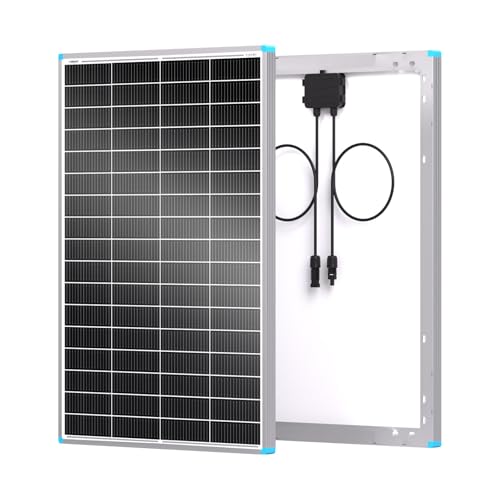
Renogy N-Type 175W Rigid Solar Panel
ASIN B0DZ6QH5R3 • $206.99 • Sold by Renogy AU on Amazon AU
At $207 this is the least money per rated watt in the guide, about $1.18 a watt against $1.80 for the 200W folder, and it gets there by skipping the folding hardware entirely. It's a rigid 175W module built on N-type 16BB cells quoted at 25 percent efficiency, in a frame Renogy describes as low-iron tempered glass with a corrosion-resistant aluminium frame and polyamide corner supports. Renogy pitches it at Class B vans, RVs, camping and off-grid systems, which is the right framing: this is a panel you install somewhere sunny and leave, not one you unfold beside a tent.
Two listing details stand out for real-world use. Renogy says it is 3.9 percent smaller and 4 percent lighter than the panel it replaces for the same power output, which matters on a van roof where every centimetre is spoken for. And the claimed low temperature coefficient matters in exactly the conditions Australian panels live in, where cell temperature, not sunlight, is what caps summer output. The listing quotes degradation of no more than 1 percent in the first year and 0.4 percent a year after that, backed by a 10-year warranty and a 25-year guarantee of 80 percent output, which is more paper than most panels at this price carry.
What you're giving up is everything the folders include: there's no kickstand, no handle, no USB ports and no cabling mentioned beyond the module itself, so mounting hardware and the run back to your station or regulator are on you. For a van roof, a shed, or a home blackout rig where the panel lives in place and earns every day, that trade is easily worth $207. Pair it with a station that lives near the meter box, wire it once with decent cable, and you've built the quiet half of a blackout kit that never needs fuel, priming or thought.
Honest caveats: This is a rigid module, not a fold-and-carry panel, and the listing doesn't state weight, dimensions or included cables, so plan your mounting and wiring before it arrives. It is a single-sided panel, so there is no rear-face bonus to count on. You'll also need your own adapter or regulator setup, since nothing station-specific is included.
Best for: A van roof or home blackout rig where it lives in place and makes the most watts per dollar.
Rated output: 175W • Cells: N-type 16BB, 25% cell efficiency • Build: Low-iron tempered glass, aluminium frame with polyamide corner supports • Degradation: 1% or less in year one, 0.4% or less a year after • Warranty: 10-year product warranty, 25-year 80% output guarantee • Form: Rigid module • Rank: #614 in Solar Panels (Amazon AU)
View on Amazon AU
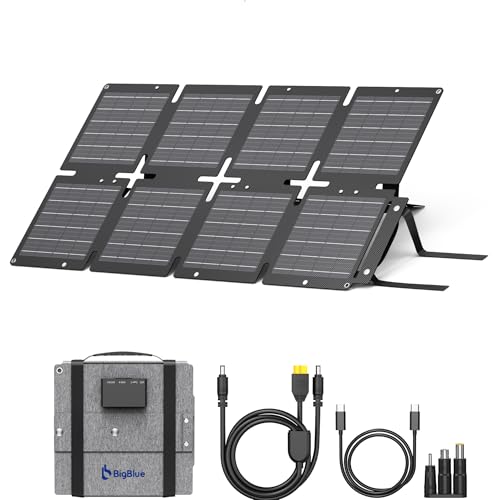
BigBlue 60W Portable Compact Solar Panel
ASIN B0DR295CY4 • $169.99 • Sold by BigBlue-AU on Amazon AU
The BigBlue 60W is the smallest panel in this guide that is built to feed a portable power station directly. It has a DC 5525 output with a DC5525 to XT60 / DC5521 cable in the pack, plus adapters for DC7909, DC8020 and DC35135 plugs, and the listing says that covers most portable power stations. That is the connector homework most buyers skip, done for you, though you should still check your station's solar input socket and voltage window against the listing before ordering.
It also has a 45W PD USB-C port and a 20W USB-A port, so it can run a phone, tablet or power bank straight off the panel as well. The cells are N-type with a quoted 24.7 percent conversion efficiency, the panel folds to roughly 26 by 21 by 6 centimetres with a carry handle, and built-in kickstands let you aim it through the day. At 60W it is a top-up panel, not a refill panel: expect a small station to gain charge slowly, and a big one barely at all.
Honest caveats: IP68 applies to the panel, and the listing notes the junction box is not waterproof. Like every panel here it stores nothing, so output swings with cloud, angle and the load connected. The listing doesn't state a weight, so check the carry load before a long walk.
Best for: A weekend camper with a small power station who wants a compact panel and the right cables in the box.
Rated output: 60W • Ports: 45W PD USB-C, 20W USB-A, DC 5525 • Cells: N-type, 24.7% quoted efficiency • Cables: DC5525 to XT60 / DC5521, plus DC7909, DC8020, DC35135 adapters • Sealing: IP68 panel, junction box not waterproof • Form: Folding, handle and kickstands • Rank: #51 in Solar Panels (Amazon AU)
View on Amazon AU
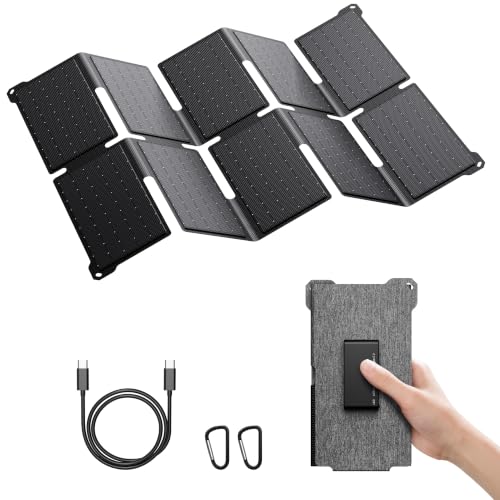
BigBlue Portable 35W Solar Panel Charger
ASIN B0FP2PQ22B • $129.99 • Sold by BigBlue-AU on Amazon AU
At 35W this is a backpack panel, not a power-station panel, and it is honest about that. It has two USB-C ports and one USB-A port, with the USB-A port quoted at QC 18W and one USB-C port at PD 25W with PPS, which is enough to charge a phone, a GPS unit, a camera or a power bank in decent sun. Folded it measures about 21 by 12 by 5 centimetres and weighs 1.54 pounds, about 0.7 kilos, so it clips onto a pack without a second thought.
The cells are monocrystalline with a quoted 25.4 percent conversion efficiency and the panel is rated IP68. The real trick, same as with every panel here, is the middle-man: run it into a power bank in the sun and charge your phone off the bank at night, rather than plugging a phone straight into a panel that browns out whenever a cloud passes.
Honest caveats: The listing says the first USB-C port is not compatible with Apple devices, so check which port you are using. The USB junction box is not waterproof, and the panel only works in direct sunlight and stores nothing. It will not run a fridge or fill a power station in any useful time.
Best for: Hikers and day-trippers who need phones, a GPS or a power bank topped up on the track.
Rated output: 35W • Ports: USB-A QC 18W, USB-C PD 25W with PPS, second USB-C • Cells: Monocrystalline, 25.4% quoted efficiency • Weight: 1.54 lb (about 0.7 kg) • Folded size: 8.29 x 4.84 x 1.89 in • Sealing: IP68, junction box not waterproof • Rank: #75 in Solar Panels (Amazon AU)
View on Amazon AU
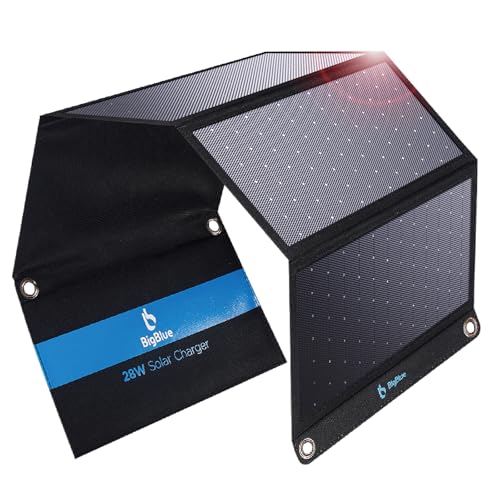
BigBlue 3 USB Ports 28W Solar Charger
ASIN B01EXWCPLC • $114.96 • Sold by BigBlue-AU on Amazon AU
If all you want is a way to keep a phone alive on a long weekend away from power, the BigBlue 28W is the lowest-cost panel in this guide and the simplest. It folds to about 29 by 16 by 3 centimetres and weighs 20.5 ounces, roughly 580 grams, with two USB-C ports and one USB-A port that each deliver up to 5V/3A (5V/4.8A in total). The listing quotes N-type cells at up to 25.3 percent efficiency and a PET polymer surface with rubber covers over the ports.
It is an emergency-kit and day-pack panel, and the listing is clear about its limits: it can't charge laptops or an iPad Pro, it stores no power, and Apple devices need their own original cable. As a backup in a blackout kit it earns its place at this price, because a phone that works is the one thing people reach for first.
Honest caveats: Output is affected by sunlight, temperature, angle and the connected device, and any cloud or cover slows charging. It will not feed a power station, so if that is the goal start with the Renogy or BigBlue 60W panels above.
Best for: A blackout kit or day-pack panel for phones and small USB gear.
Rated output: 28W • Ports: 2x USB-C, 1x USB-A, 5V/3A each, 5V/4.8A total • Cells: N-type, up to 25.3% quoted efficiency • Weight: 20.5 oz (about 580 g) • Folded size: 11.6 x 6.3 x 1.3 in • Included: 50cm USB cable • Rank: #27 in Solar Panels (Amazon AU)
View on Amazon AUSide-by-side comparison
| Product | Price | Best for |
|---|---|---|
| BigBlue 3 USB Ports 28W Solar Charger | ~$114.96 | Phones and small USB gear on a day pack |
| BigBlue Portable 35W Solar Panel Charger… | ~$129.99 | Phones, GPS and power banks on the track |
| BigBlue 60W Portable Compact Solar Panel… | ~$169.99 | Topping up a small power station |
| Renogy 16BB N-Type 175W Solar Panel | ~$206.99 | Fixed van roof or shed install at the lowest cost per watt |
| Renogy 200 watt Portable Solar Panel for… | ~$359.99 | One panel for a station plus direct USB charging |
| Companion 300W Solar Blanket | ~$599.99 | Anderson-wired 4WD and caravan setups |
| Solar Saga 100W Solar Panel | ~$398.98 | Households already running a Jackery Explorer |
| Renogy 400W Watt Portable Solar Panel… | ~$726.99 | Refilling a large power station properly |
What we see fail in the workshop: portable solar
Panels almost never die in the cells first. The silicon outlasts everything around it. What fails is the edges of the system: the junction box on the back, the cables and plugs between panel and station, and occasionally the gear on the far end that copped unstable supply. Most of it is preventable, and most of it announces itself early if you know what half-output actually means.
Junction boxes and bypass diodes
The junction box on the back of the panel carries bypass diodes that route current around shaded sections. Park the panel half in shade for long enough, repeatedly, and those diodes run hot; when one fails, a whole string of cells drops out and the panel delivers half its usual output on a perfect day. That's the classic symptom: not dead, halved. Water getting into the box does the same job faster and adds corrosion. If your panel suddenly reads half, it's usually a diode or a wet box, and both are fixable for far less than a new panel.
Cables, plugs and crushed connectors
Solar plugs live on the ground, which is where feet, camp chairs and car tyres also live. We see MC4-style pairs with pitted pins from being connected under load, Anderson plugs gone loose and resistive, and cables with crush damage that drops voltage under current while looking fine to the eye. A warm plug is the tell: connectors should run cool, and one that's warm under charge is resistance turning your solar into heat. Route cables where they won't be stood on, connect before the sun does the work, and replace any plug that's discoloured.
Creased cells and delamination
Fabric blankets and folders fail through handling, not weather. Fold a blanket tight against its cells instead of along its seams and the cells crack invisibly; output sags over the following months and nobody connects the two events. Heat does the slower version, cooking the laminate until it bubbles or lifts at a corner and moisture gets under the plastic. Store panels flat or loosely rolled, out of a hot car, and don't stack heavy gear on top of them in the drawer. The panel that's treated like glass lasts like glass treated well.
Decision tree: which one should you actually buy?
- Own a big power station that takes days to refill? → The Renogy 400W suitcase at $727. A real-world 260W or so of input turns a two-day recharge into an afternoon, and its warranty paper is the strongest here.
- Want one panel for the station plus direct phone charging at camp? → The Renogy 200W portable at $360. It feeds a station over its solar connector and carries USB-C and two USB-A ports on the junction box for everything else.
- Already running a Jackery Explorer? → The SolarSaga 100W at $399. It's built for Jackery's own connections, so there's no adapter hunt, and it packs flat with a handle.
- Tight on packing space in a 4WD wired for Anderson? → The Companion 300W blanket at $600. It ends in a 50A Anderson plug and folds soft into a fraction of the space a suitcase panel needs.
- Want the most watts per dollar and don't need it to fold? → The Renogy 175W N-type rigid at $207. Mount it once facing north and leave it earning.
- Small power station and a weekend away? → The BigBlue 60W at $170. It ships with the DC and XT60 cables the listing names, and folds small with a handle and kickstands.
- Just keeping phones and a power bank alive on the track? → The BigBlue 35W at $130, or the 28W at $115 if you only need the basics. Neither will run a power station.
- Panel putting out half its usual, or a plug that's melted or warm? → Bring it in to our Erina workshop. We'll load-test the panel, check the diodes and connectors, and tell you whether it's a $20 fix before you buy anything new.
Frequently asked questions
Do portable solar panels work in winter in Australia?
Yes, with less to collect. Winter gives you fewer strong-sun hours and a lower sun angle, so a panel left flat does noticeably worse than one propped on its kickstand and aimed. The cells themselves actually run slightly more efficiently in cold air, since heat is what drags output down, but that bonus is smaller than the loss from shorter days. Plan on roughly two thirds of your summer harvest, re-aim the panel at lunchtime, and winter solar remains well worth setting up, especially for keeping a power station topped through blackout season.
Can I plug any solar panel into any power station?
Often yes, but never assume it. Electrically, the panel has to sit inside the station's solar input window for voltage and current, which is printed in the station's manual, and physically the plugs have to match, which usually means an adapter cable. Most single 12V-class panels suit most stations. The risk case is wiring panels in series, which stacks voltage and can exceed a station's input limit and damage it. Jackery's SolarSaga is the special case here: it's made for Jackery's own stations, so pairing it with other brands takes homework.
Why does my 200W panel only make 130W?
Because the 200W figure comes from standard test conditions: 1,000 watts per square metre of light with the cell held at 25 degrees. Real sun heats the cell well past that, and output falls as temperature rises. Add imperfect angle, a bit of haze and cable losses, and 60 to 75 percent of the rating is what a healthy panel delivers in good conditions. So 130 to 150W from a 200W panel is normal. What's not normal is exactly half, suddenly; that pattern usually means a failed bypass diode or a shaded string, which is worth having looked at.
Is a solar blanket better than a folding panel?
Better at packing, worse at price per watt, and that's the whole trade. A blanket like the Companion 300W folds soft and squeezes into a loaded 4WD where a rigid suitcase simply won't go, and it pegs out or drapes over the vehicle easily. For the same money a suitcase panel usually gives you more rated watts and a sturdier stand. Blankets also ask for more careful handling: fold along the seams, don't crease the cells, and don't bury it under recovery gear. If space is your binding constraint, buy the blanket; otherwise the folder wins on value.
Do I need a solar regulator with these panels?
Not when charging a power station, because the station's own charge controller does the regulating; you just have to respect its input limits. You do need regulation the moment a panel connects to a bare 12V battery, like a dual-battery setup or a caravan house battery, since an unregulated panel will overcharge it. Some portable panels ship with a regulator and some don't, and the listings here mostly don't state one either way, so check the current listing against your use. Into a station: plug and go. Onto a battery: put a regulator in between.
How long do portable solar panels last?
The cells fade slowly and predictably; the hardware around them decides the real lifespan. Renogy backs its 400W suitcase to hold 80 percent of rated output at 10 years, and the 175W rigid carries a 10-year product warranty, which tells you roughly what the industry expects from decent cells. In practice the failures we see are junction boxes, diodes, plugs and creased cells from rough packing, all of which arrive years before the silicon wears out. Store it dry and flat, keep plugs clean, fold blankets kindly, and a good panel should outlast the power station it feeds.
Related buying guides
When the panel isn't the problem
A station that won't take charge, a phone that misbehaves after solar USB, or a panel suddenly making half its usual power usually comes down to one small component, not a dead panel. Bring the lot in to the workshop at Erina and we'll test panel output, cables, connectors and the gear on the end of them before you spend anything. Nine times out of ten it's a plug, a diode or a tired battery, and we'll tell you which.
Visit our Erina workshop Book Online