Prices from Amazon AU, updated daily. Swipe or use the arrows for more.
Disclosure: This article contains affiliate links to amazon.com.au. If you buy through one of these links iFix may earn a small commission at no extra cost to you. It doesn't change which products we recommend. We focus on what actually lasts based on 16 years of repair-shop experience.
Quick summary7 picks
- CheapestSAS Electrical 240V 10A 24-Hour Timer about$13.20
- Aoutecen KG316T Digital Timer Controller… about$32.29
- Sansai 7 Day/24hrs Outlet/Powerplug Digital… about$23.052400W.
- AIMALL Digital Timer Switch Socket Electric… about$28.99
- Bewinner Digital Timer Switch 7 Day… about$29.69
- HPM 24 Hour Analog Timer with Offset Double… about$33.90
- Most PremiumPool Pump Timer 7 Day 18 On Off about$36.07
The oldest energy gadget still earns its socket
A timer switch is about as unfashionable as home hardware gets, a $13 lump of plastic between the wall and the plug, and it's still one of the highest-return devices in the house if your tariff charges different prices at different times. The idea hasn't changed in fifty years: electricity is priced by when you use it on a growing number of Australian plans, and a timer moves a flexible load, the pool pump, the towel rail, the dishwasher, into the window where each kilowatt hour costs the least. No app, no cloud account, no firmware updates that brick it. We fix enough smart devices at the bench to have real respect for a switch with nothing in it that can be pushed a bad update.
The other half of the case is standby and habit loads, the things that run all day because nobody switches them off. A heated towel rail left on around the clock is the classic. The rail itself is only a couple of hundred watts, but a couple of hundred watts for 24 hours a day adds up fast, and cutting it back to two morning hours and two evening hours with a mechanical timer takes five minutes to set up and zero effort forever after. That's the honest pitch for this whole category: not a gadget that saves energy by magic, but a switch that enforces the schedule you'd run anyway if you never forgot.
Tariffs, explained without the brochure
There are three tariff shapes that matter here, and your bill tells you which one you're on. Flat rate charges the same per kilowatt hour at 3pm as at 3am, and on a flat rate a timer saves you nothing by shifting load, only by cutting total hours. Time-of-use splits the day into peak, shoulder and off-peak windows with genuinely different prices, typically with the expensive block in the evening, and this is where timers shine: the same kilowatt hour of pool filtering or water heating can cost a fraction as much at 1am as at 6pm, with the exact windows and rates varying by retailer and network, so read your own plan rather than trusting anyone's example.
The third shape is controlled load, sometimes still called off-peak hot water, where a hardwired circuit, nearly always the electric storage water heater, is metered separately at a lower rate and the network switches it on during slack periods. If your hot water is already on controlled load, the timing is being done for you upstream and there's nothing for a timer to improve. If it's not, that's a conversation with your electrician and retailer, not a plug-in gadget, and I'll come back to why. The broader load-shifting picture, including where smart plugs and energy monitors fit, is covered in our smart home power savings guide, and a timer is the simplest possible tool in that kit.
The hot water question, answered honestly
This guide has hot water in the title, so here's the part most listings skate past: you can't put a typical Australian electric hot water system on a plug-in timer, because it isn't plugged in. Storage water heaters run on a dedicated hardwired circuit, usually straight off the switchboard, and anything that interrupts fixed wiring is licensed electrician territory in Australia, full stop. That's not me covering myself, it's the law, and it's also just correct: a water heater is a sustained high-current load, and switching it wants properly rated gear installed by someone who can test their work.
What you can do about hot water is worth doing though. If you're on a time-of-use plan with low overnight rates, a sparky can fit a hardwired timer or a contactor arrangement so the element only heats in the low-price window, and a unit like the Bewinner below is exactly the class of hardware they'd wire in for a pool pump or similar fixed load. Alternatively, moving the water heater to a controlled load tariff gets the network to do the switching. Either way the plug-in timers in this guide are for the rest of the house: pumps, rails, chargers, lamps, dehumidifiers, the fish tank, anything that ends in a plug.
What must never go on a timer
The short list first: fridges and freezers, anything medical, the NBN box and router if anyone relies on the connection, security cameras and recorders, and sump or greywater pumps that need to run when water arrives rather than when the clock says so. A fridge cycled off for hours to chase a tariff saves cents and risks a bin full of food, which is the worst trade in home energy. Medical gear needs no explanation beyond: never. And a modem on a timer takes out phones, alarms and cameras with it, which people mostly discover the bad way.
Heaters deserve their own paragraph. A timer that turns a heater off after an hour is a reasonable safety net. A timer that turns a heater on while nobody's in the room is how house fires start, and no schedule is worth an unattended radiant bar heater. If a heater does go on a timer, it should be a modern unit with its own thermostat and tip-over protection, in a clear space, and only ever switching off, not on. While we're on electrical safety: a standard Australian socket is good for 10 amps, about 2,400 watts, and every timer here inherits that ceiling or less. Never stack a heater onto a powerboard, timer or not, and if a plug or timer body ever feels warm to the touch, that circuit is telling you something and it's worth acting on.
The maths, with the assumption stated
Take the AU average tariff at roughly 33c per kilowatt hour and the arithmetic gets simple: a 2,000W appliance flat out costs about 66c an hour, a 200W towel rail about 6.6c an hour, and a 10W phone charger about 0.3c an hour. Those three numbers explain most timer decisions. Timing the charger is pointless, the number's already nothing. Timing the towel rail from 24 hours down to 4 saves you twenty hours of 6.6c every day, which is real money over a year. And a 1,000W pool pump running its filter cycle in a low-rate overnight window instead of the evening peak saves the gap between the two rates on every one of those kilowatt hours, every day, forever.
The discipline is measuring before guessing, because wattage labels state maximums and real appliances draw what they draw. A plug-in energy meter, or one of the metering models from our smart plugs guide, tells you in a day whether a load is worth shifting. As a rule of thumb, anything under about 50 watts isn't worth a timer's socket space for savings alone, resistive heating loads and pumps almost always are, and the awkward middle is electronics with standby modes, where cutting power entirely can cost you settings or recordings. Measure, then decide, then set the schedule once and forget it, because a timer's whole advantage over willpower is that it doesn't have moods.
Mechanical or digital, pins or programs
Mechanical pin timers like the HPM twin pack are a clock motor driving a dial, with the day divided into segments you push down to switch the load on. A typical dial gives you 48 switching cycles a day at 15 minute resolution, which sounds coarse until you realise almost every real schedule is round numbers anyway. Their strengths are the price, the glanceability, you can see the whole day's schedule on the dial from across the room, and the fact that there's no memory to lose and no menu to misprogram. Their weaknesses: the same schedule runs every day of the week, they tick audibly in a quiet room, and a blackout stops the clock, so the schedule runs late until you spin the dial back to the right time.
Digital timers like the Sansai fix all three weaknesses at once. Twenty on-off programs a day at one minute resolution, a seven day cycle so weekends can differ from weekdays, summer and winter time options, and a backup battery that holds the clock and programs through a blackout, which is the single most underrated spec in this category. The cost is a menu, and menus on $23 hardware are never a joy: small buttons, terse LCD abbreviations, and a real chance of leaving it in the wrong mode if you rush. My honest guidance is that households set a digital timer once a season and forget it, so the clunky programming matters less than the battery and the weekday flexibility, but if the person setting it hates fiddly menus, the pin dial wins on being impossible to get wrong.
Contacts, ratings and why timers die
A timer is a relay or a set of cam-driven contacts switching real current, and contacts are consumables. Every switch-on across an inductive load, a pump motor, a compressor, draws an arc that erodes a little metal, and a timer rated to its limit switching a motor twice a day lives a much shorter life than the same timer running a lamp. The Sansai states its ceiling plainly, 2,400W at 240V, 10A maximum, and the honest way to read any such rating is as a resistive figure: for motors and pumps, staying well under it is what buys you years. When a timer starts sticking on, buzzing at the changeover or switching intermittently, the contacts are pitted and the unit is finished. They're not repairable at these prices, and the ones that come through our Erina workshop get a post-mortem and a recommendation, not a resurrection.
The HPM twins bring up a spec worth explaining: double pole switching, which breaks both active and neutral rather than active alone. For a device that's switching something outdoors, damp-adjacent or heating-related, full isolation of both conductors when off is simply better practice, and it's the sort of detail that shows up on gear designed for AU wiring rules, the HPM listing states Australian origin, rather than a generic global product with an adapter plug moulded on. It's also the reason I'd put the HPM on the loads that matter most rather than on whichever socket matters least.
The security side benefit
Timers earn a second job when the house is empty. A couple of lamps switching on random-ish schedules reads as occupancy from the street far better than a porch light burning at noon does, and the AIMALL below has an explicit random mode built for exactly this, wobbling its programmed times so the pattern doesn't repeat like a metronome every night. A mechanical timer does a cruder version of the same trick, and two of them from a twin pack running a lamp in different rooms costs almost nothing. It pairs naturally with the motion lighting from our solar security lights guide: scheduled interior light says someone's home, motion-triggered exterior light says you've been noticed, and neither needs a subscription.
Keep the security schedule plausible. Lights that snap on at exactly 18:00:00 and off at exactly 22:00:00 every day of a two week holiday are their own tell, which is what the random offset solves. And if you're going away in summer, the same timer bank that runs the lamps can run the fish tank, the irrigation controller's pump and the dehumidifier in the boat shed, which is the point where a $13 timer has quietly become infrastructure. Label each timer with what it runs and when you set it. Future you, standing at the switchboard in July trying to remember why the hallway lamp comes on at dawn, will be grateful.
The 5 picks, $13 to $34
Prices are Amazon AU at time of writing (28 September 2026) and move week to week. Ranks are Amazon AU category sales ranks, checked the same day.

HPM 24 Hour Analog Timer with Offset, Double Pole, Twin Pack
ASIN B0G92V9FH3 • $33.90 • Ships from Amazon AU
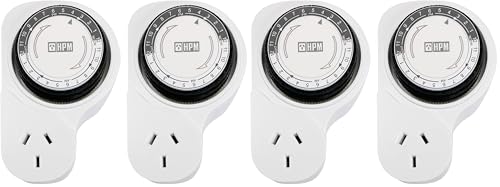
HPM is the brand you'll find printed on half the powerpoints and switches in Australian houses, and this twin pack of 24 hour analog timers is sitting at #4 in Amazon AU's Kitchen Timers category at $34 at time of writing, sold and shipped by Amazon AU. Two details separate it from the generic pin timers that share the shelf. The first is double pole switching, meaning it breaks both active and neutral when it switches off rather than active alone, which is the better way to isolate anything damp-adjacent, outdoors-adjacent or heating-related. The second is on the label: the listing states Australian origin, and gear designed against AU wiring rules from the start tends to get details like pole count right.
The offset in the name refers to the body layout, and the practical question with any plug-in timer is whether it blocks the second outlet on a double powerpoint, so check the photos on the live listing against your socket spacing if that matters. Operation is the same as every analog timer since the seventies: spin the dial to the current time, push down the segments for the on periods, done. The whole day's schedule is visible at a glance, there's nothing to program and no memory to lose, and the failure modes are the honest mechanical ones, a tired clock motor years down the track rather than a corrupted menu setting next week.
Getting two units matters more than it sounds, because timers are a habit that spreads. The first one goes on the towel rail or the pool-adjacent gear, the second ends up running a lamp for security or the aquarium gear within a month. At $17 per timer for a name brand with double pole switching, this is the pack I'd default to for anyone whose schedule is the same every day, which in my experience is most schedules. There's a quieter argument for the name brand too: when one finally wears its clock motor out years from now, the same dial layout will still be on the shelf, and the replacement takes its schedule in thirty seconds.
Honest caveats: Analog means one schedule repeated daily, no weekday and weekend split, and a blackout stops the clock until you re-set the dial. The listing states its details per pack only and doesn't quote a load rating figure, so confirm the rating printed on the unit against your appliance before running anything heavy.
Best for: Households that want name-brand, set-once timers with double pole isolation for the loads that matter.
Type: Analog 24 hour, pin segments • Switching: Double pole (active and neutral) • Layout: Offset body • Pack: Twin pack, $17 per timer • Origin: Australia, per the listing • Seller: Amazon AU • Rank: #4 in Kitchen Timers (Amazon AU)
View on Amazon AU
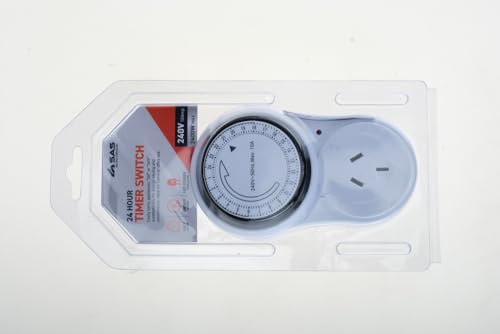
SAS Electrical 24-Hour Timer, 240V 10A
ASIN B0CQRF57VB • $13.19 • Ships from Amazon AU
The SAS Electrical timer is the least you can spend on this list at $13 at time of writing, sold and shipped by Amazon AU and ranked #135 in Kitchen Timers. That rank sits well behind the HPM at #4, and the honest reason it earns a place is the price. The listing is plain about what it is: a 24 hour timer rated 240V and 10A, 120 x 70 mm, in white, pitched at home, garage, work and office use. For a towel rail, a lamp or a fish tank light on one fixed daily schedule, that is the whole job.
What this listing gives you that the cheap end often doesn't is a rating you can check a load against. 240V at 10A works out to 2,400 W, which covers lamps, rails and a typical pump with room to spare, but it isn't a licence to hang a big heater or a hard-working motor off it. Motor loads are the pitted contacts story further down this page, so keep those well under the printed ceiling.
The listing doesn't spell out the switching resolution, a manual override or an indicator light, so treat those as unknowns and check the photos on the live listing, including whether the body will block the neighbouring outlet on a double powerpoint. At about $13 it's also the timer I'd hand someone who isn't sure the load-shifting habit will stick, because the experiment costs less than lunch and the worst outcome is a spare timer in the drawer, which has a way of finding a job eventually.
Honest caveats: The listing is thin on detail, with no segment count, override or indicator light stated, and it sells in far smaller numbers than the HPM at #4. No pack size is stated either, so don't assume you're getting a pair. Read the rating printed on the unit before it runs anything beyond lamps, rails and pumps.
Best for: Anyone testing the timer habit, or filling several sockets with simple daily schedules for the least outlay.
Type: 24 hour timer (switching mechanism not stated) • Rating: 240V, 10A • Size: 120 x 70 mm, white • Pack: Not stated on the listing • Seller: Amazon AU • Rank: #135 in Kitchen Timers (Amazon AU)
View on Amazon AU
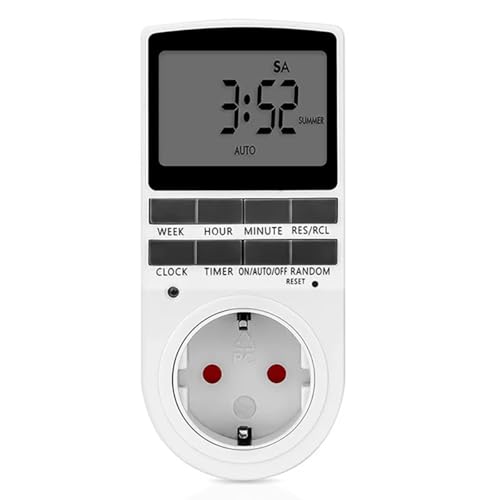
Sansai 7 Day Digital Timer, 2400W 10A
ASIN B08D6VCSDV • $23.05 • Ships from Amazon AU
The Sansai is the digital workhorse of the list at $23.05 at time of writing, sold and shipped by Amazon AU at #74 in Kitchen Timers, and it does the three things a mechanical dial can't. It runs a genuine seven day cycle, so the pool pump can filter longer on weekends or the rail can stay off entirely when nobody's home on weekdays. It programs down to one minute resolution across up to 20 on-off events a day, which is more granularity than any household schedule actually uses but means you're never rounding to the nearest pin. And it states its electrical ceiling plainly on the listing: 2,400W, 240V, 10A maximum, which is the full capacity of a standard Australian socket.
The spec I'd buy it for is less glamorous: settings retention. A digital timer without backup power forgets everything at the first blackout and then runs nothing while looking like it's running something, which is the worst failure mode in the category. The Sansai's summer and winter time options are a similarly practical touch, since daylight saving otherwise means reprogramming every schedule twice a year, and the large LCD earns its keep the day you're auditing what's actually programmed. As with every digital timer at this price, expect the programming session to involve the manual, terse abbreviations and at least one wrong guess about which button confirms. Set it on a quiet afternoon rather than five minutes before you need it.
Read the 2,400W rating the way a tech does rather than the way a brochure does: that's the resistive ceiling, and a pump or anything else with a motor should sit well under it if you want the relay contacts to last years instead of seasons. Within that discipline, this is the pick for anyone whose week doesn't repeat daily, and at $23 the price of the flexibility is nearly nothing. It's also the only plug-in pick here that puts its full electrical rating in writing on the listing, which makes it the sensible default for anything heavier than a lamp.
Honest caveats: Menu-driven programming on small buttons is nobody's favourite half hour, so keep the manual. The listing states the maximum timer setting as 7 days and the load ceiling as a maximum, not a continuous figure, so derate for motors and compressors. Verify the clock and programs survive an outage when you first set it up.
Best for: Schedules that change across the week, or anyone who wants minute-level control and daylight saving handled.
Type: Digital, 7 day / 24 hour • Programs: Up to 20 on/off per day • Resolution: 1 minute • Rating: 2400W, 240V, 10A max • Clock: Summer/winter time options • Display: Large LCD • Seller: Amazon AU • Rank: #74 in Kitchen Timers (Amazon AU)
View on Amazon AU
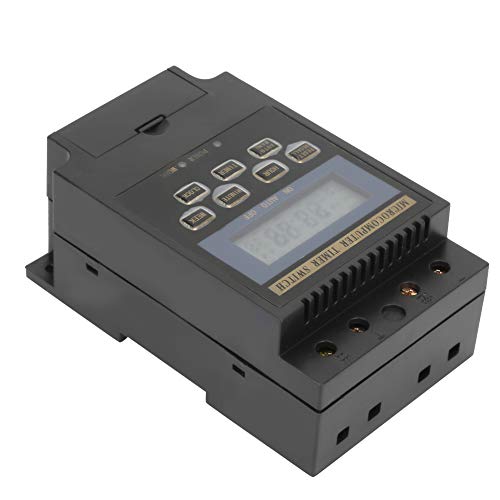
Bewinner 7 Day Digital Timer Switch, Weatherproof Box
ASIN B0FLFBR8Y5 • $31.46 • Sold by Bewinner-AU on Amazon AU
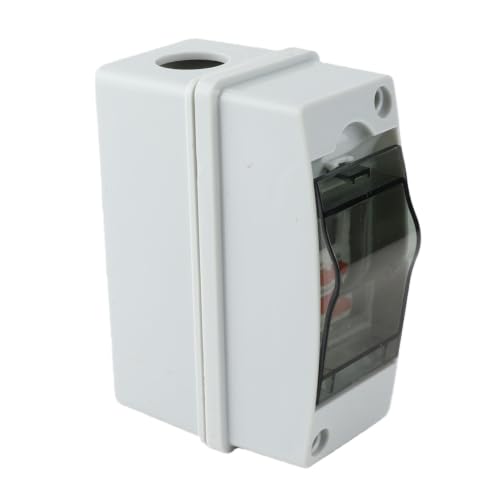
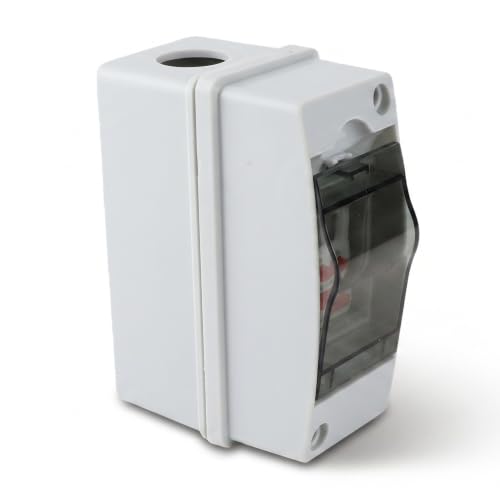
The Bewinner is the odd one out and the reason it's here is the hot water and pool question: it's not a plug-in, it's a timer switch in a weatherproof enclosure designed to be wired in line with a fixed load, pitched by the listing at pool pumps, heaters, filters and other motor-driven gear. That makes it the class of hardware an electrician fits when you want a hardwired circuit, the pool pump being the classic, running on a schedule. To be completely plain about it: in Australia, installing this is licensed electrician work, not a weekend job, and the sensible way to buy it is to confirm the model suits your load with your sparky first, then hand it over still in its box.
The feature set reads well for the job. Seven day programming with single-day or full-cycle schedules, always-on and always-off overrides, daylight saving handling, and a built-in battery that holds the programs through a power outage, which matters twice as much on a wired installation nobody wants to reprogram at the switchboard. The enclosure is the other half of the value: a PC casing the listing describes as waterproof, flame retardant and UV resistant, with cable entries arranged to keep water out of the wiring space, and a stated operating range of -10°C to +55°C, which covers everything an Australian pump shed will throw at it. It's $31.46 at time of writing from an AU storefront, ranked #108 in Swimming Pool Heaters & Accessories.
One listing discrepancy to flag honestly: the title advertises 28 on-off schedules while the feature text says up to 18, so treat 18 as the safe planning number and confirm on the current listing if your schedule genuinely needs more. Very few do; a pool pump uses two or three. The unit price is almost beside the point next to the install, so treat it as a $31 component in a job your electrician quotes as a whole, and if they'd rather fit a DIN-rail timer at the switchboard instead, take the advice. The goal is the schedule, not this particular box.
Honest caveats: Hardwired installation is licensed electrician work in Australia, so price the install alongside the unit. The listing contradicts itself on schedule count, 28 in the title against 18 in the features, and doesn't state a switching current rating in the visible text, so have your sparky confirm suitability for the connected load.
Best for: Pool pumps and other hardwired loads that need scheduling, bought to hand to your electrician.
Type: Wired-in digital timer, 7 day • Schedules: Up to 18 per the features (title says 28) • Memory: Built-in battery holds programs • Enclosure: Waterproof, flame-retardant, UV-resistant PC • Operating range: -10°C to +55°C • Pitched for: Pool pumps, heaters, motor loads • Install: Licensed electrician required in AU • Rank: #108 in Swimming Pool Heaters & Accessories (Amazon AU)
View on Amazon AU
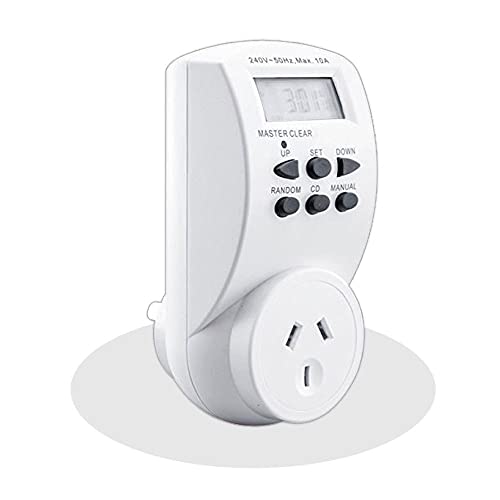
AIMALL Digital Timer Switch Socket, 10 Programs, AU Plug
ASIN B0DCZCCSY8 • $30.36 • Sold by Aimallaustralia on Amazon AU
The AIMALL earns its slot on one feature the simpler picks don't have: a random mode that deliberately wobbles the programmed switching times so a lamp doesn't snap on at the identical second every night, which is the detail that makes a security lighting schedule read as a person rather than a timer. It's $30.36 at time of writing from an AU-named storefront, ranked #112 in Amazon AU's Electrical Connectors category, with up to 10 on-off programs, a large LCD, and a moulded AU plug on a 240V body. For the specific job of running interior lamps while the house is empty, it's the most convincing tool on this list.
The listing leans hard on global compatibility, describing support for UK, US, Australian and European electrical standards, and I'd read that the way you read any generic-platform product: the hardware family ships worldwide with different plugs, and this is the AU-plug variant. That's not disqualifying at this price, plenty of perfectly serviceable gear is built exactly this way, but it's the opposite philosophy to the HPM's designed-for-AU pitch, and it's why I'd keep the AIMALL on lamps and light electronics rather than anything that runs warm. The energy-saving and occupancy-simulation claims in the listing are the standard marketing framing; the mechanism underneath, scheduled and randomised switching, is real and works.
Programming is the usual small-button LCD affair, ten programs is more than a lighting schedule needs, and the display makes checking what's set reasonably painless. Buy it for the random mode, use it alongside a mechanical pair covering the dumb loads, and the whole holiday-lighting setup lands around $50. The ten programs make it a perfectly reasonable everyday timer between holidays as well, and the LCD beats a pin dial for auditing what's set. Just keep its duties on the light side until you've read the rating stamped on the body itself.
Honest caveats: A generic multi-market platform with an AU plug rather than AU-specific gear, and the visible listing text doesn't state a wattage or amp rating, so keep it to lamps and light loads unless the rating printed on the body says otherwise. Treat the intruder-deterrence framing as a helpful pattern, not a guarantee.
Best for: Occupancy-pattern lighting while you're away, and light-duty schedules that benefit from the random offset.
Type: Digital timer socket, 240V AU plug • Programs: Up to 10 on/off • Random mode: Yes, offsets switching times • Display: Large LCD • Platform: Multi-market design, AU plug variant • Rating: Not stated on the listing • Seller: Aimallaustralia on Amazon AU • Rank: #112 in Electrical Connectors (Amazon AU)
View on Amazon AUSide-by-side comparison
What we see fail at the bench: appliance timers
Timers are simple enough that their failures are textbook, and we see the same three at the bench whether the patient is a $13 plug-in timer or the timer section inside a much dearer appliance. All three are worth knowing before you buy, because two of them are avoidable with nothing more than sensible loading, and the third is a battery.
Pitted contacts from motor loads
Every time a timer switches a pump, compressor or anything else with a motor, the inrush current draws an arc across the closing contacts and erodes them slightly. Run a motor near the timer's maximum rating and the erosion compounds: the contacts pit, then stick, then either weld closed, the load never turns off, or burn open, the load never turns on. A timer that buzzes, chatters or runs hot at the changeover is already on the way out. The fix is upstream of the purchase: size the timer so motor loads sit well under the printed ceiling, and give the biggest inductive jobs to hardware rated for them, like the wired Bewinner class.
Stalled clock motors and stripped dials
Mechanical timers die two ways. The synchronous clock motor, which has been ticking around once a day for years, eventually gums up or wears its bearing, and the dial stops advancing, so the load stays wherever the schedule left it. Or the dial itself gets stripped by someone forcing it backwards, most dials only rotate one way, and after that the set time drifts because the dial slips under the motor's drive. Neither is economically repairable on a $10 timer. The tell for a stalled motor is a schedule that runs later every day; check the dial against a clock weekly for the first month and you'll catch a dud inside its return window.
Flat memory batteries and silent amnesia
Digital timers keep their clock and programs on a small internal backup battery, and when it flattens after some years the timer develops the worst failure mode in the category: it forgets everything at the next power interruption, then sits there displaying a blank or default state, running nothing, while whatever it controlled quietly stays off. On sealed units the battery isn't user-replaceable, which sets the product's real lifespan. When a digital timer starts losing time across outages it once rode through, that's the battery going, and it's the signal to replace the unit before it strands the pool pump or the fish tank rather than after.
Decision tree: which one should you actually buy?
- Same schedule every day and you want it name-brand? → The HPM twin pack at $34. Double pole isolation, Australian origin on the listing, and two timers means the second one finds a job within the month.
- Testing the habit, or filling several sockets on simple schedules? → The SAS Electrical timer at $13. A printed 240V 10A rating to check your load against, and the worst case is a spare in the drawer.
- Weekends different from weekdays, or minute-level timing? → The Sansai at $23. Seven day cycle, 20 programs a day, a stated 2400W ceiling and battery-backed memory that survives blackouts.
- Pool pump, or a hardwired load like hot water? → The Bewinner at $31, bought to hand to your electrician, whose install is part of the budget. For hot water, ask them about controlled load tariffs at the same visit.
- Lights that look lived-in while you're away? → The AIMALL at $30. The random mode wobbles the schedule so the pattern doesn't repeat, which is the detail that sells it from the street.
- An appliance that trips the safety switch, runs hot or died on a timer? → Stop using it and bring it in to our Erina workshop. We'll tell you whether the fault is the appliance, the timer or the socket before you replace anything.
Frequently asked questions
Can I put my hot water system on a plug-in timer?
No, and it's worth understanding why. Australian electric storage water heaters are hardwired on a dedicated circuit rather than plugged into a socket, so there's physically nothing for a plug-in timer to attach to, and interrupting fixed wiring is licensed electrician work by law. What you can do is have an electrician fit a hardwired timer or contactor so the element heats only during your low-rate tariff window, or move the heater onto a controlled load tariff where the network does the off-peak switching for you. Both are one visit's work, and if you're already getting a sparky in, having them quote both options at once is the efficient move.
Do appliance timers actually save money?
Only in two situations, and it's worth being clear-eyed about both. On a time-of-use tariff, a timer saves the price gap between peak and off-peak on every kilowatt hour it shifts, which adds up fast on daily loads like pool pumps. On any tariff, a timer saves money by cutting total running hours, like a towel rail dropping from 24 hours a day to 4. What a timer can't do is make a small load worth timing: at roughly 33c per kilowatt hour, a 10W charger costs under a cent an hour, and no schedule rescues that. Measure the load first, then decide.
What should never be put on a timer?
Fridges and freezers, because hours off risks a bin of spoiled food to save cents. Anything medical, without exception. The modem and router, because phones, alarms and cameras ride on the connection. Security cameras and recorders. And pumps that respond to events rather than schedules, like sump pumps. Heaters are the special case: a timer switching a heater off is a reasonable safety net, but a timer switching a heater on in an empty room is a fire risk no saving justifies. If a heater must be scheduled at all, it should be a thermostat-equipped unit with tip-over protection, switching off only, and never on a powerboard.
Are mechanical or digital timers better?
Different jobs. A mechanical pin timer is better when the schedule repeats every day and the person setting it wants zero chance of misprogramming: the whole day is visible on the dial, and there's no menu and no memory to lose. Digital wins the moment weekdays and weekends differ, timing needs to be tighter than 15 minutes, or blackouts are common, because a battery-backed digital timer holds its clock and programs through an outage while a mechanical dial simply runs late until corrected. Households that hate fiddly menus should weight that honestly, since a digital timer programmed wrong is worse than a mechanical one programmed right.
How much load can a plug-in timer switch?
The ceiling for anything plugged into a standard Australian socket is 10 amps, about 2,400 watts at 240 volts, and the Sansai in this guide states exactly that as its maximum. Two cautions sit under the number. First, ratings are quoted for resistive loads, and motors, pumps and compressors draw a surge at switch-on that erodes contacts, so keep inductive loads well under the printed figure if you want years from the unit. Second, some timers on this list don't print a rating in the listing text at all, in which case the number stamped on the unit body is the one that governs, and lamps-only is the safe assumption until you've read it.
Should I buy a timer or a smart plug?
A smart plug does everything a digital timer does plus remote control, energy metering on the good ones, and schedule changes from your phone, so if you're already running a smart home platform, it's usually the better buy. A dumb timer wins on three fronts: it costs less, it keeps working through wifi changes, router swaps and app shutdowns, and there's nothing cloud-side to be discontinued. For fixed schedules that never change, the fish tank, the towel rail, the pool pump, I'd genuinely rather own the $10 mechanical unit. For loads you want to measure or adjust remotely, our smart plugs guide covers the metering models worth having.
Related buying guides
When the timer isn't the problem
An appliance that trips the safety switch, runs hot at the plug or died the week it went on a schedule usually has a fault the timer just exposed. Bring it in to the workshop in Erina before you replace anything. We'll test the appliance, the timer and the lead, tell you which one actually failed, and give you a straight answer on whether a repair makes sense.
Visit our Erina workshop Book Online