Prices from Amazon AU, updated daily. Swipe or use the arrows for more.
Disclosure: This article contains affiliate links to amazon.com.au. If you buy through one of these links iFix may earn a small commission at no extra cost to you. It doesn't change which products we recommend. We focus on what actually lasts based on 16 years of repair-shop experience.
Quick summary6 picks
- Entry PickWindow Cleaner Robot 5600Pa Suction Smart… about$119
- PickWindow Cleaning Robot with 5600Pa Suction about$136500mAh.
- Advwin Window Cleaning Robot about$159600mAh.
- AlfaBot GLS480 Window Cleaner Robot with… about$187
- ECOVACS WINBOT W1S Window Cleaner Robot… about$412
- Most PremiumECOVACS Winbot W2 PRO Omni Window Cleaner… about$597
Why the safety rope matters more than the suction number
A window cleaning robot is a small vacuum fan pressed against a sheet of glass, and the fan is the only thing holding it there. Everything else on the spec sheet is secondary to that. If the fan stops, the seal leaks or the cloth gets too wet, the robot slides, and on an outside pane two floors up that's a lump of plastic and glass heading for whoever's underneath. That's why I read the safety section of every listing before I look at the cleaning modes.
Every robot in this guide comes with a safety rope, and I'd treat it as part of the machine rather than an accessory you can skip. You clip it to something solid inside the room, usually a heavy piece of furniture or a door handle that can't pull through, and leave a little slack so the robot can move. Tie it to a curtain rod or a light chair and you've just added more weight to the fall. It takes ten seconds and it's the difference between a scare and an insurance claim.
Most people buy these for the outside of glass they can't easily reach, which is exactly where the risk sits. Inside a lounge room a dropped robot usually lands on carpet and bounces. Outside on a balcony or a second-storey sliding door, it can drop past the railing. If you only ever plan to do the inside of ground-floor glass, a good squeegee and a bucket is still hard to beat, and I'd be honest with yourself about that before spending a few hundred dollars.
How a window robot actually holds on to glass
Inside the body there's a small high-speed fan, much like the one in a cordless stick vacuum, pulling air out from under a rubber skirt. That creates a low-pressure pocket between the robot and the glass, and atmospheric pressure does the rest. The listings quote it in pascals (Pa), and the numbers on this page range from 3,800Pa to 5,600Pa. A bigger number means the fan pulls harder, but it only matters if the skirt seals well enough to hold that pressure.
Two layouts dominate. The ECOVACS models drive on tracks, using a rubber synchronous belt to climb, with a square cleaning pad underneath. Most of the lower-priced robots use two round spinning pads that both clean and steer, which is why they're often called double spiral designs. Track drives tend to handle wet glass better because the belt keeps grip while the cloth is damp. Spinning-pad designs are simpler and lighter but can wander on very wet glass.
The skirt seal is the part people forget about. It's a soft rubber or foam lip, and when it gets nicked on a window frame, dried out by sun, or caked with grit, the robot loses pressure even though the fan is working fine. You'll hear the fan note rise as it struggles. Wipe the skirt after every session, keep the robot out of direct sun when it's stored, and check the edge for small tears before you put it on an outside pane.
Weight matters as well, and most listings don't state it clearly. A heavier robot needs more suction to stay put, which is why the docked ECOVACS W2 PRO OMNI with its station isn't a fair comparison with a small round-pad unit. If you want to see how the same fan and seal ideas play out on floors, our robot vacuum and mop dock picks cover the floor-going relatives of these machines.
Suction figures on the listings, and why I don't fully trust them
The suction claims on Amazon AU listings for window robots are inconsistent, and that's being polite. The no-name 5,600Pa figure appears on dozens of near-identical listings from different sellers, which usually means the same factory spec sheet copied across. I can't measure any of these from a listing, and neither can you, so I treat a high Pa figure as a claim rather than a fact and weigh the safety features more heavily.
Even ECOVACS isn't consistent. The W2 PRO OMNI listing title says 2,800Pa while its own feature list says 5,500Pa, and the W1S listing quotes 5,300Pa in its features. My guess is the lower figure is a working setting and the higher one is the peak, but the listing doesn't explain it, so I'll just tell you both numbers are there and let you ask the seller before ordering if it matters to you.
What I'd look for instead is evidence the maker has thought about failure. A pressure sensor that detects a leak and stops the robot, an alarm if suction drops, and a backup battery that keeps the fan running after a power cut are all signs of a robot designed by people who've seen these fall. Those features show up in the listings far more consistently than honest suction numbers do. A lower-priced robot with an alarm and a rope is a better buy than a dearer one without them.
What happens when the power cuts out
Almost every window robot runs on mains power through a long cord, and the fan stops the instant the power goes. To cover that, they carry a small backup battery, often called a UPS in the listings, that keeps the fan running and sounds an alarm. The CHUCII listing says 20 to 30 minutes, the Advwin carries a 600mAh cell, and ECOVACS says its robots stay attached for over 30 minutes. That gives you time to reach the robot, not time to finish the window.
That backup battery is a lithium cell, and like every lithium cell it ages. After a couple of years of sitting in a cupboard, a 600mAh pack might hold a fraction of its rated time, and you won't know until the day the power drops. Before a high outside job, I'd unplug the robot while it's on a low inside pane and time how long the alarm and fan keep going. If it's only a minute or two, the battery's tired.
Storage makes a big difference to how long that cell lasts. Don't leave the robot flat in a hot garage over summer, and charge it every couple of months even if you're not using it, because lithium cells left fully drained for months can drop below the voltage where the protection circuit will let them charge again. Our guide to what poor chargers do to batteries covers why the supplied power brick is the one to keep using.
Framed, frameless and how edge detection works
A robot on framed glass finds the edge by bumping into the frame. On frameless glass, like a shower screen, a balustrade or a modern sliding door with a thin rail, there's nothing to bump, so it relies on edge sensors that detect the glass ending. ECOVACS quotes a 0.02 second response on the W1S, and the Advwin listing says it handles frameless glass and framed panes where the frame is over 5mm thick.
Edge sensors are optical, and they get fooled. Dirty sensor windows, very reflective tint and bright sun shining straight in can all confuse them. If a robot ever runs off the edge of frameless glass and hangs on its rope, check the sensor windows on the underside for smears before you blame the robot. It's usually a quick wipe with a dry cloth. Tinted glass on the outside of a house is worth a test run on a low pane first, with the rope clipped on, before you trust the sensors higher up.
Corners are the other weakness. Round-pad robots can't reach right into a square corner, and the CHUCII listing is honest enough to say corners may need a manual touch-up. Track robots with square pads get closer, and ECOVACS adds an edge cleaning mode on the W2 PRO OMNI, but I'd still expect to finish the corners by hand on most windows.
Spray, cloths and streaks
Most of these robots now spray water from small nozzles as they go, from a tank of 40ml on the CHUCII up to 100ml on the Advwin. Use distilled or filtered water, especially in hard-water areas, because tap water minerals dry as spots and slowly block the nozzles. A drop of plain glass cleaner is fine if the manual allows it, but avoid anything oily or foamy, which smears and soaks the cloth.
The cloths are the main ongoing cost, and they're also where most streaking complaints come from. A dirty or overly wet cloth smears grime around and can make the robot slip. I'd start every window with a fresh cloth, swap halfway through a big pane if it's filthy, and wash them without fabric softener, which coats the fibres and leaves a film on the glass.
On really dirty outside glass, run a dry pass first or hose the window down and let it dry, then use the robot for the finish. Salt spray on the coast and dust near building sites will clog a cloth within a single window. If you're doing big outside areas, a pressure washer on a low setting handles the heavy grime and the robot takes care of the streak-free final pass.
Cords, extension leads and the battery station
Most window robots power the fan through a long thin cord from a plug-pack, and that cord is often the first thing to fail. It flexes at the robot end every time the machine turns, and it gets shut in sliding doors and windows. If the cord's damaged or the robot cuts out at one spot on the glass, stop using it outside until it's checked.
If you need an extension lead to reach outside glass, use a proper outdoor-rated lead plugged into a safety switch (RCD) protected circuit, and keep the plug-pack inside and dry. The power draw is small, so a powerboard won't be overloaded, but water near a mains connection is the real risk. Our page on smart home power use covers how little these small appliances draw.
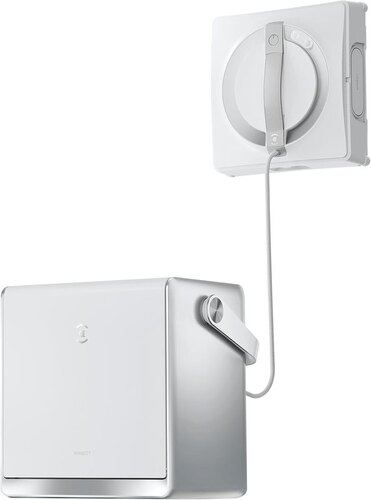
The W2 PRO OMNI changes this with a station that has its own lithium battery. ECOVACS says one charge runs the robot for 110 minutes, enough for about 55 square metres of glass, and the station combines the safety rope and power cord into one line with an automatic winder. That's useful for glass far from a power point. It's also another lithium pack and another motor that'll eventually need attention, which is part of the price.
Which windows these suit, and which they don't
Window robots work best on large flat panes: sliding doors, picture windows, glass balustrades and shower screens. They need room to move, and the Advwin listing gives a minimum of 50cm by 50cm. Small louvres, leadlight and multi-pane colonial windows are a waste of time, and textured or frosted glass breaks the seal, so the robot either won't stick or will slide.
Flyscreens are the practical problem in most Australian homes. If the outside of a window is behind a fixed screen, the robot can't reach it, and if the screen slides you'll need to take it off. Also check the glass isn't film-coated, because some window films don't like the friction of a spinning pad. If a window's thermally treated with film, our window film and thermal blinds guide explains what that layer is.
If a robot stops gripping, starts tripping its alarm or the remote stops responding, bring it into our Erina workshop before you write it off. Worn skirts, tired backup cells and broken cords are common faults, and we'll tell you if it's worth fixing before any money is spent.
The 5 picks, $119 to $597
Prices are Amazon AU at time of writing (2 November 2026) and move week to week. Ranks are Amazon AU category sales ranks, checked the same day.

ECOVACS WINBOT W1S Window Cleaning Robot with Dual Water Spray
ASIN B0F5Q373GT • $412.00 • Sold by ECOVACS Robotics on Amazon AU
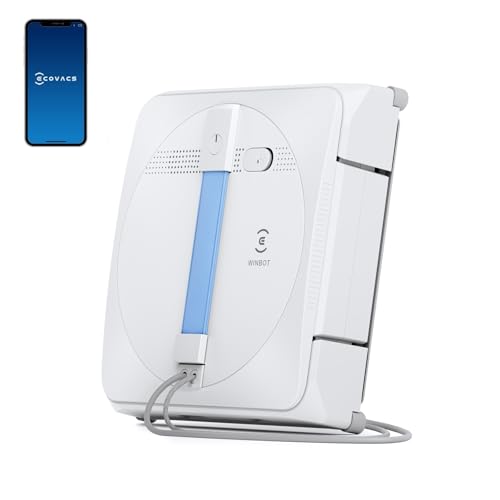
This is the window robot I'd point most people to first. It's the best-selling window robot here by Amazon AU's overall rank, at #2,149 site-wide, and it's sold by ECOVACS Robotics, the brand's own store, which ships from Amazon AU stock. The model code on the listing is W1S-AU, which is what I want to see because it confirms an Australian-version unit with a local plug. It uses a track drive with a water-resistant belt rather than spinning pads, so it keeps its grip better when the glass is wet. ECOVACS quotes 5,300Pa suction in the features. At $412 it's well above the no-name robots, and most of that money goes into safety and navigation.
The safety list is the reason I'd buy it. ECOVACS describes ten layers of protection, including a gravity sensor, edge detection with a quoted 0.02 second response, and a backup that keeps it attached for over 30 minutes in a power cut. It detects obstacles taller than 8mm, such as window hardware, and it uses air pressure sensing to work out how to recover when it gets stuck. Cleaning uses a cross spray from two directions out of a 60ml tank, with a larger microfibre cloth than ECOVACS's older models. You get three modes, called Fast, Deep and Spot, and you can drive it from the ECOVACS HOME app or the included remote.
It also remembers where it stopped, so if it's interrupted it resumes from the same spot, and it returns to where it started when it's done, which makes it easier to catch. The listing doesn't state the weight or wattage clearly, and the dimensions are only given in inches. Keep the belt clean, because grit stuck to it is what makes track robots slip. Wipe the rubber skirt after every window and store it out of the sun. Rank is shared with the W2 PRO OMNI on the same listing family, so take the category number as a guide rather than this model's own figure. For most homes with big sliding doors, this is where I'd start.
Honest caveats: The listing quotes 5,300Pa in its features but gives no weight or power figures, and dimensions are in inches only. The Amazon AU rank is shared with the W2 PRO OMNI listing. It still needs mains power through a cord. The insurance mentioned in the listing isn't detailed, so don't rely on it. Price the replacement cloths before you buy.
Best for: Most homes with large sliding doors or picture windows who want proper safety sensing and an app.
Drive: Track with water-resistant synchronous belt • Suction: 5,300Pa (listing features) • Water tank: 60ml, cross auto-spray • Obstacle detection: Objects over 8mm • Power-cut backup: Stays attached over 30 minutes • Control: ECOVACS HOME app and remote • Model: W1S-AU • Seller: ECOVACS Robotics (Amazon AU stock) • Rank: #90 in Cleaning Tools (Amazon AU), listing shared with W2 PRO OMNI
View on Amazon AU
ECOVACS WINBOT W2 PRO OMNI Window Cleaning Robot with Station
ASIN B0DCJRKLPD • $597.00 • Sold by ECOVACS Robotics on Amazon AU
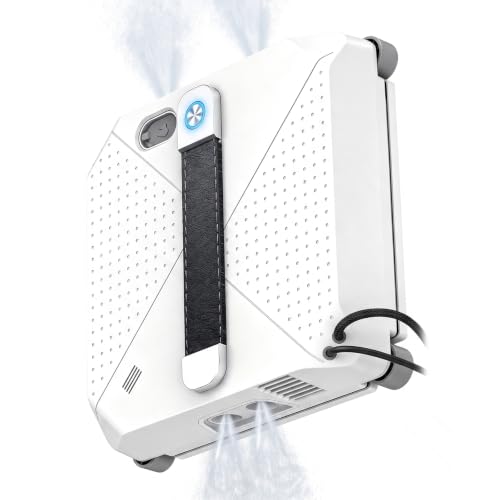
The W2 PRO OMNI is the one to buy if your glass is a long way from a power point. Its station carries a large lithium battery, and ECOVACS says a charge runs the robot for 110 minutes, which it puts at about 55 square metres of glass. The safety rope and power cord are combined into one line, and the station winds it back in automatically. That sounds like a small thing until you've untangled two separate lines on a balcony. It's $597 from ECOVACS Robotics, shipping from Amazon AU stock, and the model code is W2 PRO OMNI AU, so it's the Australian version. The station also works as a control panel with six buttons, including start, pause, mode and return to start.
Cleaning gets a three-nozzle wide-angle spray, a brushless fan motor and ECOVACS's WIN-SLAM 4.0 path planning, which ECOVACS says is about 30% more efficient than the older system. There's a dedicated edge cleaning mode, which is useful because corners are where window robots usually fall short. The app has four cleaning modes and an omnidirectional remote that can steer it in any direction rather than just up, down and sideways. ECOVACS lists twelve stages of protection, a gravity sensor, edge detection and obstacle detection down to 4mm. It also says the robot stays attached for over 30 minutes on low power. It's a track drive like the W1S, so it holds well on wet glass.
The listing is inconsistent on suction, quoting 2,800Pa in the title and 5,500Pa in the features, so ask the seller if that number matters to you. My guess is one figure is a working setting and the other is the peak. The station is bulky, and it's another lithium pack and motor to look after, so keep it charged between uses rather than leaving it flat for months. Store it indoors and out of the sun, and wipe the belt and skirt after each window. The rank is shared with the W1S listing, so it isn't this model's own figure. If you've got a lot of outside glass, though, this is the most capable robot I found on Amazon AU.
Honest caveats: The listing quotes 2,800Pa in the title and 5,500Pa in the features without explaining the difference. The battery station adds bulk and another lithium pack that ages over time. The rank is shared with the W1S listing. The weight isn't stated clearly, and the dimensions are in inches only, so measure your storage space first.
Best for: Big outside glass areas away from a power point, where the battery station and auto-winding rope earn their price.
Power: Station battery, about 110 minutes per charge • Coverage per charge: About 55 square metres (listing) • Suction: 2,800Pa title, 5,500Pa features • Spray: Three-nozzle wide-angle • Obstacle detection: Objects over 4mm • Cable: Combined rope and cord, auto winder • Model: W2 PRO OMNI AU • Seller: ECOVACS Robotics (Amazon AU stock) • Rank: #90 in Cleaning Tools (Amazon AU), listing shared with W1S
View on Amazon AU
Advwin W37D Window Cleaning Robot, 3800Pa, 100ml Tank, App Control
ASIN B0HCVQGXFX • $158.90 • Sold by Advwin on Amazon AU
The Advwin W37D is the mid-priced robot I'd look at if the ECOVACS models are more than you want to spend. At $159 it's sold by Advwin on Amazon AU, and the model code W37D matches the listing title. It claims 3,800Pa of suction, which is lower than the no-name 5,600Pa claims but more believable, and it has a 600mAh backup battery to keep it stuck on during a power cut. The listing is clear that the backup is there to buy you time to reach the remote, not to keep cleaning. A safety rope is included in the box. It's one of the few listings that gives real sizes, which helps you work out if it suits your windows.
That sizing is useful. Advwin says it handles windows from 50cm by 50cm up to 3.5m by 2m, and it'll work on frameless glass and framed panes where the frame is more than 5mm thick. It has three route patterns: Z for horizontal glass, N for vertical panes, and Z plus N for full coverage, along with edge and spot modes. The 100ml tank is the largest here, feeding four spray nozzles that mist the glass at set intervals, and there's a manual spray button for dry patches. It pairs with the Tuya Smart or Smart Life app as well as a 2.4GHz remote, and it announces its status out loud as it goes.
The listing doesn't state the weight, the drive type or a warranty period, so check the paperwork when it arrives. Tuya-based apps are common, which means it may also show up in a smart home setup you already use, although the listing doesn't promise that. Use distilled water in the 100ml tank to keep minerals out of the four nozzles, and test the backup battery on a low inside window before you trust it outside. Keep the cloths clean and wash them without softener. It ranks #325 in Cleaning Tools, so it sells steadily but well behind the ECOVACS listing. For most apartment balconies, it's a sensible middle ground.
Honest caveats: Advwin is a marketplace seller rather than an Australian storefront, and the listing doesn't state the warranty period, weight or drive type. The 3,800Pa figure is a claim I can't check. The 600mAh backup battery will age, so time it once a year. App features depend on Tuya's service staying available.
Best for: Apartment balconies and sliding doors where a big tank, app control and clear size limits matter more than brand.
Suction: 3,800Pa (listing) • Backup battery: 600mAh • Water tank: 100ml, four nozzles • Window size: 50 x 50cm to 3.5 x 2m • Frames: Frameless, or frames over 5mm • Control: Tuya Smart / Smart Life app and 2.4GHz remote • Model: W37D • Seller: Advwin • Rank: #325 in Cleaning Tools (Amazon AU)
View on Amazon AU
AlfaBot GLS480 Window Cleaning Robot with 4-Nozzle Ultrasonic Spray
ASIN B0GWC3PKW1 • $186.79 • Sold by Shiniu Direct on Amazon AU
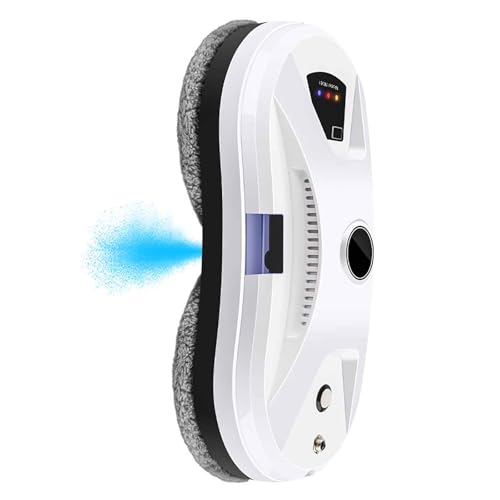
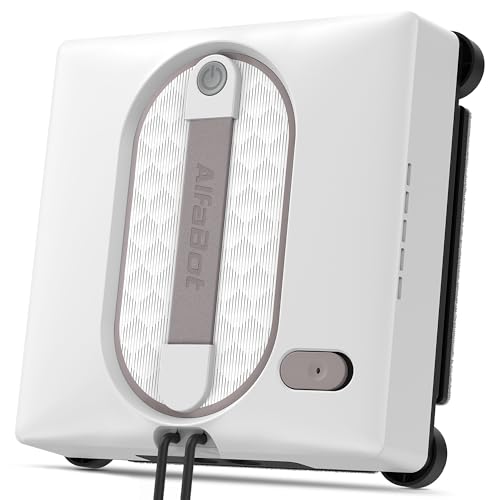
The AlfaBot GLS480 is here for its cleaning modes. It has five: Auto, Deep, Spot, Edge and Dry Wipe, and Spot mode goes over a stubborn mark five times. The dry wipe mode is more useful than it sounds, because a dry pass first on dusty outside glass stops the cloth turning grime into mud. It's $187, sold by Shiniu Direct on Amazon AU, and the model and part number are both GLS480, which matches the title. Spraying is handled by four ultrasonic nozzles, which make a finer mist than a plain pump nozzle, and a finer mist usually means less water running down the glass and fewer streaks. Shiniu Direct ships it as a marketplace seller, so read the returns details on the listing before you order.
There's a UPS backup system that keeps it attached and lets it reach a safe position if the power drops, and AlfaBot says it suits both inside and outside glass. It plans its own cleaning path and has edge detection for borders and corners. That's about all the listing says, though, and it's one of the thinnest listings in this guide. It doesn't give a suction figure, a tank size, a backup time, a weight, a cord length or a warranty period. That doesn't mean it's poor, but it does mean you're relying on the seller more than you would with ECOVACS or Advwin. Check what's in the box when it arrives, especially that a safety rope is included.
Ultrasonic nozzles are sensitive to minerals, so distilled water is a must. If the mist weakens over time, a scaled nozzle is the usual cause rather than a pump failure. Keep the underside sensors clean, because edge detection on frameless glass depends on them. Wash the cloths after every session and let them dry fully before storing them. It ranks #410 in Cleaning Tools, so it sells modestly. I'd buy it if the five modes suit how you clean, and I'd test the backup on a low inside pane before sending it up a two-storey window.
Honest caveats: The listing gives no suction figure, tank size, backup time, weight, cord length or warranty period, so you're buying on the seller's word more than the spec sheet. Shiniu Direct is a marketplace seller. Confirm a safety rope is in the box before using it on outside glass, and time the backup battery first.
Best for: People who want a dry dusting pass and a repeat spot mode before the wet clean.
Modes: Auto, Deep, Spot, Edge, Dry Wipe • Spray: Four ultrasonic nozzles • Backup: UPS backup (time not stated) • Suction: Not stated on the listing • Water tank: Not stated on the listing • Model: GLS480 • Seller: Shiniu Direct • Rank: #410 in Cleaning Tools (Amazon AU)
View on Amazon AU
CHUCII Window Cleaner Robot 5600Pa with Ultrasonic Spray (VCZX-SX)
ASIN B0G2PR1XB4 • $119.00 • Sold by ZQ-AU on Amazon AU
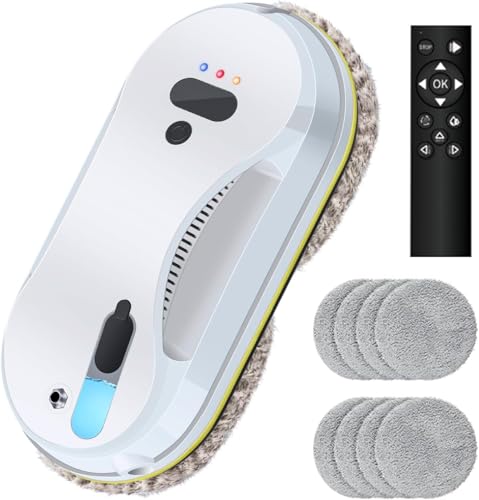
If you want to try a window robot without spending much, this CHUCII unit at $119 is where I'd start. It's sold by ZQ-AU, an Australian storefront, which makes returns easier than with an overseas marketplace seller. The model code is VCZX-SX. It's a round double-spiral design, with two spinning pads that clean and steer, and it claims 5,600Pa of suction. I'd treat that figure as a claim, since the same number appears on many similar listings. The safety kit is better than the price suggests, with a 4m power cable, a 4m climbing-grade safety rope, and a backup battery that keeps it attached for 20 to 30 minutes with an audible alarm.
I like how honest the listing is. It says outright that cleaning needs mains power and the battery is only an emergency backup, and it says square corners may need a touch-up by hand, which is true of every round-pad robot. The 40ml tank feeds ultrasonic spray nozzles, and it comes with five sets of microfibre cloths, ten pieces in all. That's enough to start each window with a fresh cloth for a while. There are three automatic modes plus manual control from the remote. It's described as low noise, but there's no decibel figure, and these small fans are usually louder than people expect. The remote's handy for steering it off a pane early if the cloth gets too dirty.
The listing doesn't give the weight, a warranty period or the backup battery's capacity, so check the box and the seller's details when it arrives. Round-pad robots can wander on very wet glass, so go easy on the spray and use clean cloths. Keep the pads' rubber skirt clean, because a small tear is enough to lose suction. It ranks #650 in Cleaning Tools, so it's a steady seller rather than a leader. If you've only got one or two big windows and want to see whether a robot suits you, it's a sensible first step.
Honest caveats: The 5,600Pa figure is the same number many similar listings quote, so treat it as a claim. There's no weight, warranty period or backup battery capacity on the listing. Round pads leave the square corners for you to finish by hand. It needs mains power for cleaning, with the battery only for emergencies.
Best for: Trying a window robot on one or two large panes with a proper rope and alarm for the money.
Design: Round double-spiral pads • Suction: 5,600Pa (listing) • Water tank: 40ml, ultrasonic spray • Power-cut backup: 20 to 30 minutes, audible alarm • Cable and rope: 4m power cable, 4m safety rope • In the box: 10 microfibre cloths • Model: VCZX-SX • Seller: ZQ-AU • Rank: #650 in Cleaning Tools (Amazon AU)
View on Amazon AUSide-by-side comparison
What we see fail in the workshop: window cleaning robots
Window robots that come in mostly fail in a few predictable places. The fan and the electronics are usually fine. The problems are the soft parts that wear and the battery that ages quietly in a cupboard. Here's what I'd check before deciding a robot's finished, and what usually fixes it. Most of these are quick fixes when they're caught early, and a robot that's been looked after usually outlasts its cloths by years.
Losing grip on the glass
When a robot starts sliding or tripping its alarm, the fan's usually fine and the seal isn't. The rubber skirt around the base gets nicked on window frames, hardens in the sun or collects grit, and once there's a gap the fan can't hold pressure. You'll often hear the fan note rise. Clean the skirt with a damp cloth and check it closely for tears. On track robots, grit stuck to the drive belt does the same thing to grip, so wipe the belt too. Replacement skirts and belts aren't always easy to find for no-name models, which is one reason I lean towards brands with local parts.
Backup batteries that don't last
The small lithium backup cell is the part that ages without anyone noticing. A robot that sat flat in a hot garage for a year might hold its fan for a minute rather than half an hour, and you won't find out until the power drops. If the alarm and fan cut out quickly when you unplug it on a low pane, the cell's worn. In many units it's a standard pack that can be replaced, and it's worth doing before the robot goes back on high outside glass. Keep the replacement cell to the same chemistry and capacity as the original, and fit it with the correct connector rather than splicing wires.
Cords and plug-packs
The long power cord flexes at the robot end every time it turns, and it gets shut in sliding doors. A robot that cuts out at the same spot on the glass usually has a broken conductor near the strain relief. The plug-pack is the other weak point, especially if it's been left outside in the damp. Don't tape a damaged cord and send the robot back up. Replace the cord or the plug-pack with the correct rated part, because a cord fault outside is a safety problem as well as a cleaning one.
Decision tree: which one should you actually buy?
- Want the safest all-round window robot for big sliding doors? → The ECOVACS WINBOT W1S at $412: track drive, edge sensing and over 30 minutes of backup.
- Is your glass a long way from a power point? → The ECOVACS WINBOT W2 PRO OMNI at $597, with a battery station rated at 110 minutes per charge.
- Want app control and a big tank without the ECOVACS price? → The Advwin W37D at $159, with a 100ml tank, 600mAh backup and clear window size limits.
- Want a dry dusting pass before the wet clean? → The AlfaBot GLS480 at $187, with five modes including Dry Wipe and a repeat Spot mode.
- Just want to try one on a couple of windows? → The CHUCII VCZX-SX at $119 from AU storefront ZQ-AU, with a 4m rope and alarm backup.
- Robot sliding off, alarming or cutting out? → Bring it into our Erina workshop and we'll check the skirt, backup battery and cord before you buy another.
Frequently asked questions
Do window cleaning robots actually work?
They work well on large flat panes like sliding doors, picture windows, glass balustrades and shower screens, and they're most useful on glass that's hard to reach safely. They don't do corners perfectly, especially round-pad models, and they can't clean small louvres, leadlight or textured glass. Very dirty outside glass is best hosed or dry-wiped first so the cloth doesn't smear grime. Think of them as a finishing tool for big glass rather than a replacement for every window job.
Can a window cleaning robot fall off?
Yes, which is why every robot in this guide comes with a safety rope. A robot holds on by suction from a small fan, so a power cut, a torn rubber skirt or an overly wet cloth can make it slide. Clip the rope to something solid inside the room, test the backup battery on a low inside pane, and keep the skirt clean. Most good robots also have an alarm and a backup battery that keeps them attached for a while if the power drops.
Do window cleaning robots work on frameless glass?
Most of the robots here say they do, using edge sensors to detect where the glass ends rather than bumping into a frame. The Advwin W37D, for example, lists frameless glass and framed panes where the frame is over 5mm thick. The sensors are optical, so keep them clean and be careful with very reflective tint or strong sun shining straight at them. Always use the safety rope on frameless outside glass, because a sensor miss there means the robot goes over the edge.
What water should I put in a window cleaning robot?
Distilled or filtered water is best, especially in hard-water areas. Tap water minerals dry as spots on the glass and slowly block the small spray nozzles, and ultrasonic nozzles are particularly sensitive to scale. A small amount of plain glass cleaner is usually fine if the manual allows it, but avoid oily, foamy or scented products, which smear and soak the cloth. Empty the tank after each use so nothing grows in it.
How long does the backup battery last in a power cut?
It depends on the model and the age of the battery. The CHUCII listing says 20 to 30 minutes, and ECOVACS says its robots stay attached for over 30 minutes. That's time to reach the robot and bring it in, not time to finish cleaning. The backup is a small lithium cell that ages, so test it once a year by unplugging the robot on a low inside pane and timing how long the fan and alarm keep running.
Are window cleaning robots worth it for a single-storey house?
If most of your glass is ground-floor windows you can reach, a good squeegee is usually quicker and costs far less. A robot earns its place when you've got big sliding doors, glass balustrades, high windows over stairs or outside glass you can't reach without a ladder. It's also handy if you don't want to climb at all. Be honest about which windows you'd actually use it on before buying.
Related buying guides
Window robot slipping or cutting out?
Most window robots that stop gripping have a worn rubber skirt, a tired backup battery or a damaged cord, not a dead fan. Bring it into our Erina workshop and we'll test the seal, the backup and the power supply, then tell you what's wrong and what it'll cost before you spend anything on a replacement.
Visit our Erina workshop Book Online